
You are currently browsing the category archive for the ‘Institutional’ category.
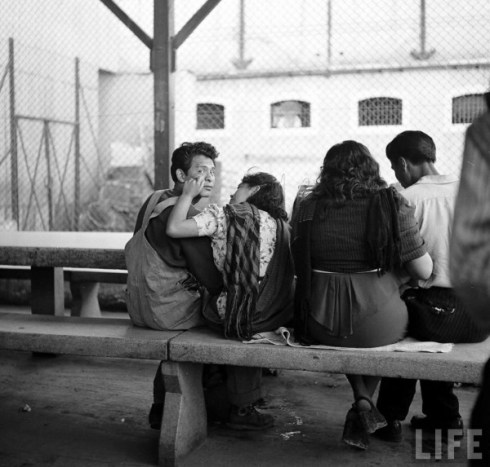
Frank Schershel. Photos licensed for personal non-commercial use only by LIFE
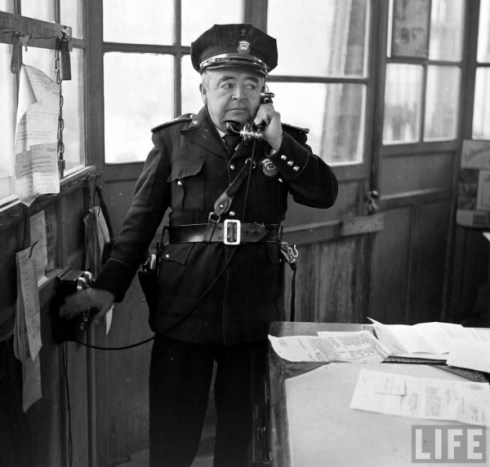
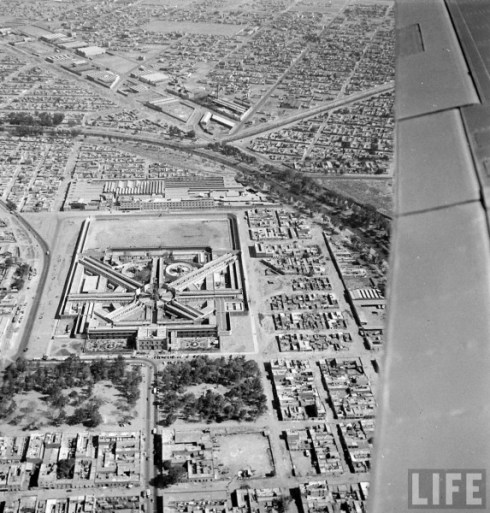
I was made aware of this set of photographs last week (sorry I forget the source!). They’re an interesting document of a bustling metropolis’ prison with an open program of movement, activity and an array of inmates.
The number of visitors and family members involved in many of the images leads me to think of this prison as an institution where people remained until the peculiarities of their situation could be agreed upon and then communicated to ensure release.
The social engagement of inmates with those from outside suggests to me (with an acknowledgement of harsh lockdown-modern-prisons) that the authorities of 1950s Mexico City either weren’t convinced of prisoners guilt, could be convinced otherwise, or simply didn’t map the denial of family-involvement on to the landscape of criminal punishment.
Frank Schershel. Photos licensed for personal non-commercial use only by LIFE
Frank Schershel. Photos licensed for personal non-commercial use only by LIFE
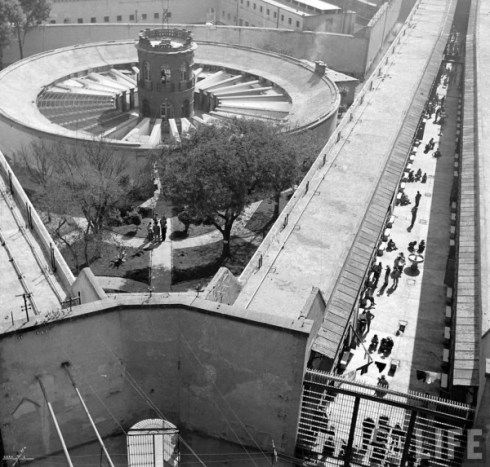
Schershel’s photographs recalled Richard Ross‘ image from Architecture of Authority. Schershel’s images doubled my visual knowledge of Mexican prisons, and so know I find myself in the unacceptable position that Mexican penitentiaries are – in my mind (at least temporarily) – the Palacio de Lecumberri … which means I have to do more research to get away from that inadequate knowledge base.

Palacio de Lecumberri (former prison) Mexico City, Mexico 2006. © Richard Ross
Until Schershel’s photo set, I had thought that Ross’ picture depicted a tower in the centre of a modestly-sized jail, but Schershel’s image puts the tower and rotunda into its larger setting (top left octant).
Frank Schershel. Photos licensed for personal non-commercial use only by LIFE

Alphonse Bertillon was born on April 24th, 1853. I call him “The Godfather of all things Criminally Photographic”.
Bertillon was the French criminologist and anthropologist who created the first system of physical measurements, photography, and record-keeping that police could use to identify recidivist criminals. Before Bertillon, suspects could only be identified through eyewitness accounts and unorganized files of photographs.
In 1883, the Parisian police adopted his anthropometric system, called signaletics or bertillonage. Bertillon identified individuals by measurements of the head and body, shape formations of the ear, eyebrow, mouth, eye, etc., individual markings such as tattoos and scars, and personality characteristics.
The measurements were made into a formula that referred to a single unique individual, and recorded onto cards which also bore a photographic frontal and profile portrait of the suspect – the “mug shot”. The cards were then systematically filed and cross-indexed, so they could be easily retrieved. In 1884, Bertillon used his method to identify 241 multiple offenders, and after this demonstration, bertillonage was adopted by police forces in Great Britain, Europe, and the Americas.
One of Bertillon’s most important contributions to forensics was the systematic use of photography to document crime scenes and evidence. He devised a method of photographing crime scenes with a camera mounted on a high tripod, to document and survey the scene before it was disturbed by investigators. He also developed “metric photography“, which used measured grids to document the dimensions of a particular space and the objects in it.


Anthropometric photography of a convict at his arrival in prison. Basse Normandie. Calvados. Caen. Prison. 1976. Photo: Jean Gaumy / Magnum Photos
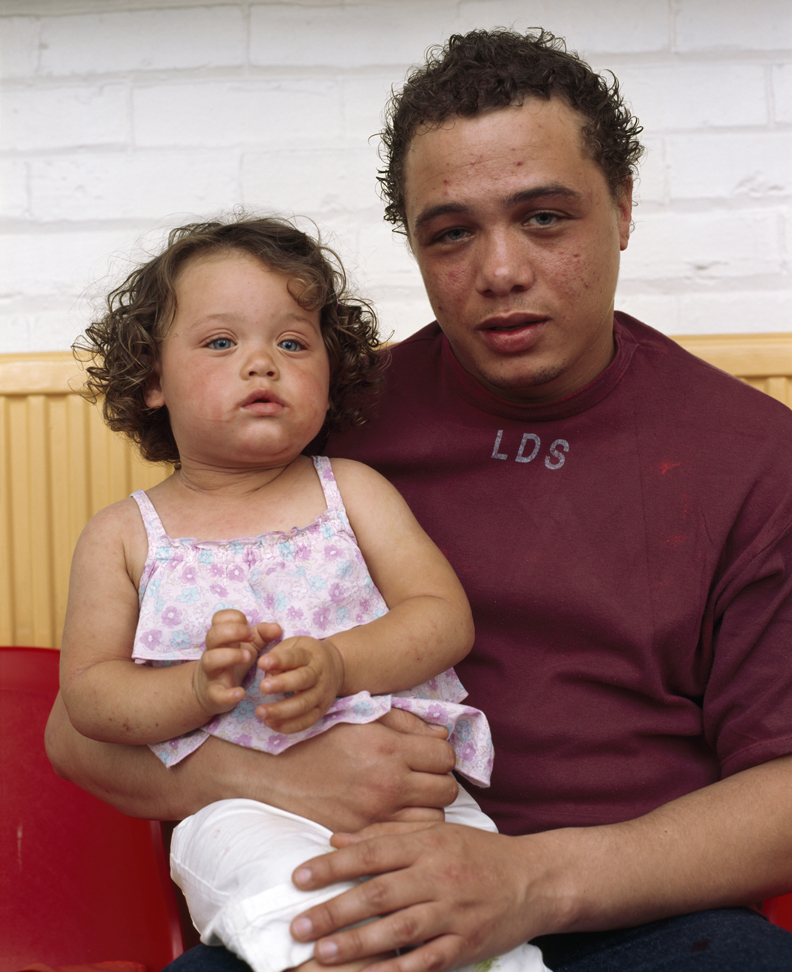
Casey Orr‘s Comings & Goings is an inquiry into movements and migration. Comings & Goings is a photographic series in three parts. Families considers the prisoners and their loved ones at Her Majesty’s Prison Leeds, UK.
Caged Birds depict the imported pigeons and parrots and parakeets of West Yorkshire, while Migrant Women portrays the recent newcomers to Orr’s county.
Orr insists the three parts be considered together – they are a whole, cannot be separated, and toy with the idea of interconnectedness Orr has grappled with throughout her career.
Comings & Goings proposes that foreign and indigenous are not so far apart. As Orr puts it we all share “a desire to be free, an instinct to nest, to seed, to move and be alive”.
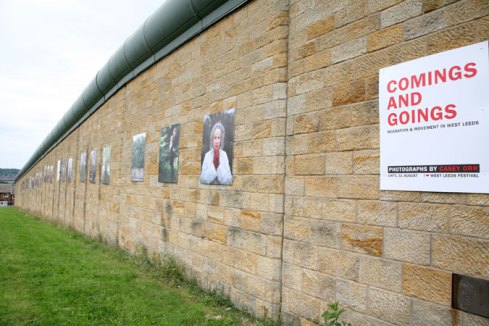
Orr’s work requires time and care to navigate – it is as delicate as it is pioneering. Prints from all three parts were displayed was on the outside walls of HMP Leeds. It was the first time the wall of a UK prison has been used as a gallery space.
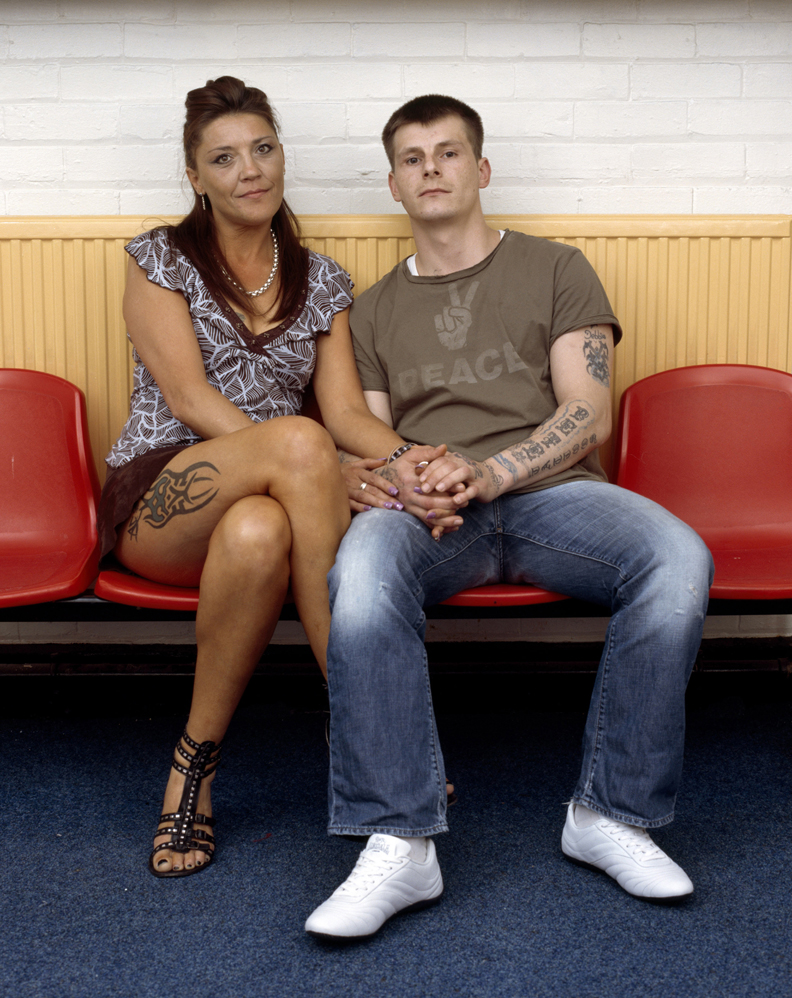
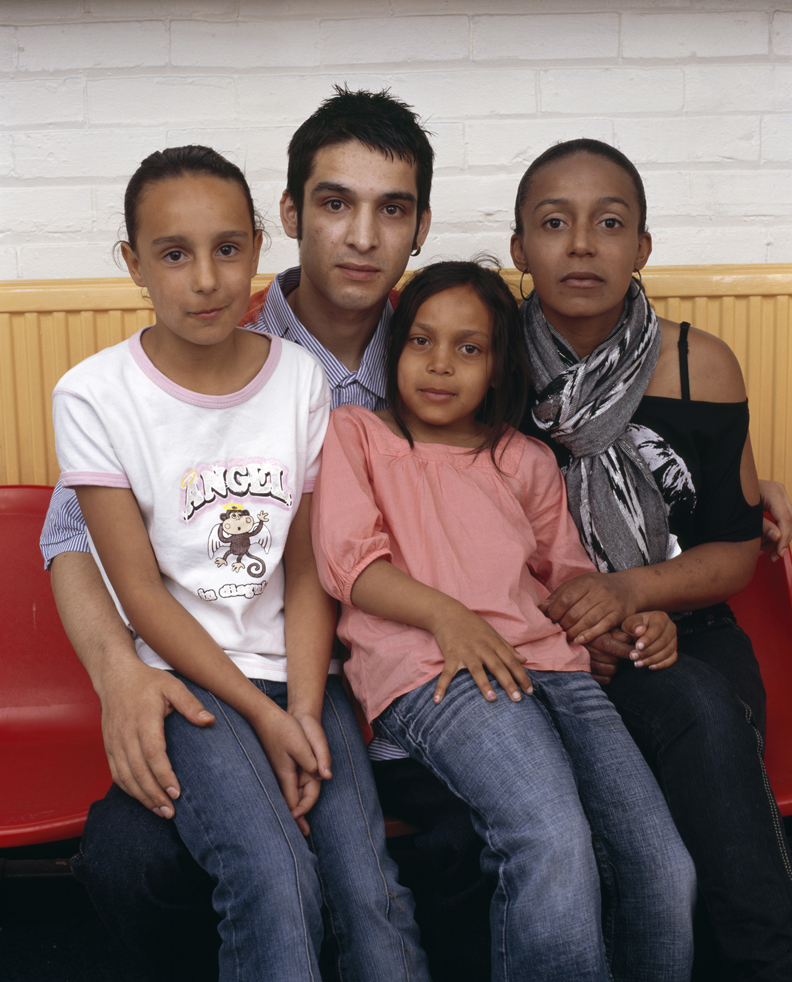
I wanted to know a bit more and so emailed Casey.
Q & A
Why did you decide to incorporate H.M.P Leeds into your Comings and Goings project? Was it the subject or the challenge of working within a prison or a mixture of the two?
My photographic work makes connections to my community and to my experience of living here in Armley, Leeds. My interest in the prison came from other projects I’ve done here. I’m always looking for the connection between the things and people I photograph, the systems that operate and seem to run through everything.
The town of Armley is very much built from the systems of power that came through the Industrial Revolution; Armley Mills, once the largest mill in the world, is now the Leeds Industrial Museum; the Leeds Liverpool Canal is now used for leisure; and the incoming migrant communities are moving from their countries for very contemporary reasons, the jobs available to them (and everyone else in Leeds) having much more to do with information technology than agriculture or textiles.
Within all of this movement, stands HMP Leeds, known locally as Armley Jail. It sits on a hill, built in 1847, so that workers in the surrounding mills could be reminded of what would happen if they stepped out of line. The prison (along with a massive, imposing Victorian church) is one of the few buildings around here still used for its original purpose.
The systems of power associated with the panopticon are still firmly in use in the prison. The prison walls, inside my community, seem to be impenetrable, and enclose a community of thousands of prisoners and workers. My interest was in the walls and how to find the connection into the prison, how to link the people inside with all of the flows of life going on outside.
I found that connection through families, through children. Hundreds of families visit their fathers, sons and brothers every week. The families and loved ones are a direct link with the communities outside. I wanted to exhibit the family portraits on the outside walls of the prison because the prison walls are such a architectural staple of this community they can become invisible, people can forget about them and the people behind them. The exhibition was shown on the interior walls as well so that the people inside were seeing the same thing, the same ideas were being shared; walls penetrated by ideas, and by art.

What negotiations did you go through to gain access? Who did you meet? How did it come about?
As a documentary photographer, very little of my time is actually taking pictures, mostly I am trying to gain access to people and places. Before contacting the prison direct I talked to many people in this community and finally went to the Jigsaw Project, the family support unit. From there I met many of the workers who support the families. They were sympathetic to my ideas and introduced me to the Head of Security. From there I met the Governor. All of this took many months. The work, finally shown on the walls as a public art installation as part of the West Leeds Arts Festival in 2009, went through many security checks.
How many times did you go to the visiting room to make the portraits?
I spent a few months in the visitors centre, talking to families, and asking who would like to be a part of the project. Obviously, I got to know them better than the prisoners who I met briefly during the sessions. I spent four days in total in the visiting room.
How did the prisoners and staff respond to your project?
Most people were really supportive of the idea. the thing about photography is that it has uses on many different levels. So this record of families I wanted to make could also be a part of their personal family archive. The fact that I’m able to give something back to people, something useful, like a family portrait, makes me feel better about the fact that I’m asking so much of people, to use their image for one of my ideas. Everyone involved received copies of whichever pictures they wanted from the sessions.
Has your work dealt with systems of detention in the past?
No, my work is about systems of power, photography being very much implicated in that, in the recording and filing of people. So the prison system is always implicated in that, as are all currents of capitalist power.
What’s next?
I’m just completing a book about Comings & Goings and another body of work following the traces of an age old ritual lingering in the English festivity of Bonfire Night.


BIO
Casey Orr (b.1968) is originally from Pennsylvania. She has lived in England for 14 years working as a freelance photographer and Senior Lecturer at Leeds Metropolitan University.Clients include Diva Magazine, Channel 4, EMI Records, Universal Records and Sports Council England. Orr has exhibited at the University of The Arts, Philadelphia, Pa. and Jen Bekman Gallery in New York. She is the recipient of an Arts Council England grant.
Read more about Orr’s exhibition at HMP Leeds in Armley at the Guardian.

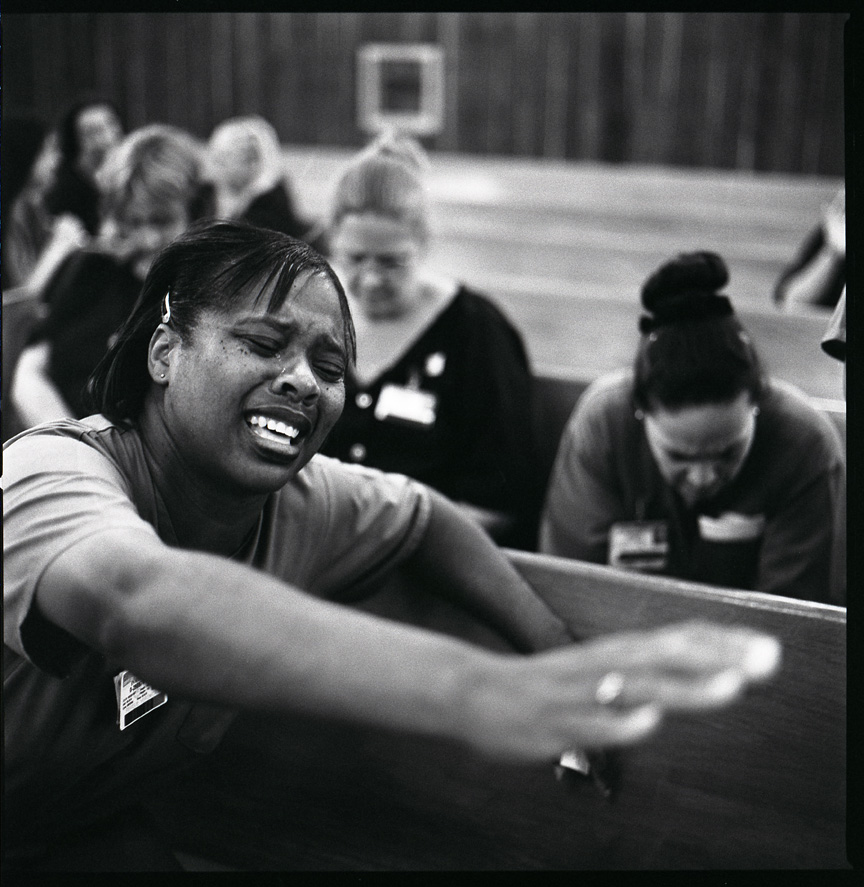
Andrew Kaufman took a long look at religion in America during the Bush presidency. His multi-story project is irreverently titled The United States of God and the Jesus Freaks. One chapter is in the Broward Correctional Institute.
Religious missions are a mainstay of many American prisons. Christian programs constitute 65% of all volunteer efforts at the prison at which I work in Washington State.
Prison religious programs are not mandatory so I steer clear of accusations of manipulation. The carceral culture may be coercive but it’s dealing in hyperbole to equate prison fellowships with exploitation. For many, the cultural relevance of Christianity and evangelism makes prison worship an understandable choice.
Reasons for the existence – in some places prevalence – of evangelism within prisons are complex and many. I will defer to Kaufman’s observations to give context to these particular photographs and the matter of fanatic religion in prisons.
Q & A
Explain your title.
During the George W. Bush presidency religion was a constant topic. My photography of, and research into, evangelism started in 2003 when the Ten Commandments statue was removed from the Alabama State Supreme court. Since that time I photographed many different elements of the Evangelical movement including a drive-in church, Holy Land Amusement Park, a hip-hop church, Christian rock, the Global Pastor Wives Network, Billy Graham’s Last Crusade and then here, at a women’s prison bible group. At that point I had come to name the project ‘The United States of God’.
During the summer of 2004, I was watching Hawaiian TV and saw a young lady being interviewed. She had just been attacked by a shark and had her arm torn off. The interviewer asked her how she was coping and said she was doing great because she was a “Jesus Freak”. The interviewer asked her if she liked being called a “Jesus Freak”. She replied “Yes” as that was how she viewed herself. She identified with the idea. At that moment the working title of my project became ‘The United States of God and the Jesus Freaks’.
Why did you extend the project to a prison?
I researched evangelical Christianity in America and made contact with the Prison Fellowship for Women. I had always known that people in prison were interested in evangelism and atoning for the sins or wrongdoings. I don’t want to speculate but it seemed that the grief of being incarcerated is eased when finding prayer.
I made a few visits with the fellowship and eventually had an opportunity to see close up what they offer. I was compelled to photograph this segment of evangelism because I wanted to see different strata of society and how each prays.
What purpose does religion serve in this particular institution?
The prison allowed them to devote time and attention to their faith. It was fascinating to see how they cope with the incarceration and [see the] time that they need to heal and move on from emotional strain.
Did any of the prisoners receive prints?
As far as I know, none of the inmates have any physical copies of the images. The work is online so they might have seen the web. As I wasn’t family, it was difficult to communicate with the inmates.

Time is of the essence today, so why not a quick look at a mugshot archive?
All these images are from HIDDEN FROM HISTORY. UNKNOWN NEW ORLEANIANS:
“The people grouped here may have had nothing in common except that their lives intersected with the municipality at least once. This exhibit brings them together in part to show how the city classified them. The documents and photographs here are therefore not representative of those New Orleanians who lived their lives quietly and within the law; they are necessarily skewed toward those who erred or strayed, who got caught or got in trouble, or, conversely, those who actively sought assistance from the city.”
The images were selected from the Louisiana Division/City Archives. My favourites here are those photographs in which intriguing, strong(?) communication persists.


– – –
The exhibit was curated by Emily Epstein Landau and funded in part by the Sexuality Research Fellowship Program (1999), a program of the Social Science Research Council, with funding from the Ford Foundation. Dr. Landau received her doctorate from Yale University in 2005. Her dissertation, “Spectacular Wickedness”: New Orleans, Prostitution, and the Politics of Sex, 1897-1917, is a history of Storyville, the famous red-light district. She will be teaching New Orleans history this Spring, as a visiting lecturer at the University of Maryland, College Park. She lives in Washington, DC.
It was either Beierle or Keijser (one of the Mrs. Deane halflings) who emailed and pointed out Simon Menner‘s photographic series Objects – 2010.

FAKE HEAD. Pillow, hat, paper, piece of Tetra Pak, hairs from a broom. @ Simon Menner
Typology is a trendy term that gets banded about easily these day but I have no better term for the straight photography of objects as these. Menner is the latest photographer in an ever-increasing line of prison tool and prison weapon typologists.
In 2005, Marc Steinmetz photographed the manufactured items of Santa Fu, Celle, Wolfenbuttel and Ludwigsburg prisons in Germany. (Featured on PP, July 2009)
Brett Yasko produced the independent book Shiv that features eleven prisoner-made weapons from the collection of Chris Kasabach and Vanessa Sica. The shivs were confiscated in the 1980s at Rahway – now known as East Jersey State Prison. Yasko’s photographs were presented in Design Observer’s feature Art of the Shiv.
Prior to 2008, Toño Vega Macotela was visiting Santa Martha Acatitla Prison, Mexico regularly and his photographs were showcased by Toxicocultura recently (via James).

Cooking Grill No.2 © Toño Vega Macotela

Pages of Brett Yasko's book 'Shiv'. © Brett Yasko

Multibladed Shiv. Image © Brett Yasko

Radio Receiver within Encyclopedia. © Marc Steinmetz, 2002

RADIO. Book, electronics (the title of the book translates “The Reputable Merchant”) © Simon Menner
The usual commentary for these types of typology is to admire the ingenuity and resourcefulness of the inmate. Notably, all four photographers have given “backstories” or contexts for the production and/or confiscation of the objects they’ve photographed. For example, Menner explains, “The objects presented here have all been seized in prison cells of the Berlin Tegel prison.” Menner also thanks the staff for allowing access. These extra details are essential if we are to avoid wonder and mere image-consumption.
These typological studies run the risk of serving politiicised positions; of becoming metaphors for human creativity or resistance.
(Worse still, the item and/or photograph is reduced to an objet d’Art.)
THE SOCIAL LIFE OF THINGS
Menner himself is concerned with how images and stories may or may not attach themselves, “What fascinates me here is the very old question of how much of the final object is already “inscribed” in its parts, even before its creation. And by asking this question I also ask a basic question on the nature of images. How much of a story is visible in the images, even before the story itself is unveiled?”
So what do you first think or ask when viewing these images? For me, I want to learn about the institutions, penology and prevailing criminal justice culture in which these inmates functioned:
With regard Yasko’s work – Why were so many shivs made at Rahway? And what led to two collectors acquiring them? With regard Menner and Steinmetz, what uses were dummy pistols and mobile phones put to inside those German prisons?
Fine art representations of these objects mustn’t be the end product in their object biographies. Narratives in the “Social Life of Things” do not end but morph.
The photographs of Yasko, Steinmetz, Macoleta and Menner impose new readings and establish new jumping off points for inquiry.

Device to hide a mobile phone. © Simon Menner

DUMMY PISTOL from blackened cardboard; found on June 23, 1988, in an inmate’s cell in Stammheim prison, Germany, after a fellow prisoner tipped off the jailers. The dummy was hidden in an empty milk pack and was most probably intended to be used for taking hostages in an escape attempt. @ Marc Steinmetz
Sometimes the name of this weblog-journal means that I simply cannot overlook certain stories or acts of publishing.

@ Tim Dirven / Panos Pictures
In the past couple of hours, the Guardian website ran a nine image Guantanamo photo-gallery. The gallery launches from the largest and most prominent rectangle of the new Guardian redesign, i.e. it is the top story on the home page.
I can only assume that this is an editorial decision to keep Guantanamo in people’s minds? After all. we’ve been distracted by healthcare reform in the US, the chancellor’s TV debate in the UK, Israeli obstinacy in the Middle East and a new guise of terrorism in Russia for which our numbed minds must recalibrate.
I can only assume this is the Guardian’s decision because the essay is totally non-descriptive – in that it is nothing new. We know there are Uighurs, Chinese separatists, who shouldn’t be there; we know they play soccer in cages, we know there are well-cushioned shackles bolted to pristine concrete floors; and we know detainees on hunger strike are force-fed Ensure by tube.
All I want to say is that you should look elsewhere for Guantanamo imagery. My Guantanamo: Directory of Photographic and Visual Resources is a good place to start.
I’ve also provided the previous insights which go beyond Dirven’s nine illustrative images:
Suicide at Guantanamo?
Justice Denied: Voices of Guantanamo
Bruce Gilden once went to Guantanamo
Interview: “Jane Smith” Former Gitmo Guard
Paula Bronstein: Guantanamo Detainees Young and Old
“There is a lot of long lens imagery of Guantanamo prisoners in their orange boiler suits, but I don’t know what that’s telling me.”
A Dozen Visits to Guantanamo
‘Guantanamo’ by Paolo Pellegrin
Guantanamo Photo Essay
– – –
None of this reflects on Tim Dirven. Dirven is a good photographer and photojournalist (check out his work on Orthodox Christians in Ethiopia).
It’s simply impossible to produce a novel photo-essay when the Joint Task Force of Guantanamo walks you around the camp … and they do it every week … with different journalists.
The US military’s media detail is as well-drilled as any other detail at Guantanamo. In fact, I’d go as far to say that the media-liaisons are, at this point, the most critical employees on the base.
“We never sat down, as far as I know, and came up with a grand strategy. Everything was very reactive. That’s how you get to a situation where you pick people up, send them into a netherworld and don’t say, ‘What are we going to do with them afterwards?’ “
Former senior US intelligence officer. (Source)

Mihail Kogalniceanu air base. Romania. @ 44.36043300, 28.49149700
Since 2001, the US has operated a program of rendition, illegal torture and operated a network of secret prisons and CIA “Black Sites”.
Men captured as part of the Bush and Obama administrations’ program were are interrogated, physically & psychologically beaten and denied human rights.
Images of these secret prisons are not common, but I’ve peppered this piece with a few just for the sake of the exercise.
At the top of this article is Mihail Kogalniceanu air base, Romania. It was used for “high-level” detainees from as early as 2005. Beneath is Kiejkuty Stare an illegal CIA prison just 20 miles away from Szymany airport, Poland. (source) It was used as early as 2005 and its function was confirmed in 2007. (source)
Khalid Sheikh Mohammed, “the mastermind of 9/11”, claims he was submitted to waterboarding 183 times over a one-month period. New evidence suggests he was interrogated in Poland. (More from Der Spiegel here and here).

Kiejkuty Stare
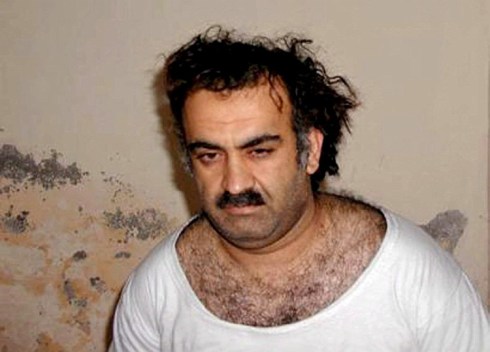
Khalid Shiekh Mohammed
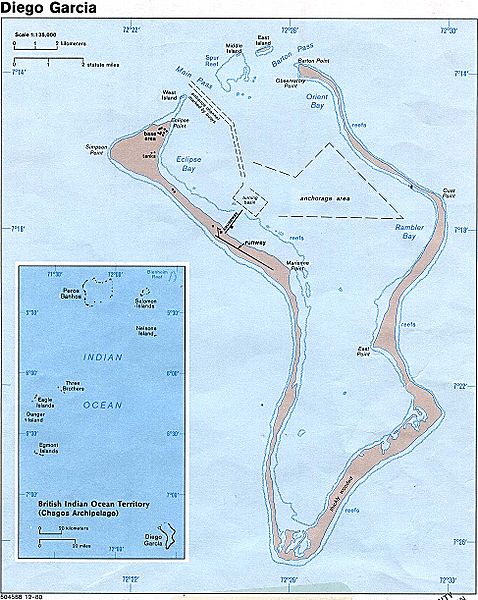
Diego Garcia Island, Indian Ocean, United Kingdom Territory. Rendition Flights Refuelled on the Island in 2002.
The UK Government provided infrastructural support for America’s extraordinary rendition program allowing rendition flights to refuel on Diego Garcia (above), a British territory in the Indian Ocean. (More here and here).
– – –
Below is the plan of a cell used during the 19 month illegal detention of Mohamed Farag Ahmad Bashmilah, a Yemeni national. Salon reports:
Bashmilah’s story also appears to show in clear terms that he was an innocent man. After 19 months of imprisonment and torment at the hands of the CIA, the agency released him with no explanation, just as he had been imprisoned in the first place. He faced no terrorism charges. He was given no lawyer. He saw no judge. He was simply released, his life shattered.
In 2007, Salon did a thorough job in describing his detention and its aftermath, even presenting plans based on Bashmilah’s descriptions of torture and interrogation rooms. No-one knows for certain where these cells were, but it is suspected they were within Afghanistan.
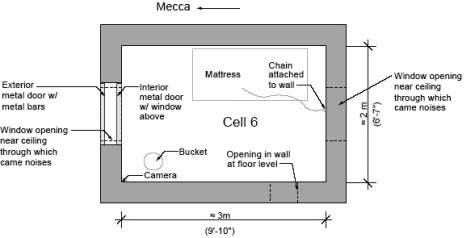
Exhibit I: Rendering of Mohamed Farag Ahmad Bashmilah's first cell in Afghanistan (based on Bashmilah's own drawings). Source: Salon.com
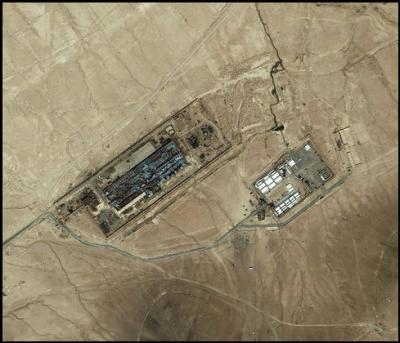
In Afghanistan, the largest CIA covert prison was code-named the Salt Pit, at center left above. (Space Imaging Middle East). Source: Washington Post
The most notorious Black Site in Afghanistan is referred to as ‘The Salt Pit’.
The Salt Pit brings us to Trevor Paglen‘s geography, photography and investigative academics, but first let me point out a couple more excellent resources.
When the details of rendition broke in 2007, Jane Mayer led the exposé with her book The Dark Side. Read a book review here and her extended New Yorker essay here.
FRONTLINE produced this astonishing interactive graphic showing all the illegal prisons and all the US aviation front-companies used for the rendition flights. That map is part of a larger presentation with interviews, time-lines and further resources.
More recently, Anand Gopal has revealed the US military’s still recent tactic against the Taliban in Afghanistan of by-night kidnappings. The result? The US has lost the support of the Afghan people toward the American project. Read America’s Secret Afghan Prisons here.
Just this month, Stephen Lendman summarised the January 26th UN Human Rights Council (HRC) report ‘Joint study on global practices in relation to secret detention in the context of countering terrorism’ which details practices by various countries “including America, by far the world’s worst offender in its war on terror.” The full report is here (Word) or here (pdf).
Lendman’s words The truth is shocking:
“Besides Guantanamo, Afghanistan and Iraq, HRC said the CIA runs scores of offshore secret prisons in over 66 countries worldwide for dissidents and alleged terrorists – in Egypt, Algeria, Jordan, Morocco, Syria, Libya, Tunisia, India, Pakistan, Russia, Uzbekistan, Sudan, Zimbabwe, Ethopia, Djibouti, Kenya, Poland, Romania, Bosnia, Kosovo, Thailand, Diego Garcia, and elsewhere.” (Source)
Onward. Now, Paglen …
TREVOR PAGLEN
The two images below are by Trevor Paglen. The first is the Salt Pit and the second is a military jail in Kabul. They are also his most ordinary of images … the only images he could capture in the circumstances.
Paglen isn’t primarily concerned with prisons; he is concerned with all the unseen activity of the military industrial complex – aviation companies, air strips, covert ops, air bases, Pentagon annual budget projections, spy satellites, shadow NASA reconnaissance agencies … the list goes on.
After meeting Emiliano Granado last Summer, he posted a good one-stop description of Paglen’s work. Granado also posted some good examples of Paglen’s Limit Telephotography and The Other Night Sky series. Check those out and then skip to Paglen’s lecture at the foot of this post.
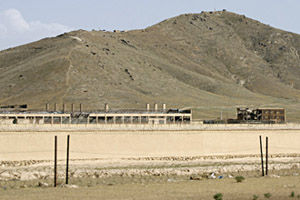
The Salt Pit, Shomali Plains Northeast of Kabul, Afghanistan. Trevor Paglen: The Salt Pit is located in an old brick factory a few miles northeast of Kabul, along an isolated back-road connecting Kabul to Bagram.

Black Site, Kabul, Afghanistan. Trevor Paglen: This site was brought to my attention by Afghan journalists and human rights activists in Kabul. The code name of this site remains unknown.
LECTURE
I have waited for a long time for an online presentation of Paglen’s oeuvre to which I could refer PP readers. (Thanks Alejandro!)
It’s quite the thrill to be brought in on Paglen’s sleuth work, as he walks us through the various public records used to piece together the rendition program. If you can spare an hour this weekend, you’ll be thankful for the education!
FORTHCOMING BOOK
Paglen’s work is to be published by Aperture in a book titled INVISIBLE. You can see Paglen and publisher Lesley Martin discussing the project here.

 Prison Photography