
You are currently browsing the category archive for the ‘Institutional’ category.
Blake Andrews says, “Together with the mugshot, the passport snapshot was the earliest application of photography as purely personal identifier.” It’s a good read and you should check it out. My favourite observation was the 1920s transition, “Photos were glued instead of stapled.” Also, is that Indiana Jones?…
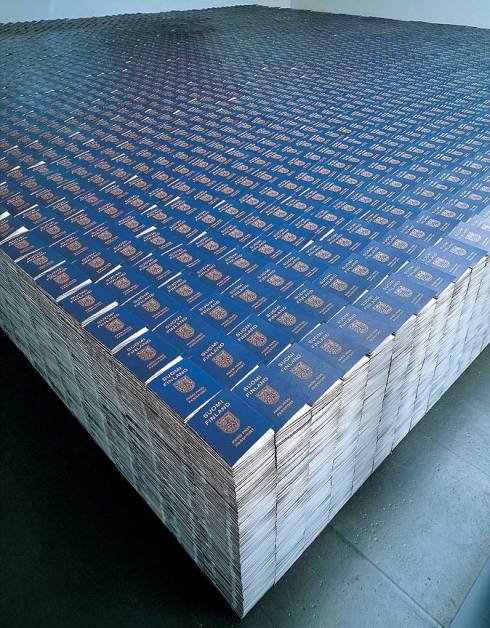
“One Million Finnish Passports”, 1995. One million replicated Finnish passports, glass, 800 x 800 x 80 cm. Installation view: Museum of Contemporary Art, Helsinki. Artist: Alfredo Jaar, courtesy Galerie Lelong, New York.
I’ve been thinking a lot about mugshots recently and how prison photography is one little orbit of many about the deathstar of dark-photography. Other orbits include Weegee, Larry Sultan & Mike Mandel (defining the cross over between documentary and fine art) forensic photography, police blotter, thanatourism, civil war hangings, Salgado’s “Beautiful Deathscapes”, lynching photography, Danny Lyon (the most appropriated of artists) and fetishism to name a few.
All of these, by method or subject, relate to the state, and thus more orbits of homeland and foreign surveillance, torture slideshows, death suites, electric chairs, driving licenses, mafia movies, Jenny Holzer and genocide.
The most everyday instance of a photographic collaboration with the state is the passport photo. No more than that. Just thoughts.
On Thursday, 28th May, photographs of prison conditions and detainee custody from six facilities other than Abu Ghraib will be released to the public.
Reports over the weekend suggested a figure of 44, but the Guardian has stated over 2,000 photographs are to be made public. Images of Bagram Air base in Afghanistan are included in the cache. Critics will surely scan for similarities in detention/torture methods used in Afghanistan as in Iraq to argue against the ‘few bad apples’ logic that railroaded earlier attempts to bring military and government commanding authorities to full-accountability.

ACLU’s advocacy deserves international acclaim. Not only have they forced the release of photographic evidence they won a ruling to prevent the destruction of audio tapes that record torture scenarios.
This is an interesting counterpoint. I presume we all assume we’ll see the images in the printed press. Would we expect the tapes to play on our televisions and radios? That scenario makes me uncomfortable.
Continuing with issues of format, it will be interesting to see how the media presents the-soon-to-be-released photographic documents in contrast to the recent torture memo’s. WoWoWoW set the bar low with the tabloid inquiry “How Bad Will They Be?” and the Los Angeles Times allays fears with a dead-pan assessment, “examined by Air Force and Army criminal investigators, are apparently not as shocking as those taken at Abu Ghraib.
No doubt these images will be contested and a ‘Meaning-War’ over the images will ensue, but I think people for and against the Bush administration’s interrogation policies are not going to change their position now – whatever the evidence.”
But, I guess it depends who’s looking.

Lefties want more weaponry in the push for prosecution of Bush and his cronies for war crimes. The right is debilitated and otherwise occupied by the economy, stocking guns before the “Obama-ban” and the latest Meghan McCain slur.
Politicians from both parties seem to want this to go away, snarking on about how the release of yet more Un-American activities will only fuel the burning hate toward the US. This position is an insult.
Did Bush care what Iraqi’s would think when he bombed them out of house and home? Did Bush care to think how American’s would react in the face of diminished civil liberties? Yet here, politicians of both parties are scrambling to avoid the negative reactions of entrenched, fundamental opponents INSTEAD of anticipating the beneficial good-will and return to mutual trust provided by honest disclosures of a transparent and constitutional government. Why cover-up a cover-up?
Maybe, the Democrats are shy to see these documents because they may implicate their top brass?

One concern I will air, is that all this could move toward some bizarre show-trial scenario, where lawyers bargain, Bush is spared, the American public settle for a conviction of Cheney, and careers and reputations lie in waste on both sides of the aisle!?!
I certainly didn’t expect the incriminating documents to flood as they have in recent weeks. I have no idea how all this is going to shake down. Obama doesn’t seem to have control of this. That doesn’t bother me. No-one can hold back the truth.
So, as wise at it’d be to remember the date, 28th May, you should bear in mind the photographs of abuse could well leak earlier…
________________________________________________
First Image lifted from Gerry May. http://www.gerrymay.com/?p=1426
Cartoon courtesy of the Nation. http://www.thenation.com/doc/20050307/duzyj
Final Image by Takomabibelot. http://www.flickr.com/photos/takomabibelot/2090273618/

© Stephan Sahm, from the series 'My Cage is My Castle'
It takes something special to jolt me from my ‘prison-photo-myopia’.
The European Prize of Architectural Photography has the most cohesive group of fine art photography winners and honorable mentions I’ve seen in the past five years. The theme was “New Homeland”. Each photographer has four prints as representative works and each mini-set is a treat!
Outstanding quality.
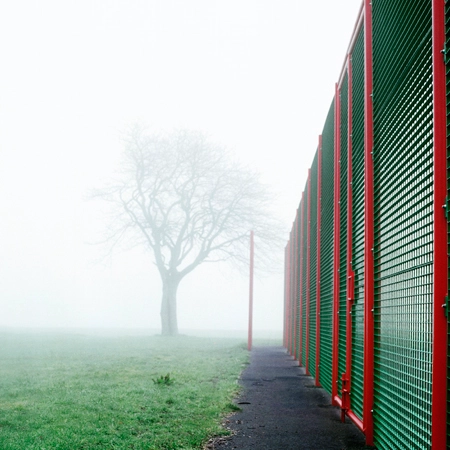
© Jacky Longstaff
You can browse the links provided below, but first see the 2009 Prize Winners Gallery.
Photographers formally recognised are Stephan Sahm, Tim Griffith, Jacky Longstaff, Freudenberger & Bachmeier, Kai-Uwe Gundlach, Frank Meyl, Szymon Necki, Menno Aden, Johanna Ahlert, Nicolas Briffod, Judith Buss, Walter Fogel, Andreas Fragel, Matthieu Gafsou, Benjamin Gerull, Juri Gottschall, Hanna Kohl, Shimizu Ken, Meike Hansen, Jonas Holthaus, Werner Huthmacher, Christian Kain, Sally-Ann Norman, Florian Profitlich, Andrew Phelps, Martin Richter, Martin Roemers, Michael Schnabel, Marcus Schwier, Michael van den Bogaard.
I was only aware of Fragel, Gafsou and Phelps previously.

© Frank Meyl

© Matthieu Gafsou

© Marcus Schwier

© Kal Uwe Gundlach
I suppose if I were to push for a relation of any of these works to ‘Photography Within Sites of Incarceration’ I would want to begin a dialogue on Sahm’s Hamster-Pop representations of confinement. Sahm was the grand prize winner.
With Jurgen Chill winning two years ago, and the presumed associations of borders and immigration within the theme of “New Homeland”, the European Prize of Architectural Photography apparently rewards photography that emphasises the psychological impact of architectural forms on its users/subjects – in which, notions of containment and non-containment are central.
________________________________________________________
I am aware Prison Photography has been preoccupied with fine art depictions of prison space recently and I intend to redress this genre imbalance in the coming weeks with more documentary works.

Yesterday, the internets celebrated Earth Day. The irony in this is that our grandparents’ generation would or could find nothing more incongruous than screen-sucked individuals posting pixels about the earth instead of actually being in its woods, lakes, deserts and mountains. I am not exempt from scorn.
Within the blogophotosphere the general tactic was to post aerial photographies. 100 eyes went to town with a series of Where Am I Now quizettes. NPR went with the easy but stunning option of Geo-Eye’s aerial images. On the aerial theme, i heart photograph posted an unintended but fitting selection of Eva-Fiore Kovacovsky’s photography. The Big Picture did not disappoint with a medley of seriously good environmental issues, opening with a shot of earth from space and Indicommons presented photochroms, albumen & photomechanical prints of nature from earth’s best collecting institutions. And, all of this buttressed by PhotoInduced‘s assertion that digital photography is the green option.
I began to think how aerial photography could tie in with prison photography. Last month, I used some official California Department of Corrections & Rehabilitation (CDCR) images for a post, and in doing so noted the fleeting resemblance of some patterns in the prison-adjacent fields to the salt-pan and tilled earthscapes of David Maisel.
Disclaimer: David, if you are reading, I respect your craft, fine art and politic. In March I camped at Owens Lake and your project formed the basis for much of our camp fire discussion. I hope you don’t think it inappropriate to juxtapose your work with standard state-sanctioned aerial photography.


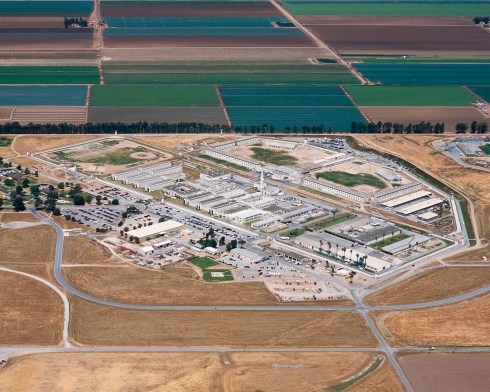


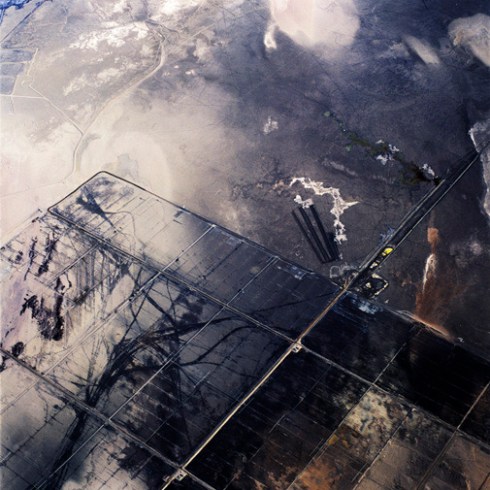


A CDCR image appears before the text. After the text, images are arranged alternatively beginning with a CDCR image. Any image without a prison is a David Maisel.
___________________________________________________________
David Maisel’s oeuvre is dedicated to altered environmental landscapes. Maisel’s images featured in this article are from The Lake Project which, along with Terminal Mirage, makes up his ongoing ‘Black Maps’ project recording “the impact on the land from industrial efforts such as mining, logging, water reclamation, and military testing.” Maisel’s official bio continues, “Because these sites are often remote and inaccessible, Maisel frequently works from an aerial perspective, thereby permitting images and photographic evidence that would be otherwise unattainable.” Prisons are often remote and inaccessible in California.
In all our justified concern for the environment and its invisible, gradual damages, I also want us to also to consider the invisible, gradual damages done to our social landscape. Men and women are wasted in America’s prisons.
___________________________________________________________
Prison Photography recommends Geoff Manaugh’s extended interview with Maisel at Archinect, audio interview at Lens Culture, Joerg Colberg’s interview at Seesaw Magazine and a full environmentally friendly CV from the Green Museum.
David Maisel was born in New York City in 1961. He received his BA from Princeton University, and his MFA from California College of the Arts, in addition to study at Harvard’s Graduate School of Design. Maisel was a Scholar in Residence at the Getty Research Institute in 2007 and an Artist in Residence at the Headlands Center for the Arts in 2008. He has been the recipient of an Individual Artist’s Grant from the National Endowment for the Arts, and was short-listed for the Prix Pictet in 2008. Maisel lives and works in the San Francisco area, where he has been based since 1993.

LONDON, UNITED KINGDOM - 15.06.08. A Metropolitan Police Forward Intelligence Team (FIT) photographer films and photographs journalists as police and protesters clash during a demonstration against U.S President George W Bush in Parliament Square, Westminster on Sunday 15 June 2008, London, England. Protesters had been banned by the Metropolitan Police from demonstrating outside 10 Downing Street to protest against the wars in Iraq and Afghanistan. (c) Marc Vallée, 2008. http://www.marcvallee.co.uk
After reading this phenomenal post by Jamblichus about state surveillance and electorate apathy/powerlessness in the UK, I was compelled to post the above image.
I know for two posts now in as many days I have diverged from “photography in sites of incarceration”, but this topic keeps throwing up unanswered questions.
Forward Intelligence Teams , introduced in 1996, are now central to British policing of all public crowd events. F.I.T.s don’t try to hide. They are highly visible and operate use facial recognition technology to add folk on camera to a central database.
Jamblichus raises a really important question about this. What is the nature of this database? We should all be asking these questions: Under who’s authority is the database maintained. Which government departments have access to it?
Local councils in Britain have used anti-terrorism legislation to spy on its citizens for minor infractions. What is to stop similar abuse with regard this database? The UK has built a police state infrastructure and no-one is immune to its effects should the cameras and mics be pointed their way.
Is the British Press “free” in all definitions of the term? I think not.
I am probably in the database due to my interest in a seal-hunting protest outside the Canadian Embassy of London last year. I went over to have a peek and a natter, mainly because I was shocked that anyone would want to picket Canada! When I turned to continue on my way, I had two long-range lens pointing at me.
Jamblichus points us to The Journalist which describes the Met’s purposeful surveillance of the press;
Police tactics seem to be becoming more menacing. Photographers have complained that the Metropolitan Police’s Forward Intelligence Team (FIT) — set up to target public disorder and anti-social behaviour by having high-visibility police officers use camera and video footage to gather intelligence — has started surveillance of press-card carrying journalists. They say that images of them are given a four-figure “photographic reference number” and held on a database.
I’d really like to know when they’ll need 5 digits or more!…. While we wait on that you can look over the Flickr group FITWatch.

London Metropolitan Police Anti-Photography Propaganda Campaign Poster
When I began writing this blog, it was meant as a vehicle to display the documentary work of photographers working in sites of incarceration and to generally expound the stories touched upon. It was also meant to deconstruct some of the persistent myths surrounding prisons and prison populations and how visual culture has played its part in weaving some of those myths.
Not once did I envisage the current situation whereby the act of photography could bring about the threat of detention and imprisonment. Such impingement on basic rights of expression has been known in some of the dictatorial and despotic regimes of modern history … but not so much in the West, right? The times they are achangin’.

Photo: Liam Oliver Newton Craik-Horan. http://www.flickr.com/photos/liamch/3423810669/
When my brother visited from the UK last month he couldn’t stress enough how much of a police state it has become. We reasoned that the fingerprints taken by US homeland security are know also the possession of the UK government. It used to be the case that fingerprints were only taken and kept on file in the UK if you had been convicted for a crime. How things change.
A few months ago I signed up as a member of ACLU, the decisive moment was when the ACLU representative said to me, “You don’t want the US turning out like Britain with all those cameras and surveillance do you?”

Photo: Stickerklub. http://www.flickr.com/photos/stickerklub/3420240889/
Britain really is a country that has got itself on edge; it’s culture promoting men and women in all guises of security to exert illegitimate power and enforce ludicrous policy. Unfortunately, this robotic application of rules has infected even our art galleries, as the venerable John Berger discovered.
This past months have seen a slew of stories coming out of Britain regarding the rights of photographers in public spaces. All these are in response to a slew of legislation to slowly whittle down the rights of photographers; the rights of UK citizens.
On 16th February, the Counter Terrorism act came into effect making it illegal to photograph a police officer or “elicit information” about them. The British Journal of Photography has the details.
After the disgust at such brazen restriction of rights, the response by the photographic community in London was to go to Scotland Yard, headquarters of the Metropolitan police, and in an act of mass civil disobedience take lots of photographs of lots of officers.
The Guardian UK has been the mainstream print media that has really pursued this topic, reminding us all of what we have just lost. They broke the story that Kent police monitored members of the press during an environment protest, for which the Kent constabulary have apologized.
The Press Gazette explained this tactic and the associated tension between police and photographers.
David Hoffman, a photographer with 32 years’ experience, said he now carries shinpads in his bag, claiming he had been kicked by police officers at protests.
“The police today [NUJ Protest] have been beautiful – but that isn’t always the case,” he said. “Recent protests have been very bad. The worst was October last year, at the Climate Rush demo. One copper spent his time kicking my leg. Stood there with his steel toe caps kicking away – and me, a silver-haired man. I’ve still got chunks missing from my legs five months on. They want you to think: I won’t cover it next time. They have been using FIT [Forward Intelligence Teams, who use cameras], they have been using intimidation.”
Hoffman added, “It’s important the police know they’re being watched and observed. If you don’t see what’s going on, your society’s less democratic.”

Photo: Tom Kondrat. http://www.flickr.com/photos/toguko/3409931955/in/pool-met
It is almost like the lines have been drawn so indelibly, people are having to pick a side. It is sad to see but the police fall in line with the government and the majority sympathise with the press. This has led to a conflation of stories involving the G20 protests, police misconduct, and the death of (and vigil for) Ian Tomlinson. Judging by the Guardian’s recent coverage, you’d be forgiven for thinking that London was on the edge of civic breakdown.
I think the media and the Guardian in particular are taking a principled stance here and just reminding the Met at every opportunity that they are watched and the press will not be cowed. I think most of us realise that with millions of people in possession of recording equipment it is unenforceable to stop people from documenting the streets.

Photo: Tristam Sparks. http://www.flickr.com/photos/friendly-fire/3287739662/in/set-72157613984292743/
Ian Tomlinson’s death received a lot of coverage and rightly so, but I shall wait for the inquiry ruling before making a call, despite the early damning evidence. We, however, in the business of images know that they can never tell the full story. This is now an investigation of excessive force by the police and distinct from the main issue of photographers/civil rights.
Yesterday, the Guardian published this footage of the police threatening photographers with arrest if they did not move. Again, later the force apologized. But what is interesting here is the Guardian‘s decision to line up video footage of various scenes of confrontation from different days in the right hand nav bar. It is a dossier of police activity and unlike anything I have seen in mainstream media.

Photo: Roger Lancefield. The protesters stickers read "I am not a Terrorist, I am a Photographer". http://www.flickr.com/photos/rlancefield/3285904973/in/set-72157613975803636/
From the sublime to the ridiculous, the Guardian showed that front-line press aren’t the only ones under scrutiny. Metropolitan police deleted a tourist’s photographs this week to “prevent terrorism”. Klaus Matzka, the tourist involved summed his experience up as such:
“I’ve never had these experiences anywhere, never in the world, not even in Communist countries.”
So, at best you are harassed for your photographic activity and at worst, if thought to hold sinister motives, arrested and face a 10 year sentence.

Photo: Tristam Sparks. http://www.flickr.com/photos/friendly-fire/3414147417/in/pool-met/
Before all this gets to any court, however, the clashes are felt on the street, on the shins and in the constantly diminished rights to freedom of expression. Where citizen photographers may feel powerless, it seems the press – and the Guardian in particular – are just getting powered up.
_________________________________________
Thanks to all the Flickr users credited above for their images, but more importantly their acts of documentation in the face of legislation to prevent such freedoms. I hope we all stay out of prison.
It gives me great pleasure to introduce Prison Photography‘s first guest blogger. However, it saddens me as much that he must remain anonymous.
A couple of months ago, I received an email from a California state employee who worked as a prison educator. To paraphrase that initial contact, he stated that “California prisons were places of extreme emotion and stress – due in part to their ‘invisibility’ – and photography within the walls of prisons could go some way in bringing visibility and public understanding to the realities of contemporary prisons.” This was a remarkable statement and the first of its kind that I had heard from someone in employment at a state prison. I asked if he could expand on those thoughts and I am grateful he did.
The great irony of this is that the essay is not illustrated by the images he witnesses daily. He has offered us poignant descriptions of scenes from within prison. The descriptions are a powerful device to get us thinking about what we think we know and what we potentially could know about our penal system.
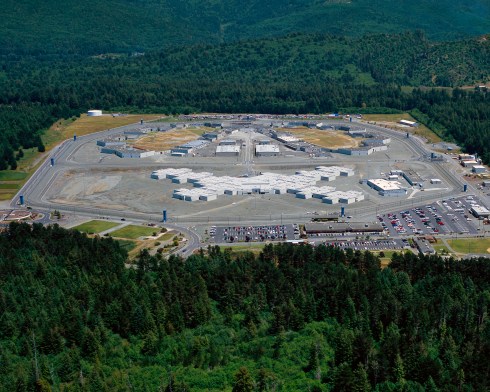
He suggested I use some of CDCR’s own images. The aerial shots included are the official vision of the California prison system that disciplines and orders the different sized units that comprise the institution; cells, wings, blocks and facilities. The institutional eye of CDCR’s aerial views lies in powerful contrast to the personal narrative recorded here.

Avenal State Prison. Courtesy CDCR
I work in California prisons. Penology has become grown into avocation over the last 10 years. A past career in journalism with some practice in photojournalism informs a strong inclination to report/communicate what I see and experience. So I am daily frustrated by prison policies against recording the visual images I see. Each day I wonder if these policies are justified. If not, are they an impediment to rehabilitation, perhaps even prison reform? Do these policies protect society and the prisoners and staff persons who are a part of society? Or are these policies so much heavy furniture upon the carpeting under which we have swept our societal human detritus?
[IMAGE] There but for the grace of God go I – Close up of a hollow expression on the face of a prisoner as he watches two uniformed guards escort another prisoner across the bare, brown dirt of a prison yard. One guard holds a baton at the ready, the other menacingly waves a carafe-sized container of pepper spray, his finger on the trigger. In the background are multiple 12-foot chain-link faces topped by rounds of glistening razor wire.

North Kern State Prison. Courtesy CDCR
If you ever work with law enforcement on the street, you will hear the mantra “officer safety.” Policies, procedures, even individual officer actions have this mantra as an underlying core within their stated mission to serve public safety. In the prison, that mantra becomes “safety and security of the institution.” Everything is measured against that mantra. Nothing is approved if anyone can show that it may be a threat to institutional safety and/or security. Uncensored and uncontrolled photographic images seem to be considered an inherent threat to institutional safety and security. From a rookie guard to the departmental secretary, few things seem to frighten them quite so much as image impotence in the institutions they so wholly control. From regular staff trainings to informal reminders I have been inculcated (brainwashed?) to accept the imprudence of taking pictures on prison grounds. Simply having a camera on prison property could be cause for termination.
[IMAGE] The burden of laundry – a prisoner wearing only boxer shorts sits on the lowest metal slab of a three-high tier of bunk beds in a prison gymnasium. His hands are deep in a bright yellow, worn mop bucket on the floor in front of him. Inside, white socks and underwear mingle in lukewarm, soapy water.
Prison regulations acknowledge their public nature and the public’s right to know what goes on inside prisons, at least bureaucratically. Title 15 of California Code of Regulations, Section3260 is entitled “Public Access to Facilities and Programs.” It states:
“Correctional facilities and programs are operated at public expense for the protection of society. The public has a right and a duty to know how such facilities and programs are being conducted. It is the policy of the department to make known to the public, through the news media, through contact with public groups and individuals, and by making its public records available for review by interested persons, all relevant information pertaining to operations of the department and facilities. However, due consideration will be given to all factors which might threaten the safety of the facility in any way, or unnecessarily intrude upon the personal privacy of inmates and staff. The public must be given a true and accurate picture of department institutions and parole operations.”
Is absolute control over visual images in and around prison an unreasonable imposition on prisoners, staff, families, general public, media, etc? Does it interfere with the desirable goal of family/community connection with prisoners? Does it contribute anything to either rehabilitation or punishment, the two general goals of incarceration? I’ve catalogued the reasons I’ve been given, or even imagined, over the years and want to see how they stand up to public scrutiny.

Pleasant Valley State Prison. Courtesy CDCR
The first and foremost reason for image control would seem to be the prevention of both escapes and incursions. Photographs of prisons may provide intelligence to anyone planning escapes, contraband smuggling, perhaps even terrorist activities. This seems reasonable enough, at least until you start prowling around the Internet. The California Department of Corrections and Rehabilitation Web site has high-resolution aerial photographs of every one of its prisons. Anyone with even rudimentary analysis skills could do serious escape/incursion planning based on these photographs alone. But wait, there’s more. Google maps have more information – local maps, photographs of the prisons, even their “street view” photographs in some instances that clearly show fences, towers, gates, etc. With that level of public information available, I don’t see how you make a credible argument that I can’t take pictures on prison grounds.
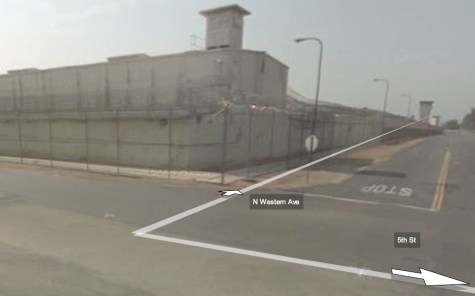
5th & Western, Norco, CA. Google Street View.
[IMAGE] The spread – four heavily tattooed prisoners in underwear standing around a dented, dingy gray metal locker. There are bowls on top of the locker and they are sharing food they cooked using hot water, instant soup noodle packets and canned meats, vegetables and seasonings. On the dirty gray concrete wall behind them is stenciled in fading red paint: NO WARNING SHOTS FIRED.
Privacy would seem to be the next strongest argument for prohibiting prison images. Given the open policies in other states, this argument seems flimsy. For prisoners, all conviction information is public. Simply go to the appropriate county court and the information is openly available to the public. Yet it is extremely difficult to get any information about prisoners in the California prisons. For the public there is one telephone number you can call. [916 445-6713] You must know either the prisoner’s CDCR Identification Number or the full name and correct date of birth. The line is perpetually busy and, if answered, the caller can expect to be put on hold for a long, long time (yes, hours). On the other hand, if you go to the Nevada Department of Corrections Web site, you can search for Orenthal Simpson and it will show not only his prison and address but all his convicted offenses, terms and release date. Oklahoma, not generally known for openness, shows the prisoner’s location, convicted offenses, release and parole dates, even pictures. The federal Bureau of Prisons will provide prisoner location and release dates for current and past prisoners. Try a search on their site for Martha Stewart.
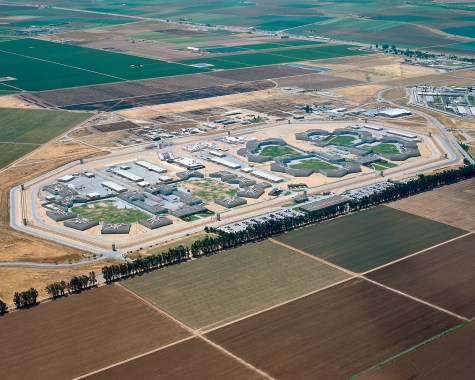
Salinas Valley State Prison. Courtesy CDCR
A major defense California prison management will make for the privacy argument is gang violence. They believe if it is easy to find a person in a particular prison, that can make it easier for gangs to use him. The gangs may use the prisoner to do their illegal work or to order him killed if he has fallen from grace, so to speak. CDCR logic is that by keeping prisoners hidden they are keeping them protected. If this is true, the magnitude of the gang problem is nothing short of monumental. Other states apparently do not have this problem. Why not?
[IMAGE] A pile of clothing, denim pants, orange coveralls, boots, etc. on a six-foot folding table. Two uniformed guards on one side of the table. Two naked inmates on the other side of the table, one bent over spreading his rear-end cheeks for officer inspection.
I categorize all other arguments against my taking prison pictures as simple totalitarian need for control. An uncontrolled image is seen as a risk – and why take a risk? The fewer images that exist, the fewer possibilities there are for something to happen that they can’t control. Statistically speaking, very few members of the public or the media ever get to see what happens inside prisons. Media representatives are escorted at all times and only see what prison management wants them to see. They are rarely given unfettered access to prisoners. Visitors are the bulk of the public that see anything of a prison, and that is a very limited view – parking lots, processing rooms and the visiting rooms. Even inmate appearance is tightly controlled in the visiting experience. The prisoner who shows up needing a shave or wearing a wrinkled shirt doesn’t get into the visiting room. And he or she will be strip-searched going in and coming out.
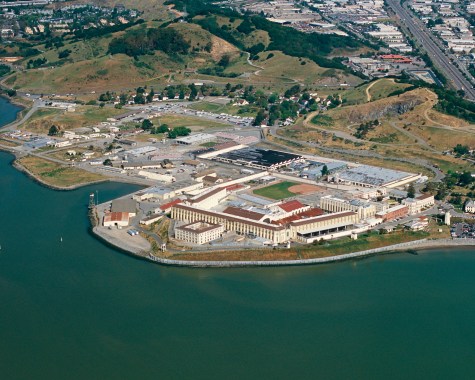
San Quentin. Courtesy CDCR
Prisons, at least in California, are reactive rather than proactive. California’s first permanent prison, San Quentin, opened for business in 1852. Since then, the prison system has been making rules and regulations based on preventing the recurrence of negative events. For example, a prisoner at R.J. Donovan prison at San Diego escaped using a fake staff identification card he had made. He walked out amid a small crowd of other staff leaving at shift change time. As was customary then, he simply held up his photo ID and was waved through with the rest of the ID card wavers. To prevent this from happening again, CDCR policy now requires the gate officer to physically touch and examine the employee ID card before letting the person through the gate. Such policy-creation has been repeated tens of thousands of times over the past 157 years of the California state prison system. It does not lend itself to the openness of unfettered prison images.
[IMAGE] The back of a prisoner’s shaved head as he sits in the audience of a GED graduation ceremony. Visible under his mortarboard are gang tattoos on his head and neck. Blurred in the background an inmate stands at the podium giving his valedictory address.
Until 1980, incarceration in California had rehabilitation as a major goal. The state legislature in that year, bowing to a Reganesque rabble-rousing changed prison law to say the purpose of incarceration is punishment. The concept of rehabilitation disappeared and so did most of the prisoner programming and policies meant to promote rehabilitation. Connection with family is known to be one of the most important factors in rehabilitation. I suggest the control of images in the prison system is one policy that discourages family connections.

Substance Abuse Treatment Facility at Corcoran. Courtesy CDCR
Prison subsumes human beings. Prisoners disappear over time. As soon as a man goes to prison, he begins to fade from his former life. Just as a photographic print will fade over the years, the place of a man in his family fades while he is in prison. Life goes on – without him. His linkages to the fabric of family and community eventually fray and break. Phone calls, letters and visits cannot fully replace the foundations of shared daily interactions, family projects, adventures, challenges and the intimacy of shared emotions. Despite our ability to love, we are creatures of habit, and over time absence can become a habit that seems a normal reality.
The absence of prison images in society supports the concept of shame in incarceration. This shame then supports an estrangement that prison system managers find useful for their purposes. The human toll of that is prisoners who simply hunker down to do their time. Some resist family contact. “I don’t want my children coming to see me in a place like this,” is a common thing I hear from prisoners who could have visits if they wanted them. Would this change if prison images were common in our society? I think so. I think it’s worth a try.
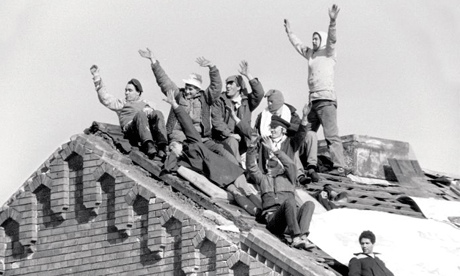
The Strangeways riots in 1990 led to breakthroughs in the prison system. Photograph: Don McPhee for the Guardian
On April 1st 1990, began Britain’s largest prison riot in history. Strangeways may not mean a lot outside of the UK, but within, Strangeways, Manchester is synonymous with the romanticised image of the Northern criminal. The photographs of prisoners on the roof are iconic. Britons watched with shock.

Photo: Ged Murray for the Observer
Prison conditions had rarely been in public debate. Our level of shock was only equivalent to our level of apathy, prior. The general public were in awe of the unprecedented institutional collapse.
Prisoners occupied the roof for 25 days in front of round-the-clock media coverage. The protest ended when the final five prisoners surrendered themselves peacefully on 25th April.
The estimated damage was pegged between £50 and 100 million. The true cost for the HM Prison Service was lord chief justice, Lord Woolf’s subsequent damning report, which cited inmate frustration and poor prison conditions as a main reasons for the riot.
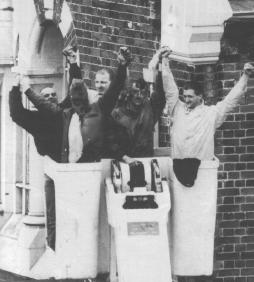
Photo: Ged Murray for the Observer
According to the Guardian – which includes a transcript of the prevailing exchange between proctor and prisoners – the stirrings of unrest began in the chapel following the 10am service. Prison officers evacuated the chapel and then (arguably) too hastily other areas of the prison. Inmates using keys taken from chapel guards released other inmates. Soon the overcrowded and understaffed facility was no longer in the control of government authority.
Strangeways roof protest photographs are iconic because their subject was so unexpected. Britain had harboured class and political confrontation much in the past. But in the miners strikes and clashes with police, football hooliganism, the general strike violence could be in some way predicted. The circumstances for those prior tensions had been played out through media narrative. UK Prisons were neglected; they were in desperate conditions and we – the public – were oblivious.
Don McPhee
Photographs of the Strangeways riot are hard to come by but I have gleaned a few from the web. In doing so I came across the work of the late Don McPhee.
I strongly urge you to watch this slideshow of his work.
McPhee had a 2005 exhibition at the Manchester Art Gallery and is a fondly remembered northern talent. He was a crucial part of the alternative editorial voice of the Guardian at that time. That distinctly Northern paper is now internationally distributed & respected.
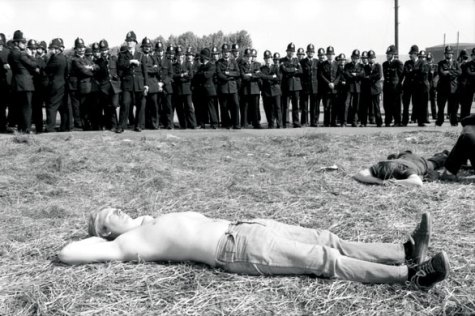
Miners sunbathing at Orgreave coking plant. Photograph: Don McPhee
_______________________________________________________
Here is the inevitable percolating legacy of Strangeways in public dialogue.
Here, Eric Allison makes a succinct argument for British prison reform.
And here is the UK Parliament debate in 2001, ten years after the January, 1991 publication of Woolf’s report reviewing the response to the report recommendations.

 Prison Photography