
You are currently browsing the category archive for the ‘Interview’ category.

AP Photographer, Brennan Linsley has visited Guantanamo twelve times in the past four years. Why? “My goal is to come back from each trip with a couple of shots that will allow me to paint more of a picture of this place'” says Linsley.
A journalist’s visit to Guantanamo is a frustrating experience – newsmen have a constant escort on a preplanned itinerary and must read and follow the fifteen pages of ground rules provided by the US military.
To offset these limitations Linsley chose repeated visits as a a tactic. In an attempt to humanise the detainees, he has weaved a photo-essay in-spite of Guantanamo’s milieu which is counter to all notions of free speech, experience and objective fact-gathering.
The British Journal of Photography has a brief but interesting interview with Linsley about his project.
This sequence of interactions between a Chinese detainee and photographers (described by Linsley) exemplifies the minutiae with which the US military must control the flow of information out of Guantanamo.
Just to get the juices flowing, Linsley closes the interview with this position, “The Golden Age of photography has been over for a long time. It died somewhere between the Vietnam War and the Gulf War.”
Discuss.
_______________________________________________________________
BJP’s interview coincides with Linsley’s work showing at the 2009 Visa pour l’Image at Perpignan.
For more images and links on Guantanamo see Prison Photography‘s Directory of Visual Sources.
This is a continuation from the Interview Part One, published Tuesday, 21st July, 2009.
– – – – –

PP: Tell us about the objectives of the workshops?
SD: The purpose of the first workshop [at Maple Lane] was to create images that would describe what life was like. To treat the camera as a photojournalist would. They had a story to tell. And they had an audience that they were supposed to reach. Once I was there I quickly realized that most of these kids have never completed a project of any description.
Photography was secondary. They just needed something to do as a group that might actually have some kind of consequence. That people could look to and be happy with. A lot of them had never had [that type of validation].
We agreed, and it wasn’t hard to get them to agree that the group as a whole took credit for each picture. And they were all okay with that. I’d print them, take them back and show them. The group would edit them and they’d feel part of the process.
The Green Hill School was a little less resolved. I wasn’t quite sure I was there honestly. I don’t think they’d quite figured it out. And so that was a little tougher I think.
When I was at Remann Hall there was a whole issue with not photographing faces. So with that I took a whole different tack and gave them pinhole cameras, which ran on long exposures.
The girls had to plan the shot. They were thinking in terms of illustration and performance for the camera. It wasn’t about trying to document as much as create these worlds for the camera. And those pictures are really beautiful.
The purpose of those pictures was to become part of a construction that they were building; It was a house with all sorts of representations, photos, paintings and stuff like that. That went to the Tacoma Museum of Glass. It might even still be there? The photos didn’t work well in the house, unfortunately, mostly for technical or logistical reasons. However, they were very significant in the catalog.
PP: What lessons did you learn?
SD: When it worked at its best we worked as a small group and we did a lot of talking.

The Institution Adapts
PP: Any problems?
SD: They’d take photos, show them and sell them to the other kids and get in trouble for that. They had a whole economy going. They were photographers for hire. The other kids would hire them. They were all doing gang signs, which completely got everyone in trouble.
PP: So they had the cameras with them during the project? In their cells?
SD: It depended which facility we’re talking about. It was actually a huge struggle at the start of the project, especially at Maple Lane where they’d confiscate the cameras. The staff would confiscate the cameras as a form of punishment. As soon as I left the building they’d take the cameras away. That part was really hard.
It got better when there was enough dialogue about it. There was a whole education process that had to go on with the staff too. They weren’t used to cameras being there! They were not comfortable with that. They allowed kids to go outside with one of the staff, you know, photograph a tree and then give the camera back to the staff member.
PP: Describe the education you gave to staff.
SD: The only thing I could do with staff was to explain my view and then get the management of the facility on my side … who could then explain to the staff and sanction the activity. The photographs were all censored at the end.
When the staff realized that the superintendent was saying it was okay they began to lay-off, but in truth there wasn’t a lot I could do with the staff. At the time, there was some really progressive staff who thought this would be good for the kids and that the exposure would actually be good for them. Over the years that changed, and they became very protective again.

PP: How did each of the workshops wrap up then?
SD: Maple Lane: I was there as long as I was supposed to be there. But it was clear I was never going to get to be back. I was caught in the middle of larger differences between organizations. That shut me out of that.
Green Hill School: I was amazed at the amount of support they gave me after a while. I went into the intensive management unit (IMU), which is the hard-core wing – the lock down.
I thought they weren’t likely to let me in there, but I approached the management anyway and I said I really needed to take pictures of that [the IMU]. I explained I didn’t want to make it pretty. The administrator said ‘Yes’ which really blew me away.
And the staff at the IMU were just so excited that someone came out to visit because that place was usually off limits.
Spotlight On/Spotlight Off
A while later the New York Times magazine was going to run my pictures including those of the IMU. I made a mistake and I went back to [Green Hill] and told them the New York Times was interested and that I wanted to get some updated photographs and releases. The management had changed by then – they threatened me with lawyers and state attorney general. It got complicated and the story never ran.
PP: Which photographs were problematic? Or was the project as a whole problematic for Green Hill?
SD: I’d sent New York Times a lot of stuff and they were interested but the final selection was never made, so I don’t know which individual pictures would’ve been the problem. The project was the problem. The editor said “do what you need to do and get it right,” but editors have very short time lines and attentions spans. When I was ready they had already moved on. My fault.
PP: Your stark environment photographs. These are pictures of the IMU too?
SD: Yes. That’s a play area that had been shut down for months. They couldn’t even use it. That’s IMUs exercise room with no weights, no anything.
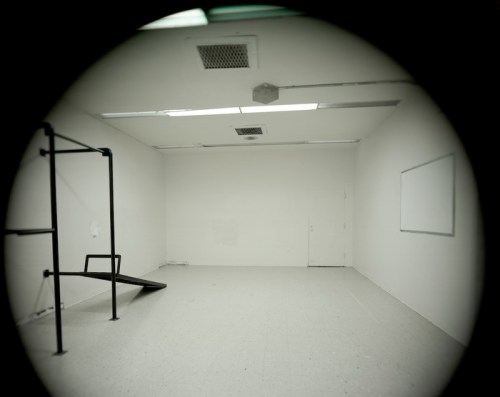
The situation here is that they’d get a chair if they were still enrolling themselves in school; they had their own choice if they wanted to be enrolled in school. If they acted up, which many did because they were locked up 23/7, they’d take away their mattress and they’d sleep on the cement. And if there was more trouble than that they strip them, and if there was more trouble than that they’d chain them up in the fetal position.
PP: Seriously?
SD: I’m serious. This is what I was told – I was told by staff. It was bad and that’s probably why they didn’t want any of my pictures running in the New York Times. They told me they were cleaning up their act. This was 2000 so that may well be true. My response was, “Great, can you invite me back? I’d like to see it.” They said they were not into that.
PP: You’ve many photographs of the steel doors and hatches.
SD: The hatch is where they’d get their food, mail and medical needs. That’s when the IMU really started to affect me emotionally. You know, when I was working with them face to face in these institutions it wasn’t any different to working with kids anywhere. But …


PP: Were these juveniles in the IMU because they were violent offenders or were they there because they’d broken prison rules?
SD: Because they’d broken prison rules.
PP: It was punishment?
SD: Yes, but part of understanding this is also getting accurate information.
I was told they put people there for their own protection. There was one kid who was a pedophile who was apparently there for his own protection, but then I was told later that that wasn’t the case. “Oh, you can’t do that [type of separation].”
PP: One would think prisons could run protective cells and wings without resorting to these stark punitive environments? It doesn’t have to be run like that?
SD: Maple Lane it is less punitive, as far as I could tell. But they’ll separate gangs as well. You know kids can’t just be housed anywhere. It has to fit with the institution.
PP: I am shocked to learn that juveniles are in isolation. What are your thoughts on solitary confinement?
SD: About the time I was shooting this story, Tim McVeigh was about to be executed for his Oklahoma bombings. Watching him on TV, he was on death row and he clearly had a better cell than those kids. This was interesting but also depressing – some kids told me they’d go to IMU because they just wanted to get away and some of them would only be there for two or three days. But some of them would be there for months.
The staff, there was one guy, I forget his name, was extremely bitter. He said in front of everybody, including the kids. “I could solve this problem easily, I’d just get a gun” and this is how he’d talk to these kids. He said back a few years ago they had tables in the open hallway and a TV and pool table.
The kids took the pool balls and beat the staff with them, they broke the television. So they removed all these things just because the staff were scared – that was the only reason. They told me one woman couldn’t go back to work because her arm could was damaged. And so you realize it is very complicated. These people come to work everyday and they don’t want to be constantly threatened with violence.

SD: But, of course, these kids [I was photographing] had nothing to do with that. Right? They had nothing to do with it but had to pay the consequences.
Some kids would go to IMU just for mouthing off and others may have done something serious.
As for the staff; some most of them were really good. And I don’t know how they do it every day. Others were those who were bringing in dope for the kids and being nasty.
The kids complained about this and there was nobody there to listen.
PP: No accountability? Did complaints ever get out of the facility – say to the DSHS for example?
SD: I don’t know. Part of the problem is the kids lie their heads off. No matter what they tell me I can’t assume it is true and that is part of the problem and just makes it more complicated. But the more I got to know them they all have their underground. You know – they’ve all got something they can get high on. It must be the staff that’s bringing the stuff in.
PP: What’s in it for the staff? Behavioral management?
SD: Well, they’d get something out of it … I don’t know what. I had camera stuff stolen. I know the staff stole it; it wasn’t the kids.
The kids would always get punished because the state didn’t know what to do with these kids. It was about management – it was not about justice.

PP: Tell us about your portraits. Did the kids see your work?
SD: Yeah, they all got a picture. If I did a portrait they all received one. Although yeah [laughs/sighs] some of the kids swore they never got them. I’d give them to staff to pass on …
Something I think is really interesting is this desire for photographs. (I video taped in there too and interviewed a lot of them). They would have empty rooms, but they’d have maybe a few pictures on the wall that they were allowed to have.
It was a huge deal to them to have these pictures. Photographs were important. And one kid who was an outsider (you could tell the other kids didn’t like him) approached the group and said, “I’ve got something but I can’t show it to you.” And they said, “Fine, we not interested.” And he kept nagging; it was clear that he did in fact want to show the group this thing.
Usually contraband is drugs or porno, but no. He pulled out this picture of him and his parents from when he was a kid. It was all wrinkled up and that was his prize that nobody could take from him, I’d never seen anything like that before.
I’d heard from Susan Warner, from before I was in there, that she came across one kid who had never even seen a photograph. I’m thinking, “He must have seen a photograph?” but some of these kids have backgrounds that are so hard to imagine.
Anyway, they loved having their picture taken and they loved having the power to visualize the result.

PP: Their futures? Do you wonder what happened to them?
SD: I tried to track them down. And it was impossible. I tracked one down. He made it into community college in Centralia. He was in college when I met him.
Another kid everybody liked. He was popular and he was smart. After he got out he called me once. The Experimental Gallery got him a scholarship. The college wouldn’t admit a felon so he couldn’t use his scholarship. He was on parole, so he had to stay in his local area and so his options were limited to colleges there. So he had a scholarship and he worked in McDonalds!
Later, I was working with a legal advocacy group in Seattle and they could identify a lot of these kids as being in the adult system now. The recidivism rate is 80%. I think in the back of their minds they just kind of expect that [return to an institution]. Prison is where their dad is in many cases. A lot of them – more than I would have imagined – were affiliated with gangs. I never really appreciated that as being a serious problem in Washington State, but most of them had some allegiance. After release most of them return to their homes and familiar neighborhoods.
PP: In how many cases did you think that the institution as it existed served the child and society?
SD: Only one. There was one who was scary. Out of his mind. But there was only one.
PP: Talk about the procedures one must go through to photograph in a site of incarceration.
SD: Everybody asks me, “Can I go do this, who do I need to call?” somebody needs to call you. They’ve already gone through the hoops and they’ve already got that figured out.
PP: Do you see yourself photographing in sites of incarceration again?
SD: Yes. Am I planning for it, no, but it could happen through other avenues. I have been planning for some years to do a project on American war veterans, which falls under the same sort of scope. That is going to be my next big project.
If I do go back to prisons or jails, I don’t want to photograph more portraits that look the same. I don’t want to take the same pictures. I would like to penetrate into [the issue] with something deeper.
PP: Any closing thoughts?
SD: I don’t know a lot about prisons. I don’t know a lot about the adult systems but the youth systems (and I have a two and half year old now) is an embarrassment. It’s really bad they don’t know how to deal with these kids and they don’t know how to make them better.
The real smart ones will figure out how to get out of there and the rest … ?

Steve Davis is the Coordinator of Photography and adjunct faculty member of The Evergreen State College in Olympia, Washington. He received the Santa Fe Center for Photography’s Project Competition in 2002, and recently won an Artist Trust Fellowship. His work has appeared in the New York Times Magazine, and is in the collections of the George Eastman House, the Tacoma Art Museum and the Musee de la Photographie in Belgium. He is represented by the James Harris Gallery, Seattle.
This is the first part of a two part interview. Part two was published on published Thursday, 23rd July, 2009.
– – – – –

You already know the work of Steve Davis, you just don’t know it. Prison Photography‘s most popular post was that of pinhole photographs made by the young ladies of Remann Hall, Tacoma. Steve Davis conceived of and led the workshop.
Concurrent to workshops, Steve worked on his own project, Captured Youth (1997 – 2005) turning his lens on the juvenile offenders and institutions within Washington State. Steve’s introduction to the Captured Youth book reads, “What are officially referred to as “schools” are, in fact, youth correctional facilities – jails for juniors. It’s a world kept secret from the general public, but there are no secrets inside. Everyone is watched.”
Steve and I sat down to talk about the circumstances of the workshops and portraits, the involvement of – and benefit to – the teens, the atmosphere in the facilities and how the practice of photography manifests in sites of incarceration.
___________________________________________________________
Prison Photography: Steve, you photographed in four institutions in total?
Steve Davis: Yes, Maple Lane, Green Hill School, Oakridge and Remann Hall.
PP: How did you pick those?
SD: I fell into it years ago. It was fairly unintentional. I was doing PR photography for an [non-profit] organization called The Experimental Gallery that was trying to bring in art teachers on residencies into juvenile facilities. It came up they were interested in maybe having a photography workshop. I said it was something I was interested in.
And, nothing happened for a couple of years, but then I got a phone call and they asked if I’d like to teach the kids photography and double up as a photographer for their publications.
I thought about it and I asked if I could do something different. I wanted to slow the process down and bring in a large 8×10 camera. I just wanted to do portraits; focus on who the kids were without all the trappings, bars, etcetera that go along with images of young offenders.
So, I went in and worked with the kids [within a photographic workshop format] and then organized outside of that to take in the large camera.
Essentially, I was working under the umbrella of The Experimental Gallery, which had a grant, so I could only be there when they said I could be there. And when they were done and the grant was over, I had no more access.

Beginnings
SD: It started in 1997 at Maple Lane, then later the Green Hill School and Remann Hall. Each of those placements was under the direction of Susan Warner and The Experimental Gallery. Susan is now the Director of Education at Tacoma Museum of Glass. Between time, Susan had a job at the Children’s Museum in Seattle and they supported her doing this and she continued through them. And likewise, since she has worked at Tacoma Museum of Glass they have supported her as well. So the name has always been the same.
Lastly, at Oakridge – that was all my own work, with anyone’s sponsorship.
PP: You returned to Oakridge and the project in 2005. Why did you decide to return?
SD: Well, at the time the project didn’t seem resolved. I wanted to do something a little different. Oakridge is a transitional facility so they are not so much under lock and key, they are allowed to wear their own clothes and they have day jobs. That is where they reside just prior to release.
Soon after [Oakridge] I felt like I was getting to the point where I was taking the same picture.
PP: How did you respond to that?
SD: I tried contacting other facilities. I really wanted to get in to Clallam Bay, which is an adult institution but has a juvenile facility. It is really hidden from the public. But none of that panned out.
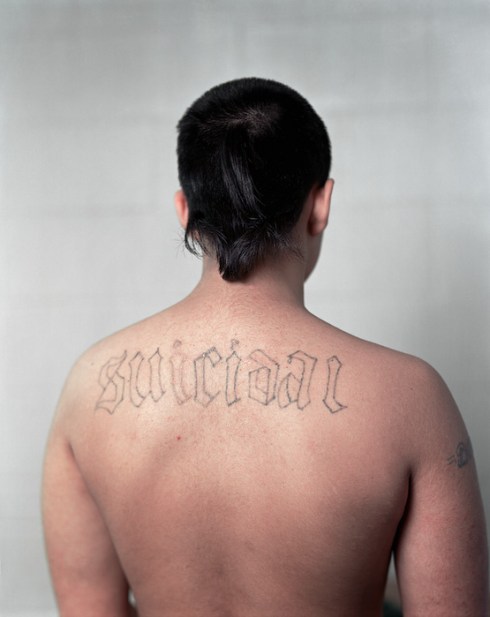
Overall, my interest with portraits has pretty much been about people who are controlled and lack all sorts of freedoms. I haven’t only focused on prison; I did a lot of work at an institution for the mentally disabled.
PP: What’s the attraction to these types of subjects?
SD: When I got into the work, I fell in with these mini societies with their own economies and their own rules and they’re all over the place. They are thoroughly hidden by intention from the public – who have no interest in examining it. It doesn’t benefit the public to do that.
I found these places intriguing partly because once you are there in the middle of it, the people you come across, they’re linked together by reasons that are not of their own choice. It’s not the type of community where people have something in common so they create their own economies. They are like dogs in a pound. They might be friends, they might not, but they share common concerns.
I was interested in trying to zero in on these people as individuals with personalities and hopefully open up a lot of questions with the viewer. That s all I wanted to do. I wasn’t trying to reach conclusions or force anything down anybody’s throat. I am just trying to acknowledge that this is 20 miles from home.
All these [sites of incarceration] have names that sound like country clubs! You’d never know that Maple Lane was anything but a nice street or golf club. When you drive past, it is a beautiful place, but you won’t see a kid outside. It looks good from the road, but it is not a place you can walk around.
When I did workshops, they’d love it if I walked them over to the fence; they’d never been! Just little things like that were huge thrills to them.
PP: So the youth were always willing participants?
SD: The first residency at Maple Lane was the best organized. The kids were engaged – some were working with painting and music. The goal was to create a mixed media large exhibition that would go into the high schools of King County, and other areas that had a lot of at-risk youth.
So the kids [inmates] would present the information of their own lives. The message was for the exhibition was generally “You don’t want this”. The young prisoners understood that and got behind it.
Method
PP: Tell us about your portrait work. How much direction did you give the boys as sitters?
SD: Well, they knew the reason why I was there. And all they knew was that their portraits were to go into a catalog. In all, three catalogs were produced. They knew the photos would be published and shown. Other than that, the motivation from these kids to have their picture taken was overwhelming.
I did go in with a bit of theater. I had a large camera, I had lights and I had an assistant. So they were just begging to get their picture taken. It wasn’t hard at all. Direction was minimal. I’d ask them to turn their head or look into or away from the camera. Because I was shooting 8×10 on a limited budget, I’d take a limited numbers of pictures of each person, maybe 2 or 3, and then they were gone.
PP: The personalities of these kids comes through very strong. Are these images an accurate reflection of the individuals in the group?
SD: Yes, each photograph is one accurate reflection. Many of the sitters look very somber, but in fact they’d be laughing their heads off a lot of the time.
Some of the portraits I feel stronger about than others. There are some portraits I don’t have a particular connection with and there’s other I really love. Kids that really struck a chord with me, part of it was the experience of them sitting with me, knowing their character.

PP: Can you talk about a few of them?
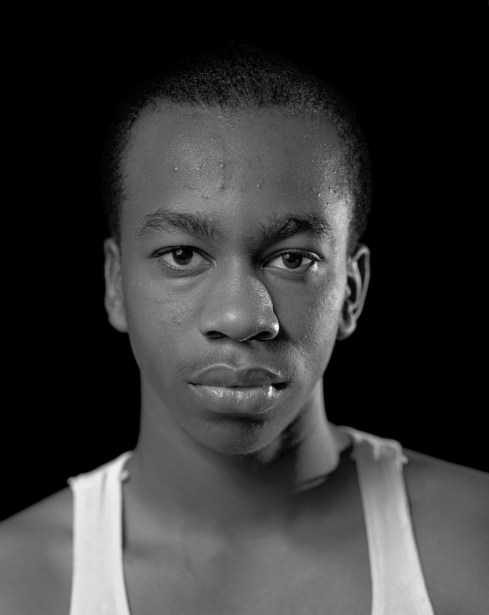
SD: This guy. The nicest guy in the world. Total white racist. Had as many black friends as white, but he was basically raised to be a white racist. Once you got to know him you fell into that world, his world. He got along with everybody, but if you asked him he would’ve told you what his views were. I shot a lot of him, indoors and outdoors, more complicated environments.
PP: This portrait?
SD: I like that one. I don’t know if it’s the picture or the kid. But out of all the time I was there, he was the only one where the staff said, “He should not be here.” He was a Mexican who got busted for being a drugs mule from Mexico. Apparently, some rivals burnt his house down. He couldn’t or wouldn’t speak English. He was scared and totally out of his element. But over about three months he started playing the role of the tough guy and you saw this transition. He was becoming what he was assumed to be to begin with. Becoming a hard guy – it was sad.

PP: And this guy?
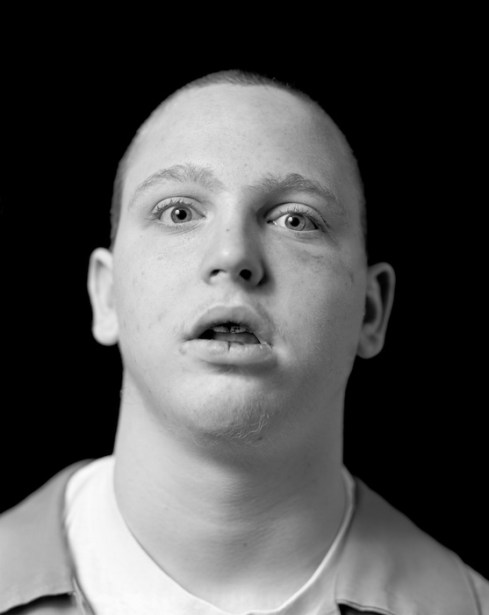
SD: This was in the psychiatric ward and they were all seriously medicated. This kid here was heavily medicated. He’s got blood on his teeth.
PP: Explain the blood.
SD: He told me he was in a fight the day before and he was walking around like this. Maybe he was continuing to bleed.
PP: Did he always have that look?
SD: Probably not. I didn’t really know this kid. But when I saw him I really wanted to photograph him. I was never demanding, but he was the only one I had to cajole. I said “If you want to make a dent, let me take your picture.” He said okay. That was just his gaze. I really thought his look was gripping. And there was a whole wing of them.
PP: Was it a common attitude among the juveniles, that they knew they were medicated and they knew they didn’t want to present themselves as such to the camera?
SD: He was the only one. I only took two pictures in the psychiatric ward.

PP: And this young man?
SD: He was the only other one I photographed on this wing and he was fine with it. A couple of years later when I was working at Green Hill, I was showing the staff my work and they recognized him and told me he’d got out and was later murdered on the street. He was involved in a knife fight.
PP: This one may stick with viewers but maybe for the wrong reasons? This is your only image where the sitter comes across as full of attitude, possibly angry?
SD: Yeah, he’s got a smirk. This picture never struck me as much as others, but many people have commented. I just never really connected with the portrait.

SD: One thing I learnt from putting the work out is that people respond to these portraits for their own reasons. A lot of the reasons have nothing to do with prison justice. Some of them like pictures of handsome young boys; they like to see beautiful people, or vulnerable people, whatever. That started to blow my mind after a while.
But on the other hand, I don’t want to force people into thinking that these portraits should be considered in one particular context. Just, here they are. Portraits are really charged that way.
PP: My wife’s favourite is the kid blowing gum. What was that scenario?
SD: He was the nicest kids. He was overweight. He had a massive pack of bubble gum and it was in Oakridge, so he was on work release during the day. He seemed like a nice kid and so I asked “could you blow a bubble”. He did. I like that picture precisely because he looks as if he doesn’t belong.

SD: But more than the portraits, the pinhole photographs from Remann Hall are my favorites.
___________________________________________________________
Please return on Thursday, 23rd July to read Part Two of this Interview.
The illicit manufacture of tools by prisoner piqued Marc Steinmetz‘s curiosity. He called around German prisons to inquire if they were still in possession of particularly ingenious contraband tools and escape devices.
Santa Fu, Celle, Wolfenbuttel and Ludwigsburg prisons all welcomed Steinmetz to view their collections. (The historical objects of Stammheim and Hohenasperg prisons were part of the Ludwigsburg collection.)
Steinmetz’s photographs were used in a German magazine editorial, but I have seen similar series of object types displayed as fine art.
When photographers set up objects (food, seeds, dead birds, insects, fish, etc) it is usually to draw extended attention to common characteristics and impose drama upon ‘the ordinary’. Against a white backdrop and removed form the clutter of daily life, it is intended that these objects can (if only briefly) transcend their functional purpose and be appreciated within the discourses of beauty and/or high art.
Steimetz wanted to highlight the ingenuity and intelligent design of these objects, and I’d like to do the same.
I have included some weapons here and omitted others. I deliberately omitted crude weapons for this post as they are hardly novel … anything with any weight becomes a dangerous weapon, right? On the other hand, I included guns and rifles as I never thought they could be manufactured from scratch. I was particularly impressed by the electrical items.
Below are Prison Photography‘s pick of the bunch with Steinmetz’s own captions. Thereafter is a brief Q & A with Steinmetz.

DOUBLE-BARRELED PISTOL This gun was found along with other homemade firearms in the cell of two Celle prison inmates on November 15, 1984. The weapons had been made in the prison’s metal workshop. They were loaded with pieces of steel and match-heads.

TATTOOING NEEDLE made from a toothbrush handle, a ball pen and an electric motor; confiscated in ‘Santa Fu’ prison in Hamburg, Germany. Tattooing instruments are a popular and common source of income among inmates but are banned as ‘illegal objects’ due to the danger of infection (Aids, Hepatitis, etc.).
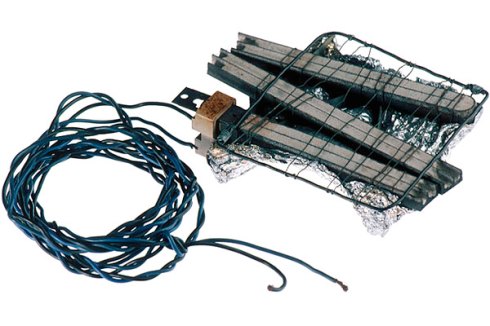
STOVE / GRILL / TOASTER An inmate of Ludwigsburg prison, Germany, botched together this multi-purpose tool from wire, a broken heating rod and some tin foil. It was found in his cell and confiscated sometime in the mid-eighties.
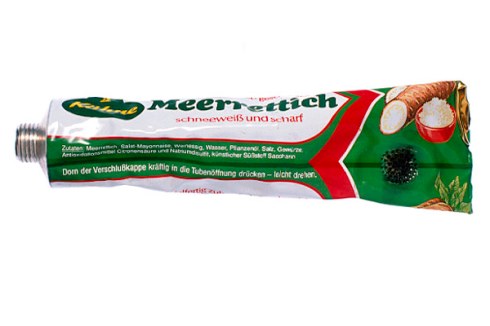
HASH PIPE fashioned from an empty horseradish tube; confiscated in ‘Santa Fu’ prison in Hamburg, Germany. Bongs are the most common of all forbidden items in prisons. The range of materials they are made of mirrors the inmates’ great imagination. And their prior needs.

RADIO TRANSMITTER / BUG made of radio recorder parts by an inmate of Wolfenbüttel prison, Germany (battery is missing). Prisoners occasionally manage to install gizmos like this one in guard-rooms to be prepared for upcoming cell searches. Also suitable as a means of cell-to-cell communication among inmates. A standard radio serves as a receiver.

IMMERSION HEATER made from razor blades; found in a cell in ‘Santa Fu’ jail in Hamburg, Germany. Jailbirds use these tools to distil alcoholic beverages forbidden in prisons. Your typical inmate’s moonshine still includes a plastic can containing fermented fruit mash or juice, an immersion coil of some sort, a rubber hose, and a plastic receptacle for the booze.

RADIO RECEIVER Sometime in the seventies an inmate of Ludwigsburg prison, Germany, built this radio on the sly and hid it inside an encyclopedia. It was probably commissioned by another inmate who had no electronic expertise himself.
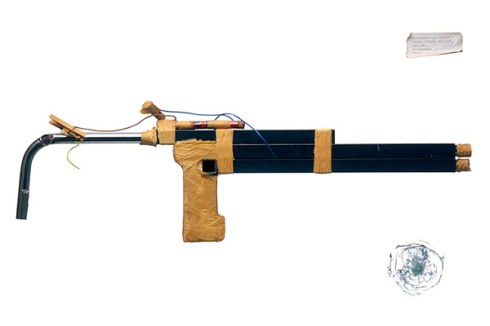
SHOTGUN made from iron bedposts; charge made of pieces of lead from curtain tape and match-heads, to be ignited by AA batteries and a broken light bulb. On May 21, 1984 two inmates of a prison in Celle, Germany, took a jailer as a hostage, showed off their fire power by letting go at a pane of bullet-proof glass, and escaped by car.
________________________________________________________
Q & A
When did you complete this project and why did you take on this subject?
I shot the whole project in April and May 1999. I had read a magazine article about a prisoner in Berlin who had whittled a key to his cell from a toilet seat. Unfortunately, prison officials in Berlin weren’t cooperative, so I wasn’t allowed to take a picture of that key for ‘security reasons’. (Can you believe that?).
But it nevertheless provided the key to the story and got me interested. Süddeutsche Zeitung Magazine editors [provided a catalyst] too – they bought the story.
The objects range in date from the 70s through to the mid 90s and from multiple German prisons. How and where did you source the objects?
Prisons often have a collection of items which were secured from inmates’ cells or after attempts at escape.
I did my research exclusively by phone and located a handful of prisons which seemed worth a visit. I decided then and there which objects to photograph.
Much of your previous photography has been about complex scientific experimentation and grand research. Was this project a departure?
Not at all. I have always been interested in the uncommon or even bizarre.
What about the objects is of interest to you?
Ingenuity of improvisation. Intelligence. Purposefulness.
In my work, not everything depends on meticulous planning, but to a great extent on chance and my ability to improvise. Therefore I can relate to these escape tools. I admire their no-nonsense design, their simplicity. Even if their escape attempts fail, these guys cross boundaries in that they find uses for things other than what they were made for.
What do your photographs of the objects add to the stories objects?
To me, they communicate intelligence and the flexibility of the human mind under adverse conditions. I wanted to share my surprise: ‘What the … ?’
Did this project inform or reflect your understanding of German prisons, prison history and/or current prison politics?
Not really. I wasn’t interested in the political or social aspects of the subject matter. It was an interesting experience, though, to get to peek inside these facilities even though I had no contact with any of the inmates.
To compensate for that and to communicate credibility, I tried to collect as much information about the objects as I could. I felt they should be preserved the same way that archaeological artifacts are.
What are you working on now?
Currently, I am working on an independent project which is called ‘Toter Winkel’. I am still searching for an international title which works both in German and English, even though I focus exclusively on Germany.
I started wondering about what cars have done to our cities. I ended up doing night shots of elevated roads with a 4×5″ field camera. It’s hard to believe what monstrosities have been erected for the sake of misconceived mobility!
But this is more of a long-term fine art project than an editorial piece. Fieldwork is completed, but post-production will take a few more months, I’m afraid.
Thank you, Marc
________________________________________________________
Marc Steinmetz is a photographer specialising in Science and Technology stories. Prison Photography recommends his work on Plasticination, Karakarum – The Archaeology of Genghis Kahn’s Empire and his series on Drinking Water. An extended interview with Marc, is here.

DUMMY PISTOL from blackened cardboard; found on June 23, 1988, in an inmate’s cell in Stammheim prison, Germany, after a fellow prisoner tipped off the jailers. The dummy was hidden in an empty milk pack and was most probably intended to be used for taking hostages in an escape attempt.
________________________________________________________
All images © Marc Steinmetz.
I originally came across Steinmetz’s work at Accidental Mysteries – a blog I highly recommend for its polished curatorial eye of surprising, inventive and humourous human interventions.

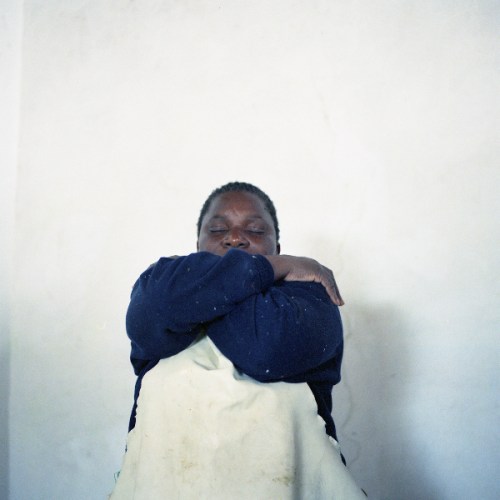
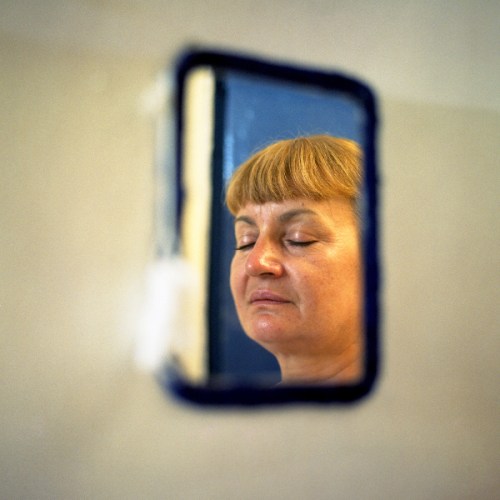
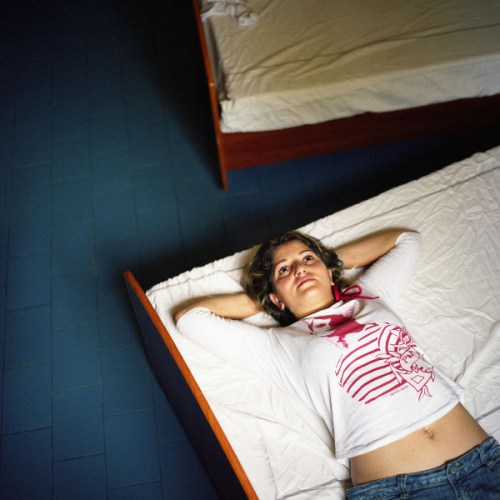
I wouldn’t describe Melania Comoretto‘s portfolio Women in Prison as portraiture; it’s bigger, it’s emotional landscape.
Comoretto’s work tinged with sadness, possibly even resignation. Their circumstance may have dulled outward looking expectancy.
This work stands out, for me personally, as one of the finest photographic documents of women prisoners, globally. Women in Prison is charming and disarming. These are women whose words would likely shock us and yet they seem to know the weight of their own stories and captive futures. The reticence of Comoretto’s subjects, paired with the arresting gaze (when given), is a triumph.
Q&A
Where is this prison?
I photographed in two Italian prisons in Rebibbia and Trapani.
Why did you do a project there?
I wanted to investigate and understand how women could express their femininity and take care of their body in a situation of extreme marginalization.
The starting idea was to reflect the mental and psychological labyrinths and internal prisons that prevent human beings from living their lives freely. I asked myself, “What could be the extreme expression of this idea?” The answer; Prison.
What were the women’s lives like? Was their prison experience positive or negative?
The way the women live in prison depend on the prison in itself and how it is organised. It also depends on the personality and psychological attitude of the woman.
Most of them fall into depression; others react in a very active way. The body is the mirror of that. The more a women fall into depression the more she forget to take care of her body, that was the reason why I decided to focus on bodies and femininity.
Where are the women now?
Most of the women are still in Rebibbia and Trapani prisons. I shot this series of photos only in the last 10 months.

Were the women good portrait subjects? Did they want to be photographed?
They were very willing to speak and to be portrayed! They liked to spent time with me. They rarely have the chance to speak with someone who wants to listen deeply their stories.
Did they see your photograph prints?
I sent them each contact sheets.
In Italy what is society’s attitude toward prisoners and, specifically, female prisoners?
Unfortunately, in every city and country of the world, the social attitude towards prisoners is not very open-minded. They [societies] focus on the fact that prisoners are guilty and rarely on the fact that (in the majority of cases) that they had no chance because their lives started in very tragic conditions. Without any help it is very difficult for prisoners to change their destiny.
What was your experience on the project?
I understand how in some situations life does not leave you many chances to change.
Can the camera be a tool for rehabilitation?
I deeply believe it is. I don’t know if photography could be a tool of rehabilitation for the women. For me it was and is … so maybe [the camera] could be for them and for many other people. It prevents me from destroying myself and I believe it could have the same advantage for many other people!




David Simonton contacted me and shared his long term project at the former Polk Youth Center in Raleigh. After thoughtful discussions David and I decided upon a pairing of articles.
In this post, Part One, David talks about the background to the project and his objectives in the work.
I also chose a selection of David’s prints to showcase and offer comment. At the bottom is a thumbnail-pop-out-gallery with all the pictures in one place.
…and, in a few weeks, Part Two will dissect the atypically rich and varied visual-history of the Polk Youth Center.
David Simonton’s Commentary (PP’s Subheaders)
Photographing Disused Architectures of Citizen Management
In the late-1980’s I was one of a number of photographers working on Ellis Island, the former Immigration Station in New York Harbor, documenting the progress of the restoration of the facility (reopened to the public in 1990).
The project was called “The Ellis Island Project: Documentation/Interpretation.” I was living in New Jersey at the time, and traveled to the island to photograph twice a week for nine months. During this period I was also pursuing my personal projects.

Opportunist Photographer
In 1989, I moved to North Carolina
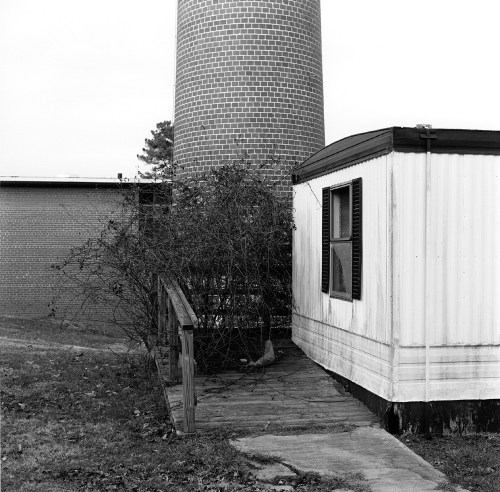
The “Old” Polk Youth Center/Prison, Raleigh which has a long and storied history, closed in 1997 when a modern facility (which the “Old Polk,” most assuredly, was NOT) opened in Butner, NC. The inmates were transferred to Butner in November of that same year.
Living nearby, I could hardly resist the opportunity to photograph there. So before any “No Trespassing” signs were posted, I went and photographed the site. The doors (cell doors, some of them) to many of the buildings were wide open!
“Old” Polk Youth Center – a euphemism if ever there was one – was located on land directly adjacent to the North Carolina Museum of Art in West Raleigh, near the State Fairgrounds.
The prison buildings were razed in 2003. But before that occurred, the prison was essentially abandoned until the land (along with the buildings on it) was transferred to the museum.
Official Photographer
During the mid-nineties, I exhibited my personal, interpretive work from Ellis Island – 90 images – at a gallery in Raleigh. Huston Paschal, a curator at the state art museum, attended the exhibition.
Unaware that I had already photographed there, Huston Paschal invited me to document the site, which was now in the museum’s hands. In late-2000 the invitation was formalized with a commission. I continued working on the project (even after the commission had lapsed) until the buildings came down, the ground leveled and grass planted.
My involvement was always with an empty site, when the prison was closed and inmates transferred. I photographed a long-abandoned facility: empty buildings, empty cellblocks and overgrown grounds.

Simonton: “Art for art’s sake”
As an art photographer (an unfortunate, nearly pretentious-sounding term, even if it’s the category my work falls into), my goal is to make interesting pictures; interesting in-and-of themselves, so that THEY are worth looking at, repeatedly.
What’s depicted is not unimportant, but it’s of secondary importance; this is my approach to my own picture making. The fact that my “subject” was a prison is happenstance – I photograph all kinds of abandoned structures. I also photograph the smalls town North Carolina (day and night) and photograph landscapes. An interesting photograph is always my intent, even when what it depicts is not itself inherently interesting … or beautiful.

Art and Documentary converge.
The Polk project was a “documentary” project, but not in the strict sense of it being wholly objective. My pictures describe the place I saw, and, if not the place I “saw”, then the place I thought and felt.
The project is not a comprehensive cataloging of the site either; rather, the pictures reflect my response to it during the passage of several years. They inform history by showing the place as it was in those waning years, after being – at long last – set aside as a relic; finally to be torn down and planted over and – with still more time – forgotten.
Polk Youth Center was located in a heavily populated area, which was not the case when it was built. Improvements were rarely made because, why spend money on any improvements if the facility was about to be moved or closed? – as were the recurrent promises for decades.
Institutional Narratives
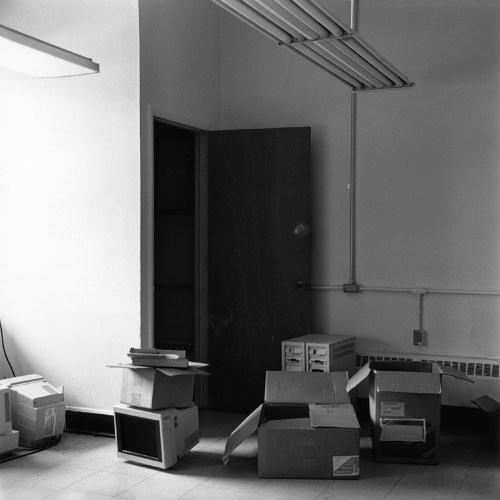
I was not aware of the prison or the prison sites history until after I had completed my work; which may be just as well, since it was difficult enough to find beauty in such a physically “unbeautiful” place.
Had I been mindful of the ugly history of the old Polk Youth Center – riots, rape and other forms of violence in its final years, – I may have had a harder time photographing.

Prison Photography’s Commentary
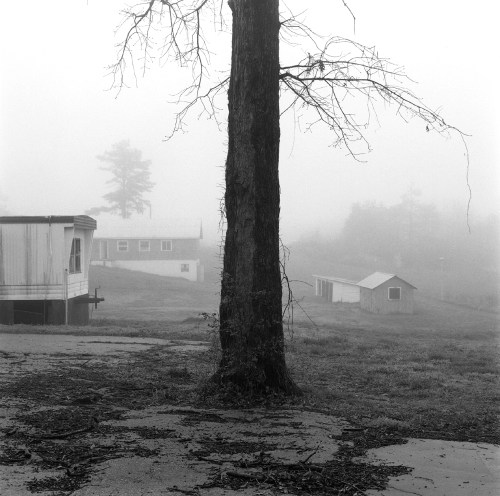
Simonton’s three years at Polk yielded a varied portfolio. In editing the selection (from 100+ images to these 16) images distinguished themselves for very different reasons. If the lens wasn’t pointed at something crumbling, it was pointing at something overgrown and grown over.
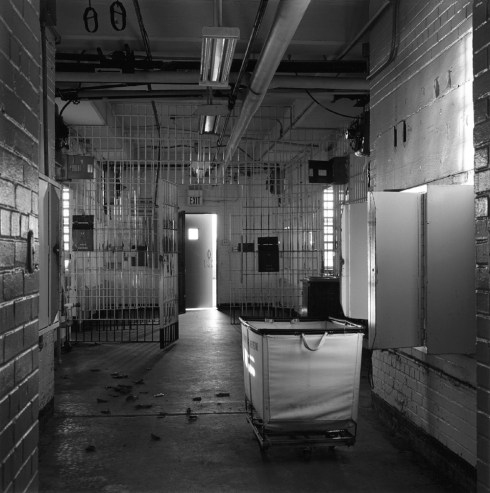
Some images (Steep Steps) are flattened and exposed matter-of-factly, whereas others (Laundry Bin) luxuriate in silvery sheen.
I choose one pairing here of the same view in different season; Simonton took many pairings so to secure the evidence of time in his series. Apparently, the chimney was a signature of Raleigh’s landscape.


It is in the different states of dilapidation that one finds a visual allusions. Simonton’s photograph of the teeth counterpoise the dental ephemera in Edmund Clark’s photography of a functioning geriatric UK prison wing. When given the opportunity, Simonton ties the fragility of the body to the decay of the site.
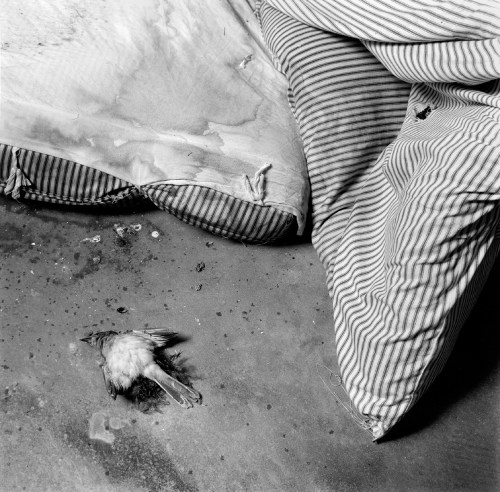
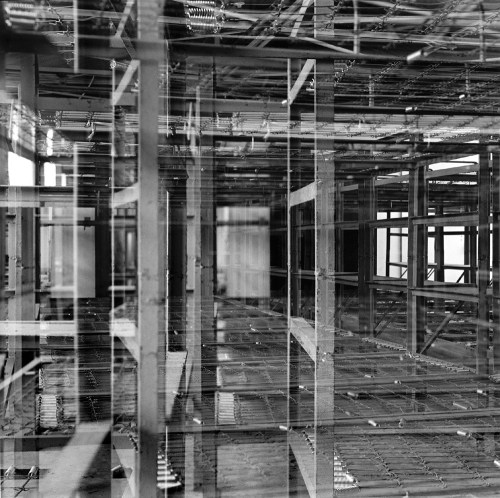
Other recalls. Simonton’s cavernous grimed up cells, the expired bird, the textural friction between hard concrete and friable life are not too dissimilar to Roger Ballen. The reflected dormitory of cacophonous bed frames is a Moholy-Nagy-informed dark-fantasia march of welded steel.
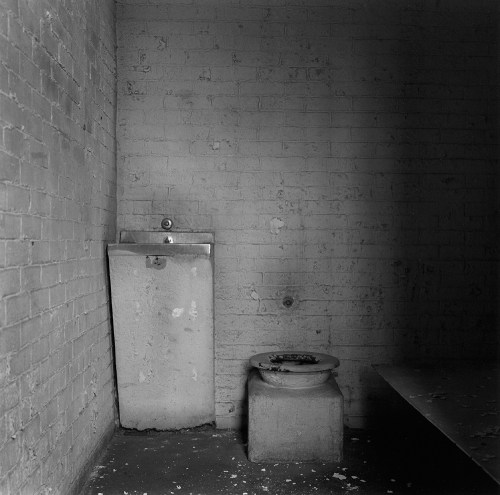
Only a few of Simonton’s images describe the site as one of incarceration. Few of the normal visual clues are available; no visible bars on windows, no holding cages. This could as easily be a disused YMCA or summer camp.
For Prison Photography, the real interest in Simonton’s work comes when it is positioned in a wider context of the site. David provided me with background info and some press clippings which whetted my appetite. Further research was rewarded with an unusual series of photographic manoeuvers sequentially on this site through its various guises. All of this I will cover in Part Two.
Closure & Erasure
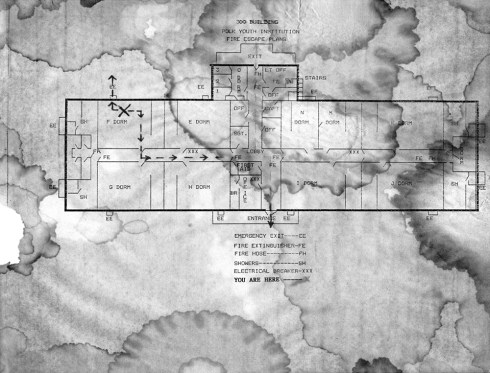
The photo of the evacuation plan below touches upon that procedural rigour that has cycled at the site of the former Youth Polk Center. The image at the very bottom (as well as being Simonton’s favourite) is a fine accompaniment to the evacuation plan.
Both images bear evidence of water blistering, bubbling and staining its way through materials. These evocations are “Art for Art’s sake” but they are also poetic closures, historical records and proof that in the absence of human interference erasure sets in rapidly.

David Simonton has been a photographer for 40 years and has been photographing North Carolina for the past 20 years. An adjunct instructor of photography at Peace College in Raleigh, David often chooses to focus on the more rural parts of the state. His series “Photographs from North Carolina” features black-and-white photographs from the 345 North Carolina towns he has visited. He has completed commissions for the North Carolina Museum of Art and the United Arts Council of Raleigh and Wake County. He has had work in solo and group exhibitions throughout the United States, and his photographs are in the permanent collection of the North Carolina Museum of Art. David was awarded a visual artist fellowship from the North Carolina Arts Council in 2001. (via)


View other images at David Simonton’s website. Indyweek have written on his work previously.
Thank you to David Simonton for reaching out. Thanks for the time spent over questions and for your collaboration. Pleasure working with you.

Prison Chess Portrait #14. Oliver Fluck
Oliver Fluck’s series of Prisoner Chess Portraits is an interesting counterpoint to other prisoner portraiture. It is unfussy, neutral, quiet. Fluck is experimenting with the figure and I would like to see him in the future settle with a preferred vantage point in relation to his sitter. For example, I like the portraits of the Prison Chess Champ and of Christopher Serrone. Fluck is headed in the right direction.
Prison Chess Portrait #14 (above) is a very strong shot also taking advantage of particularly high contrast light conditions.
Is photographing stationary silent chess-playing sitters simple or difficult? On the one hand, the sitter is still for you, but on the other, it’s difficult to spark rapport with a man concentrating on the game.
Text with Image
An integral part of the project is Fluck’s drafted questionnaire which secured answers to standard questions from as many competitors as possible.
Inmate quotes such as, “Having been incarcerated since age 15 and never getting out, it is helpful and healthy to know that not all of society lacks interest or willingness to become productively involved” keep reality checked. As do sobering statistics such as 50+ years or 66-year prison-terms.
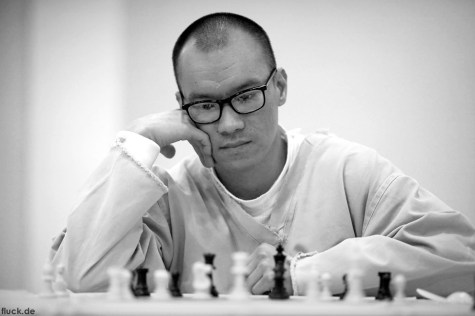
J. Zhu. Oliver Fluck

Christopher Serrone. Oliver Fluck
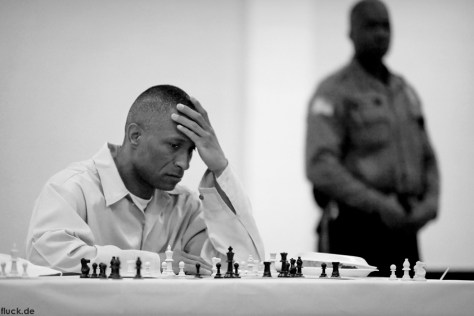
Prison Chess Champ. Oliver Fluck
Q&A with Oliver Fluck
How and why you came to this topic?
I enjoy playing chess, which is why I’m in touch with the local university chess club here in Princeton. The students got the opportunity to play against inmates of a maximum security prison, and when I heard about it, I proposed to photograph the event and volunteer as a driver for the students.
What are your hopes for the project as a whole?
Very frankly, from a photographer’s point of view, I would like to see it exhibited, and provoke some thought.
What is your message with the portraits?
I can talk about one thing that I am not trying to do: I’m not trying to propagate any kind of standpoint about how one should deal with criminals, and whether or not they should have the right to enjoy chess. I’m like most other viewers, I stumbled upon this project and got curious … Curious on an unprejudiced level from human to human. Start from there if you are looking for a message.
Anything else that you’d like to add and feel is important.
I would like to thank John Marshall for this experience, and David Wang for constructive feedback regarding the prisoner questionnaire.
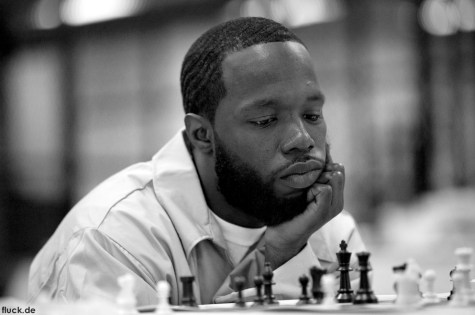
Competitor with Unknown Name. Oliver Fluck

Prison Chess Portrait #4. Oliver Fluck
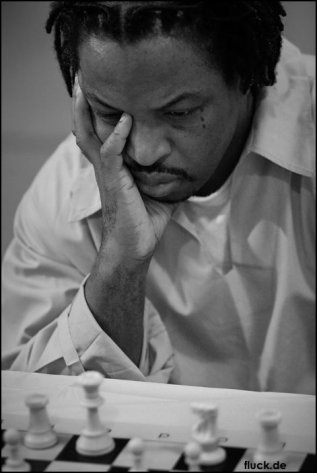
Prison Chess Portrait # 21. Oliver Fluck
Original Links to portraits 1, 2, 3, 4, 5, 6 and 7.
Oliver Fluck’s Flickr
Watch this youtube clip of a local news report from the prison during the tournament.

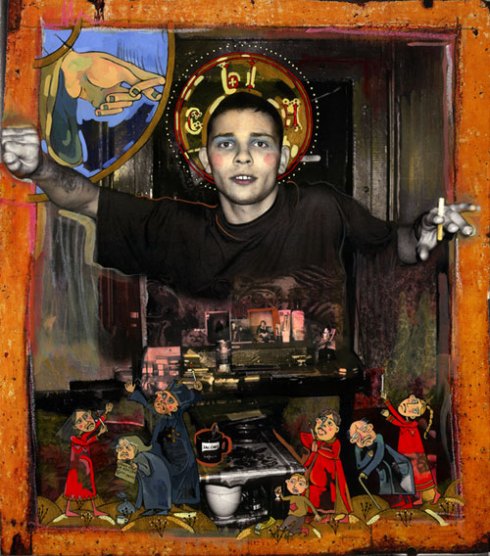
Yana Payusova’s Russian Prison Series is a complex portrait with embedded cultural memes and fierce visual détournement. It is a strong and committed project. Russian Prisons Series, painted photographs of forgotten incarcerated Russian youth is Payusova’s most extensive use of photography in her many series. In response to email request, Yana replied with the detailed account below.
PP: I am particularly interested in your experience within the prisons, your ability to photograph, your understanding with the boys & men in your images and your thoughts on photography and prisons generally.
I understand you joined your mother, who was working as a social worker, in Lebedeva and Kolpino prisons, St Petersburg. What were your initial reasons & motivations for working with the young men in these institutions?
YP: I first visited the Lebedeva prison in the fall of 2003. I was able to gain access to the prisons because my mother had been working with incarcerated teenagers there for the past nine years. She belonged (my mother has retired in 2007) to an organization called Rainbow of Hope. This organization initially specialized in working with street children, either homeless (orphans or abandoned children) or homeless by choice (those avoiding abusive situations at home). Street children are a brand new, post-perestroika phenomenon for Russia. Before the breakup of the USSR, unwanted and disabled children were housed in a Soviet-style orphanage system out of sight of society. However, there were also numerous social organizations, which created public programs for children, thus filling in where the family institution was lacking. Unfortunately, today, ragged, unwashed children hanging out in front of subway stations begging for money, smoking cigarettes and sniffing glue, are a common sight.
Rainbow of Hope formed a day-center where homeless children could eat, play, attend classes, and receive medical attention. Shortly after the inception of this new program, the social workers noticed that as some of ‘their’ kids matured they relapsed into their previous street behavior. They started disregarding any kind of authority; began consuming alcohol and hard drugs; getting in trouble for breaking into cars; and various small theft. Eventually, after either several minor offences or after one serious transgression, and if the kids were fourteen or older, they wound up in prison. When my mother first started visiting the prisons, she learned that in fact, many of the teenage inmates came from similar backgrounds: alcoholic parents (often single mothers), other incarcerated family members, chaotic upbringing without any positive adult supervision, childhood exposure to psychological and physical violence.

YP: I decided to accompany my mother in one of her weekly visits to the prisons. I cannot say that I was shocked the first time I entered one of these facilities. Having grown up in the Soviet Union and having seen royal palaces in extreme decay, I did not expect a vacation spa. The security guards were grim and humorless, the environment was filthy and unkept, and the barred-windowed buildings were rundown. There was a sense of complete surveillance, barbed wire and high brick fences always visible, a near complete blockage of the city’s activity beyond the walls. There was an eerie silence broken only by occasional savage barking of guard-dogs. The atmosphere was even more depressing once inside the prison building. The entire structure had an intolerable stale stench. It was later explained to us that this was the smell of lice being burned off the prisoners’ clothes. As we walked upstairs, we caught glimpses of the adult inmates. Their faces were gray and expressionless and they stood with their hands behind their backs.
YP: However, I was truly shocked when I saw the teenage convicts in person. When we arrived they were in their cells, mostly sleeping and passing time. They were brought out in front of us into the main hallway for lineup. I was expecting to see tough guys and intimidating criminal types, but instead I saw a group of scrawny, pale, shaven-headed young boys, many of whom were covered in warts and sores. I knew that all of them had to be ages 14 to 21, but the majority seemed like they could not be older than twelve (as I later learned, an indication of malnourishment in childhood). Many had tattooed limbs and torsos. A few of the tattoos were masterfully executed, but most were crude amateur drawings. Many of the tattoos were grossly infected. Ironically, the tattoo designs displayed harsh arrogance and aggression, which was markedly missing from most of the boys’ faces. Also, many of them spoke ‘blatnaya fenya’ (special cryptolanguage used among criminals) partially out of habit and partly to show off and flaunt their connections to the criminal culture.
PP: What did you discuss/teach each other?
YP: I was supposed to conduct an English class, however, we ended up simply talking in Russian. When they got over the initial cocky boy-talk and the showing-off in front of each other, we were able to enjoy a normal conversation. I was surprised to find out that for many, it was not their first time in prison. Paradoxically, many boys seemed to either enjoy or be ambivalent to being in prison. I got a sense that it was similar to belonging to a fraternity of sorts; with its own secret lingo and rituals. I knew that I wanted to learn more about this strange place, to find out why this hellish dump was so romanticized, while being so intolerable. It all seemed like such a paradox. I knew I wanted to come back to investigate.
PP: Exactly how long did you work there? How often did you visit?
YP: After my initial visit, I began volunteering at both Lebedeva prison (SIZO 47/4) and Kolpino colony (VK g. Kolpino) on a weekly basis. We usually visited the Lebedeva prison twice a week and the Kolpino colony on the weekend. In total, I spent around eight months visiting the prisons.

PP: At what point did you decide to take your camera into the prisons? I have read the prison staff made an exception for you and allowed you to shoot 5 rolls of film. Why was this? What sort of discussion/negotiation made this possible? What was the nature of your interactions with the young men? How much of the project did you explain to them?
YP: Two weeks before I left for the States, I was able to bring my camera inside the prison to take some pictures. I was only able to shoot five or six rolls because photographing inside the prison is prohibited, but the guards made an exception since I had worked there for an entire year. The boys were completely aware of me photographing them (in fact, I gave them copies of all of the images I shot). Since so many wanted to be photographed, the boys generally had only one chance to pose. Surprisingly, most were very relaxed and confidently confronted the camera.
PP: Had you even finalized the future use of your prints in your own mind at that time?
YP: While I was photographing the boys, I had no preconception of the future project.
After I developed the film, I felt dissatisfied with the images. The black and white portraits seemed so one-dimensional and flat, they did not even begin to scratch the surface of the complexity of my experience. The pictures captured the personality of a few individuals, but the images said nothing of history, character, or story. Similar to the way in which a prism expands plain white light into the entire color spectrum, I had to find a way to render these photographs; a way that would offer perspective and a unique angle; that would give me a vocabulary and a way to begin to speak about my experience.
When I began searching for a ‘prism’, it occurred to me that the entire experience working with the prisoners had a strong religious undertone. Most of the Rainbow of Hope’s sponsorship comes from Western missionary organizations (mostly from Southern states: Texas, Alabama). The raised and donated money is used to pay teachers to conduct classes in prisons, to buy hygiene products (such as soap, toothpaste and toothbrushes), celebrating the boys’ birthdays, buying medicine, socks, slippers and gloves in the winter, etc. However, all this comes with an additional non-monetary cost. Most missionary groups wish to see how their money is spent and like to personally visit the prisons. Since I am bi-lingual, I was to accompany such groups and serve as an interpreter during missionaries’ encounters with the prison’s residents.

YP: It was always mind-boggling for me to see how these foreigners could come into a country, knowing little about its culture and history, and speak with such aplomb about all of the country’s problems and offer their solutions. Naturally, most missionaries wanted to convert the sinful prisoners to Christianity and have them ‘invite Jesus into their hearts.’ While the boys were busy playing the roles of thieves and recidivists, the missionaries enacted their wild dreams of the great saviors, who could save an entire prison full of lost souls all before lunch. One day while translating the Jesus story for the fiftieth time, I began to ponder this concept of saints and sinners. While to the missionaries, the power dynamic was crystal clear, to me it was becoming progressively ambiguous.
As a starting point, I have decided to begin thinking about my experience using the religious terminology. Since the only official religion in Russia is (and has been for quite some time) Christian Orthodoxy, it seemed only natural to start my explorations there. Russia adopted the Byzantine form of Christianity (as in the Baptism of Kievan Rus’) in 988 A.D. As centuries passed, Christian Orthodoxy has penetrated every aspect of Russia’s social and cultural life; it is closely intertwined with its traditions and folklore. Even after seventy years in which the Soviet government actively had been trying to choke all aspects of spiritual life, most Russians will define themselves as Orthodox Christians. Although, for the majority, being a Christian, involves going to church twice a year for Christmas and Easter. In fact, most boys in prisons consider themselves to be Orthodox Christians and wear gold and silver crosses around their necks (sign that one has been baptized). Their tattoos involve quite a bit of religious iconography as well.

YP: I have always been fascinated by Orthodox icons. Beautiful objects hung on the wall, commanding such reverence, have always been mysterious to me because of their cryptic visual language. Similar to the obscure language of prison tattoos, the icons offered only glimpses into the rich exegesis of their symbolism and narrative. The individual symbols could be recognized (people, buildings, trees, animals), but when examined as a whole, lacked any coherent meaning. Originally the language of the icons was designed to be simple, its objective was accessibility to the illiterate and literate alike, but the clarity was lost as centuries passed. Conceptually, icons worked well with my idea; I wanted my work to speak of the boys’ experience while demonstrating my respect and compassion for their lives.
The word ‘icon,’ derived from the Greek ‘eikon,’ means an image, any image or representation, but in a stricter sense, it means a holy image to which special veneration is given. Unfortunately, the true intention for an icon to be an object only depicting that which is worshiped, is lost. Historically, the iconodules (the defenders or lovers of icons) had to come up with convincing formulations to prove that icons were not worshiped but venerated and that such veneration was not idolatry. Today, in a sense, the object itself became the thing that people worship, this is why I anticipated that the portrayal of prisoners in an iconic form may be offensive to some Orthodox Christians. I decided to proceed with my research and found myself getting ever more deeply fascinated by what I was finding.
It is curious that most representational formulas and compositions used in icon painting today have been established several centuries ago. One can compare an icon from the thirteenth century with one from the nineteenth century and notice virtually no major differences. There will be the exact same positioning of the figures, same gestures, and colors employed. Once one becomes aware of the grammar of the icon painting and learns the key characters of the stories, reading an icon becomes no different than reading a graphic novel or even a comic. This discovery enabled me to begin using the orthodox visual language in a post-modern form. Essentially, the iconographic structuralism of the church, gave me the means to create my own visual and cerebral language so that I could begin to analyze and interpret the complexity of the boys’ experience.

PP: Alex Sweetman has said. “She took this little world of prisons and looked through it to see the totality of Russian society – its corruption, its caste system, its misery.” How accurate a reflection is this of your position?
YP: In a country like the Soviet Union, where a significant part of the population (not necessarily criminals) went through labor camps, prison sub-cultures are very well developed and complex.
Not a very long time ago, it was considered shameful to admit to ever having been convicted or to having any family member in prison even though according to statistical study, one in four adult males in the former Soviet Union has been convicted at some point in time. Today, the criminal way of life is gaining wide acceptance and even gets glorified in the media. Countless movies and soap operas are produced about the glamorous lives of criminal ‘authorities’; they are endlessly written about in books; there is even an entire song genre of ‘blatnaya pesnya’ (criminal song) that exists. With the recent appearance of the infamous ‘New-Russian’ figure, having any relations to the mafia is considered cool, glamorous and prestigious. The New-Russian character has had a similar affect on Russian boys as Barbie has had on American girls. New-Russians are considered to be young (late twenties, early thirties), cool, loaded with cash, driving expensive cars, followed by henchmen doing all the dirty work, ex-criminals, sleep with attractive women, and have no one to answer to. They are appealing role models for young boys, many of whom lack any other alternative male role models in their lives. For many, prison functions as prep school for the criminal world. It offers a glimpse of a rigidly structured autonomous community where every member has their specially designated place and function. Some scholars argue that the rest of Russian society is modeled after the world of thieves and actually compare Kremlin principles and ideologies to those of a ‘pakhan’ (criminal authority) and his gang. If a government mimics such a model, what can be asked of teenage boys?

PP: What were/are the futures of the young men? Will some of them still be institutionalized? Will some be out?
YP: Some of the boys get out of prisons and move on with their lives. It obviously is easier if one has some kind of a support system (family, relatives). Many of the boys that I knew in prison have been to prison before and did not seem to think to be in some unfortunate predicament.
For many of the boys, who grew up neglected and unwanted, this situation is novel. For the first time in their lives, they had an opportunity to belong to a group with limited membership and clear sets of rules. As opposed to the chaos of street life, prison community offers established ground rules, protection, security, stability, a plan for the future, and most importantly, a family.
Unfortunately, with the current penitentiary system in place, these young fourteen-year-old boys become the perfect recruits for the criminal world. Generally, once detained, the teenagers are sent to pretrial detention (SIZO) prisons, either the Lebedeva SIZO or the infamous St. Petersburg’s “Kresty” prison. Both of these are adult facilities, where the minors are kept in a separate section of the floor, away from the adults. Both minors and adults are held in SIZO until they are tried in court. Until recently, the prisons have been so overcrowded that it was not uncommon that minors would have to wait up to three years to receive a court trial. Fortunately today (due to recent changes in jurisdiction), the majority waits approximately six to twelve months. Unfortunately, that still leaves plenty of time for any kind of peer pressure, physical violence, and rape, to take place. Therefore even a short time in prison can mark an individual for life.



YP: A prison stay also poses some very serious health threats. Russian prisons are infamous for epidemics of tuberculosis. Stale-aired, filthy, confined spaces hardly promote good health. According to GUIN’s (The Chief Directorate of Penitentiary Facilities) statistic, nearly one in ten convicts get infected with TB; many cases are fatal. The numbers for HIV-infected prisoners and prisoners suffering from AIDS are also extremely high. Lice, scabies, cockroaches, rats and other vermin are all the everyday reality of prison life.
However, prison must offer something unique in order to compensate for all of the dreadfulness. As complex as the prison sub-culture is, there are several key elements that are important to consider. One of the most important attributes of prison culture is its rigid hierarchy. Life in prisons is regulated by the unofficial ‘vorovskye zakony’ (thieves’ law), an oral collection of rules, norms and traditions for all ‘thieves’ to follow. Some of these laws date back to pre-revolutionary Russia. The majority, however, were formed during the GULAG years and have undergone many changes over time.



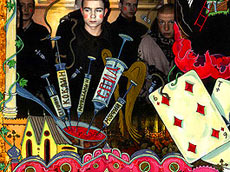
YP: For the young men with no family, prison becomes a place of acceptance and gives them a sense of purpose. Everyone aspires to become a ‘pakhan’ (criminal boss) and no one dreams of ever being an untouchable (lowest in prison hierarchy). Although the boys that I have met are far from resembling the macho superheroes they wish to be, many imitate the expected behavior. Many of the boys display a strong sense of camaraderie. I was immediately struck by an unusual display of affection among them as they constantly hang on to each other and wrap their arms around the others’ shoulders (some of that is evident in the photographs that I shot). Their community mirrors the hierarchy of an adult prison, although according to experts it is even more pronounced and cruel. Brutality and strength are the dominant forces. One is immediately able to discern the ‘bugri’ (alphas), the ‘blatnie’, and the untouchables. I was once speaking to a group of boys (8-10 people) who were all seated on a bench in front of me, when the two ‘bugri’ (alphas) came up to us. Without saying a word, all ten boys immediately got off the bench to let the ‘bugri’ sit. Apparently, the punishment for failing to show respect can be rather brutal.
Curiously, no matter how cruel the boys can be to one another, they show unusual kindness when it comes to kittens. It is not uncommon for each cell to have a pet kitten for which everyone gently cares. The cats breed inside the prison, catch rats, and have no problems moving between the bars. It was also interesting to see the ‘bugris’’ cells. The walls are covered with fake green vines, flowers, and stuffed animals (their girlfriends from the outside sent them). Hanging along side these niceties are posters depicting porn stars. Apparently, it is considered cool if one’s cell resembles a ‘normal’ room outside of prison.
PP: In a 2008 Boston Globe article said “you’d given up using photographs”. Explain that decision.
YP: I am not using photographic imagery in current projects, but it doesn’t mean that I will not do so in the future.
____________________________________________________
Yana’s CV is here. Yana won the juror’s prize at the 2005 CENTER Santa Fe awards. She is a member of the 6+ collective.
Massive thanks to Yana Payusova for her erudite, balanced and insightful words. It is a privilege for Prison Photography to host such a comprehensive account. Many, many thanks!
Please visit Yana’s website.

 Prison Photography