
You are currently browsing the category archive for the ‘Photography: Non-Prison’ category.

This is a neat idea. It tells you nothing about football, but a lot about massive environmental change, process or flux.
THE COAL WAR

The Coal War, a “documentary about hope, change, and one unstoppable grandmother”, is looking for funding.
Chad Stevens heads a team of familiar names.
QUESTION OF POWER

Carlan Tapp’s Question of Power project began in 2005. It delivers photographic essays and “the voices of individuals, families, and communities affected by the mining, processing, burning, and storage of waste materials created by coal for the generation of electricity in America”.
MINING ON NATIVE AMERICAN LANDS
“Carlan is a descendant of the Wicocomico Tribe, Taptico family. His strong belief and respect for the earth and all creatures is the continual theme in his work.”
Carlan’s documentation of the mining activities and environmental destruction on Navajo land is startling. I particularly advise viewing the 42 images and captions of Coal Production. Mining kicks up toxic dust, pollutes the earth and water, causes respiratory problems in the local population and causes structural weakness in homes.
As a point of comparison, watch Aaron Huey’s TEDxDU presentation. Huey’s talk about the broken treaties, chronic poverty and human rights abuses wrought upon the Lakota people of Pine Ridge in the Black Hills area of South Dakota (a place he describes as “ground zero for Native issues in the US”) was well received – largely due to the fact he passionately presented a history we rarely hear. It is likely the legal and environmental rights of the Native Americans in Tapp’s coverage are under attack by similar forces.
Especially in light of the Gulf of Mexico disaster, we must ask the same questions of coal, oil and all non-renewables with regard our own consumption habits.
Carlan blogs here. He has been on the Gulf Coast since last month. Good write up by Elizabeth Avedon.

Photographer Unknown
Billy Baque‘s Cuban Polaroid describes a camera’s self-contained process:
“A wooden box with the bellows and lens from a folding camera mounted at one end with a complete darkroom inside. Using photographic printing paper the photographer would expose a sheet of paper for the negative, develop, stop, and fix it inside the camera, then put a copy stand on the camera and photograph the negative (to obtain a positive), develop, stop, and fix, then wash the final print in a coffee can of water attached to his homemade tripod.”
Baque, then provides a global visual tour of street photographers using (often for official purposes) DIY cameras.
UPDATE
Joe Van Cleave commented at Baque’s site with a volley of links about photographers work in India and Bangladesh.
Mark Dummett (photographs and words) reported on Bangladeshi photographer Safder Ali. Ali’s been running his passport-sized photography business with an antique box camera by the side of a busy street in Dhaka since 1952.

© Mark Dummett
– – – –
Found via Make Magzaine

Joerg has predicted this’ll be all over the photobioblogosphere, so I’ll oblige.
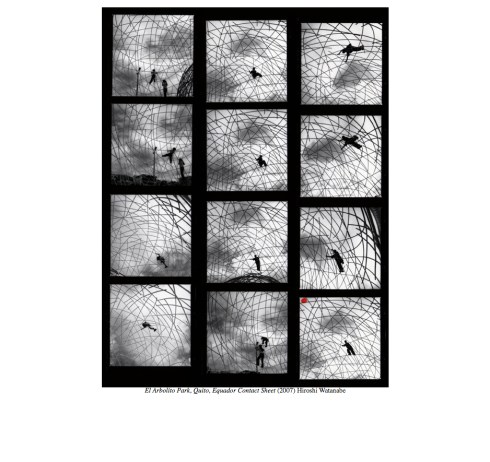
PROOF at the Edelman Gallery exhibits well known photographs with their original contact sheets.
Do I actually like the show or have I been instantly suckered by a seductive concept? I actually like the show; PROOF demystifies some of the lore about famous photography. We need to talk more about photography within the context of its manufacture.
My favourite? Hirshi Watanabe.


“The War on Drugs, is actually a War on People”
That’s a true statement. The Drug Policy Alliance is launching itself large, which is a good thing because the war on drugs has only managed to destroy communities, send people of colour to prisons in record numbers, increase the female prison population six-fold over the past 30 years, and condemn non-violent addicts to overcrowded dangerous facilities.
The CDCr has just released REPORT 2009-107.2 SUMMARY – MAY 2010. California Department of Corrections and Rehabilitation: Inmates Sentenced Under the Three Strikes Law and a Small Number of Inmates Receiving Specialty Health Care Represent Significant Costs
The report states the obvious. Three Strikes is expensive (and I’d add it is no deterrent) and health care costs are huge and dominated by a minority (aging) group. To quote:
Our review of California’s increasing prison cost as a proportion of the state budget and California Department of Corrections and Rehabilitation’s (Corrections) operations revealed the following:
Inmates incarcerated under the three strikes law (striker inmates):
– Make up 25 percent of the inmate population as of April 2009.
– Receive sentences that are, on average, nine years longer-resulting in about $19.2 billion in additional costs over the duration of their incarceration.
– Include many individuals currently convicted for an offense that is not a strike, were convicted of committing multiple serious or violent offenses on the same day, and some that committed strikeable offenses as a juvenile.
Inmate health care costs are significant to the cost of housing inmates. In fiscal year 2007-08, $529 million was incurred for contracted services by specialty health care providers. Additionally:
– 30 percent of the inmates receiving such care cost more than $427 million.
– – –
While stresses on the prison system in California are particularly acute, they are not untypical. Three Strikes laws have been a failure across the US, and still exist in the 24 states that enacted them in the mid-nineties.

I’ve just posted over at the Bag. I was really taken with American Able; a collaboration between Holly Norris and Jes Sachse. It is alarming how easy they tear down the reductive and manipulative visuals of American Apparel (and we might as well say the entire fashion industry).
By chance, I came across this article that speculates American Apparel might be going bankrupt. Although the two are unrelated, and IF financial meltdown does ensue, I’ll always like to think that Norris and Sachse dealt the final blows!

 Prison Photography