
You are currently browsing the category archive for the ‘Press’ category.

Nancy Lilia Núñez, 22, and her daughter, Claudia Marlen, 3. Ms.Núñez is in prison on a kidnapping charge.. © Katie Orlinsky
Katie Orlinsky‘s photographs, including her incredibly powerful portraits from El Cereso, the Ciudad Juárez prison, in Mexico accompany Damien Cave’s New York Times Sunday Review article Mexico’s Drug War, Feminized.
Cave:
Ms. Núñez is only 22. She grew up here, in one of the world’s most crime-infested cities. But was she just hanging out with the wrong crowd, or is she a criminal deserving decades behind bars? With her case and others, this is what Mexico is struggling to figure out. The number of women incarcerated for federal crimes has grown by 400 percent since 2007, pushing the total female prison population past 10,000. No one here seems to know what to make of the spike. Clearly, the rise can partly be attributed to the long reach of drug cartels, which have expanded into organized crime, and drawn in nearly everyone they can, including women.
With 80% of the female inmates at Ciudad Juarez Prison imprisoned for narcotics related crimes, the war on drugs cartels is certainly having results – one wonders though if the results in terms of incarceration are having an effect on lessening the organised crime. A pessimistic position would suggest that these women (and their children) are easily replaced by others to be used by the cartels in identical ways.
One of the most common threads I’ve observed through photographs of female prisoners is the solidarity and sisterhood that exists in female prisons. Whether or not this truly exists is another matter, but in a world where many women are locked up because of men, in institutions usually associated with (violent) men, the notion that the majority of women are victims and only have each other is one worth pondering.
Particularly, Orlinsky’s portraits against a white prison wall are powerful introductions to the personalities of women who’ve lived lives of – and through – severe conflict. More of Orlinksky’s documentary shots can be seen at her website.
FEMALE PRISONERS ELSEWHERE ON PRISON PHOTOGRAPHY
– Sweethearts of the Prison Rodeo
– Former Prisoner, Diana Ortiz, Inspires Confidence and Healing in Female Inmates
– Photography Workshop for Romanian Women Prisoners Produces 14,000 Images
– Women’s Prisons in Afghanistan
– Women Behind Bars: Jane Evelyn Atwood’s ‘Too Much Time’
– Women Behind Bars: Vikki Law
– Women Behind Bars: Silja J.A. Talvi
– “Angels Without Wings” Momena Jalil
– Fabio Cuttica: Colombian Prison Beauty Pageant
– “It was like being in front of a mirror.” Melania Comoretto and Women Prisoners
– Neelakshi Vidyalankara
– Patricia Aridjis: The Black Hours / Las Horas Negras
– Prison Nursery, Ohio Reformatory for Women, by Angela Shoemaker
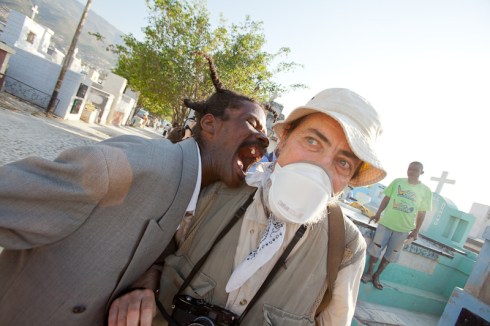
Bruce Gilden’s street shooting methods polarise opinion. His “ambush tactics” (for want of a better phrase) are, for some, the exercise of any photographer’s right in public space, for others he just goes about stuff in a rude way.
Anyway, here’s a TMZ-style photo exclusive of Gilden in front of the camera and not behind it. Gilden the ambushed; not Gilden the ambusher.
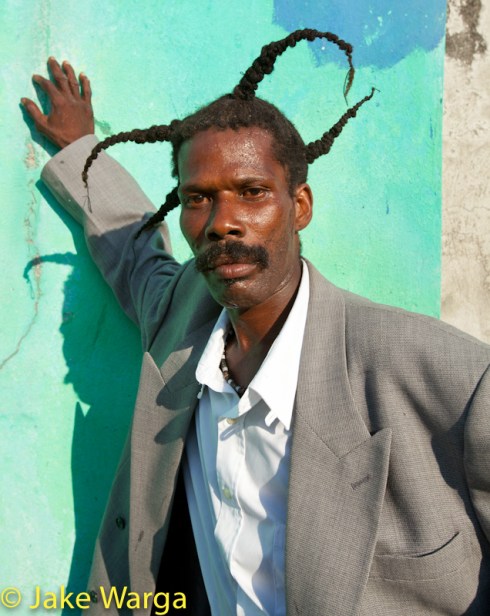
Journalist Jake Warga made these photographs in April. Warga was not part of Gilden’s entourage. We can presume that Gilden, at this time, was shooting Haiti: 15 Months Later.
I was critical of Gilden in the aftermath of the Haiti earthquake suggesting his images were little more than a digitised freak-show.
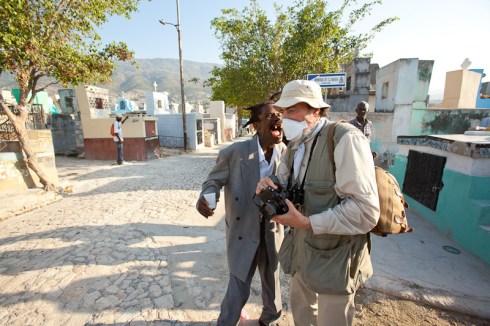
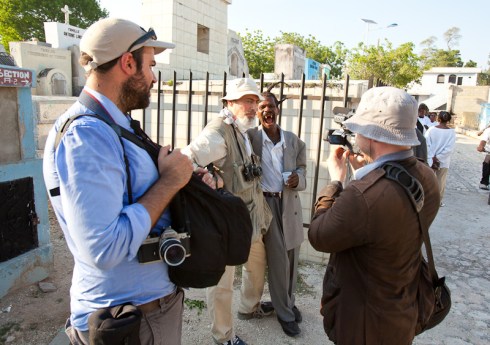
Warga was not surprised the Haitian, who he described as “drunk out of his mind on cheap wine” was attracted to the documentary film crew following Gilden through the graveyard with their photo accoutrements.
“He wanted his photo taken,” says Warga, “I try not to be seduced by spectacle but it was the only way he’d leave me alone. In turn, he gravitated towards Gilden’s cameras, joining the circus of gazes already in Bruce’s orbit.”
The bizarre nature of this interaction can be put down to a mixture of grief, inebriation, intrusion, Gilden’s personal theatre, and the scene acted out by the Haitian man. And all this in a cemetery.
This is probably just another day at the office for Gilden who makes a habit of hanging out with violent persons.
Confusing layers here no doubt, but for me, the take away is Gilden’s flitting averted eyes (top image). As if part of some karmic return, this Haitian man getting up in Gilden’s grill can be read as a metaphor; as a spectre, and brief embodiment, of Gilden’s many victims down the years.
The tables are turned and it looks briefly unsettling doesn’t it?


James Richard Verone peers through the glass of a visitation booth at the Gaston County Jail on Thursday June 16, 2011, where he is being held while awaiting trial for an alleged bank robbery. (Ben Goff / The Gazette)
There has been a portrait of an incarcerated man with wide eyes circulating the news this past week (above). Photographer Ben Goff (Flickr here) released of one other image (below) from his assignment photographing James Richard Verone in Gaston County Jail, N.C.
Verone, as Zachary Roth succinctly puts it, “robbed bank to get medical care in jail.” This is a man on the very brink. Or is he? Verone made a very drastic, but reasoned, decision to carry out a non-violent act outside the law. It’s an extreme protest admittedly, but he’s carrying all the risk. So cut him some slack.
Given that he thought through his bank robbing etiquette, waited patiently for the police and explained his motives to the press, don’t you think this man has a complex understanding of consequence? Could this be a photo of a man who knows how image and media work? Admittedly, there is potential that viewers will presume Verone’s mental health – as well as his physical health – is suspect. But could Verone be performing for the camera? I’d like to suggest Verone is in an interaction with one of the few people (Goff) who is in the business of creating testimony to stories so that they may be publicly consumed. As such, Verone consciously provides the exact facial expression he thinks we need to see.

James Richard Verone peers through the glass of a visitation booth at the Gaston County Jail on Thursday June 16, 2011, where he is being held while awaiting trial for an alleged bank robbery. (Ben Goff / The Gazette)
Verone is not pushing a political agenda; he’s trying to save his own life. He is just asking for us to see his truth. If we were in Verone’s circumstances we’d probably be severely unsettled (or, in the vernacular) crazy.
But here’s the paradox of the image: it is easier and lazier to think of Verone, even in a very small way, as crazy than it is to think of him as a rational being; to do so, would push us to ask why a rational person is behind bars. Wouldn’t logic dictate that the medical, societal and legal systems that conspired to put a rational man in jail are in fact themselves illogical?
Verone is a logic-evangelist and we need to see the light.
Within the fabric of our society, there exists a vast gulf between the ways people interface with services and institutions. To me, that is crazy.
I’m partly, suggesting a false dilemma here. There are, of course, more than two alternatives in how we see/react to the portrait. And yet, the glass of the visiting booth provides an excuse for our distance; an us and them; 1s and 0s; have and have-nots; not crazy and crazy.
Goff captions his two images Crazy Eyes and Crazy Eyes 2. Denigratory, clumsy and observant all in one, Goff describes the first startle (the first impression, if you like) Verone gives to his audience. But the introduction is only one part of this cruel photo that brims with abundance.
FREE
When I used the phrase “Verone gives to his audience” it was deliberate. That reaction is yours. Take it for free. That reaction is the opening gambit of an interaction between you, Verone and your conscience.
We believe that physical freedom ensures also the freedoms to worship, speech, choice, vote and so on and so forth. But in terms of providing immediate critical health-care, none of those things have provided for Verone. In “free society”, Verone was in economic shackles.
TRUST US
Verone’s dire straits have not been helped by America’s recession. How does Verone’s non-existent $1 bank robbery compare to the Inside Job in 2008 on Wall Street? What do we want to focus on? The pseudo-crime of an individual or the corruption of the finance sector? Michael Capuano, a Democratic representative for Massachusetts, once rebuked a panel of banking executives. He said, “You come to us today telling us we’re sorry, we won’t do it again; trust us. Well, I have some people in my constituency that actually robbed some of your banks, and they say the same thing”.
“Trust Us.” I’m sure Verone has said it to explain his truth, and I’m sure we’d say it too. “Trust us, trust me, I’m not crazy.”
LISTEN TO US
Verone’s story will resurface in the presidential debates I’m sure. It provides cheap political ammo for all parties depending on how it is spun. Verone’s face is read as either the failure of Democrat-led health reform or as the result of Republican-led economic meltdown. In either case, Verone plays both tragic hero and bogey man. Of which, he is neither.
CARE FOR US
The worst thing we could do would be to presume Verone has achieved, or will achieve, his objective. California demonstrated lethally how facilities of incarceration can fail to provide healthcare that meet minimum constitutional standards.
REMEMBER US
On the 1st of this month, an Ohio inmate who was denied medical care committed suicide. The prisoner, Greg Stamper hanged himself at Ohio’s Allen Correctional Institution. The press release from the Ohio Justice and Policy Center reads:
[Stamper] was suffering excruciating pain as a result of a nerve condition, and Dr. Myron Shank had refused to give him pain medications multiple times for non-medical reasons.
Stamper has his own truth and logic too. There’s likely two reasons his suicide was not widely circulated in the media. 1) It’s too final and upsetting. 2) Unlike Verone’s story, Stamper’s story is typical for the prison industry.

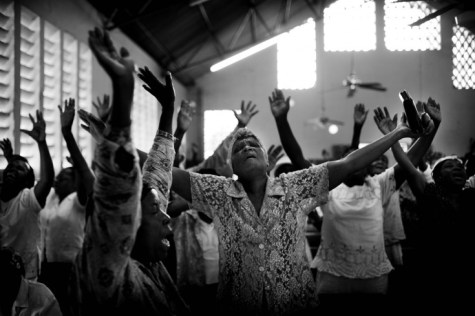
Last week, Danish photojournalist Jan Grarup was awarded the Oskar Barnack Leica Award 2011 for Haiti Aftermath.
COLOUR VS. BLACK AND WHITE
Grarup tells TIME.com: “I want to put some focus on what is going on in other places in the world. […] When you try to photograph things from perspective, you get a little more in-depth of what is happening.”
So, I guess my question is ‘Does colour not exist in the other places of the world?’ Grarup originally shot the images in colour, converting to B&W in post-production. It should be said that not all images in his Barnack entry are part of the original dispatch and so there is a (slight) chance those files were made originally in B&W. [UPDATE 06.22.11, 10:00PST. It could be that as Grarup shot in RGB, and had his screen displaying B&W. It could be that he never intended to use colour. Yet, everything’s colour still, as you look at it through the viewfinder.]
I include shots from his 136-image portfolio, dispatched to his agency NOOR briefly after his stint in Haiti, so you can compare them with the B&W images of his winning portfolio. I’m not here to argue for or against colour and/or B&W – I just want to provide a starting point for conversation.
FABIENNE CHERISMA
As part of my ongoing inquiry into the photojournalism surrounding Fabienne Cherisma’s death, Grarup offered Prison Photography a brief Q&A in March 2010.
Grarup took several photographs of Fabienne Cherisma dead on the collapsed roof-top; it’s an image, I argue, is both multi-authored and synonymous with the Haiti earthquake. Grarup did not include such an image in his Barnack entry, but did include a photograph of Fabienne’s brother and sister over her corpse after she’d been retrieved from the rooftop.
JUROR CONFLICT OF INTEREST?
And to the main issue at hand. Jan Grarup, a member of NOOR Images, was given the award by a five-person jury. One of the jurors was Stanley Greene, a member of NOOR Images.
I should say that, by my reckoning, NOOR is one of the most responsible photo agencies I’ve looked at; it’s stories impress me consistently and they have a couple of my preferred photographers on staff. This is not a distant attack, but a very specific question as to how they could possibly see this one panning out without any questions being asked.
Moreover, the Oskar Barnack Award (OBA) either shouldn’t have allowed Greene on the jury, or if he was so vital to the jury process, they should’ve insisted NOOR photographers needn’t apply. Both NOOR and OBA have exposed themselves unnecessarily to ethical questions.

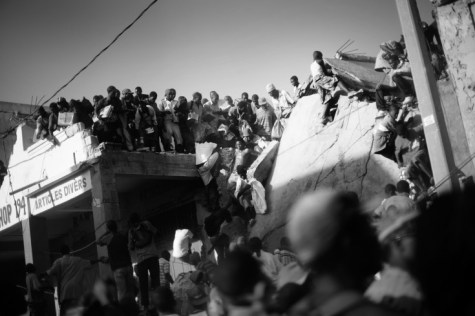

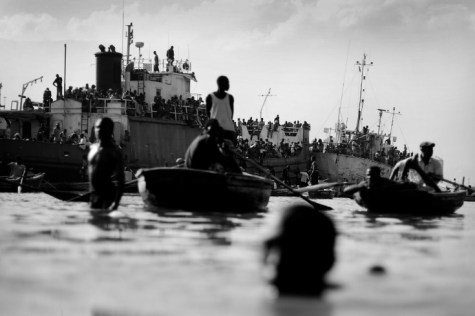
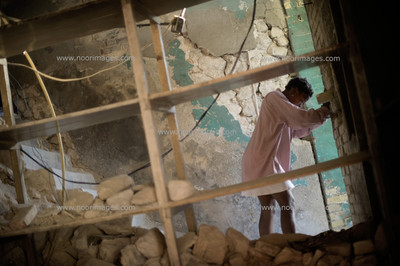

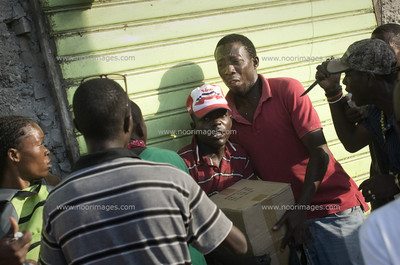
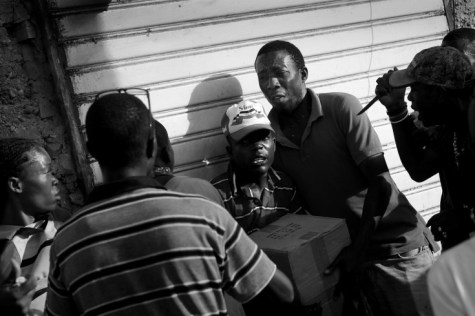
THE PURPOSE OF THIS POST?
1) These images provide anchors to which the endless colour vs. B&W debate can gain some focus.
2) Stanley Greene‘s role as a juror deserves to come under serious scrutiny. As a member of NOOR images, it’s difficult to ignore the conflict of interest.
3) I feel obliged to report on any news, updates and industry awards as they have concerned the photographers involved in my original inquiry.
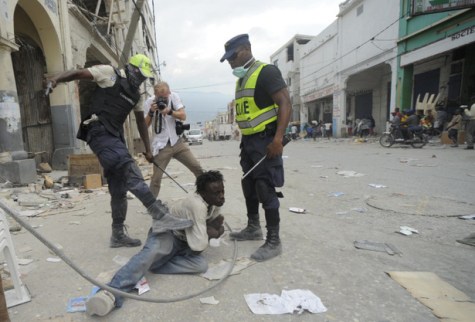
Jan Grarup photographs police beating a looter in downtown Port-au-Prince Tuesday afternoon. © Lucas Oleniuk/Toronto Star.
ALSO IN THE ‘PHOTOGRAPHING FABIENNE’ SERIES
Part One: Fabienne Cherisma (Initial inquiries, Jan Grarup, Olivier Laban Mattei)
Part Two: More on Fabienne Cherisma (Carlos Garcia Rawlins)
Part Three: Furthermore on Fabienne Cherisma (Michael Mullady)
Part Four: Yet more on Fabienne Cherisma (Linsmier, Nathan Weber)
Part Five: Interview with Edward Linsmier
Part Six: Interview with Jan Grarup
Part Seven: Interview with Paul Hansen
Part Eight: Interview with Michael Winiarski
Part Nine: Interview with Nathan Weber
Part Ten: Interview with James Oatway
Part Eleven: Interview with Nick Kozak
Part Twelve: Two Months On (Winiarski/Hansen)
Reporter Rory Carroll Clarifies Some Details
Part Fourteen: Interview with Alon Skuy
Part Fifteen: Conclusions (Matt Levitch, Felix Dlangamandla)
Part Sixteen: Fabienne Cherisma’s Corpse Features at Perpignan (Frederic Sautereau)
Part Seventeen: Brouhaha in Sweden following Award to Paul Hansen for his Image of Fabienne Cherisma (Paul Hansen, Olivier Laban Mattei, James Oatway)
Part Eighteen: A Photo of Fabienne Cherisma by Another Photographer Wins Another Award (Lucas Oleniuk)
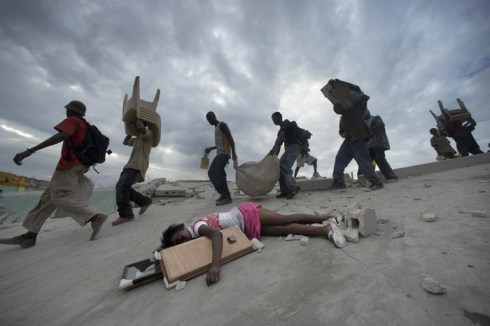
The lifeless body of fifteen-year-old Fabienne Cherisma lies on the roof of a fallen building in downtown Port-au-Prince on January 19, 2010. Photo by Lucas Oleniuk / Toronto Star
Canadian photographer Lucas Oleniuk has been awarded a National Newspaper Award in Canada for his image of Fabienne Cherisma dead on a Port-au-Prince roof-top, one week after the Haiti Earthquake.
Eight weeks ago Paul Hansen won a national award in his home country of Sweden. In March, I wrote about Hansen’s and other photographers’ awards for coverage of Fabienne’s death – Brouhaha in Sweden following Award to Paul Hansen for his Image of Fabienne Cherisma.
That’s now five photographers recognised for their images made within the space of an hour on a Tuesday afternoon.
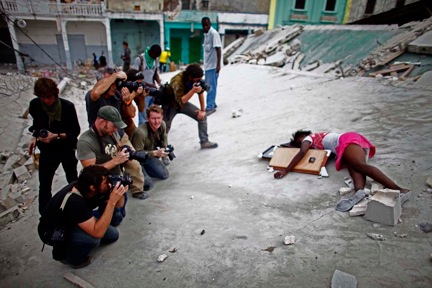
Photo: Nathan Weber
ALSO IN THE ‘PHOTOGRAPHING FABIENNE’ SERIES
Part One: Fabienne Cherisma (Initial inquiries, Jan Grarup, Olivier Laban Mattei)
Part Two: More on Fabienne Cherisma (Carlos Garcia Rawlins)
Part Three: Furthermore on Fabienne Cherisma (Michael Mullady)
Part Four: Yet more on Fabienne Cherisma (Linsmier, Nathan Weber)
Part Five: Interview with Edward Linsmier
Part Six: Interview with Jan Grarup
Part Seven: Interview with Paul Hansen
Part Eight: Interview with Michael Winiarski
Part Nine: Interview with Nathan Weber
Part Ten: Interview with James Oatway
Part Eleven: Interview with Nick Kozak
Part Twelve: Two Months On (Winiarski/Hansen)
Reporter Rory Carroll Clarifies Some Details
Part Fourteen: Interview with Alon Skuy
Part Fifteen: Conclusions (04.08.2010)
Fabienne Cherisma’s Corpse Features at Perpignan (09.07.2010)
Brouhaha in Sweden following Award to Paul Hansen for his Image of Fabienne Cherisma (03.23.2011)
Well, well, well. All sorts of commentary on the importance of photographs surrounding the assassination of Osama bin Laden and President Obama’s announcement in the East Room with reenactment of his speech for the still cameras.
From the White House Situation Room (now with added memes) and Reuters’ bloody gallery (WARNING: Graphic images of corpses) to whether we deserve or need to see bin Laden’s bullet-riddled head. Then there’s Senator Scott Brown’s faux-pas over a hoax photograph. Not to mention the reported different versions of the actual event.
For all the best articles click on the links over on Raw File Blog’s twitter feed, where I’ve been compiling them all day.
There’s still one photo – to be precise its caption – that is bothering me. And it’s this one:

White House photographer, Pete Souza, captioned the image thus: “President Barack Obama and Vice President Joe Biden, along with members of the national security team, receive an update on the mission against Osama bin Laden in the Situation Room of the White House, May 1, 2011.”
Except everywhere I’ve seen it used, the inference is that the White House team are watching a live feed of the raid on bin Laden’s compound.
They might be, but I want a SOURCE.
It seems to me this image may have been interpreted as one thing at an early stage and because it the narrative tied to the body language is so seductive, no-one has chosen to question it.
I think the reading of the image is massively altered depending on whether you think they’re watching murders in progress or whether they are, for example, waiting nervously for the screen to boot up.
Ryan Singel for Wired.com’s Epicenter blog went as far to say the White House “officials watching what one presumes is the livestream of the Navy Seal raid on Osama’s hideout in Pakistan.”
For all the hullabaloo about this image, no-one is actually sure about what is on THAT screen.
So, does anyone have a solid source saying that they are viewing a live feed of the operation?
Strangeways, Manchester, UK. April 1990. Credit: Manchester Evening News
UK PRISONER VOTING RIGHTS
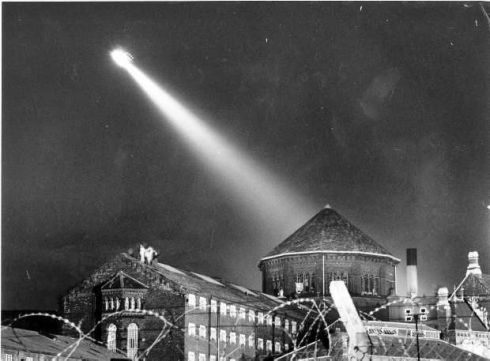
Brendan O’Friel, the governor in charge of Strangeways during 25 days of famous unrest beginning April 1st, 1990 has backed moves to give UK prisoners the vote.
O’Friel says the controversy is being deliberately stirred up for political reasons. He told the Manchester Evening News:
“I think it is a totally sensible thing to give prisoners the right to vote and then encourage them to vote. Whatever those people have done it is a question of trying to make sure that they are going to make a contribution to the community rather than being a drain on it. Anything we can do to encourage them to take responsibility and think positively is a very good thing.”
O’Friel’s view is not the concensus in the UK. In November 2010, The European Court of Human Rights ruled that denying the vote to prisoners was a violation of their human rights.
However, in early February the House of Commons voted overwhelmingly to reject any lifting of the ban, opposing the move by 234 to 22. By doing so they face a class-action lawsuit which could cost the British taxpayer millions in damages for as long as the government denies prisoners their vote.
The ridiculous thing about this is that the figures (approximately 90,000) would barely effect election results. This is expensive folly by Britain’s politicians.
The UK prisoner voting ban has been in place since 1870.
For comparison, The Telegraph reports:
“Many developed countries have some form of prisoner voting including 28 other European nations such as France, Germany and Italy. Russia and Japan exclude all convicted prisoners. Just two states in America allow it while others do not even give the vote back when inmates leave prison. Prisoners can vote in two of seven states in Australia.”
PRISONER VOTING IN AMERICA
In 2010, judges in Washington State found that felon disenfranchisement laws unfairly impacted minorities as they were more likely to be subject to racial inequalities in the application of policing procedure.
From the ever-excellent Prison Law Blog:
“On Sept. 21, the Ninth Circuit heard oral argument in Farrakhan v. Gregoire, an important case that could affect the voting rights of prisoners in Alaska, Oregon, Washington, Idaho, Montana, Nevada, California, Hawaii, and Arizona. Back in January, a split Ninth Circuit panel ruled that, in Washington State, “minorities are more likely than whites to be searched, arrested, detained, and ultimately prosecuted,” and that, because “some people becom[e] felons not just because they have committed a crime, but because of their race, then that felon status cannot, under section 2 of the [Voting Rights Act], disqualify felons from voting.”
Washington State appealed and the discussion is likely to go all the way to the U.S. Supreme Court.
It’s about time both Britain and the U.S. move into the 21st Century. From the Sentencing Law and Policy blog:
“According to a report co-published by Human Rights Watch and The Sentencing Project, a national organization working for a fair and effective criminal justice system, disenfranchisement laws are “a vestige of medieval times when offenders were banished from the community and suffered ‘civil death.’ Brought from Europe to the colonies, these laws gained new political salience at the end the nineteenth century when disgruntled whites in a number of Southern states adopted them and other ostensibly race-neutral voting restrictions in an effort to exclude blacks from the vote.”
For more on prisoner and ex-prisoner disenfranchisement, read Michelle Alexander. She condenses the arguments of her very successful book, The New Jim Crow, here.
STRANGEWAYS ON PRISON PHOTOGRAPHY
Strangeways Riot and Don McPhee
————————————————-
(M.E.N. story found via Jailhouse Lawyer)
The success of the changes in Egypt will largely be judged on the strength of the new democracy – more specifically, the viability and strength of its institutions and the way in which they unite the people’s needs. If Egypt’s justice system serves truth and enacts fair judicial process, especially regarding deaths during the protests, then it shall be a source of pride and calm for Egyptians in their quickly changing nation.
Ahmed Mohammed Mahmoud was one of the first journalists to die during the protests. Mahmoud’s family believe he himself captured the photo-evidence to prosecute his killer.
From the London Photographers’ Branch:
“Ahmed Mohammed Mahmoud’s last photograph was an image of his killer taken just before he was shot in the face. His wife hopes that this evidence will bring his murderer to justice, with the support of his trade union, the Egyptian Journalists Syndicate.”
Watch this case.


 Prison Photography