
You are currently browsing the category archive for the ‘Visual Feeds’ category.
“SnapScouts was designed and developed for children to use, before they form stereotypes of other people. They’re the perfect reporters, unbiased and unprejudiced by media concepts.”
“[SnapScouts] leverages modern technology to address the timeless threats to democracy and freedom.”

THIS is one of the best pieces of satire in a long time, at least I think, I hope, I know it is satire.
A NEW WAY OF EARNING BADGES
From SnapScouts:
Want to earn tons of cool badges and prizes while competing with you friends to see who can be the best American? Download the SnapScouts app for your Android phone (iPhone app coming soon) and get started patrolling your neighborhood.
It’s up to you to keep America safe! If you see something suspicious, Snap it! If you see someone who doesn’t belong, Snap it! Not sure if someone or something is suspicious? Snap it anyway!
All this is a great play off America’s worst paranoia and best humor. Good stuff!
The FAQ page is hilarious combining fears of soft drugs and illegal immigration with a contempt for foreign CCTV culture.
“My eight-year old caught the gardener smoking something suspicious. It wasn’t marijuana, but it turns out he was illegal!” – Phyllis Specter, 32, Idaho
and
“After only a three-month trial of SnapScouts in England, Indonesia, and Germany, we are proud to report over 600 crimes reported.”
I saw this TED talk by Ethan Zuckerman a couple of months ago and I’ve been meaning to post it since.
Zuckerman is a guy that is trying to work out how the web functions, more specifically how it is used. His research tests the claim that the web unites people from diverse communities.
In truth, the majority of us surround ourselves with like-minded people on line as we do in real life; in other words, the web isn’t used to develop wider world views – contrary to many folks’ lip service to the idea.
Zuckerman explains, “Much of my writing focuses on questions of whether the Internet is leading us to have a wider view of the world, or whether we’re becoming trapped in the “echo chambers” described by Cass Sunstein or the “filter bubbles” discussed by Eli Pariser. At Berkman, I’m running a number of small experiments that try to discover how parochial or cosmopolitan the use of the internet is in different communities – these questions are inspired in part by Pippa Norris’s work, especially her book Cosmopolitan Communications. I’ve been writing for the past several years on ways to make the internet work better for creating transnational connections, focusing on making translation transparent, engineering serendipity, monitoring what content we consume and leaning on bridge figures and xenophiles – I talk at length about these ideas in my TED talk, and am (slowly, painfully) working on a book on the subject.” (Source)

The FRANCE24-Radio France International Web Documentary Award has been won by “Prison Valley”, created by French journalists David Dufresne and Philippe Brault. (@davduf, @prisonvalley)
I am excited about this because I’d got behind Prison Valley when it was first launched.
That post drew efforts of correction and sentiment of complaint from Canon City’s chamber of commerce along with a response from the film makers.
Prison Valley was a controversial production in that it displeased the folk it portrayed. From what I can understand the small town Americans felt as if they’d been hoodwinked and did not think a dystopic frame would be put on the whole thing.
But there we go.
The format and interactivity is the type of use that many think the web has been slow to deliver. It’s pioneer.
Innovative Interactivity has an interview with the makers about the concept and design process:
“At the beginning of Prison Valley, we only though about doing an audio slideshow (Portfolio). At the end, it will be a web documentary, a documentary, a book, an iPhone application and even an exhibition this May in Paris.”
Sometimes the simplest ideas are the best. With the aid of inmate Renata Abramson (pictured in sceengrab below), Detective Kim Bogucki and Photographer/Film Director Kathlyn Horan co-founded The IF Project and asked ladies at the Washington Corrections Center for Women a single simple question:
“If there was something someone could have said or done that would have changed the path that led you here, what would it have been?”
Simply, the filmed testimonies (also here) and over 300 essays give the public an open line on the difficult lives these ladies have lived.
The lazy definition of ‘choice’ that everybody falls back on to justify punishments meted out upon the disadvantaged in our society – “they chose to do their crime, they do the time” – is exposed by these ladies’ stories. Many of them had no choice, at least not choice that would be obvious to an unloved teenager without any support, example or love.
I also know that The IF Project has expanded into men’s prisons in Washington State. Wonderful news.
IF you wouldn’t have noticed, the lady in the top image is cutting out the Washington Department of Corrections uniform badge.
IF you do anything today, spare 13 minutes for The IF Project trailer.
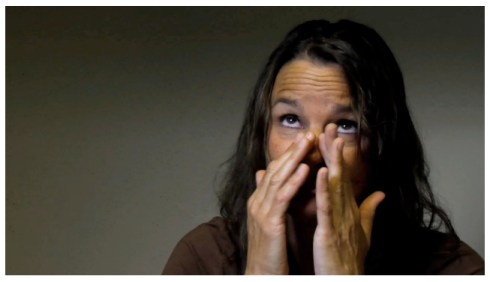
The IF Project Trailer, Screengrab
This is worrying.
Los Angeles Jail guards at the Pitchess Detention Center, Castiac, CA have a new weapon in their armory. The 7 1/2-foot-tall ‘Assault Intervention Device’ emits an invisible 5-inch-square beam that causes an “unbearable sensation”.

The device is manufactured by Raytheon, an 80 year old multibillion dollar surveillance, radar and missile specialist with a catalogue of space-war technologies. Compared to Raytheon’s sprawling, global and stratospheric innovations, the ‘Assault Intervention Device’ is small, contained and personal.
Cmdr. Bob Osborne of the LA County Sheriff’s Technology Exploration Program, one of several deputies who tested (see video) the ‘Assault Intervention Device’, described the experience, “I equate it to opening an oven door and feeling that blast of hot air, except instead of being all over me, it’s more focused.”
The device – controlled by a joystick & computer monitor and with a 100 foot range – will be mounted near the ceiling in a unit at Pitchess housing about 65 inmates.
NBC Los Angeles reports, “The energy traveling at the speed of light penetrates the skin up to 1/64 of an inch deep. […] ‘Assault Intervention Device’ is being evaluated for a period of six months by the National Institute of Justice for use in jails nationwide.”
The statistics for violence at Pitchess are quite shocking – 257 inmate-on-inmate assaults occurred in the first half of the 2010.
Pitchess, a facility with 3,700 inmates, is a large facility with riots (some very recently) and obviously needs to counter the culture of violence. I just wonder whether shooting brawling inmates with lasers is the right way to go about it?
– – –
I have looked at highly sophisticated technologies before and how their imaging can affect our understanding of prison life, tension, engagement.
How would images of prisoners reeling from a ‘Assault Intervention Device’ laserbeam influence public opinion about this new fan-dangled correctional management tool? The deputies who’ve tested it say it’s unbearable and can only be endured for three seconds maximum, yet everyone knows that tasers are often repeatedly discharged upon stubborn, adrenaline-fuelled (sometimes drugged up) targets.
Again, very worrying.

I found Pamela Bannos‘s portfolio via the MoCP, Midwest Photographers Project page. This was the same place I found the work of Tom Jones. There is plenty of other thought-provoking stuff (no prison photography though!) for you to while away an afternoon.
I am really taken by the quiet control of Bannos’ Some Untitled Pictures. Bannos: “In each of these found photographs I have tried to create a new history, or a new way of looking at a face or a gesture from another time. […] I am curious about how the illusion of photographic space can be re-constructed.”
More here.
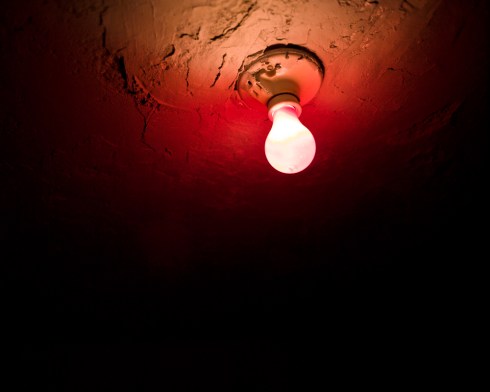
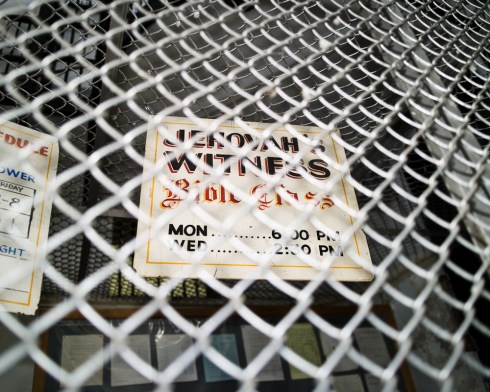
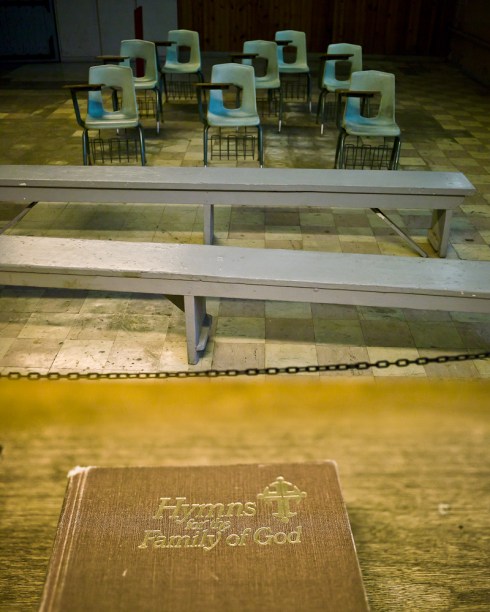
Steve Davis was in Montana last month and sent me some photographs from his visit to Old Montana Prison in Deer Lodge. Davis’ foray goes into the annals of tourist photography from prison museums.
Regarding prison museums, I have previously looked at the work of Roger Cremers, Daniel & Geo Fuchs, Daniel Etter and Polaroids from Berlin-Hohenschönhausen. Of course we shouldn’t forget that are prisons in the world in which both inmates and tourists co-mingle.



Large hangars and fuel storage, Tonopah Test Range, Nevada, distance 18 miles, 10:44 am. © Trevor Paglen
I’ve tried talking about Trevor Paglen’s expansive oeuvre before, with particular reference to his documenting of Black Sites (US extrajudicial prisons). I don’t think I did a great job, which is why I am happy to see Joerg and Asim both grapple with Paglen’s contributions.
Conscientious interviews Paglen
‘What I want out of art is “things that help us see who we are now” – and I mean this quite literally. I think of my visual work an exploration of political epistemology (i.e. the politics of how we know what we think we know?) filled with all the contradictions, dead ends, moments of revelation, and confusion that characterize our collective ability to comprehend the world around us in general.’
Asim Rafiqui delves deep: ‘Photographing The Unseen Or What Conventional Photojournalism Is Not Telling Us About Ourselves.‘
‘[Paglen’s photographs] remind us how most photojournalists prefer to pander in the simple, the obvious and the conventional, while never engaging in the complex and crucual. Our newspapers and photographers have, either out of convenience, laziness or sheer careerism, chosen to veil the GWAT behind beautifully rendered and largely distracting projects produced from the confines of embedded positions on the front line.’
Of course, war photography is only one aspect area of photojournalism, but the argument can be made that criticism of war photography has stopped short, cowered or just missed the point. If one accepts that as the case, then Jim Johnson‘s three posts about the changing conventions in war photography (here, here and here) are a good lesson in how to think and see war photography, which let’s admit it, is a genre America still dresses in wonder and heroic myth.

 Prison Photography