
You are currently browsing the category archive for the ‘Visual Feeds’ category.
An Omar Broadway Film aired on HBO last month. Omar smuggled a video camera into Northern State Prison, New Jersey and documented for six months. The film was debuted at the 2008 Tribeca Film Festival.
There are many reasons I believe in prison reform, the wasted potential is one, the wasted dollars is an other, the systematic violence is the reason to which this film speaks. Shadow and Act review it here.
Below is a video interview with Douglas Tirola, one of the directors, about how the film got made.
Talk to anyone about American documentary photography, they’ll probably mention Danny Lyon. Talk to anyone about prison documentary photography and they’ll definitely mention Danny Lyon.
In terms of US prison journalism, Lyon was the first photographer to a) give a shit, b) gain significant access, and c) distribute journalist images far and wide.
I had read Nicole Pasulka’s interview with Danny Lyon when it was published for The Morning News in December, 2008. I have since begun reading Like a Thief’s Dream (currently 100 pages deep). As in many cases, it takes an AmericanSuburbX reissue to press the issue.

Renton in his cell, Walls Unit, Huntsville, Texas, 1968. © Danny Lyon
I have a few things to say about the chapters I’ve read so far, but those thoughts need more brewing. While I mash those brain-hops, I’d like to draw your attentions to Lyon’s comments about prisons in America:
“You really need a friend, or family member inside a prison, to appreciate what we are doing. America has two million people inside of her prisons. Only China, a dictatorship, tops us in this growth industry. I like to think of the words of Fredrick Douglas “Be neither a slave nor a master.” All of us, outside of prisons, are the masters.“
“Prisons should be turned into bowling alleys, schools, and daycare centers, or demolished. We could probably do better with 90 percent of the inmates being released. Communities should deal with offenders on a local level. Review panels should meet with all of the 200,000 prisoners doing life sentences. Many of these people are harmless and aged, and should be released. I would like to see review panels sent into all the prisons, to meet with inmates face to face. Most should be released.“
“When I was working in the Texas prisons (1960s and 70s) there were 12,500 men and women inside and no executions. Today there are 200,000 in Texas and they kill prisoners all the time. Prisons are now everywhere, a major employer in upstate New York. Simply put, everything about prison is worse.”
“The best way to change yourself is to go outside your world into the world of others. It’s a big world out there. The worst thing about New York City is that all the young people that gather there are extremely like-minded. Creative people are comfortable there, but they are preaching to the choir. I always wanted to move Brooklyn to Missouri. Everyone would benefit.” (Source)
I couldn’t – and have not – ever put it better myself.
– – – – – – – –
Buy a signed copy of the book Like a Thief’s Dream at Danny Lyon’s website, Black Beauty.

Postcard sent by the author to Renton in prison in the early 1980s
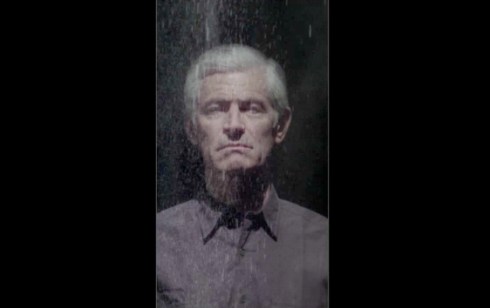
Screengrab. ‘James Nachtwey, a portrait of the artist’ (9 minutes). © Asa Mader
Get past the fact that Asa Mader is repeating Bill Viola’s tricks, my response to this installation video is that James Nachtwey is serious, and he is silent, and there’s some stuff falling to the ground around him.
Recently, I’ve been focused on photography a lot. The distraction from prisons is mostly due to the great writing and comment I read daily on the photography blogs I respect.
It occurred to me that the names of the blogs may stick longer in the memory than the names of the bloggers themselves (which might be the intent … and the branding, possibly?).
Nevertheless, I updated the hyperlinks down the left hand side to include the bloggers’ names and copy a list below.
>Re: PHOTO (Peter Marshall)
(Notes on) Politics, Theory & Photography (Jim Johnson)
[The Incoherent Light] (Darren Campion)
100 Eyes (Andy Levin)
1000Words (Tim Clark)
2point8 (Michael David Murphy)
40 Watt (Shawn Records)
5B4 Books (Jeff Ladd)
A Photography Blog (Rachel Hulin)
After Photography (Fred Rictchin)
American Suburb X (Doug Rickard)
Amy Stein
Asian Photography Blog (Yaohong)
BagNewsNotes (Michael Shaw)
Bill Eppridge
B (Blake Andrews)
Bite! Magazine (Margo de Beijer, Amanda Calluf, Sophia Greiff, Janique Helson)
British Photographic History
Buffet (Andrew Phelps)
Carlagirl photo (Carla Williams)
Colin Pantall
Conscientious (Joerg Colberg)
Consumptive (James Luckett)
Contact (Anna Stevens & Emily Graham)
Dektol (Danny Lyon)
Digressions (Daniel Shea)
Dodge and Burn (Qiana Mestrich)
Drool (Tony Fouhse)
Duckrabbit (Ben Chesterton, David White & Ciara Leeming)
Dvafoto (M. Scott Brauer & Matt Lutton)
En Foco (Miriam Romais)
Exposure Compensation (Miguel Garcia-Guzman)
Exposure Project
Eyecurious (Marc Feustel)
Fifty Crows
Food For Your Eyes (Nathalie Belayche)
Fugitive Visio (Evan Mirapaul)
Hamburger Eyes (Ray Potes & friends)
Harvey Benge
Humble Arts Blog (Grant Willing)
Ian Aleksander Adams
ILOVETHATPHOTO (Saskia Hoogerhuis)
John Edwin Mason
Lenscratch (Aline Smithson)
Lens Culture (Jim Casper)
L O Z (Laurence Vecten)
Manchester Photography (Mark Page)
Mrs. Deane (Norman Beierle & Hester Keijser)
Muse-ings (Tim Atherton)
New Photographics (Jonathan Worth)
No Caption Needed (Robert Hariman & John Louis Lucaites)
On Shadow (Nicholas Calcott)
One Way Street (Bernard Yenelouis)
Photogaphs Do Not Bend (Sherry Cuttler)
Photographers Speak (Dean Brierly)
Photographylot (Tom White)
PhotoPhilanthropy (Eliza Gregory)
Raw File: Wired
Raw Take (Mike Davis)
Reciprocity Failure (Stan Banos)
Shane Lavalette
Simon Sticker
Slightly Lucid (Aislinn Leggett)
The Photography Post (Rachel Hulin & Kate Steciw)
The Spinning Head (Asim Rafiqui)
The Visual Student (Kevin Martin)
The Year in Pictures(James Danziger)
Third Nature (Dalton Rooney)
ThisPhotoThat (This, Photo and That)
Too Much Chocolate (Jake Stangel & friends)
Truth in Photography (Robert Semeniuk)
Two Way Lens (Michael Werner)
Verve Photo (Geoffrey Hiller)
We Can Shoot Too (J. Wesley Brown)
We’re Just Sayin (Iris & David Burnett)
What’s Going On? (Dawoud Bey)
What’s The Jackanory? (Andrew Hetherington)
Zoe Strauss

Cartoon by David Walker ©
Remember these names, fame! And, I am sorry to do this, but let’s hear it for the blogs! Hope that tune stays in your head all day.
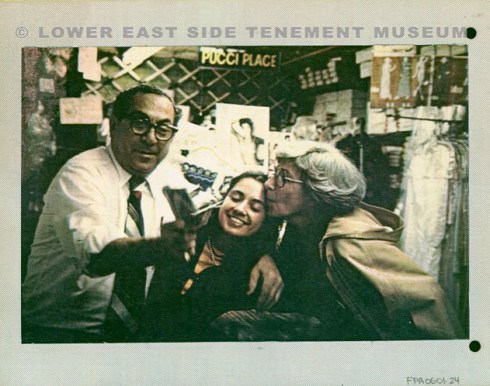
The Tenement Museum now has its photography archive online. What a treat! Go on, lose yourself …
(via)
Last week, I sent this clip over to Brendan Seibel who knows a thing or two about punk, rock and Bay Area discontent.
In return, Brendan sent this clip describing it as “one of those what-the-f#@k moments when San Francisco was cool.”
Just thought you should know.
Last week, when Foto8 ran Katarzyna Mirczak‘s article about of the detached and preserved skin of prisoners’ tattoos, I was, of course, compelled to post about it. But, in truth, I need to do a lot more than duly note a story published elsewhere.

HOW HAVE PHOTOGRAPHERS TAKEN ON THE SUBJECT OF PRISON TATTOOING?
The simple answer is with limitations. Photography can describe tattoos very precisely, but description is not comprehension. Often, prison tattoos are a tactically guarded language.
Even if tattoo symbols are deciphered, they may carry different meanings in other cultures. Prison systems exist across the globe, within and “outside” different political regimes, thus the tattoos of each prison culture should be considered according to their own rules – and this caveat applies even at local levels.
Janine Jannsen offers a good introduction to the history of different tattooing cultures. She summarises tattooing in “total institutions” (navy, army, the penitentiary); tattoos and gender; and tattoos and the demarcation of space.
With regards to prison tattoos, maybe it helps us to think of photography as secondary to sociological research. Photography should be thought of as an illustrative tool to aid external inquiry.
That said, there are a number of photographers who have made honorable efforts to describe for a wider audience much of the significance of prison and gang tattoo cultures.
Araminta de Clermont
After their release from prison, Araminta de Clermont tracked down South African gang members and discovered their stories. Interview with Araminta and her subjects here.

© Araminta de Clermont
Donald Weber
Donald Weber mixed with former prisoners (‘zeks’) in Russia and concentrated on how their prison tattoos relate to their identity and criminal lifestyle. The relationships of these men with female criminals and prostituted women (‘Natashas’) who become their companions feature in Weber’s complex investigation.
“Some rules are simple: you can only get a tattoo while in prison.”

September 1, 2007: Vova, zek. The origins of Russia’s criminal caste lie deep in Russia’s history. Huge territories of Russia were inhabited by prisoners and prison guards. Thieves, or zeks, distinguish themselves from others by tattoos marking their rank in the criminal world: there are different tattoos for homosexuals, thieves, rapists and murderers. © Donald Weber / VII Network.
Rodrigo Abd
Rodrigo Abd‘s portraits of Mara gang members in Chimaltenango prison in Guatemala illustrate gang tattoos that are used less and less (from 2007 onwards) due to the unavoidable affiliation and violence they brought the bearer; “After anti-gang laws were approved in Honduras and El Salvador, and a string of killings in Guatemala that were committed by angry neighbors and security forces, gang members have stopped tattooing themselves and have resorted to more subtle, low profile ways of identifying themselves as members of those criminal organizations. Today, gang members with tattooed faces, are either dead, in prison or hiding.”

© Rodrigo Abd / AP
Luis Sinco
In 2005, Luis Sinco of the Los Angeles Times documented Ciudad Barrios Penitentiary in El Salvador, home to 900 gang members, many of whom have been deported from the US. Ciudad Barrios incarcerates only members of the MS-13 gang, which traces its roots to the immigrant neighborhoods west of downtown L.A.
“In the woodshop, inmates made a variety of home furnishings, most of which featured the MS-13 logo. The items sold outside the walls help supplement the prisoners’ meager food rations.”
“It was a of microcosm of L.A.’s worst nightmare transplanted. Claustrophobic, crowded tiers led to darkened, bed-less holding cells and fetid latrines overflowing with human waste.”
Multimedia here.
Moises Saman
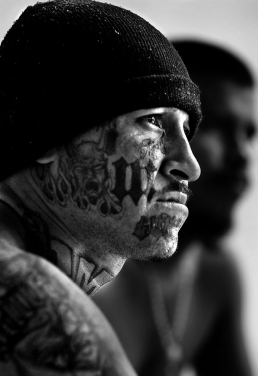
In 2007, Moises Saman documented the anti-gang activities of Salvadorian Special Police and the inside of Chalatenango prison, El Salvador. At times Saman’s project focused on the tattoos but is more generally a traditional documentary project. More here and here.

© Moises Saman
Isabel Munoz
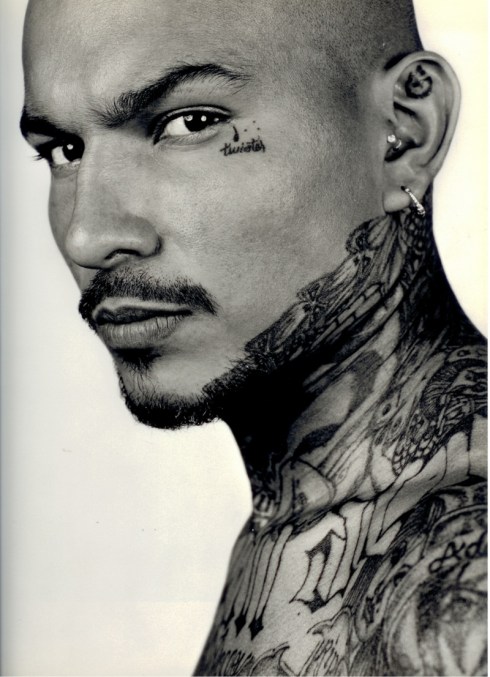
Much of Isabel Munoz‘s portraiture deals with markings of the body – what they reveal and conceal. For example, she has previously photographed Ethiopian women and their scarification markings. For her project Maras, Munoz shot sixty portraits in a Salvadorian prison of ex-gang-members. She also photographed the women in these mens’ lives. More here and here.
© Isabel Munoz
Christian Poveda
In El Salvador, Christian Poveda photographed and filmed Mara Salvatrucha (known as MS) and M18, the two Las Maras gangs in open conflict. Poveda wanted to describe their mutual violence and the absence of ideological or religious differences to explain their fight to the death. He described the origins of their war as “lost in the Hispanic barrios of Los Angeles” and as “an indirect effect of globalisation.”
Poveda was shot dead aged 52 as a direct consequence of his journalism. His work from El Salvador was entitled La Vida Loca. Full gallery can be seen here. B-Roll from his work can be seen here.

© Christian Poveda
More Resources
Ann T. Hathaway has collated (disturbing) information and links here about a number of prison tattoo codes.
Russian criminal tattoos have warranted their own encyclopaedia.

Spread from Toppled
Toppled by Florian Göttke
Two weeks ago, Foto8’s Guy Lane reviewed Toppled by Florian Göttke. The review is what it is – a description of Göttke’s “(mainly) pictorial study of the destruction, desecration and mutation of many of Iraq’s plentiful statues of its former dictator.”
Lane’s conclusion points to the significance of Göttke’s study:
“Perhaps this might all appear somewhat peripheral, an iconographical diversion from the real business – invasion, subjugation, and expropriation – of Occupation. But from amongst Göttke’s collated written testimonies and reports, it is possible to sense something of the importance that was attached to the Coalition’s iconoclasm. For example, a BBC account of British activities in Basra concluded that ‘the statue of Saddam is in ruins. It is the key target of the whole raid.’ Meanwhile, in Baghdad a US army captain was ordered to delay destroying a statue until a Fox TV crew arrived. Most famously, the Firdous Square episode appears to have been – to a degree – choreographed for the benefit of the foreign media based in the overlooking Palestine Hotel. ‘American and British press officers were indeed actively looking for the opportunity to capture the symbolic action of toppling statues and have the media transmit these to the world,’ writes Göttke. As such, Toppled’s events and pictures correspond tellingly and damningly to the Retort group’s analysis of our ‘new age of war’.”
Would I buy the book? Probably not. The book is a concept. I understand the concept. And, the images are essentially props to the concept (illustrations of the new biographies of statues, of things).
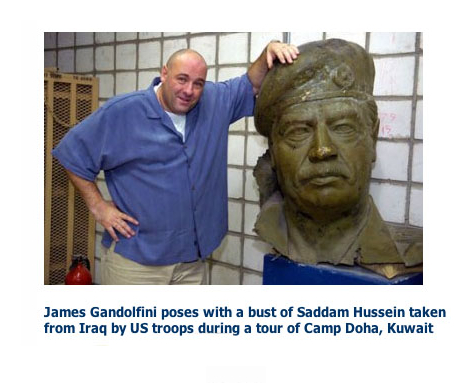
Besides, I can get my fill elsewhere. The best (most ridiculous) image – James Gandolfini meets the Butcher of Baghdad – is on the accompanying Toppled website.
SADDAM’S PERSONAL PHOTO ALBUM
Göttke’s work leaves me wondering how Saddam’s personal photo-album fits in?
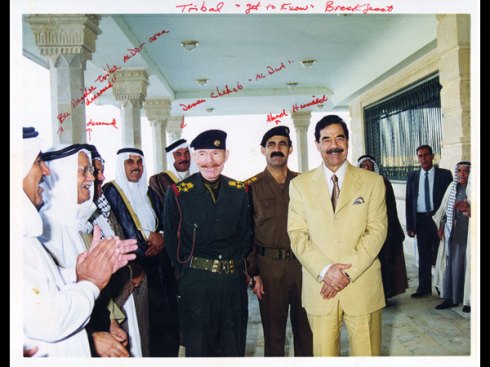
Similarly, these images were found and taken during the invasion of Iraq: “On the night of June 18, 2003, the soldiers in the 1-22 Infantry stormed a farm in Tikrit, Iraq, hoping to find a fugitive Saddam Hussein. They didn’t find their target, but they did find a consolation prize: Saddam’s family photo album […] When he returned from Iraq, Lt. Col. Steve Russell, the commander of the 1-22 Infantry, donated the album to the National Infantry Museum at Fort Benning, Ga.” (Source)
This is a reversal, no? Not the effigies of megalomania, but personal snapshots. Not public monstrosities but flimsy two-dimensional depictions. Would these have got pissed on and slapped with sandals? Would they have been torn up/burned up had Lt. Col. Steve Russell not slipped them into his luggage?
Also, to describe the collection (for media publication) as the dictator’s “personal album” is one thing, but to what extent were these Saddam’s photo-memories? Are these really the contents of an album he valued? Are we even glad that Saddam’s images still exist?
One final thought, how do we distinguish between the staging of Saddam’s images to the staging of the images in Göttke’s survey?
JAMAL PENJWENY
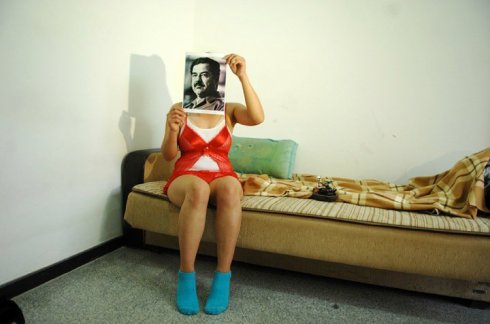
On a less-grander scale, Jamal Penjweny is attempting (with his Iraqi subjects) to make sense of the spectre of Saddam. The series is called Saddam is Here. It’s not great photography but I don’t think this type of playful exploration needs to be.

 Prison Photography