
You are currently browsing the category archive for the ‘Words’ category.

Prison Obscura got a nice review by Carolina Miranda in the Los Angeles Times.
An excerpt from Gut-wrenching photo evidence from Brown vs. Plata in ‘Prison Obscura’:
Perhaps most gut-wrenching is the series of pictures generated as evidence for the case of Brown vs. Plata, a class-action lawsuit against the state of California, related to issues of access to medical care and serious overcrowding in the state’s prisons. The case made it all the way to the U.S. Supreme Court, which ordered California to release 46,000 inmates in order to relieve conditions.
[…]
“[Prison Obscura] is aesthetically beautiful and challenging, and it’s didactic without being patronizing,” says Juliet Koss, who is the director of the Humanities Institute at Scripps. “But it also ties into what we are doing in the Institute. The theme for the semester is ‘silence’ and this was an interesting way of exploring that: of people who have been silenced or the general silence that there is about this topic.”
An absolute honour to have the attentions of critic Carolina Miranda, whose writings and focus on the vernacular, on everyday creativity and on pursuits of beauty and meaning beyond the restrictive parameters of the art market, I have long admired.

A few months ago, I shared an announcement for the ‘Marking Time’ Prison Arts and Activism Conference, organised by the Institute for Research on Women (IRW) at Rutgers University.
Earlier this week, IRW announced the schedule for the October 8the -10th conference. On it are some inspiring artists whose work I’ve long admired from distance. Great line up.
I’m also pleased to mention that I’ll be moderating a panel, the proposal for which, for your informations, I have copy&pasted below.
Panel: Imagery and Prisons: Engaging and Persuading Audiences
We produce and consume an enormous quantity of images each day (350 million photos are uploaded daily to Facebook alone and the average person sees 5,000 advertisements per day). While images often reify stereotypes and social causality, many artists are creating and distributing photographs or disrupting dominant visual culture in hopes of supporting or instigating prison activism and reform. By looking at three practitioners with distinct approaches, audiences and strategies, this panel will explore the power, limitations, and corresponding ethics of visual activism. What images do citizens have access to? Who controls cliche and motif? What new images of prisons and prisoners need to be made? How can collaborative modes of producing and understanding images be catalysts for collective action? How can photography get past its role as mere documentation of prisons to help create visions for alternatives to incarceration?
Across New York City, Lorenzo Steele Jr. exhibits photographs he made during his work as a correctional officer deep in Rikers Island. At church groups, in parking lots, in schools, and during summer community days, Steele brings graphic imagery directly to multiple generations within the catchment area of Rikers. Steele’s presentations are accompanied by a number of workshops on conflict reconciliation, criminal justice and community.
Gregory Sale has produced longterm large scale projects that with significant institutional support have managed to bring together many disparate constituencies orbiting the criminal justice world. Sale’s “It’s Not All Black & White” made a conscious effort to wrestle the visual motifs and cliche of crime (striped jumpsuits, pink underwear and even brown skin) that Arizona’s infamous Sheriff Joe Arpaio has manipulated for his own political advantage.
Mark Strandquist works with communities to create photographs requested by prisoners (“If you could have a window in your cell, what place from your past would it look out to?”). After sending images to the corresponding prisoners, the photographs are exhibited and expanded upon through extensive public programing that brings students, policy makers, former prisoners, and many others together to engage with the causes, effects, and alternatives to mass incarceration.
Moderator, Pete Brook will ask the panelists which approaches have worked and which have not. What presentations of material have engaged and persuaded audiences? What different expectations and needs do audiences have which we as artists and activists must consider?
BIOGRAPHIES
Gregory Sale is multidisciplinary, socially-engaged artist, whose work investigates issues of incarceration, citizenship, visual culture and emotional territories. In 2011, Sale orchestrated It’s Not All Black & White, a three-month residency exhibition at ASU Art Museum in Tempe, AZ. 52 programmed events brought together a wide array of constituencies including incarcerated persons, their families, parolees, ex-convicts, correctional officers, elected officials, government employees, members of the community, media representatives, artists, and researchers. It considered the cultural, social and personal issues at stake in the day-to-day workings of the criminal justice system in Arizona. Sale’s most recent project, Sleepover grapples with the challenges of individuals reentering society after periods of incarceration.
Sale is the recipient of a Creative Capital Grant in Emerging Fields (2013) and an Art Matters Grant (2014) . In summer 2012, as a resident artist at Yaddo in Saratoga Springs, NY, and at VCCA in Amherst, VA, Sale’s work has appeared in museums nationwide including the Ackland Art Museum, UNC-Chapel Hill and the Cheekwood Museum of Art, Nashville. Sale is Assistant Professor of Intermedia and Public Practice at Arizona State University in Tempe, AZ. Before that he served as the Visual Arts Director for Arizona Commission on the Arts, the Curator of Education at ASU Art Museum, and as a public art project manager for the Phoenix Office of Arts and Culture.
Lorenzo Steele Jr. is a former New York City Correction Officer. He worked for 12 years at Rikers Island, considered by some as the most violent adolescent prison America.
In 2001, Steele founded Future Leaders, a non profit youth that provides workshops, training, education and consultation to children, parents and educators about incarceration and the criminal justice system. Steele has worked as a New York City Board of Education vendor and assisted organizations — such as The Administration for Children’s Services (ACS), United Federation of Teachers (UFT) and the Nassau/Suffolk (BOCES) school district — with workshops on conflict resolution, bullying and literacy. He has also worked with the Brooklyn District Attorneys office providing gang and prison awareness to at-risk youth. He has lectured at college across the New York area. Steele is the recipient of awards from Congressional, Senate, and State Assemblymen for services to the community and to children’s development.
Mark Strandquist is an artist, educator, and organizer. His projects facilitate interactions that incorporate viewers as direct participants and present alternative models for the civic and artistic ways in which we engage the world around us. Each interactive installation functions not as a culmination but as a starting point and catalyst for dialogue, exchange, and community action. While photography is often used, the visual aesthetics and technical mastery of the medium become secondary to the social process through which the images are created, and the social interactions that each exhibition produces.
The ongoing project Some Other Places We’ve Missed: Windows From Prison was awarded the 2014 Society for Photographic Educators’ National Conference Image Maker Award, a Photowings/Ashoka Foundation Insights Changemaker Award, and the VCU Art’s Dean’s Award by juror Lisa Frieman. Strandquist’s projects have been exhibited and presented in museums, film festivals, conferences, print and online magazines, and independent galleries. The project Write Home Soon was exhibited in the 2012-13 international showcase of Socially Engaged Art at the Art Museum of Americas, Washington, DC. The ongoing project, The People’s Library is part of the permanent collection at the Main Branch of the Richmond Public Library and was presented by Strandquist and Courtney Bowles at the 2013 Open Engagement Conference. Strandquist is an adjunct faculty member at the Corcoran College of Art, a teaching artist with the University of Richmond’s Partners in the Arts, a Professional Fellow at the Virginia Museum of Fine Arts, and a Capital Fellow at Provisions Library.

Final Words, launched today, is a sprawling documentary project that focuses on the humanity at center of the death penalty in America. It is the brainchild of photographer Marc Asnin known for his brick of a book Uncle Charlie. Well, this project takes Asnin from the personal to the political, but it is no less massive. Asnin’s got form.
Asnin is asking photographers and non-photographers alike to submit selfies as statements against the death penalty. I’ll get to that in a moment but first the project and the cause.
FINAL WORDS
Final Words is a book and traveling exhibition, featuring the final statements of the 515 prisoners executed by the state of Texas since 1982. Final Words will shape and deliver curricula to American high-schoolers. If we can get the youngest generation talking then perhaps we can engineer a future without the barbaric death penalty?
The project statement explains that more than one person every month for thirty-one years has been executed by the Lone Star State:
Just before the execution is completed, each prisoner is given the opportunity to share their final thoughts. […] It is their words, their final words in this life, that allow the reader to experience the underlining humanity central to the death penalty debate. […] Final Words comprises a part of the legacy that will live on beyond us and it will stand as a testament to the kind of society we were—who our criminals were and how we implemented our idea of justice. Final Words interrogates our presuppositions about the death penalty. […] While this book is a document of death—the death of both the guilty and innocent, the criminals and the victims—it attempts to create a dialogue about life.
All this takes a movement. And money. An IndieGogo campaign will launch in a months time.
The editioned Final Words books will cost a pretty penny. Their sales will help raise money to pump simpler versions of the content and curricula into the bloodstream of the education system.
Each page of the book features a prisoner’s mug shot, their age both at the time of the crime and when they were put to death, a description of the crime for which they stand convicted, and their final words.
Photographers Selfie Against the Death Penalty
In other efforts to corral some cash, Neverland Publications (cofounded by Asnin) and VII Association are collaborating on Photographers Selfie Against the Death Penalty, an international photo campaign to call for an end to executions in America. Highflying pixelmakers & imagershakers will submitting alongside us flailing Instagram plebs.
Note that the word “selfie” is used as a verb. I like that. Jury’s out as to how much a collection of selfies can effect entrenched moral politics, but it’s worth a try. Social media does nothing if not surprise regularly. And besides, all this just gets people talking ahead of Final Words‘ big fundraising campaign that ignites in October.
As the 501c3 sponsor of the project, VII Photo has asked all its photographers to participate in the selfie campaign. Get yourself in there too:
1. Make a selfie, save it to your computer.
2a. Upload selfie to http://www.final-words.org
2b. Fill out form (name, age, email address, location, how you heard about Photographers Selfies Against the Death Penalty, your preferred photography genre)
2c. Personalize your statement against the death penalty, by completing the following “I stand against the death penalty because …” in 140 characters or less.
Go on, selfie against the machine!
[Oh, if you’re wondering how and why Asnin and his colleagues have the last statements of 515 men and women, it is because for some reason the state of Texas keeps a public online database of them. Weird, no?!]
PROTEST
The 15th Annual March to Abolish the Death Penalty takes place in Houston, Texas on Saturday October 25th at 2pm. Details on the exact location in Houston will be announced later.
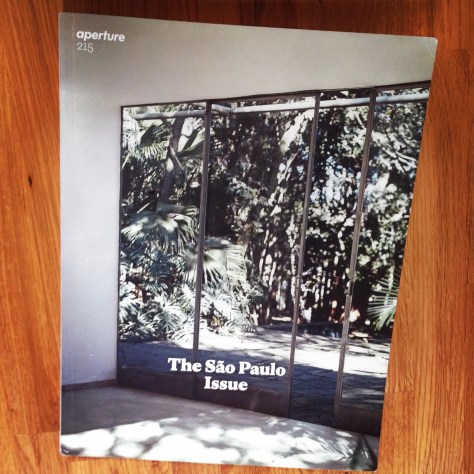
If you happen upon a copy of the latest issue of Aperture The Sao Paolo Issue (215), you will find — on p.14 — 200 words by yours truly about evidentiary imagery. As part of Aperture’s ongoing What Matters Now? series, I wrote:
In May 2011, the Supreme Court of the United States upheld an order to cut the prison population in California, on the grounds that overcrowding resulted in inadequate health care conditions and preventable deaths.
The majority ruling for the case, Brown v. Plata, was penned by Justice Kennedy who took the unorthodox step of including in the appendix three photographs of prison conditions. Perhaps, in this case, the facts really needed to be seen in order to be believed?
The three images represented a cache of hundreds of low-resolution, anonymous, poorly lit photographs used in the initial filings and ongoing compliance stages of Brown v. Plata. Their inclusion spurned widespread consternation among some law boffins who believed that photographs are too emotive and too imprecise, and have no place in high-profile legal cases. I wonder at what point did the legal community decide written and oral evidence was more legitimate than visual evidence?
For too long there has been an arrogance among photography traditionalists that a professionally-made documentary image can change the world. If we are to truly identify images that change society, then we’d be better looking to legal briefs and not newspaper front pages. The images made by prison officials and legal teams that were used in Brown v Plata changed the daily living conditions of 165,000 men and women.
MORE
Hundreds of images from Brown vs Plata are part of the exhibition Prison Obscura.
The San Francisco based law firm Rosen, Bien, Galvan & Grunfeld that represented the prisoners (plaintiffs) have made available materials from the trial online, including many photos.


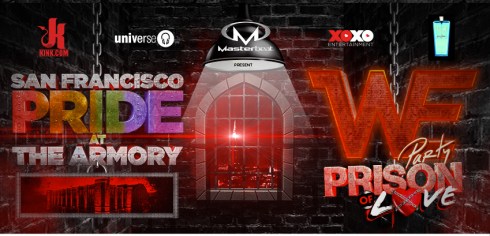
There’s a brouhaha brewing in San Francisco. The Armory — home to legendary controversial fetish porn empire Kink.com — is to host an event to coincide with San Francisco Pride. The WE Party Prison Of Love is being billed as THE BIGGEST PRIDE PARTY … EVER.
The predictable format for the prison-themed discoteque includes chains, shackles, a dungeon, and likely a whole lot of improv domination roll play. The majority of the 3,000-strong crowd is expected to be gay men.
As a cisgender straight male, I tend not to have any opinions on gay culture worthy of public proclamation. But, a prison-themed rave does seem a little tacky, though. For San Francisco’s trans-community, the Prison Of Love Party is far worse than tacky; it is an affront and a politically-clueless venture.
The Transgender Gender Variant, Intersex Justice Project in San Francisco, in an open letter to San Francisco Pride at the Armory, points out that the prison industrial complex abuses transgendered people strategically and disproportionally.
The primary signatory is Miss Major, one of this years SF Pride Grand Marshals.
It reads:
This year at least three SF Pride grand marshals are trans women who have been directly affected by the Prison Industrial Complex. Chelsea Manning is currently incarcerated, Miss Major is previously incarcerated and was politicized at Attica just after the 1971 uprising, and Jewlyes Gutierrez was arrested for defending herself from bullies in her high school.
The prison industrial complex and the incarceration of generations of people of color, gender variant, trans people, and queer people is not a sexy trope to throw a play party around. It’s not that we don’t love sex, sex parties, sex workers, and kink. It’s that we love it as much as we love justice, and are appalled by the casual use of the Prison Industrial Complex, which destroys the lives of millions of people and kills thousands every year, as a party theme.
The United States has the highest incarceration rate in the world. In our own LGBTQI communities, incarceration and significant abuses perpetrated by the Prison Industrial Complex constitutes no less than a crisis. According to the National Center for Transgender Equality, nearly 1 in 6 transgender people have been incarcerated at some point in their lives. Among Black transgender people, 47% have been incarcerated at some point in their lives. These rates overwhelmingly reflect the experiences of transgender women and especially trans women of color, who are housed in men’s prisons and face catastrophic rates of physical abuse, psychological terror, rape and sexual assault, and death. According to Just Detention International, 67% of LGBT prisoners reported being assaulted while in prison.
Not only is our queer community being harmed, the War on Drugs and the increasing privatization of prisons has created a phenomenon of mass incarceration of young Black and Latino men, and increasingly women too, which has economically, socially, and politically devastated these communities.
We are not interested in yucking anyone’s yum or shaming anyone who has fantasies or fetishes about ideas of this real-life violence. We are not interested in censorship or policing anyone’s sex life. We are interested in public space and party themes that get us closer to liberation from systemic and administrative violence and do not recreate a culture that normalizes or continues our oppression. Our push back is about navigating the legal and extra-legal targeting and criminalization of our communities.
At a time when public discussion and media finally has an eye toward the daily systemic violence against trans and queer people, your party theme and promotions are especially harmful and trivializing.
As individuals and organizations committed to justice and equality for LGBTQI peoples, we are working to end violence in our communities, and particularly at the hands of law enforcement, jails, detention centers and prisons. We’ve been doing this for years, and we’ll be supporting our brothers, sisters and siblings behind prison walls while you’re hosting a sex and dance event on Pride weekend that trivializes themes of incarceration and abuse as a good time.
We’re calling on you to understand how important these issues are to every member of our community, even if you’ve had the good fortune to not be hyper-visible and profiled by police, locked up, and then trapped in a cycle of institutional violence perpetrated by the California Department of Corrections and Rehabilitation, ICE, and the Federal Bureau of Prisons.
We’re calling on you to immediately change the theme of your party, and not use themes of arrest and incarceration, correctional officers beating inmates, solitary confinement, prison yards, or suggestions of prison rape in promoting your event.
As a step towards accountability and redress we’re also calling on you to donate a portion of the proceeds of your party to the Transgender Gender Variant Intersex Justice Project, El/La Para TransLatinas, and Communities United Against Violence, all organizations that are dedicated to ending police, prison, and systemic violence against trans and queer people in the Bay Area and beyond.
Signed,
Miss Major, SF Pride Grand Marshal/Director of Transgender Gender Variant, Intersex Justice Project
San Francisco Trans March, SF Pride Community Grand Marshal
Janet Mock, SF Pride Celebrity Grand Marshal/Author of “Redefining Realness”
Transgender Gender Varian Intersex Justice Project (TGIJP)
Community United Against Violence (CUAV)
El/La Para TransLatinas
Californians United for a Responsible Budget (CURB)
Justice Now
California Coalition for Women Prisoners (CCWP)
Community Justice Network for Youth
Sex Workers Outreach Project – Bay Area (SWOP)
All of Us or None
Dr. Annalise Ophelian, Filmmaker, Director/Producer – MAJOR! documentary
StormMiguel Florez, Musician & artist, Co-Producer – MAJOR! documentary
Courtney Trouble, Host of Queerly Beloved Pride Party, owner TROUBLEfilms
Well said.
Unfortunately, I don’t think the protests nor the #NotProud Boycott SF Pride movement will stand in the way of this Pride At The Armory shindig. Half the tickets have already sold. It’s large event long in the planning and those types of entertainment-ships don’t turn.
That’s a shame because facts are facts and the issue is undeniable.
- LGBT teens comprise as much as 15% of the general population in juvenile justice facilities; among girls alone, 27% are lesbian or bisexual.
- LGBT young people and adults face harsher penalties from the justice system. LGBT people face higher rates of abuse and assault in prison.
- The two 2 leading risk factors for prisoner rape are previous sexual abuse and being LGBT.
- Incarcerated homosexual and bisexual men are sexually assaulted at rates 10 times higher than their heterosexual counterparts.
- The federal definition of “rape” didn’t even include men or non-vaginal penetration until 2010. Men assaulted in prison were not considered rape victims by the U.S. Department of Justice until 2010.
- Incarcerated trans women in men’s prisons report rates of sexual assault nearly 13 times greater than that among groups of other people.
More depressing facts here.
Bad call. PR fail SF Pride.
As Jezebel puts it, “Call it Dungeons & Dragons themed, call it Party in Westeros, do something else that involves bars and chains and implements of “torture.” But this? Taking one of the biggest issues facing the LGBT+ community and turning it into a party?”
Update 05.11.2014: The Eventbrite registration page has been closed after 80 sign-ups. But, there’s space for walk-ins and allcomers. We don’t want to turn anyone away!
Email info@asocialpractice.com to extend your interest. Thanks.
A BIG PUBLIC CHAT
Next Friday, May 16th, as part of the Open Engagement conference, I’ll be part of a conversation about photography based art and social practice.

The Photo-Based Social Practice panel and group brainstorming is at the Aperture Gallery in New York, 10am – 12 noon.
Moderator Eliza Gregory along with panelists Gemma-Rose Turnbull, Mark Strandquist, Wendy Ewald and I will be discussing socially engaged, transdisciplinary, and expanded practices in contemporary photography.
Highfalutin, huh? Not really. The language is big, but the query is simple. Can photography build community and empower subjects? How can photography be nice?
It’s free, but preregistration is required. Do that HERE (6th option on the list).
We’re only going to do the briefest of introductions to our work before breaking into groups to tackle a host of questions that deal with audience, relevance and good design. It only makes sense that we collaborate to tackle answers to these issues.

We hope that the panel will follow nicely on from December’s Collaboration: Revisiting the History of Photography event that crowdsourced a new timeline of photo-history by focusing on projects with communities and groups as creators. I love the ideas involved in that.
While the Collaboration: Revisiting the History of Photography event gave new recognition to old projects and while it presented a new timeline and framework, it didn’t tackle best practices. From the projects it unearthed we can surmise the nature of some socially responsible projects, methodologies and motivations. In our discussion next week we hope to extend the conversation further and start to define common language, and potentially best practices, for socially engaged photography projects.
Please join us and help us along!
LOCATION, DATE, TIME
Aperture Gallery and Bookstore
547 West 27th Street, New York
10:00 am – 12:00 pm, Friday, May 16th.
FREE WITH REGISTRATION
NEW VENTURE! ‘PHOTOGRAPHY AS A SOCIAL PRACTICE’
Now is a good time to mention a joint venture recently started by my fellow panelists, Eliza Gregory, Gemma-Rose Turnbull and Mark Strandquist.
Photography As A Social Practice is a website for reference tools, teaching tools, and conversation about the intersection of social practice and photography. I’ll be contributing every so often and chatting on the phone about content. You can suggest resources by emailing info[at]asocialpractice[dot]com
SPONSORS
The panel is offered in conjunction with the Magnum Foundation and the Aperture Foundation who combined to publish Documentary, Expanded, the Spring Issue (#214) of Aperture Magazine as part of the Photography, Expanded initiative. Support also comes from the Open Society Documentary Photography Project, The School of Journalism and Communication (University of Queensland) and Portland State University‘s Art and Social Practice Program.
OPEN ENGAGEMENT, 2014
The Photo-Based Social Practice panel is part of Open Engagement, an international conference that sets out to explore various perspectives on art and social practice, and expand the dialogue around socially engaged art-making. This year, the conference addresses the theme of Life/Work. It is 2 days of programming (Sat, May 17 – Sun, May 18) at the Queens Museum, plus 1 day of pre-conference events on Fri 16th at different locations around the New York boroughs.

There’s an ugly scene unfolding in Illinois right now. The local paper in Champaign-Urbana, The News Gazette, published three attack pieces on James Kilgore, each one calling into question his character and the wisdom of the University of Illinois Champaign-Urbana (UICU) to hire Kilgore as a lecturer.
Kilgore is a respected researcher, writer, educator and criminal justice activist. He is also a former political insurgent who took up arms against federal authorities.
In the early seventies, Kilgore was part of the Symbionese Liberation Army (SLA) (of Patty Hearst infamy). He has been open about having felony convictions resulting from his political activities. Kilgore was on the run from 1975, living in Australia, Zimbabwe and South Africa until his arrest in 2002 in Cape Town. He saved the Feds the troublesome extradition process by voluntarily returning to the U.S., making a plea bargain, and pleading guilty to charges pertaining to the possession of explosives (in 1975) and passport fraud. Kilgore served 6 years in a California prison and upon his release in 2009 moved to Illinois to be with his wife, who is on the faculty of UICU. Since 2010, Kilgore has been a temporary faculty member at UIUC, teaching classes in Global Studies, Urban Planning and the College of Fine and Applied Arts.
These are the facts of the case. Jim Dey writing for The News Gazette in a Feb 9th OpEd piece In Plain Sight covers these facts. Dey’s tone is one of passive wonderment as to what UI might be thinking. The opinion piece is peppered with accounts of SLA violence from before Kilgore’s involvement. In Dey’s estimation, all the ideological mistakes of the fringe (and, yes, very damaging) SLA movement are all Kilgore. If only Dey had spent the same amount of time looking into Kilgore’s contributions in the interim four decades. It’s as if Dey and The News Gazette do not believe in change or maturation. If this is the case, then I call into question the commitment of author and outlet to the complexity of reporting and to journalism neutrality.
Kilgore is much more than his past indiscretions. As an aside, I know a person who used to be on the FBI most wanted list. This person’s charges were trumped up and when this person came out of living underground for 13 years faced no prison time. This person is one of the most politically aware, active and socially critical individuals I know.
There’s much more to Kilgore’s story than the character assassination as laid out by Dey. I believe it is motivated by a will to limit Kilgore’s very effective activism against a proposed new jail in Champaign-Urbana. Kilgore has proven himself a very adept strategist and activist leader in the town. Kilgore was instrumental in the fight. He has shared the successful tactics of the campaign with anti-prison groups across the nation.
News Gazette publisher John Foreman clearly has Kilgore in his sights. In the second OpEd piece (Feb 16th), Foreman perhaps a little miffed that Dey’s piece hadn’t wildly inflamed opinion enough) threw a hissy fit about the silence of Kilgore and UICU. What did Foreman expect? Answering to bully-boy tactics is not what Kilgore needed to do here. After all, The News Gazette had seemingly made up its mind about Kilgore a long time ago.
In his attempt to discredit UICU and question its priorities, Foreman opens his opinion piece by brushing aside a case of gross racism and sexism launched by a small (and troubled) group of students upon UICU Chancellor Phyllis Wise. Foreman mocks UICU’s attempts to deal with sexism and racism proving he’s more interested in cranking his newspaper’s controversy-du-jour than he is in taking a balanced view at all issues effecting his hometown community.
One week later, on the 23rd February, Foreman gave a platform to Dennis A. Kimme, the president of Kimme & Associates Inc., the firm that was trying to win the bid to build Champaign-Urbana’s new jail. Kimme is bitter about Kilgore’s attitude and expresses dismay that Kilgore would question the ability of Kimme’s company to assess the need for prison beds while trying to win a multimillion dollar contract to build those same beds! Of course, Kilgore and those opposed to a new jail would question motives.
Kimme’s contract bid failed on its own merits.
As if The News Gazette hadn’t already staked out its patently political position in text, it sent Jim Dey onto a talk show with it’s affiliate radio station to “discuss” the matter. Don’t bother listening to it. Host Jim Turpin is in cahoots with Dey as they proudly salute one another for their moral outrage.
I find it interesting that the UICU student newspaper has responded to this *controversy* with the statement: “The Daily Illini chose not to report on Kilgore’s status as a former felon because we did not believe that his status was news. Kilgore’s status as an instructor was no different than any other instructor.”
On April 9, the University Provost, in a private meeting, informed Kilgore that UICU would not approve any future contracts to employ him and declined to give him any explanation whatsoever as to why, how and by whom this decision had been made.
Fortunately, there is a community in Champaign-Urbana that sees the issue as more nuanced and is willing to look at the Kilgore of 2014 as well as the Kilgore of the early 1970’s.
A petition to UICU Chancellor Phyllis Wise has been circulated and already received the goal of 1,000 signatures. It reads:
We the undersigned scholars, legal professionals, activists and concerned individuals believe that the University of Illinois gave in to political pressure and refused to approve future employment contracts for James Kilgore on the basis of his background and sensationalist media coverage, rather than on his job performance.
Kilgore does not shy away from his past. He has answered to the full extent of the law his past acts and he has served time for them.
The SLA was committed to the overthrow of the federal government with planned attacks on police and federal buildings. They were of an era; one in which the violence of insurgency paled in insignificance compared to the violence waged in Vietnam. The SLA funded themselves largely through bank heists. SLA tactics were extreme, there is no doubt. The SLA cause achieved little. The SLA made grave mistakes. The SLA wasn’t the only homegrown group devoted to insurgency within U.S. borders.
Of all these activities, Kilgore was involved in one that led to a fatality. On April 28, 1975, SLA members including Kilgore robbed the Crocker National Bank in Carmichael, California. Myrna Opsahl, a bank customer was shot add killed during the robbery. Kilgore’s comrade fired the shot. Kilgore, it is reported, was furious that a gun was discharged. There’s talk of a light trigger, but still, take a gun into a bank and you should only predict unpredictability.
In a March 22 Chicago Sun-Times article, the university responded to UICU’s unceremonious dumping of Kilgore with a supportive statement from Associate Provost Robin Kaler:
He does a great job. He’s very well-respected among students. He served his time in prison. He is very remorseful. He didn’t do the shooting. He is a good example of someone who has been rehabilitated, if you believe in second chances and redemption, he’s someone who helps prove that’s the human thing to do. A child of the victim said he has served his time and should be allowed to go on with his life.
The American Association of University Professors echoed Kaler’s thoughts in their own official statement on the matter.
The News Gazette‘s OpEd series misses the point. It’s none-to-subtle rightwing attack against the classic bogeyman, against the non-patriot, argues that academia provides a profitable hiding ground for those that enacted political direct actions many decades ago. Think of the kids!?
What is at stake here is academic freedom.
More-so, we must ask do we want to believe in the ability for individuals, ANY INDIVIDUAL, to change, to improve, to educate and give back? The wording of the petition in support of Kilgore frames this perfectly:
Refusing to approve Kilgore’s employment contracts has serious implications for the 15 million Americans who have felony convictions and face a constant battle to access employment.
Get angry. Sign the petition. Follow James’ valuable work. Don’t let the boo-boys scare you.
Image: PM Press
Okay, the title to this post makes it sound like I’ll be making a habit of recording these stories of abuse. I will not. That isn’t because these episodes aren’t regular (unfortunately, they are quite regular), it is because I don’t have the time most weeks to adequately collect the many stories of misconduct from across this America.
So, why this week? Well, I came across two particularly disgusting and glaring examples of abuse. In both cases, they are presented with great clarity. The first is courtroom video footage. The second is a diaristic, written account.
COURTROOM BEATING
Above, we see a video from September 2012, in which Denver Sheriff Deputy Brad Lovingier slams a handcuffed prisoner into wall. Face first. Totally unprovoked.
Following the judge’s ruling, the defendant Anthony Waller requested clarification. At which point he is grabbed, from behind, by the handcuffs secured by behind his back, spun around, and flung into the wall. Waller falls to his knees after the impact and is then dragged out of the courtroom and into a holding cell. In the video Lovingier can be heard saying, “You don’t turn on me,” as the only explanation for his actions.
Madness. Ordinarily, a citizen guilty of such an assault would face a 6-month jail term. Lovingier was suspended for 30 days. And he’s appealing that.
SOLITARY CELL FOR GOOD SAMARITAN
The story is as simple as its logic is baffling and its behaviours are brutal.
Man witnesses a bike accident. Calls 9-1-1. Is handcuffed by police for unknown reasons. Taken to jail. Asks legitimate questions. Faces retribution from deputies. Stripped. Thrown in a shit-stained solitary cell.
You just have to read it to believe it: Good Samaritan Backfire or How I Ended Up in Solitary After Calling 911 for Help.
This kid — Paretz Partensky — is a young, educated, white, computer programmer. His abuse is likely no different (it might be less egregious?) than abuse meted out to people in San Francisco far more vulnerable than he. But Partensky gets on hot-new-story-telling-platform Medium and tells the story of his 12 hours of detention.
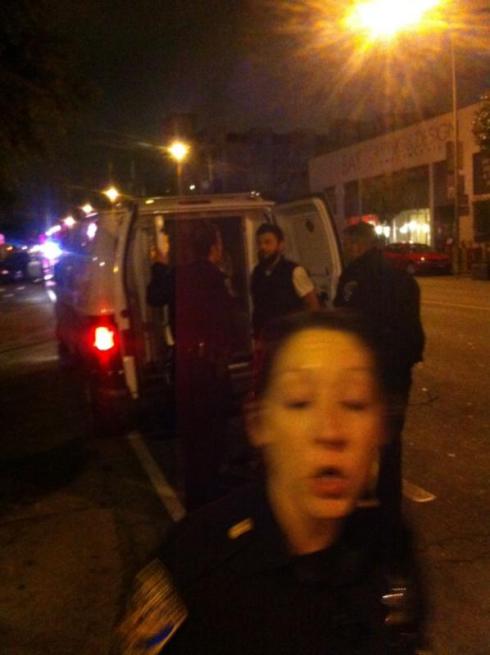
Officer Durkin, in the foreground, is telling Ben that he cannot take this photo. According to Attorney Krages, you are allowed to take photos in public places. http://www.krages.com/ThePhotographersRight.pdf Officer Durkin’s reprimand is in violation of Ben’s rights.
Partensky’s account is nuanced — he provides necessary details; he gives benefit of doubt to most of the characters involved; he tries to put himself in the position of others throughout the ordeal; he is aware of his white privilege; he ponders what different outcomes may have arisen had he and others interacted differently. In short, it is a compelling read.
Let’s not be churlish and say this is a young, comfy, SF-coder-class entrepreneur using an online platform to have a whinge. Let’s be civic and responsible and say no-one should be subject to arbitrary and vengeful treatment from law enforcement. Let us not allow our uncomfortable relationship to racial and income inequality, nor our relationship to white privilege be an excuse to dismiss Partensky’s story. Let us be shocked. Let us be angry. Let us thank Partensky for bringing his account to light.

 Prison Photography