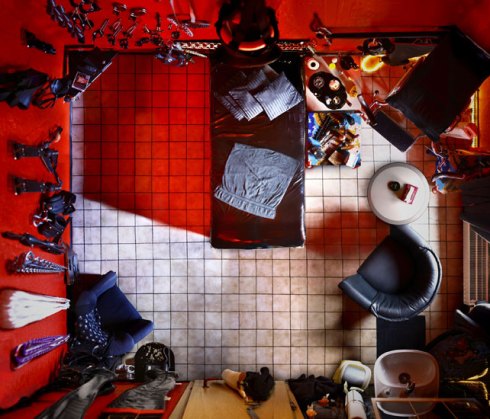
Last year, I interviewed Jurgen Chill about his project Zellen which adopted a birds eye (photo-composite) view of German prison cells.
For Chill’s series Bordelle, he repeated the technique for rooms of prostitution and bondage.

The Image / Incarceration / Representation / Media / Social Justice / Responsible Photography
Last year, I interviewed Jurgen Chill about his project Zellen which adopted a birds eye (photo-composite) view of German prison cells.
For Chill’s series Bordelle, he repeated the technique for rooms of prostitution and bondage.
Update (3.30pm): Haeberle was not a journalist. He was an enlisted, unarmed soldier. He carried a camera instead of a gun. His orders were to photograph for Stars and Stripes, the US Army’s (propaganda) publication. On the day of the My Lai Massacre he had his military-standard camera, but also carried (smuggled) his own camera.
I found this quote in Part Exposé, Part Cover-Up: 1968’s My Lai Massacre Photos Have Big Lessons For Citizen Journalists a highly recommended article written by David Quigg for the HuffPost.
Drawing on the well circulated Plain Dealer article of last November, Quigg discusses how Haeberle controlled, destroyed and released his photographs of the My Lai Massacre; how the Army campaigned against the release; how he (Quigg) as a journalist and we as viewers should regard Haerberle’s embedded activity in the US military; and what implications this has for (self) censorship but also propaganda in the age of citizen-publishing. Quigg:
“Citizen journalists must not do today’s equivalent of what Haeberle did. Citizen journalists must not give in to the urge to un-take a photo, to click delete and banish the evidence for the parts of a story that shame them. In citizen journalism, we might as well rename the delete button and think of it as the “cover-up button.”

Click on the image above or go here to see images of Cleveland’s Plain Dealer coverage of the 1969 exposé.
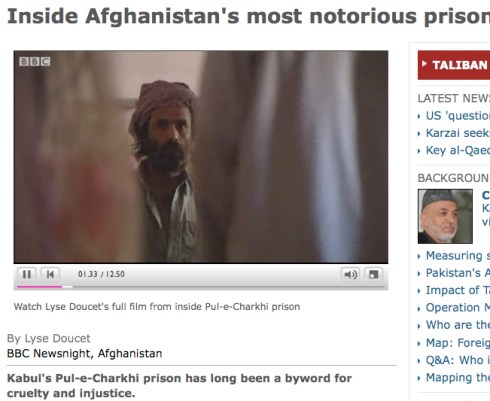
“Here” is Pul-e-Charki.
The long and contested history of this complex has eluded my ability to summarise. Lyse Doucet‘s 13 minute report for BBC Newsnight does an excellent job.
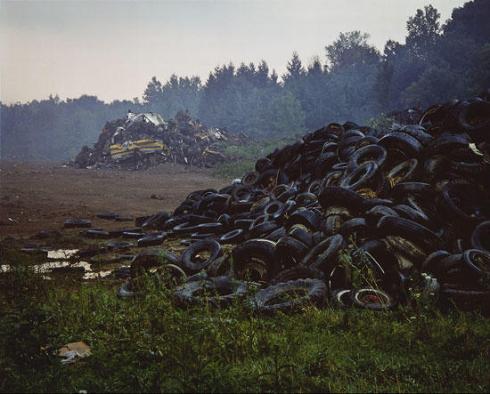
Robert Glenn Ketchum (b. 1947), CVNRA #705, 1988, Dye destruction print (Cibachrome), From the Ohio/Federal Lands project, Gift of Sue and Griff Hopkins, Amon Carter Museum, Fort Worth, Texas, P2001.8
This image came as quite a shock. I think of Robert Glenn Ketchum‘s work as New England fall colours, Hawaiian mists and Pacific Northwest greenery. Even when depicting a toxic river (below) Ketchum’s photographs have the ability to look bucolic and undisturbed (which is Ketchum’s clever conceit of ‘Overlooked in America: The Success and Failure of Federal Land Management’).
CVNRA #705 (above) is relatively early in Ketchum’s career and exists in contrast to all I presume and expect of his work. The photograph is part of Ketchum’s Ohio/Federal Lands project.
In recent weeks, we have been presented with plenty of visual prompts for guilt and shame – here, Oil reaches the shores of Louisiana.
My attraction to CVNRA #705 has made it clear I expect doom and gloom. If the subject of photograph is catastrophic then it must be a politically worthwhile photograph, right?
Furthermore, when viewing destruction, the more literal the description, the better the image slots into my pessimistic view of man’s negligent environmental stewardship.
I just guess, people shortcut to images as means to prove a point, but images are usually props. Yet, it makes sense why people, press and politicos rely so readily on images; because images can be easily used for any number of (simplified) narratives*.
In most cases, images are all we have and in all cases images are inadequate.
The world is much larger than a single view, yet still, I value the contributions of conservation photographers and wouldn’t want a visual world without them. I just need to deal with my own preference for disaster.

Robert Glenn Ketchum (b. 1947), CVNRA, #125 (a toxic waterfall in a national recreation area), 1986, from the project “Overlooked in America: The Success and Failure of Federal Land Management,” dye destruction print, gift of Advocacy Arts Foundation, ©1986 Robert Glenn Ketchum, P1996.22.3
During the earthquake, it was well reported that the National Penitentiary in Port-au-Prince crumbled and all inmates escaped. I posted on it here, here and here.
But this was not the only prison in Haiti. Les Cayes Prison, 100 miles west of Port-au-Prince, was the scene of prisoner protest, guard desertion and mass killings.
Today, the New York Times released the findings of an investigation at Les Cayes.
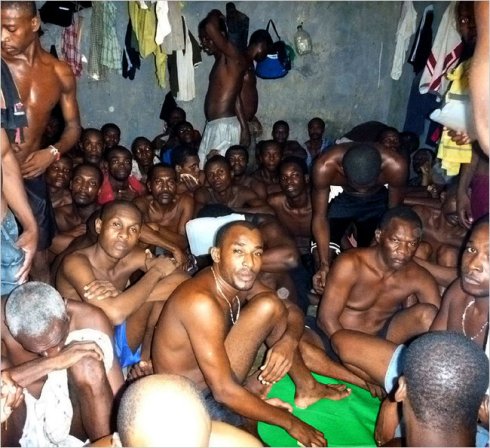
The day after the violence, the Rev. Marc Boisvert, who has run a training program at the prison for many years, was allowed in. Before the riot, conditions there were “inhumane,” he said. Afterward, with more than 400 prisoners in five or six small rectangular cells, they became “seriously inhumane.” Photo by Rev. Marc Boisvert
The New York Times reports, “After the earthquake, the warden, Inspector Sylvestre Larack, put out a “maximum alert” calling his 29 guards back to duty. But on Jan. 19, with much of Les Cayes still in a post-quake state of emergency, only five guards showed up to work inside the prison.”
Squalid conditions, described by Rev. Marc Boisvert as “subhuman”, led prisoners to hatch an escape plan. They beat an officer into surrendering his keys. All the guards fled leaving the prisoners unsupervision and doors unlocked.
Inmates could not leave the prison because UN forces had surrounded the complex.
In the New York Times’ investigation several inconsistencies were found. Among the allegations:
Haitian police gunned down prisoners, beat prisoners and then covered up evidence by burning blood soaked clothing, shoes etc.
Between 10 and 19 unarmed prisoners were killed when Haitian government forces entered the prison and instructed them to move away, lie down and then open fire.
Before the Haitian forces entered, prison authorities asked Senegalese and UN forces to enter the prison using munitions. The UN refused.
The warden, Inspector Sylvestre Larack (who has know been transferred to the post of warden at Port-au-Prince’s National Penitentiary) lied in the first and only internal investigation. He fabricated details of gun use by prisoners upon riot police.
At the forefront of your consideration when reading this story should be the fact that, of the 800 inmates, over 300 of the inmates were pretrial detainees. They have not been found guilty of a crime. Some of them were incarcerated for something as little as loitering.
The US has requested $141 million to rebuild Haiti’s justice system. If Haiti cannot carry through its own inquiry to uncover the truth and make accountable those responsible for murder and human rights abuses then it sets a very poor precedent for trust and the culture of governance in the next few years of recovery.
– – –
I HAVE PROVIDED A MERE SUMMARY OF THE NYT INVESTIGATION. GO HERE FOR THE LENGTHY ARTICLE BY. GO HERE FOR A 12 MINUTE VIDEO OF THE INTERVIEWS AND CONCLUSIONS OF THE INVESTIGATION. GO HERE TO SEE ANGEL FRANCO’S PHOTOGRAPHY FOR THE STORY.
Khuong Nguyen’s ‘Wrestlers‘ reminded me of Sam Taylor-Wood’s Crying Men series which reminded me of Marina Abramovic’s latest turn.
Be it commercial art, fine art or performance art, crying is good. Isn’t it?

© Khuong Nguyen
Source: Nguyen’s Behance, via The Photography Post

Jude Law, from “Crying Men,” 2002-2004
C-print © Sam Taylor Wood
Source: Williams College Museum of Art

Source: marinaabramovicmademecry
“The War on Drugs, is actually a War on People”
That’s a true statement. The Drug Policy Alliance is launching itself large, which is a good thing because the war on drugs has only managed to destroy communities, send people of colour to prisons in record numbers, increase the female prison population six-fold over the past 30 years, and condemn non-violent addicts to overcrowded dangerous facilities.
The CDCr has just released REPORT 2009-107.2 SUMMARY – MAY 2010. California Department of Corrections and Rehabilitation: Inmates Sentenced Under the Three Strikes Law and a Small Number of Inmates Receiving Specialty Health Care Represent Significant Costs
The report states the obvious. Three Strikes is expensive (and I’d add it is no deterrent) and health care costs are huge and dominated by a minority (aging) group. To quote:
Our review of California’s increasing prison cost as a proportion of the state budget and California Department of Corrections and Rehabilitation’s (Corrections) operations revealed the following:
Inmates incarcerated under the three strikes law (striker inmates):
– Make up 25 percent of the inmate population as of April 2009.
– Receive sentences that are, on average, nine years longer-resulting in about $19.2 billion in additional costs over the duration of their incarceration.
– Include many individuals currently convicted for an offense that is not a strike, were convicted of committing multiple serious or violent offenses on the same day, and some that committed strikeable offenses as a juvenile.
Inmate health care costs are significant to the cost of housing inmates. In fiscal year 2007-08, $529 million was incurred for contracted services by specialty health care providers. Additionally:
– 30 percent of the inmates receiving such care cost more than $427 million.
– – –
While stresses on the prison system in California are particularly acute, they are not untypical. Three Strikes laws have been a failure across the US, and still exist in the 24 states that enacted them in the mid-nineties.
 PETE BROOK ON MEDIUM PETE BROOK’S TUMBLR ‘PHOTOGRAPHY PRISON’
 Prison Photography