
© Kevin Miyazaki
Last year, I met Kevin Miyazaki. I told him of my project at Prison Photography and he told me off his recent project Camp Home.
Before I deal specifically with Kevin’s personal project of insistent history, let me briefly set some context for thinking about photography as it relates to WWII Japanese internment. Kevin and I discussed the well known photographers who visited the internment camps in California – Clem Albers, Dorothea Lange and Ansel Adams.

“Richard Kobayashi, farmer with cabbages, Manzanar Relocation Center, California.” Ansel Adams, photographer. Photographic print, 1943. Reproduction numbers: LC-USZC4-5616 (color film copy transparency); LC-A35-4-M-31 (B&W film negative)
Adams’ was often criticised for his seemingly apolitical – almost bucolic – images of internees. The accusation was that Adams made the place look like a site of vacation and not of incarceration; this was a criticism I held too … until I met Kevin.
Kevin explained that Adams purposefully avoided depicting the internees as victims; Adams knew his (government-assigned) photographs would reach a large population, and into that population internees would eventually return. Adams’ intention was to protect, promote – even elevate – the dignity of his subjects.
One astonishing fact from this era, is that over two thirds of internees were American citizens.
Kevin and I also talked about Andrew Freeman, Mark Kirchner (both dealing with Manzanar) and the late and great Masumi Hayashi.

CAMP HOME
During WWII, at the age of thirteen, Miyazaki’s father was interned at Tule Lake in the Klamath Basin, CA, just shy of the Oregon border. Kevin work deals with the physical and domestic remains of that historical moment and movement:
“The barracks used to house Japanese and Japanese American internees were dispersed throughout the neighboring landscape following the war. Adapted into homes and outbuildings by returning veterans under a homesteading movement, many still stand on land surrounding the original camp site. In photographing these buildings, I explore family history, both my own and that of the current building owners – this is physical space where our unique American histories come together. Because photography was forbidden by internees, very few photographs of homelife were made by the families themselves. So my pictures act as evidence, though many years later, of a domestication rarely recorded during the initial life of the structures”, explains Miyazaki.
Well, I’d like to share with you a few Library of Congress images (1, 2, 3 & 4) I located on Flickr.
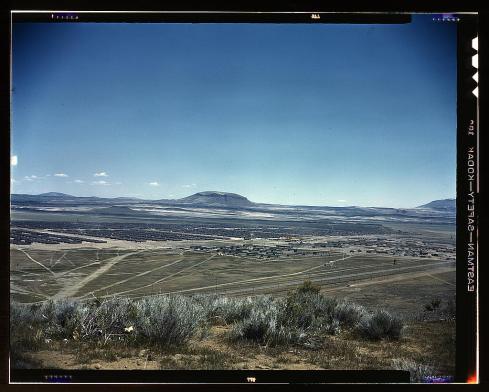
Japanese-American camp, war emergency evacuation, [Tule Lake Relocation Center, Newell, Calif. 1942 or 1943] 1 transparency : color. Collection: Library of Congress.
While looking at these Russell Lee attributed photographs consider these words about Miyazaki’s Camp Home by Karen Higa, Adjunct Senior Curator of Art at the Japanese American National Museum, wrote:
“President Franklin Roosevelt Delano Roosevelt ignored his own administration’s intelligence and in February 1942 issued Executive Order 9066, a presidential decree that paved the way for the largest mass movement of civilians in modern American history. Initially Japanese Americans were forbidden from living in western coastal regions; weeks later the US government began moving more that 110,000 civilians into temporary detention centers and finally to permanent camps. Over 700 government issued barracks were constructed o the dry lake bed at Tule Lake creating what amounted tot he largest population in a region of wind-swept sage brush.”
“The people that settled in Klamath after the war may not bear the specific responsibility of incarceration, but they share a generalized sense that something happened. their homes have a prior life worth recognizing.”
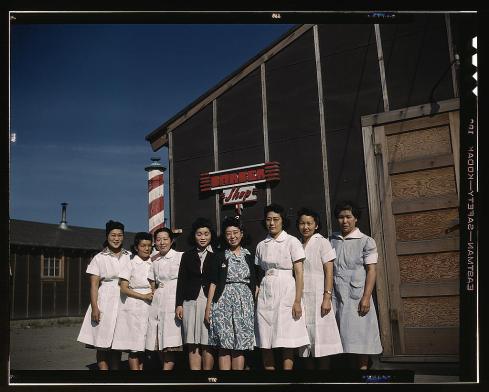
Japanese-American camp, war emergency evacuation, [Tule Lake Relocation Center, Newell, Calif. 1942 or 1943] 1 transparency : color. Original caption card speculated that this photo was part of a series taken by Russell Lee to document Japanese Americans in Malheur County, Ore. Re-identified as Tule Lake because of similarity to LC-USW36-789, which shows Abalone Mountain. Title from FSA or OWI agency caption. Photo shows eight women standing in front of a camp barber shop. Transfer from U.S. Office of War Information, 1944.

Japanese-American camp, war emergency evacuation, [Tule Lake Relocation Center, Newell, Calif. 1942 or 1943] 1 transparency : color. Original caption card speculated that this photo was part of a series taken by Russell Lee to document Japanese Americans in Malheur County, Ore. Re-identified as Tule Lake because of similarity to LC-USW36-789, which shows Abalone Mountain. Title from FSA or OWI agency caption. Photo shows eight women standing in front of a camp barber shop. Transfer from U.S. Office of War Information, 1944.

Japanese-American camp, war emergency evacuation, [Tule Lake Relocation Center, Newell, Calif. 1942 or 1943]. 1 transparency : color. Original caption card speculated that this photo was part of a series taken by Russell Lee to document Japanese Americans in Malheur County, Ore., and showed people transplanting celery. Re-identified as Tule Lake because of similarity to LC-USW36-789, which shows Abalone Mountain. Title from FSA or OWI agency caption. Transfer from U.S. Office of War Information, 1944. Repository: Library of Congress, Prints and Photographs Division, Washington, D.C. 20540 USA, hdl.loc.gov/loc.pnp/pp.print Part Of: Farm Security Administration – Office of War Information Collection 12002-55 (DLC) 93845501.
ELSEWHERES
It’s uncanny how the internet works sometimes. This image was the subject of some debate over at the Oregon State University Flickr Commons archive. Unsurprisingly, Kevin’s work was noted and praised there too.

KEVIN
As well as an excuse to wade through the various photographic approaches to Tule Lake internment camp, this post was to bring attention to Kevin’s ongoing contributions to the photo community. Kevin extends his teaching beyond his Milwaukee classroom and does us all a service by listing the interviews he serves up his class, on the class blog. Last week, Flak Photo called out for some more suggestions to the pile.
Kevin also launched collect.give last year which offers choice prints by respected photographers for prices no-one can quibble. All proceeds to good causes.
– – –
Kevin J. Miyazaki (b. 1966, USA) is a freelance editorial and fine art photographer based in Milwaukee, Wisconsin. He began his career on the staff of The Cincinnati Enquirer, and later became the photography director at Cincinnati Magazine. He went on to become the photographer at Milwaukee Magazine. His publication credits include, Time, Newsweek, Forbes, Fortune, National Geographic Traveler and numerous others. He is represented by Redux Pictures.





 Prison Photography