
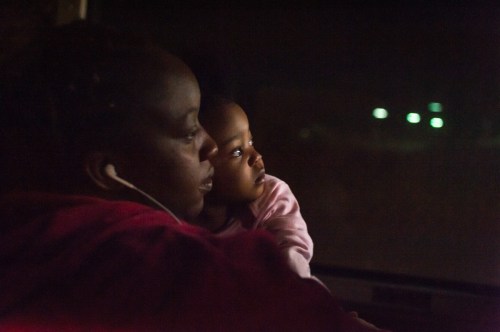
Every Friday Evening, in New York City, Women and Children Board Buses Headed for Upstate Prisons
Photographer Jacobia Dahm Rode Too and Documented, Through the Night, the Distances Families Will Go to See Their Incarcerated Loved Ones
_____________________
There are various ways to depict the family ties that are put under intense strain when a loved one is imprisoned. Photographers have focused on sibling love; artists have focused on family portraits, and documentarians have tracked the impact of mass incarceration across multiple generations. Often, the daily trials of family with loved ones inside are invisible, unphotographable, psychological and persistent—they are open ended and not really very easy to visualise.
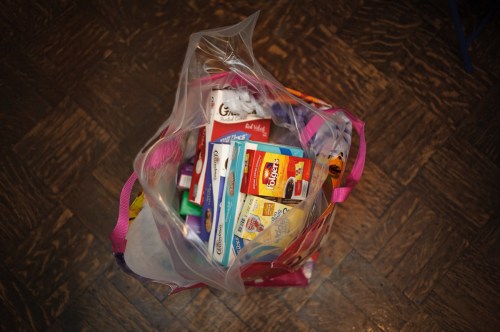
One of the many strengths of Jacobia Dahm’s project In Transit: The Prison Buses is that it very literally describes a time (every weekend), a duration (8 or 10 hour bus ride), a beginning and an end, and a purpose (to get inside a prison visiting room). In Transit: The Prison Buses is a literal example of a photographer taking us there. Dahm took six weekend trips between February and May 2014.
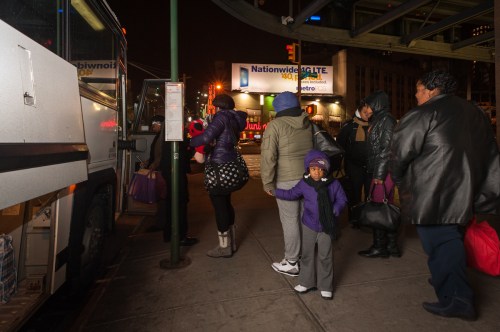
Dahm’s method is so simple it is surprising no other documentary photographer (I can think of) has told the same story this way. Dahm told me recently, that since the New York Times featured In Transit: The Prison Buses in November 2014, the interest and gratitude has been non-stop. I echo those sentiments of appreciation. Dahm describes a poignant set of circumstances with utmost respect. It is not easy to travel great distances at relatively large cost repeatedly, but families do. As a result, they take care of the emotional health of their loved ones — who, don’t forget are our prisoners — and society is a safer place because of it.
“Honestly, I don’t know why they place them so far away,” says one of Dahm’s subjects in an accompanying short film.
The women on these buses—and they are mostly women—are heroes.
I wanted to ask Jacobia how she went about finding the story and photographing the project.
Scroll down for our Q&A.



Prison Photography (PP): Where did the idea come from?
Jacobia Dahm (JD): In the fall of 2013, I began studying Documentary Photography at the International Center of Photography in New York. When the time came to choose a long-term project, I realized I had been captivated for a long time by the criminal justice system here in the U.S., where I had lived for the past decade. Frequently the severity of the sentences did not seem to make any sense, and the verdicts seemed to lack compassion and an understanding of the structural disadvantages that poor people — who make up the majority of prisoners— face. In short, sentencing did not seem to take human nature into account.
My sense of justice was disturbed by all of this. I was shaken when Trayvon Martin was killed and his killer walked free. Or when shortly after, Marissa Alexander, a woman who had just given birth, was given a 20-year sentence for sending a warning shot into the roof of the garage when cornered by her former abusive partner. Her sentence has since been reduced dramatically. But it’s complex: Where does a society’s urge to punish rather than help and rehabilitate come from? In both cases there was a loud public outcry. What’s remarkable is that there are frequent public outcries against the US justice system, because the system simply does not feel just. So I decided to do some work in this area.

JD: But how do you even begin to photograph injustice?
My original plan was to take on one of the most worrisome aspects of US criminal justice: I wanted to photograph the families of people who were incarcerated for life without parole for non-violent offenses. But New York State does not incarcerate in that category and, as I had classes to attend, travel to further locations would have meant trickier access and less time with the subjects.
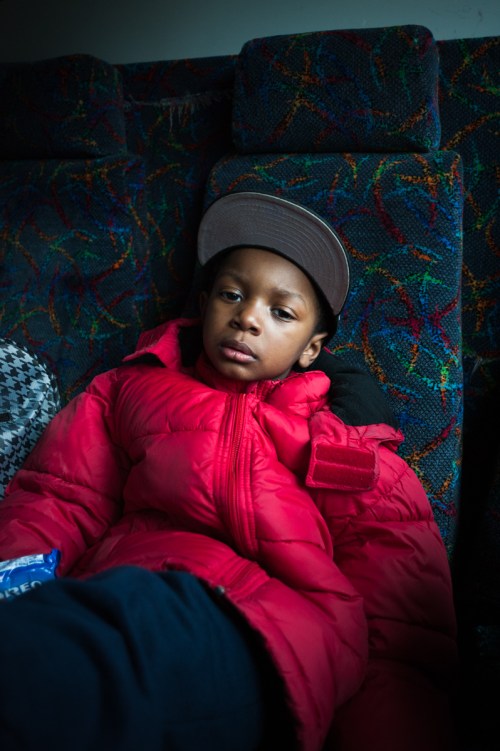
In conversation with one of my teachers Andrew Lichtenstein, who had done a good amount of work on prisons, he mentioned the weekend buses that take visitors to the prisons upstate. And once I had that image in my head — of a child on these buses that ride all night to the farthest points of New York State to see their incarcerated parent — I wanted to go and find that image.


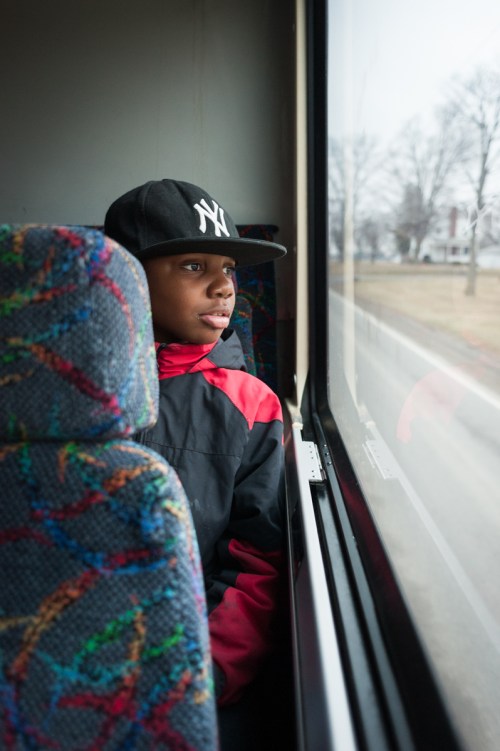
PP: How much preparation did you need to do? Or did you just turn up to the terminus?
JD: I researched the bus companies beforehand, some of them are not easy to find or call. And I had to find out which company went where. I also looked into the surroundings of each prison beforehand. I knew I would not be able to go into prison and knew most of them are in the middle of nowhere, so I had to make sure — especially since it was in the midst of freezing winter — that I would be within walking distance of some sort of town that had a cafe.
The first time I went upstate, it was on a private minivan. I had just finished reading Adrian Nicole LeBlanc’s amazing non-fiction book, Random Family that narrated life over a decade in the 1980s and 90s in the South Bronx. The characters in the book travel with a company called “Prison Gap” which is one of the oldest companies running visitor transportation in New York City, and so I felt they were the real deal and decided to use them on my first trip upstate.
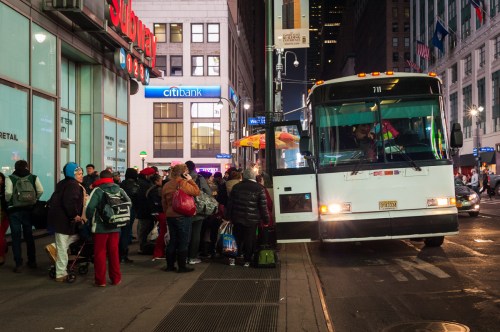
It was a freezing February night in 2014 and we gathered in a Citibank branch south of Columbus Circle for two hours before the minivans appeared. Many people came in to use the ATMs and some looked at us wonderingly, but no-one would have known that these people were about to visit prisons. What they would have seen is a mostly African-American crowd, mostly women, waiting for something.


PP: I see Attica in your photos, did you just photo one route or many?
JD: The bus I ended up focusing on — because riding on the same bus would allow me to get to know passengers better — went to six different prisons in the Northwest of New York State: Groveland, Livingston, Attica, Wyoming, Albion and Orleans. Most buses and mini vans ride to a number of prisons, that way they always have a full bus because they serve a wider demographic.
I wanted to be on a bus that went to Albion, the largest women’s prison in NY State, because my assumption was, that female prisoners get more visits from their children, simply because the bond is almost always the most crucial one. But I was wrong, because as it turns out, women have fewer visitors, and for a number of reasons: Women tend to act as the social glue and make sure visits happen. And so when they’re the ones who are incarcerated, not everyone around them takes over or can take over the same way. Some dads are absent and if the children are raised by the grandmother, that trip will be very difficult to make for an elderly person.

PP: What were the reactions of the families to your presence, and to your camera?
JD: The time I traveled upstate I was squeezed into the back of a white mini van, the only white person traveling up and the only one with a camera strapped around her neck. We drove all night and barely talked. It felt otherworldly thinking we are now driving to the Canadian border, but I forced myself to take at least a few pictures through the frozen window and of hands etc. Later the next morning we were moved to a larger bus and that bus was the one I rode on for the next five rides between February and May.

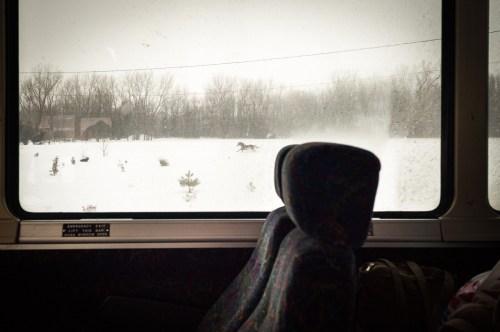
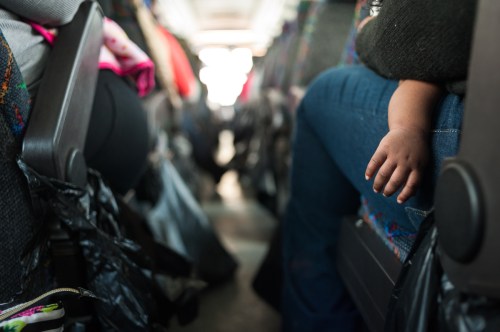

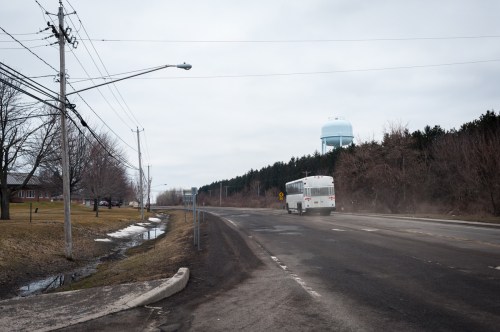
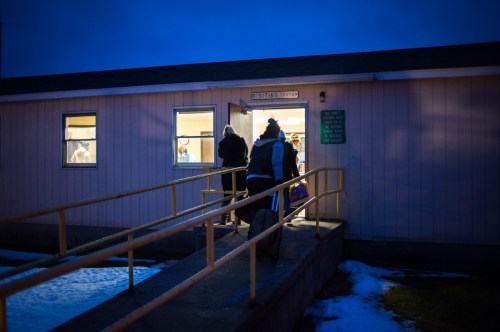
JD: The first one or two times I took the trip, I did not take many pictures on the bus and I photographed the towns instead. I could quickly tell there was a sense of shame involved in having family in prison, and people where uncomfortable being photographed, which I understand. People had to get used to me first an understand what I was doing. So I did what you do when you are in that situation: I introduced myself to people, I took some pictures and brought them a print next time.
Once they had seen me on the bus more than once they were starting to be intrigued. I also told them that I too was a parent and could not imagine having to bring my children on such a long and difficult journey, and that I was sorry this was the case for them. I think it was rare for many of these women to encounter any kind of compassion from others, and it might have helped them to open up to me.

PP: You describe the journeys as emotional, tiresome, grueling.
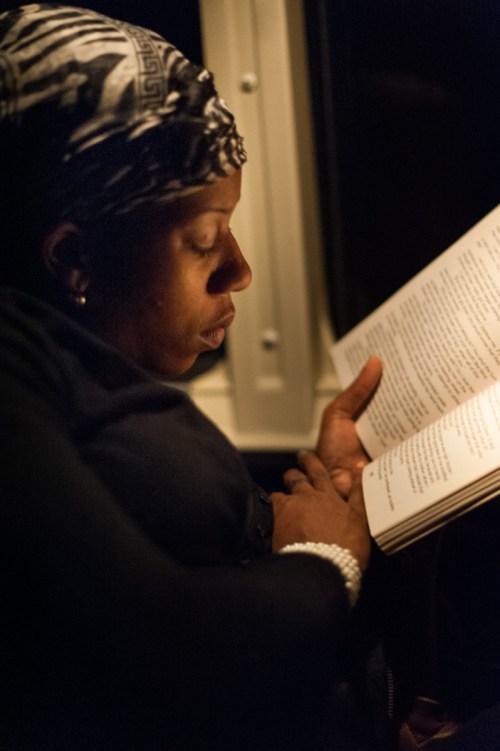
JD: You’re on the bus all night without getting much sleep. The expectations of the visits can be tense, because the mood of your entire relationship for the next week is depending on a few hours. But the journey has also been expensive and most likely exhausted all your funds for the week. During the visit you will be watched closely by the correctional officers, some of them might be rude to you. And if you bring your kids that aspect might be particularly difficult because you’re in no position to stand your ground.
You worry and hope your kids sleep well because you want them to be in good shape for the visit. I knew a grandmother who slept on the floor so her grandson could get the sleep he needed.

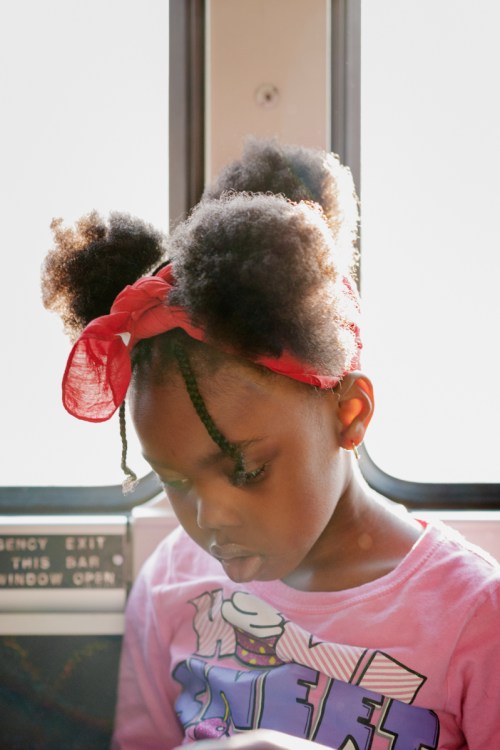
JD: Another one of the moms I knew was not allowed to bring her three kids to Attica because Attica only allows for three people to visit. The child that was left at home with a babysitter or family member was upset and that puts stress on the entire family.
PP: Why are New York State’s prison so far upstate?
JD: New York has around 70 state prisons, and many of them are in rural, post-industrial or post-agricultural areas. You could not get to some of these towns with public transport if you wanted to. The prisons have been economic favors to depressed rural areas that have little else to offer in terms of jobs, but not factored in is how these favors tear families apart and further widen the distance between children and their incarcerated parents.

PP: Do other states have similar geographic distances between communities and prisons?
JD: I am only beginning to understand what the system looks like in other states, but I believe people have to travel far in most states, as there seems to be no policy on the part of Departments of Corrections to place prisoners in proximity to their families.
In California for example, most prisoners at the Pelican Bay State Prison come from Los Angeles, and that prison is a 12-hour ride away. In Washington D.C. it seems a large part of the prisoners are placed federally, rather than within state, so the distances can be even larger. And with distance come increased travel costs that poorer families have a very hard time covering with regularity.

JD: Considering that family ties are crucial in maintaining mental health and key in helping the prisoners regain their footing when they are out, it is a cruel oversight not to place people closer to those that are part of the rehabilitation process. Statistics tell us that the majority or prisoners have minor children.
PP: What can photography achieve in the face of such a massive prison system?
JD: I think at the very least pictures of an experience we know nothing about can create awareness, and at best it can move people to develop a compassion that can move them to act. I think a photograph can give you a sense of how something feels. Seeing is a sense of knowing, and it’s easy not to care if you don’t know.
In the face of the U.S. incarceration system — a system that seems to be concealed from most people’s sight but at the same time permeates so many aspects of the American life and landscape—it feels particularly important to me that photography plays the role of a witness.


PP: How do you want your images to be understood?
JD: I think my images highlight a difficult journey that many people know nothing about.
The focus of the journey, and of my photographs, is on the people that connect the inside of a prison to the outside world: the families.
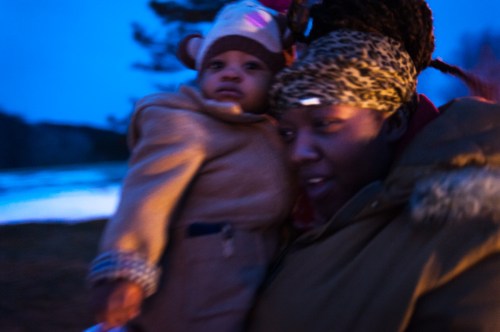
It might be that by seeing how an entire family’s life is altered people seeing those images and beginning to understand something about how incarceration affects not just the person on the inside, they are maybe capable of a compassion they don’t usually afford for prisoners themselves.


PP: How do you want your images to be used?
JD: It’s hard to say because I believe an artist’s intention has limits when it comes to how the work is used.
I want people to put themselves in the families’ shoes. I want these images to help people begin to imagine what the secondary effects of incarceration are and how they could be softened. 10 million children in the US have experienced parental incarceration at some point in their lives, and that is not a good start in life for a very large number of the most vulnerable population.


BIOGRAPHY
Jacobia Dahm (born Frankfurt, Germany) is a documentary storyteller and portrait photographer based in New York and Berlin. She graduated from the International Center of Photography in 2014, where she was a Lisette Model Scholar and received the Rita K. Hillman Award for Excellence. Dahm’s photography and video has been recognized with awards from Rangefinder and the International Photography Awards. Her work has been published by Makeshift Magazine, The New York Times, Shift Book, AIAP and Prison Photography. Her key interest is documenting issues of social justice.


8 June 2012: Crescent City, CA. California State Prison: Pelican Bay Prison. Examples of kites (messages) written by prisoners. These were discovered before they were smuggled out.
Too often since writing this post, I have lamented the dearth of images of solitary confinement. We have suffered as a society from not seeing. A few years back a change began. Solitary confinement became an anchor issue to the prison reform and abolition movements. Thanks largely to activist and journalist inquiry we’ve seen more and more images of solitary confinement emerge. However, news outlets still relying on video animation to tell stories, which would indicate images remain scarce and at a premium.
Robert Gumpert has just updated his website with photographs of Pelican Bay State Prison. Some are from the Secure Housing Unit (SHU) that has been the center of years of controversy and the locus of 3 hunger strikes since the summer of 2011. Other photographs are from the general population areas of the supermaximum security facility.
Click the “i” icon at the top right of Gumpert’s gallery to see caption info, so that you can be sure which wing of this brutal facility is in each photograph.

Despite seeing Gumpert regularly, I am still not aware of exactly how these images came about. I think Gumpert was on assignment but the publication didn’t, in the end, pull the trigger. Their loss is our gain. Gumpert provides 33 images. It’s a strange mix. I’d go as far to say stifled. Everything is eerily still under dank light. We encounter, at distance, a cuffed prisoner brought out for the camera. Gumpert’s captions indicate interviews took place, but there are no prisoners’ quotes. In a deprived environment it makes sense that Gumpert focuses on signs — they point toward the operations and attitudes more than a portrait of officer or prisoner does, I think.
The gallery opens with images from the SHU and then moves into the ‘Transition Housing Unit’ which is where prisoners who have signed up for the Step-Down Program are making their transition from assigned gang-status to return to the general population. Critics of the Step-Down Program say it is coercive and serves the prisons’ need more than the prisoners.
Note: It doesn’t matter how the prisoner identifies — if the prison authority has classed a prisoner as a gang member it is very difficult to shake the label. The Kafkaesque irreversibility of many CDCR assertions was what led to a growth in use of solitary in the California prisons.

8 June 2012: Crescent City, CA. California State Prison: Pelican Bay Prison. A SHU cell occupied by two prisoners. Cell is about 8×10 with no windows. Bunks are concrete with mattress roles. When rolled up the bunk serves at a seat and table.. Cones on the wall are home made speakers using ear-phones for the TV or radio. Speakers are not allowed.
I’ve picked out three images from Gumpert’s 33 that I think are instructive in different ways. While we may be amazed by the teeny writing of a prisoner in his kites (top) we should also be aware that these were shown to Gumpert to re-enforce the point that prisoners in solitary are incorrigible. The suggestion is that these words are a threat and we should be fearful. But we cannot know if we cannot read them fully. How good is your eyesight? Click the image to see it larger.
As for the “speakers” made of earphones and cardboards cylinders! Can those really amplify sound in any meaning full way?
And finally, to the image below. I thought the quotation marks in the church banner (below) were yet another case of poor prison signage grammar, but reading the caption and learning that the chapel caters for 47 faiths, makes “LORD’S” entirely applicable. Not a single lord but the widest, most ill-defined, catch-all version of a lord (higher presence/Yahweh/Gaia/Sheba/fog-spirit/Allah/fill-in-the-blank) in a prison that is all but god-forsaken.
See the full gallery.

8 June 2012: Crescent City, CA. California State Prison: Pelican Bay Prison. The religion room serving 47 different faiths and beliefs.

Say NO to a New Jail in SF
The discussion about the long proposed San Francisco County Jail has taken many turns. It’d have been built by now without the opposition of many California groups fighting for social justice under the umbrella organisation CURB (Californian’s United for Responsible Budget).
On Monday, March 2nd from 6-8pm, Sheriff Mirkarimi and staff from the Department of Public Works will be hosting a public meeting on the environmental impact of the $278 million dollar jail plan at the Community Assessment and Service Center (CASC).
The CASC at 564 6th Street in San Francisco — it is just around the corner from San Francisco County Jail #3, at 850 Bryant.
All info and RSVP here.
RALLY
The protest rally begins in front of the jail at 850 Bryant on Monday, March 2nd at 5:30pm and moves to the Community Assessment and Service Center (CASC).
“Come prepared to dance! We will be joined by the BLO (Brass Liberation Orchestra)” says organiser Lisa Marie Alatorre, of the San Francisco Coalition on Homelessness. “San Francisco needs real solutions to public safety, housing, jobs, education, mental health care, not more of the same failed policies that harm our community. Justice is won when we build a future of opportunity for everyone, not more jails.”
Make banners and signs that reflect the environmental impacts that jail and incarceration has on your life and your community.
All info and RSVP here.
CITY HALL MEETING
Separately to the Sheriff’s meeting, the Capitol Planning Committee is voting on the jail plan also on Monday!
Anyone who can speak out against the jail should go to San Francisco City Hall from noon to 2pm Monday, March 2nd and voice their concerns.
GET THE WORD OUT
On Facebook
#NoMoreJails
All info and RSVP here.
UPDATE: WEDS., 25TH FEB, 2:50PM. I JUST HEARD FROM PARSONS THAT THE WORKSHOP IS FULL. THAT IS GOOD NEWS FOR MARK AND THE PARTICIPANTS. LESS GOOD FOR THOSE WHO MAY HAVE GOT THEIR HOPES UP BECAUSE OF THIS POST.
__________
SPACES ARE STILL AVAILABLE FOR MARK STRANDQUIST’S TALK These Images Won’t Tell You What You Want: Collaborative Photography and Social Justice AT THE SJDC ON FRIDAY, FEBRUARY 27TH AT 6PM.
__________

Description from prisoner at Richmond County Jail, Virginia, from a workshop by Mark Strandquist.
WINDOWS FROM PRISON
Mark Strandquist will be coordinating a participatory workshop this Saturday, February 28, in New York City. Over the course of the day, artists, activists, lawyers, students, journalists, photographers, corrections officers, formerly incarcerated individuals and others will work together through dialogue to create photographs requested by prisoners in New York state.
Mark and his collaborators who include the Correctional Association of New York, the Young New Yorkers, Exalt Youth and the New York Writers Coalition have already sourced written responses from prisoners to the question:
“If you had a window in your cell, what place from your past would it look out to?”
The workshop is at the Sheila C. Johnson Design Center, at the Parsons School of Design. Those who gather at SJDC on Saturday will travel in groups to the various locations to make images, which will be sent back to the prisoners.
The workshop is part of the programming for Prison Obscura, a show of prison photography I have curated. Prison Obscura includes Strandquist’s series Some Other Places We Have Missed which was the earliest iteration of his workshops conducted in Richmond Jail, Virginia. Since then, Strandquist has partnered with local reform groups and stakeholders in the prison issue to custom-designed workshops in Washington D.C. and Philadelphia.
The ongoing program of workshops Windows from Prison is designed to open up conversation about the impacts of mass incarceration by using the medium of photography.
Images made during the workshop will be exhibited in the atrium space of the Sheila C. Johnson Design Center adjacent to the Prison Obscura exhibit.
__________
Prison Obscura is made possible with the support of the John B. Hurford ‘60 Center for the Arts and Humanities and Cantor Fitzgerald Gallery at Haverford College, Haverford, PA.

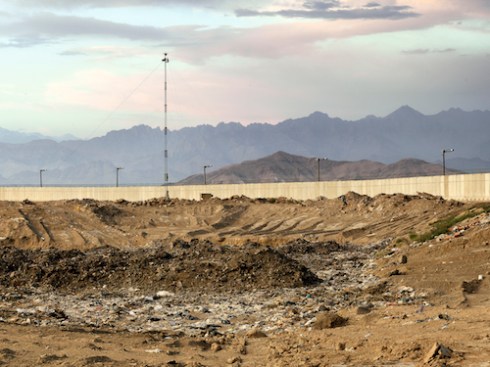
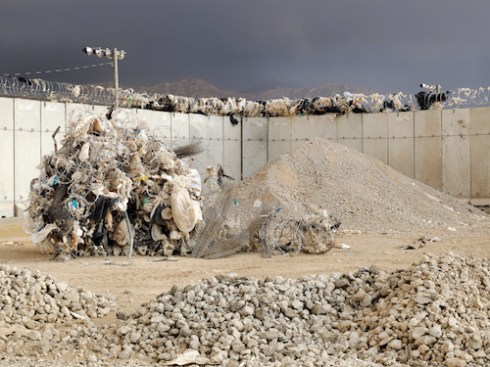
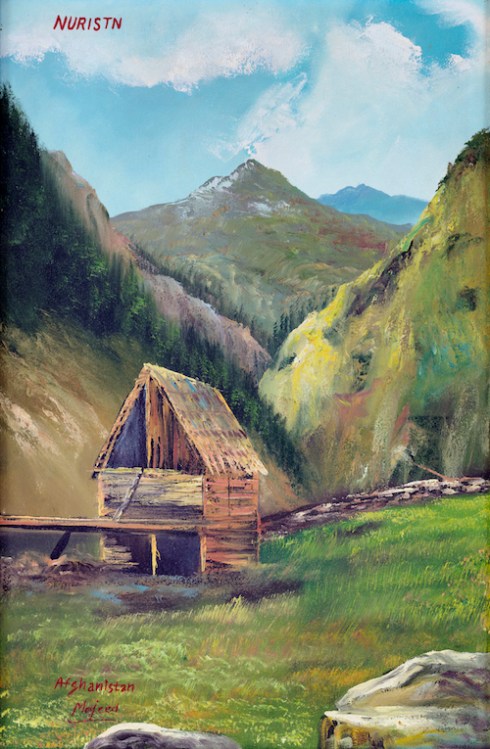
Edmund Clark is cheeky, thoughtful and a bit subversive in his critique of institutional power. During his 10 days embedded at Bagram Airbase in October 2013, he realised most people there don’t ever get outside its confines.
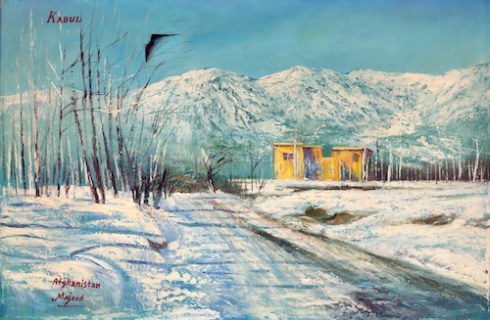
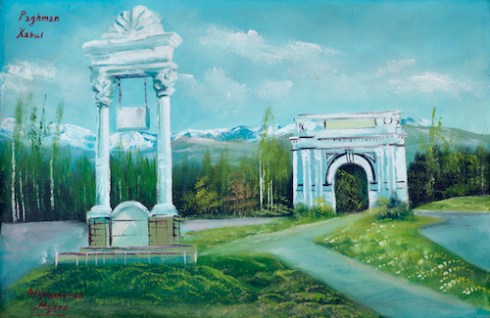
But Bagram has nice paintings of murals to provide an idealised Afghanistan.
My latest for WIRED, The 40,000 People on Bagram Air Base Haven’t Actually Seen Afghanistan I consider his latest body of work and book Mountains Of Majeed:
Clark documented the infrastructure needed to support a military base that covers 6 square miles and employs 40,000 people. He photographed everything from the mess halls and laundry to the sewage treatment system, but the colorful murals and paintings dotting the base most intrigued him. They depict an idyllic, romanticized vision of the local landscape and Hindu Kush, one free of war. The reality, of course, was much bleaker, with the distant peaks of the mountains beyond Bagram riddled with conflict and danger.
Read the piece in full.





IS THE INTERNET BECOMING LESS SNARKY?
Portraits of incarcerated youth made by Steve Davis were published on BuzzFeed yesterday. That they are featured does not surprise me; no, it is the reasonable comments that follow that surprise me.
They internet, a space known to often bring out the worst in people has had a special place for trolls as far as images of American prison and prisoners are concerned. Often photographs themselves are bypassed in discussion in order for commenters to shortcut straight to their long held positions — by they left or right, sympathetic or not, nuanced or short-sighted, familiar or prejudiced. Prisons are a divisive issue and often people miss the point of prison photographers who, in the first instance at least, are merely trying to hold a mirror to a system. In this case, Davis holds a mirror to a nation that locks up 65,000 youth on any given night at a cost of $5billion per year.
In my own prejudice, I would’ve expected THE INTERNET + BUZZFEED + KIDS IDENTIFIED AS CRIMINALS would be an equation for vitriol. Not so.
Why would I be so pessimistic? Well, despite BuzzFeed founder Jonah Peretti’s insistence that serious, longform news can exist beside listicles — and despite recent pieces — on last meals of the executed, a trans-activist transforming a prison from within, reflections on wrongful conviction, and the shacking of women prisoners in labor — BuzzFeed content still leasn heavily on shock, innumerable pet vids, “27 things you only know if…” nonsense, and flashes of celeb flesh. The lowest denominators remain our and BuzzFeed’s bread and butter.
All that said, let’s just be thankful for this comment thread:
Some of these faces are so hard. Some are bewildered. And some are just heartbreaking. So beautiful and tragic.
Each one of these faces should never have ended up there. Their incarceration marks the failure of society to raise contributing citizens.
That would imply that society failed every person who has made bad choices. That’s simply not a generalization that pans out entirely. I don’t disagree that we have failed many of these faces as a society, just the generalization.
Look to the parents. Well, perhaps they are/were also incarcerated. Sad all around.
There needs to be a better solution to helping these kids achieve more in life. Yes punish them for their crimes but surely there is better way! Locking them up like this gives them no hope of something better! Nobody but them know the full story so why jump to saying they “deserve” it? some of these kids have been failed by family, peers, society which has resulted in this! Tragic!
I think we should look to the systems used in Scandinavian countries — humane prisons, lots of community service, a focus on rehabilitation, not punishment. …Or we could just stop monetizing the prison system, that would help.
The system makes money off of these children, and I guarantee you there is not one child in there whose parents have a little bit of money! Our prisons are filled with poor people! Justice is definitely not blind!
I can see where you’re coming from, but in my personal experience (two relatives that have been incarcerated both as youth and as adults), there are individuals who will, regardless of the number of chances given, continue to make the wrong choices. You can not force, coerce, or convince someone to act and live as you see fit. They will make choices of their own. These are individuals that do, in fact, deserve the punishments they receive. Like you said only they know the whole story, but regardless of that fact, there are some choices that incarcerated individuals have made that have impacted the lives of innocent people. Do those choices, then, not merit the fullest punishment?
I DO, however, believe there are also individuals who can be guided into a better life because they’ve only known one way. These are the individuals that CHOOSE to make themselves better, both in their own eyes and in societies eyes. They make the choice, and seek out those that can help guide them.
One summer in college, I had an internship in WA for an office of juvenile probation. I went to one of these places with one of the counselors because one of the kids was going to be getting out soon and heading home. This kid was probably 14 or 15 and I remember him sitting there crying because he didn’t want to leave. He had been in out of the system for years and I remember him telling us that no matter how bad it was there, he knew he was going to get fed and have a place to sleep. He told us that he was going to do something as soon as he got out that would send him back. It was tragic on so many levels. Everyone had just given up on this kid and he had pretty much given up on himself.
Locking up a young person in prison is always a shocking and sad thing, but what concerns me is people’s knee jerk reaction that all youth incarceration reflects society’s ultimate failure. Remember, most of you are also the same people who regularly rage against the violent and intolerable stories we read about rape and murder that we regularly see on this site. There are thousands of teenagers (perhaps some of the faces you are seeing here) who are guilty of these crimes. Are you saying that we needn’t incarcerate minors who commit violent crime? Should these individuals only be counseled then allowed to return into society? Despite the fact that several here have unilaterally declared that each of these incarnations are the wholesale fault of society’s failure?
But our prisons out not filled to the brim with people who have committed the kinda of crimes you speak of, and THAT is the failure.
I work in the teen department of my library system, and every librarian takes turns to go visit our JDC to talk to the kids there and find books for them in the collection we maintain at the facilities for them. It’s hard seeing them…especially when they’re super young (I swear a couple I’ve seen couldn’t be older than 11), or especially when you’ve helped them in your branch before. It sucks, and I just always hope that they can come around and learn from the experience and never become a repeat offender.
I have a serious problem with photographers leaving their [captioning on] photos blank when it comes to picturing at risk groups. Each has their own valuable story to tell and name. They are not just “black kids: or troubled youths or street punks etc…the categories that pop up due to the viewers own prejudices. We live in a fucked up world. Such photography should be there to give names to the victims and not participate in their being reduced to a number in the “incarceration game.”
Perhaps the Facebook-linked comment board has sophistication to remove idiot comments and promote those exhibiting most human thought?
Internet, you have my faith again.
Even the commenter that wonders about an anonymous portrait showing a youth with painted nails and foolishly labels the child as possibly “a fabulous homosexual” goes on to demonstrate a knowledge of the system that is unable to adequately care for LGBQIT youth; “In adult prisons obviously gay or transgendered individuals are usually put in solitary confinement for their own protection.” We know that is an unacceptable situation. LGBQIT prisoners are denied access to programming because prisons cannot guarantee their safety in general population.
Unfinished: Incarcerated Youth
Steve Davis is currently taking pre-orders for a book of his photographs from Washington State juvenile prisons, titled, Unfinished: Incarcerated Youth.
You can preorder with Minor Matters Books.
G-LAW
Fight Hate With Love, a documentary film about Philadelphia-based artists and activist Michael Tabon (a.k.a. G-Law a.k.a. OG-Law) has been shortlisted for the Tim Hetherington Trust‘s inaugural Visionary Award.
The film made by Andrew Michael Ellis, director of photography at Mediastorm is about “one man’s journey to change the world and still be the guide his family needs him to be.”
The film looks inspiring, but as with any narrative arc, the protagonist faces challenges. It seems the stresses of Tabon’s art and activism upon his family is the emotive hook, Ellis is molding.
I met Tabon and his wife Gwen this time last year as he was embarking on his third self-imposed lock up in a self-built cell on the cold February streets of Philly. They did not display the tension as they do in Ellis’ trailer. Tabon was putting his un-prison cell together and Gwen was helping with supplies, PR, food & drink, and vocal support. It was clear they rely on one another to make work and to meet the silent, unending need for Tabon’s love-filled message.
Tabon’s manipulation of visual tropes is cunning and effective. He has reclaimed the cell, the orange jumpsuit and the shackles. He has jogged 10 miles a day for seven days around Philadelphia with a 40-foot banner reading FIGHT HATE WITH LOVE. He has walked with a ball-and-chain from Selma to Montgomery.
“Tabon has been caught in the revolving door of the prison system since he was sixteen years old. Incarceration became a way of life, seen as an inherited destiny for America’s young Black poor, until he had a revelation – that he could break the cycle of the womb-to-prison pipeline gripping marginalized communities across the country,” says Mediastorm.
It’s wonderful to see Tabon on the Mediastorm platform and Hetherington Trust’s radar. His unorthodox but unmissable approach to social change needs to go national.
Youtube trailer here. Follow Tabon on Twitter and on the web.


 Prison Photography