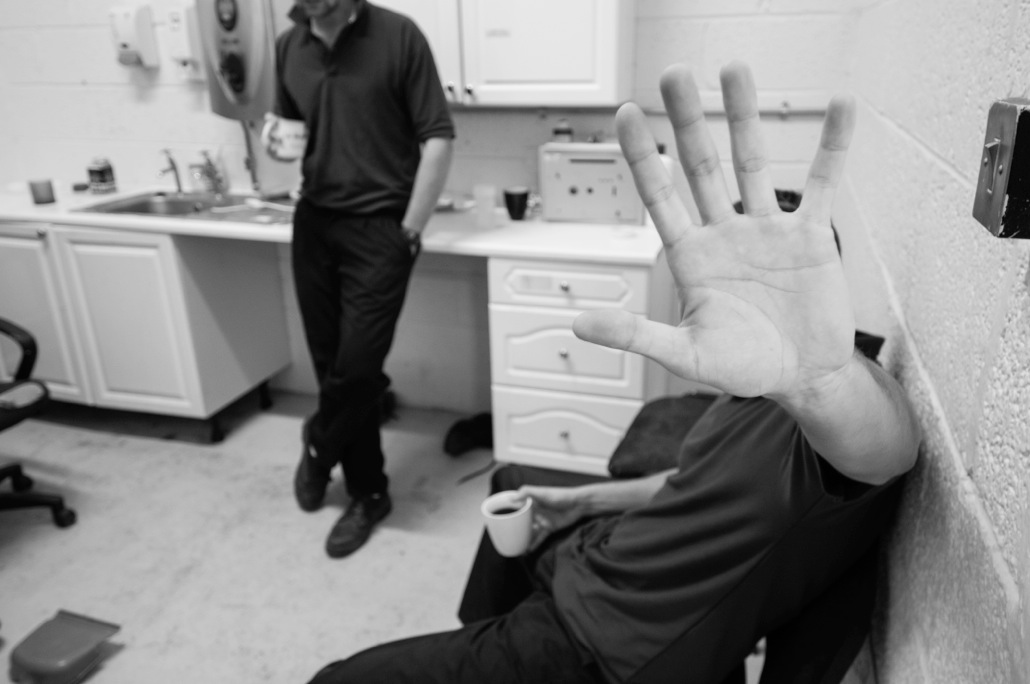
Photographs © Inside View  Guernsey 2013. Courtesy of Jean-Christophe Godet

Cameras needn’t always be a security tool. And, in the hands of prisoners, they needn’t be a security hazard. I’m always encouraged to find photo-education-projects in prisons that nurture storytelling skills of prisoners. Therefore, the Inside View project in Guernsey, a Channel Island in Europe, is cause for interrogation.

CONTEXT

I’ve written about the history of photography workshops in prisons, but let me offer a quick re-cap. Except for photo workshops in New York in the 1970s to Washington D.C. in the 1980s no other photography classes that I know of have existed in male adult prisoners in the U.S. None occur today.

Internationally, programs in Columbia, Romania and Switzerland prove the model exists. In U.S. juvenile facilities photo education has operated in Washington State and currently exists in New Mexico and Rhode Island. Generally, we can say that these isolated examples are the exception rather than the rule.

A SIGNIFICANT PROGRAM

Given the paucity of photo-workshops, current and ongoing programs such Inside View are noteworthy, and Inside View might even be a program from which we can learn. It could be replicated! Inside View is the brain child of Jean-Christophe Godet, who also happens to be the Director of the Guernsey Photography Festival.

“Designed to help the participants acquire new technical and social skills, a sense of responsibility, a better understanding of themselves and a greater awareness of the environment in which they live in,” reads the press release, the Inside View project gives prisoners access to equipment and teaches them technical skills.

Inside View started at the end of 2010 with workshops taking place each week over six months. To date, three workshops have taken place, always discussing the importance of objectivity and integrity in creating a documentary.

Photographs © Inside View  Guernsey 2013. Courtesy of Jean-Christophe Godet

“The thing I can’t get my head round is that these teachers trust us,” says one prisoner-participant in the same press release. “They respect us and give us well expensive kit to hold and to use. The cameras belong to them and it feels good to be given the responsibility to be trusted with their precious cameras. I will always have the camera round my neck, I will teach my children to look after their things and to respect kit”

“I like it when this gives us a chance to show the outside that we don’t live in a 5* hotel,” reflect a another participant. “We are told when to eat, when to exercise, and we see doors but cant open them. I think that our pictures have captured the essence of what it is to lose your freedom. That’s why our photos are so good”

The assistance of the Governor and prison officers was essential for Inside View to play out, with Officers Dave White and Belinda Help at the sharp end of negotiating the exemplary project.

David Matthews, Guernsey Prisons Governor says, “It is important that prisoners can learn technical and life skills whilst in custody, these new skills can help in reducing offending behaviour and aid resettlement. There is a marked difference in behaviour and attitude when prisoners are exposed to these types of activities.”

Photographs © Inside View  Guernsey 2013. Courtesy of Jean-Christophe Godet

LESSONS LEARNT

Let’s be clear, the Channel Island of Guernsey is quite different to the U.S., or anywhere else for that matter. It is a province with a population of only 65,000. It has a single prison — The Guernsey Prison — with only 122 prisoners. For the sake of comparison, that’s 0.005% of the U.S. prison population which stands at 2.3 million.

If we wanted to imagine a similar program taking grip in the American prison industrial complex, we’d have to deal with massive issues of scale and the inconveniences they cause. Nevertheless, the point is made, photography can be a voice for prisoners — to facilitate that there only need be the resources, the will of any given administration, and systems of political and security that are less interested in covering their ass than they are in delivering rehabilitation.

To find out exactly how the program came about, I asked Inside View coordinator Jean-Christophe Godet a few questions.

Prison Photography (PP): Where did the idea to put cameras in the hands of prisoners come from?

JCG: Inside View was inspired by a similar project organised by a collective of photographers “FrameZero” at the Wandsworth Prison in London in the late 90’s. The project was run by Jason Shenaï.

PP: You worked with the Guernsey prison services. How did you negotiate that?

JCG: It took almost three very long years of negotiation. My first letters and emails were simply ignored. I finally met Wendy Meade by chance (she came to one of my photography courses) who told me that she was a prison visitor. I took the opportunity to talk to her about my project. She then introduced me to a Deputy Governor who gave me an opportunity to explain in details what I was trying to achieve.

PP: Who is Wendy Meade?

JCG: Wendy is part of The Panel of Prison Visitors comprised of six volunteers, at present appointed by the Policy Council. They are an independent body authorised by the 1998 Prison Administration (Guernsey) Ordinance to pay frequent visits to the prison at any time of day or night. At least two members are required to visit at least once a month.

PP: What were the prisoners’ reaction to the project?

JCG: I think they didn’t know what to expect first. They took the opportunity to join the group as they had nothing else to do..

Very quickly they started to get more and more involved. The course now is completely oversubscribed with a long waiting list. One of the first reactions that I always get is, “What do you want us to photograph? There is nothing interesting here.” I see my role as teaching them to see and look in a different way.

Photographs © Inside View  Guernsey 2013. Courtesy of Jean-Christophe Godet

Photographs © Inside View  Guernsey 2013. Courtesy of Jean-Christophe Godet

Photographs © Inside View  Guernsey 2013. Courtesy of Jean-Christophe Godet

PP: What was the staff’s reaction to the project?

JCG: The course created lots of challenges for the staff as I didn’t want to stay inside the classroom. I needed to have access to every single corner of the prison. In this special environment having a group of prisoners walking around with cameras on hands is obviously a logistical nightmare. The administration finally came up with an idea of having a dedicated security officer who walks around with us everywhere.

I have a great respect for the staff. Their job is not easy and can be very stressful but their attitude has always supportive and helpful. There is nothing we can do without their help so it was important to gain a level of trust but also share some understanding.

PP: You made over 2,000 pictures for the third iteration of the project and edited those down to 40 for the exhibition. Can you tell me about the editing process?

JCG: We did a couple of sessions with the prisoners where we looked at the photos and decided which ones worked best and why. We didn’t have access to computer inside the prison so I processed all the photos in my studio and did the final editing.

My hope is to give prisoners a way to express themselves, building their self-esteem and reaching a sense of achievement and proud in what they managed to produce. I occasionally meet some of them whose been released. When they tell me that they are still taking photos or saving to buy a new camera, it makes my day.

PP: Thanks Jean-Christophe

JCG: Thank you, Pete.
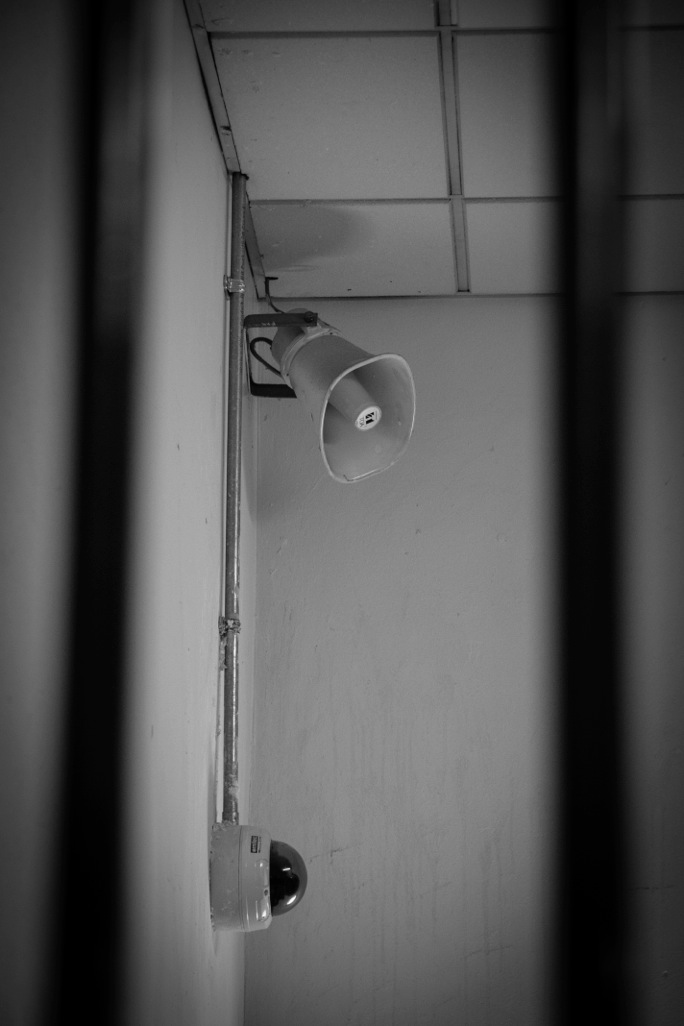
Photographs © Inside View  Guernsey 2013. Courtesy of Jean-Christophe Godet

Photographs © Inside View  Guernsey 2013. Courtesy of Jean-Christophe Godet

Photographs © Inside View  Guernsey 2013. Courtesy of Jean-Christophe Godet

    Photographs © Inside View  Guernsey 2013. Courtesy of Jean-Christophe Godet

Photographs © Inside View  Guernsey 2013. Courtesy of Jean-Christophe Godet

EXHIBITION

Presented by the Guernsey Prison in collaboration with the Guernsey Photography Festival, Inside View was first exhibited in November 2013, at the Guernsey Prison Visitors Centre. Inside View is on show from 20th of March – 4th April 2014, at the Gatehouse Gallery, Elizabeth College, The Grange, St Peter Port, Guernsey GY1 2PY

AWARD

Inside View was awarded the Koestler Trust’s William Archer Platinum Award for photography, which attracts more than 5,000 entries from offenders across the UK. The Trust promotes the arts in special institutions, encouraging creativity and the acquisition of new skills as a means to rehabilitation.
01_Apokaluptein16389067

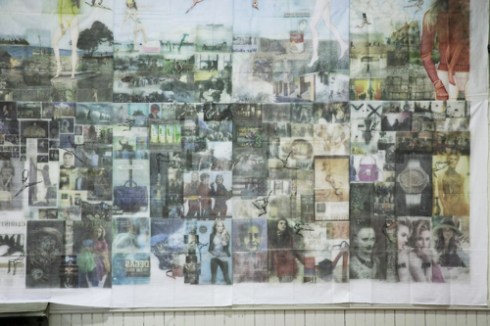
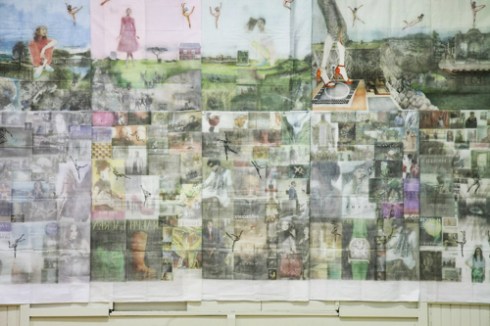
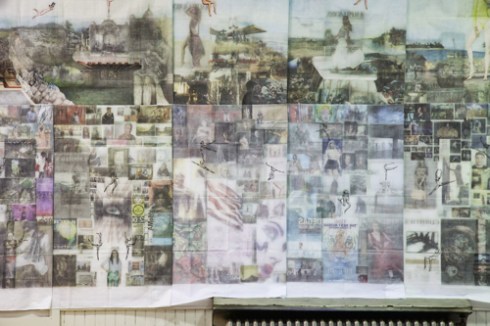
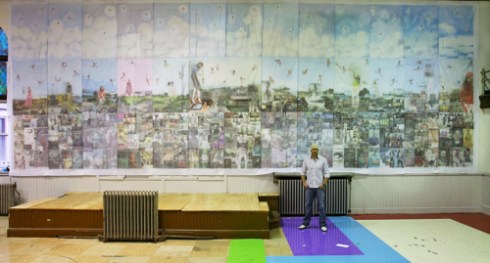
Artist Jesse Krimes stands in front of his 39-panel mural Apokaluptein:16389067 (federal prison bed sheets, transferred New York Times images, color pencil) installed, here, at the Olivet Church Artist Studios, Philadelphia. January, 2014.

The New York Times has a track record for high quality visual journalism. From experiments in multimedia, to its magazine’s double-truck features; from its backstage reportage at the swankiest fashion gigs, to their man in town Bill Cunningham. Big reputation.

NYT photographs are viewed and used in an myriad of ways. Even so, I doubt the editors ever thought their choices would be burnished from the news-pages onto prison bed-sheets with a plastic spoon. Nor that the transfer agent would be prison-issue hair gel.

In 2009, Jesse Krimes (yep, that’s his real surname) was sentenced to 70 months in a federal penitentiary for cocaine possession and intent to distribute. He was caught with 140 grams. The charges brought were those of 50-150 kilos. Somewhere in the bargaining it was knocked down to 500 grams, and Krimes plead guilty to conspiracy. The judge recommended that Jesse be sent to a minimum security prison in New Jersey, close to support network of friends and family, but the Federal Bureau of Prisons (BOP) opted to send him to a medium security facility in Butner, North Carolina — as far away as permitted under BOP regulations. That was the first punitive step of many in a system that Krimes says is meant first and foremost to dehumanise.

“Doing this was a way to fight back,” says Krimes who believes ardently that art humanises. “The system is designed to make you into a criminal and make you conform. I beat the system.”

Last month, I had the pleasure of hearing Krimes speak about his mammoth artwork Apokaluptein:16389067 during an evening hosted at the the Eastern State Penitentiary and Olivet Church Artist Studios in Philadelphia.

The mural took three years to make and it is a meditation on heaven, hell, sin, redemption, celebrity worship, deprivation and the nature of perceived reality. Krimes says his “entire experience” of prison is tied up in the artwork.

07_Apokaluptein16389067

In the top-left is a transferred photo of a rehearsal of the Passion play at Angola Prison, Louisiana.

05_Apokaluptein16389067

17_Apokaluptein16389067

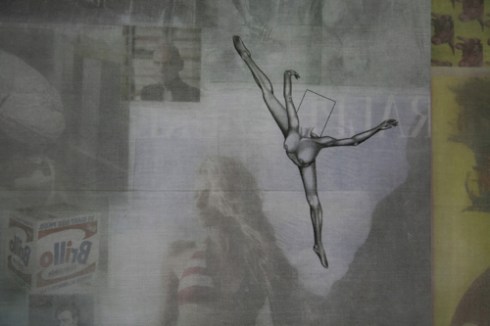
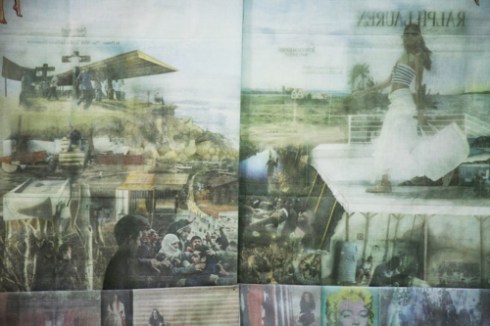
Through trial and error, Krimes discovered that he could transfer images from New York Times newspapers on to prison bedsheets. At first he used water, but the colours bled. Hair gel had the requisite viscosity. As a result, all imagery is reversed, upturned. Apokaluptein:16389067 is both destruction and creation.

“It’s a depiction of represented reality as it exists in its mediated form, within the fabric of the prison,” says Krimes. “It was my attempt to transfer [outside] reality into prison and then later became my escape when I sent a piece home with the hopes that it could be my voice on the outside in the event that anything bad ever happened and I never made it home.”

ART AS SURVIVAL

Krimes says this long term project kept him sane, focused and disciplined.

Each transfer took 30-minutes. Thousands make up the mural. Krimes only worked on one sheet at a time, each of them matching the size of the tabletop he worked on. A notch in the table marked the horizon line for the 13 panels making up the center horizontal. He shipped them home. Not until his release did he see them together.

The enterprise was not without its risks, but Krimes found favour being a man with artistic talent. He established art classes for fellow prisoners in an institution that was devoid of meaningful programs.

“Prisoners did all the work to set up the class,” says Krimes.

Once the class was in place, guards appreciated the initiative. It even changed for the better some of the relationships he had with staff.

“Some helped mail out sections,” he says of the bedsheets which were, strictly-speaking, contraband.

Krimes would cut sections from the New York Times and its supplements, sometimes paying other prisoners for the privilege.

“In prison, the only experience of the outside world is through the media.”

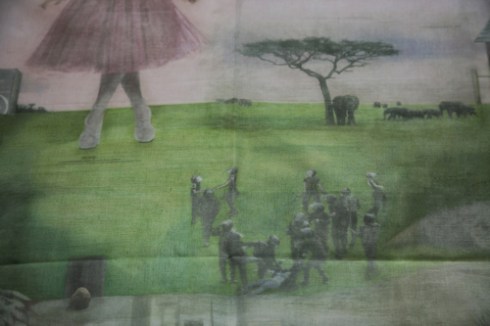
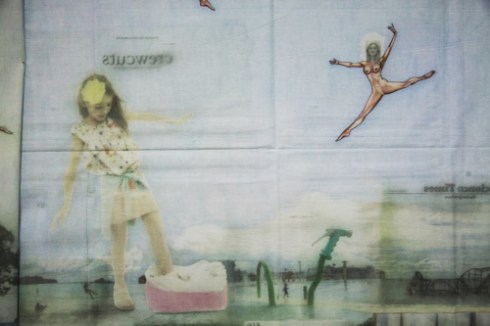
The horizon is made of images from the travel section. Beneath the horizon are transferred images of war, and man-made and natural disasters. Krimes noticed that often coverage of disasters and idealised travel destinations came from the same coasts and continents. Influenced by Dante’s Inferno and by Giorgio Agamben’s The Kingdom and the Glory, Krimes reinvigorates notions of the Trinity within modern politics and economics. The three tiers of the mural reflect, he says heaven, earth and hell, or intellect, mind and body.

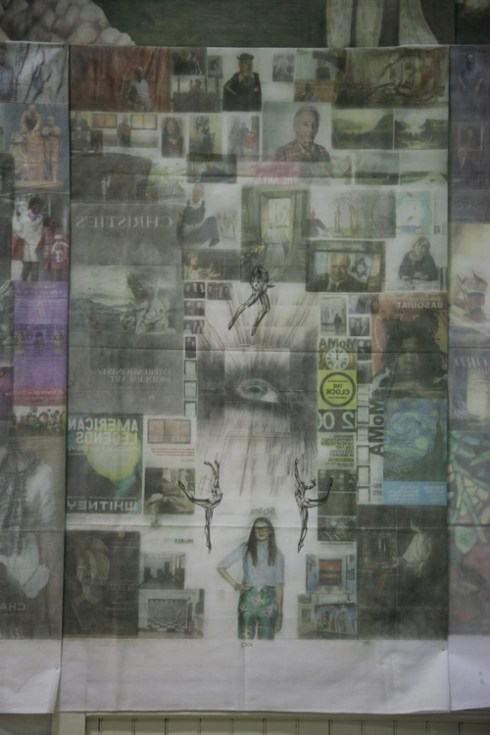
One can identify the largest victories, struggles and crimes of the contemporary world. All in perverse reverse. All in washed out collage. There’s images of the passion play being rehearsed at Angola Prison from an NYT feature, of Tahrir Square and the Egyptian revolution, of children in the aftermath of the Sandy Hook School massacre, and of a submerged rollercoaster in the wake of Hurricane Sandy.

The women’s rights panel includes news images from reporting on the India bus rape and images of Aesha Mohammadzai who was the victim of a brutal attack by her then husband who cut off her nose. Krimes’ compression of images is vertiginous and disorienting. We’re reminded that the world as it appears through our newspapers sometimes is.

06_Apokaluptein16389067

03_Apokaluptein16389067

14_Apokaluptein16389067

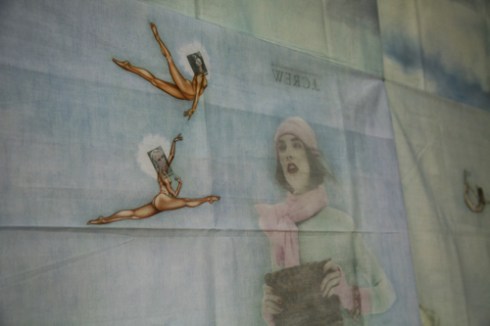
The large pictures are almost exclusively J.Crew adverts which often fill the entire rear page of the NYT. Jenna Lyons, the creative director at J.Crew is cast as a non-too-playful devil imp in the center-bottom panel.

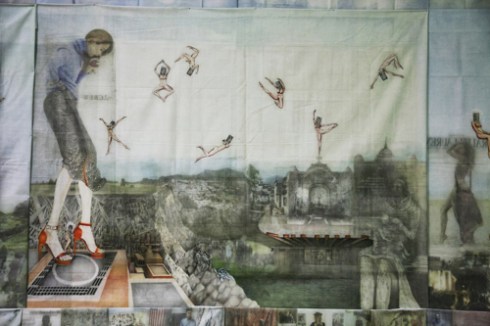
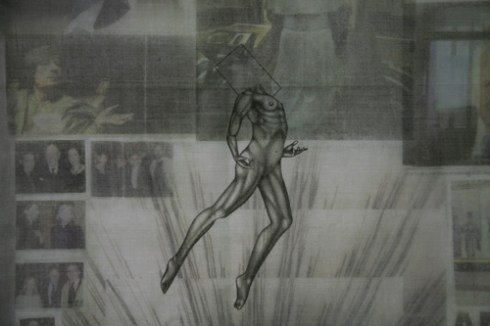
Throughout, fairies transferred straight from ballerinas bodies as depicted in the Arts Section dance and weave. Depending on where they exist in relation to heaven and earth they are afforded heads or not — blank geometries replace faces as to comment on the treatment of women in mainstream media.

11_Apokaluptein16389067

The title Apokaluptein:16389067 derives from the Greek root ‘apokalupsis.’ Apokaluptein means to uncover, or reveal. 16389067 was Krimes’ Federal Bureau of Prisons identification number.

“The origin [of the word] speaks to the material choice of the prison sheet as the skin of the prison, that is literally used to cover and hide the body of the prisoner. Apokaluptein:16389067 reverses the sheet’s use and opens up the ability to have a conversation about the sheet as a material which, here, serves to uncover and reveal the prison system,” says Krimes who also read into the word personal meaning.

“The contemporary translation speaks to a type of personal apocalypse — the process of incarceration and the dehumanizing deterioration of ones personal identity, […] The number itself, representing the replacement of ones name.”

PRISON ECONOMICS: THE HAVES & HAVE NOTS

One of the most interesting things to hear about at Krimes’ presentation was the particular details about how he went about acquiring materials. In federal prison, just as on the outside, money rules. Except inside BOP facilities the currency is stamps not dollars (something we’ve heard before). A $7 book of stamps on the outside, sets a prisoner back $9.

Access to money makes a huge difference in how one experiences imprisonment.

“People who have money have a much easier time living in prison but that is usually rare except for the white collar guys or the large organized crime figures,” says Krimes. 

“Prisoners who have money in prison gain automatic respect and power because you are able to have influence over anything really — most people without money will depend on those with cash to be the buyers of whatever products or services they need.”

Without cash to hand, a rare skill comes in handy. Krimes could make art. In prison artists are afforded much respect. Ironically, free society doesn’t treat artists with the same respect, but I guess we’ve already established that we’re dealing in reversals here?!

“We had to provide some kind of skill or service in order to receive money or books of stamps. Some people cook for others, do laundry, do legal work, or artwork.”

In FCI Butner, a high-quality photorealistic portrait would go for as much as $150. Or, 20 books of stamps. Krimes did portraits and tattoo designs, spending proceeds almost exclusively on hair gel and coloured pencils.

“The majority of portraits I did were for the guys who had money or else I did them for free, for friends or those going through hard times.”

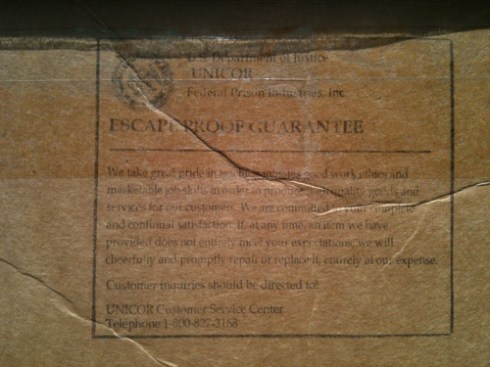
The prison sheets came for free. Krimes smiles at the irony that these sheets are made by UNICOR, the Federal Bureau of Prisons’ factory and industries arm. UNICOR makes everything from steel frame beds to bedsheets; from U.S. military boots and helmets to plastic utensils. In 2005, UNICOR generated $765 million in sales — 74% of revenues went toward the purchase of raw material and equipment; 20% toward staff salaries; and 6% went toward inmate salaries.

I’d liken Krimes’ acquisition of bed sheets to liberation more than to theft. His image transfers are appropriation more than homage. The scope of the project reflects the sheer size of American prison system. The ambition reflects that of the individual to survive, not the system to improve its wards.

That such a large statement came out of the prison sytem (in one piece!) is a feat in itself. That Apokaluptein:16389067 is so layered and so plugged into contemporary culture is an absolute marvel. That the photographs of international media are the vehicle for that statement should be no surprise at all.

08_Apokaluptein16389067

04_Apokaluptein16389067

12_Apokaluptein16389067    16_Apokaluptein16389067

More here.

All images: Sarah Kaufman

10_Apokaluptein16389067

One of the cardboard boxes in which Krimes shipped out a completed panel. The boxes are made by the federal prison industries group UNICOR which employs prison labour. The box is marked with “ESCAPE PROOF GUARANTEED.”

G-LAW Michael Ta'Bon

Today, the Huffington Post published 31 Reasons Philadelphia Is The Most Underrated City in America. Having spent two weeks in Philly recently, I can’t argue with most points (veggie friendly baseball park, c’mon!?).

But I can go further. Allow me to add a 32nd reason. Philadelphia’s anti-prison artists and activists.

Case in point: G-LAW. G-LAW, or OG-LAW (God’s Love Always Wins/God’s Love AT Work) is the adopted name of Michael Ta’Bon, an artist and activist who’s message is peace, love and no more prisons.

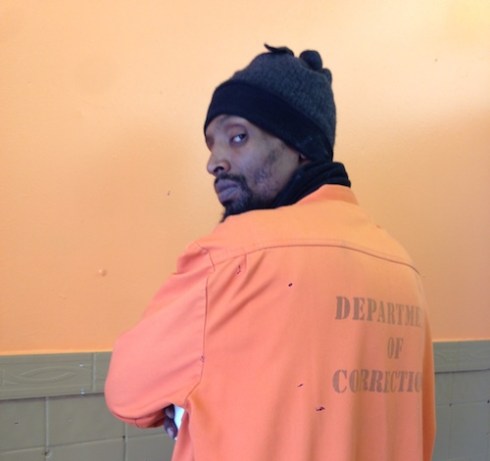
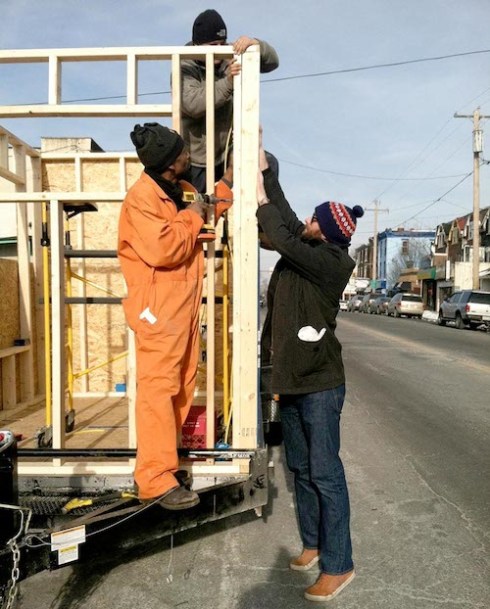
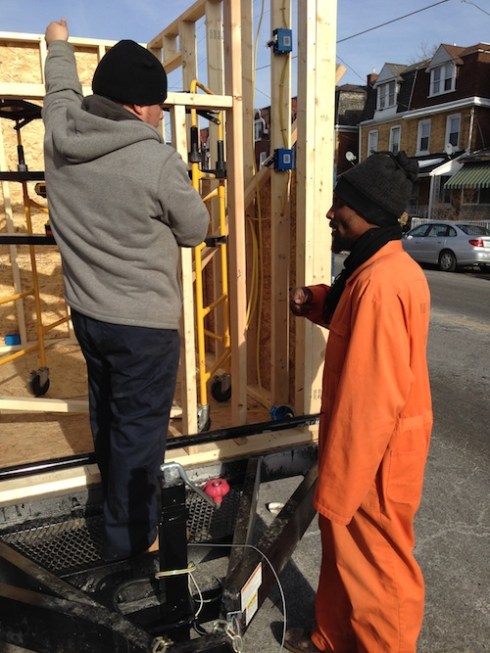
For the month of February, G-LAW lived in a self-built cell-sized space on the streets of Philly. Lori Waselchuk and  I visited G-LAW on the first of the month to see how he was going with construction, buy a coffee and learn more about his project. These photos are from that day. I have not heard how the past four weeks have gone, but as with all of G-LAW’s public happenings, I am sure he’s raised a lot of eyebrows and a lot of discussions.

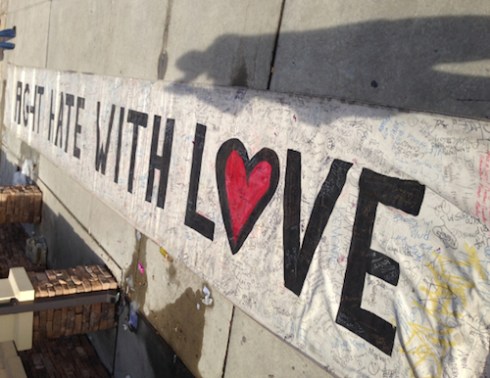
This isn’t the first time G-LAW has protested prison construction, poverty, inequality and hate. He has jogged 10 miles a day for seven days around Philadelphia with a 40-foot banner reading FIGHT HATE WITH LOVE; he has walked with a ball-and-chain from Selma to Montgomery; and this is, in fact, the third time he’s  spent the month of February on the Philly streets in his own prison cell. You can see coverage of the the first occasion in 2011 here and here. One year, he mounted the event in Atlanta.

G-LAW Michael Ta'Bon

G-LAW Michael Ta'Bon

G-LAW Michael Ta'Bon


“JAIL IS 4 SUCKAZ!”
 is one of G-LAW’s many tags lines. He means everyone. He means you. Taxpayers are suckers for stumping the bill to maintain abusive and broken prison systems. One side of his cell is emblazoned with the phrase.

The project as a whole is called The Un-Prison Cell. It’s “the only prison in America designed to keep you out,” laughed G-LAW. It sounds like progress on construction slowed in the days after I visited, due to vicious weather and troubles getting materials.

G-LAW was also away from the site on February 12th as he joined the monumental People’s Budget Hearing protest at the Pennsylvania capital building in Harrisburg (videoaudiophotos). The People’s Hearing was organised by DecarceratePA, one of the most effective and inspiring anti-prison activist groups in the nation. Don’t believe me? Listen to DecarceratePA member Sarah Morris debate PA Prisons Secretary John Wetzel and call him out on the misinformation peddled by the Pennsylvania Department of Corrections to the state legislature justify proposed prison expansion.

It was through DecarceratePA that I learnt about G-LAW’s art — you can listen to him on their radio show.

Maintaining momentum against massive forces for grassroots movements is a constant effort. A large part of that is being relevant to people outside the choir, having press strategy and adopting visual strategy too. DecarceratePA’s 100-day #InsteadOfPrisons Instagram campaign was the first and only interesting anti-prison campaign use of Instagram I’ve seen. (I adopted the hashtag myself later to spread the words of PA prisoners who’s work was in Prison Obscura.) Also, look how incredible this visual statement is.

Philadelphia should be proud of its grassroots activism. Bravo. More.

Follow G-LAW. Follow DecarceratePA on Facebook and on Twitter and on Instagram.

Thanks to Lori for some images.

G-LAW Michael Ta'Bon

G-LAW

G-LAW Michael Ta'Bon

G-LAW Michael Ta'Bon

G-LAW Michael Ta'Bon

Miley Twerk

I never expected to make comment on the career of Miley Cyrus here on the blog, but then again, I never expected to come across the greatest sketch of Miley Cyrus ever made.

The drawing, titled Miley Twerking, was made by my friend Christian Nagler. It originally appeared in the Fall 2013 Issue of Actually People Quarterly (APQ), an indie print publication based in San Francisco. APQ and Nagler kindly provided permission to share the picture.

There’s not a day that goes by that I don’t see a thumbnail image of Miley Cyrus in the sidebar of some website. Collections of Cyrus-resembling pixels are ubiquitous. In terms of describing Miley-Cyrus-the-person, a photograph is almost meaningless. In terms of describing Miley Cyrus-the-product, a photograph is the perfect hype-spinning money-making tool.

The reason I like Nagler’s sketch so much is that skewers the ridiculous theatre of her MTV Awards twerking AND undermines the grotesque image-driven publicity machine that surrounds her. It lays bare what she is and discards the useless debate of who she is.

Cyrus is, as with all celebrities, almost unknowable. She is not a person, but a product. She is no longer a who, but a what. Photography when it encounters celebrity elevates and promotes the what. Photography may purport to depict the who, but it does not.

This is my reading and not necessarily Nagler’s intent. I think he is genuinely interested in Cyrus; perplexed by the who, the what, and the gap between.

“The reason I think Christian’s picture is amazing is because it leaves space left open,” says APQ founder and editor, Sarah Fontaine. “It doesn’t totally proscribe an opinion on her. There’s a level of investment. A drawing takes time but a photo takes an instant.”

If I could even know Cyrus, I don’t think I’d dislike her. Everyone wants to have an opinion about Cyrus’ conduct. Some think her various states of undress hinder the movement of our culture toward one of gender equality. Often Cyrus is the focus of vitriol and frustration, but perhaps we should be looking at society as a whole? I’ll defer to Gloria Steinem and suggest we hate the game, not the player.

“I think that we need to change the culture, not blame the people that are playing the only game that exists,” said Steinem.

Photography upholds, forwards and fortifies the game. Nagler’s sketch respectfully questions the game. My thoughts on photographing Miley Cyrus? Don’t.

03_JaimieWarren

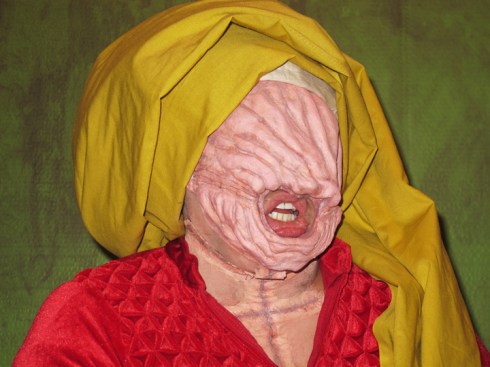
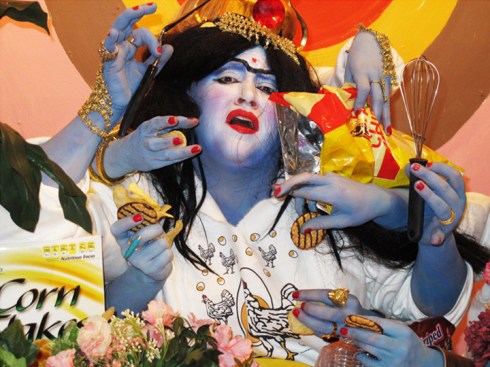
Kansas, MO and Brooklyn, NY based artist Jaimie Warren is the recipient of the 2014 Baum Award for an Emerging American Photographer. This is a curious selection for many reasons — all of them good.

Firstly, I wasn’t aware of Warren’s practice; even though she has a Wikipedia page and a long history with VICE, I had not come across Warren’s work before. I am glad I did.

Secondly, her work is wacky. The meanings of her images are elusive and you’ve got work hard with them. As many photographic artists do, Warren plays with ideas of fantasy, fun, performance and artifice, but she does so in much more aggressive, brazen way. These are not the cool, clinical images of studio assemblages we see from many young (MFA-bearing) image-makers.

07_JaimieWarren

01_JaimieWarren

I really, really enjoy Warren’s disfigured portraits and tableaus. They’re pop, they’re a bit grotesque, they cinch perfectly into the shock-visuals of audiences habituated to the  Tumblr-driven flow of images. Warren’s work is Peewee Herman meets Carnivale meets that bonkers Halloween party you went to in 1997.

Thirdly, it is great to see an award go to a photographer who isn’t just a photographer. For all the intelligent image detournement in her work, Warren is not operating from a fine art ivory tower. Quite the opposite. Central to Warren’s work is constant collaboration with communities. Her main vehicle for making art is the non-profit community arts initiative Whoop Dee Doo.

Whoop Dee Doo works with communities “to create unique and memorable events that challenge the everyday art venue or community event.” Everything from concept to end product is intended to fit the needs of host communities, and all acts are “truly inclusive endeavors that celebrate differences and unabashed self-expression.”

Probably the best and quickest way to get a handle on the art and performances is to view the Whoop Dee Doo Vimeo Channel.

Whoop Dee Doo has worked with youth programs including Caldera Arts (Portland/Sisters, OR), Operation Breakthrough (Kansas City), the Boys & Girls Club (Kansas City), Big Brother/Big Sister (Kansas City), Girls, Inc. (Omaha, NE), Experimental Station’s Blackstone Bicycle youth Program (Chicago, IL), Urgent, Inc. and the Rites of Passage Program (Miami, FL), Muse 360 and 901 arts (Baltimore, MD), as well as college interns at the University of Central Missouri, Pacific Northwest College of Art, the Kansas City Art Institute, the University of Chicago, Maryland Institute College of Art, Rockhurst University, and the Pennsylvania Academy of Fine Arts.

Impressive.

JaimieWarren

Jaimie Warren, Self-portrait as Bulls fan in La Jeunesse de Bacchus by William-Adolphe Bouguereau/Michael Jordan basketball painting by dosysod of the Independents, 2012.

JaimieWarren2

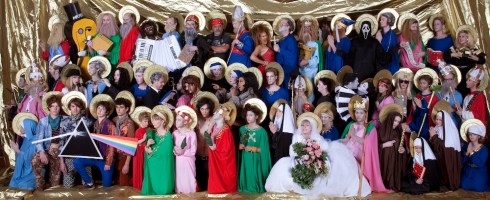
Jaimie Warren, Self-portrait as Nun with some of my Mother’s Favorite Famous People in the Forerunners of Christ with Saints and Martyrs of the Fiesole San Domenico Altarpiece by Fra Angelic, 2014.

From looking over the portfolios, I reckon the folky-rainbow-eclecticism of Warren and her collaborators’ work reflects something close to common feeling. What else could there by except fun, wild variance and complexity when the hands of dozens go into making something?

Breaking down stereotypes and barriers between age, gender, culture and sub-culture is one of Whoop Dee Doo‘s main objectives. The group is open to designing performances and workshops “between unlikely pairings of community members that ultimately blossom into exceptional and meaningful interactions.”

A lot of the time, the use and outcomes of awards can be hard to pin down, but I can’t imagine it’ll be too long before Warren is putting the $10,000 to use making more happenings with communities. Because she always has. Let the merriment continue.

02_JaimieWarren

05_JaimieWarren 

08_JaimieWarren

BAUM AWARD

The Baum Award for An Emerging American Photographer is a project established out of the conviction that photography is a powerfully influential medium with the capacity to emotionally connect with audiences in ways that words cannot. This ability to reach people on a visceral level can transform awareness to understanding and lead interest into action – fundamental aspects of a healthy and vital society.

Click here to see previous Baum Award winners.

TALKING HEAD

The kind folks at the Cantor Fitzgerald Gallery at Haverford College wanted to make a video to accompany Prison Obscura. So, we sat down with camera and I talked for an hour. It’s a blessed relief for you all that they managed to distill it down to 3 minutes. Much more bite-size than the essay.

Vimeo link. Also available on Youtube.

PRESS

Photo Exhibit Offers Look Into the Lives of Prisoners (Philadelphia Inquirer)

Prison Obscura: A Look Into the Cell of Self (Bi-College News)

Prison Obscura at Haverford’s Cantor Fitzgerald Gallery (The Art Blog)

Shedding Light on a Dim Situation in Prison Systems (The Temple News)

5 Intriguing Things: Thursday, 1/23 (The Atlantic)

‘Lives Lived Behind Bars are Too Often Invisible’ (In These Times)

Prison Obscura, Curated by Pete Brook (aCurator)

Exhibition: Prison Obscura (No Caption Needed)

Installation shots here and here.


Call for Papers, Art, Workshops, and Presentations:

Marking Time: Prison Arts and Activism Conference

Rutgers University October 8-10, 2014

CALL

We invite proposals for papers, panels, workshops, and artwork for Marking Time: Prison Arts and Activism Conference at Rutgers University on October 8-10, 2014. This conference aims to provide national and international perspectives on art created inside prison and in response to mass incarceration.

The conference has three primary objectives: 1) to facilitate the development of networks and support for prisoners, artists, scholars, and organizations working in the field; 2) to promote the importance of prison artistic practices as vital components of contemporary culture and vernacular arts traditions; and 3) to provide a forum to examine the impact of prison systems on culture and specific populations. We hope that the conference will appeal to a broad audience, ranging from students to arts educators, and from legal scholars to prison reform activists.

The conference organizers are the Institute for Research on Women (IRW) and the Department of American Studies at Rutgers University, New Brunswick, with the participation of several other academic units including the Mountainview Program. Additional conference partners include nonprofit organizations, such as the William James Association’s Prison Arts Project and the American Friends Service Committee’s Prison Watch Project, as well as professional curators and artists such as documentarian and curator David Adler.

Some of the thematic areas for critical inquiry, creative engagement and activism include, but are not limited to:
Connections between nonprofit organizations and the prison industrial complex

– Political art and posters
– Gender identity and testimony
– Aesthetic influences of prison on everyday cultures
– Prison theater projects
– History of prison writings
– Spoken word and rap traditions
– Vernacular art and photography
– Documentation of prison interiors
– Folk and outsider art traditions
– Prison architecture and landscape
– Censorship in/out of prison
– Collecting and the art market
– Ethics and politics of socially engaged art
– Surveillance technologies and visuality
– Issues of consent Institutional archives and issues of access

SUBMISSION GUIDELINES

Download forms here.

To submit individual papers or artwork as well as proposals for workshops or group sessions, please send the following information to rutgersprisonarts@gmail.com

Or mail it to: Institute for Research on Women, Rutgers, The State University of New Jersey, 160 Ryders Lane, New Brunswick, NJ 08901.

Name
Affiliation (independent scholar, artist, educator, activist)
Mailing address
Office and cell phone numbers
Email address
Equipment needs
Biography (50 words)
Title of Presentation
Abstract (250-300 words)

Travel assistance may be available, contingent on funding.

Deadline for submissions is March 15th, 2014.

LeonCollin

© Leon Collin

EARLY 20TH CENTURY CRIMINAL EXILE

Some enchanting photographs among the collection of Dr. Léon Collin. The problem is that not all are benign and not all were intended to be enchanting. Some were meant to outrage. The photographs of Dr. Collin recently surfaced after decades in the dusty attic of the Collin family home in Saône-et-Loire, France.

The visual difference and the enjoyment allowed by this historical (detached?) collection reminds me of those well-loved Australian police mugshots portraits. Beautiful character studies from absolutely abject circumstances.

PHOTOS AGAINST ABUSE

Between 1906 and 1911, Dr. Léon Collin made thousands of glass plates and manuscripts depicting the life of prisoners — from their departure from (outpost island) Île de Ré to their imprisonment in French Guiana or New Caledonia penal colonies.

Most of his photographs he made during crossings of the ocean, but Collin also made certain to make pictures on land, in the penal colonies. He was outraged by the harsh living conditions and, once, anonymously submitted his photographs to Le Petit Journal Illustré to denounce and expose awful conditions.

What an inspiring early political use of imagery. Although, I doubt they had much change-making effect. The intent was there.

HOW DID THEY GET TO THIS SCREEN?

Collin’s grandson Philippe Collin discovered the boxes. The Musée Nicéphore Niépce de Châlon-sur-Saône digitize them. Philippe Collin sold the rights to the city of Saint-Laurent. In anticipation of an upcoming exhibition at the future Centre d’interprétation de l’Architecture et du Patrimoine (CIAP). So far, nearly 150 photographs of Guyana prison camps have been brought together for the CIAP show. CIAP is built on the site of a former transit camp. Today, they photos landed on l’Oeil de la Photographie which has a dozen examples and I couldn’t help myself.

Thanks to Hester for the tip.

EMAIL

prisonphotography [at] gmail [dot] com

Prison Photography Archives

Post Categories