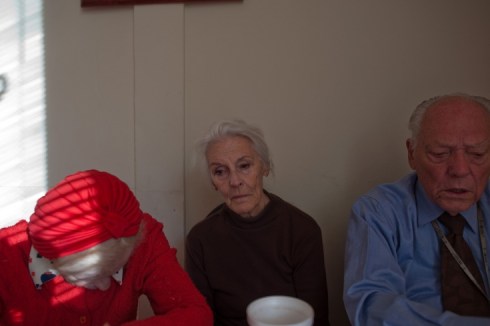
Photo: Roger May. (Source)

You’d think after 26 months in an Iranian prison, Shane Bauer would not be interested in seeing the inside of another cell. Think again. As I’ve noted before, Bauer is a journalist with human rights at the core of his stories.

Since his return to the U.S. he has been increasingly involved in describing the real problem we have with our approach to corrections. From Bauer’s Mother Jones feature piece:

I’ve been corresponding with at least 20 inmates in SHUs around California as part of an investigation into why and how people end up here. While at Pelican Bay, I’m not allowed to see or speak to any of them. Since 1996, California law has given prison authorities full control of which inmates journalists can interview. The only one I’m permitted to speak to is the same person the New York Times was allowed to interview months before. He is getting out of the SHU because he informed on other prisoners. In fact, this SHU pod—the only one I am allowed to see—is populated entirely by prison informants. I ask repeatedly why I’m not allowed to visit another pod or speak to other SHU inmates. Eventually, Acosta snaps: “You’re just not.”

Bauer excavates the policy and the logic, if you can call it that, used by the CDCR in their categorisation of prisoners and how those policies lands individuals in solitary. Pelican Bay State Prison, the oldest state-built Supermax, is Kafkaesque in its imprisonment of prisoners classified as gang affiliated. Bauer describes the *evidence* used by the CDCR in its case tying Dietrich Pennington to gang activity.

In Pennington’s file, the “direct link” is his possession of an article published in the San Francisco Bay View, an African American newspaper with a circulation of around 15,000. The paper is approved for distribution in California prisons, and Pennington’s right to receive it is protected under state law. In the op-ed style article he had in his cell, titled “Guards confiscate ‘revolutionary’ materials at Pelican Bay,” a validated member of the Black Guerilla Family prison gang complains about the seizure of literature and pictures from his cell and accuses the prison of pursuing “racist policy.” In Pennington’s validation documents, the gang investigator contends that, by naming the confiscated materials, the author “communicates to associates of the BGF…as to which material needs to be studied.” No one alleges that Pennington ever attempted to contact the author. It is enough that he possessed the article.

Getting out is a Catch-22 that is best described by Bauer than I.

For the longest time, there was a media blackout in California prisons and very few journalists got in to the SHU. I have heard from a few reporters and photographers this year who have visited Pelican Bay’s SHU but on a very tightly controlled media tour. Ultimately, Bauer wants to decode what purposes are served by solitary confinement. The CDCR argues it keeps prison violence down, but …

Prison violence fluctuates for myriad reasons, among them overcrowding, gang politics, and prison conditions. It’s impossible to say for certain what role SHUs play; what is clear is that in states that have reduced solitary confinement — Colorado, Maine, and Mississippi — violence has not increased. […] Since Mississippi State Penitentiary at Parchman released 75 percent of inmates from solitary in the mid-2000s, violence has dropped 50 percent. CDCR officials claim California is different because the gang problem is worse here, though they don’t have data to confirm this.

Bauer goes on to compare the correspondences he received as a prisoner with the letters he receives from Californian prisoners during his investigation. He describes the extreme psychological stress of solitary confinement and possibility of less labyrinthine regulation of SHUs with forthcoming CDCR policy changes (which may or may not transpire.)

He also offers readers to chance to contact the prisoners in the article.

Recommended read.

– – – – – – – – – – – – – – – – – – – – – – – — – – – – – – –

UPDATED: Oct 23rd, 2012

See Shane Bauer’s two-part conversation with Amy Goodman on Democracy Now – one and two – and his support for California Hunger Strikers alongside Sarah Shourd and Josh Fattal in Oakland, Oct, 2011.

For Three Strike, Northern Irish photographer Adam Patterson made portraits of men who had been sentenced to term-to-life sentences under Three Strikes Laws. The men have in common the fact all their releases were secured due to the work of the Stanford Three Strikes Project.

Patterson writes, “In 1997, William Anderson stole a dollar in loose change from a parked car. He was arrested and sentenced under California’s voter-approved “three strikes and you’re out” law. Mr Anderson’s two previous convictions of daylight residential burglary in 1985 now accounted for his first two strikes, allowing his petty theft from the car to trigger the hammer blow—the third strike. He was sentenced to 25 years to life in state prison. A number of states in the US have the three strikes law, under which criminals who persistently offend are given increasing penalties. Yet in California there remains one glaring difference that many believe is a catalyst for continued injustice. While the first two strikes must be “serious or violent” crimes, the third strike does not. This discrepancy has allowed criminal prosecutors to press for a variety of life-crippling sentences for the most minor of offences.”

Three Strike is four images.

VIDEO

Journalists Kelly Duane de la Vega and Katie Galloway‘s must-see multimedia documentary Three Strikes Of Injustice appeared on the New York Times website recently.

Three Strikes Of Injustice opens with an apology by Judge Howard Broadman, made to Shane Taylor. Broadman sentenced Taylor to 25-to-life for a non-violent offense fifteen years ago. It was Taylor’s third conviction. Taylor speaks from prison over the telephone and his family is interviewed. It’s very hard to disagree with Taylor’s tearful 19-year-old daughter who observes the absurdity of a 25-to-life sentence.

Duane and Galloway had long standing interest interest in prisons (they released Prison Town in 2007) but like Patterson was drawn to the work of the Stanford Three Strikes Project and specifically their 2010 study that showed that more than 4,000 inmates in California are serving life sentences for nonviolent offenses under the three-strikes law.

BIOGRAPHIES

Adam Patterson (b. 1982), received a postgraduate bursary in 2008 from the Royal Photographic Society to undertake a project on youth gang culture in London. He holds an MA in Photojournalism and Documentary Photography from the London College of Communication. He has worked with the BBC Panorama documentary team in Dubai, Chile and the UK and on documentary projects addressing issues such as the slave labor trade in Dubai and the rise of cheap heroin in Wales. He helped smuggle a digital camera to Chilean miner Edison Pena, who then photographed underground conditions while trapped during the Copiapó mining accident between August and October 2010,

– – – – – – – – – – – – – – – – – – – – – – – – – – – – – – – – – – – –  –

Kelly Duane de la Vega and Katie Galloway received the best documentary screenplay award this year from the Writers Guild of America, West, and the Gotham Independent Film Award for best documentary last year, for their film Better This World.

Three Strikes Of Injustice was partly funded by David W. Mills, a Stanford law professor who supports Proposition 36 and has advocated reform of California’s three-strikes law.

Jeanie, after crying over William’s depiction of women being “easily beguiled,” 2012. © Isadora Kosofsky

Sometimes it takes a while for great photography to percolate, for me at least. I’ve been aware of Isadora Kosofsky‘s documentary of Adina, Jeanie and Will – three seniors in a love triangle – for several months but spent some time with it yesterday.

Kosofsky’s series, titled The Three is potent and unique work full of surprise and bittersweet optimism. I’m not much like Adina, Jeanie and Will, but I am immediately interested in their story and emotions. They’re giving something a go which is less than ideal and it wears on them, but there are bright spots too. There’s a lot to mull over when considering who Kosofsky’s subjects are, where they’ve been and where they may be going.

It seems trite to suggest it, but by tapping the inconvenient messiness of emotion, Kosofsky’s work gets at some truth inherent to life. Truth, huh? Dangerous label when attached to photography.

Isadora Kosofsky is a Los Angeles-based documentary photographer. Her work can be seen here.

More here and here.

Jessica Dimmock. Credit: Unknown

Think Outside The Cell, a NYC based advocacy group, and VII Photo Agency recently collaborated to make and distribute a media campaign to educate the public about the continued struggles for felons post-release. This conversation with Jessica Dimmock is the fourth of a five part series, ‘Ending The Stigma Of Incarceration.’

(Part One): Think Outside The Cell / VII Photo Partnership
(Part Two): A Conversation With Ron Haviv
(Part Three): A Conversation With Ed Kashi
Part Five): A Conversation with Ashley Gilbertson

– – – – – – – – – – – – – – – – – – – – – – – – – – – – – – – – – – – – – – – – – – – – – – – –

Prison Photography (PP): In the first two interviews of this series, I’ve spoken with Ed Kashi and Ron Haviv who followed Ronald Day. You collaborated with Ashey Gilbertson to tell the story of Mercedes Smith. Tell us a little about her.

Jessica Dimmock (JD): Mercedes spent 20 years in prison. She was 24-years-old when she was convicted. She has been out for only two years and she is in her late forties. Her energy is pretty amazing; if you met her you’d have no idea she’d spent so long in prison. She’s the perfect subject in that people ask, ‘what does a person who has been in prison look like?’ and she overturns the stereotypes.

She’s so warm. There’s a giddiness to her energy which, to me at least, indicates a lack of bitterness. Whether or not she’s guilty or innocent doesn’t matter. The reality is that she was in prison for 20 years and she is a lovely person to be around. Her relationship with her children is good. She is close with her granddaughter. They are a strong family for sure and it is good to see.

PP: Could Mercedes success not also have been problematic for you as a storyteller? It might be that you’d present a subject and the audience think, ‘Oh, well, people have no problem readjusting, there is no issue here.’

JD: I don’t wish her situation upon anyone, but in terms of her standing in for a large population in similar circumstances – people going through difficulties with housing, employment, family and reintegration – she is a good subject.

PP: What issues specifically is Mercedes dealing with?

JD: Housing. She currently lives with an aunt. She could stay with her mother – who is an amazing influence in her life – but because her mother’s building is where Mercedes was arrested Mercedes cannot live there. So, she has to stay elsewhere, which in her specific case, is probably more detrimental to her wellbeing and to her chances of reentering successfully.

Employment for her right now is good. That employment is not a problem for her but housing is, is in itself very interesting because you can see she is very high functioning with the type of work she does.

PP: Why were you attracted to the project?

JD: There has been a lot of stories and documentaries about prison – about the wrongfully accused and the exonerated – which are all important stories, but I don’t feel like I’ve seen many documentary treatments about the reintegration process.

In movies we often see an opening scene in which the prison gates open, the main character walks out and that’s the beginning of a character arc. It is a trajectory commonly used in fiction. I realized I didn’t know what the real life version of that was, or is.

PP: How did you approach it then?

JD: We wanted to spend some real time with Mercedes. To see how she reintegrates with her family; how she is with her kids, who are great, by the way; and what it is like for her in the workplace.

PP: What did Mercedes want to get out the project?

JD: Overall, she realizes there’s a lot of stigma attached to former prisoners. Now, she works with at-risk populations and with women who are currently incarcerated. She’s really involved in the church. She prays and that is a process tied very much into decision-making for her. She’s an open person. I don’t think she was overly moralistic about it – she was just thinking, ‘that sounds as if it would break down stigma, go ahead.’ We didn’t feel driven by any agenda of hers.

PP: During the project did you discover anything about how male and female populations function differently inside prison?

JD: Yes. There’s not the same amount of educational programs in women’s prisons.

I know a woman who had been imprisoned at Valhalla [Westchester County Jail], which has a very small female prison population of girls that have been, for example, convicted for shoplifting or prostitution. But because it is such a small prison there are no programs. This woman spent 10 months there and didn’t go outside once. It’s not the longest sentence, but could you spend 10 months indoors? I don’t want to do that.

Mercedes talked about how overall Bedford Hills was a pretty supportive environment in terms of the actual women; there wasn’t a lot of drama; there wasn’t a lot of fights; there wasn’t a lot of craziness; they all took good care of each other. That’s maybe the other side of the gender issue.

PP: The project is on reentry. Does Mercedes feel like she has adequate support?

JD: In some areas, yes, but in housing definitely not. She wants to have her own place – she’s a woman in her late 40s who has a job. It’s valid that she wants that and she’s finding it difficult.

She also doesn’t have credit. If you’ve spent twenty years of your adult life behind bars you’ve not been able to build up credit. It’s not that she has bad credit; she just doesn’t have a credit score. Compared to other adults her age, that is a significant disadvantage and that won’t change unless of some direct intervention. Even though it doesn’t seem like the most soul wrenching part of it – maybe the family reintegration stuff is more emotive – there is a reality that makes credit scores an issue.

PP: I am interested by the word ‘stigma’. How would Mercedes characterize her situation?

JD: One of the things Mercedes discussed was that she will always wear the label ‘felon’. She will always have this version of a scarlet letter. She doesn’t get to walk around free of that. It will interfere with job applications, housing applications, and so on.

The paradox for her and the thing that feels very unfair is that she served time and that’s supposed to be the punishment, so to find you’re still being punished for the one act you were told you served time for is a frustrating process. You want to feel like you’ve done the time. But the reality is, you have to go around and tell people all the time that you’re a person who served time. Mercedes’ frustration makes sense to me.

PP: Was it an emotional story to cover?

JD: Not emotional, more enjoyable and that is down to Mercedes’ personality. She was very forthcoming about all aspects of her life. Mercedes has a son who is currently incarcerated – that’s got to be really hard. A son, who several months after she came home – went into prison. As a parent it’s potentially shameful and difficult to discuss but she would totally talk about it. She had received a letter from her soon one night when we went over and she read it out loud to us. She didn’t say, ‘This is an aspect which should stay hidden’, but rather, ‘This is all of me and you can share it.’

PP: VII has done other partnerships in the past? Starved for Attention probably the biggest example. MSF is international. US Aid is national. Think Outside The Cell is a much smaller organization.

JD: If you dive into the VII archives you’d find similarly small or lesser known organizations in addition to big ones such as Human Rights Watch with whom Marcus Bleasdale works.

VII and other photographers are more and more linking up with NGOs. What is less common, and particular to our work with Think Outside The Cell, was that there were several of us doing it.

People are moving toward more collaborative efforts – a) because people are doing more video, and filming is not a solo project, and b) because there is an interest in watching how several people can work together, even on a single subject.

PP: You’re invested in constructing a narrative, dealing with an issue. My angle for the longest time has been political – I believe there are serious structural problems with the criminal justice system. Some times those arguments can be quite abstract. You’ve said Mercedes wasn’t bitter but how did she feel about the prison system in America?

JD: Mercedes is actively involved with programs that support people still inside and about to reenter. It’s about how she wants to lead her life. I think she thinks, ‘If I don’t get weighed down by my past and I continue to engage with it, I’m not in any denial but instead I am emotionally and psychologically moving forward with it.’

That’s the sense that I get; now that her sentence is over, it is a decision to have that time be over. Even though she struggles, her energies and emotions suggest she is not staying stuck in the past.

PP: What do you hope the VII/TOTC campaign might achieve?

JD: I always try to show things as they are. I really try to not say, ‘Look at how outrageous this is.’ My storytelling might come from a place of thinking there is a problem but I try not to show a story in that light.

If people see something that is authentic and they observe the real things that are happening then they will then come to their own conclusions. I don’t have to be moralistic in my telling of the story. And so what I most immediately hope is that people watch it – I want exposure – and but more than that, I want people to spend time in someones elses experience. I hope we convey it accurately so the audience says, ‘Okay, now you’ve just watched that. That’s what her life is like. That’s what her situation is like.’

PP: You’d be really satisfied if people identified the story with someone in their own lives – a friend, family member, or someone on who lives on their street?

JD: Yes, then they have a reference point and they get it. But, if you push people too much to feel bad for this or that person, it might not happen or translate much in their real life. I want the audience to understand the issue; I don’t want them to feel bad.

PP: You don’t want audiences to say of your subjects, ‘Oh, they are different, and I’ve always thought that.”

JD: Right.

PP: Outside of you as a story teller, and instead you as Jessica Dimmock, do you feel the criminal justice system works?

JD: Definitely not. I am a political person but this project on stigma is not overtly political; it comes from my curiosity about correctional facilities. What it is that correctional facilities do to prepare people to come back to society and not fail? What do they do to make sure that after serving time prisoners are better equipped to come out and not repeat their actions? The locking people up part is happening, but the reentry part is not.

All you must do is look at the statistics in populations that the criminal justice system is directly effecting. How many people on the street have gone through a correctional process? Those figures start to go off the charts. If it’s really failing – and looking at the numbers – it is, then we have a massive problem.

PP: Any thoughts on the intersections between prisons and photography?

JD: There is an organization that takes requests from prisoners in solitary confinement …

PP: Yes, the Tamms Year Ten Project organised by activists based in Chicago. They accept photo descriptions and requests from prisoners in Tamms Supermax Prison in the south of Illinois. Fascinating and unique project.

JD: Some of those requests are so sweet. No one at the Tamms Year Ten Project is saying how you should feel about people on death row. All I did was see these requests and it changed everything. “I would like a picture of a horse galloping in the sunset” – words so sweet and that I could never make up. “I want a picture of a woman and I’m on my knee holding a rose for her.” It’s what every woman would want. Sweet and romantic, which was very surprising. If I’ve ever read paragraphs that break down stereotypes, then those requests are them.

PP: Jess, thanks.

JD: Thank you.

Source: NYCLU

Recently, Nina Berman and I talked about Stop & Frisk in New York and the difficulties for photographers to depict the issue. Of course, there is the possibility of citizens documenting Stop & Frisk.

Stop & Frisk is a matrix of interactions (1,800 stops per day) that go on between between NYPD and members of the public … and in almost every case without audio or visual documentation.

Stopped-and-Frisked: ‘For Being a F**king Mutt’ by Erin Schneider and Ross Tuttle for the Nation is one of the best presentations of this controversial recent issue I’ve come across.

Schneider and Tuttle’s video centres around the story of a Harlem teenager named Alvin who secretly recorded NYPD officers during a stop.

In the course of the two-minute recording, the officers give no legally valid reason for the stop, use racially charged language and threaten Alvin with violence. Early in the stop, one of the officers asks, “You want me to smack you?” When Alvin asks why he is being threatened with arrest, the other officer responds, “For being a fucking mutt.” Later in the stop, while holding Alvin’s arm behind his back, the first officer says, “Dude, I’m gonna break your fuckin’ arm, then I’m gonna punch you in the fuckin’ face.”

[…]

Alvin’s treatment at the hands of the officers may be disturbing but it is not uncommon. According to their own stop-and-frisk data, the NYPD stops more than 1,800 New Yorkers a day. A New York Times analysis recently determined that more than 20 percent of those stops involve the use of force. And these are only the numbers that the Department records. Anecdotal evidence suggests both figures are much higher.

The multimedia piece is 13 minutes and worth every moment. Illuminating, shocking and important.

And on the topic of sousveillance, the NYCLU recently released the Stop & Frisk Watch App which allows bystanders to fully document stop-and-frisk encounters and alert community members when a street stop is in progress.

– – – – – – – – – – – – – – – – – – – – – – – – – – – – – – – – – – – – – – – –

SEE ALSO

Stop and Frisk: NYC and UK Kids Respond with Cellphone Photography, Artist with Projections

When Police Harassment Comes Knocking

– – – – – – – – – – – – – – – – – – – – – – – – – – – – – – – – – – – – – – – –

Image

Ronald Day en route to work, NYC. © Ed Kashi / VII Photo

– – – – – – – – – – – – – – – – – – – – – – – – – – – – – – –

Think Outside The Cell, a NYC based advocacy group, and VII Photo Agency recently collaborated to make and distribute a media campaign to educate the public about the continued struggles for felons post-release. This is the third of a five part series, ‘Ending The Stigma Of Incarceration.’

(Part One): Think Outside The Cell / VII Photo Partnership
(Part Two): A Conversation With Ron Haviv
Part Four: A Conversation With Jessica Dimmock
Part Five: A Conversation With Ashley Gilbertson

Ed Kashi, together with Ron Haviv, photographed and videoed Ronald Day‘s story. Ed and I chatted about his experience and the issues at stake.

– – – – – – – – – – – – – – – – – – – – – – – – – – – – – – –

Editor’s note: On September 27, 2012, Ronald Day was discharged from parole. He has since obtained his passport and registered to vote. On November 6, he will vote for the first time in his life. These interviews were conducted prior to September 27.

– – – – – – – – – – – – – – – – – – – – – – – – – – – – – – –

Prison Photography (PP): When the idea of this partnership cropped up, how was it that yourself, Ron, Ash and Jess became the first four photographers?

Ed Kashi (EK): To some degree we were chosen on proximity to the subjects. Proximity to New York … and budget. We sense that we’ll expand this work dramatically into a bigger documentary series – not only in terms of going more in depth with our two subjects but with two more subjects.

EK: I’ve done a lot of work on prisons and similar subject matter. I don’t know about the other three. I am driven by examining social and political issues and increasingly it is frustrating to be able to do that for publications and the editorial world. I can speak confidently for all four of us and say our hearts lie in examining social and political issues, but it is so hard to get the funding let alone the interest and the buy-in of the editorial world, so whenever the chance to partner with NGOs or foundations or organizations and go out in the world and do honest and good visual reporting and know that the work will be used in an effective way to advocate for these issues, we take it.

PP: Can you give us a brief background on those stories you’ve done on prisons before?

EK: The first project that I did was in the late 80s. I pursued a personal project on the issue of private prisons looking at Corrections Corporation of America (CCA) based in Nashville. I was fascinated back then by the issue of privatization that began under Reagan and Bush Snr. I was concerned that we were privatizing such a critical function of society. I went to four facilities around the country.

Over the years, I’ve also had assignments to go to San Quentin or Folsom to do one or two day shoots for TIME magazine, that kind of thing.

The next really big encounter with prisons was during my aging project. During the very first stage of what became an eight-year project on how America is growing old, I did a story on aging prisoners. I went to a couple of prisons with dedicated geriatric facilities. I did the fieldwork in 96 and 97 and the story eventually ran in the New York Times Magazine in 1997. It seems to be an issue I’m always bumping up against in one way or another.

PP: Compared to most photographers, your experience with and within prisons is incredibly wide and involved. Most photographers if they touch on the subject – and sometimes it might be accidental – might do do only once. Repeated visits to prison across the states is unusual. Access to private prisons is very unusual.

EK: I’d be amazed if CCA would give me or another photographer access again. They let me go to a juvenile facility in Nashville, an immigration facility in Houston, a maximum security prison in Santa Fe, New Mexico and a prison in Panama City in Florida. That the early operating years of CCA and maybe they were seeing it as a PR/marketing effort. I mean, I wasn’t even on assignment. To think that CCA would allow in the late eighties a freelance photographer from San Francisco to photograph in their facilities figuring, ‘Well, we’ve not had bad publicity yet, we’re just getting started, this is a way for people to know what’s going on.’ In the state of California, years ago I believe, they set down a policy in which journalists are not allowed in any of their facilities. More and more today, things are really shutting down. Access is in general shutting down for journalists in many ways. We’re perceived as having lost our neutrality and are now considered partisans!

PP: Well, we hear the term “liberal media” constantly. It is one of the most meaningless slurs I can think of. NPR is not liberal.; it’s journalism organization and it is neutral.

EK: The fact that anyone would call Obama a socialist is ridiculous. You should be sent back to school!

In terms of media, the type of person to go in to journalism should have an open and progressive mind. And I don’t mean progressive in a political sense; I mean you’re looking at the world trying to find out what’s going on; trying to figure out how to move forward; seeing the problems and then looking for where there may be solutions. By the nature of this work, you should be progressive and open minded, but unfortunately that has been translated into, ‘You’re Liberal.’

Quite frankly, I think there is something much more venal and dangerous this represents. What we’re now experiencing is something that was begun under the Nixon White House in the sixties and Pat Buchanan was very much behind it … and truthfully Cheney and Rumsfeld and the older Bush were part of it. It is in many ways, no different to what fascist and authoritarian regimes have done – which is to debunk and attack the media. If you don’t kill them physically, you delegitimate them. Really, that’s my very firm feeling of how these political movements work and it is very sad to me to see that this is happening in America.

I don’t see it happening in Europe, but America is such a huge country, a huge swathe is under-educated or naive. I think it is the nature of a large country. It is not that these are bad people, it’s just that they are not educated. It pisses me off and it scares me.

PP: Let’s talk about how that relates to this partnership. Does that landscape you just described, does that imperil the way potential this work and it’s products could be seen, interpreted or understood? Or do you look at it another way, a more positive way, that there wouldn’t have been a pressing need in the past to reach down and give a helping hand to a young, fledgling NGO. How does VII Photo, Think Outside the Cell and Sheila Rule anticipate that this work will be consumed?

EK: The way I look at this advocacy journalism, which is what I call it, is we gain access to subject we would otherwise have trouble getting access to. That’s number one. Number two, we’re doing it in cooperation with an organization that we know will disseminate the product to the policy makers and the people and organizations who can make a real difference and drive change – be it on a legislation for funding level.

Then, VII or the photographer can take that work and have a free hand to distribute it in the media landscape. The difference is that in the past I’d have to convince New York Times magazine or whoever it is [ahead of time] to give me time and money to go and do the work. Theoretically, I’d have been able to gain access because of the guarantor of a reputable organization and then the work would be funneled through that media organization for good or bad effect. In a sense, I prefer this [way of doing things] which sounds kind of weird. Just so you understand, on a process level, I’d rather just be working all the time for New York Times magazine or National Geographic or whomever, just because I love that being a journalist and having the support and protection of a media organization, but given the way things have changed and given the reality – both economically, politically and structurally of media in our society today, this is an exciting development that is taking place. As long as it is done in the correct way, where there is no slanted or biased reporting.

PP: You’ve been liberated but not compromised? And you use the phrase ‘advocacy journalism’ which is the most fitting term I’ve heard.

EK: On a deeper level – and this is definitely a product of my age and the stage I am in my life. Being mid career in terms of my work and certainly being mid career in terms of my life span and being a parent of teenagers and being engaged with the world not just as a journalist but as a citizen – I want this goddamn work to make a difference.

It’s not just about, ‘Hey, look, I got the cover of National Geographic magazine’ or ‘Hey, I’m on assignment for the New York Times Magazine.’ Its not that those things don’t have value any more, it’s that they are not the purpose. The purpose is, ‘How do I make work that makes a difference. How do I make work that can be utilized to make positive change?’ I think it is critical for us to find ways to tell stories that give optimism and a belief that there’s a way forward. We need to bear witness to the worst things that are going on in the world and not sugarcoat them. Obviously we need that objective first hand view of things. Whenever we can tell a story that exposes a problem but proposes a solution, I think that is the height of journalism.

Image

Ronald Day at his home in the Bronx, during a Father’s Day barbecue, held on June 17, 2012 in New York City. © Ed Kashi/VII Photo.

PP: That’s what you want out of it. What do you think your subject, Ronald Day, wanted out of it?

EK: That’s a great question because it cuts through to the potential naked ambition of the photographer or the journalist. You’re getting points by shooting in a prison because it is gritty and it is edgy and it is tough and cool. You know what I mean? Characterized in that warped way the professional can work. Whereas, I am at a point now where I wouldn’t want to go into a prison or do a story on Ronald or anyone if I were to hurt the subject in any way.

What does Ronald want? I think he wants his story to be told, and it is common among people who agree to cooperate with journalists – it’s a little bit of vanity and a little bit of hope. At the very least, their situation will improve and for those who are a little more magnanimous, telling their story may help others in similar positions. I believe Ronald is a selfless man. He’s a pretty brilliant dude; he’s a smart and totally impressive. He is a poster-child for this particular issue. He is not your average ex-prisoner. I left the project missing him.

PP: How long have you lived in New Jersey?

EK: I moved here Christmas 2004, so eight years. I was born in New York city and raised in the New York area. In 1979, I moved out to the Bay Area.

PP: What did you learn, as a resident of the region, about New York State? VII and Think Outside the Cell intend to expand the initiative to other states. At that point the stories will change because each state carries different laws. But did you learn anything through Ronald peculiar to New York State when it comes to the stigma of reentry.

EK: I was surprised to learn about how a one size-fits-all nature of bureaucracy ends up shafting extraordinary guys like Ronald. The probation rules are a central theme of Ronald’s psyche and story.

PP: I’m presuming you think he should’ve had a faster track through probation and been able to take on student loans and start his PhD and make international travel.

EK: Yes, and for instance, now he is in this position where because of the job he has and the teaching at night, it forces him to break his curfew rules. He has to get up a 5 in the morning, to catch the bus to the train at 6:30, so he gets to Brooklyn in time for his work, but technically he’s not supposed to be out of his house until 7am. He could potentially be penalized for that. Or he has to go to some event in the evening, where he is teaching or speaking or taking a class and technically then he’ll get back home after his curfew. I understand that with tens of thousands of parolees in the state of New York you can’t have tens of thousands of different sets of rules, but it would be great to find a way to bend and accommodate for people when it is so clear they are on the right path. That might seem like a minor thing, but it is not minor to him.

PP: Anything else?

EK: I don’t know if I expressed this adequately but ultimately the goal of this work is to further break down the stigma of people who have been in prison and – as is the case with any journalism – to educate people. We have to look at the formerly incarcerated in a different light and in a sense we need to look at how the structures of our society deal with the formerly incarcerated. At a functional level, that is more important for former prisoners – so that when they go for housing or employment, they don’t face hurdles that basically leave them in a self perpetuating negative cycle.

PP: Do you think your media of choice, photo and video, are entirely appropriate? Inasmuch that you are battling stereotypes and many misleading stereotypes that have been created through mass media images, TV and film.

EK: That’s where this partnership with Think Outside The Cell is different. In a perfect world scenario, the work gets presented through big outlets, but ultimately this work will be used by Sheila Rule and her organization to advocate in the trenches. Progress occurs when a few minds who actually have some influence on the system are changed. So, they go into their next hearings, congressional meetings or classrooms and they open up others’ eyes. It is something I believe in – even despite all the cynicism and the over-mediated world we are living in, I absolutely believe in that, because I’ve seen it happen. You change one mind and then there is a ripple effect.

PP: Hear, hear. Thanks Ed.

EK: Thank you, Pete.

Young Russian Prisoners. Source.

Last week, TIME’s Lightbox published Michal Chelbin’s portraits from Russian and Ukrainian prisons.

Michal Chelbin‘s work includes adults and juveniles, but there is a strong persuasion in her work to consider youth and beginnings. Much of Chelbin’s past work depicts children who are fighters, gymnasts, miners or contemporary dancers – it as if they’ve been fast-tracked to adult lives of graft, competition and discipline. In that regard, her portraits of imprisoned children continues a theme and I’d argue we are not only presented with the seriousness of their confinement but also glimpse the awareness these children have of their deprivation.

On top of those winning elements (in terms of hooking the viewer) there is the obvious exotic; Chelbin communicates the exotic – and manipulates it too – with clear emphasis on, as Lightbox lists, “tropical wallpapers, lace-covered tables, furniture painted in glossy blues and greens […] floral house-dresses, cloth jackets and rubber sandals common to village life in the region. Religious icons seem as ubiquitous as tattoos.”

Fair enough. But let us not just subscribe to Chelbin’s heavily constructed view. A few months ago a friend sent me a link to the spuriously titled and information-vacant Young Gangstas. I think you’ll agree, the images catch the eye. First, because of their novelty and second because these are self-representations.

People aren’t going to be swayed toward feeling empathy for these posturing “gangstas” as they may for Chelbin’s maudlin subjects and even though Chelbin worked fast on the single days she had access to prisons it doesn’t mean she didn’t work fast to create a myth. In a previous conversation with Prison Photography, she described her approach:

“While I shoot almost all my work in Russia or the Ukraine, I feel that my interest is not social or geographical, but rather a mythological one. I return to these countries because they provide me with the visual contrasts that are the basic set up I am searching for – between old and new, odd and ordinary, as well as fantasy and reality. When I record a scene, my aim is to create a mixture of plain information and riddles so that not everything is resolved in the image.”

How different is this to the self-made camera phone photographs? In their naive posturing, and certainly in their tattoos, the young Russian prisoners are pushing their own mythology. One cannot know what the “photographer” holding the mobile phone had in mind, or if any of the subjects would expect their snaps to make it onto the web for a foreign audience.

If riddles are Chelbin’s game, and mystery her currency, maybe she’s found a match in these anonymous camera phone portraits? Forget about the gulf in aesthetic intent and you quickly realise there are as many unanswered questions, as many riddles about the cameras’ presence, and the photographer-subject relationships in the two bodies of work.

It might just be that Chelbin’s serves a much more palatable representation (for Western audiences). And that’s why her images are on a gallery wall right now.

Sergey, imprisoned for violence against women, juvenile prison, Russia © Michal Chelbin

Young Russian Prisoners. Source.

© Michal Chelbin

Young Russian Prisoners. Source.

The Day Nobody Died (detail), by Broomberg and Chanarin

SOURCE, the Belfast based contemporary photography magazine, has recently been considering how we can define (if at all) and think of conceptual photography.

The series WHAT IS CONCEPTUAL PHOTOGRAPHY is anchored by three well researched and neatly edited videos that canvas the opinions of artists, photographers, curators and critics.

I enjoyed learning about the work of John Hilliard in the first video. The surprise that conceptual photography – to which I will apply the adjectives non-figurative and self-referential – finds a welcome reception in art galleries and art festivals such as Documenta should be no surprise at all. People still expect representations of things in photography and as such representational photographs still dominate our visual culture, and especially our news culture.

The debate gets interesting is in the third video when it attaches itself to a specific body of work, The Day Nobody Died, by Broomberg and Chanarin.

In June of 2008, Broomberg and Chanarin traveled to Afghanistan to be embedded with British Army units on the front line in Helmand Province. Instead of making *traditional* photojournalistic images of the conflict, they rolled out seven metre sections of a roll of photographic paper and exposed it to the sun for 20 seconds. The Day Nobody Died is a refusal of photojournalism tropes and a question to audiences: what constitutes evidence in war, and in photography?

Broomberg and Chanarin make an effective challenge to the mechanisms at play in the embedding system – a system that routinely denies the public many accurate images of war, i.e. the wounded or dead soldier. Sean O’Hagan, photography critic for the Guardian, on the other hand, describes the project as an “arrogant” and “narcissistic” stunt.

Recommended viewing.


EMAIL

prisonphotography [at] gmail [dot] com

Prison Photography Archives

Post Categories