
You are currently browsing the tag archive for the ‘Magnum’ tag.
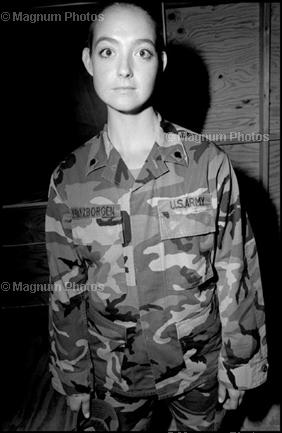

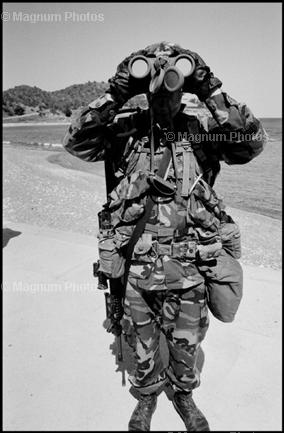

Go to Magnum and search “Gilden Guantanamo”. I’m not sure Gilden’s technique could really flourish at the illegal prison but he had a good go.
(From top left, clockwise) 1. Major-General Geoffrey Miller, Commander of Joint Task Force at Guantanamo Bay, is in charge of the 680 suspected enemy combatants in the camp. 2. Specialist Lily Allison Fitzborgen, a reservist who wants to become a police officer, is one of the guards who watches over the detainees. 3. Surveillance at Camp America. 4. Sergeant guard at a hospital for “enemy combatant” detainees. His name is blacked out so the detainees can’t see it. (Below) Before a prayer breakfast at Camp America.
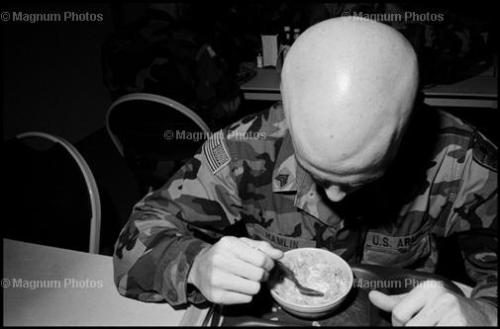
All photos © Bruce Gilden/Magnum
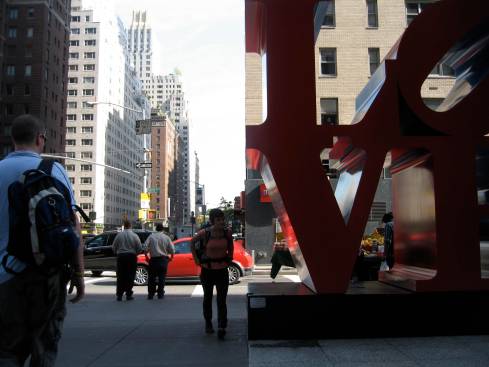
Had a fun time in New York last week. Stayed with Jack and Marisa. Below is not Jack. Below is Chris by Jack.
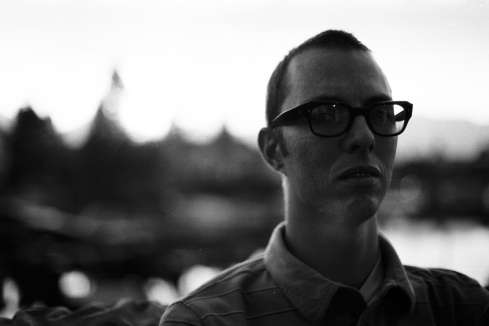
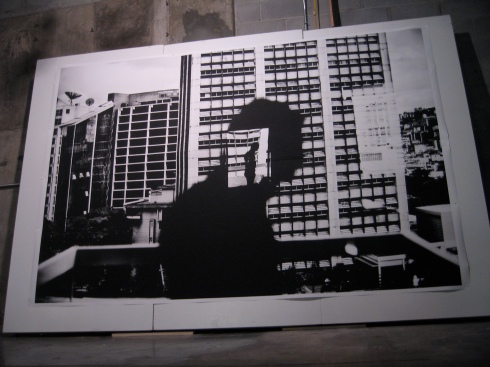
We went to Christopher Anderson’s book launch for Capitolio. It was great to see it after recent reviews, heated debates (check out comments) questions and wot not. I don’t think the selection of the images was the best.
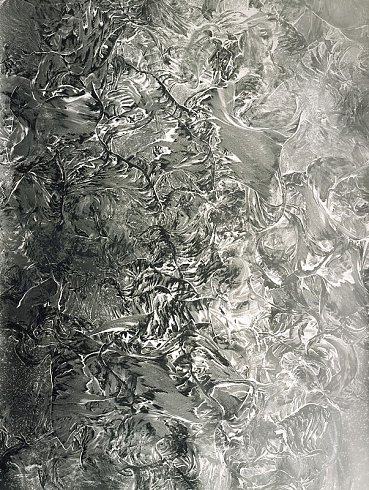
At the Metropolitan, Surface Tension: Photographs from the Permanent Collection was a pleasant whimsy into some mesmerizing works, notably Adam Fuss’ UNTITLED (1997) made by the metronome shimmers of snakes upon black dust upon white dust. Image Source: Cheim & Read
The Met’s photography department was putting together the final touches on Robert Frank’s The Americans which opened this week. It was all hands to the pump as evidenced by besuited Malcolm Daniel – who I spied carrying large, heavy object (post?) behind a partition and into the exhibition space.
Egg and Cheese Bagel.
Over at the Museum of Modern Art, I was pleased to see Russell Lee‘s work Bulletin Board in Post Office Showing a Large Collection of “Wanted Men” Signs, Ames, Iowa (1936). Who doesn’t love a mug shot?


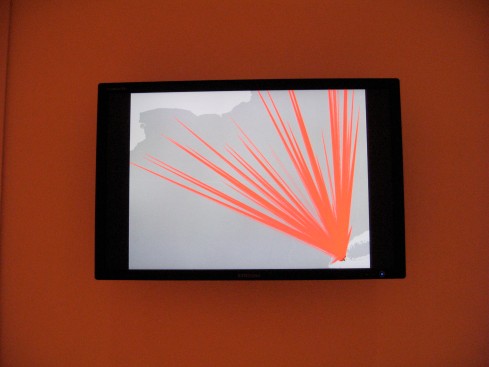
Bringing the practice of mapping of transgressions into the 21st century, the Spatial Design Lab from the Graduate School of Architecture, Planning and Preservation at Columbia University exhibited its Million Dollar Blocks Project (2006).

On Monday night I sat with Andrew Lichtenstein. We talked. Andrew recommended Brennan Linsley‘s work and was quite emphatic about the book ‘Concrete Mama‘. He also spoke highly of Max Kenner and the work at the Bard Prison Initiative
Tuesday, I met Emiliano Granado. We were first in contact over his San Quentin Giants pictures. We talked about many things including Trevor Paglen, Argentina, the Burke Gilman, and the Horticultural Society of New York, which recently lost Barbara Margolis who was an inspiring leader. Emiliano recommended Alessandra Sanguinetti‘s work.
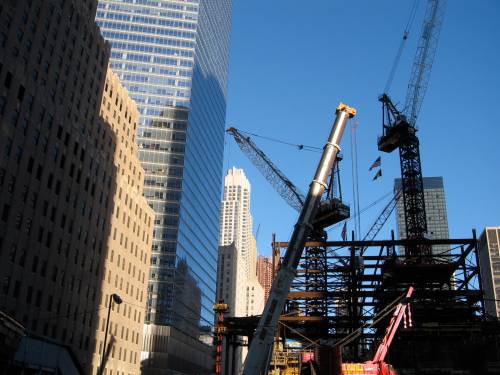
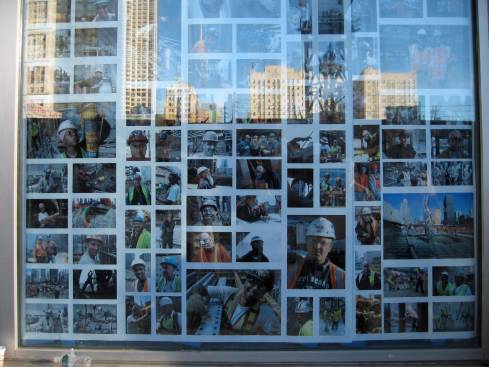
On Sunday, I’d been at the WTC construction site. There was some portraiture on display in a window. The space behind the window was closed but would usually be open. The photographs were easy on the eye.
On my last night I checked out Steven Hirsch’s Courthouse Confessions.
That’s Matt Kelley looking at Steven’s work. He’s coordinator for Change.org Criminal Justice, online communications for the Innocence Project and all together nice bloke. Matt’s double identity is twittered and can be followed here and here.
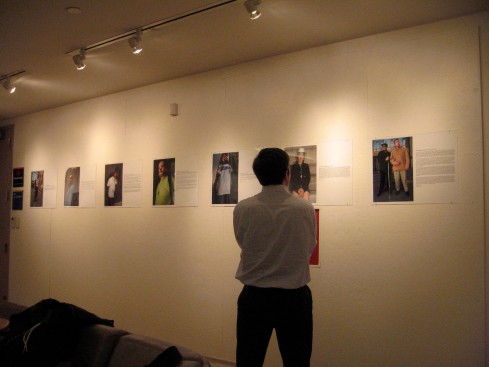
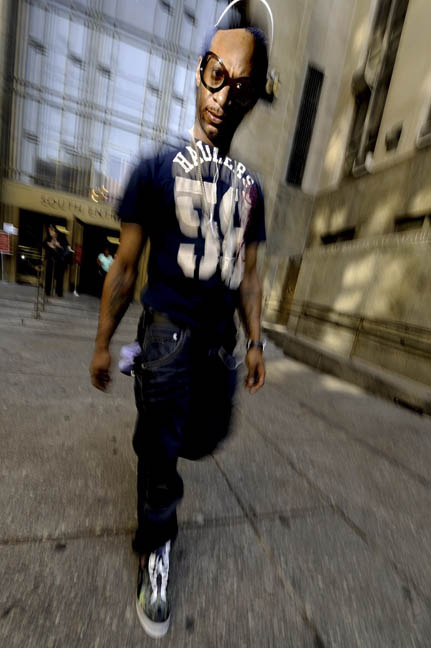
Hirsch takes street portraits of folk going to court, secures (in some ironic twist) a non-binding statement and then transcribes it verbatim to go with the portrait. Constantly moving the camera, Hirsch uses hard flash and distorted angles/zoom to depict these individuals as shape shifters; as anomalies. The fact Hirsch’s subjects (in most cases) seem alien to the logic of the courts – that any lessons arising from their cases are unlikely to effect sentencing laws in the future – should but be a source of disquiet for us as an audience.
One last thing. On Saturday, I saw John Baldessari sat outside a Grennwich Village coffeehouse, but I bottled saying anything. I’ve learnt that famous people abound in Manhattan and you see ’em everywhere.
Thanks to everyone who altered their orbits a little to coincide with mine.
This post is to salve the disappointment of thousands of visitors to Prison Photography that are tempted by the post titled View Inside Guantanamo: Video only to find that the Guardian’s rights to the three minute “tour” video have expired.

There exists a bristling irony in the Guardian’s curt and formal explanation of circumstance: the erasure of evidence based upon ‘rights’ pertaining to the command is an insulting reminder of the powerlessness of detainees whose lives are manipulated at will.
Paradoxically, in this case, it is the denied party that is the apologist for the US military’s enforced expiration and unavailability of material. It seems the controlled release of this footage has been trumped by its controlled withdrawal.

As a worthy (and non-governmental) alternative, Magnum offers Paolo Pellegrin’s 11 minute slideshow ‘Guantanamo‘. There are a few interesting things about this piece none of which are the actual photographs. The prints are steeped in morbid detachment and the unsurprising truth that the photographer was also controlled throughout this military prison.
The slideshow’s early description of Guantanamo as a small American town is sinister; the edited audio interviews of former UK detainees, family members, detainee lawyer and psychologist are very successful. The follow-up portraits of former detainees that Pellegrin later completed in Afghanistan are very strong.


All photos copyright of Paolo Pellegrin/Magnum Photos
Please, refer to my earlier post, for a comprehensive directory of photographic resources for Guantanamo including Bruce Gilden’s subtle flash-bulb mockery of Guantanamo’s rank and file. (Search within Magnum archives as deep-linking is impossible).
BURN Magazine, under the fiscal umbrella of the Magnum Cultural Foundation, have announced a $10,000 grant “to support [the] continuation of the photographer’s personal project. This body of work may be of either journalistic mission or purely personal artistic imperatives”
I am encouraging people to take on the difficult task of securing prolonged and necessary time with a prison/jail/detention-centre population in order to faithfully describe the stories and systems of its particular circumstance. On top of that your product must be “work is on the highest level”.
It’s a tall order but if you have carried out portrait or documentary photography in a site of incarceration before (I know many of you), then submit an application to continue that critical and valuable work. It will have to better than my attempt.

San Pedro Prison, La Paz. July 2008.
Hmm. On the same day I encourage photographers to attempt access into sites designed to be impenetrable, the government and police in my home country have introduced “laws that allow for the arrest – and imprisonment – of anyone who takes pictures of officers ‘likely to be useful to a person committing or preparing an act of terrorism’.” (British Journal of Photography via In-Public)
BURN Magazine is a new(ish) venture by David Alan Harvey whose got a Magnum portfolio and his own internets.
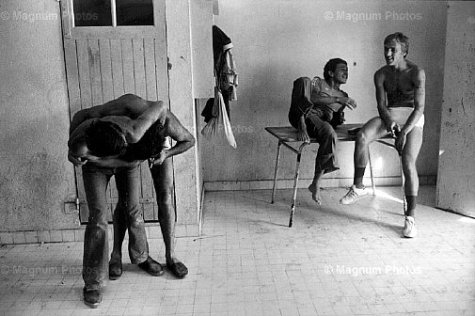
Jean Gaumy, Prisoners' horseplay. St Martin de Ré. Prison. France. 1978
Preamble: Jean Gaumy puts the fear of God into me. As an art historian, I am supposed to know how to describe and relate his ouevre. Quite honestly, the thought of discussing his work paralyses me. He embodies almost all attributes I respect in fine artists. What words build on his thoughtful photography?
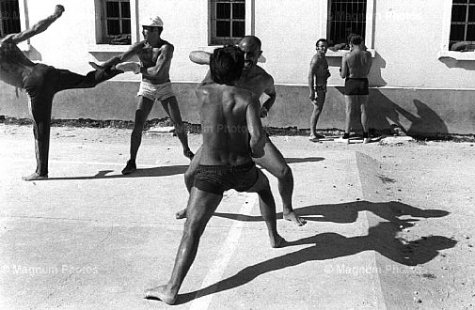
Jean Gaumy. Sports training of prisonners in the walking court. St-Martin-de-Ré. La Citadelle. Prison. 1976
Gaumy’s intellectual curiosity in his subjects – which translates as respect – was an atypical regard for prisoners during the 70s. At that time, he was one of the few photographers paying attention to criminal justice systems. He was the first photojournalist allowed inside French prisons. Les Incarcérés established Gaumy’s reputation as a thoughtful artist who revealed to society its lesser known undertakings.
Sure enough, Danny Lyon was working in Huntsville, Texas in the early 70’s but he was an inheritor of civil rights awareness and his project Conversations with the Dead has always been discussed in political terms first. Perhaps it is an unfair comparison of two great artists working in two different penal systems; perhaps it was easier for Gaumy in France to be neutral and curious. Gaumy operated without the spectre of racism and violence as existed in the South, in Texas and on death row.
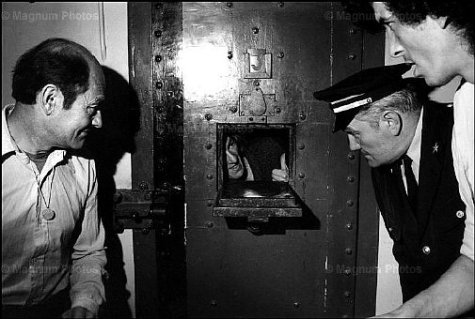
Jean Gaumy. Seine-Maritime. Rouen. Prison. France. 1979. Cell-door grating: the old system for serving meals and delivering mail to convicts.
The impression that Gaumy actually cares for his subjects may be a confusion with the possibility he just understood them. A great many of his pictures are so unique (and one presumes a long-time-making) it can be said without doubt he knew his subjects. They knew him well enough to either ignore the camera or look directly at it to communicate clear messages. Let me explain: when a camera first enters an environment it steals the attention and comfort of most subjects. At this point a great many images are of subjects reacting directly to the camera’s novel presence, and of subjects calculating the nature of their relationship to the camera and operator. For this to pass the camera must be around long enough for it to ‘become invisible’. Thereafter, when the subject addresses the camera directly, it is purposeful – with a message – a not as a reflex reaction.
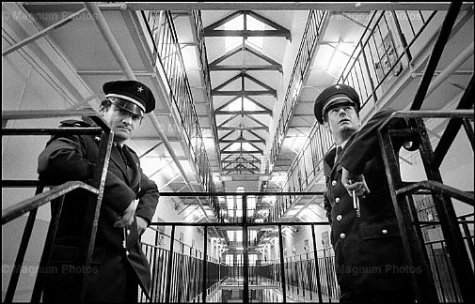
Jean Gaumy, Maison d'arrêt. Caen, France, 1976. Surveillance in the Passageway.
His work is that which enriches the viewer the longer they spend with it. These are not platitudes. Over the course of several years, with craftsmanlike rigour and repeated visits to many institutions, Gaumy pieced together a body of work (ultimately for his 1983 book, Les Incarcérés) that held a mirror to the multitude of attitudes and realities of prison life.

Jean Gaumy. Convict in his Cell, St-Martin-de-Ré. La Citadelle. Prison. 1976
Rather than taking a position or preferring the stories of one group over another Gaumy flits about the different prisons and – through (as I suspect) thorough editing – presents prisons as predictable places that are occasionally enlivened by quirks of human behaviour. Gaumy’s photography shows the machismo of a minority of inmates only after it has shown the solitude of some, the collective boredom of others, the routine awareness of guards and the bureaucratic tasks of the prison itself. There are no stereotypes in Gaumy’s work, and there a very few visual clichés.

Jean Gaumy, St-Martin-de-Ré. Prison. La Citadelle. France. 1976. Administrative procedure for the release of a prisoner.
Gaumy’s craft is the manner in which he casts an even hand over all objects and subjects. His studies of guards at their most relaxed and animated are as interesting as that of the lounging inmate reading his paper (as if a photographer stands in his cell every day). Well perhaps Gaumy did stand in his cell every day … for a period. Such is the familiarity of Gaumy’s portraits some could be mistaken for subjects in their own houses. Now is this Gaumy’s fabrication, or were the institutions of St. Martin-de-Ré; Maison d’arrêt, Caen; Seine-Maritime, Rouen; Ile-de-France, Seine-et-Marne, Melun; and the Calvados, Basse Normandie really as calm as he depicts? There is no violence, barely even tension among the inmate or guard populations.

Jean Gaumy. Transit lock chamber between the walking courts and the cells. St-Martin-de-Ré. Prison. La Citadelle. 1976

Jean Gaumy. Tattooed Prisoner. 1978. Charente Maritime region. Poitou Charentes department. Village of Saint Martin de Ré. La Citadelle. Prison. Saint-Martin de Ré was the departure point for prisoners who were sent to the Cayenne prison in French Guyana. The last shipment of convicts was in 1938.
The only suggestions of violence power Gaumy portrays are the immediate exertions of the weightlifter and, alternatively, the viewers semantically-derived understanding of violence as exhibited in tattoos.
Gaumy makes four individual studies of tattoos. It is hard to comprehend whether Gaumy was original in this. Today we are saturated with images of the tattoo, to the extent that street graffiti, body art and gallery hangings are one and the same; not a year passes without a photojournalist embedding themselves among gangs (either within or without prison) to study the pervasiveness of ink and brevity. Maybe I am biased, but I like to think of Gaumy’s interest in the tattoos of social transgressors, as an artist pioneering a genre in its infancy.
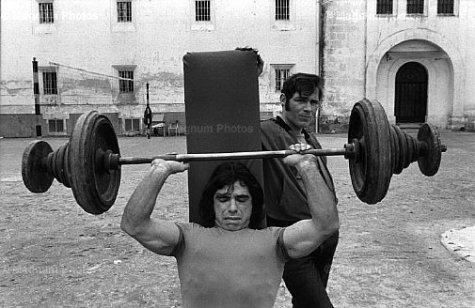
Jean Gaumy. Sports training of prisonners in the walking court. City of Caen. Prison. 1976.

Jean Gaumy. Coming on watch of warders' team. Ile-de-France. Seine-et-Marne. Melun. Prison. 1978
Gaumy kept adding the layers. Unwilling to present only the palatable human side – and seemingly unable to present the darker side of prison life – Gaumy changed his viewpoint. At times his lens was that of a fine artist concerned with shadow and form, at others his eye was that of a faux-Precisionist prompted by the reductive lines of prison architecture. Only Gaumy’s work differed from Charles Sheeler’s et al because of the presence of people – ants; dots; inhabitants. Gaumy’s work, inclusive of crowds, repeats the affections of Lowry. Gaumy’s act of recording is a testament to the physical imprisonment of these French men as Lowry’s was a testament to the social imprisonment of Salford’s working class.

A Street Scene in Clitheroe, L.S. Lowry.
As I write, another (probably meaningless) similarity between the two men springs to mind. Lowry was always drawn to the sea, particularly England’s Northeast coast and the North Sea. He returned to it into his old age. Gaumy late in his career has grappled with the enormity of the oceans. I could hypothesise both artist’s careful handling of mankind derives from an ever-present haunting of that which is larger than mankind. To appreciate the awesome scale of the sea is to wonder at the fragility of man. Ask a surfer … or a fisherman.
Gaumy also manages to reconcile – If one presumes them at opposite ends of the same spectrum – the human scale and the systemic scale of prisons. Couldn’t the three pictures below be by that of a different hand, and yet don’t they make perfect sense grouped together?

Jean Gaumy. "Bonne Nouvelle" prison ("Good news" prison). 2nd section. Walking court. Seine-Maritime. Rouen. Prison. 1979
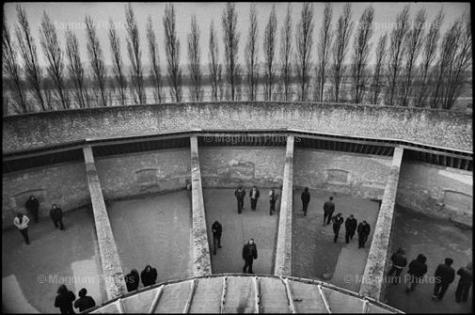
Jean Gaumy. Walking Courts, Caen. Maison d'arrêt. 1976

Jean Gaumy. "Bonne Nouvelle" prison ("Good news" prison). 2nd section. Walking court. Seine-Maritime. Rouen. Prison. 1979
Gaumy got close in and later retreated right back. Even if this is considered a privilege of a photographer with free passage through the walls of a prison, it does not guarantee good execution. My favourite image is the church service attended by a congregation of boxed men. Gaumy lays bare the crude and incongruous use of discipline and religion, and in doing mocks the scene. The viewer can’t fail but be in agreement with Gaumy; the interaction is absurd and directly contradicts the extraordinary ordinariness of Gaumy’s other scenes.

Jean Gaumy Mass in the chapel. The prisoners are isolated in individual compartments. Caen. Maison d'arrêt. 1976
Gaumy, it seems, didn’t want to extricate himself from the action, nor from the space and time spent on the series. Unwilling to let himself nor the craft of photography off the hook, Gaumy includes three studies of the anthropometric photography room. This is not a Surrealist maneouver, but it does point toward the Postmodernist insistence that the practitioner is an inevitable part of the work. Gaumy never intended to be an objective viewer but rather an active participant (he only ever took photographs with the prisoners consent) and the images below are an open admission of photography’s classifying, even disciplining, function. The camera … the metre-rule … the artificial light … the document … the knowledge … the authority.

Jean Gaumy. Anthropometric photography of a convict at his arrival in prison. Basse Normandie. Calvados. Caen. Prison. 1976

Jean Gaumy. Anthropometric photography of a convict at his arrival in prison. Basse Normandie. Calvados. Caen. Prison. 1976
Without doubt, Gaumy was fortunate to have a wild-haired caricature sitting for this particular anthropometric observation. The docile subject is the perfect compliment to the act of observation and documentation. The treatment of this prisoner is akin to expedition-photography that attempted to measure the anatomical dimensions of colonised peoples and thus provide scientific evidence for Western genetic superiority. This appreciation is the perfect close to a series throughout which Gaumy balances his artistic aims, social purpose, photography’s interferences and the loaded history of Modern taxonomic praxis. Gaumy dismantles assumed norms and hierarchies of social order and allows the viewer to meditate on the subtleties of carceral systems.
I escaped my paralysis, jolted by the news that last week Jean Gaumy was awarded the Peintre de la Marine (Painter of the Fleet) by the French Ministry of Defence. Gaumy is only the fifth photographer to join the select circle, which is composed of only 40 members.
For a full biography and portfolio please visit the pages of Magnum Photo Agency.
The folkology (keyword tags) within the Magnum archive are inconsistent. Different sets of Gaumy’s images turn up for different searches. Here is another isolated set for St-Martin-de-Ré. La Citadelle also from 1976. I would encourage readers to search at length Gaumy’s work throughout the different institutions with permutations on keyword searches.

 Prison Photography