
You are currently browsing the tag archive for the ‘New York’ tag.
In photography Cornell Capa has huge renown. In prisons, Attica has a huge renown. It is therefore, expected that I’d transcribe Capa’s testimony to the McKay Commission (New York State Special Commission on Attica) Hearings.
After the text I shall offer my opinion.
TEXT
Cornell Capa: I was asked eventually by Arthur [Liman, Counsel] if I would want to look at Attica for the reasons that he mentioned, that photography and a photographer may have something to contribute …
As a human being and a photographer, my personal and professional and civic feeling was to look into it and – as my professional life is involved in understanding human condition – try to perceive what it is all about.
I think photography can serve a most useful role in an investigation and that’s exactly what I consented to do.
I [have] submitted 26 photographs which I will be showing to the commission and I have submitted equally a very short written statement and captions for the photographs.
I would like to really just read my written statement and following that as the photographs go by, I will do the captioning job for them.
At Attica: A Photographic Report.
Recently I spent three days at Attica, having been asked by the McKay commission to take a look at the institution and bring back my visual report.
During the visits to Attica I was, at all times, accompanied by a correction officer and a member of the Commission staff; all persons recognizable in these photographs consented to be photographed.
My photographs and their captions constitute my report for the commission. There is just a little more to add.
A feeling of nervous expectation seems to pervade Attica. Everybody is waiting the result of the work of the Commission’s investigations on the causes of the explosion which occurred there six months ago, and their recommendations for the future avoidance of such a tragedy in the future. Both sides, inmates and guards expect some new things to evolve from the findings – some kind of miracle which will transform the institution into a place where the Biblical lion and lamb will better live together peacefully.
The only hitch: each side has its very own view of the meaning of peaceful and better coexistence, and how to achieve it.
From the outside, Attica situated in the rolling farmland in western New York, has a Disneyland-like appearance, especially at night.
Attica’s inmates are all locked in their cells from approximately 5pm until 7am the next morning. Officers on the night shift make lonely rounds checking the count six times a night.
All movement in Attica is limited by locks. At night the duty officer must carry with him all the keys he will need on his nightly round of inspection
Confined to their 4 x 9 cells, inmates may talk to one another across the cellblocks and play music instruments until 8pm.
Locked in a cell a mirror is an inmates eyes to the rest of his gallery, and whenever something happens, the mirrors appear as if on cue.
After 8pm talking and noise are not permitted. There is little to do until lights out at 11pm except read, write letters or listen to one of the three channels of the prison radio which plays music, sports and the audio portion of TV shows.
In E Block, Attica’s medium security prison with the maximum-security walls, a small group of inmates in special programs are permitted to remain at night in the blocks day room to watch television, play cards or talk.
Corrections officers on the day shift leave homes in the town of Attica and surrounding communities and report for roll calls at 7am, 9.20am, 3pm and 11pm to receive their assignments.
These are the guns and smoke parts etc, what [sic] they keep in the armory for emergency use only.
These are the keys, which they use, the whole system is based on keys. This is just a very small selection of all the keys that open all the doors in Attica
On signal the cells open and inmates in each company line up in two’s to be escorted down one of the endless corridors to the mess hall for breakfast
In his daily movements throughout the institution, an inmate must pass through several times through ‘Times Square’ where the corridors leading from the four main cell blocks converge and gates point in four directions.
Many inmates spend up to five hours a day working in one of the prison industries, the largest of which is a large metal shop, where inmates build steel cabinets and office furniture for state institutions.
For a few hours each day, inmates are allowed to go into their cellblock’s yard for outdoor recreation
The sports facilities, always limited, have been even more curtailed since September. For most inmates the yard means walking around and around or standing around.
The only opportunity for most inmates to watch TV is outside in the yard. Due to the winter climate and the meager daytime TV schedules, few are interested.
While some are out in the yard, others return to their cellblocks. In some areas there are improvised meeting rooms where a few inmates can pursue simple hobbies and handicrafts.
For the rest it is back to the cells to pass the hours until supper. The site of disembodied hands outside the bars playing cards is not unusual here.
Some play chess but the opponent remains unseen.
There is so much idle time; one of the most common activities is preparing legal paper for appeals and writs.
9.30 to 3.30 every day are visiting hours. Those inmates whose families live nearby or who can afford the long journey to Attica may receive a visit. Visits take place in a large room, under the watch of officers and a wire screen separates the inmates from his visitor.
An inmate’s personal touch, often his own creation, is the difference between one cell and another.
One of the statewide changes since the riot is the creation of inmate liaison committees at each institution.
The committee at Attica was elected last month, has adopted a constitution and has begun the task of drawing up projected reforms.
Although life at Attica is again becoming routine, grim reminders of what happened there are everywhere.
This is the round State Shop in damaged condition beyond repair.
Two of the cells blocks were destroyed beyond repair and are still unoccupied. D Block yard on which the eyes of the world were focused for four days last September is deserted now. The trench is filled in but remains visible like a scar reminding one of the great illness which fell upon Attica seven months ago.
[END]
_____________________________________________________
Capa’s review is a rather bland description of everyday life in the prison. This comes as quite a disappointment; I had expected a rousing polemic against the unsuitable conditions of mammoth prisons and their effect on the will of man.
These words seem particularly tame when one considers the magnitude, violence and precendence Attica has in the history of prison resistance. The words are detached from the extremely graphic photographs [WARNING] documenting the riot and its bloody remnants. Capa’s words are the epitome of obsolescence.
Attica was a disaster.
Capa’s words fall short of the strength needed to describe the institution six months on from disaster.
I encourage you all to browse Attica Revisited an encyclopaedic resource of official papers, oral history video and photography.
Note: This one’s off topic, but I’ll be coming back with prison related visual critique sooner than you can say “Jack Lemon”.

The Computer History museum in Mountain View, California. Credit: David Glover
How do museums and galleries use online media to promote themselves?
I have been required to think about “The Museum” and it’s engagement with public and web2.0 audiences recently. If you look about you’ll find really good uses and catastrophic uses of web2.0 by museums and galleries alike. I don’t want to beat up on small galleries for their ill-advised, tweeting non-personas nor criticise lackadaisical irregular blog posting; both of these activities are for the intern. I’d really complain if I thought someone was getting paid to stumble through blog posts and ideas after a full day educating outreach audiences.
I do think the MoMA and San Francisco MoMA are fair game though.
Let’s start with the good.
MoMA: A delicate, understated film-short, with good production values. Some might argue it’s over sentimental and panders to arty self obsessions, but the MoMA is the beacon of an art world, art market and art-as-brand that has Western obsessions about the object at its core. I’ll allow it to veil this truth and remould it as individual yearning.
Click on the image below to view the video at The Contact Sheet blog.

Still from MoMA's promotional video "I See"
And now, to the bad.
SFMoMA: Apparently inspired by the White House launch of Obama coverage on Flickr, the San Francisco MoMA launched its own stalking eye upon director Neal Benezra. They call it Director Cam.

Benezra at press preview, being interviewed by Don Sanchez for ABC7, in the SFMoMA rooftop sculpture garden.
Now, I am all for transparency, informality, familiarity and all that, and, to be fair, SFMoMA has done this reasonably well with its other Flickr sets (although I’d prefer less high-society party coverage and more high-school outreach coverage).
However, Director Cam just rubs me the wrong way. I don’t want to see the privileged folk of the museum-world lording over its institutions, I want to see public audiences getting knee deep in collections & archives and mixing it up a bit. I want to see Flickr used as a means to entice people into the museum not as a mirror for already existing (and exclusive) engagements.

Neal talking with Exhibitions Design Manager / Chief Preparator Kent Roberts. With Chuck Schwab, chairman of the board of trustees (center) and Catherine Kuuskraa (right). In the background on the left wall you can just slightly see the new bridge commission, by Rosana Castrillo-Diaz.
BLDGBLOG (via Twitter) this week called for an alternative narrative of the built environment.
As I understood this, it is a theoretical proposal that would include interviews and testimonies of electricians, security guards and the fixers that keep the nuts and bolts in place while arty self-obsessed types flit about amid well-maintained frameworks.
After the white-collar fraudulent dismantling of the city, there is no better time to call for an alternative version of urbanity. A blue-collar city narrative.
With these thoughts looming, it is not Benezra that interests me, rather Kent Roberts, Exhibitions Design Manager and Chief Preparator at SFMoMA. Bring on ‘Museum Preparator Cam’!
All of this throws up more unanswered questions about the role of new media in the operations of museums and galleries. Fortunately, I recently discovered Nina Simon’s Museum 2.0 blog which provides some riposte.
___________________________________________________________
Images. Computer History Museum by David Glover. As well as his Computer History Museum Set, you should check out his Byte Back Set.
Author’s Note: If there exist any photographs of the violence described below I wouldn’t want to see them, only trust that photographs were used to bring high ranking US officials to justice for crimes against human rights.
I have been familiar with Mark Danner‘s work since reading the excellent Torture and Truth. It dealt commandingly with the Abu Ghraib scandal, putting it into the procedural context of the Bush administration and US operations during the War on Terror. Not to be distracted by the available Abu Ghraib images, Danner continued his fervent document-trawling professionalism and pursued the truth with regard to other Black Sites and detainee torture & interrogation.

Abu Zubaydah after his capture in Pakistan, 2002. Credit: ABC News
Last month, Danner published an Op-Ed piece for the New York Times (to accompany an extended piece for the New York Review of Books) that laid out the details of an International Red Cross report of detainee testimonies. I have only read the shorter NY Times piece and strongly urge you to take 10 minutes to do so. It is a succinct presentation of facts detailing US torture procedures.
Men were tortured in America’s name.
Indeed, since the detainees were kept strictly apart and isolated, both at the black sites and at Guantánamo, the striking similarity in their stories would seem to make fabrication extremely unlikely. As its authors state in their introduction, “The I.C.R.C. wishes to underscore that the consistency of the detailed allegations provided separately by each of the 14 adds particular weight to the information provided below.”
Danner deals with the circumstances of three high ranking Al Qaeda prisoners, one of whom is Abu Zubaydah (pictured above following his 2002 capture). Judging by the Red Cross report which used separate chapters – “suffocation by water,” “prolonged stress standing,” “beatings by use of a collar,” “confinement in a box” one can assume Zubaydah looked significantly more broken after his months of early detention and beatings.
Danner concludes;
What we can say with certainty, in the wake of the Red Cross report, is that the United States tortured prisoners and that the Bush administration, including the president himself, explicitly and aggressively denied that fact.
The use of torture was a decision made by the US government. Danner’s conclusion is ominous;
The consequences of this choice, legal, political and moral, now confront us. Time and elections are not enough to make them go away.
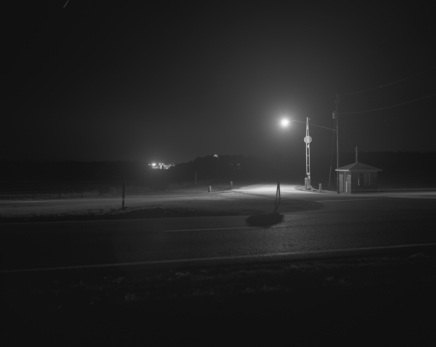
Alabama Death House Prison, Grady, AL, 2004. Silver print photograph. © 2009 Stephen Tourlentes
Stephen Tourlentes photographs prisons only at night for it is then they change the horizon. Social division and ignorance contributed to America’s rapid prison growth. Tourlentes’ lurking architectures are embodiments of our shared fears. In the world Tourlentes proposes, light haunts; it is metaphor for our psycho-social fears and denial. Prisons are our bogeyman.
These prisons encroach upon our otherwise “safe” environments. Buzzing with the constant feedback of our carceral system, these photographs are the glower of a collective and captive menace. Hard to ignore, do we hide from the beacon-like reminders of our social failures, or can we use Tourlentes’ images as guiding light to better conscience?
Designed as closed systems, prisons illuminate the night and the world that built them purposefully outside of its boundaries. “It’s a bit like sonic feedback … maybe it’s the feedback of exile,” says Tourlentes.
Stephen Tourlentes has been photographing prisons since 1996. His many series – and portfolio as a whole – has received plaudits and secured funding from organisations including the John Simon Guggenheim Foundation, the Massachusetts Cultural Council and Artadia.
Stephen was kind enough to take the time to answer Prison Photography‘s questions submitted via email.
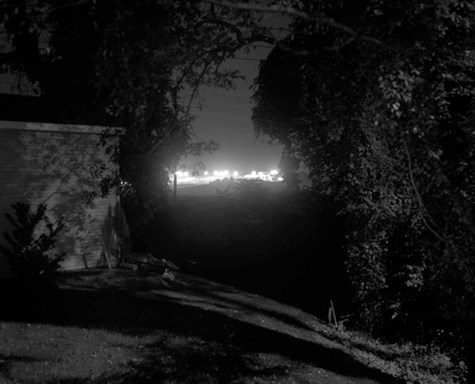
Penn State Death House Prison, Bellefonte, PA, 2003. © 2009 Stephen Tourlentes

Carson City, Nevada, Death House, 2002. Gelatin silver print. © 2009 Stephen Tourlentes

Blythe Prison, California. © 2009 Stephen Tourlentes
Pete Brook. You have traveled to many states? How many prisons have you photographed in total?
Stephen Tourlentes. I’ve photographed in 46 states. Quite the trip considering many of the places I photograph are located on dead-end roads. My best guess is I’ve photographed close to 100 prisons so far.
PB. How do you choose the prisons to photograph?
ST. Well I sort of visually stumbled onto photographing prisons when they built one in the town I grew up in Illinois. It took me awhile to recognize this as a path to explore. I noticed that the new prison visually changed the horizon at night. I began to notice them more and more when I traveled and my curiosity got the best of me.
There is lots of planning that goes into it but I rely on my instinct ultimately. The Internet has been extremely helpful. There are three main paths to follow 1. State departments of corrections 2. The Federal Bureau of Prisons and 3. Private prisons. Usually I look for the density of institutions from these sources and search for the cheapest plane ticket that would land me near them.
Structurally the newer prisons are very similar so it’s the landscape they inhabit that becomes important in differentiating them from each other. Photographing them at night has made illumination important. Usually medium and maximum-security prisons have the most perimeter lighting. An interesting sidebar to that is male institutions often tend to have more lighting than female institutions even if the security level is the same.
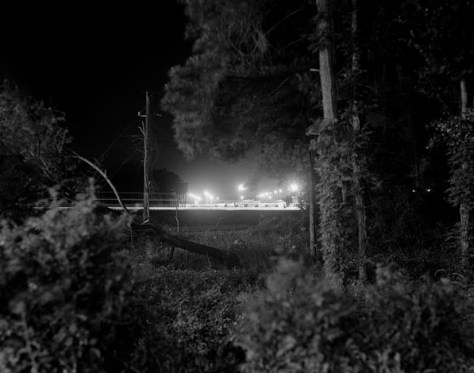
Holliday Unit, Huntsville, Texas, 2001. Gelatin silver print. © 2009 Stephen Tourlentes
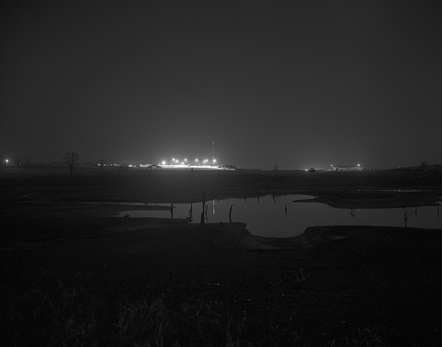
Springtown State Prison, Oklahoma, 2003. Archival pigment print. © 2009 Stephen Tourlentes
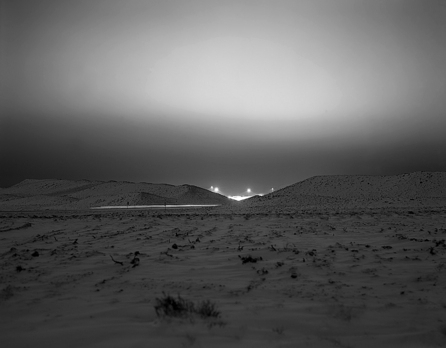
Death House Prison, Rawlins, Wyoming, 2000. Archival pigment print. © 2009 Stephen Tourlentes
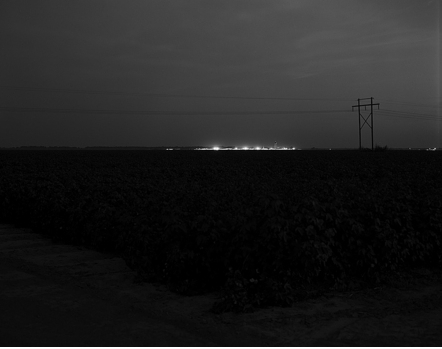
Arkansas Death House, Prison, Grady, AK, 2007. © 2009 Stephen Tourlentes
PB. Are there any notorious prisons that you want to photograph or avoid precisely because of their name?
ST. No I’m equally curious and surprised by each one I visit. There are certain ones that I would like to re-visit to try another angle or see during a different time of year. I usually go to each place with some sort of expectation that is completely wrong and requires me to really be able to shift gears on the fly.
PB. You have described the Prison as an “Important icon” and as a “General failure of our society”. Can you expand on those ideas?
ST. Well the sheer number of prisons built in this country over the last 25 years has put us in a league of our own regarding the number of people incarcerated. We have chosen to lock up people at the expense of providing services to children and schools that might have helped to prevent such a spike in prison population.
The failure is being a reactive rather than a proactive society. I feel that the prison system has become a social engineering plan that in part deals with our lack of interest in developing more humanistic support systems for society.
PB. It seems that America’s prison industrial complex is an elephant in the room. Do you agree with this point of view? Are the American public (and, dare I say it, taxpayers) in a state of denial?
ST. I don’t know if it’s denial or fear. It seems that it is easier to build a prison in most states than it is a new elementary school. Horrific crimes garner headlines and seem to monopolize attention away from other types of social services and infrastructure that might help to reduce the size of the criminal justice system. This appetite for punishment as justice often serves a political purpose rather than finding a preventative or rehabilitative response to societies ills.
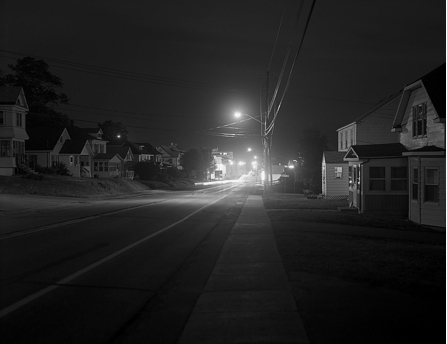
State Prison, Dannemora, NY, 2004. © 2009 Stephen Tourlentes

Prison, Castaic, CA, 2007. © 2009 Stephen Tourlentes

Federal Prison, Atwater, CA, 2007. © 2009 Stephen Tourlentes

Utah State Death House Complex, Draper, UT, 2002. © 2009 Stephen Tourlentes
PB. How do you think artistic ventures such as yours compare with political will and legal policy as means to bring the importance of an issue, such as prison expansion, into the public sphere?
ST. I think artists have always participated in bringing issues to the surface through their work. It’s a way of bearing witness to something that collectively is difficult to follow. Sometimes an artist’s interpretation touches a different nerve and if lucky the work reverberates longer than the typical news cycle.
PB. In your attempt with this work to “connect the outside world with these institutions”, what parameters define that attempt a success?
ST. I’m not sure it ever is… I guess that’s part of what drives me to respond to these places. These prisons are meant to be closed systems; so my visual intrigue comes when the landscape is illuminated back by a system (a prison) that was built by the world outside its boundaries. It’s a bit like sonic feedback… maybe it’s the feedback of exile.
PB. Are you familiar with Sandow Birk’s paintings and series, Prisonation? In terms of obscuring the subject and luring the viewer in, do you think you operate similar devices in different media?
ST. Yes I think they are related. I like his paintings quite a lot. The first time I saw them I imagined that we could have been out there at the same time and crossed paths.
PB. Many of your prints are have the moniker “Death House” in them, Explain this.
ST. I find it difficult to comprehend that in a modern civilized society that state sanctioned executions are still used by the criminal justice system. The Death House series became a subset of the overall project as I learned more about the American prison system. There are 38 states that have capital punishment laws on the books. Usually each of these 38 states has one prison where these sentences are carried out. I became interested in the idea that the law of the land differed depending on a set of geographical boundaries.

Federal Prison, Victorville, CA, 2007. © 2009 Stephen Tourlentes
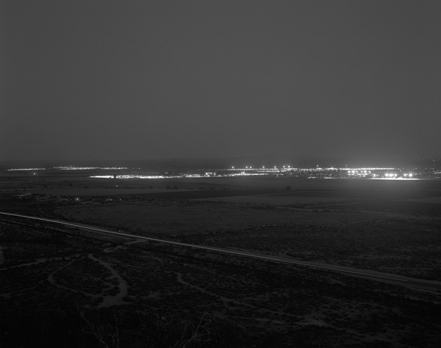
Prison Complex, Florence, AZ, 2004. © 2009 Stephen Tourlentes

Lancaster State Prison, Lancaster, CA, 2007. © 2009 Stephen Tourlentes
PB. Have you identified different reactions from different prison authorities, in different states, to your work?
ST. The guards tend not to appreciate when I am making the images unannounced. Sometimes I’m on prison property but often I’m on adjacent land that makes for interesting interactions with the people that live around these institutions. I’ve had my share of difficult moments and it makes sense why. The warden at Angola prison in Louisiana was by far the most hospitable which surprised me since I arrived unannounced.
PB. What percentage of prisons do you seek permission from before setting up your equipment?
ST. I usually only do it as a last resort. I’ve found that the administrative side of navigating the various prison and state officials was too time consuming and difficult. They like to have lots of information and exact schedules that usually don’t sync with the inherent difficulty of making an interesting photograph. I make my life harder by photographing in the middle of the night. The third shift tends to be a little less PR friendly.
PB. What would you expect the reaction to be to your work in the ‘prison-towns’ of Northern California, West Texan plains or Mississippi delta? Town’s that have come to rely on the prison for their local economy?
ST. You know it’s interesting because a community that is willing to support a prison is not looking for style points, they want jobs. Often I’m struck by how people accept this institution as neighbors.
I stumbled upon a private prison while traveling in Mississippi in 2007. I was in Tutweiler, MS and I asked a local if that was the Parchman prison on the horizon. He said no that it was the “Hawaiian” prison. All the inmates had been contracted out of the Hawaiian prison system into this private prison recently built in Mississippi. The town and region are very poor so the private prison is an economic lifeline for jobs.
The growth of the prison economy reflects the difficult economic policies in this country that have hit small rural communities particularly hard. These same economic conditions contribute to populating these prisons and creating the demand for new prisons. Unfortunately, many of these communities stake their economic survival on these places.

Kentucky State Death House, Prison, Eddyville, KY, 2003. © 2009 Stephen Tourlentes
PB. You said earlier this year (Big, Red & Shiny) that you are nearly finished with Of Lengths and Measures. Is this an aesthetic/artistic or a practical decision?
ST. I’m not sure if I will really ever be done with it. From a practical side I would like to spend some time getting the entire body of work into a book form. I think by saying that it helps me to think that I am getting near the end. I do have other things I’m interested in, but the prison photographs feel like my best way to contribute to the conversation to change the way we do things.
________________________________________
Author’s note: Sincerest thanks to Stephen Tourlentes for his assistance and time with this article.
________________________________________
Stephen Tourlentes received his BFA from Knox College and an MFA (1988) from the Massachusetts College of Art in Boston, where he is currently a professor of photography. His work is included in the collection at Princeton University, and has been exhibited at the Revolution Gallery, Michigan; Cranbook Art Museum, Michigan; and S.F. Camerawork, among others. Tourlentes has received a John Simon Guggenheim Foundation Fellowship, a Polaroid Corporation Grant, and a MacDowell Colony Fellowship.
________________________________________
This interview was designed in order to compliment the information already provided in another excellent online interview with Stephen Tourlentes by Jess T. Dugan at Big, Red & Shiny. (Highly recommended!)

 Prison Photography