
You are currently browsing the tag archive for the ‘Prison’ tag.
Street Photography is a recognised genre.
Prison Photography is yet ill-defined. For the most part, it is a series of interventions by camera and operator into the procedures and relations within institutions of containment.
With these criteria in mind – the familiarity of the subject; the public visibility of the practitioner(s); the obstacles to access; and the assumption of existing/distinctive authority – it seems like the two approaches to subject are in opposition.
My presumption my be illustrated as thus:

The x axis is Time on the job.
The y axis is The original number of leads (to securing access to your subject) still open. Shown as a percentage.
Ben Gunn, Guardian. Monday September 14th, 2009
There is an interesting debate growing in the UK. Should prisoners be allowed to blog?

Ben Gunn, who claims to be the only serving UK prisoner who blogs, had a letter to his wife intercepted by the prison governor and told “the content is interesting enough to be published on the internet” and on this ground it was stopped from leaving the prison.
Gunn set up the blog at the end of August. He writes the content and his editor posts it to the web.
Gunn has caused a stir with forthright opinions on politicised victims groups, spineless politicians and poor prison management. These, he argues, are not fallacious rants, but genuine problems of an overly-punitive system and disengaged society.
Furthermore, Gunn argues that despite his original sentence of 10 years, he remains in prison after 30 because he has continuously challenged the prison authorities. At present Gunn is engaged in research towards a PhD, focused upon the role of Human Needs Theory in prison conflicts.
My question “How do we feel about Prison Bloggers?” is largely rhetorical. How we feel about them makes no impingement on their lawful right to write and publish from prison. Let’s be absolutely clear here. Gunn is breaking NO LAW.
The only law that may pertain is that Gunn may receive no compensation for his writing while a ward of the prison service. But this was never the issue at stake. Gunn’s free speech was deliberately quashed by the administration of a system that stood to face criticism through his words.
The official position as summarised by another excellent prison rights blogger John Hirst (The Jailhouse Lawyer):
The Ministry of Justice writes: “There is no specific Prison Service policy on prisoners using or posting blogs, as they do not have direct unregulated access to computers or the internet”. However, the reply goes on to to say that it can be implied from Prison Service order 4411, that a prisoner cannot ask someone else to communicate what the prisoner is not in a position to do himself and which violates the rules. The MoJ has clearly failed to take into account the human right to freedom of expression guaranteed under article 10 of the European convention, and prisoners’ rights to contact the media “on matters of legitimate public interest“.
I agree with many of Gunn’s positions, I don’t appreciate his tone sometimes, but I think he must absolutely exist within the dialogue about British criminal justice. His thoughts as a serving prisoner are of central value to debate and an informed public.
The echoes ring true and far. Gunn’s concerns over misinformation, scare-mongering and codes of silence are as acute (if not moreso) in the US prison industry.
I’ll leave you with Gunn’s view on prevailing distortions to debate and his admirable defiance:
In reducing discussions to trite slogans and vote-grubbing soundbites, we debase ourselves as a collective and as people. I realise that I pose a challenge, but regardless of any efforts expended by the government I am not going away.
_____________________________________________________________
As well as the Guardian sources linked in this article, the BBC picked up on this story and includes a brief but informative audio discussion of the issue.
_____________________________________________________________
Editor’s note: It seems strange that in the UK this quasi-controversial issue has taken a long time to rear its head – after all, Michael Santos has been blogging from US federal prisons at his own Prison Journal and as a guest at Change.org since January 2009.
Two things today. First an important debate. Second my own reflections and housekeeping.
debate
Ben Chesterton at DuckRabbit has had ongoing discussions with MSF / Medicin Sans Frontier / Doctors Without Borders for many months (years?) about the use of media and the fine line between MSF’s promotion of aid work and fair representation of the peoples they work with. Duck has opened a worthwhile debate with Pete Masters of MSF on the duckrabbitblog with regard this new MSF advertisement.
Feel free to add your comments over on Duck’s blog. I know Ben will appreciate and we should all benefit, right?
house keeping
In absolutely no way related – AND, I encourage you not to presume the fictional scene in the MSF ad as one set in Africa – I’d like to return to an image I featured on Prison Photography in December.

The image is by Tim McKulka. The caption reads: The container which serves as a detention facility as human rights and protection officers make an inspection of the capacity of police and prison service. UNMOs from Torit team site were engaged in a long range patrol to Chukudum along with various civilian sections of UNMIS in order to assess the security and social conditions of the area.
Last night, I had the great privilege of attending a YPIN World Affairs Council presentation by Tim McKulka and his partner Anyieth D’Awol about Human Rights in Sudan. There were a few thing that I took from the talk:
1. The problems in Darfur are very serious, but Darfur is not the only conflict in Sudan
2. Things are better now than they were one, two or three years ago – if you measure better by fewer deaths.
3. The predominant source of unrest in the Sudan always stems from the growth of the capital, Khartoum, at the expense of the periphery.
4. Since independence from the British in 1955, Southern Sudan has never known stable or benevolent governance (Civil wars raged from 1956 – 1975; and then from 1982 – 2005). The first war was settled with the drawing of a new boundary between North and South and newly provided autonomy. The second war began because rich reserves of oil were found within the territory of South Sudan and consequently Khartoum and the North reneged on the agreement, grasped for the wealth and resorted to aggression.
5. There exists to this day tribal conflicts in the central areas of contested lands, particularly Aybei where much of the oil reserves lie.
Needless to say the talk was humbling – Tim and Anyieth successfully gave a summary of culture and politics across the entire country, covering the last 60odd years. No small achievement!
I wanted to finally pin down some background to the image and so I asked Tim, “What is that container assemblage exactly?” His response,
It was in a place called Chukudum in southern Sudan, East Equatoria State and it shows that there is no other place to put prisoners. There are crimes being committed but there is no justice, no security; no security sector. The police don’t have guns, or cars, or transportation. They don’t have communications. So the container is what people are left to use when they have prisoners. What else can you do with them?
Tim has followed much of the peacekeeping and reconstruction work in Sudan. This has involved shadowing the training of new prison officers and the establishment of new institutions for juvenile justice. I hope to follow up on this with more involved comments from Anyieth as she, as a human rights lawyer, has far more knowledge in the area … and Tim deferred to her experience.
Here’s Tim’s portfolio Faces of Sudan.
Tim McKulka has been working as the senior photographer for the United Nations Mission in Sudan since September 2006. Prior to that, he was based in New York covering national and international news as a freelance photojournalist for Polaris Images. He graduated with a fine arts degree in photography from the School of Visual Arts in New York. His work has been featured in numerous national and international publications including The New York Times, Christian Science Monitor, Italian Vanity Fair, The Washington Post, and Time Magazine.
Anyieth D’Awol LLB, LLM is an independent researcher working in Southern Sudan. She has worked for the United Nations Mission in Sudan (UNMIS) as a Human Rights Officer. She also worked for the Joint Donor Office as a Policy Officer. Anyieth was a Senior Researcher for the Presidential Advisor on Gender and Human Rights with the Government of Southern Sudan, focusing primarily on sexual violence and human rights issues and the military. She is the founder of a civil society organization providing underprivileged women and girls opportunities for sustainable income through arts and crafts while creating opportunities for capacity development in literacy and numeracy, and providing information on HIV, gender and human rights issues.
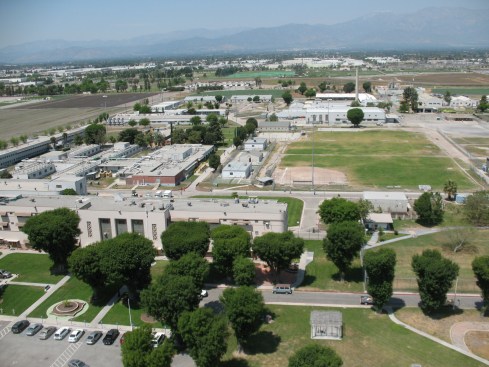
California Institute for Men at Chino, 2008 (Prior to Riot). Photo Credit: CDCR
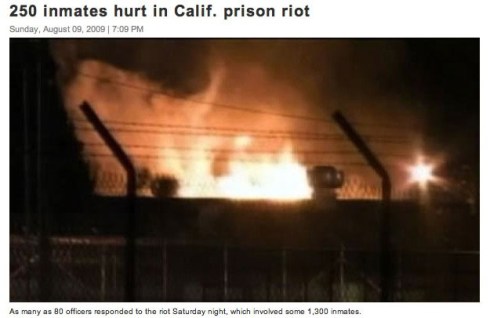
Michael Shaw over at the excellent BAGnewsNotes pointed out a rather bizarre anomaly in our image-saturated world. There exist barely any photographs of the prison riot at the California Institute for Men at Chino that occurred this weekend.
Given that Shaw has his hand firmly on the newswire pulse of America I’ll take him at his word … photojournalist coverage of this significant riot was is scant.
I even think that the image Shaw presents is a concession; a still from film footage.
Today, the Los Angeles Times published this image showing the aftermath of the riot.

Photo: A view from outside the fence after weekend rioting at the California Institute for Men at Chino shows a dorm with a hole burned through its roof and a yard littered with mattresses and other debris. Credit: Allen J. Schaben / Los Angeles Times
The BBC was quick to cover the riot. Most news sources framed the riot as a result of racial tension, but in truth those tensions only came to surface due to inexcusable and acknowledged overcrowding. In 2007, Doyle Wayne Scott, a former Texas corrections chief consulting on California prison security reported that overcrowding at the California Institute for Men at Chino created “a serious disturbance waiting to happen.”
Overcrowding is a problem that ignites other problems, and represents a serious issue that has no easy answers. Some prison reform activists would be wiling to see new (temporary) facilities built to ease the tensions, but this is an unlikely scenario as trust between they and the legislature, Governor’s office, CDCr and CCPOA is low. Recent history has taught us that when new prisons are built, they are filled and calls for more prisons follow. The solution is to change the laws that over the past two decades have warehoused increasing numbers of non-violent offenders.
One of the other depressing aspects to this story is that the racial tensions are apparently the result, partly, of enforced desegregation at Chino. Prison populations operate on strict codes and it would seem that top-down-enforcement of an anti-racist policy doesn’t change the attitudes of the men only agitates their existing prejudices, distrust and expected antagonisms toward one another.
My humble suggestion to work against these deep-seated hatreds would be to operate smaller facilities with immediate access to education programs. Sociological models taught as part of a basic curricula are revelatory for many prisoners. Many inmates, given the tools and the logic to explain their oppositions will identify other ways of seeing race.
It is true that some prisoners don’t want to rehabilitate, but they are in the minority. Often it is simply the case that race for this population has never been discussed in complex or nuanced terms.
Here’s some video of the aftermath.
Thanks to Scott Ortner and Stan Banos for the tips on this story.
I am away from the computer for the next week. Joseph Rodriguez will occupy much of my thoughts during that time. As I have said before, I’ll be returning to his work and method.
In the meantime, read his interview and watch his multimedia piece over at RESOLVE blog.


No Caption Needed (NCN) is a bubbling blog-broth of visual politics and opinion that swills about their own cast-iron-think-piece cauldron. Last year, NCN (Robert Hariman & John Louis Lucaites) posted thoughts on America’s Prison Industrial Complex.
NCN began by stating, in my opinion, an irrefutable fact, “The prison system in the United States gives a hard meaning to the adage ‘out of sight, out of mind’.”

2008. Copyright: Andrew Lichtenstein
Specifically, NCN was reacting to the formidable work of Andrew Lichtenstein who has documented for many years America’s sites of incarceration. In 2006, he was a Soros Documentary Photography Grant recipient.
The words that stuck with me from NCN’s post The American Gulag were those that lamented Democrat and Republican obstinacy and mutual blindness to shared agendas. NCN suggests both major parties have ideological roots which should inform progressive positions on prison reform and thus the down-scaling of US reliance on custodial sentencing:
NCN’s brand of commentary on this type of pariah-issue is in stark comparison to the empty promises of politicians to reach across the aisle.
“Those walls aren’t there just to keep me in, but to keep you out.”
Tyrone W. (Prisoner and student)
Providing meaningful education in sites of incarceration is a difficult task. How do educators get inside the walls?

Inmates taking an Adult Basic Education class at the Norco prison include Paul Rodriguez (left), Jobentino Romero (front), Felipe Ramos (right) and Marco Tielve (back). Chronicle photo by Michael Macor Photo: Michael Macor / SFC
In 1994, the Clinton Administration withdrew Pell Grants and thus all funding for college education in US prisons. Prisoners were deemed unworthy of tertiary education. The disaster of this legislation (law was amended to omit prison populations) immediately impacted the prospects for tens of thousands of men and women, but also it crippled America’s critical thinking and cultural landscape.
With the stroke of the president’s pen, education – a cornerstone of the American dream narrative – was denied to a stipulated group by popular consensus. It was, and remains, discrimination defined.
Since that time, any college courses taught within US prisons have been supported entirely by non-profit organisations, brave foundation funding, volunteer hours and volunteer skills.
With this in mind, I’d like to bring to your attention some of the venerable organisations providing education despite innumerable legal and practical obstacles.
Prison Education Organisations
Recently, I took on a teaching role at Washington State Reformatory, one of four facilities at the Monroe Correctional Complex, WA. I teach in the University Behind Bars project, one of the programs run by the Prisoners Education Network (PEN).

PEN is a fledgling organisation that has just taken on an expanded curriculum, new teachers and a two year strategic plan for sustainable growth. It is the only college education provided to any inmates in the state of Washington.
In order to inform our growth we’ve been scrutinising other education programs across the United States.

Temple University, Philadelphia runs the Inside Looking Out program which pairs prisoners with students as peers to develop educational goals. For background, view this video by Tiffany Kimmel which describes the work at Oregon State Penitentiary.

The Prison University Project at San Quentin is the model program for the state of California.

John Jay College, New York runs the Prison Reentry Institute.

Boston University administers the Prison Education Program.

Bard College operates the Bard Prison Initiative.
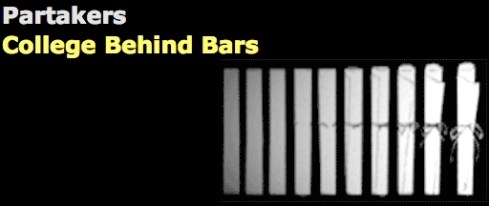
Faith-based group Partakers in Massachusetts calls for sponsors to support its College Behind Bars program.

And, last but not least, is the business oriented Prison Entrepreneurship Program (PEP) in Texas.
If you have a spare hour watch PEP’s director Catherine Rohr talk about the inspiration provided by the students and how they overturned her prior apathy and self-confessed ignorance to the needs of prisoners.
These are a mere selection. I’d be very happy to hear of more prison education programs from any corner of the US and beyond
Onward.

Sorry, more self-promotion. For Cooleh magazine, I rewrote old speculations on the non-existent genre of prison photography. I discuss the visual vocabulary of prison photography and the slipperiness of cliche depending on the experience of the camera operator.
The editor confirmed it for me though: It was the strength of the images by nameless inmates of Remann Hall youth detention facility that carried the story! Fearful Symmetry is part of Cooleh’s 14th issue which takes a story-based, raw and somewhat irreverent angle on crime; politics of crime in jamaica, urban pot growers, secession states, botched 7/11 robberies and interviews with the unheard.


 Prison Photography