
You are currently browsing the monthly archive for December 2017.

Artist-filmmaker Nirit Peled and director Sara Kolster have produced A Temporary Contact, a real time series of text messages and short videos delivered via WhatsApp and Facebook Messenger, that allows users to join family members as they journey from New York city to upstate prisons and back.
Over 30-hours, beginning at 10pm the evening after you sign up, you’ll receive at first few texts and then consistent volley of 22 short videos. The main protagonist is Amanda, a 20-year-old from Brooklyn who is visiting her brother, but other women speak to the camera and relay their experiences. Most videos are 45 seconds long and shot from the aisle of the bus. Gas station and restroom breaks are a relief for all. Audio is overlaid the blurred land at 60mph. I include a few screencaps for the purposes of this commentary.
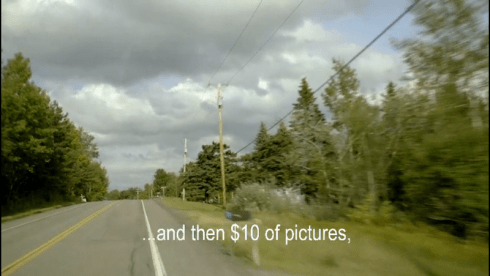
As we know, the majority of new prison construction in the past 30 years has occurred in rural America and in post-industrial towns. The “logic” was to replace the dead agriculture and manufacturing jobs with prison jobs. However, the small (and ever-decreasing) benefits that may have been brought to struggling, job-scarce populations are eclipsed by the hardships wrought upon prisoners and their distant friends and families. A Temporary Contact takes us on the weekend journey that family–mostly women and children–make; a journey essential for keeping family ties. Bear in mind that, for incarcerated persons, maintaining close relations with loved ones is the most important factor in helping them stay out the system after release.
New York state, as with other large states such as California, Texas and Illinois, is one of the worst offenders in siting prisons hundreds of miles from the communities from which prisoners are extracted. A Temporary Contact offers users a moment inside the collateral damage done by this particular extended and prohibitively expensive travel.
Some thoughts on the title: Temporary contact is fleeting, it’s real but not sustained. The title simultaneously recognises the intermittent opportunities that family have to make in-person visits (those with financial means and time, might make the journey as often as twice a month), but also points to our passing point of contact with a time-consuming (and likely foreign) travel-commitment which prisoners’ loved ones regularly and necessarily sign up for.
Despite the journey’s substantial 30-hour timeframe, it’s one that is largely self-contained and not seen … except for maybe the lines of people waiting for pick up at 34th street or Columbus Circle in NYC late on a Friday or Saturday evening. (For an in-depth photo essay on prison buses, please see Jacobia Dahm’s work; read the interview she and I did; and then read this follow-up conversation Dahm had with Candis Cumberbatch-Overton, who Dahm photographed as she visited her husband John.)
There are many revealing moments in A Temporary Contact and it’d be foolhardy to describe them; you should just sign up for the messages toy our own smartphone. The presence of time–and time seen–is part of the art’s structure! That said, I thought it instructive that immediately following their departure from the prisons, the women shared photos of their loved ones and talked about the costs to have the portraits made.
“The only thing we take out the visits,” says Amanda, “are the pictures.”

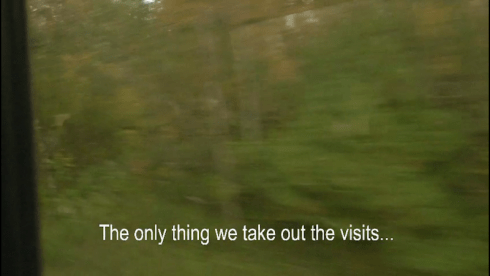

The women compare costs of a single Instax picture. In one prison it is $2 per photo. In another it is $4. They talk about physical changes, new facial hair, how they all appear in one another’s photos. They laugh and gripe about the quality of the murals in front of which they must stand for the portraits.
Visitors are allowed to have five pictures made on each visit. Despite the huge expense (relative to single prints in free society) the women tend to get five. Max out on memories. Optimise the presence of their loved one in the world. A photo is a thin slice of time, but it is a substantial presence in the free world of someone who is behind bars in a limbo-state of social death.

It seems that every photography conference these days is talking about getting beyond the frame, and using new technologies and digital platforms to tell stories. Peled and Kolster propose a model that delivers important, compelling content with direct efficiency. The bar for access is as low as it gets; who doesn’t have WhatsApp or Facebook on their phones at this point? The temporal quality of the project is key. The success of A Temporary Contact rests on the fact that, every one or two hours, users are prodded with gentle reminders of other’s devotion to time … time spent in love and support of prisoners.
I wholly recommend A Temporary Contact. I learnt new things, I think you will too.
–
A Temporary Contact was developed within the framework of the veryveryshort competition, a NFB and ARTE co-production in collaboration of IDFA Doclab. Very very short is a collection of 10 interactive projects for smartphones, exploring the theme of mobility through very, very short experiences – all under 60 seconds.
Credits
Creators: Nirit Peled & Sara Kolster
Camera: Aafke Beernink
Editor: Wietse de Swart
Additional editing: Paul Delput
Sound mix: Sander den Broeder
Color: Maurik de Ridder
Developer: Martijn Eerens
Scripting: Wireless Services
Music: Amit Gur & Itai Weissman
Cast: Amanda, Diamond, Gina, Latoya and Stephany
Research help: Ilja Willems, Five Mualimm-ak, Ray Simmons
Special thanks: Katie Turinski, Junior from Flambouyant Transportation Inc., Het Raam, Hortense Lauras
So great, and so important, to see the Participatory Defense movement expanding to, and empowering within, more U.S. cities.
 Albert Cobarrubias Justice Project
Philadelphia has to be one of the most exciting cities in the country when it comes to community power challenging the daily operations of the courts. Philadelphia has elected a civil rights lawyer Larry Krasner as their next District Attorney, has a head of the Public Defender Office Keir Bradford-Grey who is committed to building community support for those facing court, and the people are taking to the streets for Meek Mill. Changes are happening in Philly that may be a blue print for the rest of the country.
And now, Philadelphia is starting participatory defense. Read this piece in the Philadelphia Citizen “Ideas We Should Steal: Participatory Defense” to see how the community is well-positioned to take the methodology to new heights.
 (Poster from the first participatory defense forum in Philadelphia.)
View original post 809 more words
PRISON ART LIBRARY IN THE MAKING
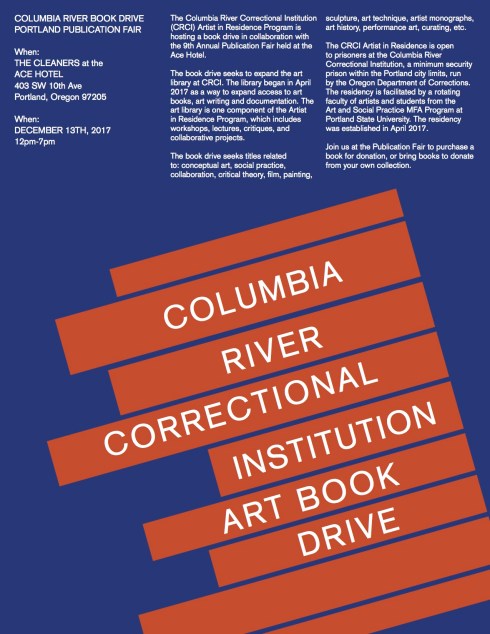
If you’re in or near Portland, Oregon and if you’ve art books you no longer want on your shelves, please consider donating the to the Columbia River Correctional Institution (CRCI) Art Book Drive.
This Wednesday, December 13th, from 12-7pm, the CRCI Artist In Residence Program is holding a Book Drive at the 9th Annual Publication Fair held at the Ace Hotel Cleaners space.
The book drive seeks titles related to: conceptual art, social practice, collaboration, critical theory, film, painting, sculpture, art technique, artist monographs, art history, performance art, and curating.
Go on. Donate your books!
The CRCI Art Book Library began in April 2017 as a way to expand access to art books, art writing and documentation. The art library is one component of the Artist in Residence Program, which is open to prisoners at the Columbia River Correctional Institution, a minimum security prison within the Portland city limits, run by the Oregon Department of Corrections. The residency is facilitated by a rotating faculty of artists and students from the Art and Social Practice MFA Program at Portland State University.
PUBLICATION FAIR
After you’ve donated your books, go check out the booths full of paper goods from these lovelies:
Ampersand Gallery & Fine Books
Book Arts Editions
Douglas F. Cooley Memorial Art Gallery
Future Tense Books: A Micro-Press
Independent Publishing Resource Center
Portland Institute for Contemporary Art


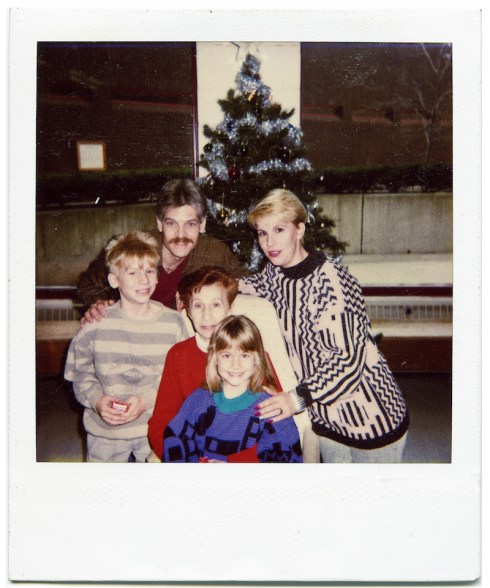
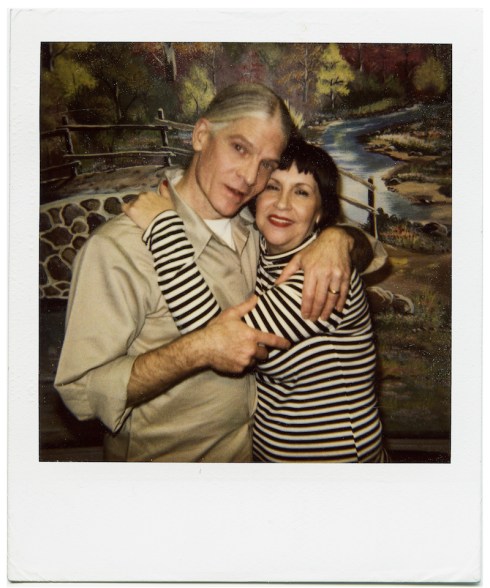
I wrote recently about Davi Russo‘s family portraits made inside two New Jersey State prisons between 1987 and 2007: 20 years of prison polaroids chart son’s resolve, love, and only contact with dad.
The Polaroids chart visits he, his mother, sister, grandparents and friends made to see his father David who was incarcerated on suspicion of murder in 1984, stood trial, and was found guilty and sentenced, in 1987, to life plus 20 years. He has been eligible for parole since 2010 but remains in prison today. Russo, a director and photographer these days, was nine years old at the time of his father’s conviction.
Russo hoped sharing his experience might help others get free of the stigma of incarceration too.
“Growing up with Shawshank Redemption and all the horrible prison TV shows, I wanted to take authorship,” explains Russo. “I had a chance to put something different together. And it was legitimate. Polaroids are thought of as the most fun type of photography. Super quick, on the beach, snap, shake it. The world is perfect! Shoot it on polaroid! But not for me. I didn’t experience polaroids that way and I knew I wasn’t the only one.”
Russo was reluctant to share the photos publicly for many years and when he finally did he asked his father to write a reflection on the collection. Instead, his father wrote single memories on Post-It notes of each photo … of each moment they stood before the camera. Those written memories became the captions for each image–an unexpected and personal twenty year narrative. Therefore, I encourage you to visit the series, which Russo has named Picture Time, on Russo’s website and read the full captions. There too, you will find essays by Russo’s sister and mother.
–
Read and see more: 20 years of prison polaroids chart son’s resolve, love, and only contact with dad.





 Prison Photography