
You are currently browsing petebrook’s articles.
Was it an inside act of rebellion?
I have absolutely no grounds on which to make an accusation, which is why I phrase it as a question.
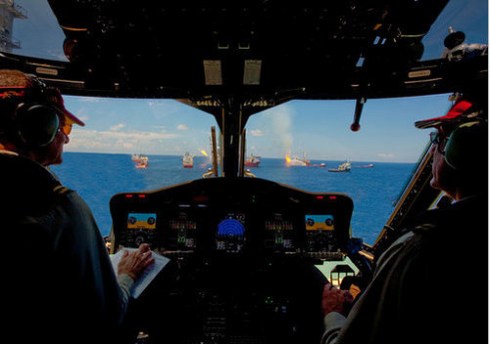
But just looking at the foolish doctoring of images, especially the helicopter cockpit image, I wonder if the culprit intended to be caught? The color of the photoshopped image is just ludicrous, literally unbelievable, unless that is Martin Parr’s Gulf of Mexico!
To me, the reworking seems suspiciously blatant. Who is the “contract photographer” doing these pig-eared photoshoppings? And, is he/she a saboteur?

Original. © BP p.l.c.
Botched photoshop. © BP p.l.c.
INTERNET MEME
Rather joyously, this image has become a meme. See the comments in the original and excellent Gawker article!
Last month, I mentioned Jane Evelyn Atwood’s TV interview and to Jane’s appeal in support of Gaile Owens‘. A campaign operated to have Gaile’s death sentence commuted to life imprisonment. Gaile will be eligible for parole in late 2011.
Jane contacted me this morning with this piece of good news. “Please be informed that Gaile Owen’s sentence has been commuted by the Governor of the State of Tennessee to a life sentence. She will no longer be executed on September 28. Thank you for your support, thank you for helping save Gaile Owen’s life.”
Why stop here? Please inform yourself and others about domestic violence and the violence it can engender.
Family Violence Prevention Fund www.endabuse.org
National Domestic Violence Hotline http://www.ndvh.org/
An Omar Broadway Film aired on HBO last month. Omar smuggled a video camera into Northern State Prison, New Jersey and documented for six months. The film was debuted at the 2008 Tribeca Film Festival.
There are many reasons I believe in prison reform, the wasted potential is one, the wasted dollars is an other, the systematic violence is the reason to which this film speaks. Shadow and Act review it here.
Below is a video interview with Douglas Tirola, one of the directors, about how the film got made.

Image courtesy Edgar Martins/HotShoe Gallery
I’d agree with Joerg that We Need Better Critical Writing About Photography. This is pretty simple task – just cut out the jargon. Having posted On Statements last month, Joerg is only demanding the same of critics as he is of photographers.
Which brings me to Exhibit A: Photographer, Edgar Martins is talking bollocks again.
“One could argue that this work seeks to communicate ideas about how difficult it is to communicate. My images depend on photography’s inherit tendency to make each space believable, but there is a disturbing suggestion that all is not what it seems. The moment of recognition that there is something else going on, the all too crucial moment of suspended disbelief, is the highest point that one can achieve. This process of slow revelation and sense of temporal manipulation is crucial to the work. Above and beyond this, in having to shift between the various codes, the viewer becomes acutely aware of the process of looking, of the reconciliation required between sensory and cognitive understanding. As you rightly say, it is difficult to know for sure if what you are looking at is a photograph. However, they are photographs.”
Déjà vu
You might remember Edgar Martins. He’s the photographer who photoshopped images of foreclosed America for the New York Times. It was one of the more substantive photoshop kerfuffles of recent years.
I remember at the time thinking that the way Martins wiggled his way out of the controversy was skilled; he put all his energies into How can I see what I see, until I know what I know? a meditation on truth in photography, diluting his deception in M.F.A. critical theory references.
Martins confused 90% of his detractors with his busy response and sapped the energy of the remaining 10% who were looking for the next headline anyway.
He really intrigues me!
– – – – – – – – – – – –
Thanks to Alan Rapp for the tip-off.
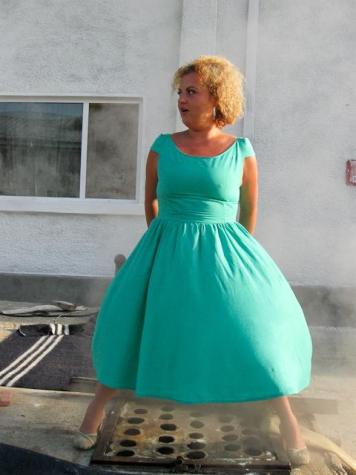
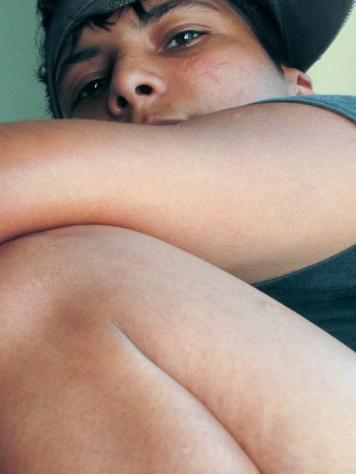
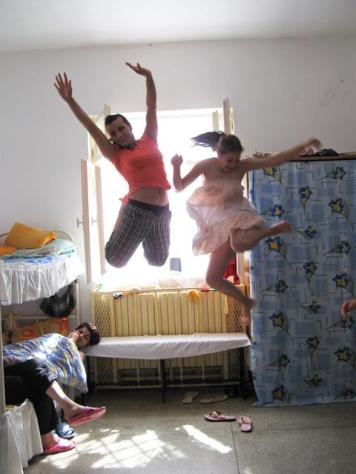
Fourteen female prisoners at Tirgsor Prison in Romania participated in a six-camera workshop led by Cosmin Bumbuţ.
The workshop was suggested by a Miss Raducanu (presumably the warden), and Cosmin Bumbuţ took up the initiative. Bumbuţ gained sponsorship from f64 and insisted that – after basic training – the women be left unsupervised with the cameras for the duration of the project.
Bumbut: “I received six Canon PowerShot cameras that I took with me to Tirgsor in July. The cameras worried me, they had so many buttons and the manual was so complex that I was skeptical that anyone could use them; I, for one, wasn’t able to. I felt very nervous.”


Over a two month period the group captured 14,000 images. 395 were chosen for the final exhibition and 95 can be seen in an online gallery at Punctum (Romanian language). Here is a Google translation.
I’ve picked out 12 images.
This is a marvelous project. I would like to see more photography used as rehabilitation in prisons. I have a colleague who uses video in an ethnological framework and the men really benefit from the novel educational approach.
This Romanian project is similar to the pinhole photography of the girls of Remann Hall here in Washington State.
Finally, it is worth saying that Bumbut was inspired by Klavdij Sluban‘s prison workshops which he has conducted across the globe.




Ed Winkelman has posted another must-read POV, ‘Why Curmudgeons Often Make the Best Collectors‘
Ed responds to this article in The Art Newspaper profiling gambling millionaire David Walsh, whose private collection has just been opened to the public in the purpose built, subterranean Museum of Old and New Art.
Walsh on MONA’s raison d’être:
“Mona is my temple to secularism,” he adds, explaining that he is interested in “talking about what we are”, in other words what makes humans human. “People fucking, people dying, the sorts of things that are the most fun to talk about.”
Walsh on the potential benefits Mona will have to local business:
“We don’t know whether I’m going to make any difference to the economy and I must say I don’t particularly care. If it happens, great. If it doesn’t happen, I don’t give a shit.”
Walsh on curating:
“I believe most curation is bullshit … curators tie together a bunch of stuff they can get their hands on then create the most abstruse and obtuse reality and, in the end, fill an exhibition up with a few things that are slightly connected and the upshot is that about 30% of the art is just there to fill space.”
Walsh on being an artist:
“No one makes art for art’s sake. There are only two reasons to create art: to get laid or defy death.”
Hilarious! Thanks Ed.
Talk to anyone about American documentary photography, they’ll probably mention Danny Lyon. Talk to anyone about prison documentary photography and they’ll definitely mention Danny Lyon.
In terms of US prison journalism, Lyon was the first photographer to a) give a shit, b) gain significant access, and c) distribute journalist images far and wide.
I had read Nicole Pasulka’s interview with Danny Lyon when it was published for The Morning News in December, 2008. I have since begun reading Like a Thief’s Dream (currently 100 pages deep). As in many cases, it takes an AmericanSuburbX reissue to press the issue.

Renton in his cell, Walls Unit, Huntsville, Texas, 1968. © Danny Lyon
I have a few things to say about the chapters I’ve read so far, but those thoughts need more brewing. While I mash those brain-hops, I’d like to draw your attentions to Lyon’s comments about prisons in America:
“You really need a friend, or family member inside a prison, to appreciate what we are doing. America has two million people inside of her prisons. Only China, a dictatorship, tops us in this growth industry. I like to think of the words of Fredrick Douglas “Be neither a slave nor a master.” All of us, outside of prisons, are the masters.“
“Prisons should be turned into bowling alleys, schools, and daycare centers, or demolished. We could probably do better with 90 percent of the inmates being released. Communities should deal with offenders on a local level. Review panels should meet with all of the 200,000 prisoners doing life sentences. Many of these people are harmless and aged, and should be released. I would like to see review panels sent into all the prisons, to meet with inmates face to face. Most should be released.“
“When I was working in the Texas prisons (1960s and 70s) there were 12,500 men and women inside and no executions. Today there are 200,000 in Texas and they kill prisoners all the time. Prisons are now everywhere, a major employer in upstate New York. Simply put, everything about prison is worse.”
“The best way to change yourself is to go outside your world into the world of others. It’s a big world out there. The worst thing about New York City is that all the young people that gather there are extremely like-minded. Creative people are comfortable there, but they are preaching to the choir. I always wanted to move Brooklyn to Missouri. Everyone would benefit.” (Source)
I couldn’t – and have not – ever put it better myself.
– – – – – – – –
Buy a signed copy of the book Like a Thief’s Dream at Danny Lyon’s website, Black Beauty.

Postcard sent by the author to Renton in prison in the early 1980s

A bathroom inside the Maze Prison, near Lisburn, Northern Ireland, on Tuesday, April. 11, 2006.
Andrew McConnell‘s work The Last Colony from the Western Sahara has gained some traction recently, promoted at DVAFOTO and backed up by TPP.
McConnell is from Northern Ireland so I was not too surprised upon looking through his portfolio to find a series on the Maze prison.
I’ve seen a few projects from Maze Prison – the most well-known being that of Donovan Wylie – and yet a few of McConnell’s images really stood out.
STATEMENT
McConnell: “HM Maze Prison, also known as Long Kesh and the H-Blocks, held some of the most dangerous men in Europe during its 30 year operation. The prison closed in September 2000 after 428 prisoners had been released under the Good Friday Agreement. There are now plans to turn the abandoned site into a national football stadium.”
The bathroom image (above) is admittedly more powerful to me, having seen the bloodied-knuckle washing scenes in Steve McQueen’s powerful debut film Hunger.
Also, admittedly the image of the football (below) is more loaded given the now-defunct plans to convert the site into a national stadium.
In January 2009 plans to build the £300 million multi-purpose stadium were officially axed with politicians saying plans to start the construction of the stadium wouldn’t be reconsidered for another 3 to 4 years. (Source)

An old football lies in the exercise yard of the Maze Prison, July 18, 2006.
I had been under the impression every structure at the Maze had been demolished but apparently not:
Discussion is still ongoing as to the listed status of sections of the old prison. The hospital and part of the H-Blocks are currently listed buildings, and would remain as part of the proposed site redevelopment as a “conflict transformation centre” with support from republicans such as Martin McGuinness and opposition from unionists like Nigel Dodds who are against erecting a memorial to those who died during the hunger strike. (Source)
Which ties nicely back into the crucial question about McConnell’s photographs of the site. Are these photographs of memory, for memory, for memorial? What audience do they serve?
It seems to me that politics and emotions vary so wildly, that when a photographer (so soon after decommission) takes on a contested site such as this, his/her photographs are open to many different interpretations. The Maze and its history are fascinating, discussion-worthy topics, but is it the case here that the images are nothing more than notable ‘urban exploration‘?
Donovan Wylie dodged this suspicion by documenting over a five-year period the slow demolition of The Maze. Wylie has talked about wanting to create an archive of this transitional moment. However, if a photographer’s series is too brief (either within its own boundaries or by comparison to another practitioner’s series) then how is it justified or explained?
I don’t want to be dismissive here, as I think this is a problem many political-documentary photographers face – namely, their work may not adequately reflect or contain the disputed political landscape it references.
Perhaps we should read McConnell’s The Maze as undefinable and undecided, just as the former prison site remains?

The Cages of the Maze Prison, Northern Ireland, July 18, 2006.
Biography
Andrew McConnell was born in Northern Ireland in 1977 and began his career as a press photographer covering the closing stages of the conflict in his homeland and the transition to peace. He later worked in Asia and moved to Africa in 2007 to document the issues and stories of that continent which are widely overlooked by the international media.
His images have appeared appeared internationally in publications such as National Geographic Magazine, Newsweek, Time magazine, The New York Times, The Guardian, FT Magazine, L’Express, Vanity Fair (Italy), the Sunday Times Magazine, and Internazionale.

 Prison Photography