
You are currently browsing petebrook’s articles.

© Beb C. Reynol
Last month, I met social documentary photographer Beb Reynol.
For the past five years, Reynol has concentrated his documentary work in Central and south Asia, specifically in Afghanistan and Pakistan. Reynol has been an Artist in Residence at the Photographic Center Northwest and is now on its faculty.
In 2005, Reynol trained local photojournalists in Kabul with AINA, the non-governmental organization founded by veteran photojournalist Reza Deghati. AINA aims to rebuild the Afghan’s freedom of expression through journalism.
Whenever I look at imagery from the AfPak region I am consciously looking for work that does not depict military engagement. It was for that reason I was drawn to Reynol’s series of Afghan Coalminers.
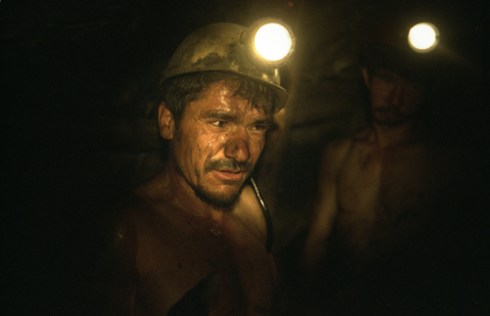
Lit only by headlamps, the miners discuss the conditions of the shaft and their approach to the coal seam. Kar-kar, Afghanistan, May 10th, 2005. © Beb C. Reynol

© Beb C. Reynol
Beb’s The Cost of Coal in Afghanistan statement:
During past decades, Afghanistan has only known a succession of conflicts: the Soviet occupation, the Afghan civil war, the rise and fall of the Taliban and today American and allied military engagement. These wars ruined economic development and eroded the vitality of the Afghan population. Coal, abundant in Afghanistan, is an essential fuel used for the production of electricity, making it a basic need.
When Russian forces occupied the country in 1979, they sent their own engineers to run the large-scale production of natural resources. I visited a mine (difficult to access due to its geographical location) 12 kilometres northeast off Pol-e-Khomli. During the Soviet occupation, more than 2000 miners extracted the black gold from the mine. Today, the 150 employed miners barely cover the vast site and the hundreds of formerly excavated galleries.
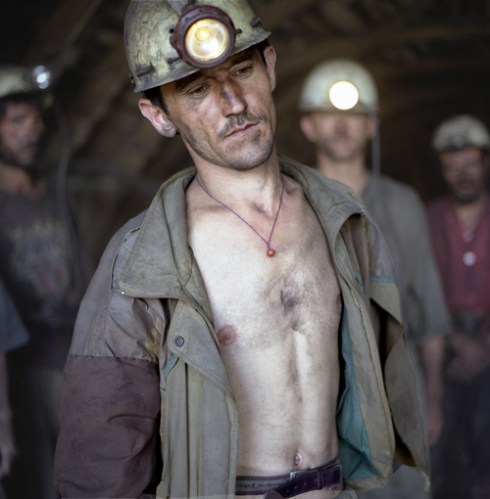
Often working at a depth of more than 360 metres, the miners extract coal with only shovels and pick-axes in hand, battery powered lamps on top of their heads, and old equipment once imported from Czechoslovakia. Intense heat, total darkness and the risk of explosion from methane gas make coal-mining very difficult and dangerous.
The limited local demand for coal makes the mining far from profitable. Lacking reliable transportation and security infrastructure, the Afghan government is unable to exploit the fossil fuel. While the present war against the Taliban wages on, the country seems to be losing grip on its most wanted resource.
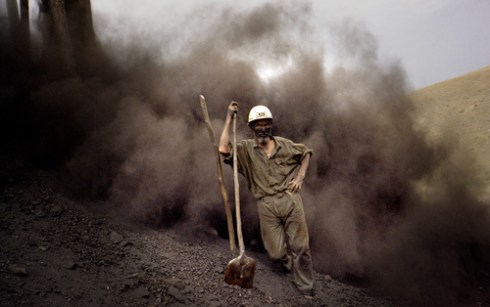
Coal mine, Kar-kar, Afghanistan, May 11th, 2005. © Beb C. Reynol
© Beb C. Reynol
I have also been thinking about Jim Johnson’s recognition of “powerful installment[s] in what should be considered a photographic tradition depicting men who work in extractive industries.”
If you are looking for a one-stop-shop for the visual politics of mining in photography then look no further than Jim’s posts labeled ‘Miner’.
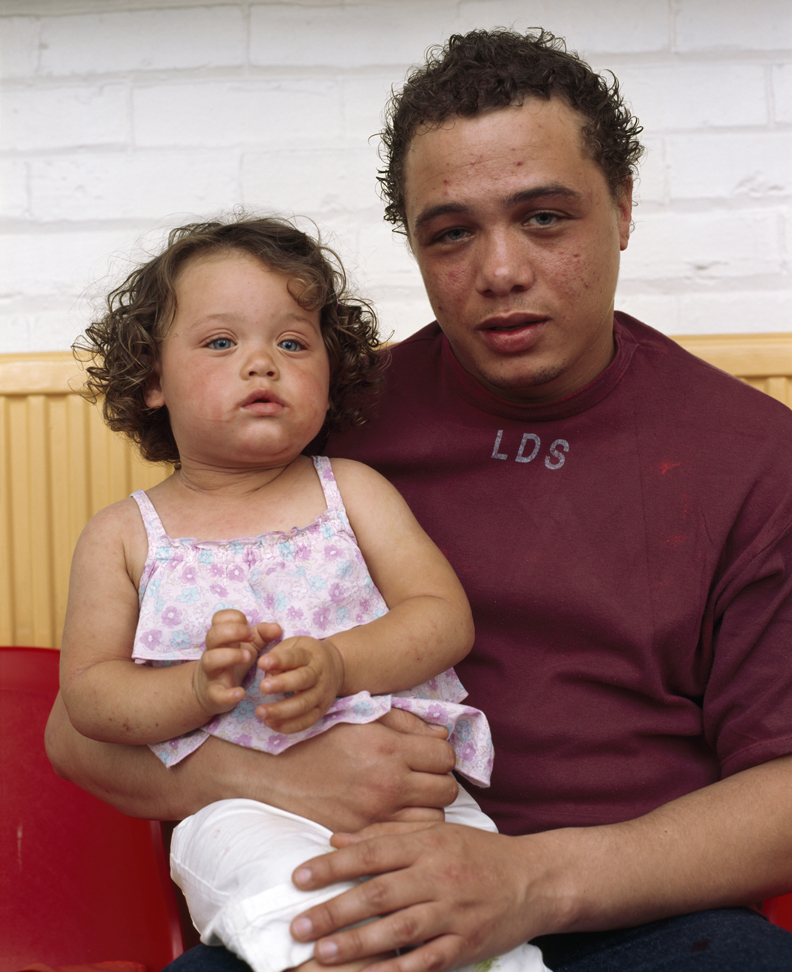
Casey Orr‘s Comings & Goings is an inquiry into movements and migration. Comings & Goings is a photographic series in three parts. Families considers the prisoners and their loved ones at Her Majesty’s Prison Leeds, UK.
Caged Birds depict the imported pigeons and parrots and parakeets of West Yorkshire, while Migrant Women portrays the recent newcomers to Orr’s county.
Orr insists the three parts be considered together – they are a whole, cannot be separated, and toy with the idea of interconnectedness Orr has grappled with throughout her career.
Comings & Goings proposes that foreign and indigenous are not so far apart. As Orr puts it we all share “a desire to be free, an instinct to nest, to seed, to move and be alive”.
Orr’s work requires time and care to navigate – it is as delicate as it is pioneering. Prints from all three parts were displayed was on the outside walls of HMP Leeds. It was the first time the wall of a UK prison has been used as a gallery space.
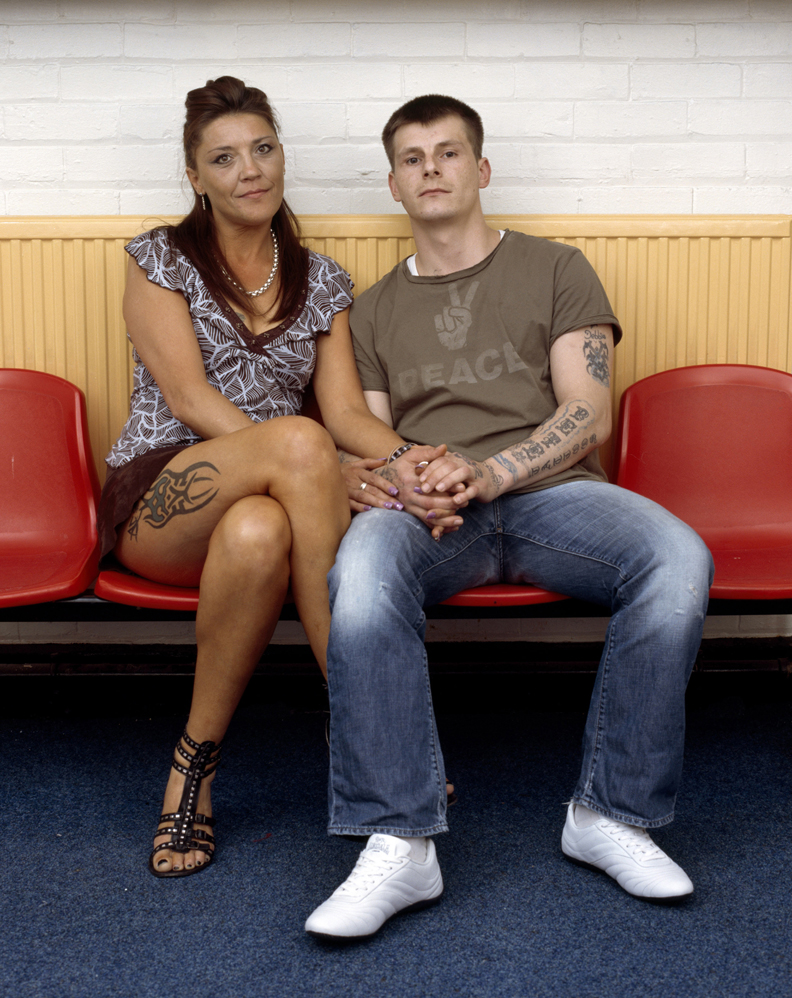
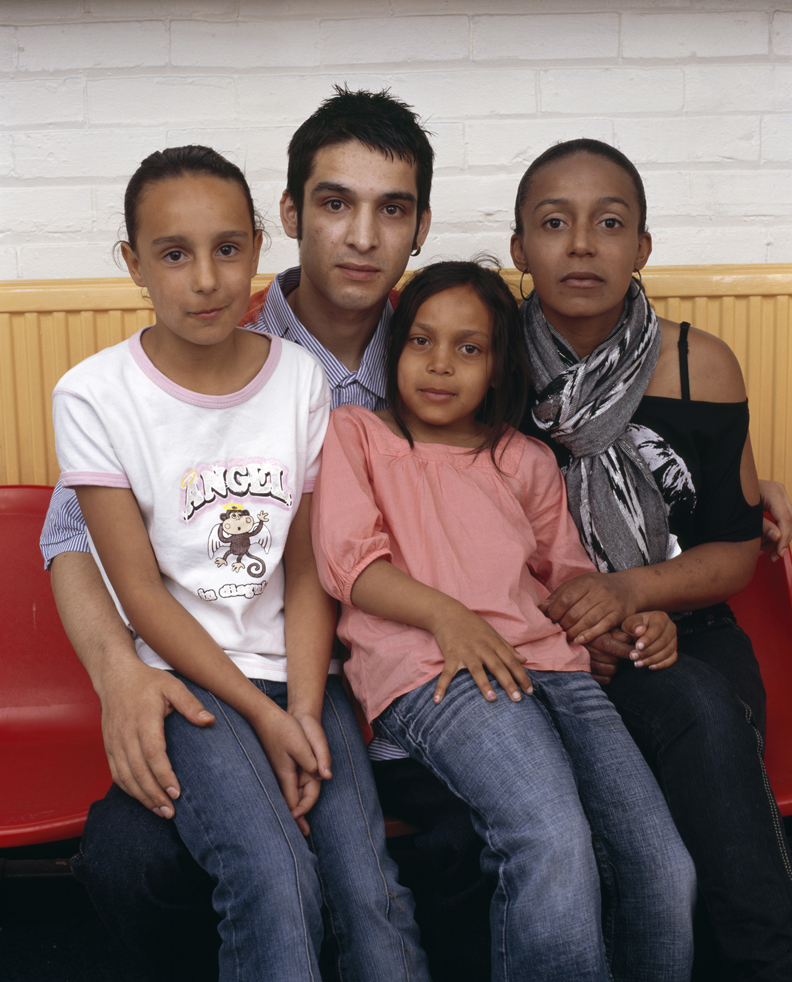
I wanted to know a bit more and so emailed Casey.
Q & A
Why did you decide to incorporate H.M.P Leeds into your Comings and Goings project? Was it the subject or the challenge of working within a prison or a mixture of the two?
My photographic work makes connections to my community and to my experience of living here in Armley, Leeds. My interest in the prison came from other projects I’ve done here. I’m always looking for the connection between the things and people I photograph, the systems that operate and seem to run through everything.
The town of Armley is very much built from the systems of power that came through the Industrial Revolution; Armley Mills, once the largest mill in the world, is now the Leeds Industrial Museum; the Leeds Liverpool Canal is now used for leisure; and the incoming migrant communities are moving from their countries for very contemporary reasons, the jobs available to them (and everyone else in Leeds) having much more to do with information technology than agriculture or textiles.
Within all of this movement, stands HMP Leeds, known locally as Armley Jail. It sits on a hill, built in 1847, so that workers in the surrounding mills could be reminded of what would happen if they stepped out of line. The prison (along with a massive, imposing Victorian church) is one of the few buildings around here still used for its original purpose.
The systems of power associated with the panopticon are still firmly in use in the prison. The prison walls, inside my community, seem to be impenetrable, and enclose a community of thousands of prisoners and workers. My interest was in the walls and how to find the connection into the prison, how to link the people inside with all of the flows of life going on outside.
I found that connection through families, through children. Hundreds of families visit their fathers, sons and brothers every week. The families and loved ones are a direct link with the communities outside. I wanted to exhibit the family portraits on the outside walls of the prison because the prison walls are such a architectural staple of this community they can become invisible, people can forget about them and the people behind them. The exhibition was shown on the interior walls as well so that the people inside were seeing the same thing, the same ideas were being shared; walls penetrated by ideas, and by art.

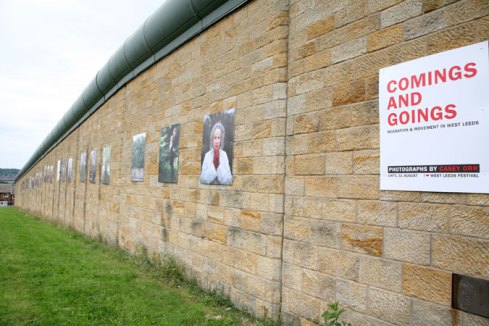
What negotiations did you go through to gain access? Who did you meet? How did it come about?
As a documentary photographer, very little of my time is actually taking pictures, mostly I am trying to gain access to people and places. Before contacting the prison direct I talked to many people in this community and finally went to the Jigsaw Project, the family support unit. From there I met many of the workers who support the families. They were sympathetic to my ideas and introduced me to the Head of Security. From there I met the Governor. All of this took many months. The work, finally shown on the walls as a public art installation as part of the West Leeds Arts Festival in 2009, went through many security checks.
How many times did you go to the visiting room to make the portraits?
I spent a few months in the visitors centre, talking to families, and asking who would like to be a part of the project. Obviously, I got to know them better than the prisoners who I met briefly during the sessions. I spent four days in total in the visiting room.
How did the prisoners and staff respond to your project?
Most people were really supportive of the idea. the thing about photography is that it has uses on many different levels. So this record of families I wanted to make could also be a part of their personal family archive. The fact that I’m able to give something back to people, something useful, like a family portrait, makes me feel better about the fact that I’m asking so much of people, to use their image for one of my ideas. Everyone involved received copies of whichever pictures they wanted from the sessions.
Has your work dealt with systems of detention in the past?
No, my work is about systems of power, photography being very much implicated in that, in the recording and filing of people. So the prison system is always implicated in that, as are all currents of capitalist power.
What’s next?
I’m just completing a book about Comings & Goings and another body of work following the traces of an age old ritual lingering in the English festivity of Bonfire Night.


BIO
Casey Orr (b.1968) is originally from Pennsylvania. She has lived in England for 14 years working as a freelance photographer and Senior Lecturer at Leeds Metropolitan University.Clients include Diva Magazine, Channel 4, EMI Records, Universal Records and Sports Council England. Orr has exhibited at the University of The Arts, Philadelphia, Pa. and Jen Bekman Gallery in New York. She is the recipient of an Arts Council England grant.
Read more about Orr’s exhibition at HMP Leeds in Armley at the Guardian.
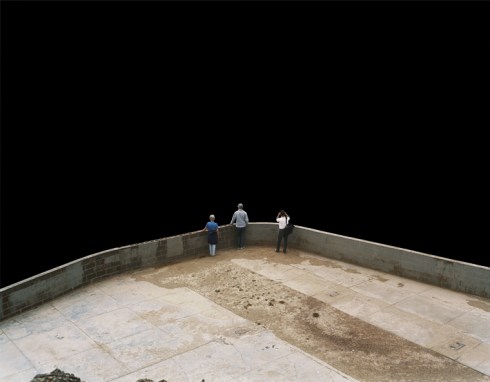
And Still We Gather With Infinite Momentum 1. © Justin James King

© Justin James Reed
Both of these photographers deal with big spaces in different ways.

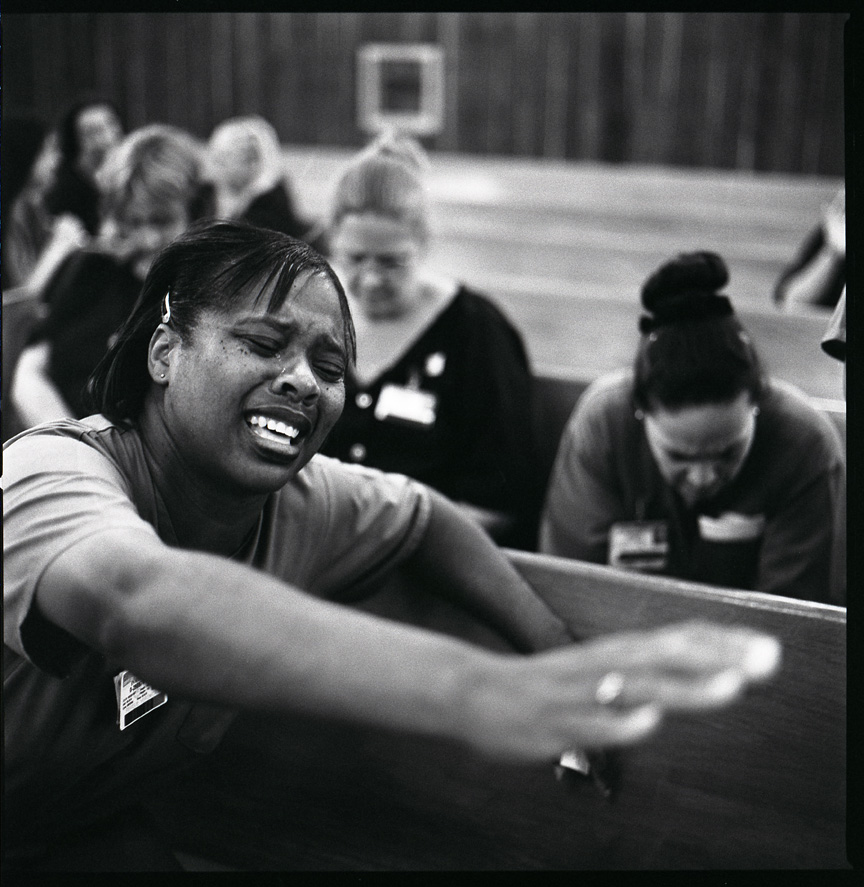
Andrew Kaufman took a long look at religion in America during the Bush presidency. His multi-story project is irreverently titled The United States of God and the Jesus Freaks. One chapter is in the Broward Correctional Institute.
Religious missions are a mainstay of many American prisons. Christian programs constitute 65% of all volunteer efforts at the prison at which I work in Washington State.
Prison religious programs are not mandatory so I steer clear of accusations of manipulation. The carceral culture may be coercive but it’s dealing in hyperbole to equate prison fellowships with exploitation. For many, the cultural relevance of Christianity and evangelism makes prison worship an understandable choice.
Reasons for the existence – in some places prevalence – of evangelism within prisons are complex and many. I will defer to Kaufman’s observations to give context to these particular photographs and the matter of fanatic religion in prisons.
Q & A
Explain your title.
During the George W. Bush presidency religion was a constant topic. My photography of, and research into, evangelism started in 2003 when the Ten Commandments statue was removed from the Alabama State Supreme court. Since that time I photographed many different elements of the Evangelical movement including a drive-in church, Holy Land Amusement Park, a hip-hop church, Christian rock, the Global Pastor Wives Network, Billy Graham’s Last Crusade and then here, at a women’s prison bible group. At that point I had come to name the project ‘The United States of God’.
During the summer of 2004, I was watching Hawaiian TV and saw a young lady being interviewed. She had just been attacked by a shark and had her arm torn off. The interviewer asked her how she was coping and said she was doing great because she was a “Jesus Freak”. The interviewer asked her if she liked being called a “Jesus Freak”. She replied “Yes” as that was how she viewed herself. She identified with the idea. At that moment the working title of my project became ‘The United States of God and the Jesus Freaks’.
Why did you extend the project to a prison?
I researched evangelical Christianity in America and made contact with the Prison Fellowship for Women. I had always known that people in prison were interested in evangelism and atoning for the sins or wrongdoings. I don’t want to speculate but it seemed that the grief of being incarcerated is eased when finding prayer.
I made a few visits with the fellowship and eventually had an opportunity to see close up what they offer. I was compelled to photograph this segment of evangelism because I wanted to see different strata of society and how each prays.
What purpose does religion serve in this particular institution?
The prison allowed them to devote time and attention to their faith. It was fascinating to see how they cope with the incarceration and [see the] time that they need to heal and move on from emotional strain.
Did any of the prisoners receive prints?
As far as I know, none of the inmates have any physical copies of the images. The work is online so they might have seen the web. As I wasn’t family, it was difficult to communicate with the inmates.
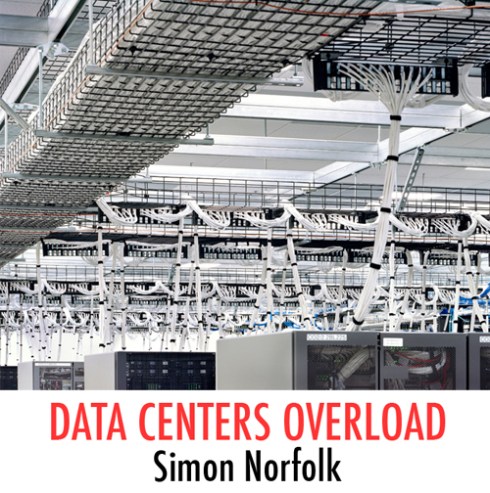
“It was surprising for Norfolk to discover that the infrastructure of the internet age is as imposing, ugly and ‘real’ as the cotton mills, mines and factories of Victorian Manchester. Like pulling back the the curtain to find that the Wizard of Oz is actually a little old man, the cloud is no more than giant buildings full of computers, air conditioning units and diesel back up generators; there’s nothing fluffy or vaporous about it.” (Here)
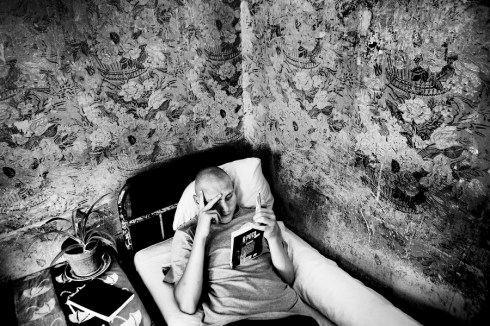
Every Wednesday the inmates have free time for a couple of hours in the afternoon, where they have to clean their dorm room, but there is also time to read a book. © Christian Als / GraziaNeri
Christian Als contacted me recently, to let me know of his project A Childhood Behind Bars.
Als visited Cesis Correctional Facility for Juveniles, Latvia’s only juvenile prison. A quick internet search indicated a paucity of information on Cesis; so this documentary project should be considered a important record of this particular institution and the lives contained within.
Cesis is situated one hundred kilometres northeast of Latvia’s capitol, Riga. It houses 140 young men between the ages of 14 and 21. As soon as the youngsters turn 21 they are transferred to adult facilities.
Als describes the young prison population as half Russian youth and half Latvian youth.
2007
The project is now three years old, so I encourage caution not to assume that all things are the same.
“A study from 2005 made by the ‘Latvian Centre for Human Rights’ evaluated the situation of juvenile prisoners in Cesis and gave recommendations how to bring the prison in line with International standards. So far nothing has been done and the prison looks like something out of Soviet Union and not EU 2007,” says Als
Latvia’s system for juvenile offenders is unique. “Four percent of Latvian prisoners are juveniles; that is a far higher rate of juvenile incarceration than other countries in the region. In comparison Sweden has only 0.2%, Denmark 0.6% and Poland 1.3%,” explains Als.
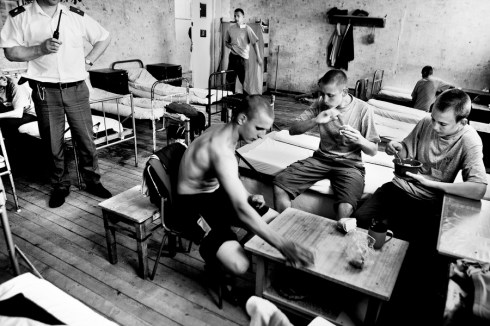
During the inmates free time some boys are eating soup and playing cards, while the warden is keeping an eye on the action. In Latvia the official standard for living space per juvenile prisoners is three square metres. In the section for sentenced prisoners, juveniles are accommodated in large dormitory type rooms for 20-22 inmates in eight units. © Christian Als / GraziaNeri

The boys are not allowed newspapers or television, because they are not to have any influence from the outside world. But the boys save pages from magazines and hang them on the wall. The most popular teenstars are Britney Spears and Christina Aguilera. © Christian Als / GraziaNeri

© Christian Als / GraziaNeri
WHEN IS A PRISON NOT A PRISON?
ALs recounts, “The management insists on calling the prison by other names like school, institution or home. The plaque outside reads: ‘Cesis Correctional Institution for Underage Children’.”
The age of criminal responsibility in Latvia is 14 years-old. Prior to the new Criminal Law of 1999, the age of criminal responsibility for most crimes was 16, and 14 only for the most serious crimes.
The new Criminal Law extended the maximum prison sentence length for juveniles from 10 to 15 years. Many of the children in Cesis Prison were convicted on charges of murder.
INSTITUTIONAL VIOLENCE
In March 2005 a juvenile prisoner was killed by hanging by two fellow prisoners. On July 28, the Vidzeme District Court sentenced both killers to eleven years imprisonment.
Months later at Cesis, in December 2005, a 16-year old boy, upon his return from a Central Prison hospital, was murdered in his cell by two other juvenile cell-mates.

The boys in Cesis Correctional Facility for Juveniles are allowed a bath once a week, every Wednesday. © Christian Als / GraziaNeri

According to Latvian law the juvenile prisoners are entitled to at least one short visit by relatives or other persons once a week for up to one hour in the presence of a prison officer, and one phone call a week, not shorter than five minutes. But the prisoners rarely get in touch with the outside world. © Christian Als / GraziaNeri

Every Wednesday the inmates have free time for a couple of hours in the afternoon, where they have to clean their dorm room, but there are also time to hang out in the court yard. © Christian Als / GraziaNeri
– – –
A Childhood Behind Bars won third place in the PoYI’s Feature Picture Story category, 2008.

Time is of the essence today, so why not a quick look at a mugshot archive?
All these images are from HIDDEN FROM HISTORY. UNKNOWN NEW ORLEANIANS:
“The people grouped here may have had nothing in common except that their lives intersected with the municipality at least once. This exhibit brings them together in part to show how the city classified them. The documents and photographs here are therefore not representative of those New Orleanians who lived their lives quietly and within the law; they are necessarily skewed toward those who erred or strayed, who got caught or got in trouble, or, conversely, those who actively sought assistance from the city.”
The images were selected from the Louisiana Division/City Archives. My favourites here are those photographs in which intriguing, strong(?) communication persists.


– – –
The exhibit was curated by Emily Epstein Landau and funded in part by the Sexuality Research Fellowship Program (1999), a program of the Social Science Research Council, with funding from the Ford Foundation. Dr. Landau received her doctorate from Yale University in 2005. Her dissertation, “Spectacular Wickedness”: New Orleans, Prostitution, and the Politics of Sex, 1897-1917, is a history of Storyville, the famous red-light district. She will be teaching New Orleans history this Spring, as a visiting lecturer at the University of Maryland, College Park. She lives in Washington, DC.
I have talked in the past about the politicisation of immigrants, their reduction to visual cliche and indeed there is a lot more to be said on Tent City, Maricopa, AZ particularly.
I even began this blog way-back-when with musings on physical & psychological borders and unseen landscapes that define flux, unknowns and action.
AIDING IMMIGRANT PASSAGE: The Transborder Immigrant Tool
I just received an email from Bryan Finoki about some unpleasant political muscling down in San Diego.
I am proud to support Ricardo Dominguez and to add my signature to the petition to save Professor Dominguez’s tenure:
Target: UC President Mark Yudof, UCSD Chancellor Marye Anne Fox, UCSD SVC Paul Drake
Sponsored by: UC Multi-Campus Research Group in Internationalism and Performance
Ricardo Dominguez (Associate Professor, Visual Arts, UCSD) is currently being threatened with criminal action and the revocation of his tenure by UCOP and several UCSD senior administrators. This is a long, rapidly-developing story. Time is of the essence. Please sign now!
UC Office of the President has reportedly been upset over Ricardo’s involvement in the Transborder Immigrant Tool – these are recycled cell phones loaded with software that points border-crossers to caches of fresh water in the desert, obviously saving lives. It’s a controversial project, to say the least; and Ricardo has received death threats from people in the SD community and beyond. The project was picked up by the national and international presses, and CNN named Ricardo one of its “Most Interesting People” of 2009 because of the project. Several Republican congressmen also recently sent a letter to UCSD demanding that the project be ceased and Ricardo be censured. In response to this, the university has been scrambling to find a way to shut it down. Importantly: the project has been included in every one of Ricardo’s professional reviews over the last few years, all of which have gone successfully (and have been signed off on by this very SVC); in addition, the project has been FUNDED by UCSD (and yet again, signed off on by this SVC). Now that the controversy has gotten attention in DC, they’re reversing course.
More recently, as part of the March 4 actions, Ricardo’s bang.lab created a virtual sit-in on the UCOP web site. A virtual sit-in works in this way: participants go to a specified web page, which continuously “refreshes” connections to the target web page (in this case, ucop.edu). This obviously increases traffic to that site — much like a live sit-in at a specified locale — with the potential effect of making it too busy to accept new incoming connections. It is similar, in form, to what’s called a “Distributed Denial of Service Attack” (DDOS). There are several critical difference between a virtual sit-in and a DDOS: a DDOS is prolonged and unending, used by various governmental groups to censor a wide variety of free speech groups, activist groups, etc, and non-transparent (the creators of the DDOS set up virtual robots to blast a given site with millions of hits, and hide the creators behind various firewalls and filters. A virtual sit-in is open, does not use such “robots,” and the creators are identified freely).
SIGN THE PETITION
Please sign the petition below to protect academic freedom and tenure from politically-motivated attacks.
http://www.thepetitionsite.com/1/stop-the-de-tenuring-of-ricardo-dominguez
THE RESEARCH
Click on the sheet below for a larger version.


 Prison Photography