
You are currently browsing petebrook’s articles.
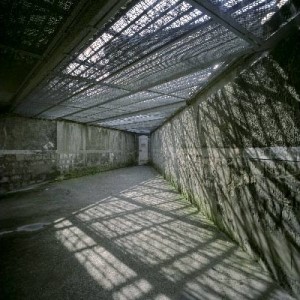
© Jacqueline Salmon
 “In France, photography and prisons have rarely got along” says Clair Guillot for Le Monde (translated). Guillot, prompted by the current exhibition L’Impossible Photographie, Prisons Parisiennes (1851-2010), speculates on the common conditions for prison photographers listing limited access, lack of light and space, constant supervision and uncertain scheduling.Guillot quotes Mathieu Pernot, a photographer occupied by issues of the Panopticon, ‘In prison, the main body is the eye, because the buildings are designed to improve monitoring. At the same time prisoners are held [partly] to deprive them of self-image [and held to deny society his image and presence.]’ I paraphrase due to the vagaries of translation.
(Pernot is flavour-of-the-month, right now, exhibiting in Fotodok’s State Of Prison show in Amsterdam as well as this Parisian outing.)
Guillot goes on to suggest that there has been a recent rise in the practice of prison photography, yet she doesn’t provide projects or practitioners on which she bases that statement.
Whether or not praxis and interest in prison photography is on the up, the ever-existing requirement of French law not to show the faces of prisoners is a steady constant. This is a paradox that needs explaining and, to some extent, apologising for. The effort and will of prison photographers to reveal the hidden arguably achieves the opposite; images of faceless prisoners only contribute more abstracted views of prisons.
Is photography the right tool for the job of describing prisons and the lives within?
Let’s take a look at the work of a couple of the prison photographers in the l’Impossible Photographie show, and evaluate their contributions to this proposed fledgling genre. Matheiu Pernot, Jacqueline Salmon and Michel Semeniako were commissioned for the show. A request was made access for five photographers, but the authorities only allowed three.JACQUELINE SALMON
Jacqueline Salmon‘s photograph are straight environmental studies. In some works she uses the silhouettes of cage, fence and shadow. Often Salmon’s images will offer the promise of a window or vista only to present a barrier or razor wire immediately behind the promise. These are images of frustration. When Salmon documents open doors, they are within larger areas of containment, not strategically imperative and are not policed by the disciplining authority. Through some of these are the work and leisure activities offered at Le Santa Prison, Paris; gymnasium, family rooms, kitchen, chapel and laundry.
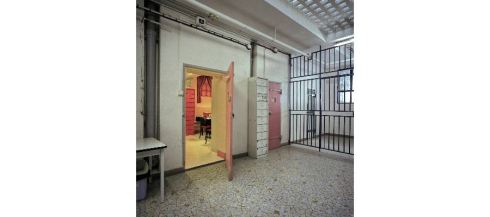

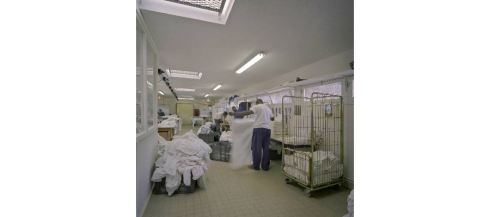
Salmon’s use of orange is occasionally reminiscent of Mikhael Subotzky’s studies in South African prisons and of course echoes the jumpsuits we’ve come to associate with the global and most lawless of prisons – allied sites of detention, Guantanamo, Bagram and beyond …
It is very difficult to be a fair judge when one only has 300 pixel wide website images to go by, but there are 40 images to browse and take in. Aside of the debates about artistic merit, the project as a contemporary document of an old and famous prison in the French capital is an achievement in itself.
MICHEL SEMENIAKO
Salmon’s impartial observations lie in contrast to Michel Semeniako‘s close engagement with the inmates. Semeniako conducted portrait workshops but not permitted to exhibit this work he collaborated with inmates on still lives of their possessions; portraits of men as evidenced by the objects they possess.
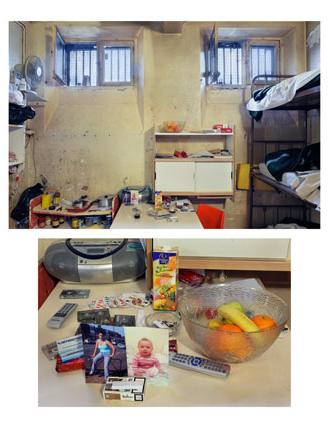
Screengrab. Varga Traian, Maison d’arrêt de Paris-la-Santé, 2009. © Michel Semeniako.
It’s an interesting concept and an approach used by other prison photographers (Jeff Barnett-Winsby and Edmund Clark spring to mind). For Semeniako’s project, each prisoner is a co-author of the images. Could we argue that this is part rehabilitation, part art, part documentary? I guess one must decide on how wants to judge Semeniako’s project first.
I’ll judge it on two criteria; firstly, on the self-esteem and therapeutic advantages for the prisoners in discussing and constructing ones own environment for presentation; and secondly, on the otherwise impossible connection to prisoners’ lives which is afforded to viewers of the photographs. This connection informs (just a little) and in so doing completes a minor but profound transaction initiated by Semeniako and each prisoner during their discussion on how to assemble their still lives.
EXHIBITION REVIEW
Brendan Seibel penned an overview of the l’Impossible Photographie. Seibel concludes that the exhibit is large and potentially overwhelming;
“Tying the exhibition together is not chronology but classification. Rooms are broken down by location, with contributions by a steady cast of photographers spread throughout. Women’s prisons La Petite Roquette and Saint-Lazare reveal a jarring juxtaposition of nuns and incarceration, the role of religion in rehabilitation. The men’s – Grand Roquette, Sainte-Pelagie, Mazas and Santé – lay clustered together, more barren and austere. Throughout the exhibition essays on each prison, brief summations of photographers, developments in regulations and politics accompany each turn of the corner.”
Seibel was particularly engaged by the archive of Henri Manuel from the 20s and 30s. Manuel was employed by the French government to document the prison and justice systems. He gained unprecedented access and his prints are pivotal in the genre of prison photography.
Other artists include photographer Pierre Jouve (talking here, in French, about his juvenile detention photographs), also designer/photographer Anne-lise Dees and the photographer/oral historian Catherine Rechard.
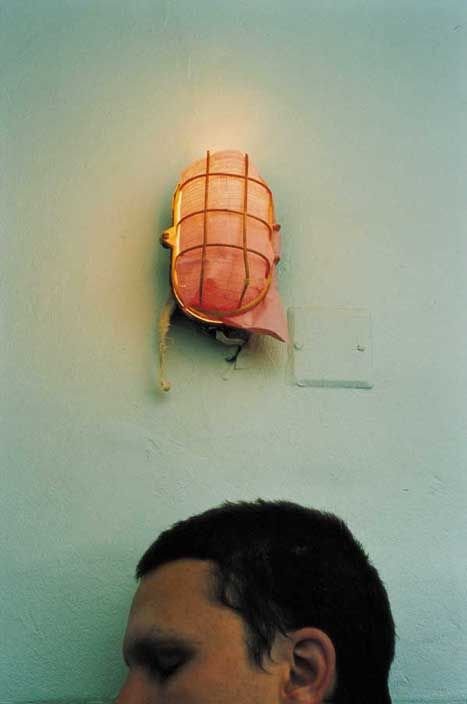
© Catherine Rechard.

– – –
All in all, this exhibit is a significant attempt to reconcile the curiosity and desire to see the activities of the state (think about the ethics and standards debates about military embedded journalists) with the work of artists who endeavour in to do so. Perhaps Guillot is right, perhaps following this exhibition, prison photography may be defining the parameters of its own genre?
– – –
The Carnavalet is hosting a series of tours, discussions and other events related to the exhibition. A schedule can be found here.
l’Impossible Photographie
From now until 4 July 2010
7€/5€ Reduced 10:00-18:00
Closed Mondays and Holidays
Musée Carnavalet
23 rue de Sévigné
Mº St-Paul/Chemin Vert
It’s no secret I am a fan of Flickr Commons. The UK National Archives just went online.

George Davey was sentenced to one month’s hard labour in Wandsworth Prison in 1872 for stealing two rabbits. He was ten years old. (Source)
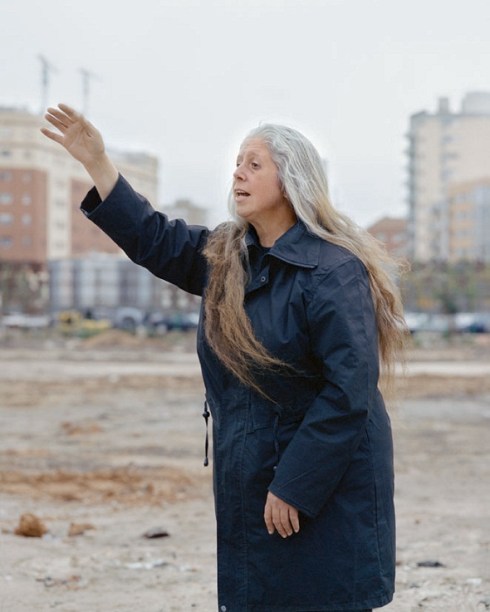
I posted an image of Mathieu Pernot‘s earlier this week, but I thought his work was so novel it required a post of its own.
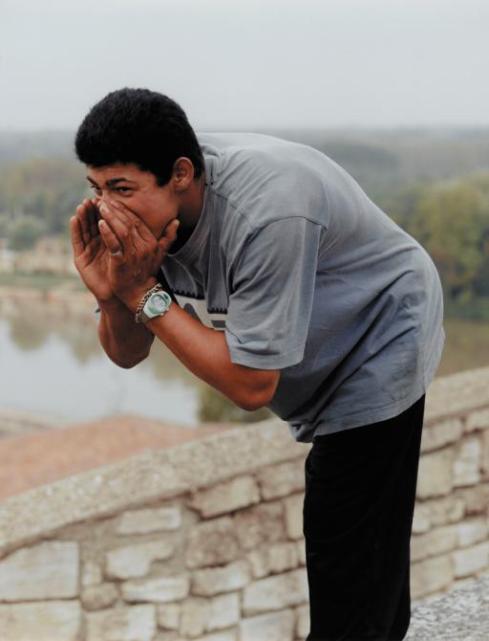
Les Hurleurs (The Howlers) – completed between 2001 and 2004 – is a series of photographs of people screaming to detainees in three prisons – Les Baumettes, Marseilles, France; Avignon Prison, France (which is now luxury apartments); and the Unidad Hospitalaria Penitenciaria D’homes, Barcelona, Spain.
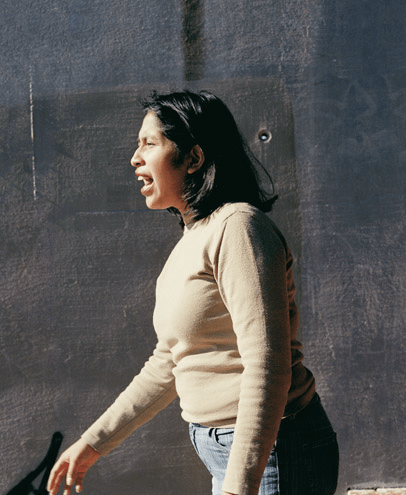

Pernot “portraits” are surprising more than anything else and – for me at least – touch upon the diminished possibilities of family and friends when someone close to them gets locked up. The severance, deserved or not, results in desperate and almost pitiful tactics by Pernot’s subjects. Indeed, these images are meant to be seen alongside Pernot’s other series Panopticon which takes a documentary view of structures of the carceral “machine”.
Pernot’s work is intelligent in that it shows both sides of the experience and the deafening silence of his interior prison shots are roundly supported by the unheard vocal efforts of Pernot’s subjects.
View the full set here.



The five boys who came to illustrate the class divide. Photograph: Jimmy Sime/Getty Images
Ian Jack wrote a glorious piece in today’s Guardian about Jimmy Sime‘s iconic image.
‘The photograph that defined the class divide’ describes 70 years of misreadings and its use as illustration for shallow assessments of Britain’s class disparities.
Jack is masterful in his analysis because he keeps it based in fact. The consequent lives of the five boys (which are not what you’d expect) are ultimately the critical blow to all the users and abusers of Sime’s image down the years.
“When a newspaper had asked the three men to get together to reconstruct the picture at Lord’s, one of them refused. I could see why: which of us would want to be remembered as a stereotype, especially in a class war where we’re given no choice of sides?”
Jack doesn’t dismiss the notion that Britain is still divided by class. To the contrary he says that Britain remains the European nation with the biggest gap between rich and poor. He (and I) can see that these arguments about UK inequality are better made with relevant illustration and not this nostalgic claptrap that does nothing to inform or elaborate.
” If a photographer wanted to re-create Sime’s picture, he might be faced with five boys dressed much the same, in jeans and brand names. Giving a superficial impression of equality, the picture would be even more of a lie than before.”
Just to prove the entrenched and idle use of Sime’s photo right up to present day, Jack finishes with this:
“What picture accompanied the Daily Telegraph’s report in January 2010? Sime’s, of course; the same as Picture Post had published in January 1941. There they were again: Wagner, Dyson, Salmon, Catlin and Young, doomed for ever to represent our continuing social tragedy.”
Brilliant stuff!

© Nico Bick
I just received an email from FOTODOK who present this month State of Prison, an exhibition with work of Nico Bick (The Netherlands), Carl de Keyzer (Belgium) and Mathieu Pernot (France). Also included – I am proud to say – are two photographers I’ve interviewed for Prison Photography – Stephen Tourlentes (United States) and Jürgen Chill (Germany).

© Jurgen Chill
FOTODOK statement:
“Photographing official institutions such as schools, government buildings, prisons and old people’s homes often goes hand-in-hand with limitations. PR and communication departments conscientiously guard their image and impose restrictions on photographers.”
“Even so, photographers still succeed in making individual and meaningful series in these places that go further than PR photos. From surreally painted Siberian prison camps to screaming family members outside the prison walls.”
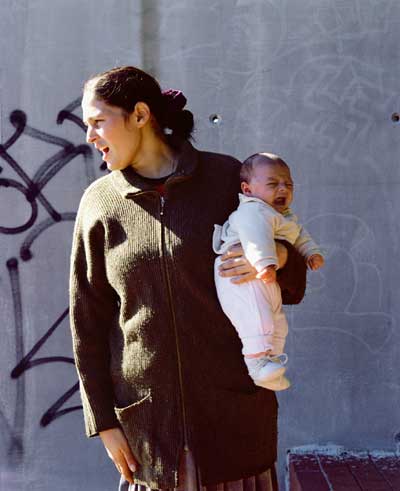
© Mathieu Pernot
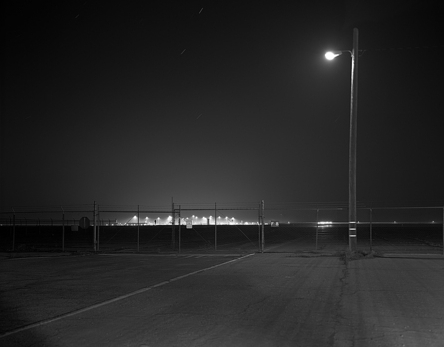
Federal Prison, Atwater, CA, 2007. © Stephen Tourlentes
The curator is photographer Raimond Wouda (The Netherlands) who himself has taken a look at the impression of institutional architecture upon its users, most notably the social spaces of Dutch high schools.
Throughout 2009, Raimond Wouda reported on his research on FOTODOK’s website. This process and all the findings of the past year have been compiled into a collection of words and images. The publication will be presented during the opening. I’d love to get my hands on that!
– – –
The exhibition runs from the 26th March to the 25th April 2010. An opening will held this week at 19.30pm on the 25th March at Van Asch van Wijckskade 28, Utrecht (map).

From the ZONA series. © Carl de Keyzer

Maurizio Anzeri
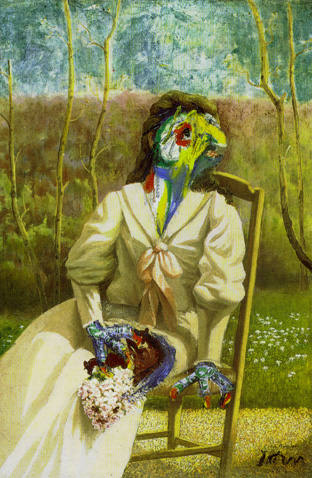
Asger Jorn
Ever since Maurizio Anzeri was roundly acknowledged as the star (here and here) of Paris Photo last November, his embroidered portraits have hung in a stasis awaiting the key association which my visual memory was willing upon them.
It only took six months, but the penny of association dropped: Asger Jorn‘s Defigurations (1962). Both artists appropriate existing images with humour, a touch of spite and avian motifs.
As Jorn used flea-market paintings and vintage subjects, so Anzeri picks up vernacular photographs and family portraits. Given their choice of materials you might think that they hold some reverence for the original object, and yet their surface interventions are violent, in most cases obliterating recognisable features.

Maurizio Anzeri
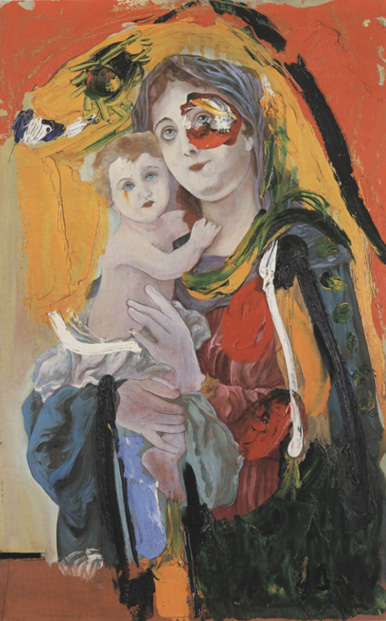
Asger Jorn

Maurizio Anzeri

Asger Jorn

JAIL GUITAR DOORS, headed by Billy Bragg, is a program that bring musicians and instruments to prisons in the UK. Thanks to a conversation between Bragg and the superintendent of Travis County Correctional Complex, JAIL GUITAR DOORS expanded its program into American jails.
Bragg and Tom Morello of Rage Against the Machine among other musicians played live and collaborated with inmates at the Austin jail. The theory is one of music therapy. Bragg left six guitars inside the institution.
Bragg began JAIL GUITAR DOORS in 2007 naming the program after The Clash song of the same title. Since its inception, 32 prisons and more than 300 guitars have been part of the program.
Listen to the full story on NPR, visit the website for JAIL GUITAR DOORS, link up on the JGD’s Facebook page and a bit of local news here.

“No, it was not a random shooting. There was a group of three police officers. One officer took aim and shot Fabienne in the head.”
Fabienne’s father, Osama Cherisma, March 2010
Michael Winiarski and Paul Hansen recently returned to Port-au-Prince with the specific intention of following up on the fortunes of the Cherisma family.

Fabienne's family (left to right): Father, Osama Cherisma, brother Jeff, 18 years, his sister Amanda, 13 years, and mother Amante Kelcy. Photo: Paul Hansen
Following my interview with Winiarski, I had asked rhetorically what the Cherismas may feel about the international coverage of their daughter’s death. I was raising the issue of media and journalists’ responsibilities toward the subjects of their stories, and more specifically I was wondering if the Cherismas would ever be interviewed at length to elaborate on their experiences since that terrible day.
Well, a part answer can be provided in the actions and article of Winiarski and Hansen who published this story on the 13th March. (Swedish original / English translation):
– Osama says he knows the identity of the killer – a high ranking police officer from their own neighbourhood.
– The family have not filed a police report because they are too scared. They say the police are watching them daily.
– They have not talked to local media and only talk to Winiarski and Hansen of Dagens Nyheter because they are foreign journalists.
– Osama dealt with the body directly because he didn’t trust he’d see his daughter again if he handed her corpse over the police and authorities.
– Although their house still stands, it is so destabilised they live in a tent city.
– The schools of Jeff and Amanda, Fabienne’s brother and sister, were both destroyed during the earthquake.
– Jeff, Amanda and their mother Amante all – understandably – still feel extreme pain and emotion. Osama cannot sleep.
– Fabienne is buried in Zorange, north of Port-au-Prince. It is the village of Fabienne’s grandmother.
– – –
ALSO IN THE ‘PHOTOGRAPHING FABIENNE’ SERIES
Part One: Fabienne Cherisma (Initial inquiries, Jan Grarup, Olivier Laban Mattei)
Part Two: More on Fabienne Cherisma (Carlos Garcia Rawlins)
Part Three: Furthermore on Fabienne Cherisma (Michael Mullady)
Part Four: Yet more on Fabienne Cherisma (Linsmier, Nathan Weber)
Part Five: Interview with Edward Linsmier
Part Six: Interview with Jan Grarup
Part Seven: Interview with Paul Hansen
Part Eight: Interview with Michael Winiarski
Part Nine: Interview with Nathan Weber
Part Ten: Interview with James Oatway
Part Eleven: Interview with Nick Kozak
Reporter Rory Carroll Clarifies Some Details
Part Fourteen: Interview with Alon Skuy
Part Fifteen: Conclusions

 Prison Photography