
You are currently browsing the category archive for the ‘Activist Art’ category.
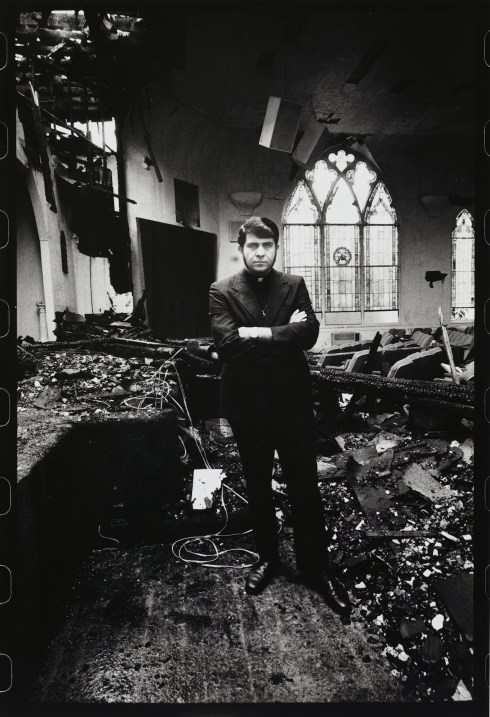
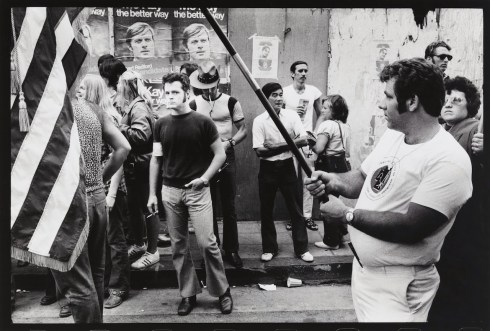
Coinciding with San Francisco’s annual Pride events and the 45th anniversary of the Stonewall riots in New York City, Anthony Friedkin’s seminal body of work The Gay Essay goes on show this month at the De Young Museum, in San Francisco.
The Gay Essay chronicles the gay communities of Los Angeles and San Francisco between 1969 a 1973 — an era of great strides for political activism in the gay communities in California and nationwide.
Friedkin (b.1949) has always been committed to documenting cultures in his home state of California. The Gay Essay was one of his earliest efforts; he embarked on it as a 19-year-old. Self-assigned, Friedkin went poolside, to the city streets, and into motels, bars and discos in an attempt to create the first extensive record of gay life in the Golden State.
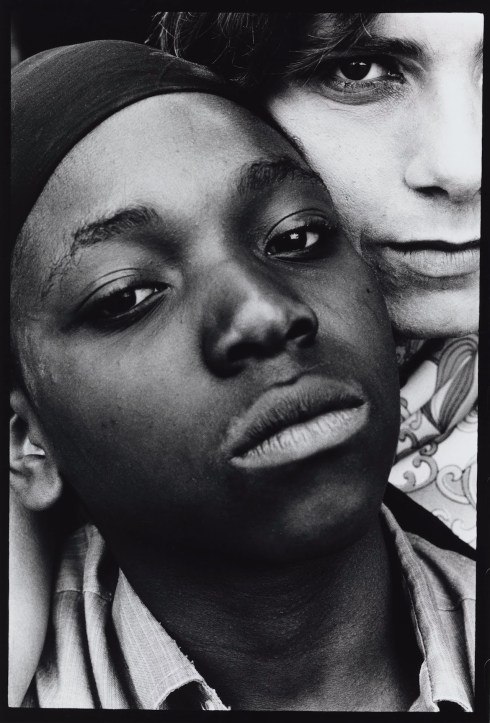


“Friedkin found his place in an approach that retained the outward-looking spirit of reportage combined with individual discovery. As an extrovert with an avid curiosity, he developed close relationships with his subjects that enabled him to create portraits that are devoid of judgment,” says the de Young press release. “He did not aim to document gay life in Los Angeles and San Francisco slavishly, but rather to show men and women who were trying to live openly, expressing their individualities and sexualities on their own terms, and improvising ways to challenge the dominant culture.”
In 1973, the San Francisco Art Week wrote, “The Gay Essay is comparable in magnitude to Robert Frank’s The Americans. The exhibit in its entirety is amazingly strong. And for the most part the photographs are singularly beautiful in execution.”
And yet, The Gay Essay has remained known, since, primarily only to photo-boffins. Consequently, I am personally eager to see this work. It’s “footprint” is not as large as its social significance warrants. Indeed, at the time of writing, a search “Anthony Friedkin” on Google has as the first result a speculative piece I posted on Prison Photography nearly five years ago. (Who knows, perhaps Google’s search metrics might shift a little once Friedkin and The Gay Essay enjoy new press interest for this big De Young show?)

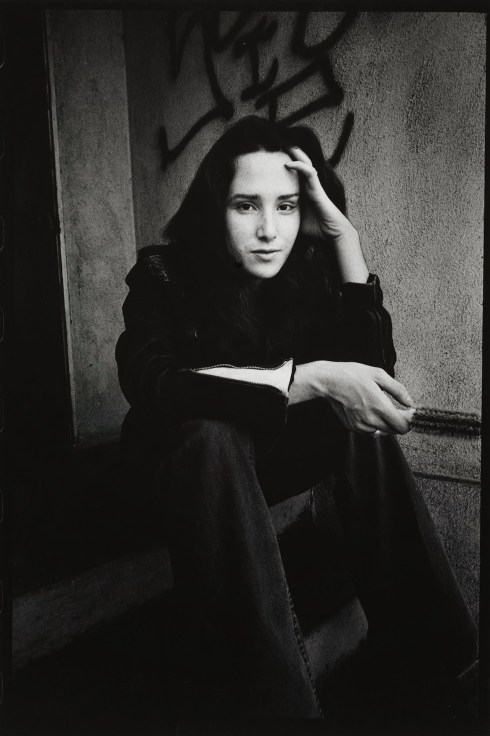
The paucity of images and information on the internet is indicative of a wider photo culture that just hasn’t had Friedkin on the radar. This dearth has been reflected in the real world too. While selections from The Gay Essay have been on public display in museums and galleries in the past, the entire scope of the series — 75 vintage prints — has never been exhibited before in one venue.
“The Gay Essay accords with our goal of bringing to light important, and sometimes neglected or overlooked, bodies of work that enrich the history and study of photography, a medium that is central to art and society today,” said Colin B. Bailey, director of the Fine Arts Museums of San Francisco.
If you’re in the Bay Area at any point in the next six months, I recommend catching this exhibition.



EXHIBITION DETAILS
The Gay Essay runs June 14, 2014 – January 11, 2015, at the DeYoung Museum, Golden Gate Park, 50 Hagiwara Tea Garden Drive, San Francisco, CA 94118.
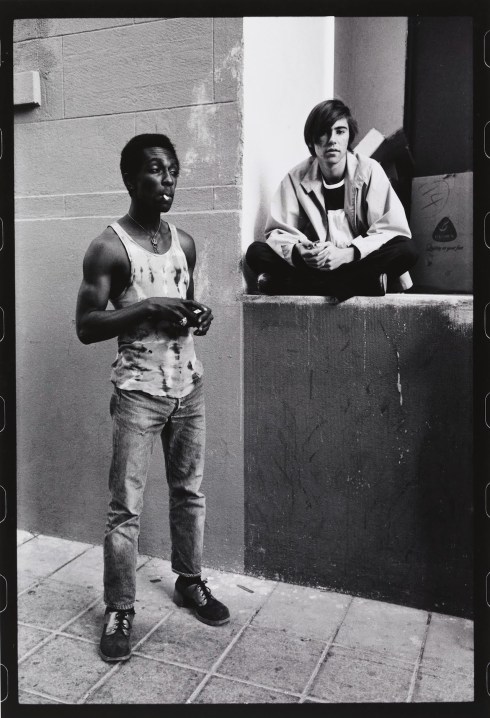
Accompanying the original full-frame black-and-white prints will be contact prints, documents and other materials from the photographer’s archive and loans from the San Francisco Public Library and the San Francisco Gay, Lesbian, Bisexual, and Transgender Historical Society that provide valuable historical context and insight into the conception and execution of the work.

Exhibition catalogue: 144 pages, Yale University Press. Hardcover $45.
Read more at Los Angeles Times, and at DRKRM Gallery.
All images: © Anthony Friedkin
BIOGRAPHY
Anthony Friedkin started out as a photojournalist working as a stringer for Magnum photos in Los Angeles. Friedkin’s photographs are included in major Museum collections including the Museum of Modern Art, the Los Angeles County Museum of Art, San Francisco MoMA and The J. Paul Getty Museum. His work has been published internationally including in Rolling Stone, Newsweek and others. He lives in Santa Monica, California.
Anyone doing work about drone and drone policy that I’ve spoken to has, as some point in their research, relied on the information put out by the Bureau of Investigative Journalism (BIJ). When I wrote my piece Here’s What Drone Attacks in America Would Look Like for WIRED, BIJ was an invaluable resource, especially in providing solid figures for the numbers of drone strikes, deaths from those strikes, and specifically civilian deaths from those strikes.
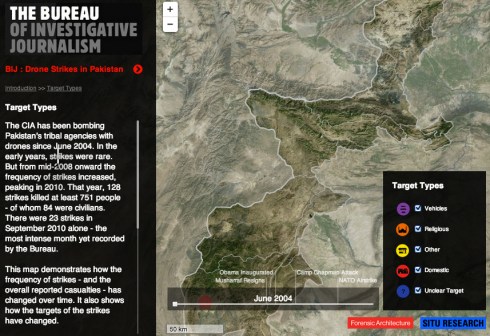
BIJ’s good work continues, as it played host to the Forensic Architecture (Goldsmiths University, London) and SITU Research to produce an online interactive WHERE THE DRONES STRIKE.
With WHERE THE DRONES STRIKE which we can examine drone target types (vehicles; religious; other; domestic; unclear target). Was that an insurgent training camp that was annihilated or was it a marriage celebration full of women and children?
Due to secrecy at the Pentagon (and previously at the CIA, when it controlled the drone program), reliable information on drone attacks is very difficult to come by.
“The CIA has been bombing Pakistan’s tribal agencies with drones since June 2004. In the early years, strikes were rare. But from mid-2008 onward the frequency of strikes increased, peaking in 2010. That year, 128 strikes killed at least 751 people – of whom 84 were civilians. There were 23 strikes in September 2010 alone – the most intense month yet recorded by the Bureau,” say the BIJ.
BIJ routinely collects info on drone strikes through thousands of reports, witness testimonies and on-the-ground data from Pakistan, but this is the first time this data has been put rendered as an interactive to propel human rights and accountability.
“The map demonstrates how the frequency of strikes – and the overall reported casualties – has changed over time. It also shows how the targets of the strikes have changed,” explains BIJ. “Domestic buildings have been the most frequently hit target type in each year of the drone war. Attacks on vehicles have become gradually more frequent, and in 2011 almost as many vehicles were hit per strike, on average, as buildings. But this dropped from a peak that year and in 2013 drones targeted vehicles just three times. Attacks on vehicles tend to kill fewer people than attacks on domestic buildings, and fewer civilians. The highest death tolls of all are in the comparatively rare attacks on madrassas and mosques.”
The U.S. dropped it’s first bomb from a drone in late 2002, on Yemen. The Obama Administration only formally acknowledged it was flying killer robots over foreign lands in 2012.
Go to www.WHERETHEDRONESSTRIKE.com
For a wild editorial break down of the data (and more graphs!) read the BIJ’s report Most US Drone Strikes In Pakistan Attack Houses which accompanied last week’s release of WHERE THE DRONES STRIKE.
For regular updates on drones at home and abroad, may I recommend following the Drone Weekly Roundup and signing up for the Newsletter (scroll down) put out by the Center For The Study Of The Drone at Bard.

“I had buddies that couldn’t take the job and wound up quitting because of the mental abuse and, sometimes, physical abuse,” says Steele. “You could be responding to a fight, not knowing that they’re setting you up to stab you with a shank. It’s a very dangerous job. Corrections officers don’t have guns. At that time we weren’t even carrying mace. The only weapon you really have is your mind — how you used it dictated if you were going to have a good 8 hours or a bad 8 hours.”
COP TURNED ADVOCATE
Lorenzo Steele Jr. worked as correctional officer on Rikers Island between 1987 and 1999. Most of his time was spent in the juvenile units. When the officers had retirement parties and other events, he was the one with the camera. In 1996, Steele began talking his small compact film camera into the units and making photographs of the dirt, the filth and the despair. All without any official approval. As part of his work, he also made evidence photos of injuries following violence inside the Rikers Island.
WARNING: THIS ARTICLE INCLUDES GRAPHIC IMAGES OF MUTILATION
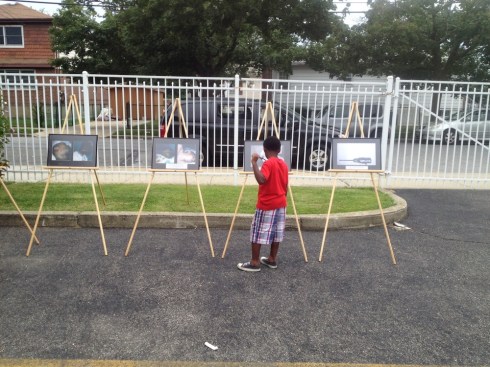
When Steele decided to leave the job, his “leap of faith” took him back to community instruction. As founder of Behind These Prison Walls Steele gives public lectures and brings pop-up exhibitions to New York neighbourhoods. It’s a mobile show & tell to shock and educate youngsters on the destructiveness and terror of prison. Steele estimates he has made close to 1,000 presentations in schools, churches and community centres since 2001.
I came across Steele’s archive when some of his images accompanied For Teens at Rikers Island, Solitary Confinement Pushes Mental Limits, a Center for Investigative Reporting article that was also adapted and cross posted to Medium as Inside Rikers Island, part of the excellent ‘Solitary Lives’ series.
It is very unusual for photographs made by correctional staff to surface, let alone for there primary use to be as tools for street-side exhibition and engagement. I called Steele and asked him some questions about his self-propelled cop-to-advocate career change, his motives for making the images, the efficacy of his methods and what we need to start doing differently to decrease the numbers of kids we lock up.

Q&A
Prison Photography (PP): When did you decide you wanted to be a correctional officer?
Lorenzo Steele (LS): At 21 years old I took a [New York] City test. At that same time I was a para-professional for the New York City Board of Education working with Middle School children. I was there for 8-months and loving the job. I got a letter from the city saying that if I could pass a physical, if I could pass the psychological, if I could pass the drug test, I could become a correction officer.
The only reason I became a correctional officer was because it was paying more money than the Board of Ed. I didn’t know I had to experience the system for 12 years, in order to know the system, and later to help people avoid the system.
I’m 22 years old, and it is just a job — no one in my family went to jail. In the neighborhood I grew up in, nobody went to jail.
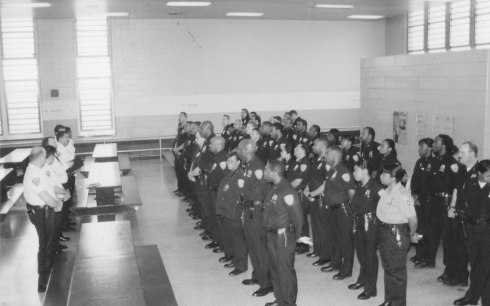
The academy was 2 to 3 months at that time. They could never prepare you mentally and physically for what you were about to experience working in a prison. On the first day took the ‘on the job trainees’ OJT’s into an actual facility. Now, they would tell you things — don’t talk to the inmates; don’t stare at the inmates but that was about it. I was afraid, but later I realized that in a prison you can not show fear because you will be manipulated. OJT was about 2 weeks, and after that we were assigned to our facilities.
I worked the C-74 Unit, the Adolescent Recession Detention Center (ARDC) for 14 to 21 year olds. Within that age range, of course, half are adolescents and half are adult inmates. One day you’re working with the adolescents, the next you’re working with adults. I dealt with mental health issues, behavior issues, socio-economical issues. I found out what our people actually go through and why they come to jail.
PP: What were your early impressions of the job?
LS: I’m young, I’m making good money. I have my own apartment, but I have the mind of an officer now.
Can you imagine sitting in a day room with a capacity of 50 inmates and you’re one officer that’s in charge? Your main function is to make sure they don’t kill each other or rape each other and if you see a fight you push a personal body alarm. Depending on which housing area you are in, you can sit there sometimes for 8 hours. I remember the day when I thought, “I can’t do this for twenty years. There are bigger and better things out there for me.”
I’m a photographer. I wondered what I could do legally. I started formulating a mentoring program. I used to volunteer my time in schools as a correction officer and share my insight on what the prison system’s really like. The average person doesn’t really know until its too late. It’s my mission to let these young children know that jail is the last place on earth they want to be.
PP: Do you consider yourself fortunate in that you came to that decision? Because for a lot of people in a lot of jobs, sometimes the stress is so high and the options seem so few they can’t even step back for a minute to see a change in circumstances.
LS: It was very rare for anyone to just resign from the department, unless they were brought up on charges. It was almost unheard of. People asked, “What are you gonna do? This is the best job.”
The last day that I knew I was going to be there, I walked around the jail and I grabbed a little object where I could and wrote on the wall. I carved my name in some wood objects and on some metal doors.
It was around the time of Mother’s Day. My Grandmother was in town and I took her to church. Sometimes, the preacher is actually talking to you. He said, “If there’s anything on your mind just leave it behind you, step out on faith.” That next day, that Monday, I went downtown and turned in my shield, turned in my gun.
PP: What year did you resign?
LS: 1999.
PP: In between which years did you make photographs in Rikers?
LS: I began maybe around ’95 or ’96.
I was the photographer for COBA, the NYC Correctional Officers Benevolent Association. People retire or you have parties or special events. I always had a camera on me. After that, I used to take pictures of inside of the prison not knowing that I was to turn it into an enterprise to save people from going into the jail.
I had a camera with no flash. Can you imagine taking out a camera? You’ve got 200 prisoners coming down the corridor to the cafeteria — they’re going to see the camera going off so I had to disguise it somehow. You get an adrenaline rush knowing that you can’t get caught. Once that shutter button is released its almost the best feeling in the world. Its like a high once that shutter button goes off and you’ve captured that image. And you know.

PP: Where did you keep the camera? In an office or did you take it home with you every day?
LS: I had it in my pocket. Sometimes I would take pictures of the officers in their uniform because the average officer never really has a picture of himself in uniform. It was a good time back then because the camaraderie was great. We had one team; the officers, the captains, the deputies, the warden. We were all one team back then, but you couldn’t do it today because after twenty years things change in the department.
PP: What type of camera did you use?
LS: A 35mm. One of those CVC store cameras. Digital cameras weren’t even out then. I put some black tape around the flash and disguised it almost like a cell phone or a beeper.
PP: How many photographs do you think you took, in total, inside the prison?
LS: Over 200 photos. Shots of prisoners in cells, of the solitary confinement unit, pictures of prisoners who were physically cut. In colour. You can’t imagine the power of those images when I show the kids: “If you don’t change your ways, this could happen to you.”
LS: Children cannot relate to prison, yet they see the negative violence on television and sometimes a rapper will glorify prison. Some rappers are promoting violence, promoting gang activity, and that’s some children’s reference to the criminal justice system.
But, once you step foot in that criminal justice system your life changes forever. Sometimes they might not even make it out. At 15-years-old we’ve had adolescents that end up taking 25 years with them upstate because they caught jail cases cutting and stabbing individuals while they was on Rikers Island.

PP: How do you exhibit those 200 photographs to the public?
LS: It depends on the audience. I have a lot of graphic images so I don’t put those in the schools with the kindergarten kids and the third graders.
I have select images that I use when I exhibit on the sidewalk in at-risk communities. About 20 images at a time but it depends on where and what message I’m trying to get out.

PP: I’ve seen only a few images like the ones you’ve published. One example is the selection of images leaked by a Riker’ Island officer to the Village Voice two years ago.
We don’t see many images shot from the hip. If we do, they’re usually anonymous. Such images do exist but one must work hard to seek them out. How many people see your presentations? Are people shocked? Surprised? Do people respond to the images in the way that you hope they will?
LS: The first time they see the images, yes, they are shocked, especially students. Students that I deal whether in the church, in schools, in the community, are shocked. Images are powerful but the knock out blow is information, the experience, that actually goes behind what’s in that image.
PP: How dangerous was Rikers? In the 12 years you worked there how many incidents of serious assault and possibly even murder occurred or occurred on your shifts?
LS: Let’s talk about the adolescents first. Rikers Island was considered the most violent prison in the nation. We used to average sometimes 50 to 60 razor slashings a month. Slashing with the single edge razor blade. Cut somebody over the face multiple times inside. There was a lot of blood.
When I went into corrections, I didn’t like the sight of blood [but] I saw so many people get cut that it became normal. I was so desensitized. And that’s scary because that normalcy meant somebody had a scar on their face for life and for every cutting there was a repercussion; if a prisoner got cut he had to get revenge on the other guy and catch another jail case.
PP: I have no idea how politics, street politics or gang culture — in or out of prison — work in New York today let alone in the late 80s and 90s. Over your twelve years, was there consistent gang activity or did it change?
LS: In ’87, there weren’t gangs in the New York prison system. In the early ’90s, we realized we had a gang problem in the prisons. The gangs had their own language. 300 prisoners in the cafeteria and five officers. We had to learn the language real quick and that is what established the Gang Intelligence Unit. By conducting cell searches, we would get the paraphernalia and the by-laws of the gangs
Later on, they flipped gang members into telling the department what the language meant; that’s how the Department of Corrections infiltrated the gangs. We passed the information on to NYPD.
It was very dangerous. You had to be on your toes all the time. The gangs recruited younger people whom they would force sometimes to do harm on officers or do harm to prisoners. We did the best we could.
One of the blessings was that I always had good supervisors. When the captain said ‘go’, you went, and when he said ‘stop’, you stopped. You put your life in the hands of your captain; it’s almost like being in a war. I am old school. That’s what really kept us on top of the prisoners. The jail would never be overrun because you had a select group of officers that demanded respect and that knew how to take care of the business without anybody getting hurt. When prisoners saw that select group of officers, nothing was going down that day.
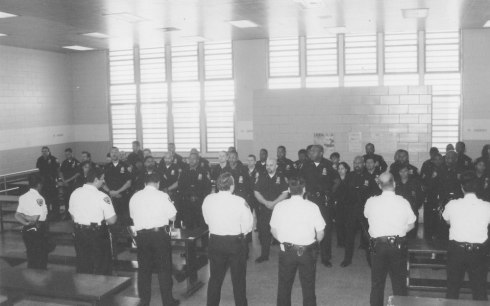
Part of being a Correction Officer is knowing your prisoners and you always wanted to know the gangster, you always wanted to know the person who was running the housing area because that’s the one that you would use, you know. “Listen man, while I’m here today, nothing’s gonna go down. Tell the boys man to shut it down while I’m here.”
PP: Clearly, I’m opposed to prisons as they exist. I think we lock too many people up and I think when we’re locking people up we’re not providing the right sort of conditions or services for them. Obviously, what goes on in the jails and prisons relates to outside society. The reason you do your work now, I presume, is because you see that link between poverty, what goes on in the neighborhoods and what happens in the jails.
What do we need to do better? How do we rely less on incarceration and when you must imprison people, how do you make it safer for everyone in the place? How do you stop people from coming back? Do we need smaller prisons, do we need more money, do we need different sentences for different crimes?
LS: It starts before prison. I worked in the neighborhoods classified by criminal justice books as “high-crime areas” and it starts with parenting.
Bill Cosby said on National TV that we have parents more focused on giving their kids cell phones, expensive gear and expensive pants. And they condemned Cosby. They found some black guy on CNN to come on and say ‘Cosby, you are wrong.’ But he was right. Unless you are inside the school system you wouldn’t necessarily know.
That’s why I hit the streets. I try to let the parents know that without that proper parenting their child has more chance of going through the criminal justice system.
Imagine being in a first grade class in an impoverished neighborhood (it depends on the school district) with 30 to 35 students in one class. 1st grade. Half the children can read, half the children cannot read, now you have one teacher. How is that teacher going to really teach? There’s two different dynamics going on in that classroom. We have children across America that are coming into the public school system unprepared to learn.
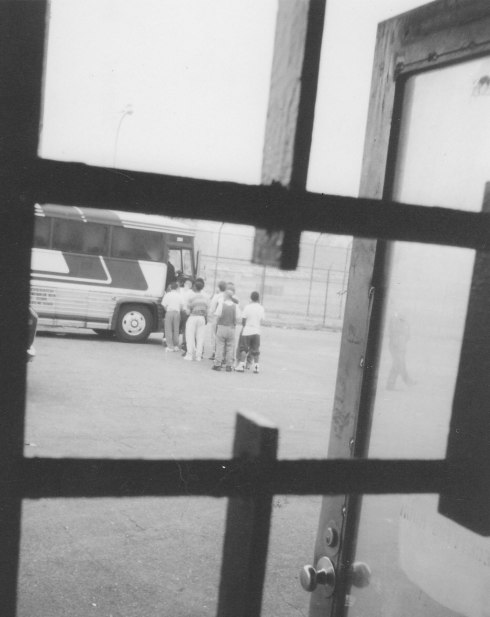
LS: Poverty is a crime, because poverty comes with where you live. Those in impoverished neighborhoods are subjected to crime, shootings, and drugs, and then children have to go into a school system that doesn’t have the necessary resources. It’s a ticking time bomb.
Unless a parent or guardian is there to break down that math homework, for them, some children don’t know what’s going on. Unless there’s a parent there that could check the homework that the teacher gives every night. Its not going to get done. There’s a lot parents in poorer communities who are uneducated themselves. Look at the statistics coming out of poor neighborhoods — many young adults are not finishing high school and are not going to college. If a parent is not educated, then probably education is not talked about in the home.
The point of attack, strategically, needs to be that early childhood.

PP: Parenting and education. I can agree. But we can’t roll back the years’ generations to correct past mistakes. So what about the situation as it stands now? Say, you have a 15-year-old who’s acted out, he’s been pulled in by the police, he’s got a serious charge over his head. Is Rikers Island the best place to deal with that kid? Is Rikers Island the sort of institution in which — while they are kept away from the public for public safety — they themselves are kept safe?
LS: If you break the law there are consequences. There are necessary disciplines in place so we have a civil society. But is it Rikers Island or is it a juvenile detention center?
If you would have asked me this question as an officer, I’d have said, “Rikers, yeah.” But, now, when I go into the communities and hear what the parents have to say about a lot of these children just mimicking their parents, I wonder is that child at fault? Why did he steal that cell phone? Maybe his father was a thief, or maybe they don’t have structure in the home. Maybe there needs to be a place where a child’s whole history needs to be examined? What’s going on in that child’s home. Does he have a support system? He lives in a high crime area, how much do we expect him to succeed?

LS: Yes, I feel there needs to be places where children can go to receive those special considerations, not thrown into a place like Rikers Island in which you’re housed with murderers.
Let’s create places and bring in the necessary mentors. And I’m not just talking about doctors in psychology. Sometimes, it takes the correction officer. Sometimes, it takes that guy that did 25 years in jail.
Create a first offense type place. “Young man, we give you a year. If you do the right thing in this place we’ll seal your record, but if you don’t, you gotta go to the next level.” Sometimes, some people have to go through that prison system if they’re going to turn their lives around.
Create a place where they could come in and get properly mentored to. You understand? Some people have degrees and others not, but there’s only a select few who can really get through to these children.
PP: So, the prison system is too rigid?
LS: It doesn’t always work. Prisons are putting way too many adolescents with mental health problems behind bars. They’re banging on the cells for 3 or 4 hours. These young children need advocates. They can’t speak. Not too many kids are writing a letter to mommy saying, “I’m thinking about suicide tonight; being locked in a 8×6 foot cell for 23 hours, I can’t take it no more.”

PP: Your photographs were used in an article by the Center for Investigative Reporting about solitary confinement. Over your time as a correctional officer did you see the use of solitary for youngsters increase, decrease, or stay the same?
LS: We had one unit, about 66 cells. Prisoners that cut, stabbed, or assaulted officers, were locked in solitary confinement.
Warden Robinson implemented a program called Institute for Inner Development (IID). The warden put together a team. Hand-picked. A select few that you could trust and you knew they weren’t going to violate any prisoners rights. We did two weeks of training and took it to a select housing area. We transformed that housing area. Imagine going from 50 slashings a month, [among the] adolescents, to zero for four years.
Programs work if you can get the necessary personnel to properly run and maintain them. When we ran the IID program, we took another housing area — a hundred more prisoners — then another housing area. Eventually, we had 200 prisoners in the nation’s most violent prison in America and and next to no violence.
PP: What was different about that program? What was it that you provided the youngsters?
LS: I love children. I’m a disciplinarian, I love reading, so I had tons of knowledge about slavery and the connection between slavery and incarceration, so when you start talking about this new thing, they just love it. These 14, 15, 16 year-olds didn’t have any type of discipline at home, didn’t have the male role models at home. “This is what men do young man. Pull your pants up. Grown men do not walk around with their pants down.”
PP: So it was more about developing different interactions between the correctional officers and the prisoners, and changing the culture within the unit?
LS: Out of all of those officers, twelve officers, we had no psychologists, no therapists. We were the psychologists we were the therapists. Just because you have a degree that doesn’t mean that you can work in an area like that. There’s a lot of passion that’s involved in that.


PP: After you resigned, when did you begin exhibiting the photographs?
LS: I detoxed for about 8 months, just not doing anything. From being on the drill to taking it back to normal. Then I started going into the schools and just sharing my information.
PP: With the images?
LS: I laminated some 8×10” color prints and put them on the blackboard. Then I got a laptop and a projector, and went from holding the pictures in my hand to projecting them agains auditoriums and classrooms walls. My first printed use of the images came in a 2005 Don Diva Magazine feature. They gave me 5 or 6 pages. I provided my phone number. Soon after, a police officer who worked with youth called me and asked, “Could you come in a talk to my youth?” That was the start of giving back.
PP: How do you evaluate your work?
LS: Seeing that look on somebody’s face when they think they know what jail was like, but then I show them the reality. Talking to 500 students in an auditorium and asking them, “Is this new information?” and they all say yes. Many of them have to make a change right there. For others its going to take longer to make that change.
PP: Is what you do anything like Scared Straight!?
LS: I’m not trying to scare you straight I’m trying to inform you straight.
When you’re looking at somebody and they got a thousand stitches on their face, the shock is there but along with the shock is the information behind it. Prison is a violent place and the criminal justice system is a for profit agency and so I break down a lot of information within the program.
PP: What images do we need to see?
LS: We need to see the graphic images of the young guy that was in solitary confinement unit who just cut himself with a razor blade because that was the only way that he could get out.

LS: We need to see the images of a young girl in shackles walking down the corridor with a hospital gown on. We need to see images of somebody crying in their cell at night and the only reason he’s in the cell is because his parents didn’t have the money to bail him out. We need to see those images of the abuses, we need to see the dirt, we need to see the filth.
We need to see the pain the officers go through — the officers that get cut and the officers that get feces thrown in their face hoping that they don’t have Hepatitis. An image is what stays in the mind. Every time you think about doing bad you need to think about that image.
Hollywood uses images too to glorify the rich and powerful with the jewelry on their neck. But it is fake. I use images to bring awareness to what really takes place behind bars and what young adolescents are actually going through. Everyday. It has to be traumatic.
Is the prison system still in the business of rehabilitation? That’s a question that needs to be asked in the Department of Corrections nationwide. Are prisons and jails in the business of rehabilitation? Yes, he did commit a crime, but does he have to be put into a cell for 23 hours. Is that rehabilitation? Or is that torture? We have to define cruel and inhumane treatment. We have to bring up those: terms, rehabilitation or torture.
What we do with this young child while we have him here for a couple years could make or break him for the rest of his life. There’s volunteers that go into the prison and mentor. Recently, I had the week off so I went back to Rikers Island, and did some workshops, talking to the kids. I felt obligated because we’re in a place that could make or break them. Some are going to the street. Some are going upstate. If you’re going to the street, prepare their minds while they’re here. If we’re trying to rehabilitate.
PP: Over the 12 years that you’ve been doing this work, if you can estimate, how many times have you presented to groups speaking and how many times have you presented images?
LS: I’ve done close a thousand presentations — in churches, schools, and sometimes putting them on the streets. Just taking the images right to the high crime areas and putting them right on the sidewalk. People in the poor neighborhoods are not going to go to the museum so I bring the museum to the streets.
PP: Thanks, Lorenzo.
LS: Thank you, Pete.
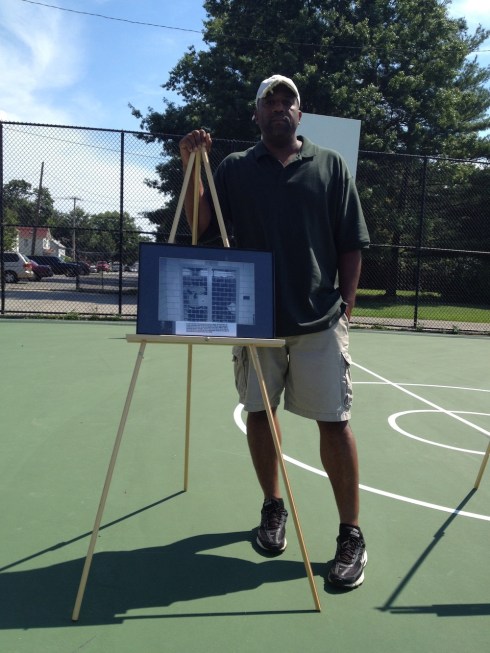
Update 05.11.2014: The Eventbrite registration page has been closed after 80 sign-ups. But, there’s space for walk-ins and allcomers. We don’t want to turn anyone away!
Email info@asocialpractice.com to extend your interest. Thanks.
A BIG PUBLIC CHAT
Next Friday, May 16th, as part of the Open Engagement conference, I’ll be part of a conversation about photography based art and social practice.

The Photo-Based Social Practice panel and group brainstorming is at the Aperture Gallery in New York, 10am – 12 noon.
Moderator Eliza Gregory along with panelists Gemma-Rose Turnbull, Mark Strandquist, Wendy Ewald and I will be discussing socially engaged, transdisciplinary, and expanded practices in contemporary photography.
Highfalutin, huh? Not really. The language is big, but the query is simple. Can photography build community and empower subjects? How can photography be nice?
It’s free, but preregistration is required. Do that HERE (6th option on the list).
We’re only going to do the briefest of introductions to our work before breaking into groups to tackle a host of questions that deal with audience, relevance and good design. It only makes sense that we collaborate to tackle answers to these issues.

We hope that the panel will follow nicely on from December’s Collaboration: Revisiting the History of Photography event that crowdsourced a new timeline of photo-history by focusing on projects with communities and groups as creators. I love the ideas involved in that.
While the Collaboration: Revisiting the History of Photography event gave new recognition to old projects and while it presented a new timeline and framework, it didn’t tackle best practices. From the projects it unearthed we can surmise the nature of some socially responsible projects, methodologies and motivations. In our discussion next week we hope to extend the conversation further and start to define common language, and potentially best practices, for socially engaged photography projects.
Please join us and help us along!
LOCATION, DATE, TIME
Aperture Gallery and Bookstore
547 West 27th Street, New York
10:00 am – 12:00 pm, Friday, May 16th.
FREE WITH REGISTRATION
NEW VENTURE! ‘PHOTOGRAPHY AS A SOCIAL PRACTICE’
Now is a good time to mention a joint venture recently started by my fellow panelists, Eliza Gregory, Gemma-Rose Turnbull and Mark Strandquist.
Photography As A Social Practice is a website for reference tools, teaching tools, and conversation about the intersection of social practice and photography. I’ll be contributing every so often and chatting on the phone about content. You can suggest resources by emailing info[at]asocialpractice[dot]com
SPONSORS
The panel is offered in conjunction with the Magnum Foundation and the Aperture Foundation who combined to publish Documentary, Expanded, the Spring Issue (#214) of Aperture Magazine as part of the Photography, Expanded initiative. Support also comes from the Open Society Documentary Photography Project, The School of Journalism and Communication (University of Queensland) and Portland State University‘s Art and Social Practice Program.
OPEN ENGAGEMENT, 2014
The Photo-Based Social Practice panel is part of Open Engagement, an international conference that sets out to explore various perspectives on art and social practice, and expand the dialogue around socially engaged art-making. This year, the conference addresses the theme of Life/Work. It is 2 days of programming (Sat, May 17 – Sun, May 18) at the Queens Museum, plus 1 day of pre-conference events on Fri 16th at different locations around the New York boroughs.

Rashed, 14, leaves the camp to buy furniture from Jordanian merchants and comes back to sell it, much as his family once did back home.
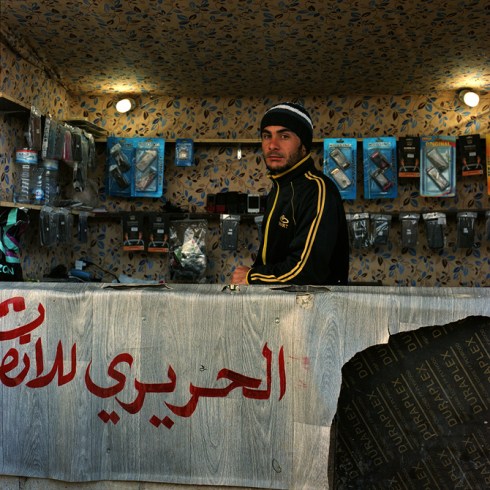
Toufic Beyhum‘s photographs of the Za’atari refugee camp in Jordan provide a look into the makeshift pastimes and work as well as the daily mundane activities of Syrian refugees. His series Champs Elysées focuses on the retail and food stands along the central road in Za’atari nicknamed Champs Elysées by French aid workers.
This body of work is more interesting than many others emerging from the Syrian conflict. There are no bombs here, but there is trauma. That trauma though isn’t immediately apparent. We’ve got to dig deep into Beyhum’s photographs.
Beyhum’s focus on small-scale trade is instantly connective; there’s no society in the world that doesn’t move about the continuous modest commercial negotiations. Beyhum shows us the less fraught but no-less-important side of the Syrian conflict and the refugee resettlement.
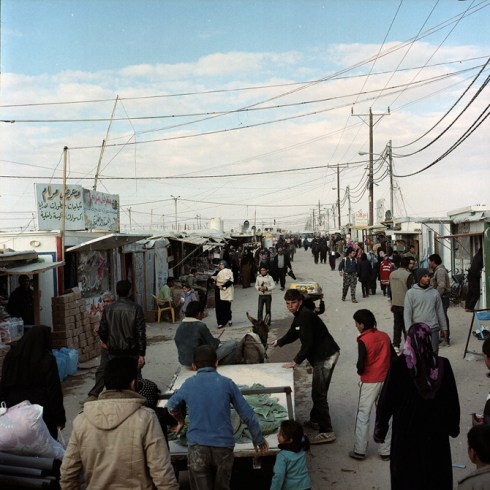
How do cities, wanted or not, develop? How do humans resettle? And what happens if that resettlement is involuntary? Refugee camps are a hive of struggle and psychological trauma, but they are also a hive of survival and continuing on. Of course, the degree to how much refugees want to live on, move on, accommodate and adapt in camps differs hugely. In Western Sahara, for example, refugee camps have housed Sahwaris who fled war over 38 years and the definitions of “home” are under great assault.
One hopes that Za-atari and Syria’s other refugee camps won’t be the “home” for repeated generations. Za’atari is home to an estimated 130,000 Syrians. It is only 3 years old. It is now the 4th largest city in Jordan. It’s an extraordinary place for all the wrong reasons.
The world tends to think of refugee camps as a necessary inconvenience — as better than war, and as the most stable iteration of displacement. Refugees, on the other hand, are daily reminded of lost goods, careers, projects and anchoring points of pride from their former lives (a French psychologist talks about this very well in this VICE feature, Syria: Ground Zero shot by Robert King).
Beyhum’s series, I think, expertly patrols those gaps between subject and audience’s perceptions.
PHOTOGRAPHY’S ROLE
Before digging a little deeper into Beyhum’s work I want make a nod to work made by NOOR photographers at the turn of the year that simultaneously documented the camp and provided opportunities for refugees to make new family portraits. VICE:
Nina Berman, Andrea Bruce, Alixandra Fazzina, and Stanley Greene — supported by the UN Refugee Agency (UNHCR) and Japan Emergency NGOs (JEN) — turned a large tent into a photo booth where refugees could come and have their portraits made. Refugees were asked to bring an object they cherished or, if they didn’t have anything, to bring a person they loved. A boy came wrapped in his blanket. A man brought his shisha pipe. A mother posed with her five children. In all, about 300 portraits were printed on the spot and given to people to keep.
Beyhum‘s series Champs Elysées strikes me as a worthy project for attention. He used film. He self-funded. He partnered with writer Nadim Dimechkie, whose words appear below in italics.
There are common attributes to all refugee camps (devastating stories of different degrees) but Beyhum identified one of the defining characteristics of Za’atari — the extraordinary growth of independent businesses. According to UNHCR’s Andreas Needham, is the growth has been “impressive compared with other refugee camps.”
Eighteen months after the camp’s establishment there were 2,500 shops, and 700 on the Champs-Elysées alone.
So while I’d argue that photography’s role is to give subjects a voice, gift or benefit (e.g. NOOR’s portrait studio) its role is also to usher audiences into the psychological territory of the subjects. The shops and shop-owners in Beyhum’s series are perfect vehicles in explaining to us far-away and comfortable consumers that the Za-atari refugee camp is a place of making do.
Beyhum’s images must remind us however that survival is only partly related to the aid-organisations’ food and shelter that provide physical security. Survival has as much to do with forging ones own spaces, purpose, pride and as a result psychological health.
What a refreshing foil to the photographs of desperate handout and sacks of rice being thrown from atop aid-trucks that we so often see in the media.
Please scroll down to read Dimechkie’s original text that accompanies these images. It provides important context.


‘CHAMPS ELYSEES’ by NADIM DIMECHKIE
The salesman on the Champs-Elysées displays the shiny black shoes in neat, even rows. Each time the wind picks up, each time a truck roars past, they are drowned in billows of fine desert sand. And each time, the salesman dusts the sand off each shoe, wipes it down and places it back in line. Another cloud of sand may come along any moment, but the shoes will stay clean.
130,000 refugees are trying to make a living somewhere they do not wish to live. Most have left their homes, trades, families, and material possessions behind and they want to go back now. But until they do, they must manage with what they have left.
Father-son traditions fostered in the souks of Damascus and Aleppo, and preserved by the protectionism of successive Assad governments, are so ingrained they are almost instinctive. By one reckoning, 80% of the shops hark back to skills honed at home.
Where tradition fails, resourcefulness steps in. There are no cars here, and law and order is the preserve of the UN. So Abdul Mansoor, once a policeman in Syria, now makes phenomenal falafels. Omar was a car mechanic; now he sells second-hand clothes. Mounib established an impressive perfume shop — which he insists is nowhere near as good as the one his family ran in Syria for generations.
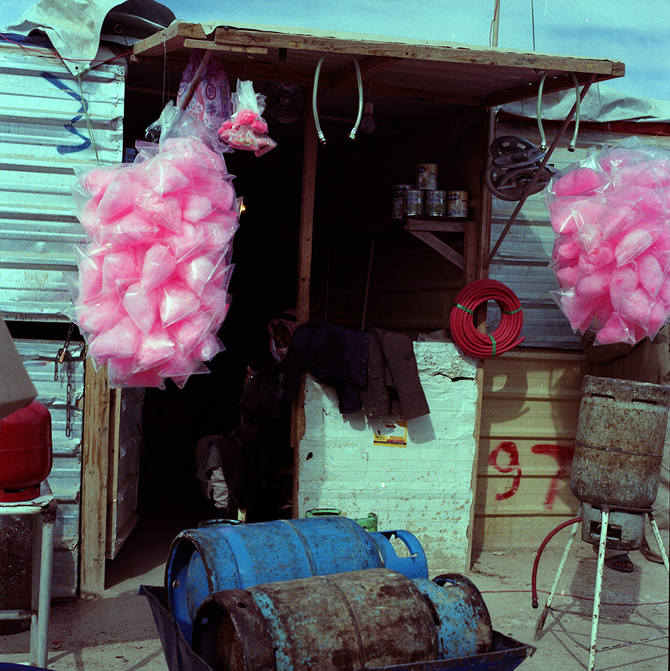
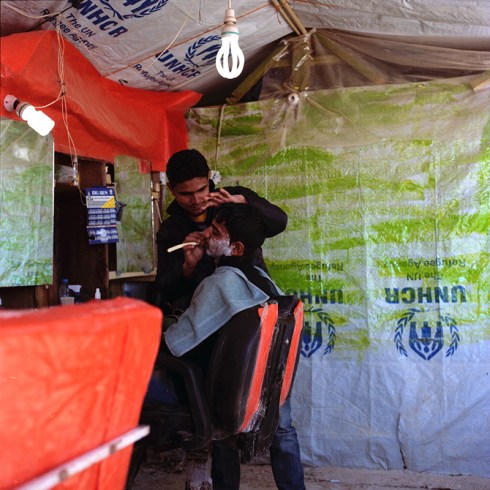
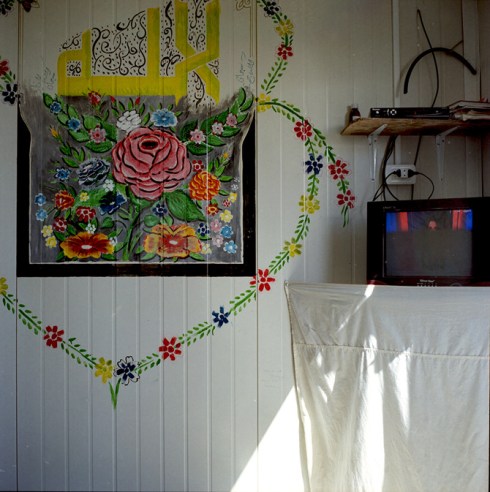
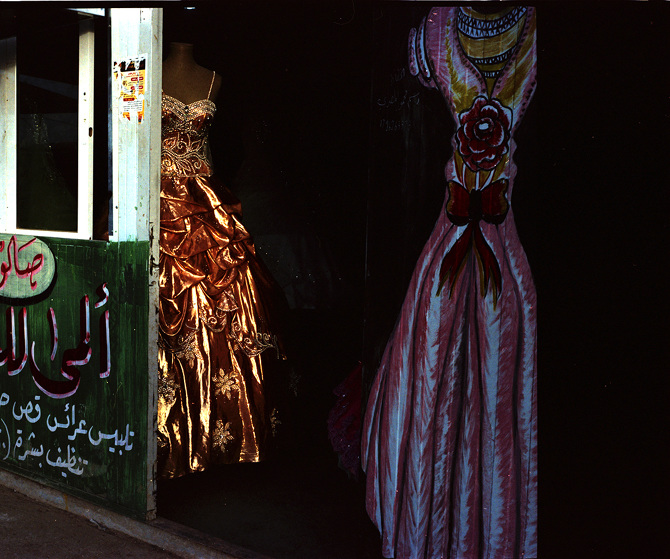
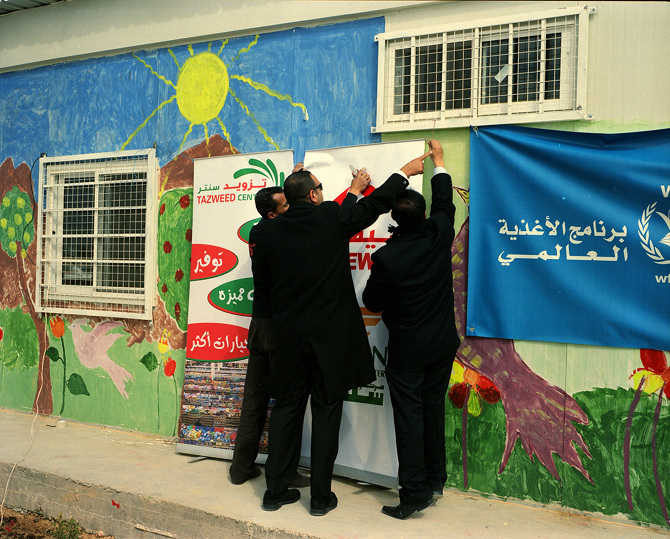

Some jobs have been invented before anyone’s come up with a name for them. What do you call the kids who use wheelbarrows to help people with their shopping for tips, or to resell UNHCR blankets and tents so they can buy what they really need? What do you call the welder-joiners who fuse impossible things from impossible combinations of materials, or the makers of custom-made flat-bed trolleys designed to shift shipping-container homes between buyers and sellers?
Small gardens grow in infertile ground. Bottled water is still sold even though water filtration units have been closed down. Recently, someone stuck a whole police station on wheels and dropped it off somewhere they felt was more appropriate.
The ‘Mayor of Za’atari’, UN Special Field Coordinator Kilian Kleinschmidt, appreciates their entrepreneurial nature. Refugees are building their own amenities, like showers and toilets and kitchens. Even if this is sometimes using illicit materials, Kleinschmidt prefers to see refugees build facilities proactively than wait to receive them. Elements of their success are also down to other factors: there are 193 NGOs here, including UNHCR who provide blankets for warmth, containers for homes and security for business to thrive.
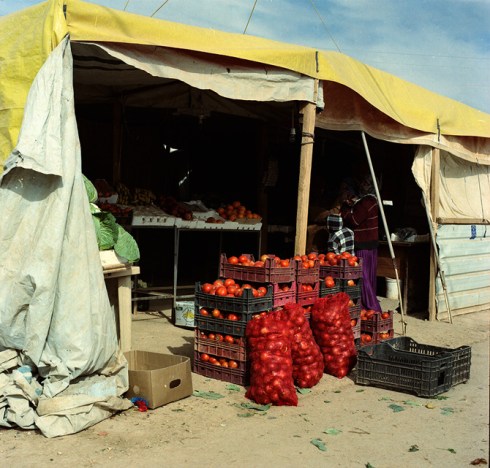

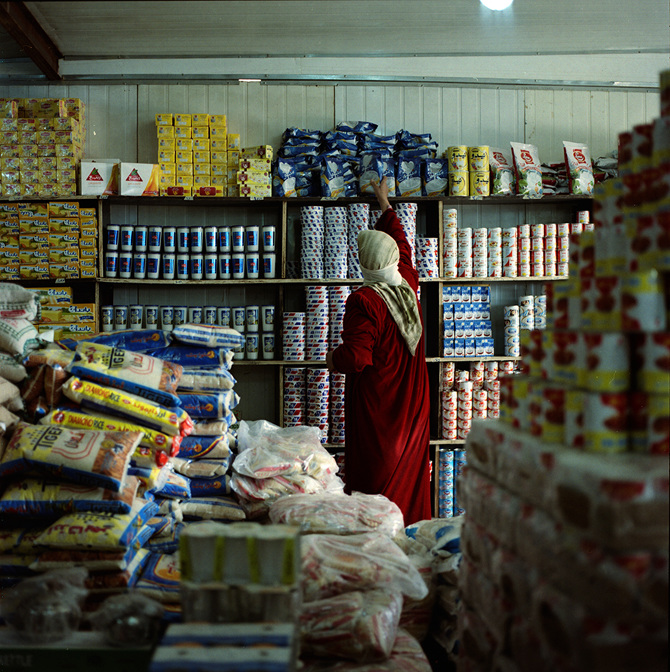

Atallah revived the family bakery from Syria and set up shop in Za’atari.

Some business-owners benefited from existing ties with Jordanian pre-war business partners and set up an enormous supermarket in the centre of Za’atari.
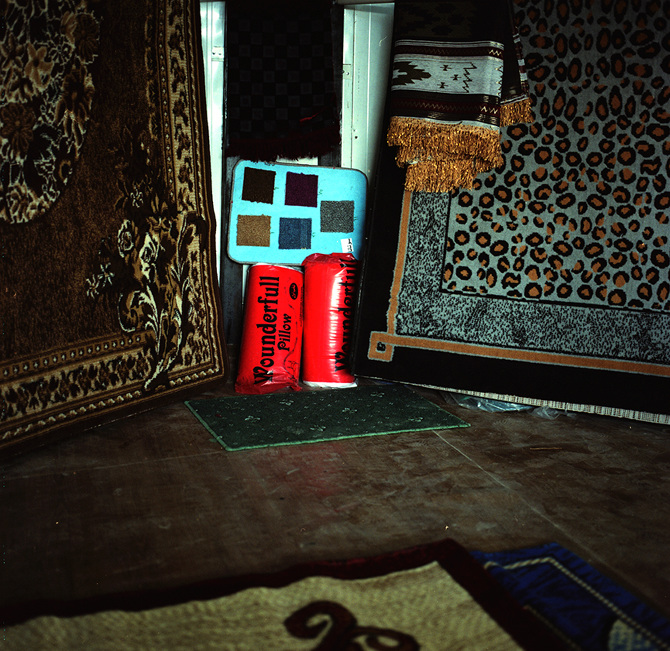
Of course, not all of the attributes brought by the empty-handed are good ones. Fear has also followed them—of government informers, of ISIS informers, of the mafia. Criminality, which characterized the town of Dara’a from which many of the refugees fled, has followed many of them too.
A combination of good governance and the opportunity for dignity has quelled many of these less desirable elements, while providing opportunities for the better instincts to grow. For some, there is even excitement here—in the relative law and order, in the electricity (which some Syrian villagers had never had on tap before), in the entrepreneurial opportunities. But nobody wants to be here.
For all their ability to survive the present moment, no one can build lasting happiness here, for that would mean accepting their fate. Still, there is enough tradition and resourcefulness to make life bearable.
And there is always pride — another resource from within. Pride keeps the streets tidy and the wedding dresses moving. Pride keeps the homes orderly, the teenaged boys groomed and fragrant, the barbershops busy. Pride keeps the shoe salesman in business.
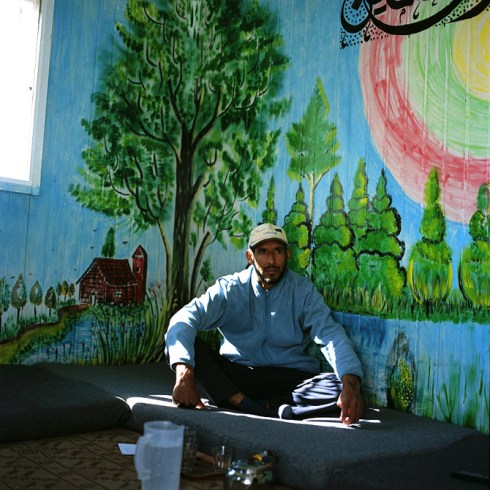

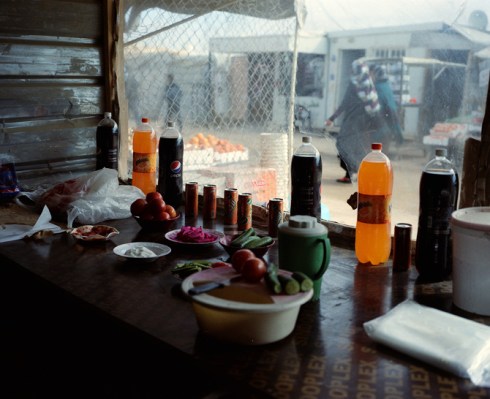
All images: Toufic Beyhum
Introduction: Pete Brook
Text: Nadim Dimechkie
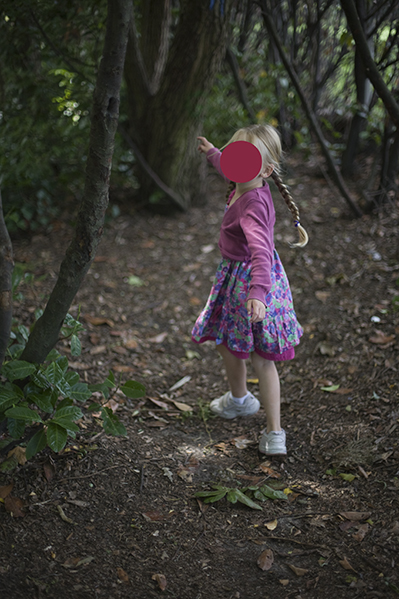
W. simply asked for a picture of his daughter playing near her mother’s house. “I used to take a lot of pictures of her myself.”
When Dutch photographer, Desiree Van Hoek visited Leuven Prison in Belgium, her intention was to photograph the pictures on prisoners’ cell walls. To look at prisoners’ use of — and values placed within — photographs would have been an anthropological study of sorts. Alas, as with many a proposed prison photography project, the administration would not allow it. Her plans for a camera workshop were also nixed. Undeterred, Van Hoek conceived of another way to use photography to connect with the prisoners.
“I was visiting a very outdated prison, and noticed that there were only very small windows. There was nothing to see for the prisoners but a wall, some mud and an old goat,” explains Van Hoek. “This seemed very depressing to me, so I asked the prisoners if there was an image they would like me to photograph for them. Something that would make them feel better.”
The resulting series, titled Leuven Centraal, is essentially a pen-pal project, but making use of pictures not words to forge connection. After successfully getting approval for the project at Leuven, Van Hoek repeated the formula at Turnhout and Hoogstraten prisons, also in Belgium.
The methodology of Van Hoek’s project is akin to Mark Strandquist’s Some Other Places We Have Missed and the Tamms Year Ten project Photo Requests From Solitary. Both these projects I’ve applauded in the past (here and here). In the same spirit, I wanted to ask Van Hoek about the outcomes and motives for her project.
Scroll down for Q&A

D. gave me a blue piece of paper ripped out of a magazine. He wanted a picture of a blue sky with soft white clouds. “Sun and a light breeze keep depression away.”
Q&A
Prison Photography (PP): Describe the types of requests.
Desiree Van Hoek (DVH): It could be anything, as long as it wasn’t related to their crimes. The men came up with all kinds of ideas: family members, cars, dogs, their favorite soccer team, sunsets, etc. I also asked them to write down why they wanted these particular images.
PP: How did you come up with the idea?
DVH: I wanted to do a photography project and a workshop with prisoners. During an earlier project in the streets of Los Angeles, I had met several ex-prisoners who got their life back together thanks to (among other things) painting and photography. This had inspired me, and I had an appointment in the Leuven prison to see what was possible. The office of the person I was visiting was right in the middle of the prison.
PP: What was your initial interest?
DVH: I’ve always been interested in the way people live under different circumstances, and what they do with their homes. My work always has a social component.

K. spent 13 years breeding and training Dobermans. Prison management wouldn’t allow a picture of a big dog, so he chose a puppy. “Dobermans are sweet dogs, although most people think they are not.”
PP: What is the state of criminal justice in Belgium right now?
DVH: From a Dutch perspective, many Belgian prisons are old and outdated. There are often uprisings. Prisoners with psychological problems are mixed with other prisoners. Many prisoners told me they would rather be in a Dutch prison. They had heard good stories about the living conditions and the food (french fries once a week).
PP: How are prisoners perceived in Belgium?
DVH: That is hard for me to say. But I think the Belgians in general don’t perceive them as victims of society, but really as criminals who should be put away. In Holland, this used to be different, but nowadays more and more people seem to have the same view.
PP: Did any of the requests surprise or touch you?
DVH: What I found touching was that they were all very polite. Only one guy asked for a picture of a sexy girl, which was okay with me, but the prison wouldn’t allow it. Also touching: one guy asked for picture of me (this wasn’t allowed either).
What I found surprising and painful was that they didn’t ask for more people. I expected them to ask pictures of their family, but most of them asked for nature, animals or objects. This was because, they said, they had no one.

L. asked for a picture of the latest model BMW, Audi or Mercedes, taken in a showroom. “I’ve always loved beautiful cars.”
PP: What were the reactions of prisoners?
DVH: Very positive. The staff later sent me letters with their reactions. One prisoner who hadn’t participated said he regretted it seeing the results. A father who had asked for a picture of his daughter started to cry in front of all the other men, and everybody was touched by this.
PP: What were the reactions of staff?
DVH: Also very positive. I financed the projects in Leuven and Hoogstraten myself, and then got an offer to do another one in Turnhout for which I got paid. Staff was very cooperative, and one of the directors sent me a thank you letter to say he was grateful.
PP: Would you like to do any more work with prisoners or in prisons?
DVH: I would really like to repeat the project with female prisoners. But I’m back in Holland now, and it’s much harder here to get into prisons.

S. wanted a picture of Muntplein, the only legal graffiti spot in Antwerp. ‘This is where I would hang out with my friends.”

There’s an ugly scene unfolding in Illinois right now. The local paper in Champaign-Urbana, The News Gazette, published three attack pieces on James Kilgore, each one calling into question his character and the wisdom of the University of Illinois Champaign-Urbana (UICU) to hire Kilgore as a lecturer.
Kilgore is a respected researcher, writer, educator and criminal justice activist. He is also a former political insurgent who took up arms against federal authorities.
In the early seventies, Kilgore was part of the Symbionese Liberation Army (SLA) (of Patty Hearst infamy). He has been open about having felony convictions resulting from his political activities. Kilgore was on the run from 1975, living in Australia, Zimbabwe and South Africa until his arrest in 2002 in Cape Town. He saved the Feds the troublesome extradition process by voluntarily returning to the U.S., making a plea bargain, and pleading guilty to charges pertaining to the possession of explosives (in 1975) and passport fraud. Kilgore served 6 years in a California prison and upon his release in 2009 moved to Illinois to be with his wife, who is on the faculty of UICU. Since 2010, Kilgore has been a temporary faculty member at UIUC, teaching classes in Global Studies, Urban Planning and the College of Fine and Applied Arts.
These are the facts of the case. Jim Dey writing for The News Gazette in a Feb 9th OpEd piece In Plain Sight covers these facts. Dey’s tone is one of passive wonderment as to what UI might be thinking. The opinion piece is peppered with accounts of SLA violence from before Kilgore’s involvement. In Dey’s estimation, all the ideological mistakes of the fringe (and, yes, very damaging) SLA movement are all Kilgore. If only Dey had spent the same amount of time looking into Kilgore’s contributions in the interim four decades. It’s as if Dey and The News Gazette do not believe in change or maturation. If this is the case, then I call into question the commitment of author and outlet to the complexity of reporting and to journalism neutrality.
Kilgore is much more than his past indiscretions. As an aside, I know a person who used to be on the FBI most wanted list. This person’s charges were trumped up and when this person came out of living underground for 13 years faced no prison time. This person is one of the most politically aware, active and socially critical individuals I know.
There’s much more to Kilgore’s story than the character assassination as laid out by Dey. I believe it is motivated by a will to limit Kilgore’s very effective activism against a proposed new jail in Champaign-Urbana. Kilgore has proven himself a very adept strategist and activist leader in the town. Kilgore was instrumental in the fight. He has shared the successful tactics of the campaign with anti-prison groups across the nation.
News Gazette publisher John Foreman clearly has Kilgore in his sights. In the second OpEd piece (Feb 16th), Foreman perhaps a little miffed that Dey’s piece hadn’t wildly inflamed opinion enough) threw a hissy fit about the silence of Kilgore and UICU. What did Foreman expect? Answering to bully-boy tactics is not what Kilgore needed to do here. After all, The News Gazette had seemingly made up its mind about Kilgore a long time ago.
In his attempt to discredit UICU and question its priorities, Foreman opens his opinion piece by brushing aside a case of gross racism and sexism launched by a small (and troubled) group of students upon UICU Chancellor Phyllis Wise. Foreman mocks UICU’s attempts to deal with sexism and racism proving he’s more interested in cranking his newspaper’s controversy-du-jour than he is in taking a balanced view at all issues effecting his hometown community.
One week later, on the 23rd February, Foreman gave a platform to Dennis A. Kimme, the president of Kimme & Associates Inc., the firm that was trying to win the bid to build Champaign-Urbana’s new jail. Kimme is bitter about Kilgore’s attitude and expresses dismay that Kilgore would question the ability of Kimme’s company to assess the need for prison beds while trying to win a multimillion dollar contract to build those same beds! Of course, Kilgore and those opposed to a new jail would question motives.
Kimme’s contract bid failed on its own merits.
As if The News Gazette hadn’t already staked out its patently political position in text, it sent Jim Dey onto a talk show with it’s affiliate radio station to “discuss” the matter. Don’t bother listening to it. Host Jim Turpin is in cahoots with Dey as they proudly salute one another for their moral outrage.
I find it interesting that the UICU student newspaper has responded to this *controversy* with the statement: “The Daily Illini chose not to report on Kilgore’s status as a former felon because we did not believe that his status was news. Kilgore’s status as an instructor was no different than any other instructor.”
On April 9, the University Provost, in a private meeting, informed Kilgore that UICU would not approve any future contracts to employ him and declined to give him any explanation whatsoever as to why, how and by whom this decision had been made.
Fortunately, there is a community in Champaign-Urbana that sees the issue as more nuanced and is willing to look at the Kilgore of 2014 as well as the Kilgore of the early 1970’s.
A petition to UICU Chancellor Phyllis Wise has been circulated and already received the goal of 1,000 signatures. It reads:
We the undersigned scholars, legal professionals, activists and concerned individuals believe that the University of Illinois gave in to political pressure and refused to approve future employment contracts for James Kilgore on the basis of his background and sensationalist media coverage, rather than on his job performance.
Kilgore does not shy away from his past. He has answered to the full extent of the law his past acts and he has served time for them.
The SLA was committed to the overthrow of the federal government with planned attacks on police and federal buildings. They were of an era; one in which the violence of insurgency paled in insignificance compared to the violence waged in Vietnam. The SLA funded themselves largely through bank heists. SLA tactics were extreme, there is no doubt. The SLA cause achieved little. The SLA made grave mistakes. The SLA wasn’t the only homegrown group devoted to insurgency within U.S. borders.
Of all these activities, Kilgore was involved in one that led to a fatality. On April 28, 1975, SLA members including Kilgore robbed the Crocker National Bank in Carmichael, California. Myrna Opsahl, a bank customer was shot add killed during the robbery. Kilgore’s comrade fired the shot. Kilgore, it is reported, was furious that a gun was discharged. There’s talk of a light trigger, but still, take a gun into a bank and you should only predict unpredictability.
In a March 22 Chicago Sun-Times article, the university responded to UICU’s unceremonious dumping of Kilgore with a supportive statement from Associate Provost Robin Kaler:
He does a great job. He’s very well-respected among students. He served his time in prison. He is very remorseful. He didn’t do the shooting. He is a good example of someone who has been rehabilitated, if you believe in second chances and redemption, he’s someone who helps prove that’s the human thing to do. A child of the victim said he has served his time and should be allowed to go on with his life.
The American Association of University Professors echoed Kaler’s thoughts in their own official statement on the matter.
The News Gazette‘s OpEd series misses the point. It’s none-to-subtle rightwing attack against the classic bogeyman, against the non-patriot, argues that academia provides a profitable hiding ground for those that enacted political direct actions many decades ago. Think of the kids!?
What is at stake here is academic freedom.
More-so, we must ask do we want to believe in the ability for individuals, ANY INDIVIDUAL, to change, to improve, to educate and give back? The wording of the petition in support of Kilgore frames this perfectly:
Refusing to approve Kilgore’s employment contracts has serious implications for the 15 million Americans who have felony convictions and face a constant battle to access employment.
Get angry. Sign the petition. Follow James’ valuable work. Don’t let the boo-boys scare you.
Image: PM Press

“By definition, a government has no conscience. Sometimes it has a policy, but nothing more.”
— Albert Camus.
Photographer Tomas Van Houtryve puts the above quote top and center of his most recent artist statement. He believes that human activity becomes increasingly absurd and dangerous when it loses empathy.
Researching my latest WIRED piece Here’s What Drone Attacks in America Would Look Like about Van Houtryve’s Blue Sky Days, I was shocked by the number of civilians killed by U.S. drone strikes in Pakistan, Afghanistan, Yemen and Somalia.
“The Obama administration doesn’t release a lot of details, so firm figures are hard to come by. But the Bureau of Investigative Journalism estimates unmanned aerial vehicles have killed between 2,296 and 3,718 people, as many as 957 of them civilians,” I wrote.
President Obama’s Drone War is not widely discussed. Drones operate remotely and forge the very distance that prevents a critical look at their continued use. Drones dismantle empathy.
If a technology with extremely powerful spying and killing capabilities is shielded from public scrutiny there is bound to be abuse,” says Van Houtryve.
WHAT’S IN OUR WORLD?
Art can foster empathy. At least, that’s an aim of political art, no? There are many worthy projects that have co-opted and subverted drone visuals:
Jamie Bridle traces drone shadows in the streets and launched Dronestagram to populate social media with satellite views of drone strike sites; John Vigg surveilled drone research labs and airports; Trevor Paglen photographed drones at distance; Josh Begley’s App MetaData alerts users to drone strikes; and Raphaella Dallaporte took a drone to Afghanistan to do some archaeological surveying.
Most recently, a JR-inspired Inside Out project named Not A Bug Splat is tweaking the consciences of drone “pilots” by laying massive pictures of children in strike zones. However, the novelty (still) of these projects suggests we are not well-versed in drone operations.
WHAT’S IN A WORD?
Furthermore, I worry about how the definition of the word “drone” is shifting. When we hear “drone” do we think about military-grade killer robots or about newer domestic-use quadcopters?
The photo and video world has embraced smaller, non-lethal drones — we oohed and aahed at this aerial surf video and we protested when the police forced down a drone flown over a traffic accident by an off-duty photojournalist.
Soon, a small drone will be a part of every photographers kit.
Also, new legislation is being written to catch up with the technology and the proliferation of public drone ownership and operation. The FAA had self-appointed itself as the authority on drone use and looked disapprovingly at Joe Public sending lil’ aircraft up in the air. So, the FAA started sending out cease and desist letters and $10,000 fine threats.
The recipients — commercial photographers — weren’t threatening homeland security; they were mostly using camera-mounted drones to map agriculture, oil fields and the like. One commercial drone user, Raphael Pirker, challenged his fine in court. He won and nullified the FAA’s authority over him or any other drone operator.
“Pirker’s attorney maintained that the FAA could not simply declare a regulation without having a public notice-and-comment period. His argument went like this: Congress has delegated to its bureaucracy the authority to make rules, but when new regulations have a substantial impact on the general public, the government must have hearings and take comments,” wrote David Kravets for WIRED.
Until those hearings, it is a free-for-all. We must just hope that creepy idiots who want to spy through windows are the exception.
There’s a third player in the mix though. Between the everyday citizen and the military industrial complex are corporations. Who would bet against Amazon actually delivering your slippers by drone? Or Facebook delivering WiFi via drones to the entire globe in the next decade?
Overall, we hope that citizens retain access to the use of drones just as corporations and the state do. We hope citizens’ drone use is protected by laws similar to those allowing street photography on public thoroughfares.
NEW WORDS IN OUR WORLD
‘Drone’ is a new word in photography. ‘Selfie’ is a new word in photography too. In fact, the emergence of the two words was almost parallel.
The earliest usage of the word selfie can be traced to an ABC Online Australian internet forum, on 13 September 2002. Just seven weeks later, on November 3rd 2002, the first ever lethal U.S. drone strike hit Yemen, killing six.
At the turn of the millennium neither the words drone or selfie, as we know understand them, were in our lexicon. I’d argue the definition of both terms is ongoing apace, but for different reasons. Drone visuals and facts are obscured; we must search them out. Selfie visuals, on the other hand, are impossible to avoid.
At some level, the selfie provides the everyday citizen a type of agency and incorporates our foibles, connectedness, and our awkward relationships with social media. Selfies may not be inherently humanizing but they are individually created and do reflect human idiosyncrasy.
By comparison, drone scopes reduce humans to video-mediated targets. Drone visuals eradicate individuality and of course, very literally snuff out human life. The selfie is, spoken of at least, as a completely controllable form, whereas the drone is an apparatus of control. It’s bottom-up liberation vs. top-down oppression.
The drone and the selfie inhabit different ends of an image spectrum. Both in terms of production and consumption, the selfie is all us and the drone is all them. We know us well. We don’t know them at all.
That these are two of the main new words we are processing together as a culture is intriguing to me.
These are just thoughts out loud and may or may not lead to more fleshed out criticism, but the near-simultaneous emergence and widespread use of the words “drone” and “selfie” alongside their contrasting correlation to human consciousness in our remotely-networked globe might provide fodder for further investigation.

 Prison Photography