
You are currently browsing the category archive for the ‘Activist Art’ category.
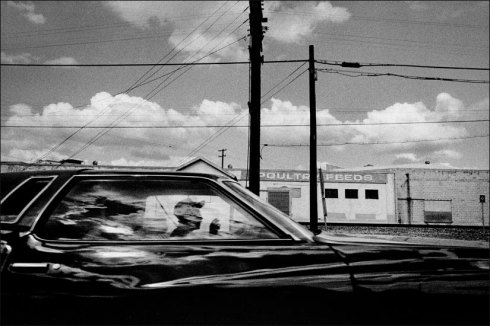
Warehouse District, Fresno, California © Matt Black
Last week, Stan blew the cover on my long held admiration of Matt Black. In the past couple of months, and on three different occasions, when conversation has moved toward photographers’ work that really turns us on I’ve begun explaining Matt’s work only to have the other person blurt out his name. You know that excitement when you’re on the same wavelength? Repeated.
Matt Black also has a great name. What else could he be but a photographer?
Matt’s documentary photography focuses on the social and environmental realities of southern and Central California, and the span of Mexico. Man-made borders need not apply. He’s knee-deep in the regions.
Each of Matt’s portfolios eddies of the last. It’s an admirable body of work. For his latest project, The People of Clouds, Matt has teamed up with Orion Magazine and Daylight Online for a cohesive distribution plan. He has also, for the first time, made use of Kickstarter for a very well-stated funding pitch.
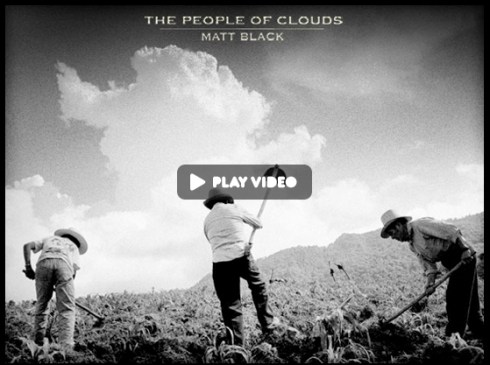
Matt explains:
High in the Mixteca mountains of southern Mexico, an exodus is unfolding. In the birthplace of corn cultivation, where farmers first coaxed maize from the earth nearly 9,000 years ago, an ancient way of life is crumbling as land degradation and erosion cripple the soil and as migration tears families apart.
Named the “Place of the Cloud People” by the Aztecs, the Mixteca is home to one of the oldest and largest indigenous cultures in the Americas. Rugged and remote, the isolated region sheltered a pre-Colombian way of life that largely vanished from the rest of Mexico in the aftermath of the conquest. At its heart, it’s a culture of the land, and corn. Along the region’s hillsides, it is still possible to glimpse ancient terraces, canals, and runoff channels that protected the Mixteca’s rich but fragile soil, and nourished its inhabitants, for thousands of years.
But today, these ancient farming traditions have been lost, replaced by chemical fertilizers, hybrid seeds, and herbicides, the trifecta of modern agriculture heavily promoted in indigenous communities by the Mexican government and international charities as part of the “Green Revolution” of the 1960s. When combined with slash and burn farming, the Mixteca’s steep terrain, and the loss of other indigenous soil-preserving traditions like multi-cropping, these imported industrial agricultural techniques have turned Mixtec corn farming, one of the world’s oldest and most perfectly integrated agricultural systems, into a soil-eating machine.
Today, much of the Mixteca has been declared an “Ecological Disaster Zone,” the result of unchecked erosion, deforestation, and soil exhaustion. Per capita maize consumption is less than ten ounces per day, 90% below US rates, and fewer than a third of children under the age of five show normal growth by weight and height. Ranked on the UN’s Human Development Index (HDI), the Mixteca’s poverty is deeper than nearly all of Latin America’s, comparable only to areas of Africa, India, and the Gaza Strip. Far from sparking a Green Revolution, the industrial farming techniques prescribed to the Mixtecs have resulted in their becoming unable to even keep themselves fed.
Nearly a quarter million Mixtecs have emigrated to the US. Some villages have lost as much as 80% of their population and have become little more than ghost towns. “I only think about dying,” one elderly man told me. “My only worry is how my funeral will be.”
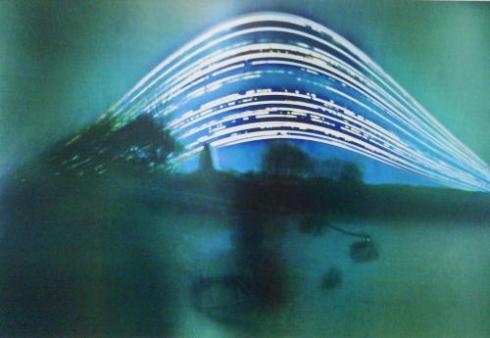
Photographer Mark Woods-Nunn and FLACK, a charitable social enterprise which works with homeless people in Cambridge, UK have put together an intriguing project.
Varsity Mag says, “the attachment of beer-cans to assorted lamp-posts is not another example of misguided modern art. A thin sheet of photographic paper was placed in each can, exposed to the world by only a tiny pin-hole, silently and vulnerably capturing an image.”
Good stuff.
Found via British Photographic History Blog.

The funeral of Horacio Bau a montonero militant from Trelew in the Argentine patagonia. He disappeared in La Plata in November 1977. His remains were found and buried nearly 30 years after. © João Pina
About this time last year, LENS blog featured João Pina’s ongoing project Operation Condor (since renamed Shadow of the Condor). Daniel J. Wakin wrote, “Operation Condor was a collusion among right-wing dictators in Latin America during the 1970s to eliminate their leftist opponents. The countries involved were Brazil, Argentina, Chile, Paraguay, Uruguay and Bolivia.”
João Pina has broken up those six countires into three segments and is currently raising funds via Emphas.is to complete the first focusing on Brazil.
Pina has already interviewed victims and families in Brazil:
In Recife in northeastern Brazil I interviewed and photographed Elzita Santa Cruz, a mother of ten who is now 97 years old. In 1964, when Brazil’s military dictatorship began, several of her children were arrested for political reasons on different occasions. In 1974, one of them, her son Fernando, became Brazil’s first politically “disappeared” person. Since then, Elzita has been demanding that the Brazilian authorities open their archives and explain what happened to Fernando and the other victims of the twenty-one-year dictatorship.
Having worked across South America for six years already, Pina will, as he intends, be able to create a “visual memory”, but as for making evidence for “use by a number of human rights organizations which are still trying to bring those responsible for Operation Condor’s repression to justice,” well, that’s an ambitious goal. Nevertheless, as a documentary project the subject is ranging and imperative. Good luck to him. I’ve stumped up some cash, so should you.
See the Emphas.is project page for Shadow of the Condor and see Pina’s video pitch.

Photojournalist Vance Jacobs talks about teaching a workshop in a maximum security prison in Medellin, Colombia.
PREVIOUSLY ON PRISON PHOTOGRAPHY
In November 2009, I described Jacobs’ prison workshop as an exercise in self-documentation overturning stereotypes and the ‘exotic fetish’.
If you are in Liverpool over the next couple of months, then you should drop in to any number of the exhibits put by LOOK2011 the inaugural Liverpool Photography Festival.
The theme for the festival is “Is Seeing Believing?” Of particular interest is Confined at the Bluecoat.
Confined is an exploration of the idea of confinement in contemporary life by photographers Juergen Chill, Edmund Clark, John Darwell, Dornith Doherty, Ben Graville, David Maisel and David Moore. Subjects range from imprisonment and detention, the ethical treatment of animals, ecological conservation and the history of psychiatric care.

I have a personal involvement in the show. Exhibitions curator Sara-Jayne Parsons asked me to pen some words for the Confined catalogue. And, after interviewing David Moore about his Paddington Green Police Station series I encouraged him to contact Parsons and together they decided to exhibit the prints. It will be the first time Moore has publicly shown his Paddington Green Police Station photographs.
Unfortunately, I won’t be making it over to the UK soon, but I hope those of you who are in Blighty make it to the exhibition, not to mention all the other LOOK2011 exhibits, lectures and workshops.
Confined is on show at the Bluecoat, School Lane, Liverpool L1 3BX, from Fri, 13 May 2011 – Sun, 10 Jul 2011, 10.00 AM – 6.00 PM, Tickets: Free. (Visitor info)

… you should check out a fine exhibition of prison art.
As some of you may know, I teach an art studio class once a week at a nearby prison. Last year, I asked a local gallery if they’d be interested in partnering for a show. The time has come. Here’s the skinny:
NON-SUFFICIENT FUNDS
Fundraiser for University Beyond Bars
Opening Reception: Thursday, April 28, 5-9pm.
Vermillion Gallery, 1508, 11th Ave (between Pine & Pike), Seattle
Featuring Artists from Monroe Prison with Special works by Buddy Bunting and Paul Rucker. (show runs through May 14.) Special Video Presentation of When You Learn, You Don’t Return, by Gilda Sheppard at 7:30pm.
Non-Sufficient Funds brings together the work of twelve prison-artists from the University Beyond Bars program at Washington State Reformatory, Monroe, WA, with works by established artists Buddy Bunting and Paul Rucker.
This exhibition of more than 50 acrylic paintings, graphite drawings and one video installation address abstract, figurative, allegorical and spiritual concerns. Non-Sufficient Funds is the culmination of over a year’s worth of weekly studio sessions within the prison and the brainchild of Pete Brook, a dedicated volunteer and board member of the University Beyond Bars.
In addition to the artwork by the inmates at Monroe, Paul Rucker will be showing his video, ‘Proliferation’, which documents the growth of the US Prison system over the past 200 years in an animated mapping of the US Prison system set to original music. Also, Buddy Bunting is presenting a 13 foot color painting of the stark facade of a prison at ground level.
The title of the show, Non-Sufficient Funds, has a few meanings: First, it refers to the stretched resources of volunteer-based rehabilitation programs within prisons across America, which is what this particular exhibit is advocating for. Research indicates that inmates who maintain contact with the outside world and who engage in educational and vocational programs experience a much lower rate of recidivism.
Second, it is a commentary on the financial burden the Prison-industrial Complex places on US society. Due to harsher sentencing laws and the war on drugs, the prison population has quadrupled since 1980. Now, in times of economic crisis, serious questions are being asked about the amount of tax dollars spent on prisons.
Finally, it refers to the scenario when a prisoner receives a letter or package has insufficient postage, and no funds available in their prison account fund to cover the difference. “Non-sufficient funds” is stamped upon the return correspondence. Many of us are unaware firsthand of the rigid structure the penal system requires. Mail sent to inmates in violation of policies can lead to punishment. Prison libraries and other media are also highly censored for various reasons. Non-sufficient funds hopes to shed some light on the way art and education in institutions benefits society as a whole and we hope it encourages a dialogue and additional advocacy.
In the local press
Keegan Hamilton of Seattle Weekly penned Insider Art and also ran a photo gallery with the article.
“The friend was killed at Abu Ghraib. His picture with Graner, on the floor with ice and beaten face. He was friend from work.”
– Jabar Abdel, former Abu Ghraib detainee, quoted in A Friend of Mine Was Arrested (below), by Daniel Heyman

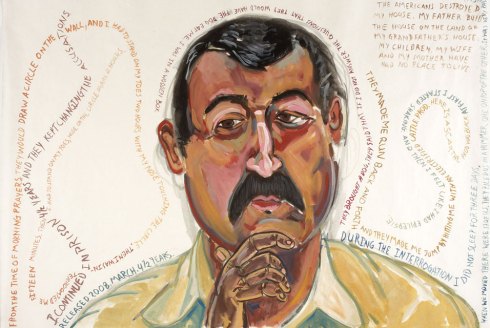
Anyone that has made analysis of the photographs of Abu Ghraib should also be aware of Daniel Heyman‘s paintings Portraits of Iraqis.
Heyman made the watercolours and sketches while sitting in on interviews between former Abu Ghraib detainees and Susan Burke, a human rights lawyer with Burke O’Neil LLC, Philadelphia. Burke was looking to bring in artists and writers to tell the stories of her clients in different ways and to reach a wider audience. (Simultaneously, photographer Chris Bartlett was also working on portraits for his Detainee Project.)
Heyman had previously used facsimiles of the Abu Ghraib pictures in his mixed-media and woodblock artworks, but had become discouraged by the laziness of the appropriation:
“The potency of those images really diminished. All sorts of artists had started to use these images, and the more they were used, the more they indicated Abu Ghraib without providing any understanding of Abu Ghraib. They became a kind of code for anger about so many things to do with the war. You flash on the famous picture of the man on the box, and people become numb to that image. And you re-humiliate that man. You re-victimize that person.”
I recently saw three of Heyman’s works in a gallery; they are the perfect foil to those infamous images of Abu Ghraib. In December 2008, upon reflection of Standard Operating Procedure, Errol Morris’ film that gave the US soldiers a voice against the military brass, I suggested, “what the global community needs now is an equally comprehensive documentary project bringing together the testimonies of all those held and tortured at Abu Ghraib.”
There have been articles written, lawsuits brought, oral testimonies made – but Heyman’s work stands out as a particularly successful enterprise. Heyman makes the paintings and records the words in real time as the interview goes on. A slightly grueling process about a horrifically grueling topic. Heyman brings us very close to these victims of torture; they are no longer the abstractions we’ve known through the Abu Ghraib files, but individuals with the knowledge and details of fact that should shake our conscience.
In consideration of the broad range of artists’ responses (from good to bad) to the Abu Ghraib images of torture, for me, Daniel Heyman’s paintings carry an impact far beyond that within the capabilities of most photography.
Read Heyman’s interview with Foreign Policy in Focus.
View Heyman’s website.
SmithMag has an easy-to-navigate gallery.



 Prison Photography