
You are currently browsing the category archive for the ‘Activist Art’ category.

–
UPDATE: You can get stickers these ways
–
SUBTLE, VIOLENT OMISSIONS
The ability to ignore the human rights abuse that is mass incarceration is built upon millions of small omissions, denials, and blind eyes turned. A group of students and faculty from Parsons The New School are pointing out to fellow New Yorkers one such omission.
Rikers Island, New York city’s main lock-up, is an institution beset by problems–including but not limited to environmental hazards, beatings by guards, juvenile solitary, predation, inadequate healthcare, suicide, abominable pre-trial conditions and more. On any given day it holds. Consensus is building that it is a jail that cannot be reformed and must be closed.
Ignominiously, Rikers Island jail is iconic. In a strange and depressing way, it represents NYC. Other icons for the Big Apple invariably include other structures: Empire State Building, The New York Public Library, Rockefeller Building, Statue of Liberty, The Metropolitan Museum.
The system and graphics that connect NYC’s important sites and buildings is the MTA subway map. Again, no less iconic. The subway map is ubiquitous; it is a powerful dictate of information. The subway map shapes knowledge.
Estefanía Acosta de la Peña, Laura Sánchez, and Misha Volf, graduate students at The New School, and creators of #SeeRikers, write:
The MTA and Rikers Island have a complicated relationship. Over the years the massive jailing complex has fallen on and off the subway map. An erratic absence, today Rikers Island is labeled on station maps but not inside trains, on digital versions but not in digital kiosks. #SeeRikers stickers are a simple way to acknowledge this erasure.
Whether an accidental oversight or an intentional omission – we believe it’s important to recognize a place that confines nearly 10,000 people each day and effects the lives of many more New Yorkers. So as you make your way across the city – on your morning commute or evening transfer – please help us put Rikers back on the map.
STICK RIKERS BACK ON THE MAP
You, me, anyone can be part of a rapid, insurgent and widespread correction. Acosta de la Peña, Sánchez and Volf have developed a sticker that riffs on the MTA “You Are Here” arrow. The sticker de-centers the map.
“Whereas the MTA’s label serves as an individual way-finding tool, ours signals a collective void,” say Acosta de la Peña, Sánchez and Volf.

–
FEEL THE BERN
Stickers will be passed out during the Bernie Sanders Rally at Washington Square Park on Wednesday, April 13th
Stickers will be handed out at the #CLOSErikers rally at City Hall.
THREE WAYS TO GET STICKERS
1. If you are a New York organization working on criminal justice reform email info[at]itsamademademademadeworld[dot]com and stickers can be delivered.
2. If you are an individual, visit the States of Incarceration Exhibition at the Sheila C. Johnson Design Center (66 Fifth Avenue at 13th Street, New York, NY) now through April 24th.
3. DIY. Use the #SeeRikers Print Files and print on clear sticker paper.
–
Follow #SeeRikers on Twitter.
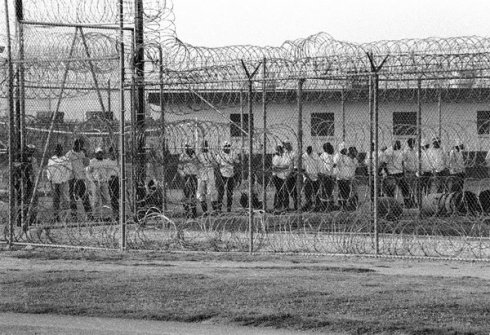
“Angola Prison, 2004,” by Keith Calhoun and Chandra McCormick.
–
It was gratifying to be mentioned in Sabine Heinlein’s recent NYT article Artists Grapple With America’s Prison System which surveyed the ways artists, curators and thinkers are responding to mass incarceration. The cue for the article, I’m guessing, was the two exhibitions currently on show in NYC–Andrea Fraser at The Whitney and Cameron Rowland (covered on PP) at Artists Space.
There’s some wonderful practitioners and projects profiled, including Deana Lawson, Keith Calhoun and Chandra McCormick, Ashley Hunt and Sable Elyse Smith among others.
The paragraph that immediately follows the mention of Prison Obscura reads:
Ben Davis, the author of 9.5 Theses on Art and Class, praises artists for taking up the topic, he warned: “We should push the question beyond just consciousness-raising. There is this progressive-era style of political art where well-to-do people throw banquets for homeless people and then stand up on the balcony and congratulate themselves. There is an icky history of using the suffering of the people at the bottom as a spectacle.”
Can’t argue with that.
Keeping check of ones own interests and benefits relative to those of prisoners and prisoners’ families is critical. I believe my work has not exploited incarcerated people but I never assume that the assessment of Prison Photography, Prison Obscura or any of my other projects is fixed or final.
With criminal justice reform and prison reform emerging into the mainstream over the past, say, 5 years, I habour a continuous niggling suspicion that my writing–my blogging–has less and less effect. This is down to several factors, most of them having to do with the way we consume content on the Internet today as compared to how we consumed in 2008 when I started Prison Photography. These include, but are not limited to, the dominance of Facebook and it’s pay-to-see algorithms (I’m not on Facebook); the killing of Google Reader which in turn made RSS and the independent sources/blogs RSS aggregates more impractical to access (not to say there aren’t other RSS readers out there, but none are as elegant, or free, as Google Reader); Tumblr and the trend toward infinite scrolls of visual content, not text; and, of course, the fact that on any given day NYT, WaPo, NPR, The Guardian, The Marshall Project, The Intercept, VICE, CJR and countless other international news outlets are covering the U.S. prison industrial complex–against a backdrop of such comprehensive coverage, Prison Photography barely registers.
Some days, it feels like I’m scrapping just to stay visible. That’s an icky place to be. It’s a dangerous place too; I think it’s a place where motives and energies can be tainted and focus on the issues can diminish. For that reason, practitioners–myself included–must be subject to continuous criticism and critique.
If you ever see me standing on the balcony and congratulating myself, call me out. Shoot me down.

–
Earlier this month, in Portland, Oregon, a coalition led by immigrants and refugees, successfully campaigned to see the city cut its ties with prison profiteer Wells Fargo. At the same time, in Los Angeles, Black students moved California State University Los Angeles (CSULA) to divest from private prisons and reinvest in services for Black students.
These victories follow on the heels of the divestment by a $25M endowment fund from the University of California and Columbia University’s decision to divest fully from prisons.
These victories demonstrate the sweeping effect that committed and targeted activism can have. Dismantling the prison industrial complex requires paradigmatic shifts, brave thinking, millions of small + incremental fixes as well as massive, infrastructural disassemblage. These divestment victories are such disassemblage, and they show that committed individuals can pressure institutions and civic authorities to enact transparency and moral judgement when it comes to invested monies, endowments and assets.
These victories feel like, if you will, a bright spot on the yard. Moments of illumination.
I’ve watched with great admiration as the divestment movement has grown in the past few years. A lion’s share of the good work has been done by Enlace, an alliance of low-wage workers, unions, and community organizations in Mexico and the U.S. Enlace’s interest began with the growth of privatized immigrant detention facilities (Under the rubric of homeland security, Federal laws have changed, and the detention of people without papers has grown exponentially.)
But of course, the capitalism and social fear that gives rise to ICE prisons, has the same roots as that which gave rise to the tumorous growth of state and federal prisons over the past four decades. Of all the factors that drive the growth of the prison industrial complex, money is the most pernicious and, perhaps, the most invisible. Enlace targets the cycle, intends to interrupt the flow of finance and influence.
–

Photo: Pete Shaw
Currently Enlace has offices in Portland, OR; New York, NY; and Los Angeles, CA. The organization has identified key targets within the cycle of exchanged goods, ideas and policy. From the Enlace website:
Private Prisons
Two publicly-traded companies dominate the private prison market in the U.S.: Corrections Corp of America (CCA) and GEO Group (GEO). CCA and GEO are notorious for abusing inmates, understaffing, and committing fraud at their for-profit prisons and detention centers. Both lobby the government for contracts and for policies that promote mass incarceration and immigration enforcement. In 2012 alone, they netted $3 billion of our taxes and spent over $1.8 million on lobbying and campaign contributions.
Million Shares Club
33 major investors own nearly all CCA and GEO stock. Each of these 33 investors owns over 1 million shares of private prison stock, so they have a huge stake in the growth and success of the prison industrial complex. With the financial and political support of the Million Shares Club, CCA and GEO are able to successfully lobby for policies that increase government demand for private prison, like “tough on crime” laws and criminalizing immigrants. We must sever the financial ties that allow shareholders to cash in on the incarceration of immigrants and people of color.
Local Institutions
Most of us are invested in private prisons–our universities, cities and faith institutions are invested with the Million Shares Club, which has no portfolio screen preventing the investment of our money in for-profit prisons. Some states, universities, cities and pension funds are even directly invested in CCA and GEO. It is unconscionable that our local institutions are using their investments–our money–to profit from and promote mass incarceration and immigration enforcement. We call on our local institutions to divest!
Politicians
Federal politicians have the power to stop private prisons. Members of the Budget and Appropriations committees have the most power to cut off funding for wasteful contracts with CCA and GEO, and for inhumane immigration enforcement policies. Unfortunately, many politicians take lobbying and campaign contributions from GEO and CCA. Others have assets in the Million Shares Club. Many politicians have both. We’re working to make private prisons a toxic liability, financially and politically.
Activism to stymie the ease with which corporations and politicians can exploit economically and socially disadvantaged communities is thrilling.
And it’s free! You can investigate private prison investments in your community and launch your own campaign. Map it here. More resources here.

For its seventh and final stop, Prison Obscura will be on show at Newspace Center for Photography in Portland, Oregon from April 1 to May 28.
(Check out official Prison Obscura website and the PP “Prison Obscura” tag for the background and journeying of the exhibition.)
I’ll be at Newspace for the opening next Friday night, April 1, 6–8pm. I’ll be installing Wednesday and Thursday so stop by and say hello.
Also, on the Saturday afternoon I’m moderating a panel titled Can Images Counter Mass Incarceration? with some of my favourite artists and thinkers. Here’s the Facebook event page and see bolded events’ details below.
THE BLURB (AGAIN)
No country incarcerates a higher percentage of its population than the United States. More than 2.2 million people are currently locked up in the U.S.—a number that has more than quadrupled since 1980. But sadly, the lives lived behind bars are all too often invisible to those on the outside. Prison Obscura sheds light on such experiences and the prison-industrial complex as a whole by showcasing rarely seen surveillance, evidentiary, and prisoner-made photographs. The exhibition encourages visitors to ask why tax-paying, prison-funding citizens rarely get the chance to see such images, and what roles such pictures play for those within the system.
Alyse Emdur’s prison visiting room portraits from across the nation and Robert Gumpert’s recorded audio stories from within the San Francisco jail system provide an opportunity to see, read, and listen to subjects in the contexts of their incarceration. Juvenile and adult prisoners in different workshops led by Steve Davis, Mark Strandquist, and Kristen S. Wilkins perform for the camera, reflect on their past, describe their memories, and self-represent through photographs. The exhibition moves between these intimate portrayals of life within the prison system to more expansive views of legal and spatial surveillance in Josh Begley’s manipulation of Google Maps’ API code and Paul Rucker’s animated video. Prison Obscura builds the case that Americans must come face-to-face with these images to grasp the proliferation of the U.S. prison system and to connect with those it confines.
Prison Obscura is made possible with the support of the John B. Hurford ‘60 Center for the Arts and Humanities and Cantor Fitzgerald Gallery at Haverford College, Haverford, PA.
PUBLIC PROGRAMS
In conjunction with the exhibition, Newspace is hosting a series of events related to the prison industrial complex and the role images play in exposing the structures of the U.S. criminal justice system.
OFFSITE Panel discussion: Can Images Counter Mass Incarceration? Saturday April 2, 2-4pm: Panelists Lorenzo Triburgo, Sarah-Jasmine Calvetti and Barry Sanders. Moderated by me. OFFSITE Location: Native American Student and Community Center, Portland State University (710 SW Jackson St). Sponsored by Portland State University Camera Arts Society.
Discussion: Re-Envisioning Justice: What Is Between Reform and Abolition of the Criminal Justice System?: Sunday, April 24, 4-6pm. At Newspace (1632 SE 10th Ave.)
Community Discussion: The Ethics of Photography: Thursday, May 12, 6:30-8pm, organized in collaboration with the Oregon Jewish Museum. At Newspace (1632 SE 10th Ave.)
All public programs are free, open to the public. Please note event location.
CLASSES
Expanding Photography: Discovering the Stories Behind Your Work: May 9 – May 23, 6:30 -9:30 pm | Instructor: Gregory Parra.
Education Lecture Series: The Screen Politics of Public Projections: May 17, 7:00 – 8:30pm | Instructor: Dr. Abigail Susik.
Build Your Own Pinhole Camera: June 5, 12:00-4:00pm | Instructor: Pete Gomena.
INFO + HOURS
Newspace Center for Photography, 1632 SE 10th Ave, Portland, OR 97214
Mon–Thurs 10am-9:30pm; Fri–Sun 10am-6pm
Facebook | Instagram | Tumblr | Twitter | Vine
For press inquiries, contact Newspace Curator Yaelle S. Amir at curator@newspacephoto.org or 503.963.1935.

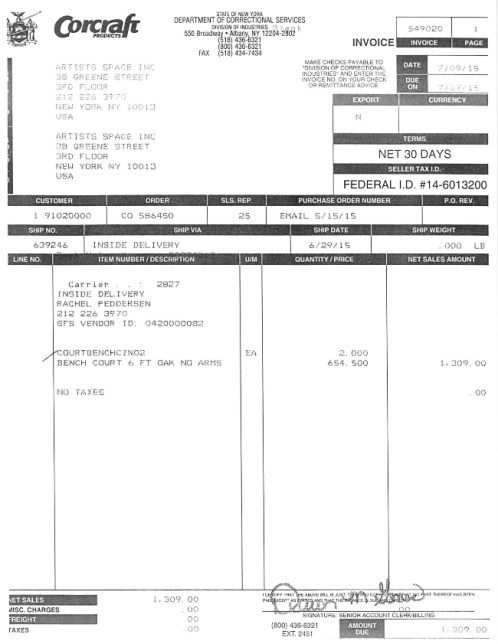
Cameron Rowland, “New York State Unified Court System” (2016), oak wood, distributed by Corcraft, 165 x 57.5 x 36 inches, rental at cost. Courtrooms throughout New York State use benches built by prisoners in Green Haven Correctional Facility. The court reproduces itself materially through the labor of those it sentences. (photo by Adam Reich, courtesy the artist and ESSEX STREET, New York)
You may have sat in the chairs, or slept on the pillows, or worn the smocks. What am I talking about? You may have used goods made by prison labour. You or your kids, depending what state you’re in, may have eaten school meals made by prisoners.
Wellington boots, uniforms, mattresses, furniture, binders, paper-goods, forms, flagpoles, hardware, utensils, even cookies … the list of goods made by prison industries is long. CALPIA (California Prison Industries Authority) in California and Corcraft in New York State are just two government agencies making high-quality goods while paying low-quality wages.
Prisoners working for CALPIA earn between 30 and 90 cents per hour (the higher end is rare) and then about 50% is taken out for taxes, charges and restitution. Supporters of these multimillion dollar agencies say it they provide valuable jobs training for prisoners. Opponents say it’s slave labor. Of course, you’re opinion will be swayed by whether you think prisons and jails are a net benefit or a net cost for society.
For prison abolitionists these state-insider agencies are second only in evil to the private prison companies. Why? Because they execute the quieter but some of the more pernicious maneuvering within capitalism. They devalue labor and devalue human beings. In California, those that defend CALPIA point out CALPIA only sells to other state bodies, but a market is a market and who the buyer is doesn’t change the work, wages or conditions for prisoners. In fact, most state-run prison industries don’t sell beyond state agencies is because they’d destroy many “free” markets simply by undercutting them on price–so great is the savings on wages. Look at those benches above; the joinery on those is out of this world. A steal at $654.50 (see below).

Artist Cameron Rowland is dismayed. And energised. The benches and the jackets and desk in the images here are from Rowland’s latest show 91020000 at Artists Space in New York. Continuing his minimalist installation approach, Rowland has put a few (of the bigger) Corcraft goods in the gallery space. The project is as much an extended and deeply researched essay as it is this gallery installation.
“Property is preserved through inheritance,” writes Rowland. “Legal and economic adaptations have maintained and reconfigured the property interests established by the economy of slavery in the United States. The 13th constitutional amendment outlawed private chattel slavery; however, its exception clause legalized slavery and involuntary servitude when administered “as a punishment for crime whereof the party shall have been duly convicted.”
To prison activists this is not new language. Even to Oprah’s List devotees this is not new. Michelle Alexander put into plain and passionate terms how the legal inequities of first, convict leasing, then Jim Crow laws and, now, expanded disenfranchisement laws in the era of mass incarceration, have maintained a “sub-class” made up disproportionately of people of colour.
Crucially, when Rowland talks of inheritance, he’s not talking about the bank accounts and assets of our parents. No, he’s talking about our shared inheritance as a nation that enjoys civic infrastructure and communities who benefit from, or not, the provision of nurturing institutions and spaces. Capitalism depends upon the movement and trade of raw materials. Roads, ports, markets, factories and comms all built upon a dependent system of inequality.
Rowland describes how convict leasing replaced a “largely ineffective” statute labor provision. And the roads in southern states got built. From there, Rowland rolls with the examples into modern day, not letting up to allow us an escape route argument of ‘This is now, That was then.’ It all connects. Read it.

Cameron Rowland, “1st Defense NFPA 1977, 2011” (2016), Nomex fire suit, distributed by CALPIA, 50 x 13 x 8 inches. Rental at cost “The Department of Corrections shall require of every able-bodied prisoner imprisoned in any state prison as many hours of faithful labor in each day and every day during his or her term of imprisonment as shall be prescribed by the rules and regulations of the Director of Corrections.” – California Penal Code § 2700. CC35933 is the customer number assigned to the nonprofit organization California College of the Arts upon registering with the CALPIA, the market name for the California Department of Corrections and Rehabilitation, Prison Industry Authority. Inmates working for CALPIA produce orange Nomex fire suits for the state’s 4300 inmate wildland firefighters. (photo by Adam Reich, courtesy the artist and ESSEX STREET, New York)
Alternatively, and also, read Ta-Nehisi Coates’ Case For Reparations. It looks at generations of African Americans robbed of earnings, assets and net-worth, with a focus on agriculture in the south and red-lining of properties in Chicago. Coates’ piece is not a tour de force only because of its impeccable research but because he puts figures on it.
Scholars have long discussed methods by which America might make reparations to those on whose labor and exclusion the country was built. In the 1970s, the Yale Law professor Boris Bittker argued in The Case for Black Reparations that a rough price tag for reparations could be determined by multiplying the number of African Americans in the population by the difference in white and black per capita income. That number—$34 billion in 1973, when Bittker wrote his book—could be added to a reparations program each year for a decade or two. Today Charles Ogletree, the Harvard Law School professor, argues for something broader: a program of job training and public works that takes racial justice as its mission but includes the poor of all races.
To celebrate freedom and democracy while forgetting America’s origins in a slavery economy is patriotism à la carte. Perhaps no statistic better illustrates the enduring legacy of our country’s shameful history of treating black people as sub-citizens, sub-Americans, and sub-humans than the wealth gap. Reparations would seek to close this chasm. But as surely as the creation of the wealth gap required the cooperation of every aspect of the society, bridging it will require the same.
Which brings us to the modern day. And to the darker corners of American commerce.
Let’s be clear, Rowland isn’t arguing about the merits, or lack thereof, of the existing judicial system and the rightness or wrongness of the control of prisoners. No, he’s more interested in the economic uses of the prisoners, of those bodies.
I’ll argue, in Rowland’s absence, that prisons in the U.S. are morally repugnant and a violence on poor Americans to a unconscionable degree. I’ll double back round and point to Rowland’s beautifully constructed text and visual arguments as one piece of evidence for the assertion.
I’m sure Rowland and I would agree that the over-arching forces of commerce (from which all hands are a few steps removed from the control panel and therefore responsibility) are the problem.
Now read Seph Rodney‘s review The Products of Forced Labor in U.S. Prisons on Hyperallergic.
This excerpt particularly:
But how do we conceal the theft? The question that has to be posed when people are systematically disappeared is: Where do we hide the bodies? “In prison” is only part of the answer. The deeper, more sinister response is also the most seemingly benign: we abstract them so they become only sources of labor and wealth. We reduce them to lines in an actuarial table, an oblique reference in a statute, a number in a log book. We dissolve people into fungible assets.
A lot of the time quiet gallery spaces don’t do a lot for me. They just seem sad. But when an artist can fill the space with poignancy … and especially when they are dealing with a grave matter that is–like in the case of prison labor–desperately sad, then I think it works.
Cameron Rowland: 91020000 continues at Artists Space (3rd Floor, 38 Greene St, Soho, Manhattan) through March 13. Get there if you can.
–

Cameron Rowland, “Attica Series Desk” (2016), steel, powder coating, laminated particleboard, distributed by Corcraft, 60 x 71.5 x 28.75 inches. Rental at cost: The Attica Series Desk is manufactured by prisoners in Attica Correctional Facility. Prisoners seized control of the D-Yard in Attica from September 9th to 13th 1971. Following the inmates’ immediate demands for amnesty, the first in their list of practical proposals was to extend the enforcement of “the New York State minimum wage law to prison industries.” Inmates working in New York State prisons are currently paid $0.10 to $1.14 an hour. Inmates in Attica produce furniture for government offices throughout the state. This component of government administration depends on inmate labor. (photo by Adam Reich, courtesy the artist and ESSEX STREET, New York)

Installation view of ‘Cameron Rowland: 91020000’ at Artists Space, New York (photo by Adam Reich)
On November 11th, five imprisoned people at Central California Women’s Facility (CCWF) endured extreme violence at the hands of prison guards. They immediately filed grievances against the officers and called for an independent investigation, but so far none of their requests have been met. They have now developed a more comprehensive set of demands listed in the letter below.
Family members alongside California Coalition for Women Prisoners, Justice Now, Family Unity Network and TGI Justice Project have prepared a petition and are asking the California Department of Corrections and Rehabilitation and the Senate Public Safety Committee for recognition of, and response to, a set of demands penned by the incarcerated women.
My letter below. You can send your own HERE.
Warden Deborah K. Johnson, Scott Kernan and Senator Loni Hancock,
I recently learned about a serious incident of physical assault and sexual harassment at CCWF.
Stacy Rojas, Sandra Rocha, Yvette Ayestas, Melissa Blanchard, Sara Lara and others were subject to degrading treatment during a November 11th incident.
I join the people in prison, their family members and advocacy groups in calling for an independent investigation into the incident and the suspension, pending investigation, of the officers specified in the administrative appeals filed.
Many women and transgender or gender non-conforming people incarcerated at your facility have long histories of sexual and domestic violence and an incident such as this can trigger trauma and PTSD. Yet the officers involved in the incident are still working in close proximity to those impacted by the assault.
I strongly support the demands of the imprisoned people:
• We demand the right to document, expose, and protect ourselves to stop abuses and violations of our human rights without retaliation or punishment.
• We demand safety from retaliation and from being coerced, threatened and blackmailed to betray our imprisoned peers.
• We demand immediate and ongoing medical attention and access to mental health support services. Additionally, we demand access to mental health support if requested, due to the extreme mental stress this assault has caused as a result of the histories of trauma that this incident triggered.
• We demand an independent investigation by the Inspector General’s office.
• We demand that any internal investigation coordinated by the CDCR and through the Investigative Services Unit (ISU) be transparent both during the process and in the sharing of results and that the investigation be conducted in collaboration with legal advocates. Additionally, when ISU is requested by people in the care and custody of CDCR, and most specifically at CCWF where staff misconduct and violence at the hands of CDCR staff was reported, those requests are immediately addressed and responsibly handled.
• We demand immediate suspension of all officers specified in the appeals filed after the incident pending independent investigation. Suspension should include those higher up the chain of command, namely the Captain and Sergeant who were involved in this incident.
• We demand an immediate end to violence and brutality at the hands of prison staff and officials. We demand an end to gender-based violence in all California prisons. We connect this violence and brutality to the state violence people experience in communities of color throughout the country and demand an end to police brutality both inside and outside of prison.
I look forward to hearing your responses.
Pete Brook, San Francisco, Calif.
Send your own letter supporting the petition HERE.

Benedict Fernandez, Memorial to Martin Luther King, Jr., Central Park, New York, 1968. Courtesy Harvard Art Museums/Fogg Museum
–
UPDATE: I guess the essay was that good, Aperture had second thoughts about sharing it online? It was deleted from the web a couple of days after publication. You can read a cached version here.
–
Sarah Lewis, an Assistant Professor of History of Art and Architecture and African American Studies at Harvard University, has a lot of exhilarating thoughts about the roles images play and why they are so important to a justice-inclined society. More exciting for me is the argument she makes about we, as consuming citizens, having to educate ourselves, and to read images. In essence, we must leverage images to our democratic and just ends while rejecting the image-messaging of nefarious sources.
The essay “Vision & Justice” that Lewis penned as intro to the May 2016 Aperture magazine (of the same title) is a call to action, but one that demands buy-in and effort. It’s the opposite of abandoning media because we presume it’s controlled by corporate and state forces. It’s an essay that falls within the pedagogy of activism. Love it. Here’s a snippet:
“Understanding the relationship of race and the quest for full citizenship in this country requires an advanced state of visual literacy, particularly during periods of turmoil. Today, we’ve been able to witness injustices in a firsthand way on a massive scale that would have been unimaginable decades ago. We have had to ask ourselves questions that call upon powers of visual analysis to read, for example, the image of Eric Garner’s killing, virally disseminated through social media, or to understand the symbolism in Dylann Roof’s self-styled portraiture before his killing of the Emanuel 9 in Charleston. Being an engaged citizen requires grappling with pictures, and knowing their historical context with, at times, near art-historical precision. Yet it is the artist who knows what images need to be seen to affect change and alter history, to shine a spotlight in ways that will result in sustained attention. The enduring focus that comes from the power of the images presented in these pages—from artists such as Ava DuVernay and Bradford Young, Deborah Willis and Jamel Shabazz, to Lorna Simpson and LaToya Ruby Frazier—move us from merely seeing to holding a penetrating gaze long enough that we consider what is before us anew.”
And this:
“It was an abolitionist print, not logical argument, which dealt the final blow to the legalization of the slave trade—the broadside Description of a Slave Ship (1789). The London print of the British slave ship Brookes showed the dehumanizing statistical visualization with graphic precision—how the legally permitted 454 men, women, and children might be accommodated by treating humans as more base than commodities (though the ship Brookes carried many more, up to 740). The image it conjured in the mind was intolerable enough to help abolish the institution; the broadside served in parliamentary hearings as the evidentiary proof of slavery’s inhumanity.”
–
Sarah Lewis is the author of The Rise: Creativity, the Gift of Failure, and the Search for Mastery (2014).
–
THE IMPORTANCE OF GIVING
Securing help, even for the most simplest things, isn’t guaranteed for lots of returning citizens. I once listened to a talk by Troy Williams, who served 18 years in the California prison system, and he ended by pointing out that the state spent (conservatively) $900,000 keeping him locked up and then one the day of release handed him $200 and waved him off at the prison gate. Anyone can see that there is a sick disproportionate allocation of funds, especially if we’re to believe any argument that prison can improve those subject to it.
Across the United States, picking up the responsibility for care during the crucial post-release days, weeks and months, are volunteer groups. 2,100 miles from San Quentin in Champaign, Illinois one such group FirstFollowers are doing amazing work. Orchestrated by all-volunteer workforce, FirstFollowers is made up of activists and the formerly incarcerated who provide support and guidance to the people getting out of prison, to their loved ones, and the community as a whole.
FirstFollowers is currently seeking $10,000 to continue its invaluable work.
DONATE MONEY AT THE FIRSTFOLLOWERS GOFUNDME PAGE
FirstFollowers are committed to peace-bulding process in the community. Crucially they involve all voices in that. Experienced voices.
“In light of the recent spate of gun violence in Champaign, formerly incarcerated people can play an important role in creating a safe environment in our communities,” says FirstFollowers which opened its doors in March of 2015.
Our program grew out of the struggle to stop a 2012 proposal by our county authorities to spend $30 million on jail construction.
“We argued that the county needed more programs and services for the community, not more incarceration,” say FirstFollowers. “Our efforts paid special attention to the fact that our county was targeting Black people for imprisonment. While only 13% of the population of our county is Black, in September 2015, 71% of the jail population and more than 60% of the parole population was African American. We realized that we needed to stop jail construction but we also needed to provide community-based alternatives. We aimed to make FirstFollowers one of those genuine alternatives.”
–
–
DONATE MONEY AT THE FIRSTFOLLOWERS GOFUNDME PAGE
There are many reasons to donate money. Here’s a few. Here’s what FirstFollowers provides–a safe stigma free environment; peer mentoring; assistance with employment searches; job readiness training; advocacy for individuals with felony convictions; family reunification; and service referrals
“We don’t seek financial assistance for salaries but for our activities, equipment, and direct support for our participants when they need IDs, birth certificates, court transcripts, even clothes for a job interview. We also want to provide short-term stipends for formerly incarcerated folks to engage in community work.
DONATE MONEY AT THE FIRSTFOLLOWERS GOFUNDME PAGE
Contribution will fund:
- Training to formerly incarcerated people and their loved ones in advocacy-we need those impacted by incarceration to speak for themselves.
- Support groups for people with issues of substance abuse, mental health and family reconnection.
- Training in research skills to our participants so that they can carry out a participatory needs assessment among the formerly incarcerated and their loved ones in our communities.
- Transportation for family members to visit loved ones, especially those who are incarcerated but are close to their release date.
DONATE MONEY AT THE FIRSTFOLLOWERS GOFUNDME PAGE
–
For more information, visit the FirstFollowers website. Or contact them via email at firstfollowerscu at gmail.com

 Prison Photography