
You are currently browsing the category archive for the ‘Activist Art’ category.
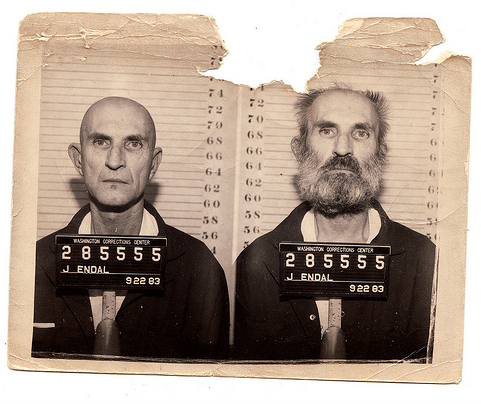
Torn Shorn, Misc. Set. Courtesy of Least Wanted aka Mark Michaelson. http://www.flickr.com/photos/leastwanted/sets/72157605201939008/
Another nod for Blake Andrews. Although not planned, it is welcome, as I think he tries keeps the blogophotosphere fresh, trying new stuff from his hideout in Portland.
Earlier this week I featured Blake’s Brief History of the U.S. Passport Photograph. An artist/collector with hundreds of Passport and ID Photographs, named Least Wanted, followed up with Blake to get the word out on his sprawling collection.
Also earlier this week, I put up a piece about the JUSTICE Art Installation in Bridewell Police Station, London. Coincidentally, one of the artists for the JUSTICE exhibition exhibition was Mark Michaelson, aka Least Wanted. It seems like a small-internet-triangle-of-providence presented itself this morning and it is up to me to draw the hypotenuese …

Head Gear, Misc. Set. Courtesy of Least Wanted aka Mark Michaelson. http://www.flickr.com/photos/leastwanted/sets/72157605201939008/
Least Wanted collects, groups and displays a huge collection of I.D. photos on Flickr. In addition to passport shots, it includes medical photographs, badge I.D. photos and other documentary ephemera. Prison Photography is interested in the majority of the collection: Mugshots.
Least Wanted’s sets are a mad enough curatorial project to keep me going for months. For now, I’ll just echo Blake’s sentiment and point you in the direction of Michaelson’s epic archive.

Austin Old Timer, Misc. Set. Courtesy of Least Wanted aka Mark Michaelson. http://www.flickr.com/photos/leastwanted/sets/72157605201939008/
The three images used in this article were drawn from Least Wanted’s misc. Set
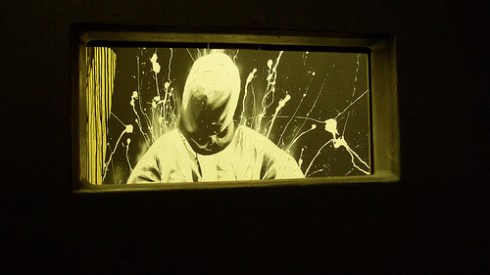
I found this via Wooster Collective who provide good daily visual feeds.
Info from the JUSTICE Flickr set. All images from JUSTICE Flickr set.
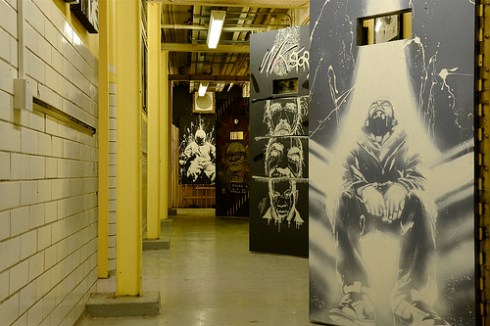
JUSTICE, a concept show based on themes of Law and Order, is the hard endeavours of 5 artists; C215, Dan23, Bruno Leyval, Least Wanted and MC1984.
Traveling to Bristol from France and New York to build JUSTICE, featuring site specific installations, photography, prints, stencils and a range of new original work.
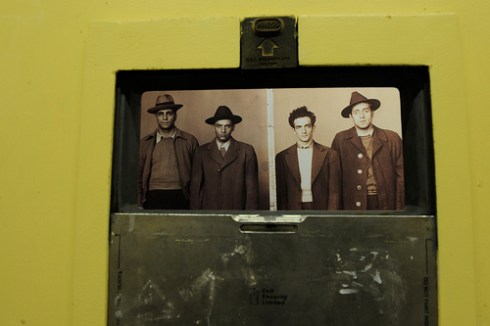
All the artists have a strong collective interest in the plights of minority cultures, human rights, freedom, homelessness and the vacuous subject of law and order, and Justice will display the combined aesthetic of these interests placed within the oppressive environment of Bridewell Police Station’s cells.

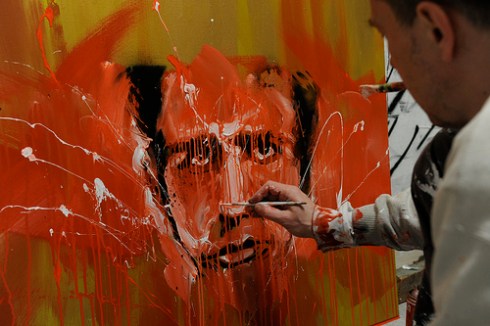
As well as the Old Bridewell Police Cells, the show was at The Long Arm Gallery, Bridewell Street, Bristol, BS1 3PY.
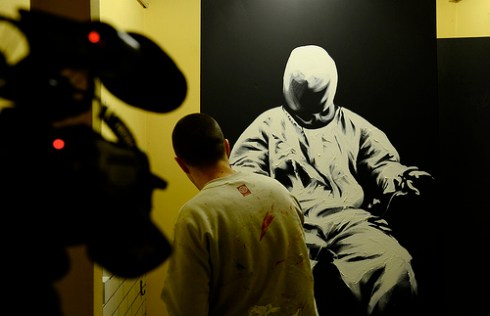


London Metropolitan Police Anti-Photography Propaganda Campaign Poster
When I began writing this blog, it was meant as a vehicle to display the documentary work of photographers working in sites of incarceration and to generally expound the stories touched upon. It was also meant to deconstruct some of the persistent myths surrounding prisons and prison populations and how visual culture has played its part in weaving some of those myths.
Not once did I envisage the current situation whereby the act of photography could bring about the threat of detention and imprisonment. Such impingement on basic rights of expression has been known in some of the dictatorial and despotic regimes of modern history … but not so much in the West, right? The times they are achangin’.

Photo: Liam Oliver Newton Craik-Horan. http://www.flickr.com/photos/liamch/3423810669/
When my brother visited from the UK last month he couldn’t stress enough how much of a police state it has become. We reasoned that the fingerprints taken by US homeland security are know also the possession of the UK government. It used to be the case that fingerprints were only taken and kept on file in the UK if you had been convicted for a crime. How things change.
A few months ago I signed up as a member of ACLU, the decisive moment was when the ACLU representative said to me, “You don’t want the US turning out like Britain with all those cameras and surveillance do you?”

Photo: Stickerklub. http://www.flickr.com/photos/stickerklub/3420240889/
Britain really is a country that has got itself on edge; it’s culture promoting men and women in all guises of security to exert illegitimate power and enforce ludicrous policy. Unfortunately, this robotic application of rules has infected even our art galleries, as the venerable John Berger discovered.
This past months have seen a slew of stories coming out of Britain regarding the rights of photographers in public spaces. All these are in response to a slew of legislation to slowly whittle down the rights of photographers; the rights of UK citizens.
On 16th February, the Counter Terrorism act came into effect making it illegal to photograph a police officer or “elicit information” about them. The British Journal of Photography has the details.
After the disgust at such brazen restriction of rights, the response by the photographic community in London was to go to Scotland Yard, headquarters of the Metropolitan police, and in an act of mass civil disobedience take lots of photographs of lots of officers.
The Guardian UK has been the mainstream print media that has really pursued this topic, reminding us all of what we have just lost. They broke the story that Kent police monitored members of the press during an environment protest, for which the Kent constabulary have apologized.
The Press Gazette explained this tactic and the associated tension between police and photographers.
David Hoffman, a photographer with 32 years’ experience, said he now carries shinpads in his bag, claiming he had been kicked by police officers at protests.
“The police today [NUJ Protest] have been beautiful – but that isn’t always the case,” he said. “Recent protests have been very bad. The worst was October last year, at the Climate Rush demo. One copper spent his time kicking my leg. Stood there with his steel toe caps kicking away – and me, a silver-haired man. I’ve still got chunks missing from my legs five months on. They want you to think: I won’t cover it next time. They have been using FIT [Forward Intelligence Teams, who use cameras], they have been using intimidation.”
Hoffman added, “It’s important the police know they’re being watched and observed. If you don’t see what’s going on, your society’s less democratic.”

Photo: Tom Kondrat. http://www.flickr.com/photos/toguko/3409931955/in/pool-met
It is almost like the lines have been drawn so indelibly, people are having to pick a side. It is sad to see but the police fall in line with the government and the majority sympathise with the press. This has led to a conflation of stories involving the G20 protests, police misconduct, and the death of (and vigil for) Ian Tomlinson. Judging by the Guardian’s recent coverage, you’d be forgiven for thinking that London was on the edge of civic breakdown.
I think the media and the Guardian in particular are taking a principled stance here and just reminding the Met at every opportunity that they are watched and the press will not be cowed. I think most of us realise that with millions of people in possession of recording equipment it is unenforceable to stop people from documenting the streets.

Photo: Tristam Sparks. http://www.flickr.com/photos/friendly-fire/3287739662/in/set-72157613984292743/
Ian Tomlinson’s death received a lot of coverage and rightly so, but I shall wait for the inquiry ruling before making a call, despite the early damning evidence. We, however, in the business of images know that they can never tell the full story. This is now an investigation of excessive force by the police and distinct from the main issue of photographers/civil rights.
Yesterday, the Guardian published this footage of the police threatening photographers with arrest if they did not move. Again, later the force apologized. But what is interesting here is the Guardian‘s decision to line up video footage of various scenes of confrontation from different days in the right hand nav bar. It is a dossier of police activity and unlike anything I have seen in mainstream media.

Photo: Roger Lancefield. The protesters stickers read "I am not a Terrorist, I am a Photographer". http://www.flickr.com/photos/rlancefield/3285904973/in/set-72157613975803636/
From the sublime to the ridiculous, the Guardian showed that front-line press aren’t the only ones under scrutiny. Metropolitan police deleted a tourist’s photographs this week to “prevent terrorism”. Klaus Matzka, the tourist involved summed his experience up as such:
“I’ve never had these experiences anywhere, never in the world, not even in Communist countries.”
So, at best you are harassed for your photographic activity and at worst, if thought to hold sinister motives, arrested and face a 10 year sentence.

Photo: Tristam Sparks. http://www.flickr.com/photos/friendly-fire/3414147417/in/pool-met/
Before all this gets to any court, however, the clashes are felt on the street, on the shins and in the constantly diminished rights to freedom of expression. Where citizen photographers may feel powerless, it seems the press – and the Guardian in particular – are just getting powered up.
_________________________________________
Thanks to all the Flickr users credited above for their images, but more importantly their acts of documentation in the face of legislation to prevent such freedoms. I hope we all stay out of prison.
98 prisoners are kept in a cell measuring 25 square meters originally designed for 16 inmates. The longest-serving prisoner in one of these cells has been there for 5 years. The prisoners are locked up for crimes as varied as non-payment of alimony to murder. The long-timers sleep in hammocks up high, the newcomers on the floor. Temperatures reach 50 degrees celsius in the summer. The prisoners are the poorest members of society, have poor legal representation, and are disenfranchised from political representation as they have no vote.
Gary Knight, Private Photo Review

Overcrowding at Polinter pre-trail detention centre, Rio de Janeiro © Gary Knight, VII Agency
Originally published in Social Issues #42 last Autumn, Gary Knight‘s astonishing photography at one of the (now closed) overcrowded Polinter Prisons in Rio de Janeiro, Brazil. Polinters are temporary holding facilities used to house police detainees.
There’s a bit of back story in to Knight’s work in his interview with the Financial Times.
Two things intrigue me about this. Firstly, my research tells me this prison closed down late 2006/early 2007. Why has it taken so long for Knight’s photography to get even short coverage? Secondly, I am astounded by Knight’s answer to the question of how he secured access:
I was doing a project on poverty, and a photographer at O Globo newspaper in Rio introduced me to the governor of Polinter prison – a place with conditions so bad the governor herself was appalled. She wanted something to be done but she couldn’t really let in a photographer from a local paper. She felt more comfortable with a foreigner: I guess she thought that stories published overseas might put pressure on the government from abroad.
Can you imagine a reversal of this logic? That US prison wardens would accommodate foreign photojournalists more readily?
Knight does his part in bringing visibility to the situation, but that doesn’t affect the shut out experienced by local photographers. That said, it is a great example of the power of international photojournalist activity bringing new possibilities to bear.
Detailed information on the Polinter prisons is hard to come by. We should share Knight’s relief that the Polinter he photographed is now closed. Amnesty International mentioned it in its 2006 report on Brazil:
In Rio de Janeiro, human rights groups denounced conditions in the Polinter pre-trial detention centre. In August the unit held 1,500 detainees in a space designed for 250, with an average of 90 men per 3m x 4m cell. Between January and June, three men were killed in incidents between prisoners. Officials in the detention centre were also forcing detainees to choose which criminal faction they wished to be segregated with inside Polinter. In November the Inter-American Commission on Human Rights ordered the Brazilian government to take measures to improve the situation.
Finally, let’s consider with necessary dexterity the role that Pastor Marcos Pereira da Silva plays in all of this. He visits, evangelises, “foot-stomps”, exorcises evil and sends prisoners collapsing to the floor. Knight confesses a “real disquiet about him”. Supporters point to the fact that violence in Polinter has abated since da Silva’s visits, but Knight parries that its easy to influence the most vulnerable of groups.
I cannot bring myself to embed the video of the Pastor at work, but you can follow this link and thusly imagine him bouncing around the walls of a prison, agitating its population and putting on a show they’re not likely to witness again or even understand. I guess different eyes experience different wonder.
_______________________________________________________
UPDATE (06.01.2012): The Open Society Institute published Justice Denied: Brazil’s Polinters, documentary video focusing on “the costs of excessive and unnecessary pretrial detention.”
The poor conditions are obvious. OSI describes the film as part of their broader work on “a Global Campaign for Pretrial Justice […] helping governments develop bail and supervision systems that can make pretrial detention an exception, and not the rule.”
_______________________________________________________
Gary Knight, born in England, started working as a photographer in Southeast Asia during the 1980s as Indochina emerged from bitter wars and the region came to grips with the end of Cold War. In 1993, he moved to collapsing Yugoslavia where he returned repeatedly from the siege of Sarajevo through the fall of Kosovo. Between assignments for Newsweek, he documented crimes against humanity.
After 9/11, he worked in Afghanistan and two years later independently followed U.S. troops into Iraq. He covered wars in the Middle East, Africa, Europe and Asia and other breaking news, but Knight’s central focus is on the survival of the world’s poor and fundamental human rights issues.
Knight is founding director of VII Photo Agency. He established the Angkor Photo Festival, is a board member of the Crimes of War Foundation, a trustee of the Indochina Media Memorial Foundation and Vice President of the Pierre & Alexandra Boulat Foundation.
His work, widely awarded, published in magazines, is in museums and private collections. He has initiated education programs with universities and voluntary agencies, and is the author of Evidence: War Crimes in Kosovo.
If you are going to spend time with anything though, make it dispatches, a superbly edited magazine co-founded by Kinght. It cuts to the core of the issues, the rest of us skirt from distance.
(Found via Travel Photographer)

Images Unseen, Images Unknown written by a guest blogger on Prison Photography last week was well received by readers, provoking more questions and some intriguing possibilities.
Change.org offered a synopsis of the article. Change.org focused on the concluding points of Images Unseen, Images Unknown which described the culture of shame shrouding California prisons created by the control of images and manipulated invisibility.
Too many prisoners are hidden from view to serve out their time. Many prisoners refuse visits from family because they don’t want loved ones to see them in institutions that deny them individuality, work to subdue the general population, hide prisoners from society, and keep them docile.
So, the issue of self-representation and empowerment arises. Specific to my interest would be the possibilities of empowerment through photography.
Recently, Stan Banos asked me, “Are you aware of any photography programs in prison for prisoners.”
My answer, in short, is no. This doesn’t mean they don’t exist, it just means for all my searching I have unearthed nothing.
Art therapy has been explored among prison populations and recently San Quentin piloted it’s first ever ‘Film School’. The project did many things at once, teaching inmates the technical skills of documentary film making, building team work and trust; and it allowed inmates to communicate narratives of their choosing from prison life.
Inmates documented the work of the prison nurses distributing medications; filmed the prison kitchens; recorded the “wasted talent” of artists, musicians and writers within San Quentin; and studied American Islamic faith in prison.
With that in mind, we can say empowerment through the arts has been well explored and apparently successful in a number of penal institutions. However, it would seem photography in prisons has not been used as a tool for self-representation and rehabilitation … yet.

Turn Away © Stephene Brathwaite, Red Hook Community Justice Center Photo Project
The model for this type of program exists. Dozens of important non-profits use photography as a means for at-risk-youth to tell their stories. Organisations such as Youth in Focus, Seattle; AS220 Youth Photography Program, Providence, RI: Focus on Youth, Portland; New Urban Arts, Providence; Critical Exposure, Washington DC; First Exposures by SF Camerawork in San Francisco; The In-Sight Photography Project, Vermont; Leave Out ViolencE (LOVE), Nova Scotia; Inner City Light, Chicago; My Story, Portland, OR; Picture Me at the MoCP, Chicago; and Eye on the Third Ward, Houston; The Bridge, Charlottesville, VA; and Emily Schiffer’s My Viewpoint Photo Initiative are exemplars of empowerment through photography.
The Red Hook Photo Project New York offers photography opportunities specifically to a community blighted by crime. The photo project is run by the Red Hook Community Justice Center which operates many programs to improve the lives of teens within the geographically and socially isolated Red Hook Neighbourhood.
Only slight tweaks would be necessary to these types of programs for them to be effective as rehabilitative tools among prison populations. The central driving philosophy is to offer individuals a method of self-representation they’ve never been afforded previously.

A Backwards Eye © Gwendolyn Reed, Red Hook Community Justice Center Photo Project
It seems the main factor, aside of funding, for rehabilitative programs establishing themselves in prisons, is the philosophy of individual wardens. San Quentin Film School was pitched repeatedly across 47 states until Warden Robert Ayers decided to launch it at San Quentin. Likewise Burl Cain, at Louisiana State Penitentiary (Angola) has become well known for maintaining a varied roster of programs to keep inmates occupied. They include the renowned (and ethically questionable) Rodeo, an American Football league and a hospice program in which inmates volunteer to carry out the palliative care tasks.
On this evidence, it would make sense that criminal justice reformers and those interested in increasing the visibility of prisons should actively seek out wardens currently supporting novel, or even pilot, projects. Wardens currently accommodate programs in education, the arts, dog-training, first aid, video and much more. Photography could be added to that list.
There is a lot of mainstream media programs featuring American prisons – Lockdown, Americas Hardest Prisons, Inside American Jail – but of course these are all made for cable distribution and ultimately profit; their common denominator is a heightened sensationalism.

© Wayman, Inner City Light Student Photography Project
Documentary projects upholding rehabilitation and education as their core purpose are a distinctively different type of exposure. There would be no need for regional or national television channels to provide financial backing as an end (marketable) product would not be the motivation. That said, if the narratives of such documentary projects could be shown to enhance the image of an institution the prison authority might be open to trying them. The prison warden has the decision making power, so if under a wardens leadership a prison is given (positive) exposure it makes sense that the warden would be interested.
All successful rehabilitative arts programs presumably share a cooperative approach from the outset. Wardens and authorities are not to be feared or misunderstood, but can be convinced, cajoled and open to novel suggestions and programs.
Matt Kelley has suggested that the criminal justice reform community take note of wardens who are open to more transparency within their institution. Could coordinated media access drive a movement against the “invisibility” of prisons in America today?
The ideal program I envisage, would have only a small operating budget allowing pre-screened inmates to learn the practical skills of photography and apply them for the purposes of self representation.
If San Quentin can mount a film school I am sure any prison in the future can develop a Photography School? What do you think?

I Reach © Stephene Brathwaite, Red Hook Community Justice Center Photo Project

Inmate Jeff Curbow, 40, says he improved a watering system for the moss after others built a special hut for it at Cedar Creek Corrections Center in Littlerock, Thurston County. Credit: Ken Lambert / The Seattle Times.
Prison Photography always looks to visual sources that represent incarcerated peoples from a different perspective. Some of the best opportunities to do this is with images of prisoners employing their time in job placements, self-growth programmes and/or restorative justice & community education projects.
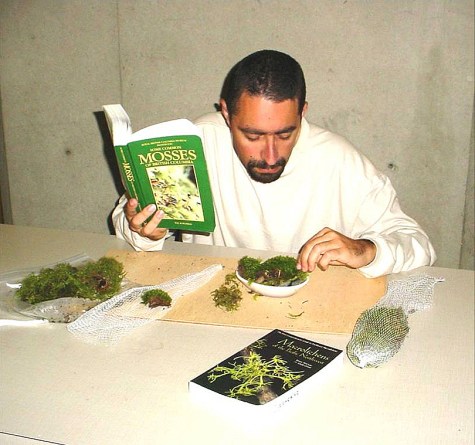
A Cedar Creek inmate and researcher in the Prison Moss Project studies mosses. Credit: Nalini Nadkarni of Evergreen State College
The Prison Moss Project, part of the Washington Department of Corrections‘ sustainability efforts uses prisoners time for the benefit of multiple causes. The project studies the growth of different mosses, cultivates the fastest growing species and sells them commercially as an alternative to mosses stripped from America’s temperate rain forests. Harvested mosses constitute a $265 million/year business. 90% of mosses come from Pacific Northwest forests. The majority of mosses are used for short lived floral-arrangement. Moss can take between 20 to 40 years to regrow even a small patch of a few square feet.
The beauty of this model based on simple scientific observation and applied methods is that it is replicable the world over. And, the business that results makes sense too.
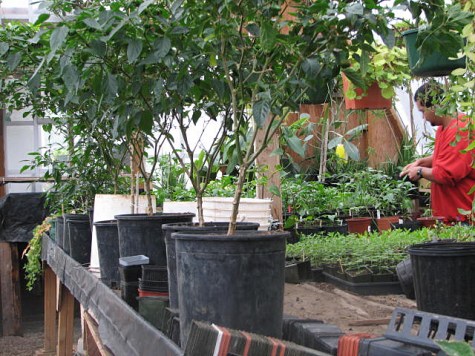
A Cedar Creek inmate and researcher in the Moss-in-Prisons project tends the garden. Credit: Nalini Nadkarni
So, the benefits? First and foremost, the inmates at Cedar Creek, a minimum security facility in the rural southwest of Washington enjoy daily active learning. Prison staff have described the facility as one without idle time among its inmate population. Engaging the bodies and minds of frequently docile populations is the first step in combating recidivism.
Concurrently, tax-payers (economically-efficient prisons), tourists (untouched old growth forests) and global citizens (robust ecological legacies) all benefit too. Finally, all this pales in comparison to the rewards for the Pacific Northwest old growth forests, which in future will not suffer unsustainable tree-stripping and moss harvesting.

A Cedar Creek inmate and researcher in the Prison Moss Project in the purpose built greenhouses. Credit: Nalini Nadkarni
How did all this start? Two convergent forces came together. The first was a general move by the Washington Department of Corrections to improve its carbon footprint, sustainability and opportunities for its inmates. This involved composting, recycling, organic farming, beekeeping at selected facilities. This green awakening fell into step with Nalini Nadkarni‘s need for extended and immediate research into moss varietal growth patterns.
Nadkarni has been called the “Queen of the Forest Canopies”. I am not one for personality worship, but let’s just say her work is socially – as well as environmentally – responsible, she knows how to work media channels, her message is imperative and the Evergreen State College in Olympia is very lucky to have her on faculty. She co-founded the Research Ambassador Program at Evergreen, which seeks to combine academic and non-academic practitioners to widen the reach of environmental dialogue and deliver relevant forms of communication to different groups; from inner city youth, to business CEOs.
It’s all about respectful communication, and it’s all for the benefit of our environmental futures.
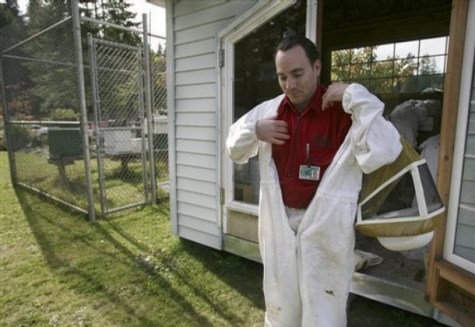
Daniel Travatte, 36, suits up to check on the Italian honey bees he cares for at the Cedar Creek Corrections Center in rural southwest, Wash. on Friday, Oct. 17, 2008. The bees are part of a program to help the prison be more environmentally green. Credit: John Froschauer/AP
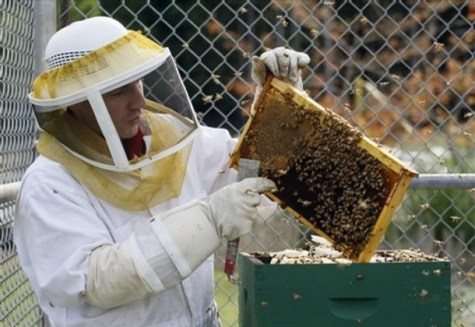
Inmate, Daniel Travatte, tends the Italian honey bees he cares for at the Cedar Creek Corrections Center in rural southwest, WA. Credit: John Froschauer/AP
The media coverage of this programme has often focused on the story of a young inmate who, since release, secured a biochemistry PhD full ride scholarship at the University of Nevada, Reno. He was imprisoned after accidentally killing his friend with his sports rifle in his student apartment. Four years later, he has continued the exceptional academic track he seemed destined to follow. It is a testament to the Washington Department of Corrections and Nalini Nadkarni (his mentor during time served) that his life has been delayed rather than destroyed.
But, he surely is an atypical case and it is a case that obscures the facts about the sustainable projects in operation at Cedar Creek. Not every inmate is a PhD candidate, but every inmate is a willing recipient of education – especially environmental education which, in many cases, is totally novel. Environmental education carries an almost redemptive message in that your actions can directly benefit everyone in modest but crucial ways. Actions based upon this new learning can be very therapeutic. Responsibility for oneself and other human beings is not separate from responsibility for our shared environment.

Inmates Robert Day (left) and Brian Deboer (right) check on plants in one of the organic gardens at the Cedar Creek Corrections Center in rural southwest, Washington, on Friday. The minimum-security prison has adopted many environmental and cost saving practices. Credit: John Froschauer/AP
I have discussed sustainability efforts in California’s prison system before. In closing I’d like to repeat the sentiments of Cedar Creek superintendents who, in attempts to convince the public of the utility of this program, talk of the direct reduction in operating costs at the facility. If commentators such as myself want to espouse the rehabilitative value also then so be it. Doubters now have firm fiscal, quantitative evidence – in addition to qualitative inmate testimonies – to shape their support for sustainability programmes in prisons. WDC senior staff are adamant Cedar Creek is the correctional model to follow in the 21st century.

Inmate Robert Knowles pitches plant stalks into a compost pile Oct. 17 at the Cedar Creek Corrections Center in rural southwest Washington. The minimum-security prison has adopted many environmental and cost-saving practices. Credit: John Froschauer/AP
There are many resources out there on the Prison Moss Project and Nalini Nadkarni‘s ongoing evangelism. I personally would recommend in this order … Nalini Nadkarni’s recent TED presentation about the opportunities for academic & non-academic communities to unite for greater good; this extended video from KCTS (9 minutes); this interview with Nadkarni; a recent Mother Jones summary of her projects and two media reports (1), (2).
While not related to the work of a single photographer or project, the lines of argument proffered by Subtopia are so resonant that Prison Photograph Blog feels the diversion justified. Through summary of the four chosen articles, we can gaze upon the complexity and omnipotence of incarceration in our frantic, contested global society. Subtopia’s images will knock you on your arse!
The analysis of Bryan Finoki at Subtopia consistently join the dots between geopolitics & biopolitics; movement & paralysis; spatial theory and spatial reality. Unsurprisingly, for a writer in the 21st century, his interest in the production of structures & networks, often leads him to theories of militarised space.
I am in awe of Subtopia’s output. From lengthy and comprehensive issue-based summaries; to purposed surveys; from fine image-editing; to diverse links and sources in each post. Finoki serves up rigorous analysis, or entertainment, but usually both.

© 2009 Subtopia/Brian Finoki
Over the past couple of years Finoki has submitted a few pieces on “The Prison”. Subtopia’s preoccupation with power and spatial production means carceral sites/archipelagos are referenced frequently. Finoki has been keen to unravel the mysteries of the Global War on Terror (GWOT), its structures and its legacies – this always means dealing with detention, rendition, and construction (that can be visible, but more often invisible.)
Article One – Fantasy Prison is a meditation on potential prison architectures spurred by the 2007 Creative Prison project a collaboration between architect Will Alsop prisoners at HMP Gartree to redesign corrective and rehabilitative space. Two things struck me about the suggestions made by prisoners. 1) They were most afraid of attack from other inmates, and therefore an option to lock themselves IN was a shared high priority, and 2) They wanted to include a designated photo-room within the visitors center to allow for photography and variant backgrounds. I have posted before about manifestly curious prison-polaroid aesthetic. This article also threw up the crucial social responsibilities of architects & designers in a time of prison expansion, most notably the Prison Design Boycott launched in 2004 by the group Architects/Designers/Planners for Social Responsibility (ADPSR).
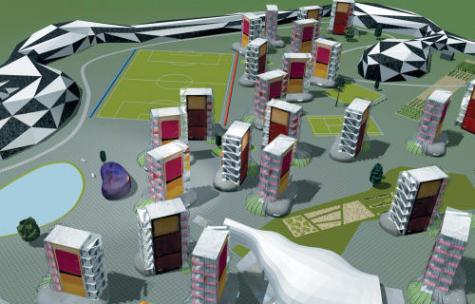
A rendering of Will Alsop’s new corrections landscape, developed in collaboration with prisoners, resembles a cross between Communist-era housing blocs and a series of South Beach condos. Courtesy Alsop Architects
I have been a fan of Alsop’s work since his 2005 hypothetical SuperCity project which would subsume my hometown in the North.
Article Two – Floating Prisons is a historical survey of sea-faring, carceral solutions by warring and colonising nations. Finoki maps the use of prison ships from 18th & 19th century economic necessity to transport human cargo to contemporary manoeuvrings in avoidance of international law. He makes reference to the convenience use of islands as sites of detention, the use of ships as temporary housing in leiu of land locked sites, and the dubious experiments in swapping refugees held in off-shore camps. The summary was to say that new legal definitions and controls are creeping in giving one the sense, “refugees and migrants are just an excess of biomass to be herded around on prison islands or in prison vessels, traded like geo-economic commodities, removed and disposed of like capitalist human waste, reinforcing the state of exception that goes on re-organizing the architectural spheres of global migration.” Phenomenal.

The Vernon C. Bain is a prison barge operated by the City of New York, housing 800 prisoners in a medium and maximum security facility. Built in 1992 at a cost of $ 161 Million means it would have been cheaper to send the inmates to Harvard instead. (Source)
Article Three – “Block D” enters the Pantheon of GWOT Space is a meditation on the totality of restricted space across the globe – in multiple nations – in order to sustain military operations. The point of the survey (which includes previously known sites such as Guantanamo, Baghdad’s ‘Green Zone’, Bagram Theater Internment Facility, US homeland immigrant detention facilities, and Taxi networks for rendition) is to add another site to the list: “Block D” in Pul-e-Charki Prison just east of Kabul, Afghanistan.
With persistent references to journalists’ work for the BBC, New York Times and Washington Post, Finoki summarises, ” ‘Block D’ or ‘Block 4’ as it is also apparently known: a newly built detention facility [is] quickly becoming understood as the Asian corollary of Guantánamo Bay. No matter, it is another utterly disturbing black hole in the universe of legally suspect and secret space.” Finoki doesn’t focus on the conditions of detention but rather America’s self-created legal imbroglio.
Nearly a year after writing, this analysis seems prophetic now, as the American public is slowly coming to realise that Obama’s closure of Gitmo doesn’t necessarily magic away the human rights issues … only shifts them somewhere slightly more obscured. As with Gitmo, one expects Block D to focus the new rounds of jousting between the same ideological stakeholders.
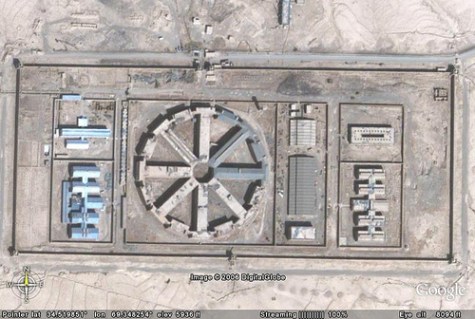
Pul-e-Charkhi prison, Kabul, Afghanistan. Construction began in the 1970s by order of then-president Mohammed Daoud Khan and was completed during the Soviet invasion (1979-89). The prison was notorious for torture and abuses under the control of Afghanistan's communist government following the invasion by the Soviet Union. (Source)
Article Four – The Spatial Instrumentality of Torture is a stomach-pounding dose of reality in the form of an interview with Tom Hilde, Research Professor in the School of Public Policy at the University of Maryland. I will not offer a synopsis, just encourage you to read through it. The interview is illustrated in part by Prison Photography‘s favourite Richard Ross.
Hilde ends with the sobering words, “The secrecy of much of the US torture program, its physical spaces, and its extent has certainly kept public debate rather subdued. But I think the dualistic moral framework has been even more corrosive of a public understanding of torture in general and the consequences of American torture in particular. When a majority of Americans say that torture is acceptable for some purposes, I think they have the fantasy of the ticking timebomb, and likely racism in many cases, in the backs of their minds.”

Camp X-Ray, Guantánamo, Cuba. The facility has not been used since early 2002, and recent heavy rains at Guantánamo Bay have brought about overgrowth. Credit: Kathleen T. Rhem
Chris Jordan was low on my list of priorities but this timely post by Mike Kelley at Change.org (a blog as impressive for its readers’ comments as it is for the straight forward presentation of Jordan’s work) compelled me to bump it up and champion the depressingly and unfathomable figures that arise when one simply runs the numbers.

Chris Jordan. Prison Uniforms, 2007. 10x23 feet in six vertical panels. Depicts 2.3 million folded prison uniforms, equal to the number of Americans incarcerated in 2005. The U.S. has the largest prison population of any country in the world.
In reading Change.org’s straight forward commentary on America’s broken criminal justice system, I signed up for Change.org and read a few of their older posts. In doing so I was presented with the catalyst to comment on Obama’s momentous inauguration without repeating the media-lovefest that has surrounded the 44th’s swearing in. This post will cover Jordan’s astounding artwork, Obama’s astounding tasks-at-hand and where they politically overlap.

Chris Jordan. Prison Uniforms, 2007. Partial zoom.
Chris Jordan has spent his time making larger and larger photographic constructions to communicate the scale at which American society wastes its resources, its environmental future and its grasp on logic. In his effort to catalogue the linear and thoughtless waste of the US, he has progressed from crushed automobiles, to cell phone chargers, to polystyrene cups to American prisoners.
Jordan is a bright guy, now consumed by his photography (which to be quite frank is eco-hip and brilliantly executed). He talks passionately about a sea-change in our cultural consumption. He specialises in highlighting “the behaviours that we all engage in unconsciously on a collective level … the actions we are in denial about and the ones that operate below our daily awareness … like when you’re mean to you wife because you’re mad about something else or when you drink too much at a party because you’re nervous.” Jordan is no prophet, he just sees the necessary u-turn we must all make in our habits and thoughts to move toward sustainable existence.

Chris Jordan. Prison Uniforms, 2007. 10x23 feet in six vertical panels. Detail at half actual size.
I like to think the strength of Jordan’s visual framework that deals with soda cans to the landfill as it does with prisoners to the cell blocks is deliberate. As hard as it is to acknowledge, the majority of Americans have turned their back on a seven-figure-minority as if it were worth no more thought than discarded packaging. Mass imprisonment is the result of widespread apathy, denial and unpinnable responsibility. How unconscionable is this situation? We are all responsible. Barack Obama talked very little about criminal justice and prison policy during his electioneering. This is not surprising as helping the invisible incarcerated masses is on the electorate’s mind as much as the whereabouts of their last twinkie wrapper. But, Obama also made it very clear that this was the time for personal responsibility and accountability.
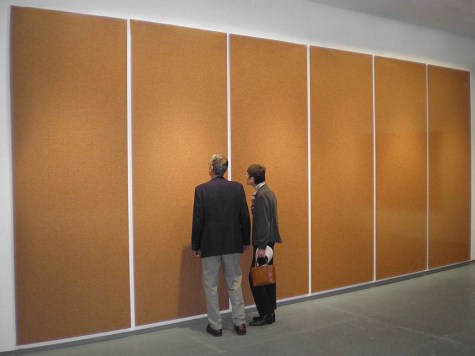
Chris Jordan. Prison Uniforms, 2007. Installed at the Von Lintel Gallery, NY, June 2007.
So after a week of photography gallery after gallery, the militarised eye vs. the personal touch, Gigapan-assisted user-generated snooping, faux controversy, minor mishaps, cult worship, sentimental clap-trap, unending debate, media catfights, nerdcore details, celeb fluff and even UFO’s isn’t it time we adopt the same realism that Obama trusted in for his inaugural speech?
A wonderful article from the Wall Street Journal lays out the realism and “the audacity of hope behind bars”. (Via Change.org). Angola prisoner, Mr. Dennis served up some REALISM: “He’s got his hands full: Two wars, the economy is going in the tank and the health-care costs are skyrocketing – I’d be surprised if he has time to brush his teeth in the next four years.” While another prisoner took care of the HOPE: “If the men here can have hope, then why can’t the rest of the country?”
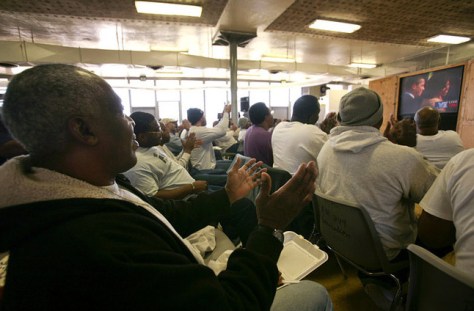
Prisoners at Louisiana State Penitentiary ("Angola") were given the day off to watch Barack Obama inaugurated as America's 44th president.
So how does this all connect? Jordan and Obama share the same call to think, with serious intent, about the things invisible to us. Both call us to consider the reality of our society and accept our shared responsibility for its faults, weaknesses and injustices. Both men challenge conventional wisdom; the logic that just because we didn’t turn the key nor bring down the gavel, we are not complicit – by our silence – in America’s mass incarceration.
What can you do? You can start by signing this petition immediately and by using web2.0 to access Obama’s administration as his team reached you during the election.
If you’d like to know more about Chris Jordan you could do worse than starting with this interview, this interview and this interview.

 Prison Photography