
You are currently browsing the category archive for the ‘Amateur’ category.
It might be unwise. It might be aborted if it only increases the speed of my daily internet treadmill. But …
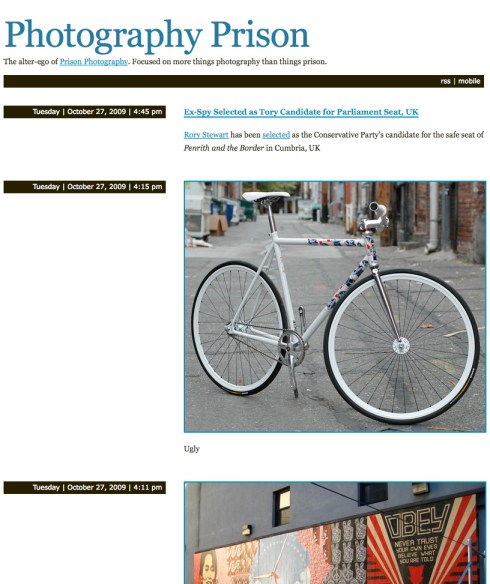
Photography Prison is on Tumblr.
It is the alter-ego of Prison Photography, focused on more things photography than things prison.
Basically, I see loads of cool things in any given day and I’d like to share them without the production that goes into Prison Photography.
Hope you find some worth. I’ll reevaluate this Tumblr thing in 4 weeks, but until then you know you can enjoy all these things …
Klavdij Sluban and Jim Casper of LensCulture talked about Klavdij’s photography workshops in juvenile prisons across the world.
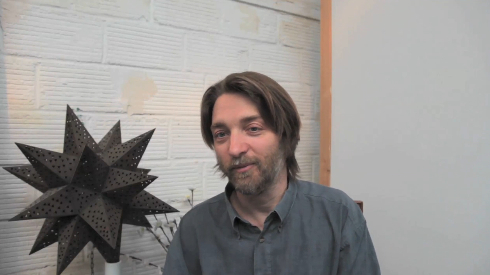
Early in the interview, Klavdij discloses his personal sadness that prisons exist. This emotion may be raw but it is not naive; Klavdij is balanced and realistic about what he can achieve with a camera in these specific distopias. He also says in seven words what I established this blog to say “Jails are a world to be discovered.”
He went to the prisons not as photographer, but as a concerned citizen. He realised if he were to go inside it would need to be with some reciprocity … so he took cameras and used them.
In terms of engagement and commitment to a population – the youth prison population of the world – Klavdij Sluban could and should be considered a ‘Concerned Photographer’. He deserves that loaded epithet.
Marvin Heiferman pointed me in the direction Tim Padgett’s Time article about news outlets’ adoption of Mug-shot galleries. Padgett remarks, “Mugshot galleries are increasingly popular features on newspaper websites, which are on a crusade for more page views and the advertising revenue that accompanies additional eyeballs.”
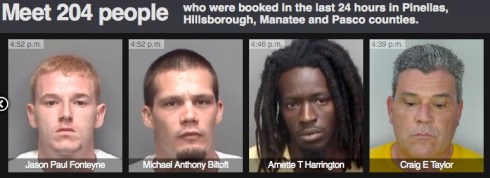
The example offered is that of Mugshots at TampaBay.com of the St. Petersburg Times. The site even breaks down the prior sixty days of bookings into the age, height, weight and eye colour statistics of those arrested.
This exercise is as artless as one would think. The laziness of the filtering of information via an automated platform is matched by the disclaimer regarding mugshots’ accompanying text.
The news group has recognised this and produced these ridiculous FAQ‘s in advance of those booked being disappointed … or worse, misrepresented.
I was arrested but cannot find my mug shot. What gives? Our goal is to provide a complete profile for individuals booked into jail in Pinellas, Hillsborough, Manatee and Pasco counties. A complete profile on Mug Shots constitutes: name, photograph, booking ID, height, weight, age, gender, eye color, birth date, booking date and booking charge.
The majority of arrest records from the county sheriff’s sites have no problems, and we store them and make them available. However, on rare occasions, the photo we receive from the sheriff’s office is flawed, or sometimes the site does not make a photo available. We skip the records that do not have photos attached. You can always search for an individual on the sheriff’s site, but just because you were booked doesn’t mean you’ll necessarily show up on Mug Shots.
I was released and my record was cleared. Will you take down my mug shot? A sheriff’s office Web site maintains publicly accessible arrest records regardless of the disposition of any particular case.One principle behind Mug Shots is to mirror the sheriff’s office Web site policies closely. We provide links from every individual’s profile page to the detail page at the corresponding sheriff’s office site, which contains instructions about how to follow up on any particular case. Much like a county sheriff’s office, there are very few instances in which we would remove a mug shot from the Web site.
Will you fix incorrect biographical information? What if the sheriff does? One guiding principle is to mirror the collective sheriff’s office sites closely. However, sometimes the sheriff’s office site contains a typo or another form of incorrect data. We don’t alter the information that we gather. We do provide links from individual’s profile page directly to their detail page at the corresponding sheriff’s office site.
Continually-updated mugshot galleries continue a long tradition of crime-obsessed media and publics. They are the latest step toward the eradication-of-reason when interfacing with social transgression.
Internet “news” mugshot galleries now dominate a new, middle-ground of visual consumption; that wasteland lies somewhere between the dark pathology (and allure) of Weegee‘s world and the instant digital delivery of crime related stats (think Comp-Stat and the Sex Offenders Registry). They are bland.
These galleries are continuous, and unnecessary, visual feeds of societies’ constructed “bogey-man”.
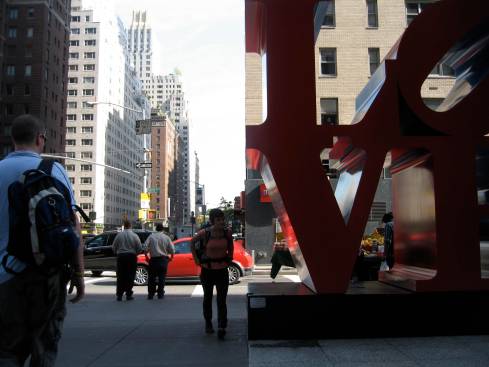
Had a fun time in New York last week. Stayed with Jack and Marisa. Below is not Jack. Below is Chris by Jack.
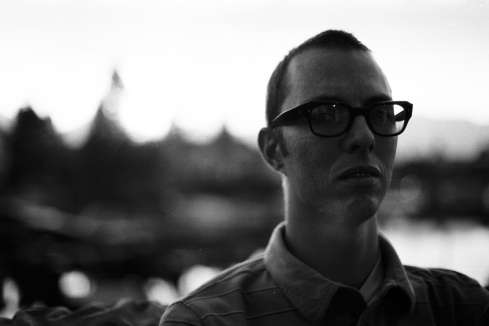
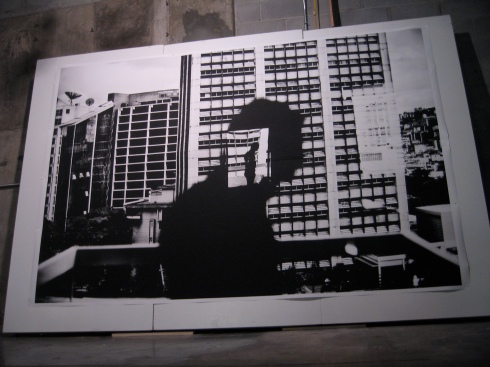
We went to Christopher Anderson’s book launch for Capitolio. It was great to see it after recent reviews, heated debates (check out comments) questions and wot not. I don’t think the selection of the images was the best.
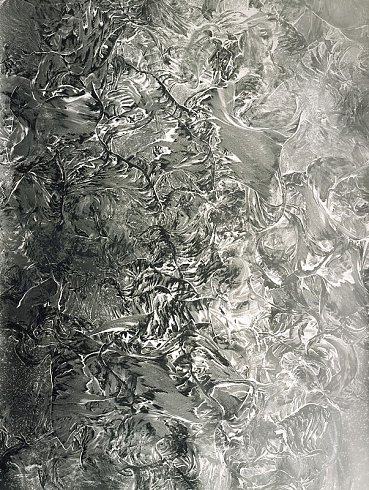
At the Metropolitan, Surface Tension: Photographs from the Permanent Collection was a pleasant whimsy into some mesmerizing works, notably Adam Fuss’ UNTITLED (1997) made by the metronome shimmers of snakes upon black dust upon white dust. Image Source: Cheim & Read
The Met’s photography department was putting together the final touches on Robert Frank’s The Americans which opened this week. It was all hands to the pump as evidenced by besuited Malcolm Daniel – who I spied carrying large, heavy object (post?) behind a partition and into the exhibition space.
Egg and Cheese Bagel.
Over at the Museum of Modern Art, I was pleased to see Russell Lee‘s work Bulletin Board in Post Office Showing a Large Collection of “Wanted Men” Signs, Ames, Iowa (1936). Who doesn’t love a mug shot?


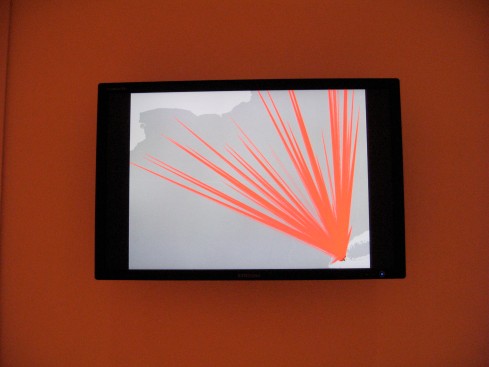
Bringing the practice of mapping of transgressions into the 21st century, the Spatial Design Lab from the Graduate School of Architecture, Planning and Preservation at Columbia University exhibited its Million Dollar Blocks Project (2006).

On Monday night I sat with Andrew Lichtenstein. We talked. Andrew recommended Brennan Linsley‘s work and was quite emphatic about the book ‘Concrete Mama‘. He also spoke highly of Max Kenner and the work at the Bard Prison Initiative
Tuesday, I met Emiliano Granado. We were first in contact over his San Quentin Giants pictures. We talked about many things including Trevor Paglen, Argentina, the Burke Gilman, and the Horticultural Society of New York, which recently lost Barbara Margolis who was an inspiring leader. Emiliano recommended Alessandra Sanguinetti‘s work.

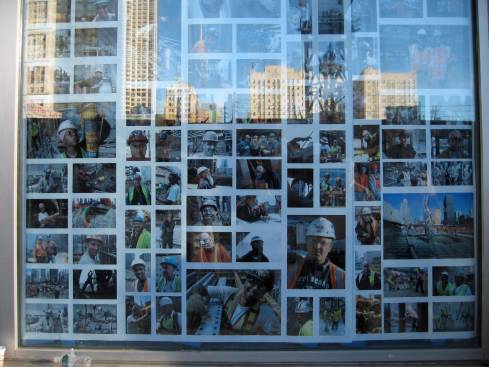
On Sunday, I’d been at the WTC construction site. There was some portraiture on display in a window. The space behind the window was closed but would usually be open. The photographs were easy on the eye.
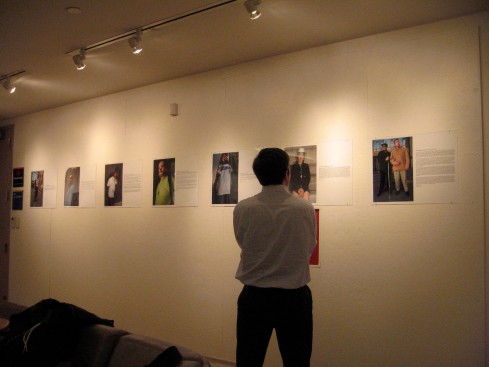
On my last night I checked out Steven Hirsch’s Courthouse Confessions.
That’s Matt Kelley looking at Steven’s work. He’s coordinator for Change.org Criminal Justice, online communications for the Innocence Project and all together nice bloke. Matt’s double identity is twittered and can be followed here and here.
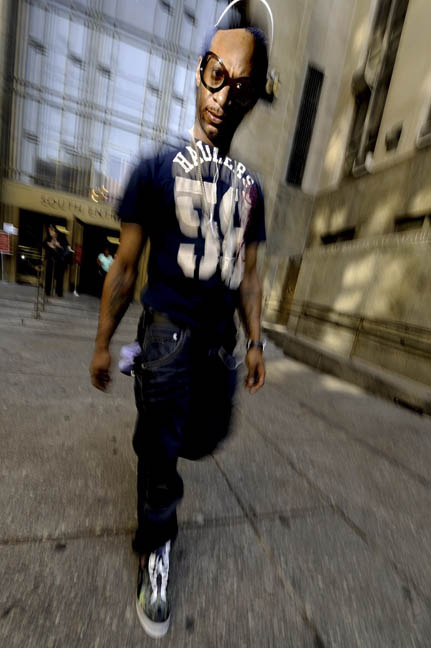
Hirsch takes street portraits of folk going to court, secures (in some ironic twist) a non-binding statement and then transcribes it verbatim to go with the portrait. Constantly moving the camera, Hirsch uses hard flash and distorted angles/zoom to depict these individuals as shape shifters; as anomalies. The fact Hirsch’s subjects (in most cases) seem alien to the logic of the courts – that any lessons arising from their cases are unlikely to effect sentencing laws in the future – should but be a source of disquiet for us as an audience.
One last thing. On Saturday, I saw John Baldessari sat outside a Grennwich Village coffeehouse, but I bottled saying anything. I’ve learnt that famous people abound in Manhattan and you see ’em everywhere.
Thanks to everyone who altered their orbits a little to coincide with mine.

The Sybil Brand Institute for women, Los Angeles. Photo Credit: LA County Arts http://www.lacountyarts.org/civicart/01_First_District/1_ela_s_sbi_ppdt_davis.htm
The fixations of Prison Photography on the infrastructural order of sites can as easily be applied outside of carceral space. The Center for Land Use Interpretation has terminus container ports, petrochemicalscapes, first responder training sites, landfill waste streams, pacific coastlines, nuclear proving grounds and even the Trans-Alaska pipeline covered by roving reconnaissance.
There is even a brief field report from the Angola Prison Museum, but I’ll have to come back to that.
I’d like to present the archive for the CLUI’s 2001 exhibit, On Locations: Places as Sets in the Landscape of Los Angeles.
Have you ever questioned the fabric of prison environments in TV or film? There were plenty prison (visiting room) scenes in The Wire, but I was too engrossed in episodes to pay the backdrop any mind. Well, this should get you thinking.
Filming in active prisons is generally not permitted for obvious reasons, and as a result, prison sets are built in soundstages, back lots, and inside other locations. A few prisons in Los Angeles are currently closed, and are regular filming locations. The Sybil Brand Institute, at the County Sheriff’s complex in City Terrace, east of downtown, was the primary Los Angeles County correctional facility for women before it closed in 1997. Though still managed by the sheriff’s department, it is now used exclusively for filming.

Credit: CLUI. Sybil Brand Institute's visiting area has appeared in several films.
Built in 1963, Sybil Brand was a minimum to maximum security facility, with a design capacity of 900, and a peak occupancy of 2,800. It once housed Susan Atkins (whose confessions to a cellmate at the prison led to the arrest of Charles Manson and family), and Susan McDougall of Whitewater scandal fame. When Sybil Brand closed, inmates were transferred to the new Twin Towers complex. The County may renovate the building and open it again as a prison, but in the meantime it offers modern looking prison rooms including cafeterias, hallways, recreation areas, visiting areas, infirmaries, and cells from solitary confinement to dormitories. As it was a women’s prison, the interior walls have a pink color, which is usually painted over for filming.
Productions film here at a rate of two or three per month. The film Blow, about cocaine dealers, recently spent five weeks shooting all over the prison. Other productions include Arrest and Trial, Gangland, X-Files, and America’s Most Wanted.
Though older and more run down, the City of Los Angeles jail in Lincoln Heights is also closed, and is used regularly as a film location, appearing in NYPD Blue, Unsolved Mysteries, and other film and television projects.

Mel Melcon / Los Angeles Times. VISITING ROOM: L.A. County Sheriff's Deputy Jack McClive peers through safety glass, while standing in the visiting room, during a tour of the Sybil Brand Institute Women's Jail in Monterey Park.
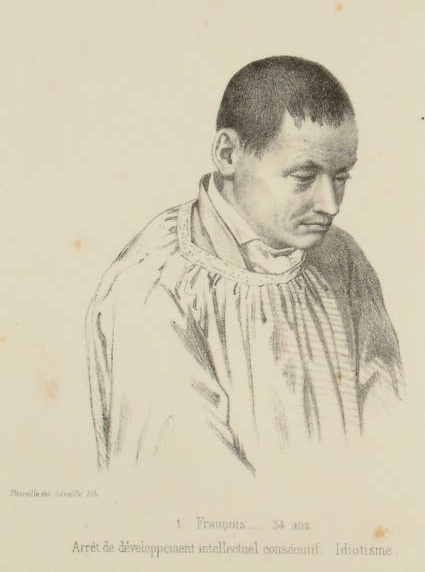
"Francois. 34 ans. Arret de Developpement intellectuel conscentif. Idiotisme." From ‘Traites des Degenerescences', by Morel (1857)

Green Hill, 2000 (C) Steve Davis
A couple of comments that have blown me away in the last 24 hours.
Convergence
From Patrick McInerney;
The similarity between Steve’s photographs and the scientific studies of psychiatric inmates the mid nineteenth century asylums is striking. (For a particularly good example see pictures of psychiatric inmates in Benedict Augustin Morel’s 1857 ‘Traites des Degenerescences: physiques, intellectuelles et morales de l’espèce Humaine’
And its interesting that they have a similar effect today as the early images did in the past, i.e. they encourage us to read the prisoner’s “true” character in their faces, with all the difficulty that incurs. It was obviously not Steve’s intent to mimic 19th c. scientists but maybe its quite understandable he feels that the style has become a bit jaded … it has after all been around for some time!
Steve was jaded not only by the limits of the portrait to communicate but also by the disconnected agendas viewer brought to his works, “People respond to these portraits for their own reasons. A lot of the reasons have nothing to do with prison justice. Some of them like pictures of handsome young boys; they like to see beautiful people, or vulnerable people, whatever. That started to blow my mind after a while.”
It is a serious issue within photography that we are all lazy viewers. The less curious and less open we are, the more likely we are to fall back on pleasing, self-affirming bias.
Memory
Three months ago I posted some images of the Prison Ship/Torture Museum, The Success

Wooden Coffin / Wooden Maiden / Iron Maiden?
Today, I received this;
I believe it was around 1944 that a prison ship, maybe it was The Success came to Cleveland Ohio at Lake Erie. I remember seeing the torture devices and one sticks in my mind to this day. I was told it was called the ‘Iron Maiden’, but your photos call it the ‘Wooden Coffin’.
Although I saw it as a child the memory stays with me to this day.
Age following age has propagated its own fascination with the macabre and majority-assigned human defect. From “scientific” research to childhood memory the will to understand difference has played out (and continues to play out) the shifting – and ultimately false – parameters of normal.

Sorry, more self-promotion. For Cooleh magazine, I rewrote old speculations on the non-existent genre of prison photography. I discuss the visual vocabulary of prison photography and the slipperiness of cliche depending on the experience of the camera operator.
The editor confirmed it for me though: It was the strength of the images by nameless inmates of Remann Hall youth detention facility that carried the story! Fearful Symmetry is part of Cooleh’s 14th issue which takes a story-based, raw and somewhat irreverent angle on crime; politics of crime in jamaica, urban pot growers, secession states, botched 7/11 robberies and interviews with the unheard.


San Pedro Prison in Bolivia has ceased tours for foreign visitors.
I regret my one missed opportunity. I’d been mildly obsessed with the La Paz prison for a couple of years before I arrived outside its gate and got turned away. That was July, 2008. I had read in Lonely Planet it was a piece of cake to get in and get a tour. Apparently not in my case. I surmise, that I had experienced the beginning of the end for La Paz’s most bizarre tourist attraction.
It’s definitely over now. This from yesterday’s Guardian;
Tours have never been officially recognised and the vagaries of securing visiting privileges for foreigners stems from the fact that prison guards have different rules/corruptions and relationships to outside ‘tour-guides’. Basically, foreigners had to be lucky or connected to get inside.
Flickr searches prove that “wide-eyed travellers” have visited in all the months since my failed attempt.

The reason for the end of this bizarre tourist ritual? Seemingly, tourists got too cocky and too brazen. The new prison warden ended the debacle. This was a peculiar decision (on first glance) given years of international coverage and tolerance by the authorities, but basically, everyone involved had become too comfortable – objectionably so – with the institution-turned-circus.
The group most guilty for giddy spectacle was of course the tourists. In February the self-titled “Wild Rover Group” posted this video.
And it was the tipping point. The video doesn’t show anything that wasn’t commonly known, but it spells it all out with clarity and (critically) to an unrestricted worldwide audience.
This thorough dissection of the events by a Bolivian source, explains;
It is surprising that a single video should be the tipping point, especially after a decade of widely circulated photographs. Nevertheless, the circus could no longer be ignored, nor controlled.
Interest online was mirrored by interest on the ground. Tourists filled the square outside wishing to visit; such numbers could no longer be surreptitiously ghosted in the side-door.
Vicky Baker explains,
Here’s the local media shining a big spotlight on activities with long-overdue questioning and coverage of the tours. Foreigners reacting to the attentions, flipping off the camera and scampering away under jackets were only ever going to look bad!
Unrest
Governor, Jose Cabrera, is emphatic, “The prisoners have to understand that this is a penitentiary.”
The tourism, while exploitative, was a reliable source of revenue for the prisoners and their families. By shutting down the tours, incomes for over a 1,000 men, women and children was dragged out from under them.
San Pedro was/is indelibly tied to society outside. Family members come and go daily to bring goods and services to the self-made micro-economy. The decision to close the tours down was exacerbated by new restrictions on visiting privileges. Discord grew.
As the Bolivian news crews were present to film the hoards of foreign tourists in the square, they captured the three hours of unrest from start to finish. Families, including children, of the prisoners were caught in the tear gas clouds. Unfortunate scenes.

The riot was a predictable end point to the new warden’s crude (but probably) necessary shut-down of this dubious spectacle. Many Bolivians didn’t like the fact the nation’s biggest prison was a site of titillation for foreign visitors; many were understandably ashamed and angered.
Paradoxically, one of the factors that allowed mass visitation was the accommodation of family members to spend unlimited amounts of time with incarcerated husbands & fathers during daylight hours. The institution had a generous (and unAmerican) protocol for the relaxed coming and goings of non-inmates.

What Next?
Money and the necessities it brings are key to solving the tensions. According to a prisoner interviewed by La Rázon, “70% of the [250 peso] fee goes to the police and the people who organize the foreigners for the tours,” the rest being split up among prisoners. This monetary ecosystem may not have been fair but it was consistent.
The new warden has since negotiated and agreed new rules for San Pedro, presumably taking into account the stymied income for all inside. Time will tell. As an indication of how fragile authority is at the prison, the new warden has adopted a fast rotation of guards to prevent foreigners … the suggestion being, a guard needs only to get comfortable at his gate post before he can start manipulating bribes to get tourists in again.
I’ll leave you arguments for permanent closure of San Pedro to foreigners with the thoughts of two Bolivians;
and
True.

The Remains
The photographic legacy is wide and varied. Amateur snaps prevail here, here, here and here. Enthusiasts occasionally turn their skills, and professionals such as Hector Mediavilla have focused on cocaine manufacture and drug addiction in San Pedro Prison.


 Prison Photography