
You are currently browsing the category archive for the ‘Amateur’ category.
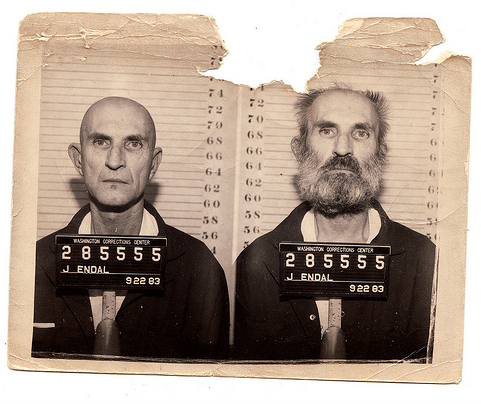
Torn Shorn, Misc. Set. Courtesy of Least Wanted aka Mark Michaelson. http://www.flickr.com/photos/leastwanted/sets/72157605201939008/
Another nod for Blake Andrews. Although not planned, it is welcome, as I think he tries keeps the blogophotosphere fresh, trying new stuff from his hideout in Portland.
Earlier this week I featured Blake’s Brief History of the U.S. Passport Photograph. An artist/collector with hundreds of Passport and ID Photographs, named Least Wanted, followed up with Blake to get the word out on his sprawling collection.
Also earlier this week, I put up a piece about the JUSTICE Art Installation in Bridewell Police Station, London. Coincidentally, one of the artists for the JUSTICE exhibition exhibition was Mark Michaelson, aka Least Wanted. It seems like a small-internet-triangle-of-providence presented itself this morning and it is up to me to draw the hypotenuese …

Head Gear, Misc. Set. Courtesy of Least Wanted aka Mark Michaelson. http://www.flickr.com/photos/leastwanted/sets/72157605201939008/
Least Wanted collects, groups and displays a huge collection of I.D. photos on Flickr. In addition to passport shots, it includes medical photographs, badge I.D. photos and other documentary ephemera. Prison Photography is interested in the majority of the collection: Mugshots.
Least Wanted’s sets are a mad enough curatorial project to keep me going for months. For now, I’ll just echo Blake’s sentiment and point you in the direction of Michaelson’s epic archive.

Austin Old Timer, Misc. Set. Courtesy of Least Wanted aka Mark Michaelson. http://www.flickr.com/photos/leastwanted/sets/72157605201939008/
The three images used in this article were drawn from Least Wanted’s misc. Set
On Thursday, 28th May, photographs of prison conditions and detainee custody from six facilities other than Abu Ghraib will be released to the public.
Reports over the weekend suggested a figure of 44, but the Guardian has stated over 2,000 photographs are to be made public. Images of Bagram Air base in Afghanistan are included in the cache. Critics will surely scan for similarities in detention/torture methods used in Afghanistan as in Iraq to argue against the ‘few bad apples’ logic that railroaded earlier attempts to bring military and government commanding authorities to full-accountability.

ACLU’s advocacy deserves international acclaim. Not only have they forced the release of photographic evidence they won a ruling to prevent the destruction of audio tapes that record torture scenarios.
This is an interesting counterpoint. I presume we all assume we’ll see the images in the printed press. Would we expect the tapes to play on our televisions and radios? That scenario makes me uncomfortable.
Continuing with issues of format, it will be interesting to see how the media presents the-soon-to-be-released photographic documents in contrast to the recent torture memo’s. WoWoWoW set the bar low with the tabloid inquiry “How Bad Will They Be?” and the Los Angeles Times allays fears with a dead-pan assessment, “examined by Air Force and Army criminal investigators, are apparently not as shocking as those taken at Abu Ghraib.
No doubt these images will be contested and a ‘Meaning-War’ over the images will ensue, but I think people for and against the Bush administration’s interrogation policies are not going to change their position now – whatever the evidence.”
But, I guess it depends who’s looking.

Lefties want more weaponry in the push for prosecution of Bush and his cronies for war crimes. The right is debilitated and otherwise occupied by the economy, stocking guns before the “Obama-ban” and the latest Meghan McCain slur.
Politicians from both parties seem to want this to go away, snarking on about how the release of yet more Un-American activities will only fuel the burning hate toward the US. This position is an insult.
Did Bush care what Iraqi’s would think when he bombed them out of house and home? Did Bush care to think how American’s would react in the face of diminished civil liberties? Yet here, politicians of both parties are scrambling to avoid the negative reactions of entrenched, fundamental opponents INSTEAD of anticipating the beneficial good-will and return to mutual trust provided by honest disclosures of a transparent and constitutional government. Why cover-up a cover-up?
Maybe, the Democrats are shy to see these documents because they may implicate their top brass?

One concern I will air, is that all this could move toward some bizarre show-trial scenario, where lawyers bargain, Bush is spared, the American public settle for a conviction of Cheney, and careers and reputations lie in waste on both sides of the aisle!?!
I certainly didn’t expect the incriminating documents to flood as they have in recent weeks. I have no idea how all this is going to shake down. Obama doesn’t seem to have control of this. That doesn’t bother me. No-one can hold back the truth.
So, as wise at it’d be to remember the date, 28th May, you should bear in mind the photographs of abuse could well leak earlier…
________________________________________________
First Image lifted from Gerry May. http://www.gerrymay.com/?p=1426
Cartoon courtesy of the Nation. http://www.thenation.com/doc/20050307/duzyj
Final Image by Takomabibelot. http://www.flickr.com/photos/takomabibelot/2090273618/

LONDON, UNITED KINGDOM - 15.06.08. A Metropolitan Police Forward Intelligence Team (FIT) photographer films and photographs journalists as police and protesters clash during a demonstration against U.S President George W Bush in Parliament Square, Westminster on Sunday 15 June 2008, London, England. Protesters had been banned by the Metropolitan Police from demonstrating outside 10 Downing Street to protest against the wars in Iraq and Afghanistan. (c) Marc Vallée, 2008. http://www.marcvallee.co.uk
After reading this phenomenal post by Jamblichus about state surveillance and electorate apathy/powerlessness in the UK, I was compelled to post the above image.
I know for two posts now in as many days I have diverged from “photography in sites of incarceration”, but this topic keeps throwing up unanswered questions.
Forward Intelligence Teams , introduced in 1996, are now central to British policing of all public crowd events. F.I.T.s don’t try to hide. They are highly visible and operate use facial recognition technology to add folk on camera to a central database.
Jamblichus raises a really important question about this. What is the nature of this database? We should all be asking these questions: Under who’s authority is the database maintained. Which government departments have access to it?
Local councils in Britain have used anti-terrorism legislation to spy on its citizens for minor infractions. What is to stop similar abuse with regard this database? The UK has built a police state infrastructure and no-one is immune to its effects should the cameras and mics be pointed their way.
Is the British Press “free” in all definitions of the term? I think not.
I am probably in the database due to my interest in a seal-hunting protest outside the Canadian Embassy of London last year. I went over to have a peek and a natter, mainly because I was shocked that anyone would want to picket Canada! When I turned to continue on my way, I had two long-range lens pointing at me.
Jamblichus points us to The Journalist which describes the Met’s purposeful surveillance of the press;
Police tactics seem to be becoming more menacing. Photographers have complained that the Metropolitan Police’s Forward Intelligence Team (FIT) — set up to target public disorder and anti-social behaviour by having high-visibility police officers use camera and video footage to gather intelligence — has started surveillance of press-card carrying journalists. They say that images of them are given a four-figure “photographic reference number” and held on a database.
I’d really like to know when they’ll need 5 digits or more!…. While we wait on that you can look over the Flickr group FITWatch.

London Metropolitan Police Anti-Photography Propaganda Campaign Poster
When I began writing this blog, it was meant as a vehicle to display the documentary work of photographers working in sites of incarceration and to generally expound the stories touched upon. It was also meant to deconstruct some of the persistent myths surrounding prisons and prison populations and how visual culture has played its part in weaving some of those myths.
Not once did I envisage the current situation whereby the act of photography could bring about the threat of detention and imprisonment. Such impingement on basic rights of expression has been known in some of the dictatorial and despotic regimes of modern history … but not so much in the West, right? The times they are achangin’.

Photo: Liam Oliver Newton Craik-Horan. http://www.flickr.com/photos/liamch/3423810669/
When my brother visited from the UK last month he couldn’t stress enough how much of a police state it has become. We reasoned that the fingerprints taken by US homeland security are know also the possession of the UK government. It used to be the case that fingerprints were only taken and kept on file in the UK if you had been convicted for a crime. How things change.
A few months ago I signed up as a member of ACLU, the decisive moment was when the ACLU representative said to me, “You don’t want the US turning out like Britain with all those cameras and surveillance do you?”

Photo: Stickerklub. http://www.flickr.com/photos/stickerklub/3420240889/
Britain really is a country that has got itself on edge; it’s culture promoting men and women in all guises of security to exert illegitimate power and enforce ludicrous policy. Unfortunately, this robotic application of rules has infected even our art galleries, as the venerable John Berger discovered.
This past months have seen a slew of stories coming out of Britain regarding the rights of photographers in public spaces. All these are in response to a slew of legislation to slowly whittle down the rights of photographers; the rights of UK citizens.
On 16th February, the Counter Terrorism act came into effect making it illegal to photograph a police officer or “elicit information” about them. The British Journal of Photography has the details.
After the disgust at such brazen restriction of rights, the response by the photographic community in London was to go to Scotland Yard, headquarters of the Metropolitan police, and in an act of mass civil disobedience take lots of photographs of lots of officers.
The Guardian UK has been the mainstream print media that has really pursued this topic, reminding us all of what we have just lost. They broke the story that Kent police monitored members of the press during an environment protest, for which the Kent constabulary have apologized.
The Press Gazette explained this tactic and the associated tension between police and photographers.
David Hoffman, a photographer with 32 years’ experience, said he now carries shinpads in his bag, claiming he had been kicked by police officers at protests.
“The police today [NUJ Protest] have been beautiful – but that isn’t always the case,” he said. “Recent protests have been very bad. The worst was October last year, at the Climate Rush demo. One copper spent his time kicking my leg. Stood there with his steel toe caps kicking away – and me, a silver-haired man. I’ve still got chunks missing from my legs five months on. They want you to think: I won’t cover it next time. They have been using FIT [Forward Intelligence Teams, who use cameras], they have been using intimidation.”
Hoffman added, “It’s important the police know they’re being watched and observed. If you don’t see what’s going on, your society’s less democratic.”

Photo: Tom Kondrat. http://www.flickr.com/photos/toguko/3409931955/in/pool-met
It is almost like the lines have been drawn so indelibly, people are having to pick a side. It is sad to see but the police fall in line with the government and the majority sympathise with the press. This has led to a conflation of stories involving the G20 protests, police misconduct, and the death of (and vigil for) Ian Tomlinson. Judging by the Guardian’s recent coverage, you’d be forgiven for thinking that London was on the edge of civic breakdown.
I think the media and the Guardian in particular are taking a principled stance here and just reminding the Met at every opportunity that they are watched and the press will not be cowed. I think most of us realise that with millions of people in possession of recording equipment it is unenforceable to stop people from documenting the streets.

Photo: Tristam Sparks. http://www.flickr.com/photos/friendly-fire/3287739662/in/set-72157613984292743/
Ian Tomlinson’s death received a lot of coverage and rightly so, but I shall wait for the inquiry ruling before making a call, despite the early damning evidence. We, however, in the business of images know that they can never tell the full story. This is now an investigation of excessive force by the police and distinct from the main issue of photographers/civil rights.
Yesterday, the Guardian published this footage of the police threatening photographers with arrest if they did not move. Again, later the force apologized. But what is interesting here is the Guardian‘s decision to line up video footage of various scenes of confrontation from different days in the right hand nav bar. It is a dossier of police activity and unlike anything I have seen in mainstream media.

Photo: Roger Lancefield. The protesters stickers read "I am not a Terrorist, I am a Photographer". http://www.flickr.com/photos/rlancefield/3285904973/in/set-72157613975803636/
From the sublime to the ridiculous, the Guardian showed that front-line press aren’t the only ones under scrutiny. Metropolitan police deleted a tourist’s photographs this week to “prevent terrorism”. Klaus Matzka, the tourist involved summed his experience up as such:
“I’ve never had these experiences anywhere, never in the world, not even in Communist countries.”
So, at best you are harassed for your photographic activity and at worst, if thought to hold sinister motives, arrested and face a 10 year sentence.

Photo: Tristam Sparks. http://www.flickr.com/photos/friendly-fire/3414147417/in/pool-met/
Before all this gets to any court, however, the clashes are felt on the street, on the shins and in the constantly diminished rights to freedom of expression. Where citizen photographers may feel powerless, it seems the press – and the Guardian in particular – are just getting powered up.
_________________________________________
Thanks to all the Flickr users credited above for their images, but more importantly their acts of documentation in the face of legislation to prevent such freedoms. I hope we all stay out of prison.

Images Unseen, Images Unknown written by a guest blogger on Prison Photography last week was well received by readers, provoking more questions and some intriguing possibilities.
Change.org offered a synopsis of the article. Change.org focused on the concluding points of Images Unseen, Images Unknown which described the culture of shame shrouding California prisons created by the control of images and manipulated invisibility.
Too many prisoners are hidden from view to serve out their time. Many prisoners refuse visits from family because they don’t want loved ones to see them in institutions that deny them individuality, work to subdue the general population, hide prisoners from society, and keep them docile.
So, the issue of self-representation and empowerment arises. Specific to my interest would be the possibilities of empowerment through photography.
Recently, Stan Banos asked me, “Are you aware of any photography programs in prison for prisoners.”
My answer, in short, is no. This doesn’t mean they don’t exist, it just means for all my searching I have unearthed nothing.
Art therapy has been explored among prison populations and recently San Quentin piloted it’s first ever ‘Film School’. The project did many things at once, teaching inmates the technical skills of documentary film making, building team work and trust; and it allowed inmates to communicate narratives of their choosing from prison life.
Inmates documented the work of the prison nurses distributing medications; filmed the prison kitchens; recorded the “wasted talent” of artists, musicians and writers within San Quentin; and studied American Islamic faith in prison.
With that in mind, we can say empowerment through the arts has been well explored and apparently successful in a number of penal institutions. However, it would seem photography in prisons has not been used as a tool for self-representation and rehabilitation … yet.

Turn Away © Stephene Brathwaite, Red Hook Community Justice Center Photo Project
The model for this type of program exists. Dozens of important non-profits use photography as a means for at-risk-youth to tell their stories. Organisations such as Youth in Focus, Seattle; AS220 Youth Photography Program, Providence, RI: Focus on Youth, Portland; New Urban Arts, Providence; Critical Exposure, Washington DC; First Exposures by SF Camerawork in San Francisco; The In-Sight Photography Project, Vermont; Leave Out ViolencE (LOVE), Nova Scotia; Inner City Light, Chicago; My Story, Portland, OR; Picture Me at the MoCP, Chicago; and Eye on the Third Ward, Houston; The Bridge, Charlottesville, VA; and Emily Schiffer’s My Viewpoint Photo Initiative are exemplars of empowerment through photography.
The Red Hook Photo Project New York offers photography opportunities specifically to a community blighted by crime. The photo project is run by the Red Hook Community Justice Center which operates many programs to improve the lives of teens within the geographically and socially isolated Red Hook Neighbourhood.
Only slight tweaks would be necessary to these types of programs for them to be effective as rehabilitative tools among prison populations. The central driving philosophy is to offer individuals a method of self-representation they’ve never been afforded previously.

A Backwards Eye © Gwendolyn Reed, Red Hook Community Justice Center Photo Project
It seems the main factor, aside of funding, for rehabilitative programs establishing themselves in prisons, is the philosophy of individual wardens. San Quentin Film School was pitched repeatedly across 47 states until Warden Robert Ayers decided to launch it at San Quentin. Likewise Burl Cain, at Louisiana State Penitentiary (Angola) has become well known for maintaining a varied roster of programs to keep inmates occupied. They include the renowned (and ethically questionable) Rodeo, an American Football league and a hospice program in which inmates volunteer to carry out the palliative care tasks.
On this evidence, it would make sense that criminal justice reformers and those interested in increasing the visibility of prisons should actively seek out wardens currently supporting novel, or even pilot, projects. Wardens currently accommodate programs in education, the arts, dog-training, first aid, video and much more. Photography could be added to that list.
There is a lot of mainstream media programs featuring American prisons – Lockdown, Americas Hardest Prisons, Inside American Jail – but of course these are all made for cable distribution and ultimately profit; their common denominator is a heightened sensationalism.

© Wayman, Inner City Light Student Photography Project
Documentary projects upholding rehabilitation and education as their core purpose are a distinctively different type of exposure. There would be no need for regional or national television channels to provide financial backing as an end (marketable) product would not be the motivation. That said, if the narratives of such documentary projects could be shown to enhance the image of an institution the prison authority might be open to trying them. The prison warden has the decision making power, so if under a wardens leadership a prison is given (positive) exposure it makes sense that the warden would be interested.
All successful rehabilitative arts programs presumably share a cooperative approach from the outset. Wardens and authorities are not to be feared or misunderstood, but can be convinced, cajoled and open to novel suggestions and programs.
Matt Kelley has suggested that the criminal justice reform community take note of wardens who are open to more transparency within their institution. Could coordinated media access drive a movement against the “invisibility” of prisons in America today?
The ideal program I envisage, would have only a small operating budget allowing pre-screened inmates to learn the practical skills of photography and apply them for the purposes of self representation.
If San Quentin can mount a film school I am sure any prison in the future can develop a Photography School? What do you think?

I Reach © Stephene Brathwaite, Red Hook Community Justice Center Photo Project
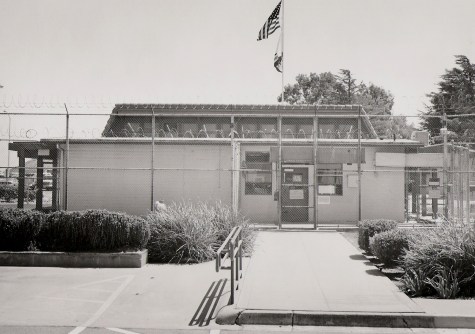
Deuel Vocational Institution, California. © 2009 Robert Walsh
Predictably, my partner is my first critic and supporter. Often distilling my whirling thoughts, she’ll draw some coherence from my arguments. I asked her to look over the photography of Robert Walsh. He had submitted his work via email. She pointed out that three of his images bore striking resemblance to school environments. I can only agree.
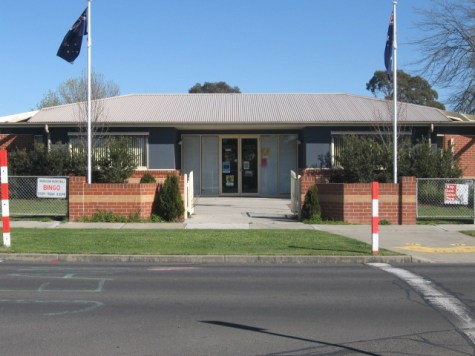
School
Of course, this is not a novel notion and philosophers have, for decades, had a field day dissecting and bisecting institutional architectural forms. I’ll add this quick post to the heap of rhetoric and swagger.
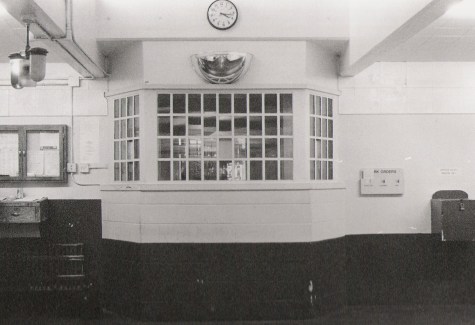
Deuel Vocational Institution, California. © 2009 Robert Walsh

Mill Creek Middle School secretary Jane Crum works beside the new buzz-in system that was installed for safety purposes at the school. Press Photo/Emily Zoladz
Maybe worth returning to would be Richard Ross‘ work. He pin-pointed the many shared criteria in institutional architectures of authority. His prints are pristine and his visual evidence compelling.

Deuel Vocational Institution, California. © 2009 Robert Walsh

School Buses in Yard
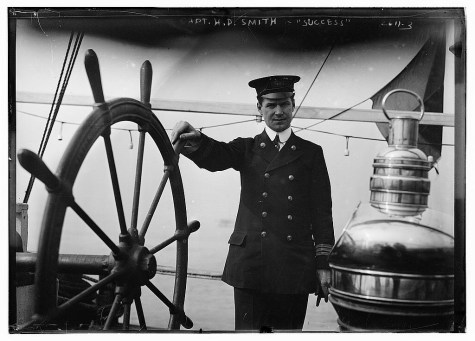
Capt. H.D. Smith of SUCCESS, Date Unknown. Glass negative. George Grantham Bain Collection (Library of Congress). Call Number: LC-B2- 2611-3
A couple of weeks ago I gave a nod to subtopia’s article on Floating Prisons. This is a topic that gets more meaty the more contemporary the examples become. The intrigue levels reach new heights when the 21st century, nautico-military gun-vessels are spear shaped, warp radar detection and travel quicker than your average barracuda. Concomitantly, the further back one ventures, prison ships are mired in the shameful times of slavery and the dirty deeds of colonial conquest.
There is a period between these two paradigms, when American authority locked up American pioneers on prison hulks. When the western expansion became western settlement, predominantly centered about San Francisco, the authority of the time needed a “bulk” solution to the settling and incorrigible population. The quickest solution to the quickest lawlessness on the continent was the prison ship.
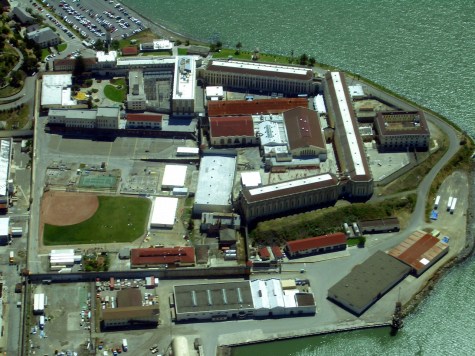
San Quentin Prison. Image: Telstar Logistics (Source)
In 1851, the first prison on the west coast of America was established at Point San Quentin, but when it was established it was not bricks and mortar but beams and gulleys. The Waban, a 268-ton wooden ship, anchored in San Francisco Bay, was outfitted to hold 30 inmates. Subsequently, inmates who were housed on The Waban constructed San Quentin which opened in 1852 with 68 inmates. Unfortunately, I could find no images of The Waban.
I think it is interesting that a “prison-as-terminal” was immediately necessary when humans reached the edge of a continent. San Quentin prison replaced the archipelago of local jails across America as a permanent and expanding facility – the final stopping point for California’s early lawless contingent.
It is poetic that the first penological-structure chosen (based on practical needs) was one that straddled land and water; permanently moored, but temporary in its utility. Carceral use demotes the ship to ‘container’ and The Waban, like its inhabitants, entered its demise.
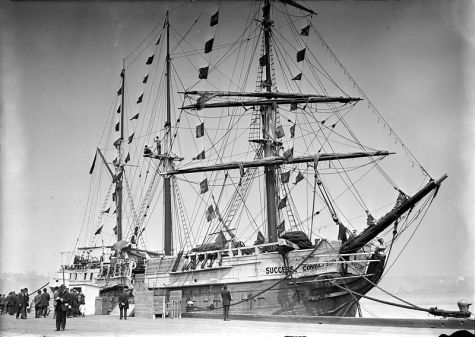
Success convict ship, no date recorded. Image: Library of Congress
Anyway, just to prove its not all bad news for prison ships, above is one of the most famous. Success was reincarnated as a global museum traveling the world purportedly as a museum demonstrating the transportation horrors of the British Empire.
Here’s the skinny, “Constructed in built in Natmoo, Tenasserim, Burma in 1840. sold to London owners and made three voyages with emigrants to Australia during the 1840s. On 31 May 1852 the Success arrived at Melbourne with emigrants, and the crew deserted to the gold-fields, this being the height of the Victorian gold rush. Due to an increase in crime, prisons were overflowing and the Government of Victoria purchased large sailing ships to be employed as prison hulks. These included the Success, Deborah, Sacramento and President.
“When no longer needed as a prison ship as such, the Success was used as a detention vessel for runaway seamen and later as an explosives hulk.
“When the Victorian Government decided to sell the last of its redundant hulks, Success was purchased by a group of entrepreneurs to be refitted as a museum ship to travel the world advertising the perceived horrors of the convict era. Although never a convict ship, the Success was billed as one, her earlier history being amalgamated with those other ships of the same name including HMS Success that had been used in the original European settlement of Western Australia.
“A former prisoner, bushranger Harry Power, was employed as a guide. The initial display in Sydney was not a commercial success, and the vessel was laid up and sank at her moorings in 1892. She was then sold to a second group with more ambitious plans.
“After a thorough refit the Success toured Australian ports and then headed for England, arriving at Dungeness on 12 September 1895 and was exhibited in many ports over several years. In 1912 she crossed the Atlantic and spent more than two decades doing the same thing around the eastern seaboard of the United States of America and later in ports on the Great Lakes.
“The Success fell into disrepair during the late 1930s and was destroyed by fire at Lake Erie Cove, Cleveland, Ohio, while being dismantled for her teak on 4 July 1946. (Source)
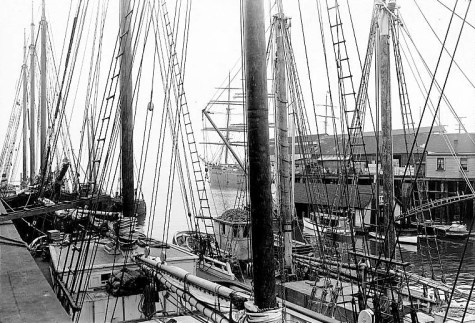
Prison ship SUCCESS, Seattle, 1915. Photographer Unknown. Image: University of Washington Digital Archives
The Success passed through the Panama Canal and spent 1915/1916 on the Pacific Coast. She drew huge crowds in Seattle. I found the image above at the University of Washington Archives, which was my main reason for constructing this post. Success also docked in Tacoma in 1916.
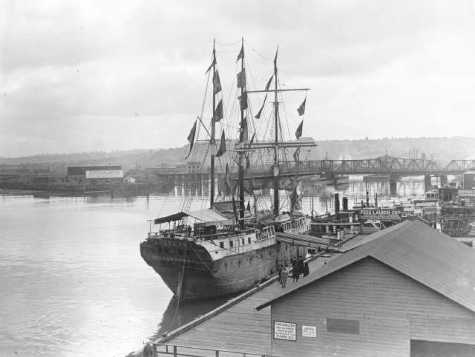
Around 1916, the exhibition prison ship "Success," from Melbourne Australia, was docked at the Tacoma Municipal Dock Landing and open for tours. Marvin D. Boland Collection, Tacoma Public Library. Series: G50.1-103 (Unique: 31555) (Source)
I guess I just like the fact the Success was repurposed so many times and for a long period of time was a museum to the macabre. Some commentators were bothered by Roger Cremers recent World Press Photo win in the “Arts & Entertainment” category for his photographs of Auschwitz tourists. I guess ‘Dark Tourism’, or Thanatourism, has always existed. 21st century generations may not be as perverse as we perceive.
__________________________________________

Inmate Jeff Curbow, 40, says he improved a watering system for the moss after others built a special hut for it at Cedar Creek Corrections Center in Littlerock, Thurston County. Credit: Ken Lambert / The Seattle Times.
Prison Photography always looks to visual sources that represent incarcerated peoples from a different perspective. Some of the best opportunities to do this is with images of prisoners employing their time in job placements, self-growth programmes and/or restorative justice & community education projects.
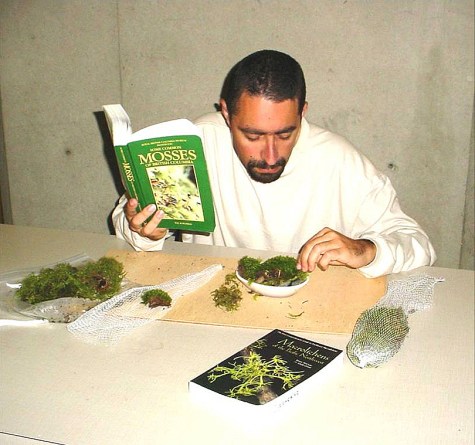
A Cedar Creek inmate and researcher in the Prison Moss Project studies mosses. Credit: Nalini Nadkarni of Evergreen State College
The Prison Moss Project, part of the Washington Department of Corrections‘ sustainability efforts uses prisoners time for the benefit of multiple causes. The project studies the growth of different mosses, cultivates the fastest growing species and sells them commercially as an alternative to mosses stripped from America’s temperate rain forests. Harvested mosses constitute a $265 million/year business. 90% of mosses come from Pacific Northwest forests. The majority of mosses are used for short lived floral-arrangement. Moss can take between 20 to 40 years to regrow even a small patch of a few square feet.
The beauty of this model based on simple scientific observation and applied methods is that it is replicable the world over. And, the business that results makes sense too.
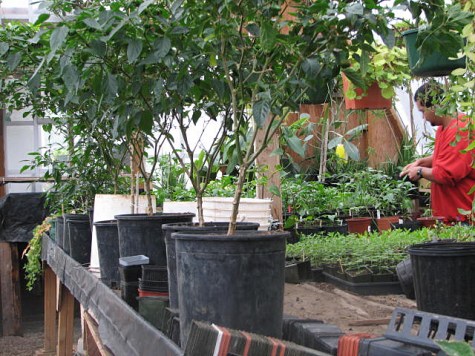
A Cedar Creek inmate and researcher in the Moss-in-Prisons project tends the garden. Credit: Nalini Nadkarni
So, the benefits? First and foremost, the inmates at Cedar Creek, a minimum security facility in the rural southwest of Washington enjoy daily active learning. Prison staff have described the facility as one without idle time among its inmate population. Engaging the bodies and minds of frequently docile populations is the first step in combating recidivism.
Concurrently, tax-payers (economically-efficient prisons), tourists (untouched old growth forests) and global citizens (robust ecological legacies) all benefit too. Finally, all this pales in comparison to the rewards for the Pacific Northwest old growth forests, which in future will not suffer unsustainable tree-stripping and moss harvesting.

A Cedar Creek inmate and researcher in the Prison Moss Project in the purpose built greenhouses. Credit: Nalini Nadkarni
How did all this start? Two convergent forces came together. The first was a general move by the Washington Department of Corrections to improve its carbon footprint, sustainability and opportunities for its inmates. This involved composting, recycling, organic farming, beekeeping at selected facilities. This green awakening fell into step with Nalini Nadkarni‘s need for extended and immediate research into moss varietal growth patterns.
Nadkarni has been called the “Queen of the Forest Canopies”. I am not one for personality worship, but let’s just say her work is socially – as well as environmentally – responsible, she knows how to work media channels, her message is imperative and the Evergreen State College in Olympia is very lucky to have her on faculty. She co-founded the Research Ambassador Program at Evergreen, which seeks to combine academic and non-academic practitioners to widen the reach of environmental dialogue and deliver relevant forms of communication to different groups; from inner city youth, to business CEOs.
It’s all about respectful communication, and it’s all for the benefit of our environmental futures.

Daniel Travatte, 36, suits up to check on the Italian honey bees he cares for at the Cedar Creek Corrections Center in rural southwest, Wash. on Friday, Oct. 17, 2008. The bees are part of a program to help the prison be more environmentally green. Credit: John Froschauer/AP
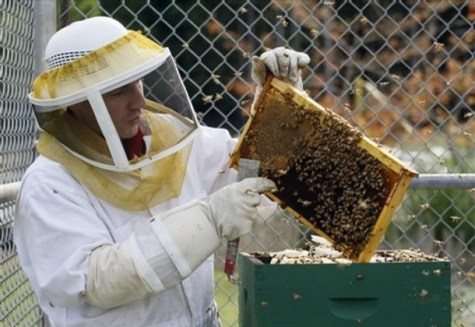
Inmate, Daniel Travatte, tends the Italian honey bees he cares for at the Cedar Creek Corrections Center in rural southwest, WA. Credit: John Froschauer/AP
The media coverage of this programme has often focused on the story of a young inmate who, since release, secured a biochemistry PhD full ride scholarship at the University of Nevada, Reno. He was imprisoned after accidentally killing his friend with his sports rifle in his student apartment. Four years later, he has continued the exceptional academic track he seemed destined to follow. It is a testament to the Washington Department of Corrections and Nalini Nadkarni (his mentor during time served) that his life has been delayed rather than destroyed.
But, he surely is an atypical case and it is a case that obscures the facts about the sustainable projects in operation at Cedar Creek. Not every inmate is a PhD candidate, but every inmate is a willing recipient of education – especially environmental education which, in many cases, is totally novel. Environmental education carries an almost redemptive message in that your actions can directly benefit everyone in modest but crucial ways. Actions based upon this new learning can be very therapeutic. Responsibility for oneself and other human beings is not separate from responsibility for our shared environment.

Inmates Robert Day (left) and Brian Deboer (right) check on plants in one of the organic gardens at the Cedar Creek Corrections Center in rural southwest, Washington, on Friday. The minimum-security prison has adopted many environmental and cost saving practices. Credit: John Froschauer/AP
I have discussed sustainability efforts in California’s prison system before. In closing I’d like to repeat the sentiments of Cedar Creek superintendents who, in attempts to convince the public of the utility of this program, talk of the direct reduction in operating costs at the facility. If commentators such as myself want to espouse the rehabilitative value also then so be it. Doubters now have firm fiscal, quantitative evidence – in addition to qualitative inmate testimonies – to shape their support for sustainability programmes in prisons. WDC senior staff are adamant Cedar Creek is the correctional model to follow in the 21st century.

Inmate Robert Knowles pitches plant stalks into a compost pile Oct. 17 at the Cedar Creek Corrections Center in rural southwest Washington. The minimum-security prison has adopted many environmental and cost-saving practices. Credit: John Froschauer/AP
There are many resources out there on the Prison Moss Project and Nalini Nadkarni‘s ongoing evangelism. I personally would recommend in this order … Nalini Nadkarni’s recent TED presentation about the opportunities for academic & non-academic communities to unite for greater good; this extended video from KCTS (9 minutes); this interview with Nadkarni; a recent Mother Jones summary of her projects and two media reports (1), (2).

 Prison Photography