
You are currently browsing the category archive for the ‘Amateur’ category.

TORTURE REVELATIONS
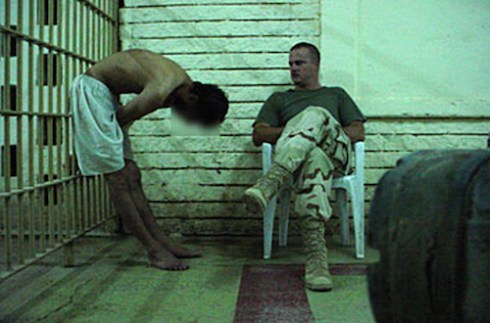
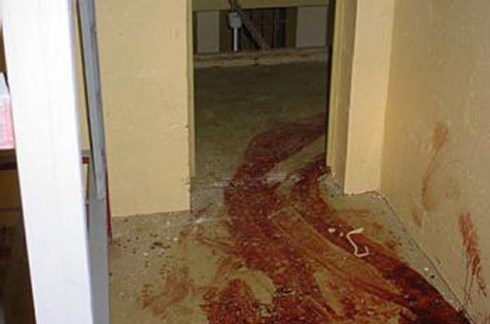
It was a double whammy this week. Everyone noticed the 6,000 page report into CIA torture. Many won’t know that today was the day that Justice Department attorneys presented the Obama administrations rationale for suppressing over 2,100 photos and videos of torture by American military personnel in Iraq, and Afghanistan.
Since 2009, the Obama administration has argued that releasing them would inflame anti-American sentiment abroad and place Americans at risk. Federal Judge Alvin Hellerstein of the United States District Court for the Southern District of New York is not so easily convinced and wants the government to explain, photograph by photograph, how each might pose a threat to national security. The fight to release these photos dates to 2004, when the American Civil Liberties Union filed a Freedom of Information Act request.
David Levi Strauss has tracked these developments from the very beginning. Several chapters in his new book is Words Not Spent Today Buy Smaller Images Tomorrow (Aperture, 2014) deal directly with the war over control of torture photos.
CONVERSATION
Strauss and I, for WIRED talked about state secrets, how the brain is wired, the political power of images and whether or not photos of Osama Bin Laden’s corpse actually exist.
WIRED: Why has the release of 2,000-plus remaining images and videos made by US military personnel in Abu Ghraib not been resolved?
Strauss: Because of the effectiveness of the images. They became the symbol of the change in US policy to include torture. Images are very powerful. That’s why the US government has become very afraid of the effects of these images worldwide.
The other amazing thing about the Abu Ghraib images was that they crossed the boundary between private and public. That is unusual. It changed things for photojournalism, for the military, certainly, and for the public at large. Prior to the release of the Abu Ghraib images, the military was handing out cameras to soldiers so that they could use photos to stay in touch with their families, and to be used operationally.
Read the full conversation: The War Over the US Government’s Unreleased Torture Pictures.
–
[All images for this Prison Photography post via Salon]


2041
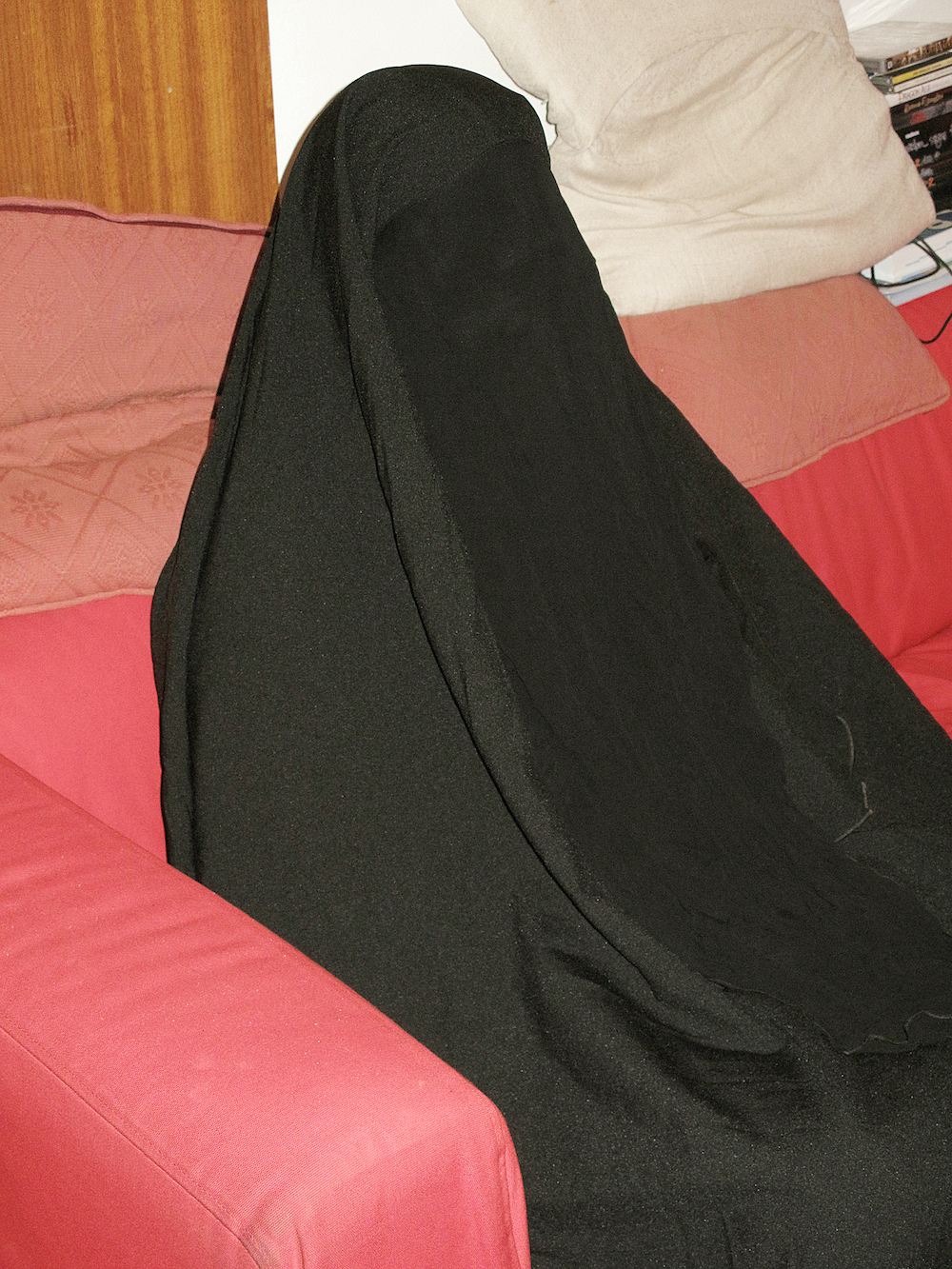
HERE PRESS has done it again; it has produced a book that allows us an irresistible glimpse into foreign space and psychology. 2041 is a collection of self-portraits, made by a man, donning makeshift burqas and niqabs, in his home in England.
The title 2041 refers to the name by which the man is known. “2041” made thousands of images with the express intent to share them online with fellow full-coverage enthusiasts.

“Using the camera to articulate a passion he has secretly indulged for decades, the artist appears dozens of times without ever disclosing his image or identity,” says the HERE press release. “Long before 2041 bought his first real burqa online, he began crafting his own versions from draped and folded fabrics in a rich array of textures and colours … ranging from the traditional to the theatrical.”
2041 is part of a connected online community of men and women from across Western Europe and the Gulf States. They are Christians, Muslims and without religion.

This is a gripping book and look into a world that cannot be fully known, nor can be fully verified. What is interesting, therefore, is that without identifiable subjects, the veracity of photography collapses. Or, at the least, we have to completely shift our expectations about what photography provides. The book 2041 is working on, and with, many levels. There’s a motivation by HERE to celebrate photography by revealing its limits and capacity. Despite a reliance on images to connect themselves, 2041 and his cohorts are inhabiting the unphotographable.
As such, 2041 is a playful but earnest exposé of the photographic medium as much as it is this small web of like-minded folks.
A similar type of mood persists in previous titles by HERE. Harry Hardie and Ben Weaver skirt the outer territories of our photo-landscape and delineate the edges. Edmund Clark’s Control Order House took us inside the ordinary domestic spaces of a terror suspect under house arrest. Power was described precisely by what was not photographed. Jason Lazarus’ Nirvana took us into grunge-infused personal histories; the photographs were just a foil to get subjects feting up about beautiful and traumatic pasts.
I, for one, am getting quite excited by HERE’s growing catalogue of ever-so-slightly-disconcerting photobooks.
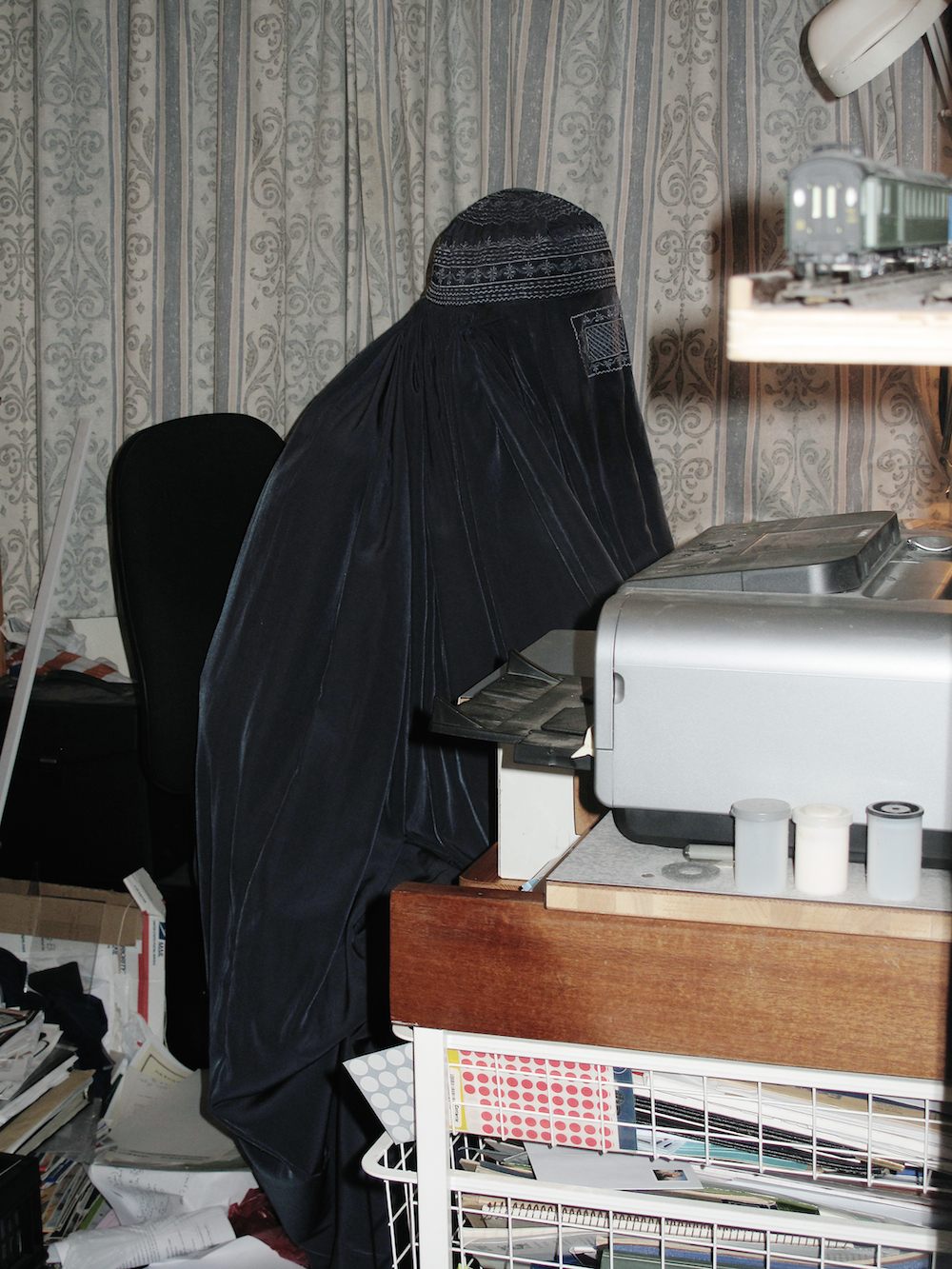
Between the internet and the veil 2041’s anonymity folds and billows. He remembers the enveloping cassocks and cottas he wore as a choirboy. As an adult, he moved toward total covering. In the early millennium, 2041 his bought his first computer and plugged into an online community that shared his passion.
“What almost all [of the people covering themselves] seem to crave is transcendence of the physical self – or at least being judged on the physical – coupled with the excitement of observing the world unseen, safely cocooned in luxuriant fabrics,” says HERE. “This is the burqa seen in a celebratory light.”
Naturally, I have lots of questions so I dropped Harry at HERE PRESS a line. He put me in touch with Lewis Chaplin who is co-founder of Fourteen Nineteen, but more importantly co-editor of 2041.
Scroll down for our Q&A

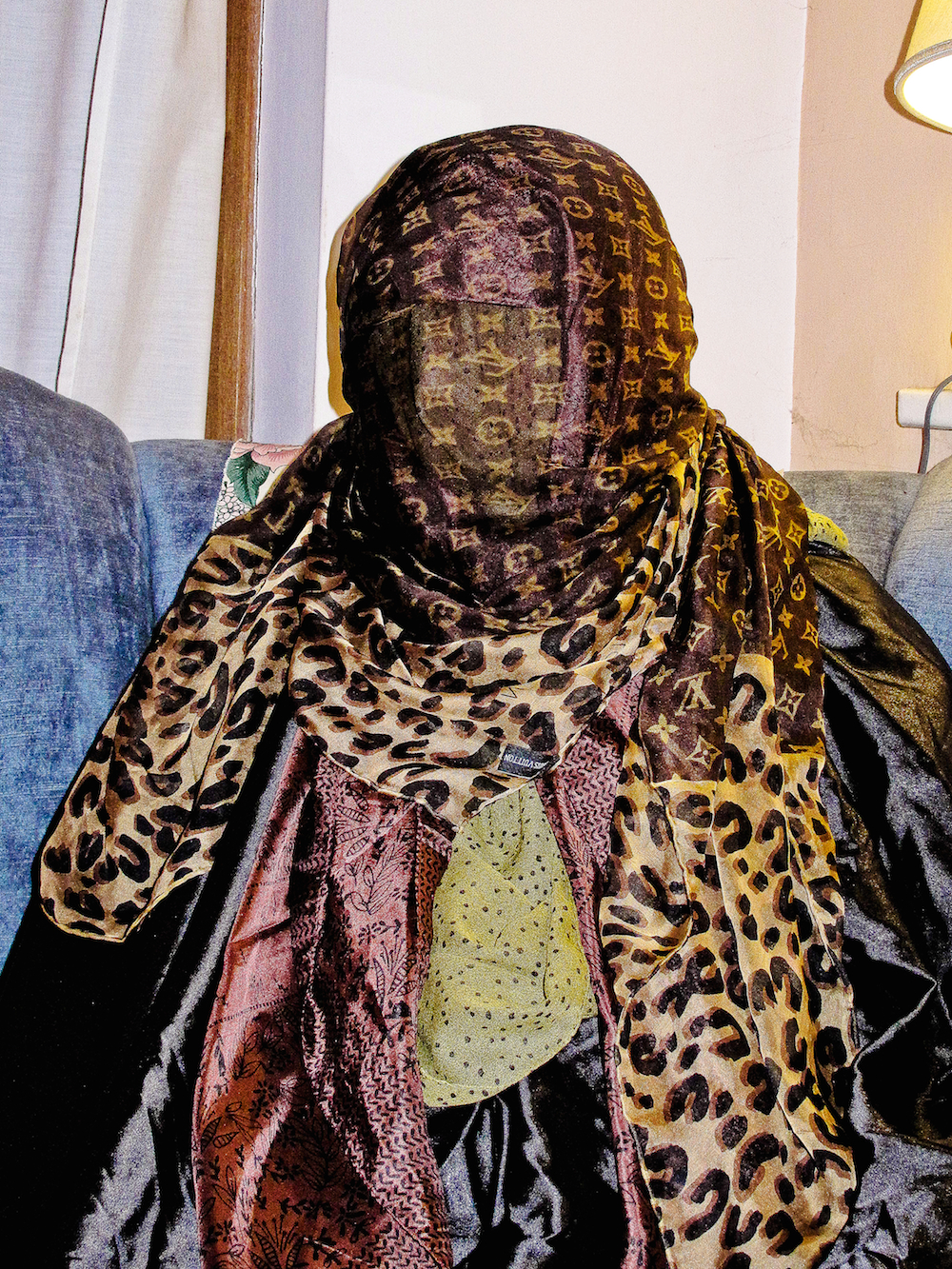
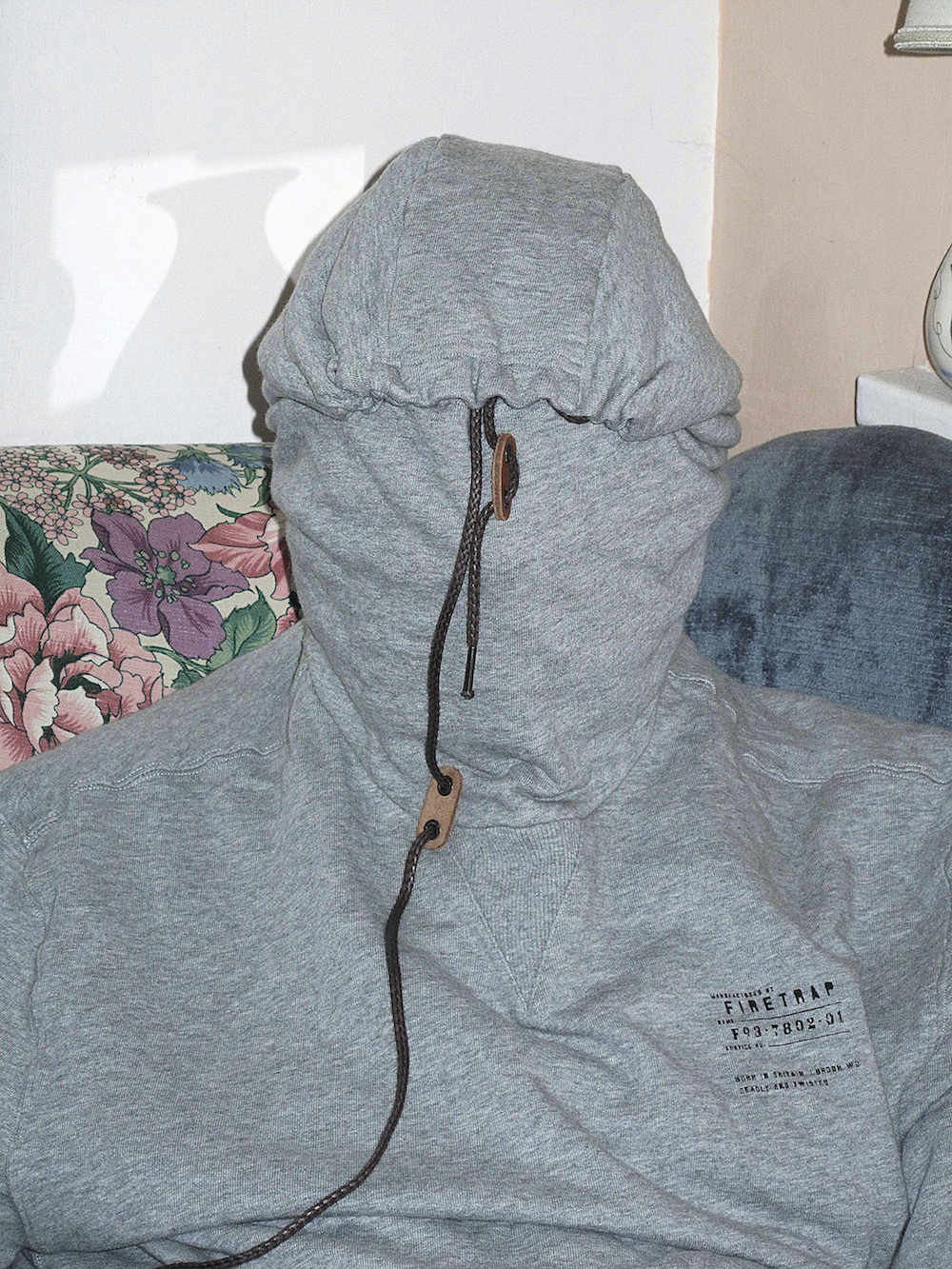

Q&A
Prison Photography (PP): Where did you first see and hear about 2041’s photographs?
Lewis Chaplin (LC): I first found these images almost four years ago, while researching emergent subcultures of fetishists/obsessives who were finding community and likemindedness through the internet. Many of these people use Flickr in particular to indulge in their private desires, and it was here that I found 2041’s images. I was struck by the rigidity, flatness and compositional skills that his images had. Compared to most who used the image more as a byproduct or vehicle to access their fetishes, 2041’s images seemed more like the images were performed for the camera and the camera only, for the sake of documentation, rather than for anything else.
PP: Is the book 2041 made in collaboration with the subject? If so, how did you make contact, build trust, ensure discretion?
LC: Yes, it is fully collaborative. Contact was made initially by Harry Hardie , who introduced himself as a publisher, and then I was bought into the conversation. I began a regular correspondence with him, which culminated in a face-to-face meeting and then visits to his house, where we collaborated and photographed each other, and I went through his image archives.
PP: Have all the pictures been verified? Can we know it is the same person under the burqas and niqabs in all the pictures? Does verification matter? Is not knowing something in absolute certainty one of the facets of the images and their use?
LC: I can verify 90% of them through their EXIF data, as we have had access to raw camera files. However, it is not necessarily the same person concealed. I think it is this lack of verification that is the titilating point of these images. Beneath the veil, your physical identity shrinks into a few gestures and outlines, and you can take on the form and countenance of another.
Even now there are images which Ben Weaver (HERE PRESS) and I cannot decide whether they depict our protagonist or others. To be certain though – this form of image-making is a firmly social practice, one based around solid online and offline networks. A few images in the book give this away, and were you to find 2041 online you would find images of me concealed, for example.


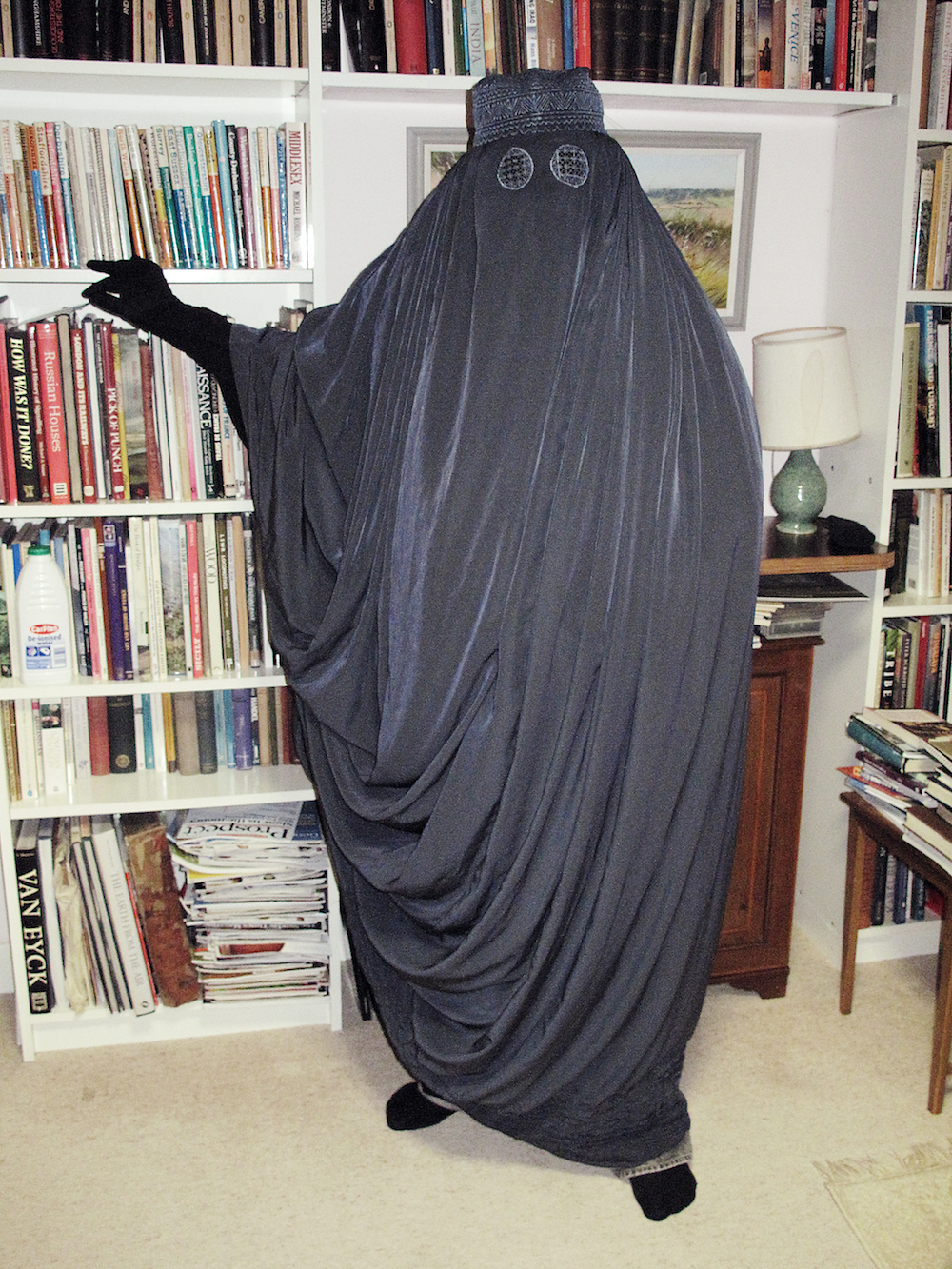
PP: Why did you want to make this book?
LC: Because I think that unlike many of the images made by people with strange interests on the internet, these images say something very complex about photography. What I like about these images is that there is that they are purely performative gestures – but yet they give nothing away. They reveal the presence of an individual, but not their likeness, or an accurate representation. Something about the concealment of desire, or the hiding of the true likeness of an object in these images actually feels like a very nuanced statement on photography, that at no stage in the process ever actually tries to use the camera to bear any details, or describe anything accurately.
PP: How many potential subjects and/or images did you have to choose from in making the book? What makes 2041’s images special — some aspects of aesthetics, or merely their availability?
LC: It wasn’t so much a matter of choice, more that these images asked for some kind of sequencing and exploring. There is definitely an aesthetic dimension of these images that is appealing – the composition and contrast between flatness and texture, the shapes are unlike others I have seen – and there is also a lot of time and effort that has gone into these. 2041 is also an actor, and a painter. You can see the influence of classical painting on some of his poses and crops. He is also akin to humour and self-deprecation, you can see it sometimes.
PP: 2041 wishes to remain anonymous. Obviously, as the editor, you’re a legitimate proxy to whom I can talk. I want to ask what 2041 thinks of the book?
LC: Let’s ask him once he has seen it!


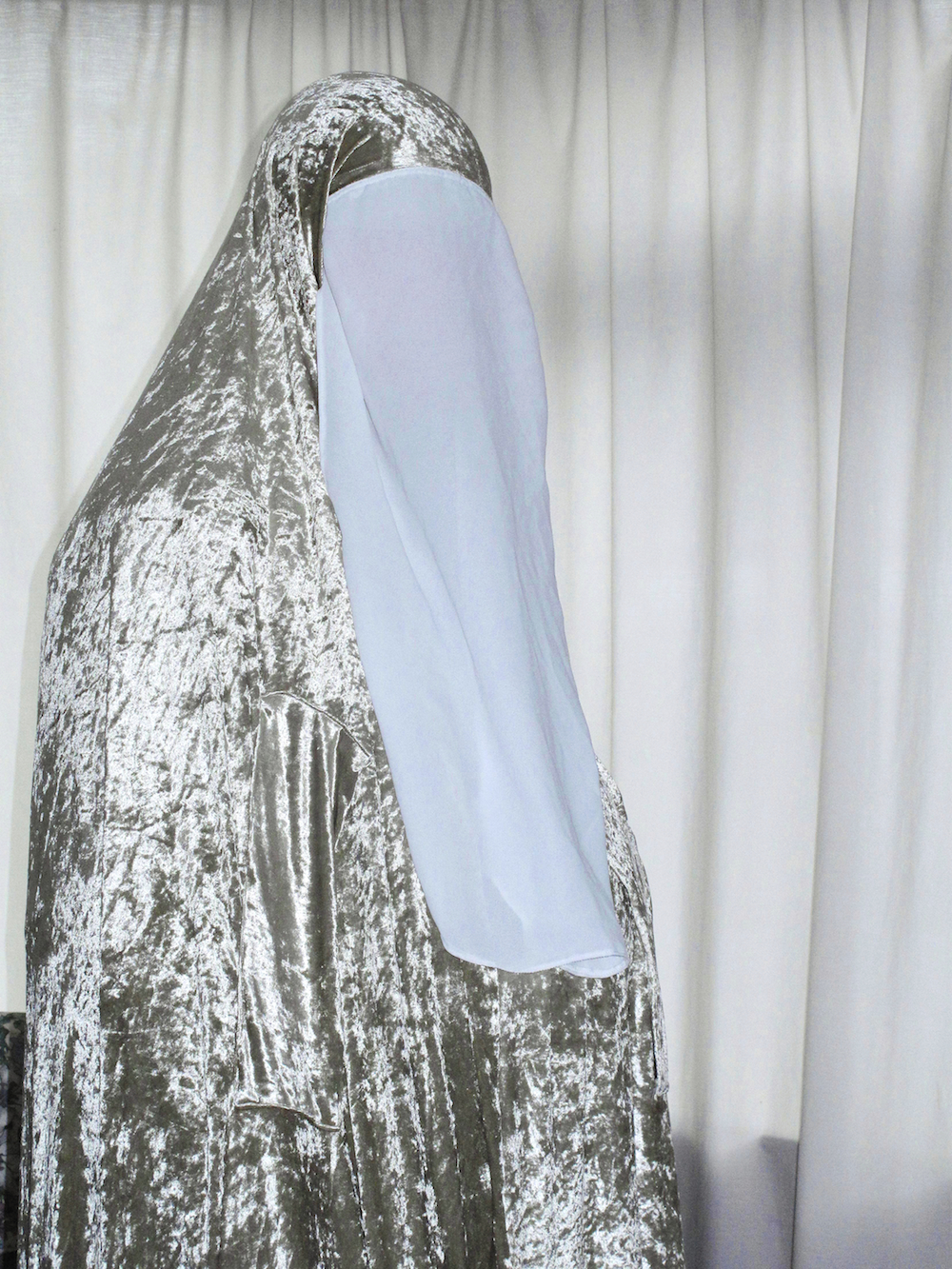
PP: What do members of the online burqa fetish community think? What do you think they might think?
LC: I don’t think it has made its way through to these channels, but I would hope that what they see here is that we are not trying to ridicule or pass judgement through our scrutiny. This book I hope comes off as a sincere tribute to photography being used in a genuinely interesting way that talks about self-perception, the way images are used on the internet and so many other things, through the prism of a very personal, domestic and specific application of the camera.
PP: Do we understand what the burqa is and what it does?
LC: In these images the burqa, niqab or any other Muslim garment is a means to an end in some way. You can see in some of 2041’s experimentations that it is just about complete coverage through any means. He is not wearing a burqa in most images, in fact. The removal of physical presence is the goal here – it is never about using the burqa in a subversive or political way.
PP: Thanks, Lewis.
LC: Thank you, Pete.

2041, the book
170 x 240mm, 120pp + 6pp insert
72 photographs + 1 illustration
Offset lithoprint on coated & uncoated paper Sewn in sections with loose dust jacket
Foil title
Choice of 3 cover ‘photo insert’ cards
Text, illustration & photographs by 2041
Edited & designed by Lewis Chaplin & Ben Weaver Edition of 500.

© Ronnie Goodman
ARTS AND RECIDIVISM
“Evidence suggests that arts-in-prisons programs lower recidivism (returning to prisons) by 27% and reduce disciplinary actions by 75%,” reads the press release for the prison art exhibition The Cell and the Sanctuary: Art and Incarceration currently on show at the Santa Cruz Museum of Art & History (SCMAH).
That’s a bold claim.
One of the great difficulties with justifying arts and/or liberal arts education is the difficulty in measuring its direct (positive) effects. Evaluation in budget-constrained prison systems is especially demanding and cynical. First and foremost, people want to know if any type of program steers a prisoner away from anti-social behaviour. If the answer is complex, partly elusive or complicated by other criteria then doubt descends, the enterprise is labeled as airy-fairy, and premise is dismissed.
In brief, prison arts programs wanting to prove themselves have a tough audience.
The effects of arts and education is difficult to track because many benefits such as relative thinking, critical engagement outside of institutional narratives, cumulative learning, etc. take years. Education is a slow build. Benefits are for years down the line; for a lifetime. Also, many prisoners are on long sentences and the primary criteria corrections departments and researchers look to – recidivism – can only be measured once a prisoner is released. The intangibles of a liberal arts education aren’t necessarily contributing to a measurable impact the next hour.
A general aura of skepticism surrounding arts and liberal arts education is compounded by the fact that research money often goes toward other prison programming (vocational, prison industries) and other evaluation first. We saw this was the case when the State of California stripped the DOC of its Arts-In-Corrections funding 7-years ago. In times of crisis, arts funding is first on the chopping block.
Despite no state funding, groups such as the William James Association continued, driven by volunteer efforts. The recent California budget has put millions back into the coffers earmarked for Arts-In-Corrections. The William James Association has returned to work in 11 state prisons.
The return was helped by the convincing results of a study, California Prison Arts Evaluation 2014, that was commissioned jointly by the William James Association and the California Lawyers for the Arts. You can download it here.
Here’s the results of the study and reason for bold claims.
The California Prison Arts Evaluation 2014 was a one-year study in four prisons revealing that arts programs improve prisoners’ behavior and their attitudes about themselves.
“A significant majority of inmates attribute their greater confidence and self-discipline to pursue other academic and vocational opportunities to their participation in arts programs, signaling a pathway for overall personal growth,” says the William James Association.
A BRIEF HISTORY OF RESEARCH
The author was Dr. Lawrence Brewster of the University of San Francisco who had, in 2012, completed a Qualitative Study of the California Arts In Corrections Program.
Prior to these two studies, there had been little research since a cost-benefit study in 1983, An Evaluation of the Arts-in-Corrections Program of the California Department of Corrections (also conducted by Brewster), which posited that society and the institutions benefited by reduced disciplinary actions, community service and beautification of the prisons.
It was high time someone brought the research up to date and dampened down naysayers and skeptics. Hopefully, the California Prison Arts Evaluation 2014 might spur other states to make a return to arts programming.
“Arts-in-prisons programs improve relationships between people within the prison as well as with guards and supervisory staff,” says the William James Association.” Prisoners exposed to arts programs are more likely to adjust to life outside prison and are less likely to become repeat offenders.”

‘Blind Curve’ (2010) © Felix Lucero

‘Lower Yard, San Quentin’ @ Ronnie Goodman

‘Baseball at Old Folsom Prison’ @ Ronnie Goodman

© Justus Evans
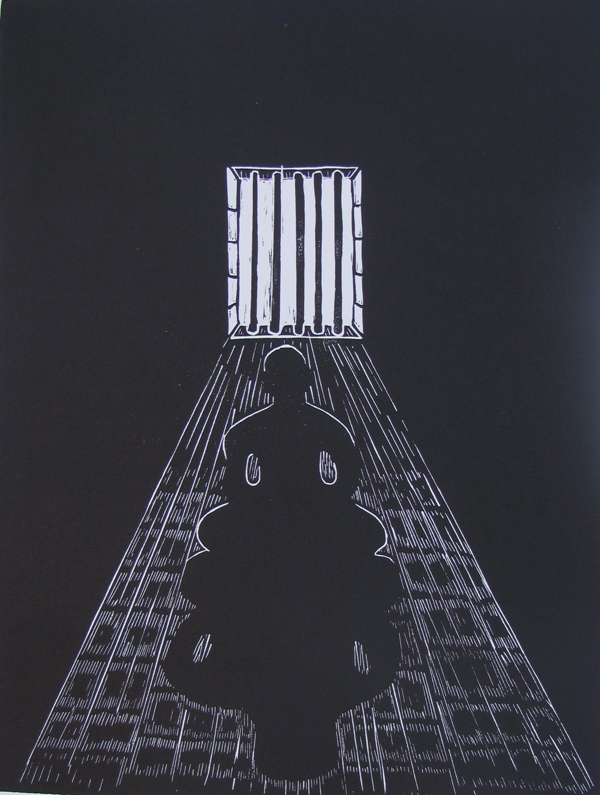
‘Obscuring Self’ © Rolf Kissman

‘Jazz In San Quentin’ @ Ronnie Goodman

‘Uphill Struggle’ @ Ronnie Goodman
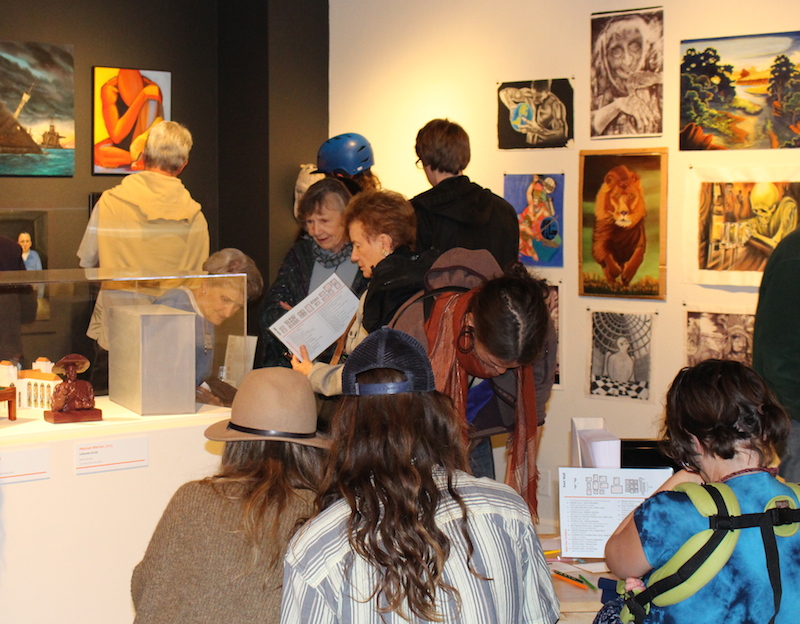
The Cell & The Sanctuary opening, Santa Cruz Museum of Art & History, November 7th, 2014. Photo: Laurie Brooks / William James Association

‘Prison Boots’ @ Ronnie Goodman

Installation view of The Cell & The Sanctuary, Santa Cruz Museum of Art & History. Photo: Laurie Brooks / William James Association

THE CELL AND THE SANCTUARY
The Cell and The Sanctuary features paintings, drawings, sculptures and writings by teachers, artists and organizations who are “working together within the prison system to provide a direct link between incarcerated individuals and something larger than their dehumanizing cells,” says SCMAH.
Artists including Ronnie Goodman, Justus Evans, Felix Lucero and Rolf Kissman (whose works are included in this post) are in the exhibition, as well as Ned Axthelm, Peter Bergne, Guillermo Willie, Stan Bey, Khalifah Christensen, Dennis Crookes, Isiah Daniels, Bruce Fowler, Henry Frank, Roy Gilstrap, Thomas Grider, Gary Harrell, Amy M. Ho, John Hoskings, David Johnson, Ben Jones, Richard Kamler, Chung Kao, Darryl Kennedy, Katya McCollah, Pat Messy, Omid Mokri, Gerald Morgan, Carol Newborg, Stan Newborg, James Norton, Eric “Phil” Phillips, Anthony Marco Ramirez, Adrienne Skye Roberts, Mark Stanley, Fred Tinsley, Tan Tran, Kurt Von Staden, Geno Washington, Michael Williams, Thomas Winfrey, and Noah Wright
The Cell and the Sanctuary: Art and Incarceration is produced in collaboration with Barrios Unidos and the William James Association (also on Facebook)
It is on show November 7, 2014 – February 22, 2015

Senseless © Felix Lucero
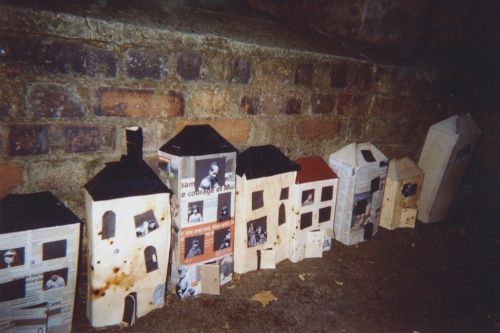
Photo: Spike Aston
Photography is often best kept simple. Likewise, the description of photography is, also, best kept simple. So let’s do that.
Disposable is a photography project that puts cameras in the hands of a dozen or so homeless men and women in London, England. Very straightforward. Disposable garners images that have given – in their production – moments to create and reflect, and – in their viewing – moments for reflection upon creative practices toward a more equal society. Right? What use is this post, and what use the participants’ efforts, and what use the program coordination efforts of Adele Watts if we’re not to reflect on the issues of poverty and homelessness in our society?
Disposable began in 2012. Disposable is grassroots. The men and women involved consider themselves a collective.
Watts worked closely with homeless artists over the period of a year and developed a body of original photographs.
“Without a brief, each participant took single-use cameras away, returning them a couple of weeks later to be developed and to look though the work and discuss it together,” explains Watts.
“Photography is a science of seeing. I like to see ordinary things too because they can tell you a lot about where you are if you don’t know. You can discover many beautiful and interesting worlds that don’t seem like worlds without photography,” says participant Spike Aston.
In the past 18 months, Disposable has mounted three exhibitions — at a Central London outreach venue in April 2013, and later at Four Corners Gallery, Bethnal Green in October 2013 and Ziferblat, Shoreditch in August 2014.
“Disposable allows us to view homelessness from the rich and insightful perspective of those experiencing it, but does so with refreshing subtlety. This is achieved through a belief in cultivating authorial voice and expression without exception, which is truly at the heart of the project and all those who have brought it to life,” says Claire Hewitt who provides texts for the Disposable newsprint publication. “I was overwhelmed by the ways in which they had each nurtured their own visual languages.”
A collection of photographic works by Bill Wood, R.O.L and Spike Aston, Disposable’s most devoted members — has now been brought together in a 16-page newspaper publication.
The Disposable newsprint publication is available as an insert to the latest issue of Uncertain States a lens-based broadsheet. It is distributed through and available at: Brighton Photo Biennial 2014, V&A London, Tate Britain, Four Corners Gallery, Ikon Gallery & Library of Birmingham, Flowers East, Turner Contemporary, Margate.
Keep in touch with the project via Adele Watts’ website and Twitter, and the Disposable Tumblr.
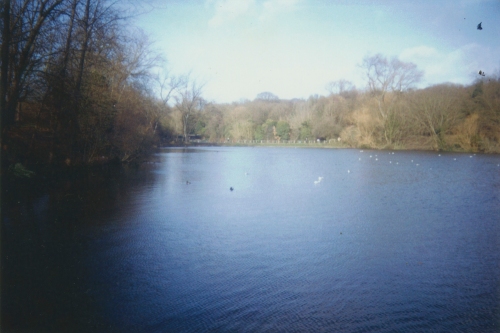
Photo: Bill Wood
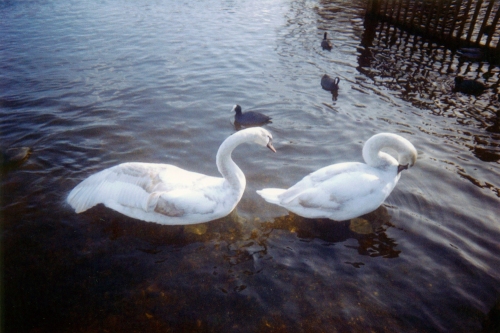
Photo: Bill Wood
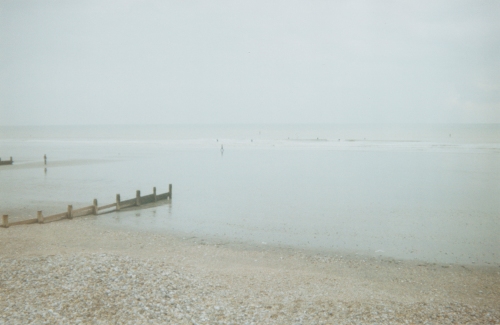
Photo: R.O.L.
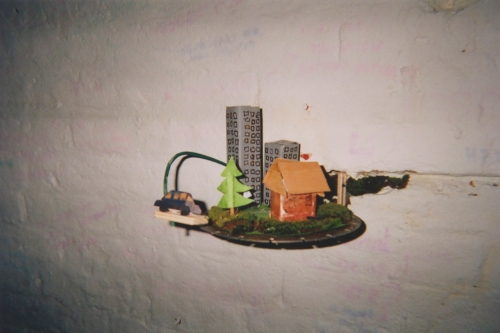
Photo: R.O.L.
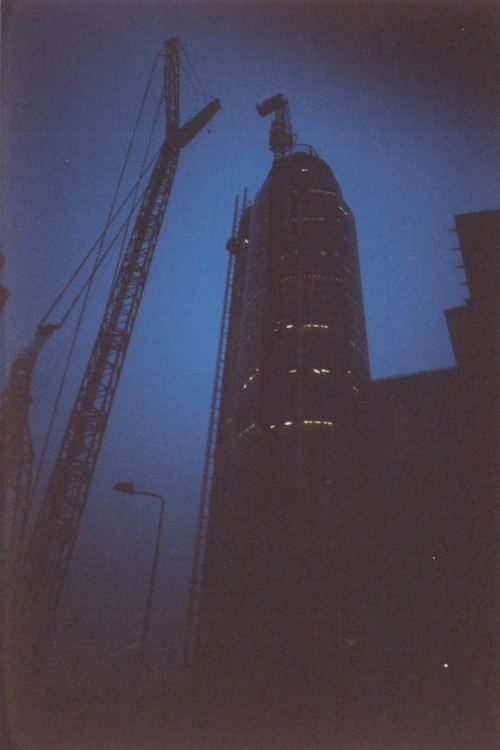
Photo: R.O.L.
Photo: Spike Aston
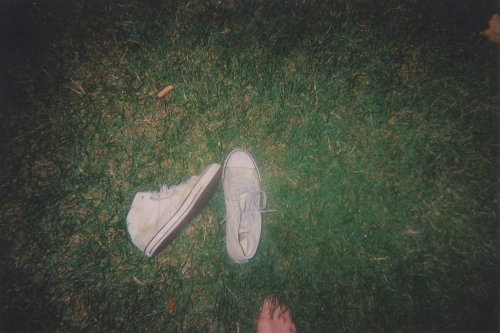
Photo: Spike Aston
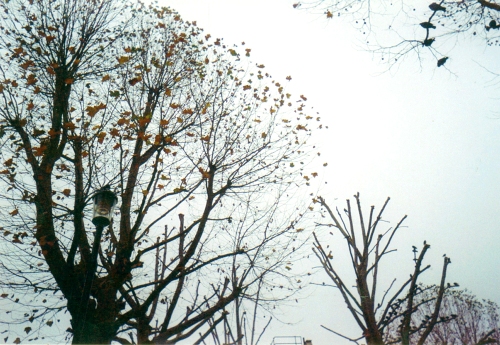
Photo: Spike Aston
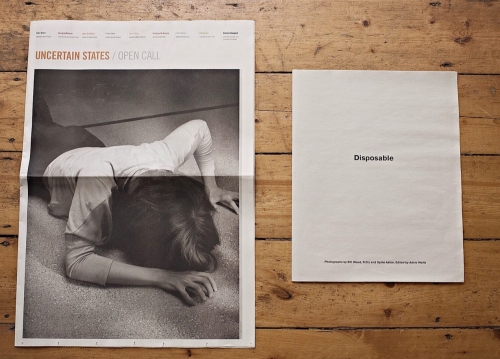
Disposable Insert. Uncertain States. Open Call. Issue 20
Disposable
Edition of 5000 copies
290mm x 370mm
16 pages printed full colour on 52gsm recycled newsprint. Inserted into Uncertain States Issue 20, a lens-based broadsheet.
Photographic works by Bill Wood, R.O.L & Spike Aston.
Texts by Clare Hewitt & Jenna Roberts.
Edited by Adele Watts.
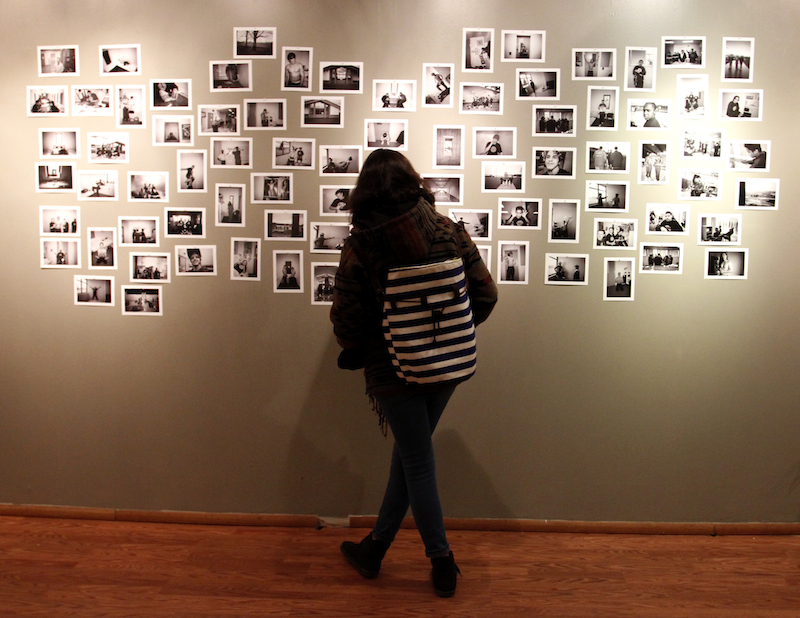
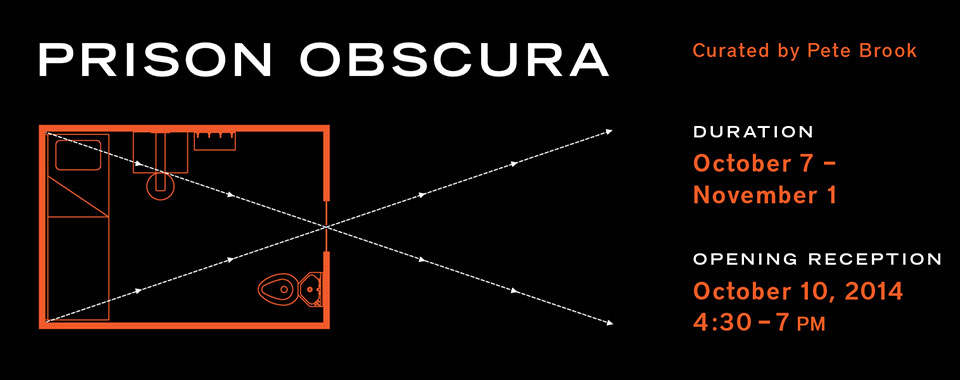
Prison Obscura continues to travel. If you’re in or around New Jersey then you should know a version (a tighter edit) of Prison Obscura is currently on show at Alfa Arts Gallery in downtown New Brunswick. The show runs until November 1st.
The official opening was last Friday (10th) and coincided with the Marking Time: Prison Arts & Activism Conference at Rutgers University and hosted by the Institute for Research on Women (IRW). To give you a taster of the presentation, below are some snaps taken by staff at Alfa Arts Gallery. But not before a few notes of thanks …
GRATITUDE
I’d like to thank Alfa Art Gallery-owners Chris Kourtev and the entire Kourtev family for generously giving over their space for three weeks to house the show. Thanks to Nicole Fleetwood, Sarah Tobias and all the staff at IRW involved in bringing Prison Obscura to NJ. Thanks for a wonderful conference too!
I’d also like to extend my thanks once more to Matthew Callinan, Associate Director of Cantor Fitzgerald Gallery at Haverford. Matthew continues to make sure the logistics for each venue are taken care of and, in this case, gave up an entire Sunday to drive from Philadelphia and install the show. Thanks to the staff at John B. Hurford Center for Arts & Humanities at Haverford, who continue to support the exhibition.
For more information about the exhibition, visit the Prison Obscura website.


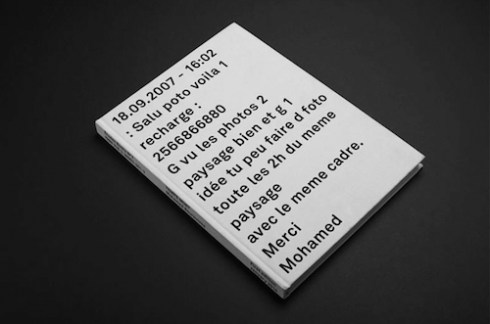
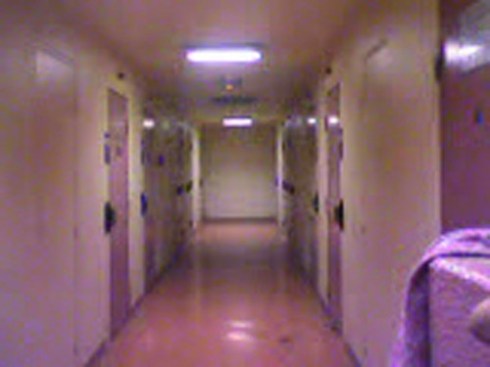
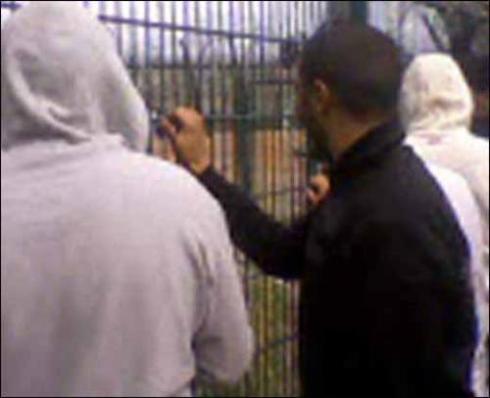
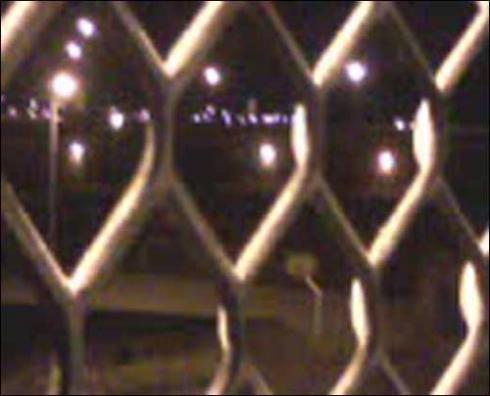
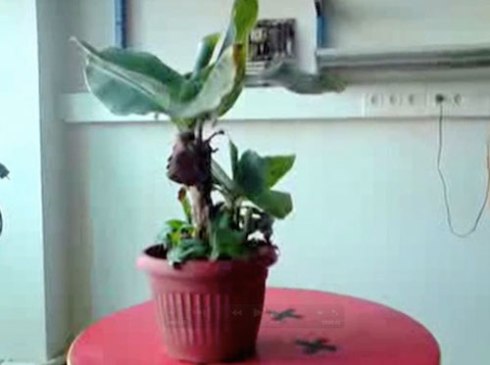
Ever since I came across the work Temps Mort it has haunted me. Haunted me in a good way; it has stayed with me. It resonates because of the power delivered by Mohamed Bourouissa and his collaborator’s low-res images. It resonates, also, because this is the only project made by an artist and prisoner with contraband cell-phones that I know of. Surely, there are exchanges like this happening all the time, but this is the only published example. And it was made with the express intentioned to make art.
So I was pleased to discover, recently, that Temps Mort is now a book.
Methodologically, Bourouissa is way ahead of the game. As well as asking for images made according to description and sketches, he asked for videos. Bourouissa would send example videos and his collaborator (whom we know only as Al) would mimic. Throughout the project, Bourrouissa is clearly thinking about how the work will look to secondary and tertiary audiences. We are asked to make sense of seemingly random glimpses of an institution’s innards.
In exchange for composed views of the inside, Bourouissa sent short videos of the Paris streets. The simplest gestures become impressive. Even the txtspk language that is reproduced in the book is touching. In prisons, cellphones are illegal, valuable and a scarce resource, but the two use the tool with abandon and they repeatedly text to make sure they’re adequately fulfilling one another’s requests for footage.
This is not a photobook heavy on photos, yet everything inside depends on the discussions about images between Bourouissa and Al. There’s a lot of white space. The texts ensure we know the timeline and the white space ensures we know — and sense — the slow passing of time.
Temps Mort is over 5 years old now and the book feels a little like a memorial to that audacious moment when an artist dared and a prisoner dreamed. The book is a document that will last longer than the exhibitions and the interest in cellphone videos that declare a moment in Parisian jail operations. This blog post is many more steps removed from the original gifts between Bourouissa and Al. This blog post has no audio/visual jacks nor 9-foot white cube walls. This blog post lags behind the thrill of the original creation of the works and behind the recent exhibitions Bourouissa has mounted. My humble hope, here, is to impress how impressed I am. There’s nothing like this project.
There’s been many projects made in collaboration with prisoners from Virginia to Tennessee, and from Louisiana to Illinois, artists have communicated with prisoners to conjure something beyond the limits of the cell. And yet, none of those efforts have used the illegally smuggled mobile phone as their tool. There’s a subtle two fingers to the man in Temps Mort that we shouldn’t deny. I’m inclined to celebrate it.
Here’s some images and videos appropriated without permission from the web. Enjoy.







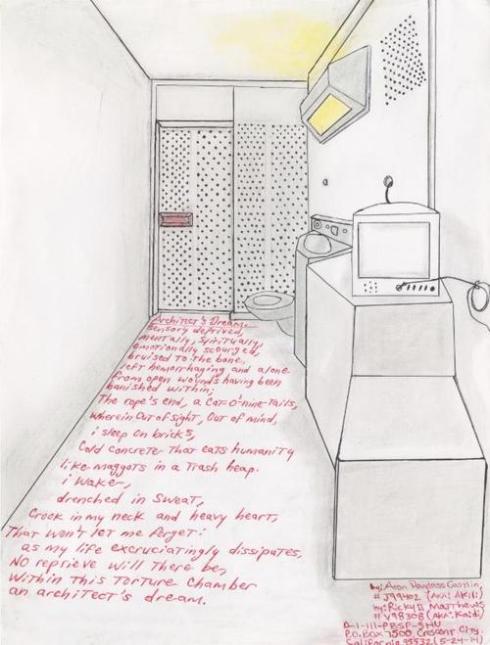
I’ve wondered before where all the photographs of solitary are. This question presupposes that the American public’s exposure to the inside of these modern dungeons will spur a degree of enlightenment, consternation and protest.
Putting the veracity of that string of causality aside for a moment, it might be worth saying that photographs are perhaps not necessary to stir emotional and political response. Maybe sketches can do these things as well, or better?
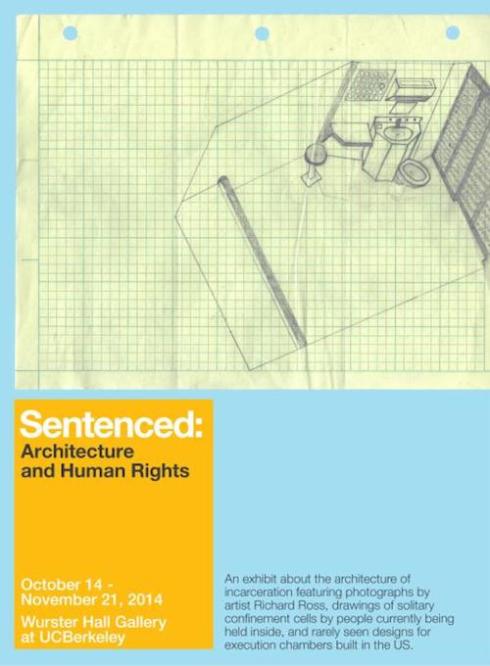
An opportunity to discuss this will arise in the next few weeks at the UC Berkeley’s Wurster Hall Gallery, in the College of Environmental Design.
Architects/Designers/Planners for Social Responsibility (ADPSR) present “Sentenced: Architecture and Human Rights,” an exhibit about the architecture of incarceration featuring drawings of solitary confinement cells by people currently being held inside.
In addition, rarely seen designs for execution chambers built in the U.S. and photographs by Richard Ross will be on show.
“Sentenced: Architecture and Human Rights,” highlights problematic and little-known spaces within United States prisons and detention centers that house activities deemed to violate human rights. What do these spaces have to teach us about the state of freedom in America?
The exhibit is free and open to the public M-F 10-5 until Nov. 21st, and the opening reception is this Tuesday, October 14th from 6-8pm, at which author Sarah Shourd, Professor Jill Stoner, and architect John MacAllister will be in attendance.
Here’s the announcement and here’s the Facebook event page.

Aug 12 – dbtvcampaign: #IfTheyGunnedMeDown which pic would they use? Thank you @underserverillance for Helping @dbtv13 shine light on the tragic shooting of 18yr old UNARMED Mike Brown, shot and killed by a St. Louis County police officer, show support by posting your photos! | Join in this movement. #DBTV #JPA #JusticeforMikeBrown #IFTHEYGUNNEDMEDOWN (Instagram)
“America. How do you think we look when the world can see you can’t come up with a police report, but you can find a video?”
— Rev. Al Sharpton, speaking at Michael Brown’s funeral, Friendly Temple Missionary Baptist Church, St. Louis, August 25th, 2014.
POLICING, IMAGING AND REIMAGINING POLICING
In the wake of Michael Brown’s killing by a police officer, the United States has been asked to look at itself in a grave and deep way, once more.
The Brown family, the Ferguson community and America generally must figure out how to turn a tragedy into a movement. The Brown family shouldn’t have to do this; they should be living normal lives, but once that police officer shot six bullets into Michael, their lives took an uncontrollable turn. Strength to them and to their ability to carry a movement born of circumstances no parent would want to endure.
Racial profiling is a national problem — the New York Police Department’s Stop & Frisk policy being the most overt example. Police abuse exists and minorities suffer the brunt of that abuse. The extent to which reports of mistreatment have declined among forces who adopted lapel-cameras for their officers is eye-opening. In Rialto, California — the city widely cited as the earliest pilot program of police officer body cams — had all 70 of it’s officer wear one. Between February 2012 and February 2013, public complaints against officers plunged 88% compared with the previous 12 months. Officers’ use of force fell by 60%.
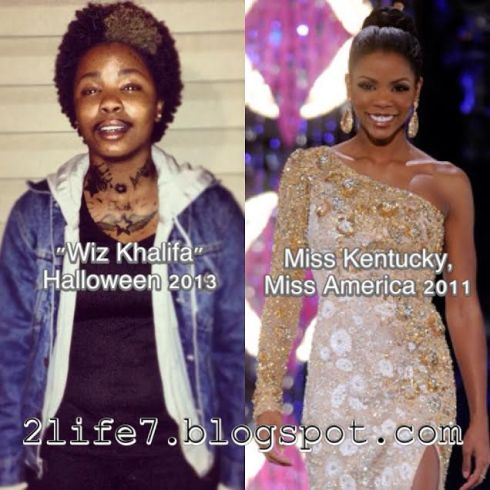
Aug 14 – djuantrent: #ForThoseWhoHaveBeenGunnedDown “…because our souls cannot rest at the hands of injustice.” More on Djuan Trent’s blog)
Following Ferguson, a renewed call to look at policing rings loud. The figures from Rialto and other pilots like it prove problems exist. We must remember that these figures are merely late confirmation of what poor communities have known and experienced for decades — that they receive a particular and disproportionate amount of scrutiny.
[Ferguson police have started to wear body cameras, albeit 50 cameras donated by two private companies.]
Thinking about these convergences of issues, it’s surprising how much of the conversation comes back to sight: What is the nature of watching a police search? How do we see our society? How do we see class and race? How do people see the police force? How does the state see, monitor and discipline the citizenry? How are images and imaging technologies used to put forth a case when accounts conflict and versions stand to convict or acquit?
How bad does it look when police roll in military armored vehicles in the face of peaceful protest?
These preoccupations over perceptions and narrative were never more in evidence than when the Ferguson police, who unable and/or unwilling to present an officer’s name or autopsy report to the enraged public, were able to publish a corner-store CCTV camera showing Michael Brown push the store owner. Quite how some unrelated grainy footage impacts the facts of a cold-blooded murder is beyond any of us. In the early scramble to win over the public during what quickly developed as a cops v. community narrative, the police turned to video. Desperate and insulting.

Aug 13 – phoenixpsyd: If I were killed by police today, which picture would they use? #IfTheyGunnedMeDown #WhichPictureWouldTheyUse #IFTHEYGUNNEDMEDOWN (Instagram)
WHICH PICTURE WOULD THEY USE?
As awkward and insulting the police’s use of imagery was in the wake of Brown’s murder, the visual strategies employed by protestors was subtle, simple, subversive and hard hitting. On the streets, protestors walked with their arms in the air. Across the nation, the Tumblr Which Picture Would They Use gave young black Americans the opportunity to simultaneously show their support for the Ferguson protestors, skewer the media, and critique the duplicitous versions of character cast open them by wider society.
I am so impressed by Which Picture Would They Use. Its question is so simple and its rhetorical strategy so strong.
People of colour are subtly vilified daily, and young people of colour more so. Selfies are the snap of choice for many youngsters and Which Picture Would They Use is populated with dozens. This Tumblr shows that young millennials are savvy, canny, funny and more visually literate than us older folk. It shows that they’re totally hip to the media’s rating games. It’s a political engaged use of selfies and Tumblr’s “Like-culture.”
Which Picture Would They Use is a off-the-cuff (off-the-camera) stick in the eye to an ambivalent media. It doesn’t take much time, but the crowdsourced results are striking. Some might say youth might have been primed for this discussion (and controlled anger) following the politics surrounding the images of Trayvon Martin and George Zimmerman used in the media. But that would be glib. I would say each of the Which Picture Would They Use contributors are responding to years of experience and observations.
Which Picture Would They Use puts to bed the “conversations” about hoodies and the associated issues — race; presentation of the self; perceived dis/respect for adult America; generation gaps; and popular culture.
Hoodie or not, sports team colours or not, cross-dressing, swimwear or military fatigues, it doesn’t matter. Which Picture Would They Use demonstrates that we’re all combinations of many different traits and our personalities are not fixed. It is ludicrous to reduce a person to a single reading based upon the appearance of a dominant (most widely-circulated) image.
The young black Americans submitting to Which Picture Would They Use know Michael Brown had already been judged by a portion of America and know the remainder would judge (even if unconsciously) based upon the media’s choice of images.


 Prison Photography