
You are currently browsing the category archive for the ‘Documentary’ category.
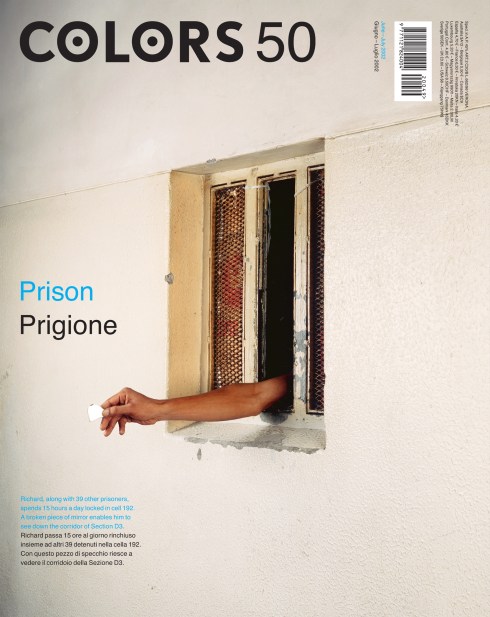
Front cover
COLORS magazine first fell onto my radar last year when reviewing Broomberg & Chanarin’s work. It cropped up again in March when I delved into Stefan Ruiz’s early career. All three were creative directors in COLORS continually rotating roster of aesthetic leadership.
Based in the north Italian town of Treviso, COLORS is part of the publishing activity of Fabrica, Benetton’s communication research centre. Benetton’s searing brand-making hit my young retinas with its controversial United Colours of Benetton (billboard) ad campaign of the early nineties.
Besides Saatchi and Saatchi, Benetton was the only time in my childhood I was aware of the names behind billboard products. That is an assumed level of cultural penetration, but I’m working from precious memory too much to determine its significance.
[As an aside, Enrico Bossan Head of Photography at Fabrica and Director of COLORS Magazine was co-curator for the 2011 New York Photo Festival. He also founded e-photoreview.com in 2010, which delivers without no-nonsense video interviews with photographers.]
The 50th edition of COLORS (June 2002) focused specifically on prisons. From the introduction:
With over eight million people held in penal institutions the prison population is one of the fastest growing communities in the world. In the United States, a country which holds 25% of the world’s prison population but only 5% of the world population, prisons are now the fastest growing category of housing in the country.
For COLORS 50 we have visited 14 prisons in 14 countries and asked a difficult question: Is it possible to rehabilitate a person back into society by excluding them from it? We spoke to murders, rapists, pedophiles, armed robbers, thieves, frauds, drug dealers, pick pockets, high-jackers and prison wardens. In most cases the stories we heard confirm one thing. That prison does not work. In COLORS 50 we ask the inmates themselves to suggest alternatives.
The magazine is 90 pages of portraits and interior landscapes. I came to this collection of work late (in my research here at Prison Photography) and in many ways it challenges many of my former presumptions. This edition is a precursor to the “VICE-aesthetic” celebrating the battered and broken, and I’d be happy to dismiss it if it weren’t for the long-form statements made by the prisoners, which are printed with care and without censorship.
The issue includes bodies of work by photographers I was previously unaware of including Juliana Stein, Vesselina Nikolaeva, James Mollison, Charlotte Oestervang, Suhaib Salem, Federica Palmarin, Mattia Zoppellaro, Ingvar Kenne, Kat Palasi, Dave Southwood, Gunnar Knechtel, Pieter van der Howen and Sye Williams. I will be featuring selections of these photographers over the next few weeks.
I bought the paper edition, but you don’t have to as the entire Prison/Prigione Issue 50 can be viewed online.
Above all, while browsing the images and stories of the magazine, I am really pressed into thinking about the ease with which a commentator can politicise and argue against the prison system in America, but be flummoxed when asked to appreciate prison systems elsewhere. Benetton uses the common theme of incarceration to raise questions, but I am at a loss to think of common answers to tackle the pain, blood and damage done to individuals in their lives before, during and after imprisonment.
At a surface level this is car-crash photography; a look inside worlds we’ll never know, but at its heart it is a call to think about the nature of humanity and to think about the capacity for humans to kill, to survive, to get addicted and to repair and to forgive.
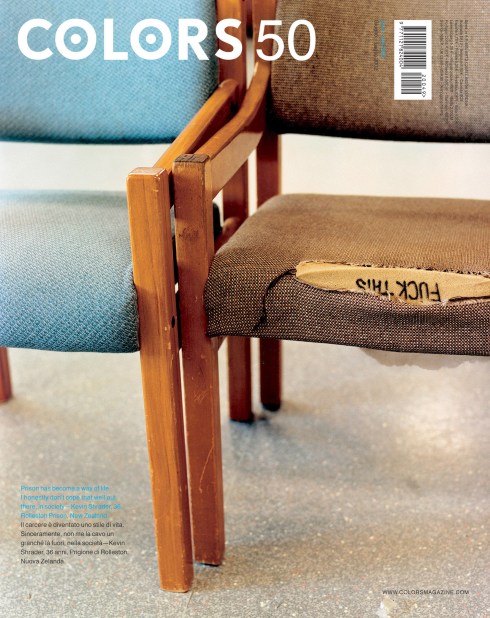
Back cover

The funeral of Horacio Bau a montonero militant from Trelew in the Argentine patagonia. He disappeared in La Plata in November 1977. His remains were found and buried nearly 30 years after. © João Pina
About this time last year, LENS blog featured João Pina’s ongoing project Operation Condor (since renamed Shadow of the Condor). Daniel J. Wakin wrote, “Operation Condor was a collusion among right-wing dictators in Latin America during the 1970s to eliminate their leftist opponents. The countries involved were Brazil, Argentina, Chile, Paraguay, Uruguay and Bolivia.”
João Pina has broken up those six countires into three segments and is currently raising funds via Emphas.is to complete the first focusing on Brazil.
Pina has already interviewed victims and families in Brazil:
In Recife in northeastern Brazil I interviewed and photographed Elzita Santa Cruz, a mother of ten who is now 97 years old. In 1964, when Brazil’s military dictatorship began, several of her children were arrested for political reasons on different occasions. In 1974, one of them, her son Fernando, became Brazil’s first politically “disappeared” person. Since then, Elzita has been demanding that the Brazilian authorities open their archives and explain what happened to Fernando and the other victims of the twenty-one-year dictatorship.
Having worked across South America for six years already, Pina will, as he intends, be able to create a “visual memory”, but as for making evidence for “use by a number of human rights organizations which are still trying to bring those responsible for Operation Condor’s repression to justice,” well, that’s an ambitious goal. Nevertheless, as a documentary project the subject is ranging and imperative. Good luck to him. I’ve stumped up some cash, so should you.
See the Emphas.is project page for Shadow of the Condor and see Pina’s video pitch.

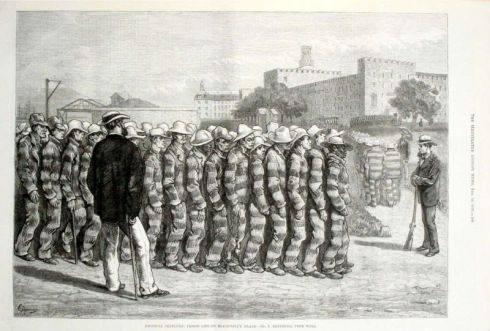
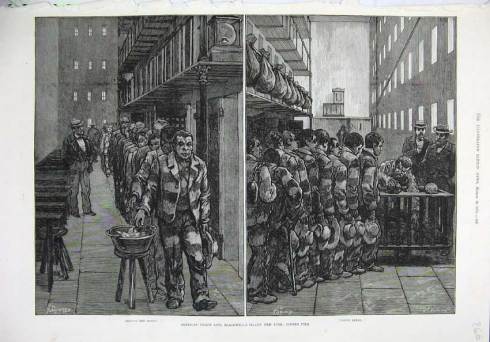
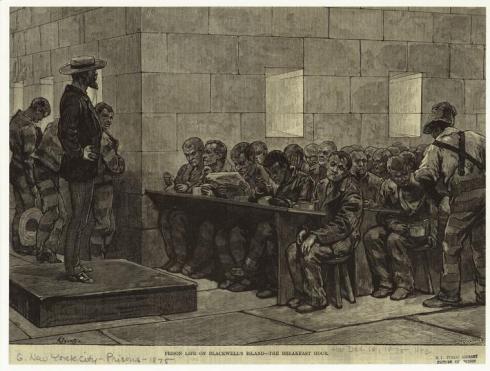
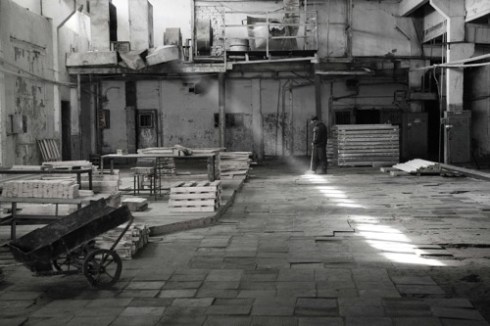
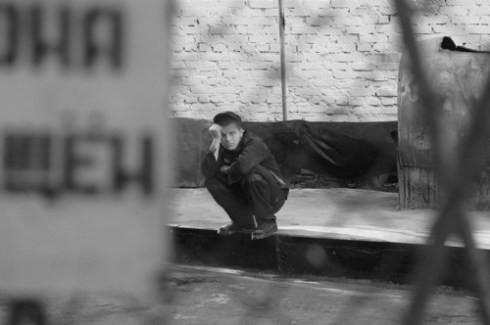
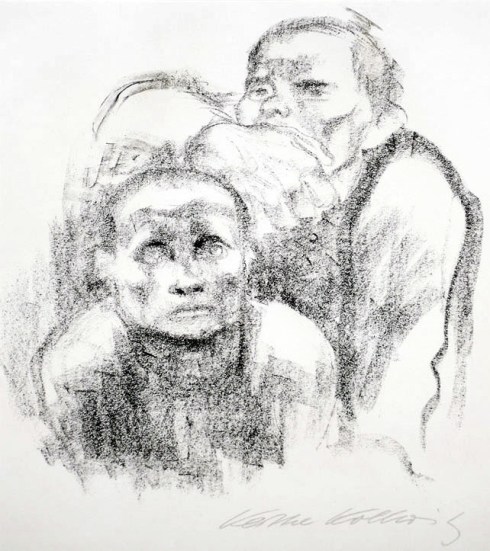
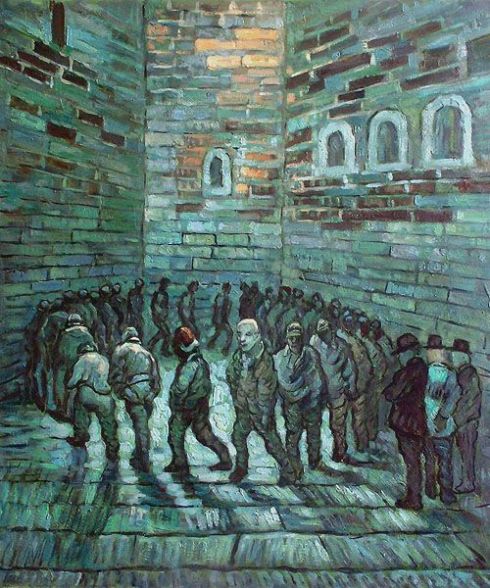
Earlier today, I posted House of the Dead (or How We See and Expect Tropes in Photographs of Russian Prisons) with images of blighted prisoners from art history. Regimented and downtrodden, the subjects of these historical works seem to me like precursors for the B&W grey photographs of Russian prisons, even today.
It was a set-up of sorts.
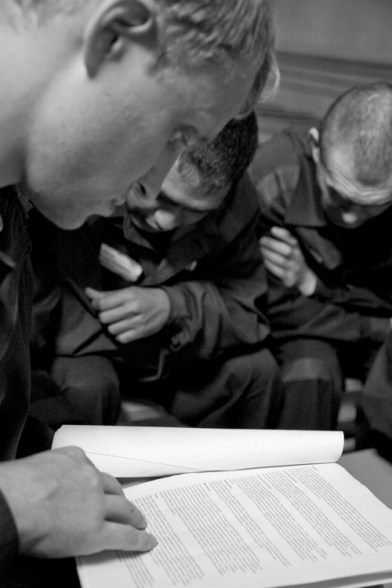
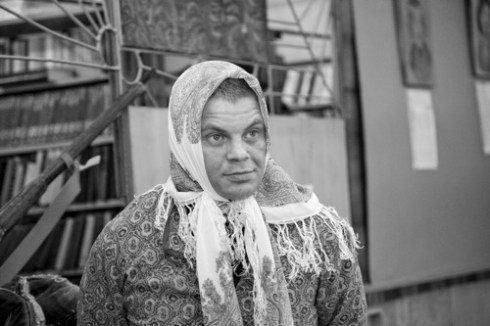
I used a selection of Sebastian Lister‘s photographs to illustrate my point, but I didn’t show you the majority of Lister’s portfolio, nor did I tell you why he had visited Prison Colony 29, Perm in Russia. (Sebastian, I hope you don’t mind my chicanery!)
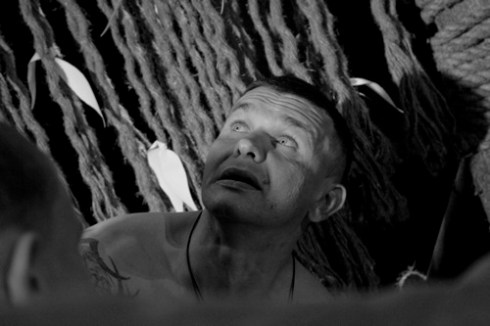
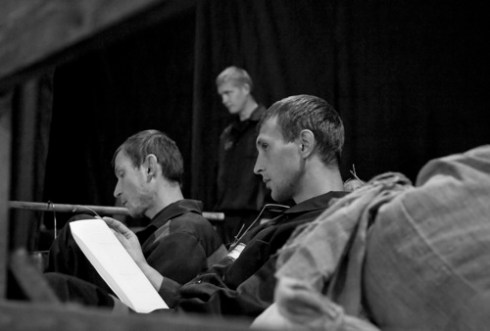
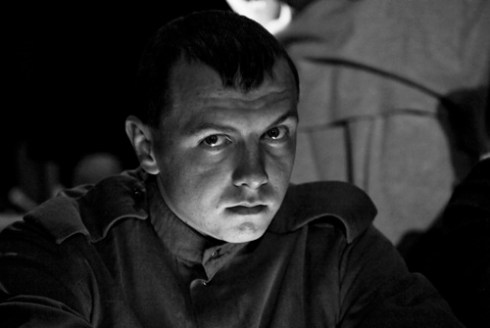
Elsewhere in Sebastian’s portfolio are unexpected images of costume, make-up, curtain calls, cross-dressing, pressured script-reading, nervous rehearsals and opening night applause.
Sebastian joined Alex Dower, director, actor, musician and artistic director of Creating Freedom, an international production company working in prisons. For more information, click here and then on the ‘prisons’ tab. Russia Today produced a wonderful half-hour documentary about Dower’s project.
Prison theatre is a common mode of arts rehabilitation in Russia, and Sebastian Lister’s documentary photographs are valuable insight into the “movement”. Perm Colony’s players are diligent creatives and their activities allow for more positive representations of prisoners in the Great Bear nation.
If you’d like to see more, Sebastian has posted more images on his Facebook page.
Scroll down to read my Q&A with Sebastian.



How did you get involved?
I became involved with Theatre in Prison: Territory Festival 2009 having studied acting & directing with Alex Dower. We were trained in the science of acting by the Russian Sam Kogan in London. It seemed fitting to be taking Kogan’s system ‘back home’. It is a rigorous, research based approach which appeals to those with a strong work ethic. For the most part the prisoners relished the opportunity and thrived under Dower’s leadership.
Tell us about Alex Dower’s work in Russian prison theatre.
Dower is a pioneer in that his project was the first high-profile prison theatre project in Russia. It caught the eye of the authorities, some of whom now regard theatre (and perhaps the arts in general) as having a role in rehabilitation. The media interest was aided by the fact that Alex and I are British. Arrangements were complex – we didn’t have the go-ahead until a month or so before. The show was beamed onto a big screen in Perm during the Territory Festival 2009. Crucially, I would say Dower nurtures the prisoners as artists in their own right without any hint of condescension.
How seriously did they take the acting?
As a group the prisoners set about their job with a high degree of diligence. There were some stand-out levels of commitment. In fact, Igor, one of the cast of Chekhov’s “The Burbot” has been offered a job in the professional theatre. And ironically a former neo-nazi murderer played the Jewish lead in “My First Goose” by Babel, a story for which the main theme are fear and courage.
Why does prison theatre prosper? What is the psychology behind it?
I think prison theatre prospers because it is an opportunity for inmates to learn from the characters they play, to exercise their imaginations and to acquire a sense of freedom on stage, thus escaping from the confines and drudgery of their daily lives. There is also the thrill of an audience – including inmates and parents – witnessing this transformation. It is an occasion for them.
One negative aspect of the experience was the come-down the prisoners felt after the show. Future projects should take this into account.
How many of the prisoners would have attended theatres before imprisonment?
I don’t know the exact figures but I would say that barely any of the prisoners had been to the theatre before imprisonment. Most prisons (I’m not sure about the high security ones) have a theatre of some kind.
What are the motivations for the actors?
The motivations for the actors come from the challenges of the characters in the stories – Chekhov’s “The Burbot”, Babel’s “My First Goose” and “Butterfly” written by Albertik Sadrutdinov, one of the prisoners. Characters were discussed and interpreted in the first week of rehearsal. Tanja Arno, an actress from Moscow was the only member of the cast not from the prison.
What other activities are available to them at Colony 29, Perm?
Albertik Sadrutdinov (now free) gained a qualification in building fireplaces whilst in the colony. He also spent time running, meditating, working out in the gym, reading, and playing in a band. On our first day, during quite a media scramble, I saw prisoners in class learning geometry. There is also a “working zone” with a timber yard and metal working shop.
Do either you or Dower plan more prison theatre coverage?
Dower plans to direct in a prison in Kazan, Russia in November 2011, and in Columbia in February 2012. Whether I accompany him or not depends on the funding available.


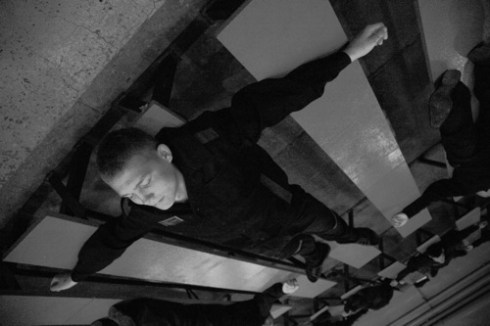
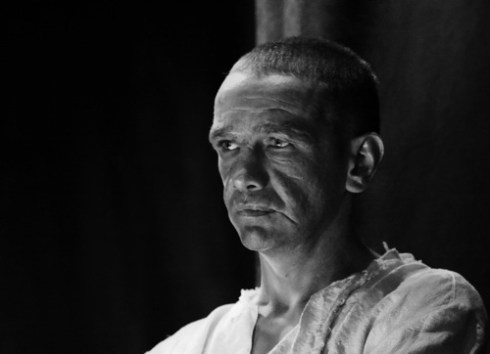
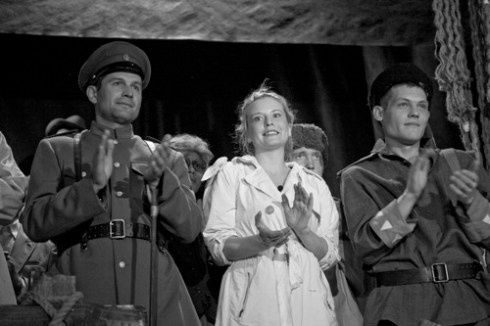
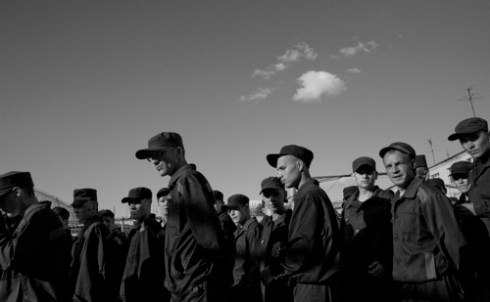
The title for this post comes from Dostoevsky’s famous 1862 novel House of the Dead. The book is full of imagery of malnourished, edgy prisoners who are corralled through the harsh drudgery of the Siberian prison camp. For me, it is almost impossible not to think of Dostoevsky’s bleak interment when looking at photographs from Russian prisons. Much of the imagery I’ve seen from the former Soviet bloc (Als, Alvarez, Atwood, Krauss, Nachtwey, Vasiliev, Payusova) has depicted cold, hardened wretches. This may or may not reflect reality, but here I want to emphasise the prevalence of this type of imagery.
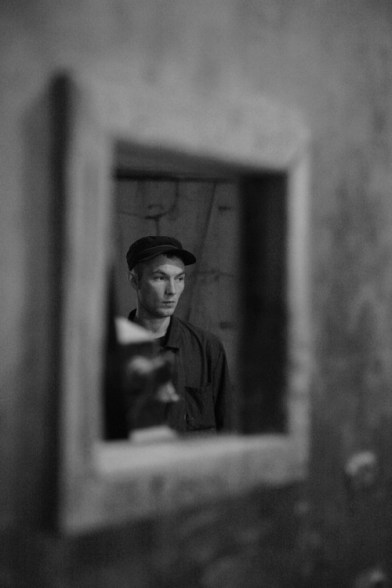
All photographs here in this post are by Sebastian Lister. I’ve taken the liberty to feature a small portion of his images and I’ve peppered them between famous etchings and paintings from art history to illustrate the persistence of marching, ordering, misery and boredom in prison imagery. America, Germany and England all feature in the historical images so we can acknowledge that this type of treatment and mood has existed in prison systems across the world.
Could it be that Russian prisons are persistently depicted as backward, brutal and stuck in the past? Is this the reality?
If you’ve not guessed, I’m setting something up here. I posit that, sometimes, these types of photographs are what we expect. Tune in on the blog later today to see a contrasting view.










After working closely with his legal team for more than three years, Alan Crotzer feels alone as he sits in the CNN spotlight for his first live solo television interview, days after his release. “The whole world is out there and I am all alone.” Photo Credit: Vance Jacobs
There’s a thorough Q&A with photojournalist Vance Jacobs at Photographers on Photography.
Vance covers his work in Medellin Prison with Colombian prisoners (which I’ve dissected before) and talks about his compulsion toward friendship with Alan Crotzer, a man who was exonerated after serving 25 years for a crime he did not commit, and the subject of Jacobs’ Exonerated: Alan Crotzer.
“From a purely journalistic standpoint, it was hugely fulfilling to be able to draw a line between a story about Alan that appeared on the front page of the Miami Herald and the car a local doctor decided to donate to him after reading about his plight or to see how one three-minute appearance on Wolf Blitzer’s show on CNN led a total stranger to give Alan a nice apartment in a safe neighborhood to live in at a very discounted rate.”
“But at the end of the day, I felt my responsibility was to help Alan in any way I could—not just to take pictures and I think that can be at odds with what some people think of as the journalistic oath not to intervene—just to witness and document. I ended up spending over 30 days with Alan and I spent a vast majority of that time just trying to help him set up his life. Whether it was his first cell phone, first bank account, first driver’s license, first apartment, first job and so on …”
I read this on the same day the New York Photography Festival opens and co-curator Elisabeth Biondi says:
“There are no more discoveries to be made. Anyone can take a picture now, so it’s forced documentary photographers to have a more personalized vision.”
Within the field of prison photography, it is my observation that the best projects incorporate elements of collaboration with prison inmates, staff and/or volunteers. Have we moved toward a norm where the photographers’ story is the story; that personal perspectives are what the audience wants?
If photojournalists are getting personally involved with the people in front of the lens – especially if they’re making positive contributions that no-one else provides – then so be it.
Stephanie De Leng‘s Inside HMP Manchester is a very low-key but intriguing exhibition (by appointment only) currently on in Liverpool.
De Leng says:
“I have been allowed inside HM Prison Manchester, formerly known as Strangeways, to document its workings, staff, and prisoners who are willing. This is a delicate project built on trust, and follows in the wake of a TV documentary in the coming months. It is the first time that a photographer or camera crew have been allowed inside this prison since the 1990 riots. A lot has changed since then in a very positive way, and for my part I intend to document it honestly, and not in a grim trying to dish the dirt way. There is a lot of good to say, or show in my case.”
So far, de Leng – trying to avoid “bland corporate” style portraits – has focused on photographing the staff. She hopes to slowly bring more and more images of the prison to wider audiences over a period of time. Softly, softly. I’m intrigued.

Officer Alan Blocksidge, Butler Trust winner and MBE for his work rehabilitating drug addicts within HM Prison Manchester. Photo Credit: Stephanie de Leng
Inside HMP Manchester
De Leng’s photographs will be on show at Baltic Creative as part of LOOK2011, the inaugural Liverpool Photography Festival based around the theme “Is Seeing Believing?”
LOOK2011 says:
“It has been 21 years since the ‘Strangeways’ Prison riot, the 26 day roof top protest that changed the face of the prison system. The riot in April 1990 resulted in the partial destruction of the old Victorian wings and the injury of 147 prison officers and 47 prisoners. The disturbance inspired copycat riots at a number of other prisons, including HMP Bristol and HMP Dartmoor. A five-month public enquiry ensued, resulting in The Woolf Report which served as an ongoing blueprint for the reform of the prison system. ‘Inside HMP Manchester’ is intended to make the viewer set their normal prejudices and assumptions aside, and to look at justice from another angle.”
The exhibition is by appointment only. Except on May 13th, when Baltic Creative will be open between 6 – 9pm for the Light Night. Stephanie de Leng will be present to discuss her works. The Baltic Creative Center, 22 Jordan Street, Liverpool, Merseyside, L1 0BW, UK. 0151 703 2005
STRANGEWAYS ELSEWHERE ON PRISON PHOTOGRAPHY
Former Governor of Strangeways: “Give UK Prisoners the Vote.” And in the US?
If you are in Liverpool over the next couple of months, then you should drop in to any number of the exhibits put by LOOK2011 the inaugural Liverpool Photography Festival.
The theme for the festival is “Is Seeing Believing?” Of particular interest is Confined at the Bluecoat.
Confined is an exploration of the idea of confinement in contemporary life by photographers Juergen Chill, Edmund Clark, John Darwell, Dornith Doherty, Ben Graville, David Maisel and David Moore. Subjects range from imprisonment and detention, the ethical treatment of animals, ecological conservation and the history of psychiatric care.

I have a personal involvement in the show. Exhibitions curator Sara-Jayne Parsons asked me to pen some words for the Confined catalogue. And, after interviewing David Moore about his Paddington Green Police Station series I encouraged him to contact Parsons and together they decided to exhibit the prints. It will be the first time Moore has publicly shown his Paddington Green Police Station photographs.
Unfortunately, I won’t be making it over to the UK soon, but I hope those of you who are in Blighty make it to the exhibition, not to mention all the other LOOK2011 exhibits, lectures and workshops.
Confined is on show at the Bluecoat, School Lane, Liverpool L1 3BX, from Fri, 13 May 2011 – Sun, 10 Jul 2011, 10.00 AM – 6.00 PM, Tickets: Free. (Visitor info)

Newark, New Jersey, December 2009: A Buthanese refugee is changing his shirt siting on the floor of his room. CREDIT: Gabriele Stabile/CesuraLab
Four years ago, Gabriele Stabile of CesuraLab went out to photograph in the airport hotels of New York, Newark, Chicago, Miami and Los Angeles – the five official US ports of entry for approved asylum seekers. The result The Refugee Hotel (originally The Refugee Motel) has been steadily added to since.
‘The “Refugee Hotels” are today’s Ellis Islands. Places of temporary lodging on refugees’ journeys from where ever “there” was to wherever in America they end up. My intention was to document the moments between two kinds of uncertainty. Refugees come fleeing hunger, they come from forced exile, they come escaping certain death. Some spend years in camps waiting for their ballot to be cast. I spoke to one person who’d waited seven years to talk to me in an anonymous hotel room in Newark, New Jersey. The resettlement process, even with all its difficulties and challenges, must be light years away from the harsh realities of life in a refugee camp. Still, I don´t know what to make of the establishing shot we start their American stories with: standardized hotel chains.’
The Refugee Hotel recently achieved it’s next phase by securing a pre-print agreement with McSweeney’s and raising $6,000 on Kickstarter to publish a book.
This is a fascinating project about immigration because while the lives of the subjects are swept up in global politics, there’s no possibility of them being caught up in the rhetoric of illegal immigration. Quite contrary, these are formerly persecuted people for whom the United States of America hold a real shot at stability.
Perhaps, Stabile’s photographs are of nascent American dreams, or maybe they’re simply the first images of American lives?
Stabile interviews with FADER and Miss Rosen.

 Prison Photography