
You are currently browsing the category archive for the ‘Fine Art’ category.
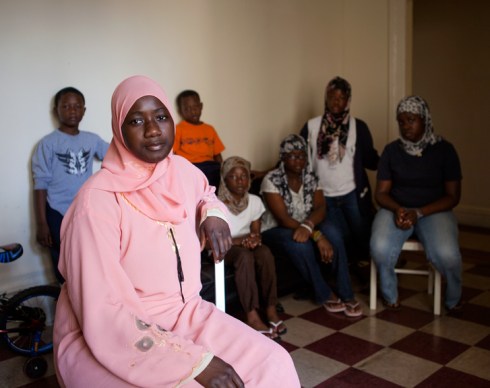
Last week, photographer Graham MacIndoe and writer Susan Stellin were awarded a $20K Alicia Patterson Fellowship for their joint project The UnAmericans: Detained, Deported and Divided.
The project is “a series of interviews and photographs documenting the stories of immigrants who have been ordered deported from the U.S. as well as their family members — often, American citizens — who suffer the consequences of harsh punishment of exile. The stories illustrate the wide range of people locked up while caught up in deportation proceedings: not just individuals who crossed the border illegally but asylum seekers, legal permanent residents and immigrants trapped int he bureaucracy of adjusting a visa.”
Immigration and deportation, are arguably, one of the most pressing human rights issues on American soil. Many people subject to immigration and deportation proceedings are not hardened criminals, they are not violent, nor are they a threat to public safety. The long reach of ICE can collar Green Card holders who have lived in the U.S. for years or decades and who have raised families, paid taxes and abided the law. It can take only a small misdemeanor. Frequently, there is no recourse. Loving spouses are separated and society is asked to assume responsibility for children whose parents are sent half-way across the globe. The collateral effect of inflexible deportation laws on families and communities is considerable. MacIndoe and Stellin’s subjects have lived firsthand at edge of legal territory where resources are squeezed, timelines are shortened and due process is compromised; it is here where we can fathom our health, or lack of it, as a just nation.
Stellin and MacIndoe are both seasoned storytellers and their fusion of text and image is a huge advantage when making connection with audiences. The work is needed and it will shock you.

INVISIBLE PROCEDURES
I’ve barely talked about Immigration & Customs Enforcement (ICE) prisons here on the blog because they are very, very rarely photographed. ICE detention facilities are as unseen as ICE surveillance is broad.
Due to extended legal definitions and new laws, President Obama is deporting more people than any previous president. ICE facilities are often strategically hidden, nondescript buildings in urban hinterlands. ICE facilities also oversee near-permanent media shut out. With access so problematic, Stellin and MacIndoe’s decision to meet, interview, photograph and tell the stories of those who’ve been imprisoned is both wise and practical. The prison conditions will be described through first-hand testimony as opposed to literal photographic description. MacIndoe’s respectful and intimate portraits are our starting point.
Stellin brings years of reporting experience which has recently turned toward stories about Homeland security, border technology & search and the legal grey area for Green Card holders with minor offenses.
KNOWING YOUR SUBJECTS
MacIndoe was once subject himself to the Kafkaesque immigration and deportation system. I contend that from personal insight may grow public awareness.
Stellin and MacIndoe have already met, photographed and interviewed subjects. Many are fearful to go public. Scottish-born MacIndoe understands why non-citizens may be reticent but he has the personality to reassure, and understands the small margins on which our comfort rests. MacIndoe has become a friend and mentor to some of the family members he has met in the preliminary stages of the work. He understands that current immigration policy — in it’s inability to be flexible case-by-case — impacts step-children, the poor and the already marginalized more than other groups. He knows that gay couples have not the same legal qualification and therefore protection. MacIndoe and Stellin are looking to hold a mirror to everyday people that have been harshly punished by very new laws. The laws are young, somewhat clumsy, inelegance and overly punitive.
The tumorous growth America’s prison industrial complex goes back four decades whereas the focus of The UnAmericans: Detained, Deported and Divided — the establishment of an extended archipelago of Immigration and Customs Enforcement (ICE) detention facilities — is a much more recent, post 9/11 phenomenon. MacIndoe and Stellin’s work is utterly contemporary and it meets the desperate need for journalism that probes ICE procedures.
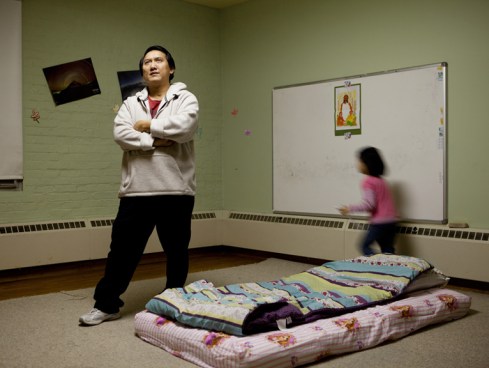
All images: Graham MacIndoe


Photobook “Best-Of” lists sprout like wild-cakes this time of year. Among selections, we are not always guaranteed variety, but we are guaranteed quantity.
Aperture tends to preempt many of the main runners and riders in the autumn with its shortlists for the Aperture/Paris Photo Book Awards (30 books total). Then the deluge beings.
A deluge that which Photolia has made an inventory. It’s a list of Photobook “Best-Of-2013” lists; a list of 80+ lists!
Furthermore, QT Luong at Terra Galleria has taken all the individual titles of those 80+ lists, broke down the votes and constructed a meta-list that cumulates each book’s number of votes. Some titles have votes in double figures, and the “winner” Lieko Shiga’s Rasen Kaigan has 22 votes.
By years end, Best-Of lists had been written and checked twice by Wired, American Photo, Time, Mother Jones, New York Times, Dazed Digital, Lens Culture, Washington Post, Brain Pickings, Tom Claxton, Microcord, Eric Gundersen, Conscientious, Tim Clark, Monsters & Madonnas, Valerian and Discipline and Disorder just to name a few.
The Guardian made two lists — one for best indie books and one for offerings by established photobook publishers. Not to mention Alec Soth and Martin Parr‘s eagerly anticipated annual dispatches. Roger May shifted the formula and picked his favorite book purschases . The Artists Book Cooperative maintained their cheeky approach with the year’s worst photobooks.
So what does all this mean? Head to Blake Andrew’s analysis of the best of the “Best-Of photobook lists. Hilarious.
Well, who am I to reject this ubiquity of Photobook “Best-Of” lists? A few weeks ago, I was asked by Photo Eye to name my highlights for the PhotoEye Best Photobooks 2013 feature. I picked seven titles. Here they are. And, below they are.
Bumbata, Cosmin Bumbuţ (Punctum)
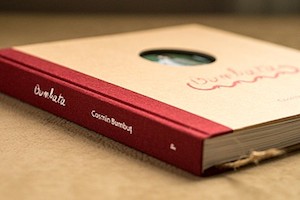 Beyond the prison subject matter which is, of course, very appealing to me, Cosmin Bumbuţ’s book is the best of design with beautiful binding, a punctured front cover, and thoughtful essay. Those elements compliment pictures that are, frankly, some of the closest, least judgmental I have seen of incarcerated peoples. Bumbuţ spent 3 years visiting a single prison. The portrait he paints is of a closed but relatively stable environment with equal representation. Staff and prisoners feature in similar amounts. The variety and color is something beyond that of most American prison photographers. Here is a documentarian who has worked hard to form an understanding with his subjects.
In December, I spoke at length with Bumbuţ about his project and the book.
Tales From The City Of Gold, Jason Larkin (Kehrer Verlag)
 It is astonishing that with such a distinct and consistent approach to image-making that this is Jason Larkin’s first monograph. His work seems so familiar. Once more, the Englishman Larkin has entered (with his 4×5) a peculiar faraway place with peculiar and depressing social and environmental history. Johannesburg is one of the world’s most successful mining cities but waste dumps litter the landscape. South Africans have built communities in the mines’ hinterlands. The price of gold is spiking and the lives of people who live and work in the region is tied to our global commodities market. Larkin casts a curious but not a judgmental eye over our priorities at the dusty and noisy point at which commerce and daily life intersect.
Photojournalists On War, Mike Kamber (University of Texas Press)
 End of year lists often prioritize photo books with fancy design elements; books that are small run, hand-sewn delicate things. But what about those books about photography that are a bit bigger? What about books put out by a large press, such as UT Press, say? And what about books with more text than image? Photojournalists On War is a brick of a book. Mike Kamber interviewed 89 photographers who covered the War on Iraq. If we are to understand the nature of that flawed conflict then we should pay attention to the journalists whose activities were meant to makes sense of it at the time; make sense of it for us. But, what sense do they make of it now? By virtue of the breadth of opinion and depth of questions, Photojournalists On War is THE reference book for any discussion of the War on Iraq and photography. In much the same way as Photographs Not Taken in 2012 delivered us personal reflections and new entry points to photographic thinking, so Photojournalists On War in 2013 surprises and delights with the first-hand and imperfect narratives. Truth is not usually found in a photograph, but perhaps it can be found in a photographer’s words?
Swell, Mateusz Sarello (Instytut Kultury Wizualnej)
 Sea foam smells, threatening birds, big clouds. Swell is a rough experience. As was Mateusz Sarello’s break-up. This book is in two halves. Each half is a visit to the Baltic Sea — the first with his girlfriend, and the second without as part of some therapeutic turn. So different are the images and mood of the images it’s effectively two books in one. Both books’ exposed spines reflect the vulnerability Sarello has embraced in creating a book about his crushed love-life. 88 pages of fragile hand-made loveliness. Handle with care. Given the proliferation of east-of-Western-Europe sea photography projects (think Petrut Calinescu, Rafal Milach, Mila Teshaeiva, Mikhail Mordasov and even Rob Hornstra), it’s tricky to do something novel in this sub-sub-genre, but Sarello pulls it off with focus on the hyperpersonal. And he’s not afraid to use Instax Fujifilm either. I was skeptical at first, but later blown over by the earnestness of the well-edited and understated grouping of images.
Rasen Kaigan, Lieko Shiga (AKAAKA)
 Between 2006 and 2012, Lieko Shiga lived and worked in the region of northeast Japan worst hit by the 2011 Tsunami. Shiga is part photographer and part conceptual artist, so it makes sense that these images (many of which abandon formal photographic considerations) look nothing like the photojournalism we saw in the aftermath of the Tsunami. Darkness, hard-flash, plants, flowers, sweaters, sand and minerals. It’s all very earthy … and strange. But then again, that region is a geography and a collective psychology transformed. Despite Shiga’s camera experiments, we are still presented images of Japanese communities on the mend, making do, building up, tilling the land and doing the simple things that they must. Big disasters are met with small victories. Shiga’s volatile approach is a reminder that the uncomplicated things she photographs only exist because of massive tectonic force.
What might be otherwise read as an assault on the senses is a celebration of the senses — a celebration of life and of living.
Control Order House, Edmund Clark (HERE Press)
 The images are boring; but the concept is exhilarating — which is exactly the point. Edmund Clark photographed the interior of a “home” inhabited by a UK terror suspect under house arrest. A dull suburban 3-bed semi in no-name Britain. Clark worked within pre-agreed, tightly controlled parameters set out by the UK Home Office. Clark and HERE Press include scans of his contracts and official correspondence. The act and the access is more important than the images; the images are only evidence that Clark made a sortie into this never photographed territory before. (In April, I wrote about Control Order House for Wired.)
So many projects these days comment on control from the outside, but here we see images from from within, and according to, control.
Two Rivers, Carolyn Drake (Self-published)
 Carolyn Drake’s photography has long impressed me, so I’m not surprised her first book is a triumph. Dutch book-designer Sybren Kuiper brought considerable style to Two Rivers. Apparently, it was Kuiper who proposed starting the book’s sequence at where the two rivers appear to end versus Drake’s original idea to begin where the rivers originate high in the mountains. Drake has visited the vast expanse of central Asia that lies between the Amu Darya and Syr Darya rivers 15 or more times in recent years. Judging by the images, it remains a region that beguiles Drake. Two Rivers abandons traditional documentary sequencing and reveals the creators own feelings, uncertainties, awe and brief encounters. One slimmer book is words and notes for the chapters in the other larger book containing pictures of fuzzy narrative, refused objectivity and love. The wrap of images around the Japanese style bound pages is stunning.
SIGN OF THE TIMES
Andres Serrano has just released Sign Of The Times a new body of work for which he bought signs from the homeless in New York at $20 a pop. Over 200 signs in total.
I’m not sure about the sound track to the video, but Serrano’s words are worth a read on the Creative Time Reports website. He doesn’t breaking any new rhetorical ground but he does make a good case for this work being a timely statement to coincide with the end of Bloomberg’s stint as city mayor. New York has a problem with homelessness.
Just once, Serrano’s words veer dangerously close to over-analysis and sentimentality:
“What struck me about the people who sold me their signs was their willingness to let go of them. It was as if they had little attachment to them even though some signs had been with them for a long time. Of course, they needed the money. Many people would tell me they had made nothing that day. But I also think that those who possess little have less attachment to material things. They know what it’s like to live with less.” [My bolding.]
But, ultimately, he grounds the work where it should be — in an it-is-what-it-is conclusion about art, and in an it-is-an-outrage statement about society:
“Although the homeless are at the bottom of the economic ladder, many Americans are not far from it. They may not be homeless, but they’re poor. Fifty million or more Americans live at or below the poverty line.”
You’ll recognise the name. Serrano brought us the *controversial* Piss Christ and in doing so exposed the small-minded vitriol of the culture wars in eighties America, that set the tone for the rightwing unthink so common today.
Despite their wildly different methodologies, Piss Christ and Sign Of The Times have a lot in common. The former magnifies the cultural differences and the latter magnifies our economic differences. Cultural and economic capital are related. Both works ask audiences about how far they, we, are willing to go to manage perspective and to get out of ones own head. Both artworks create, very efficiently, the parameters to those urgent discussions.
Sign Of The Times is a very simple project. It’s not a subversion of capitalism; in fact barter-and-trade might be one of capitalism’s purest forms!? Regardless, Serrano made small but significant one-off contributions to the lives of hundreds of homeless during the making of the work. Hopefully, the presentation of Sign Of The Times will shape public and political opinion to improve the lot for many more homeless folk?
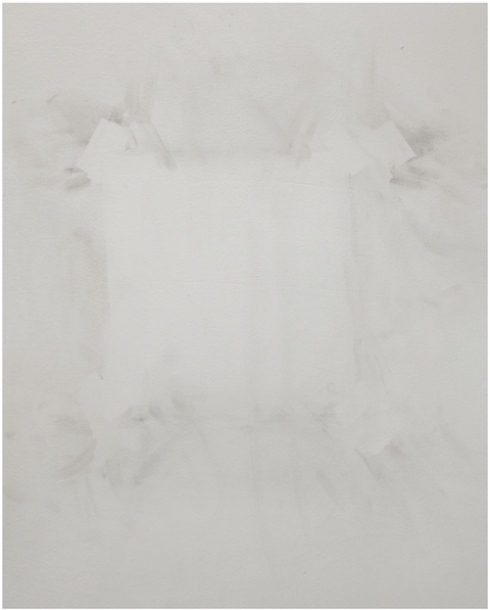
Today, Daylight Digital published a presentation (online and iPad App) of Amy Elkin‘s project Black Is The Day, Black Is The Night.
Black Is The Day, Black Is The Night (BITDBITN) is a collection of images, texts, letters, objects, quotes and ephemeral queries borne of Amy’s correspondence with men on death row and in solitary confinement. It is a project I know well having interviewed Amy about it in 2011 and curated it into the exhibition Cruel and Unusual in 2012. I’ve keenly followed the development of BITDBITN. In some cases, Amy and I bounced ideas back-and-forth about it when we lived in the same town. Amy and I are close friends and she once invited me to guest curate at Women In Photography. When Daylight asked me to write an essay to accompany the images and audio it was a no-brainer.
BITDBITN is about execution, time on death row, solitary confinement, sensory deprivation. It is also about the most invisible parts of America’s prison industrial complex. Amy grew up in California, the state that was first to operate a specialised solitary confinement facility at Pelican Bay State Prison. This past summer, as I was writing the piece, the California Prisoner Hunger Strike in protest of conditions in Pelican Bay and other SHU, IMU and solitary facilities was in full swing.
Amy’s work is our entry into this highly contested political territory; a territory that remains, for all intents and purposes, hidden. It is hidden because solitary makes people insane and is psychological torture.
Daylight Digital’s presentation includes the words of Freddy (spoken by Rafael Ramirez) who was sent to prison as a 13 year-old, has spent the last 20+ years of his life in solitary confinement, and with whom Elkins corresponded for four years.
I’m proud to have been invited to join this multimedia collaboration. See the images, listen to the testimony, read the words.

Photo: “Me & Myself” by an anonymous student of photography workshop at the Rhode Island Training School, coordinated by AS220 Youth.
ONO ŠTO SE VIDI A NE ČUJE
If you happen to be in Belgrade, Serbia over the next couple of weeks, I encourage you to head to the Kulturni Centar Beograda (KCB) and see Seen But Not Heard, an exhibition I’ve curated of photographs from American juvenile detention facilities. The show features photographs made by incarcerated youth in photography workshops coordinated by Steve Davis in Washington State and by As220 Youth in Rhode Island, as well as well known photographers Steve Liss, Ara Oshagan, Joseph Rodriguez and Richard Ross.
The invite to put together Seen But Not Heard — which is my first international solo curating gig — was kindly extended by Belgrade Raw, an impressive photo-collective who have operated as guest exhibition coordinators at the KCB’s Artget Gallery throughout 2013. Belgrade Raw called it’s year long program Raw Season. and it was 10 exhibitions strong, including Blake Andrews, Donald Weber and others. Here’s Belgrade Raw’s announcement for Seen But Not Heard.
I’ll update the blog next week with installation shots and a loooong list of acknowledgements (the hospitality, skills and hard work of everyone here has been so overwhelming.)
Beneath, is a long essay I wrote for Seen But Not Heard . Beneath that is a selection from the 200+ works in the exhibition. Beneath the works are the details of the photographer and/or program who made them.
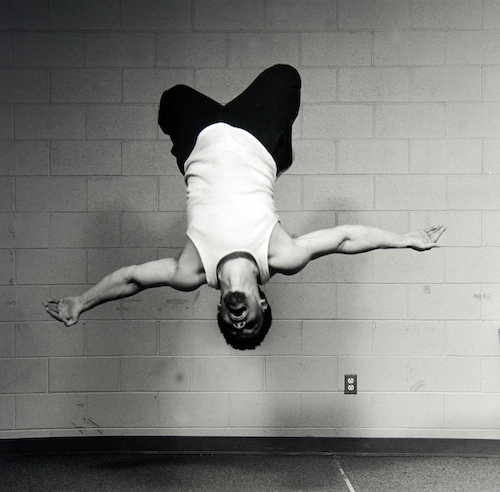
Photo: “Flip” by an anonymous student of photography workshop at the Rhode Island Training School, coordinated by AS220 Youth.
ESSAY
USING PHOTOGRAPHY TO COMMUNICATE NOT CONTROL
“Ten thousand pulpits and ten thousand presses are saying the good word for me all the time … Then that trivial little Kodak, that a child can carry in his pocket, gets up, uttering never a word, and knocks them dumb.”
– Mark Twain, writing satirically in the voice of King Leopold in condemnation of the Belgian’s brutal rule over the Congo Free State. King Leopold’s Soliloquy (1905).
The United States of America is addicted to incarceration. In the course of a year, 13.5 million Americans cycle through the country’s 5,000+ prisons and jails. On any given day, 2.2 million American’s are locked up — 60,500 of whom are children in juvenile correctional facilities or residential programs. The United States imprisons children at more than six times the rate of any other developed nation. With an average cost of $80,000/year to lock up a child under the age of 18, the United States spends more than $5 billion annually on youth detention.
What do we know of these spaces behind locked doors? What do we see of juvenile prisons? The short answer is, not a lot. However, photographs can provide some information — provided we approach them with caution and an informed eye.
Seen But Not Heard features the work of five well-known American photographers who have taken their cameras inside. Crucially, the exhibition also includes photographs made by incarcerated children on cameras delivered to them by arts educators and by staff of social justice organizations. Many of the children’s photographs are being exhibited for the first time.
Cameras are used by prison administrations to maintain security and enforce order, so when a camera is operated by a visiting photographer — and especially by a prisoner — a shift in the power relations occurs. All the images in Seen But Not Heard prompt urgent questions about what it means to be able document and what it means to be prohibited from documenting. What difference is there between being the maker of an image compared to being the subject of an image? What happens if you put kids behind the camera instead of in front of it? What stories do children tell that adults cannot? Can a camera can be a tool for artistic expression instead of an apparatus of control?
EXPRESSION
“Light Paintings” made by students of the Rhode Island Training School (RITS) prove a camera is essential to the artist’s toolkit. The anonymous RITS students’ images conjure angelic limbs and alter-egos from the dark. The images contain the frustration of incarceration; the longing of a (new) time; the aspirations of youth; the childishness of comic drawing. The photography outreach program taught by AS220, a community arts group of long-standing in Rhode Island, is an extension of workshops taught to teens in the free-world. In fact, children have graduated out of RITS and into the many studio arts programs offered by AS220 Youth in the town and neighborhoods of Providence, RI. An adult would or could never make these images; it is a privilege for us to share in them.
The workshops that Steve Davis coordinated in four youth detention centers in Washington State provide us a window into the incarcerated children’s lives. For legal reasons, at Remann Hall, no images could identify the girls and so Davis made use of pinhole cameras with long exposures. The girls treated the opportunity as one for performance enacting torment, official restraint procedures and bored isolation. The blurry images are eerie and evocative; as if the girls are capturing the moments in which they are disappearing from society’s view.
By contrast, the boys’ photographs are very much embedded in reality; they carried cameras outside of structured class time with instructions to make general images and construct photographs along a weekly theme. The boys had one another as immediate audience. We see unfiltered views of their activities, cells, day rooms, programs and priorities; we see costume, computer games, machismo posturing, childlike play and even boring moments. Accidentally they collectively constructed a visual narrative in which motifs such as t-shirts, playing cards and institutional furniture recur. The photographs would be monotonous were it not for the splashed of life the children provide — perfectly communicating why and how humans kept in boxes is not the natural order, nor the ideal circumstance.
MOTIVATIONS
The photographers in Seen But Not Heard all had different motivations for going inside. After the experience, they all had the same attitudes.
Without exception, the photographers’ experiences had them wide-eyed, sometimes angry, usually frustrated and certainly more conscious of the politics of incarceration. Consequently, they feel a responsibility to share their images and to describe youth prisons to many audiences.
Steve Liss had watched the children of a Texas juvenile prisons perform a choreographed marching routine for then Texas Governor G.W. Bush. After the ridiculous spectacle, the ridiculous Bush gave a ridiculous moral instruction to stay out of trouble. Liss was furious at the patronizing tone of the event and particularly Bush. As a press photographer, Liss had parachuted in and out of that prison as quick as his subject Bush did. He vowed that if Bush ever made it to be President, he’d return to Texas to photograph the children’s lives. Bush would never see those children, but perhaps the world should. It is alarming how often we see very young and tiny children subject to shackles and apparatus designed for dangerous 200+ lb. men. It’s as if the system is blind to the physicality of its young prisoners. That being the case, how can we presume they understand or provide for the more complex psychology of these children?
Joseph Rodriguez was locked up as a young man. He also experienced homelessness, for a time, and was addicted to drugs. He was sent to the infamous Riker’s Island prison in New York twice — first, for a minor charge related to his anti-war protest activity; second, for burglary. His mother could not afford the $500. He spent 3 months locked up awaiting his court date. Post-release, Rodriguez found photography and it gave him a means to process and describe the world. Having seen the inside, Rodriguez empathizes with children who are going through any prison system. More than 20 years after his incarceration, Rodriguez felt it a duty to use his storytelling skills to tell the stories of incarcerated children. In 1999, he photographed inside the San Francisco and Santa Clara Counties juvenile detention centers and followed children through the cells, courtrooms and counseling of the criminal justice system.
Ara Oshagan’s opportunity to photograph at the Los Angeles County Juvenile Hall (the largest juvenile prison in America) was pure happenstance. He met with Leslie Neale a documentary filmmaker for lunch on a Monday. Neale was filming inside the juvenile hall and needed a photographer to shoot b-roll. Oshagan was inside on the Tuesday. He was so moved by the experience that he applied for clearance to return on his own. He followed six youngsters as they progressed through their cases and, in some cases, into California’s adult prison system. Oshagan never felt like his photographs were enough to describe the emotions of the children and so he asked each of them to write poems and presents text and image as diptych. Random circumstance, fine slices of luck, peer pressure and other people’s decisions factor far more heavily in children’s lives than in adults’ lives. Throughout, Oshagan was constantly reminded how his subjects were very much like his own children.
Late in his career and having financial security through a Guggenheim fellowship and teaching sabbatical, Richard Ross turned his lens upon juvenile detention. Ross wanted to give advocates, legislators, educators the visual evidence on which to base discussion and policy. He provides his images for free to individuals and organizations doing work for the betterment of children’s lives.
Repeatedly, Ross met children who were themselves victims; frighteningly often he heard stories of psychological, physical and sexual abuse, homelessness, suicide attempts, addiction and illiteracy. Many kids locked up are from poor communities and a disproportionate number of youths detained are boys and girls of color. Ross observed some really positive interventions made by institutions (regular meals, counseling, positive male role models to name a few) but he saw the use of incarceration not as last resort but as routine.
WHY SHOULD WE CARE?
Unsurprisingly, many have lost faith in the juvenile prison system. Recent scandals have exposed systematic abuses.
In Pennsylvania, two judges accepted millions of dollars in kickbacks from a private prison company to sentence children to custody; in Texas, an inquiry uncovered over 1,000 cases of sexual assault by staff in the state’s juvenile justice system; in New York, on Riker’s Island it has been alleged that young gangs (referred to as “teams”) organized within the jail itself, and controlled and enforced the juvenile wings while the authorities turned a blind eye. The rivalries resulted in fights, stabbings and in one case death. The New York City Department of Corrections denies the allegations, but interestingly it was NYDOC employees that exposed the violence by leaking internal photographs to the Village Voice newspaper.
Nationally, the private company Youth Services International (YSI) inexplicably continues to operate despite being cited for ‘offenses ranging from condoning abuse of inmates to plying politicians with undisclosed gifts while seeking to secure state contracts’ by the Department of Justice and also New York, Florida, Maryland, Nevada and Texas.
Not only is being locked up ineffective as a deterrent in youths who have not reached full cognitive development and don’t understand the consequences of their actions, it can actually make a criminal out of a potentially law-abiding kid. Dr. Barry Krisberg, director of research at the Berkeley School of Law’s Institute on Law & Social Policy, says, “Young people [when detained] often get mixed in with those incarcerated on more serious offenses. Violence and victimization is common in juvenile facilities and it is known that exposure to such an environment accelerates a young person toward criminal behaviors.”
THE FUTURE
Given the lessons from the failed practices of incarcerating more and more children, States are adopting more progressive policies. Certainly, authorities are turning away from punishing acts such as truancy and delinquency with detention; acts that are not criminal for an adult but have in the past siphoned youths into the court system. But more than that, incarceration for youth is widely considered a last resort.
States that reduced juvenile confinement rates the most between 1997 and 2007 had the greatest declines in juvenile arrested for violent crimes. It’s proof that incarceration doesn’t solve crime. And, it might suggest incarceration damages communities. Following repeated abuse scandals in the California Youth Authority (CYA) facilities in the 90s, California carried forth the largest program of decarceration in U.S. history. Reducing its total number of youth prisons from 11 to 3 and slashing the CYA population by nearly 90%, California simultaneously witnessed a precipitous drop in violent crime committed by under-18s.
The U.S. still has a long way to go if it is to reverse decades of over-reliance on incarceration, but as the recent Supreme Court ruling banning Life Without Parole sentences for children suggests, it seems Americans hold less punitive attitudes when it comes to youth’s transgressions, as compared to the apathetic attitudes to adult prisoners.
We need to expect and applaud photography that depicts imprisoned children as they are — as citizens-in-the-making, as humans with as complex emotional needs as any of us, as not lost causes, as victims as much as they may have been victimizers, as our future, as individuals society must look to help and reintegrate and not discard. Photography can help us appreciate the complexity of the issues at hand. Used responsibly, it can bring us closer.

Photo: “Cash Rules Everything Around Me” by an anonymous student of photography workshop at the Rhode Island Training School, coordinated by AS220 Youth.
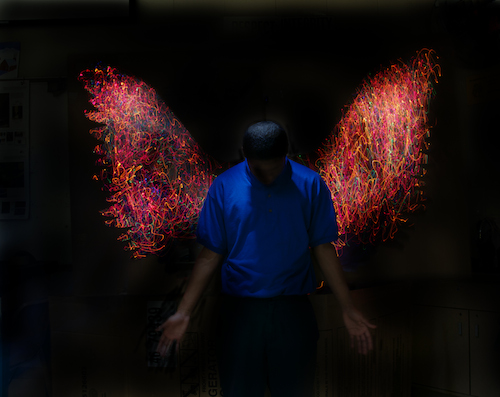
Photo: “Icarus” by an anonymous student of photography workshop at the Rhode Island Training School, coordinated by AS220 Youth.
AS220
AS220 Youth is a free arts education program for young people ages 14-21, with a special focus on those in the care and custody of the state. AS220 Youth provides free studio-based classes in virtually all media including photography. Staff including photography coordinator Scott Lapham and photography instructor Miguel Rosario (who I met when I visited in 2011) help students build a portfolio with help from a staff advisor. AS220 Youth maintains long-term, supportive relationships with youth transitioning out of RITS and the Department of Children, Youth and Their Families (DCYF) care, and offers mentoring, transitional jobs, and financial support. AS220 Youth works to connect youth with professional opportunities in the arts — through exhibitions at the AS220 Gallery and others; through publication in the AS220 quarterly literary magazine called ‘The Hidden Truth’; and through securing photo-assistant jobs on commercial photo shoots for students.
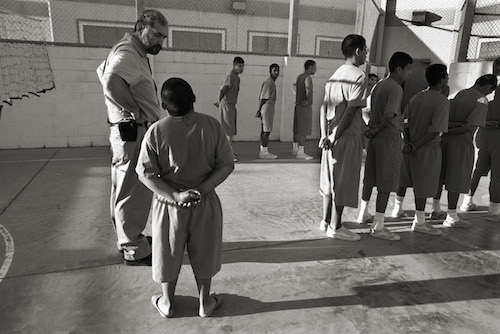
Photo: Steve Liss. Prisoners, ages 10-16, wait in line to march back to their cells in the exercise yard at the Webb County Juvenile Detention facility.

Photo: Steve Liss. 10-year-old Alejandro has his mug shot taken at Webb County Juvenile Detention following his arrest for marijuana possession. Every day the inmates get smaller, and more confused about what brought them here. Psychiatrists say children do not react to punishment in the same way as adults. They learn more about becoming criminals than they do about becoming citizens. And one night of loneliness can be enough to prove their suspicion that nobody cares.
STEVE LISS
Steve Liss photographed in Texas 2001-2004. His book No Place For Children: Voices from Juvenile Detention (University of Texas Press, 2005) won the Robert F. Kennedy Journalism Award in 2006.
Steve Liss worked as a Time Magazine photographer for 25 years, assigned to stories of social significance involving ordinary people. Forty-three of his photographs appeared on the cover of Time Magazine. For his work on juvenile justice, Liss was awarded a Soros Justice Media Fellowship (2004) for my work on domestic poverty he was awarded an Alicia Patterson Fellowship (2005). Recently, Liss received the Pictures of the Year International (PoYI) ‘World Understanding Award.’ Liss has taught graduate photojournalism at Columbia College, Chicago and Northwestern University.

Photo: Ara Oshagan, from the series ‘A Poor Imitation Of Death’
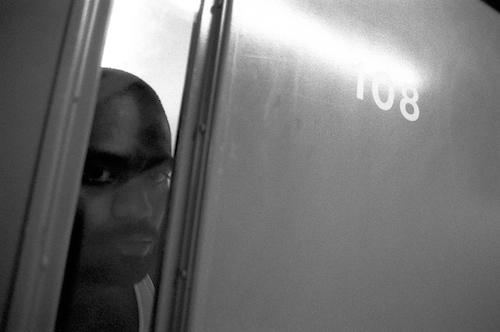
Photo: Ara Oshagan, from the series ‘A Poor Imitation Of Death’
ARA OSHAGAN
Ara Oshagan photographed inside the Los Angeles County Juvenile Hall and the California prison system. Oshagan’s book of this work A Poor Imitation of Death is to be published next year (Umbrage Books, 2014). Oshagan is twice a recipient of a California Council on the Humanities Major Grant for his documentary work on diaspora groups in Los Angeles.
Interested in the themes of identity, community and bearing witness, much of Ara Oshagan’s work focuses on the oral histories of survivors of the Armenian Genocide of 1915. Since 1995, Oshagan has been creating work for iwitness in collaboration with Levon Parian and the Genocide Project. Father Land, a book project made with his father, well-known author, Vahe Oshagan was published in 2010 by powerHouse books.

Photo: Steve Davis. ‘Tiny, Green Hill, 2000’

Photo: Anonymous student at Green Hill School. Photograph made in response to the prompt “Vulnerability” as part of photography workshop led by Steve Davis.

Photo: Anonymous student at Green Hill School. Discussing photographs made during workshop led by Steve Davis.
STEVE DAVIS
Steve Davis coordinated photography workshops in four facilities in Washington State (Maple Lane, Green Hill, Remann Hall and Oakridge) between 1997 and 2005. Simultaneously, Davis made portraits and photographs for his own series Captured Youth.
Davis is a documentary portrait and landscape photographer based in the Pacific Northwest. His work has appeared in Harper’s, the New York Times Magazine, Russian Esquire, and is in many collections, including the Houston Museum of Fine Arts, the Seattle Art Museum, the Santa Barbara Museum of Art, and the George Eastman House. He is a former 1st place recipient of the Santa Fe CENTER Project Competition, and two time winner of Washington Arts Commission/Artist Trust Fellowships. Davis is the Coordinator of Photography, Media Curator and adjunct faculty member of The Evergreen State College, Olympia, WA. Davis is represented by the James Harris Gallery, Seattle.
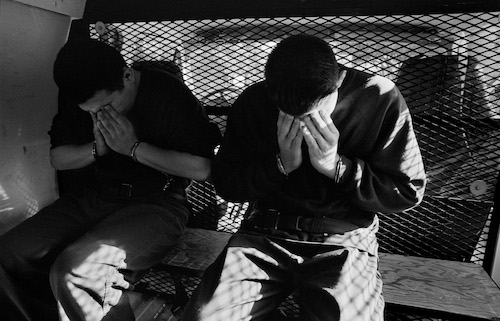
Photo: Joseph Rodriguez, from the series ‘Juvenile’

Photo: Joseph Rodriguez, from the series ‘Juvenile’
JOSEPH RODRIGUEZ
Joseph Rodriguez photographed in the San Francisco County Jails 2001-2004. The work is collected in his book Juvenile (PowerHouse Books, 2004)
Joseph Rodriguez is a documentary photographer from Brooklyn, New York. He studied photography in the School of Visual Arts and in the Photojournalism and Documentary Photography Program at the International Center of Photography in New York City. Rodriguez’s work had been exhibited at Galleri Kontrast, Stockholm, Sweden; The African American Museum, Philadelphia, PA; The Fototeca, Havana, Cuba; Birmingham Civil Rights Institute, Birmingham, Alabama, Open Society Institute’s Moving Walls, New York; Frieda and Roy Furman Gallery at the Walter Reade Theater at the Lincoln Center; and the Kari Kenneti Gallery Helsinki, Finland. In 2001 the Juvenile Justice website, featuring Joseph Rodriguez’s photographs, launched in partnership with the Human Rights Watch International Film Festival High School Pilot Program. He teaches at New York University, the International Center of Photography, New York. Rodriguez is the past recipient if Alicia Patterson Journalism Fellowship in 1993 photographing communities in East Los Angeles.

Photo: Photo: Richard Ross. Los Padrinos Juvenile Hall. Downey, California.
RICHARD ROSS
Richard Ross is a photographer and professor of art at the University of California, Santa Barbara. Juvenile-In-Justice (2006-ongoing) “turns a lens on the placement and treatment of American juveniles housed by law in facilities that treat, confine, punish, assist and, occasionally, harm them,” says Ross.
A book Juvenile in Justice (self-published, 2012) and traveling exhibition continue to circulate the work. Ross collaborates with juvenile justice stakeholders and uses the images as catalysts for change. For Juvenile-In-Justice, Richard Ross photographed in over 40 U.S. states in 350 facilities, met and interviewed approximately 1,000 children. Juvenile-In-Justice published on CBS News, WIRED, NPR, PBS Newshour, ProPublica, and Harper’s Magazine, for which it was awarded the 2012 ASME Award for Best News and Documentary Photography.

We remember the TV images of Nelson Mandela in a grey suit, in bright sunlight, walking free from prison in 1990. We might not know that he could have walked free five years earlier. The reason he did not is because the offer made to him by then State President of South Africa, P. W. Botha was conditional. The conditions basically required Mandela to retire in silence, abandon everything he had stood up for, and went against his responsibilities toward his political supporters.
Mandela once said, “In prison, you come face to face with time. There is nothing more terrifying.” To learn that he refused release after 22 years of incarceration, despite the terror of it, is more proof of Mandela’s unwavering pursuit of justice.
In 1962, Mandela was arrested, convicted of sabotage and conspiracy to overthrow the government, and sentenced to life imprisonment in the Rivonia Trial. He was imprisoned for nearly 20 years on Robben Island until a 1982 transfer to Pollsmoor Prison. Perhaps (?) another lesser known fact is that Mandela was a keen boxer. He boxed to maintain health and discipline, so I’ve included a couple of images of Mandela training — one from 1950 before his imprisonment (below) and one from a prison yard (bottom).

To keep fit, Nelson Mandela, solicitor, was at Jerry Moloi’s boxing gym at Orlando every evening. He’s shadow-sparring with Moloi (right) a professional featherweight. As the biggest case in South Africa’s history lumbered to the end of its first stage this August 1957, the 156 accused men and women wondered how many of them would be back in court again. The 156 national leaders had first appeared at a preparatory examination into treason at the end of 1956, in the specially constructd court at the Drill Hall, Johannesburg; they had spent their lives in and out of court for most of 1957; and they could now see the possibility of the same prospect for the third calendar year, 1958, if they were committed for trial in the Supreme Court. (Photograph by Drum photographer © Baileys Archive)
It’s difficult to know what to say upon the death of any man, but particularly a man who shaped history. Therefore, it was a treat, an inspiration (and a writer’s let-off) to find Mandela’s inspiring rejection of Botha’s offer on the UCSC Library website:
On 31 January 1985, Botha, speaking in parliament, offered Mandela his freedom on condition that he ‘unconditionally rejected violence as a political weapon’. This was the sixth such offer, earlier ones stipulating that he accept exile in the Transkei. His daughter Zinzi read Mandela’s reply to this offer to a mass meeting in Jabulani Stadium, Soweto, on 10 February, 1985. This was the text of his response as read publicly by Zinzi:
I am a member of the African National Congress. I have always been a member of the African National Congress and I will remain a member of the African National Congress until the day I die. Oliver Tambo is much more than a brother to me. He is my greatest friend and comrade for nearly fifty years. If there is any one amongst you who cherishes my freedom, Oliver Tambo cherishes it more, and I know that he would give his life to see me free. There is no difference between his views and mine.
I am surprised at the conditions that the government wants to impose on me. I am not a violent man. My colleagues and I wrote in 1952 to [Daniel François] Malan asking for a round table conference to find a solution to the problems of our country, but that was ignored. When [Johannes Gerhardus] Strijdom was in power, we made the same offer. Again it was ignored. When [Hendrik] Verwoerdwas in power we asked for a national convention for all the people in South Africa to decide on their future. This, too, was in vain.
It was only then, when all other forms of resistance were no longer open to us, that we turned to armed struggle. Let Botha show that he is different to Malan, Strijdom and Verwoerd. Let him renounce violence. Let him say that he will dismantle apartheid. Let him unban the people’s organisation, the African National Congress. Let him free all who have been imprisoned, banished or exiled for their opposition to apartheid. Let him guarantee free political activity so that people may decide who will govern them.
I cherish my own freedom dearly, but I care even more for your freedom. Too many have died since I went to prison. Too many have suffered for the love of freedom. I owe it to their widows, to their orphans, to their mothers and to their fathers who have grieved and wept for them. Not only I have suffered during these long, lonely, wasted years. I am not less life-loving than you are. But I cannot sell my birthright, nor am I prepared to sell the birthright of the people to be free. I am in prison as the representative of the people and of your organisation, the African National Congress, which was banned.
What freedom am I being offered while the organisation of the people remains banned? What freedom am I being offered when I may be arrested on a pass offence? What freedom am I being offered to live my life as a family with my dear wife who remains in banishment in Brandfort? What freedom am I being offered when I must ask for permission to live in an urban area? What freedom am I being offered when I need a stamp in my pass to seek work? What freedom am I being offered when my very South African citizenship is not respected?
Only free men can negotiate. Prisoners cannot enter into contracts. Herman Toivo ja Toivo, when freed, never gave any undertaking, nor was he called upon to do so. I cannot and will not give any undertaking at a time when I and you, the people, are not free.Your freedom and mine cannot be separated. I will return.
When F. W. de Klerk signed off on Mandela’s release in 1990, he was careful to make certain that Mandela’s freedom would be unconditional.


From ‘Assisted Self-Portraits’ (2002-2005) by Anthony Luvera.
PHOTOGRAPHY’S NOT JUST DEPICTION!
There’s a fascinating discussion to be had at Aperture Gallery this Saturday December 7th. Collaboration – Revisiting the History of Photography curated by Ariella Azoulay, Wendy Ewald, and Susan Meiselas is an effort to draft the first ever timeline of collaborative photographic projects. Items on the timeline have been submitted either by members of the public or uncovered during research by Azoulay, Ewald, Meiselas and grad students from Brown University and RISD.
“The timeline includes close to 100 projects assembled in different clusters,” says the press release. “Each of these projects address a different aspect of collaboration: 1. the intimate “face to face” encounter between photographer and photographed person; 2. collaborations recognized over time; 3. collaboration as the production of alternative and common histories; 4. as a means of creating new potentialities in given political regimes of violence; 5. as a framework for collecting, preserving and studying existing images as a basis for establishing civil archives for unrecognized, endangered or oppressed communities; 6. as a vantage point to reflect on relations of co-laboring that are hidden, denied, compelled, imagined or fake.
Within the gallery space, Ewald and co. will discuss the projects and move images, quotes and archival documents belonging to the projects about the wall “as a large modular desktop.”
The day will create the first iteration of the timeline which will continue to be added to.
“In this project we seek to reconstruct the material, practical and political conditions of collaboration through photography — and of photography — through collaboration,” continues the press release. “We seek ways to foreground – and create – the tension between the collaborative process and the photographic product by reconstructing the participation of others, usually the more *silent* participants. We try to do this through the presentation of a large repertoire of types of collaborations, those which take place at the moment when a photograph is taken, or others that are understood as collaboration only later, when a photograph is reproduced and disseminated, juxtaposed to another, read by others, investigated, explored, preserved, and accumulated in an archive to create a new database.”
I applaud this revisioning of photo-practice; I only wish I was in NYC to join the discussion.
As you know, I celebrate photographers and activists who involve prisoners in the design and production of work. And I’m generally interested in photographers who have long-form discussions with their subjects … to the extent that they are no longer subjects but collaborators instead.
Photographic artists Mark Menjivar, Eliza Gregory, Gemma-Rose Turnbull and Mark Strandquist are just a few socially engaged practitioners/artists who are keen on making connections with people through image-making. They’ve also included me in their recent discussions about community engagement across the medium. I feel there’s a lot of thought currently going into finding practical responses to the old (and boring) dismissals of detached documentary photography, and into finding new methodologies for creating images.
At this point, this post is not much more than a “watch-this-space-post” so just to say, over the coming weeks, it will be interesting to see the first results from the lab. If you’re free Saturday, and in New York, this is a schedule you should pay attention to:
1:00-2:00 – Visit the open-lab + short presentations by Azoulay, Ewald and Meiselas.
2:00-2:45 – Discussion groups, one on each cluster with the participation of one of the research assistant.
2:45-4:00 – Groups’ presenting their thoughts on each grouping.
4:00-4:30 – Coffee!
4:30-6:00 – Open discussion.
6:00 – Reception.
If any of you make it down there and have the chance, please let me know what you think and thought of the day.

A couple of months ago, photographer Cosmin Bumbuț contacted me out of the blue and asked if I’d look over his new book Bumbata. I was aware of Cosmin and his work because of the photography workshop he initiated in Targsor women’s penitentiary in Romania in 2009. However, I was not aware of his long term project documenting life inside a Romanian men’s prison. He made photographs in Aiud Penitentiary between 2005 and 2008.
Bumbata — which is a Romania slang term for “prison” — was awarded the Book Art Object Award at the Romanian National Book Design Awards last month. The book paints a portrait of hard life in prison with variation, colour and curiosity. It is a stunning object; thoughtfully designed and brimming with crisp, images full of intimacy, unexpected interactions and (it sounds strange to say) disarming hope. Bumbata is one of my books of the year. You all should get a copy.
During Romania’s Communist era, Aiud Penitentiary was as a site of subjugation and abuse against political prisoners. Since Romania joined the European Union, conditions in Romanian prisons have improved greatly but the country’s overall prison population is growing.
Scroll down for a Q&A with Bumbuț.
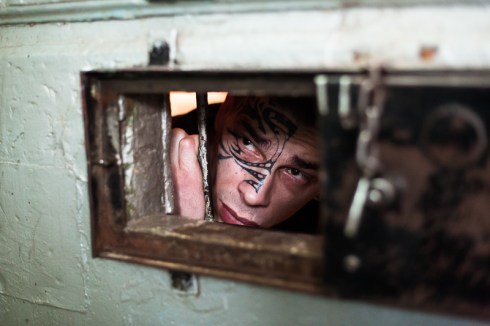
Prison Photography (PP): Congratulations on the book. How did it develop? Did you release any of the images online or have them published in print before the book?
Cosmin Bumbuț (CB): Some of the portraits of prisoners that I shot in 2005 were published in the Romanian edition of Elle Man in 2006. In the same year, I won at the International Photography Awards with these portraits. I have not published the photographs online until now because I wanted to complete the final selection and find the flow of the story. I had 15,000 images and difficulties editing them. I did not like the flow of the pictures from the layout drafts I was working on. The book looked like a classic photo album, but I wanted more. I stopped shooting at Aiud in 2008 but it wasn’t until 2011 that I was satisfied with a selection.
During my last visit at Aiud, I found a file labeled ‘Literary Works of Prisoners’ in the office of the Social Reintegration staff. I read some works on the spot and took pictures of the rest thinking I might use them. I also photographed the prison magazine called Light From The Dark, which at that time was handwritten and stapled in one hard copy.
While I was editing the photos for the 1000th time, I read a text which made me think that prisoners’ texts might be binder for my photos. After this point, it was much simpler. I finished the layout quickly using InDesign which I learned in order to be able to make the design for my own book – the project was really important for me, so I wanted to make the book on my own.
PP: How did the book realise it’s final form?
CB: I printed three copies at Blurb, just so I could film them and try to raise the money for printing through a crowdfunding campaign. After I successfully completed the crowdfunding campaign I realized that I underestimated the printing costs.
CB: Two weeks before the completion of the crowdfunding campaign, I had the idea to make a hole in the cover, a hole that leads to the idea of the eye (sight) of a cell door. I remade the whole layout of the book because of this and I started looking for a printing house that could make this cover. Eventually, I managed this with the help of Atelier Fabrik – great people who never once said “It can’t be done.” The last minute changes of the layout and print cost more money which I paid for from my own pocket.
PP: How do you describe the book to people who have not opened it?
CB: Inside the prison walls, people laugh, play, sing, watch TV, read or write. Prisoners rebuild new homes inside and have created a micro-society with its own rules and functions. Bumbata reveals an intimate perspective of this micro-society. There are libraries, art and theater but many photos are in cells or on the yard.
PP: What’s life like inside Aiud? What sort of rehabilitation programs exist? How are the prisoners’ days occupied?
CB: They are not busy at all. Not all of them are allowed to work or are willing to work, although they are released sooner if they do. Most of them “sit on the room”, as they say, and hang around watching TV or talking. There are not too many volunteers for the activities you are talking about – I met men sentenced to four years of prison who could reduce their conviction with a few months if they would work, but they preferred to lay.
After 2007, when private visits were made law, there was a noticeable difference in mood and spirit. Prisoners were allowed to receive packages from their families; they received better food; they did not have to wear uniforms any longer; and guards were not allowed to beat them.
Once Romania joined the European Union, in 2007, the whole prison system went through major revamp and the biggest reform was to introduce the right to private visits. This means that a prisoner who is married or in a relationship has the right to receive, every three months, a two-hour private visit which takes place in a separate room inside the prison compound. Plus, if a prisoner gets married in detention he or she can spend 48 hours with the spouse in the special room and is allowed visits once a month in the first year of marriage. In such a context I started photographing the first couples to enjoy the new rights inside the Aiud prison.
So, a side project is called Private Visits Room. I have photographed 34 rooms in almost all the Romanian penitentiaries. I do not know yet what am I going to do with this project.
PP: Prisoners are happier then?
CB: They are aware of their rights and this has made them more “courageous” in their relationships with the guards. I am not sure if that is right or wrong. Some of them eat and live better inside a prison than they did in their own homes – they have hot water and warm rooms.
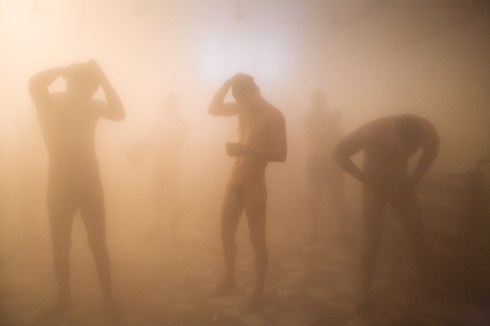
PP: I really enjoyed Hungarian writer Attila Bartis‘ musing on freedom in the introduction to Bumbata. He describes YOU as free; free from expectation, free from dogma of the medium; free to explore. Is he right?
CB: If he describes me that way, he must know something! Atilla writes that I am not “constrained by documentation nor by shocking.” I spent more than three years taking pictures in Aiud and during this time I witnessed all sorts of happy, sad and even absurd events. I tried to get close to the prisoners and to photograph them without any exaggeration, without making them look like monsters or victims, but exactly the way they were: mockers, ostentatious, nostalgic or God-fearing. So in that sense, Attila is right – I was not constrained by documentation nor by shocking. I was free to observe unspectacular everyday life in prison.
Attila and I have been friends since 2010. I met him when I published his photo portfolio in Punctum magazine. I read his novel, Tranquility, all in a breath and after that I wrote to him, telling how much I enjoyed his photographic descriptions. I knew that he was also a very good photographer, so I interviewed him for Punctum magazine.
PP: Can you tell us about Punctum?
CB: I launched Punctum in December 2009 in Romania. Until Punctum, there was no magazine dedicated exclusively to photography in Romania. I wanted to launch a printed magazine because I missed photographs’ consistence and I wanted to educate the public and prove that photography means more than technical information, exposure compensation, shutter and ISO. I found a sponsor who could take care of the contributors’ fees and printing costs. I volunteered my time.
Punctum encouraged diversity and presented different kind of artists: renowned photographers from Romania, but also young students, pictures taken by prisoners from Targsor (the women that attended my workshop), but also portfolios of photographers from New York, Japan, Cuba and Hungary. Additionally, it recovered the history of Romanian photography and published documentaries about photographers of the nineteenth and twentieth centuries, who were hardly known by the public. Each issue presented a photographic portfolio of a famous writer, director, painter or a violinist interested in photography, for example Bartis.
But after five issues (the magazine appeared quarterly with a circulation of 1,000 copies) I realized that I did not have the abilities to sell this magazine and make it profitable. After all, I am just a photographer, not a business man.
PP: Bumbata is of men’s prisons, but you also coordinated workshops in the Targsor women’s prison. Were these projects pursued at the same time?
CB: No, I held the workshop in Targsor women’s prison a year after I finished shooting in Aiud.
In Targsor, I chose six prisoners and I gave each a camera so that they could photograph inside. Of course, I needed special approvals for this. I taught them basic settings and concepts during one visit each week. The workshop lasted for two months. While I was there, I was downloading their pictures and explaining to them how could they improve and what they should shoot the next week.
PP: Did you do a similar workshop with the men in Aiud?
CB: I never held a photo workshop in Aiud. Actually, Ms. Raducanu from the Social Reintegration Department was supportive of the idea, but a workshop needed some special approvals from the National Administration of Prisons.
PP: How long have you been interested in prisons?
CB: Since 2005, when the National Administration of Prisons got in contact with me and offered me access in any Romanian prison. They had seen my photo album Transit. I told them I want to pick only one penitentiary. In order to do that, I visited several and then chose the one in Aiud, which I did for visual reasons: the old cellular system with small detention rooms.
PP: Who helped you secure access?
CB: Dana Cenusa, the spokeswoman of the National Administration of Prisons, helped me and secured my access anywhere inside the prison system.
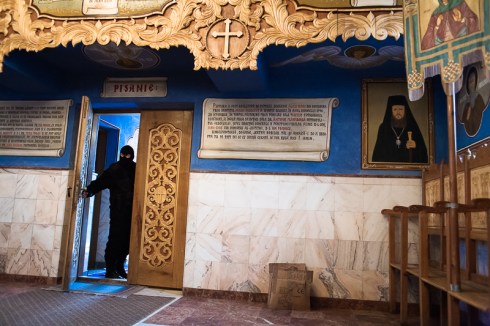

PP: The guards uniform interests me. Why the balaclava hood?
CB: According to the law, prisoners inside maximum security facilties that are convicted for murder, drug trafficking or cruelty deeds are accompanied everywhere by guards wearing balaclava hoods.
PP: Your work was exhibited and prisoners were escorted to the gallery by guards. What was the event like?
CB: I did not organize the exhibition. An art gallery from the city in collaboration with the penitentiary did so. I was touched by the encounter of the detainees with their families, wives and children.
PP: What are the attitudes toward prison and prisoners in Romania?
CB: Generally speaking, it is a controversial subject. Prisoners or former prisoners are considered the scumbags of the Romanian society. I was often asked what am I doing in the prison – have I not found anything more beautiful to photograph than the prisoners? I think that the bad image of the prisoners inside the Romanian society was one of the reasons why National Administration of Prisons asked me if I want to take photos inside the prisons. Maybe they thought that the fashion photographer in me could rehabilitate the image of the prisoners?!
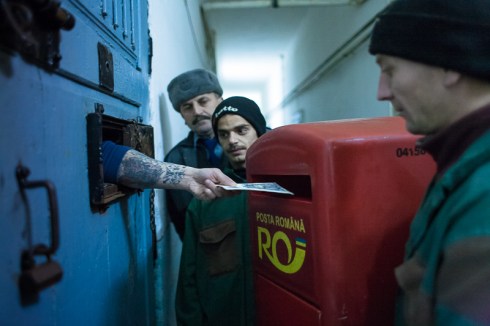
PP: You explain that the prisoners appreciated the Polaroids and printed photos you gave them. How do you define photographs value within prison?
CB: They all want to send photos of them to their families. Because photo cameras are forbidden inside the prison, the value of a printed photo is priceless. They will be released and they will go back home. Prisoners are afraid of being forgotten – so the photographs helped them to remind their families of their existence.
PP: What were the prisoners expectations of photography and of you making images in their prison? Did they think you’d hit the news or sell images for big money across the globe? What was their understanding of your work?
CB: Some of them understood my work, others did not. They kept asking me what I was going to do with the images and I answered them that I will do an exhibition and, probably, a book. After Elle Man published the photos, I became famous inside the prison. They all wanted to be photographed because they have seen that my pictures were not denigrating them. After that, they trusted me.
PP: What did the staff think of your project?
CB: They wondered why I did not have something better to do with my time and money! But as I had all the approvals from National Administration of Prisons, what could they possible do to me, a mad man?!

PP: You did three years. How did you know when the shooting stage of the project was done?
CB: I wanted to finish with a prisoner’s release, so Pricu’s release ended the project. I knew before that I had come to an end. I felt I had become too visible – all the prisoners knew me and wanted me to photograph them. I could not pass unnoticed anymore. So, I took a break until I found out that Pricu was going to be released. I went to Aiud and spent the last two weeks only with him.
PP: What’s next?
CB: Recently, I won the The Rosalynn Carter Fellowships for Mental Health Journalism together with the journalist Elena Stancu and the next year I will travel around the country working on a multimedia project about the culture of education by violence in the Romanian families and society.
PP: Thanks Cosmin and congratulations on the impressive book!
CB: Thank you, Pete
BIOGRAPHY
Cosmin Bumbuț studied at the Faculty of Journalism Bucharest, and later studied photography at the Academy of Theatre and Film. For the last 18 years, Bumbuț has been a freelance photographer. His fashion stories and reportage has been published in Elle, Esquire, Marie Claire, Tabu, Cosmopolitan, FHM, Dilema and Viva! He worked as a photographer for Nottara Theater and Today newspapers. Between 1997-1998 he was a professor at the Academy of Theatre and Film.
Bumbuț has worked on advertising campaigns for Vodafone, ING Bank, Procter&Gamble, Wella, Epson, Coca-Cola Romania, Marriott Hotels and Mercedes-Benz Romania. to name a few. He was awarded The Best Fashion Photographer, Pantene Beauty Awards (2002), The Best Advertising Photo (Ad’Or Festival, 2001) and Best Advertising Photo (AdPrint Festival 1996). In 2006, he won the International Photography Award for a series of photographic portraits of convicts from Aiud Penitentiary.
In 1999, Bumbuț co-founded the photo group 7 Days and organized a series of workshops and photo camps. He co-authored the photographic album 7 Zile – 7 Ani in Maramures “7 Days – 7 Years in Maramures” (Humanitas, 2007). His book Transit (Humanitas, 2002) won the Art Book of the Year Award awarded by the Romanian Publishers’ Association.
Between 2009 and 2010, Bumbuț published Punctum, Romania’s only magazine dedicated solely to art photography. Bumbuț’s photographs have been exhibited in New York, Amsterdam, Luxembourg, Thessaloniki, Madrid, Rome, Warsaw and Naples to name a few.
MORE
At Lenscratch

 Prison Photography