
You are currently browsing the category archive for the ‘Institutional’ category.
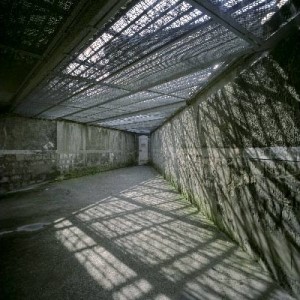
© Jacqueline Salmon
 “In France, photography and prisons have rarely got along” says Clair Guillot for Le Monde (translated). Guillot, prompted by the current exhibition L’Impossible Photographie, Prisons Parisiennes (1851-2010), speculates on the common conditions for prison photographers listing limited access, lack of light and space, constant supervision and uncertain scheduling.Guillot quotes Mathieu Pernot, a photographer occupied by issues of the Panopticon, ‘In prison, the main body is the eye, because the buildings are designed to improve monitoring. At the same time prisoners are held [partly] to deprive them of self-image [and held to deny society his image and presence.]’ I paraphrase due to the vagaries of translation.
(Pernot is flavour-of-the-month, right now, exhibiting in Fotodok’s State Of Prison show in Amsterdam as well as this Parisian outing.)
Guillot goes on to suggest that there has been a recent rise in the practice of prison photography, yet she doesn’t provide projects or practitioners on which she bases that statement.
Whether or not praxis and interest in prison photography is on the up, the ever-existing requirement of French law not to show the faces of prisoners is a steady constant. This is a paradox that needs explaining and, to some extent, apologising for. The effort and will of prison photographers to reveal the hidden arguably achieves the opposite; images of faceless prisoners only contribute more abstracted views of prisons.
Is photography the right tool for the job of describing prisons and the lives within?
Let’s take a look at the work of a couple of the prison photographers in the l’Impossible Photographie show, and evaluate their contributions to this proposed fledgling genre. Matheiu Pernot, Jacqueline Salmon and Michel Semeniako were commissioned for the show. A request was made access for five photographers, but the authorities only allowed three.JACQUELINE SALMON
Jacqueline Salmon‘s photograph are straight environmental studies. In some works she uses the silhouettes of cage, fence and shadow. Often Salmon’s images will offer the promise of a window or vista only to present a barrier or razor wire immediately behind the promise. These are images of frustration. When Salmon documents open doors, they are within larger areas of containment, not strategically imperative and are not policed by the disciplining authority. Through some of these are the work and leisure activities offered at Le Santa Prison, Paris; gymnasium, family rooms, kitchen, chapel and laundry.
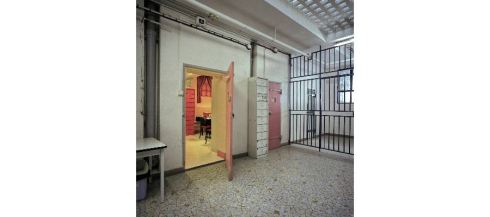

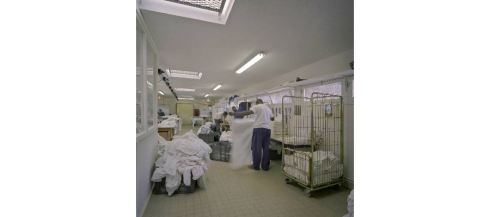
Salmon’s use of orange is occasionally reminiscent of Mikhael Subotzky’s studies in South African prisons and of course echoes the jumpsuits we’ve come to associate with the global and most lawless of prisons – allied sites of detention, Guantanamo, Bagram and beyond …
It is very difficult to be a fair judge when one only has 300 pixel wide website images to go by, but there are 40 images to browse and take in. Aside of the debates about artistic merit, the project as a contemporary document of an old and famous prison in the French capital is an achievement in itself.
MICHEL SEMENIAKO
Salmon’s impartial observations lie in contrast to Michel Semeniako‘s close engagement with the inmates. Semeniako conducted portrait workshops but not permitted to exhibit this work he collaborated with inmates on still lives of their possessions; portraits of men as evidenced by the objects they possess.
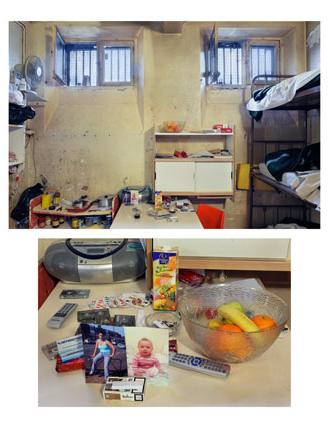
Screengrab. Varga Traian, Maison d’arrêt de Paris-la-Santé, 2009. © Michel Semeniako.
It’s an interesting concept and an approach used by other prison photographers (Jeff Barnett-Winsby and Edmund Clark spring to mind). For Semeniako’s project, each prisoner is a co-author of the images. Could we argue that this is part rehabilitation, part art, part documentary? I guess one must decide on how wants to judge Semeniako’s project first.
I’ll judge it on two criteria; firstly, on the self-esteem and therapeutic advantages for the prisoners in discussing and constructing ones own environment for presentation; and secondly, on the otherwise impossible connection to prisoners’ lives which is afforded to viewers of the photographs. This connection informs (just a little) and in so doing completes a minor but profound transaction initiated by Semeniako and each prisoner during their discussion on how to assemble their still lives.
EXHIBITION REVIEW
Brendan Seibel penned an overview of the l’Impossible Photographie. Seibel concludes that the exhibit is large and potentially overwhelming;
“Tying the exhibition together is not chronology but classification. Rooms are broken down by location, with contributions by a steady cast of photographers spread throughout. Women’s prisons La Petite Roquette and Saint-Lazare reveal a jarring juxtaposition of nuns and incarceration, the role of religion in rehabilitation. The men’s – Grand Roquette, Sainte-Pelagie, Mazas and Santé – lay clustered together, more barren and austere. Throughout the exhibition essays on each prison, brief summations of photographers, developments in regulations and politics accompany each turn of the corner.”
Seibel was particularly engaged by the archive of Henri Manuel from the 20s and 30s. Manuel was employed by the French government to document the prison and justice systems. He gained unprecedented access and his prints are pivotal in the genre of prison photography.
Other artists include photographer Pierre Jouve (talking here, in French, about his juvenile detention photographs), also designer/photographer Anne-lise Dees and the photographer/oral historian Catherine Rechard.
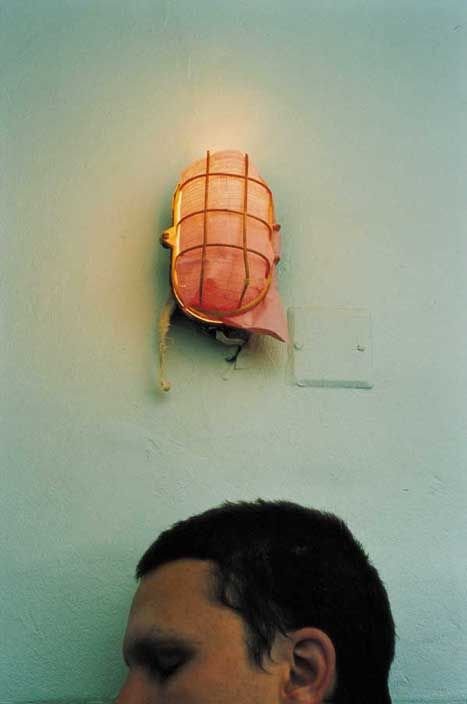
© Catherine Rechard.

– – –
All in all, this exhibit is a significant attempt to reconcile the curiosity and desire to see the activities of the state (think about the ethics and standards debates about military embedded journalists) with the work of artists who endeavour in to do so. Perhaps Guillot is right, perhaps following this exhibition, prison photography may be defining the parameters of its own genre?
– – –
The Carnavalet is hosting a series of tours, discussions and other events related to the exhibition. A schedule can be found here.
l’Impossible Photographie
From now until 4 July 2010
7€/5€ Reduced 10:00-18:00
Closed Mondays and Holidays
Musée Carnavalet
23 rue de Sévigné
Mº St-Paul/Chemin Vert
It’s no secret I am a fan of Flickr Commons. The UK National Archives just went online.

George Davey was sentenced to one month’s hard labour in Wandsworth Prison in 1872 for stealing two rabbits. He was ten years old. (Source)

© Nico Bick
I just received an email from FOTODOK who present this month State of Prison, an exhibition with work of Nico Bick (The Netherlands), Carl de Keyzer (Belgium) and Mathieu Pernot (France). Also included – I am proud to say – are two photographers I’ve interviewed for Prison Photography – Stephen Tourlentes (United States) and Jürgen Chill (Germany).

© Jurgen Chill
FOTODOK statement:
“Photographing official institutions such as schools, government buildings, prisons and old people’s homes often goes hand-in-hand with limitations. PR and communication departments conscientiously guard their image and impose restrictions on photographers.”
“Even so, photographers still succeed in making individual and meaningful series in these places that go further than PR photos. From surreally painted Siberian prison camps to screaming family members outside the prison walls.”
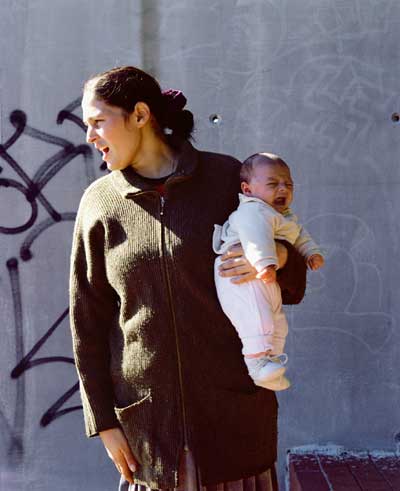
© Mathieu Pernot
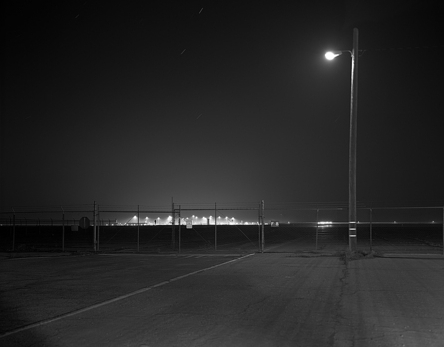
Federal Prison, Atwater, CA, 2007. © Stephen Tourlentes
The curator is photographer Raimond Wouda (The Netherlands) who himself has taken a look at the impression of institutional architecture upon its users, most notably the social spaces of Dutch high schools.
Throughout 2009, Raimond Wouda reported on his research on FOTODOK’s website. This process and all the findings of the past year have been compiled into a collection of words and images. The publication will be presented during the opening. I’d love to get my hands on that!
– – –
The exhibition runs from the 26th March to the 25th April 2010. An opening will held this week at 19.30pm on the 25th March at Van Asch van Wijckskade 28, Utrecht (map).

From the ZONA series. © Carl de Keyzer
Dawoud Bey suggested during his address to the Society for Photographic Education 2010 Conference audience, Saturday night that ‘diversity’ had become not an ideal but a political mantra of art institutions that papered cracks and contributed nothing to long-term involvement of people of colour.
Bey argued the word ‘diversity’ has been appropriated, misused and redefined. Bey does not foresee a reclamation of the word but calls for an abandonment of the institutional practices the word has come to stand for.
Bey wants ‘inclusivity’, a firm shared understanding of the term, and relevant action instead. Bey distinguishes:
Diversity to me implies that there is still some normative paradigm at the center that we are seeking to destabilize rather than doing away with it in favor of something quite different. It suggests that institutions have an inherently white and male identity that needs to be added to. To operate out of this paradigm is, of course, a kind of tokenism by yet another name and seeks to trade on the momentary (but always empty and short lived) self-congratulatory excitement of seeing a new color in still unexpected places. It would seem to me that by now we should be approaching a point where anyone should be expected to be anywhere.
I think it’s time to turn away from “diversity” as an operative objective and turn instead towards the more meaningful and substantial goal of making institutional spaces ever more inclusive and embrace the goal of inclusivity, in which everyone’s identity is central to the whole. One way to accomplish this is to consider how in fact the institution’s identity can be meaningfully transformed and expanded conceptually by this enhanced inclusiveness in a way to deeply transforms the very nature of that institution. Inclusivity implies a desire to actually change through institutional expansion, while diversity implies to me that those being brought in have to simply fit into the normative and dominant existing paradigms and simply add “color” to it.
[My bolding]

The full lecture which Bey transcribed to his blog is essential reading as it sums up with authority the history of localised art movements, the legacy of protest among minority communities against silenced or non-represented voices (even in shows dedicated to the work of African American artists for instance!)
Bey recounts the protests against the “Harlem On My Mind” exhibition at the Metropolitan Museum of Art in 1969. Bey reminds us that Roy DeCarava carried a sign outside reading, “The White Folks Show the Real Nitty Gritty.”
Bey traces many of his own successes not to umbrella changes in culture or industries but to committed artist actions doing the leg work for themselves. He is the inheritor of community spirit so to speak.
Bey drives the point home exquisitely by pointing to one of New York’s favourite and largest art love-ins:
And then along comes the Whitney Biennial 2010 to remind us just how little some things have changed … In an exhibition that ironically uses an image of Barack Obama on the catalogue cover, we find among other things absolutely no Latino artists and a total of three black artists among fifty-five artists in the exhibition. What is your response to that? What would the response have been in 1969? I can’t imagine that this kind of situation would have been tolerated at that moment.
[My bolding]
CONCLUSION
Again, cold hard figures don’t lie, and I think Bey has shown that history doesn’t lie. We’ve got a lot to do.
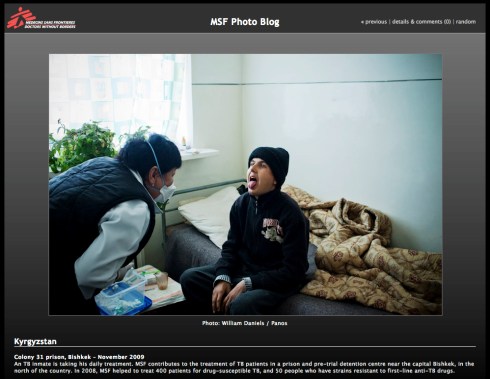
Medecins Sans Frontieres photoblog is a poke in the eye to remind us of the urgent humanitarian needs beyond the front pages of our daily news-web-papers.
WILLIAM DANIELS
Today William Daniels‘ photograph reminded us of ongoing medical efforts against Extremely-Drug-Resistant Tuberculosis (XDR-TB) in the Kyrgyzstan and the former Soviet Union, particularly in prison colonies.
Prisoners of the colonies in the former USSR received treatment under the Soviet regime, but when the Russian empire collapsed, drug treatment was abandoned and even more severe strains of TB developed.*
I highly recommend Daniel’s Faded Tulips project.
– – –
Which reminds me …
CAROLYN DRAKE
It seems to me that generally the central Asia territories are simply unknown to many in the West. Carolyn Drake supports this notion with her commentary about environmental and river politics in the five provinces established after the fall of the U.S.S.R. (Orion Magazine)
– – –
* I have talked about James Nachtwey‘s work in Siberian prison colonies previously on Prison Photography.

I am a huge fan of the Flickr Commons Project.
I have published on The Hidden Gems of Flickr Commons for Wired‘s photography blog Raw File.
For their documents of (early) 20th century fishing & skiing; industry & leisure; mountains and deserts of the Pacific Northwest, my favourite institutions are The Oregon State University and the Commons’ newest member, The University of Washington!
I have always been taken by the photographic sets out of the London School of Economics. The LSE archive has great emphasis on its department faculty; administrative staff; extra-curricula activities; student events; laboratory tableaux; campus vistas; college anniversaries; and guests of the famed school. It’s an archive with a likable and unpretentious institutional identity.
The LSE Library set contains dozens of portraits of the library scientists and staff.



Green has strong emotional correspondence with safety. Green is the most restful color for the human eye; it can improve vision. Green suggests stability and endurance. Green is used to indicate safety when advertising drugs and medical products. Dull, darker green is commonly associated with money, the financial world, banking, and Wall Street. Dark green is associated with, greed, and jealousy. Aqua green is associated with emotional healing and protection.
Source
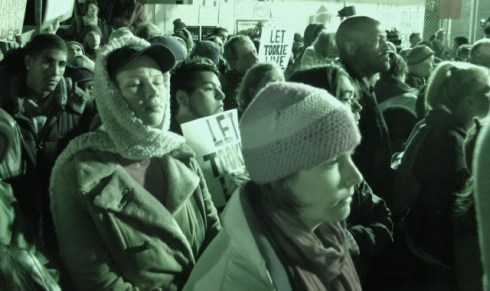
I was looking over the following images of the protest/vigil outside San Quentin Prison on the night of Stanley ‘Tookie’ Williams’ murder by the state of California.
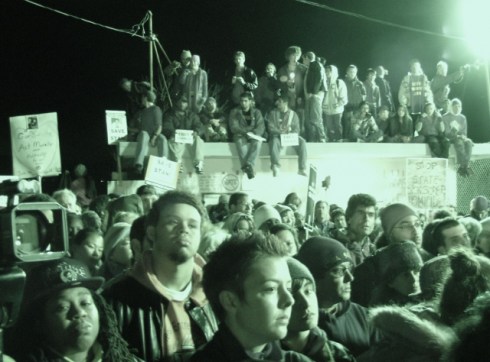

The verdant tones of green dominate and they reminded me – like some ironic twist of a krypto-knife – of California’s death-chamber itself. San Quentin has since constructed itself a new fan-dangled killing suite … and it needed to. The Golden State had taken to injecting people with poison within its old hexagonal gas chamber.
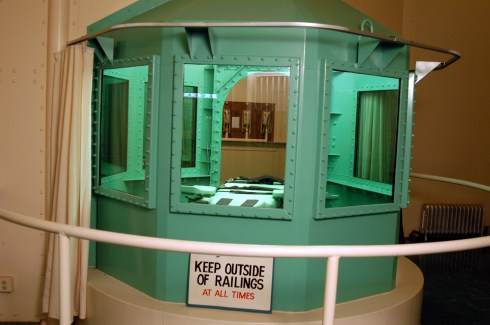
The site became an insult to the escalating industry of death, out of sync with the newest sterile modes of person-erasure. The heavy air-locked lantern no longer suitable for the clinical 21st century methods of snuff so developed by scientists, physicians and judges.

The pea green pod that transports, transforms and accelerates passage to elsewheres; An echo of an echo-death-chamber..
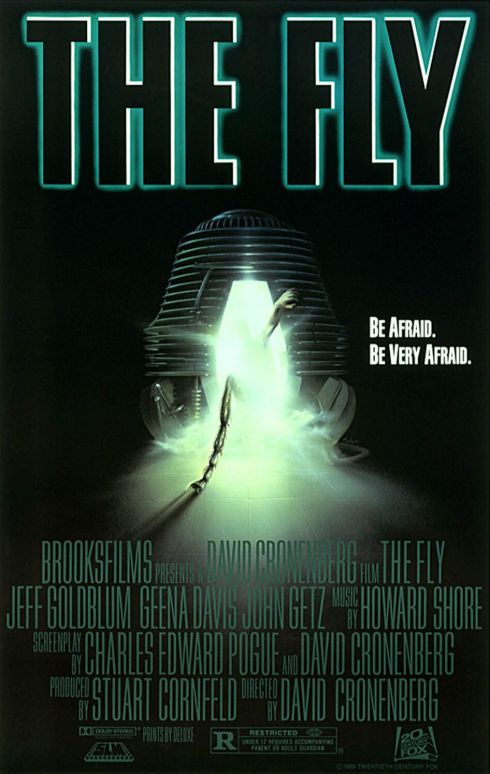
One switch, one injection, one mistake, one outcome.
Two switches, two injections, two mistakes (original crime vs. retaliatory murder), two outcomes (original verdict vs. appeals all boiled in a single decision-cauldron).

A theatre reenactment. Perfect palette.
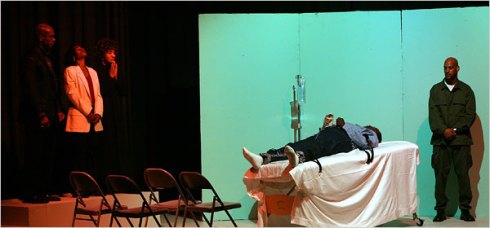
Source
Back in San Quentin, the gurney straps itself to itself.

Source
As a ten year old, I remember the same night time visions of green tinted destruction. John Major was in power and war seemed just.
I’ve seen them again recently …
Different century, same annihilation.

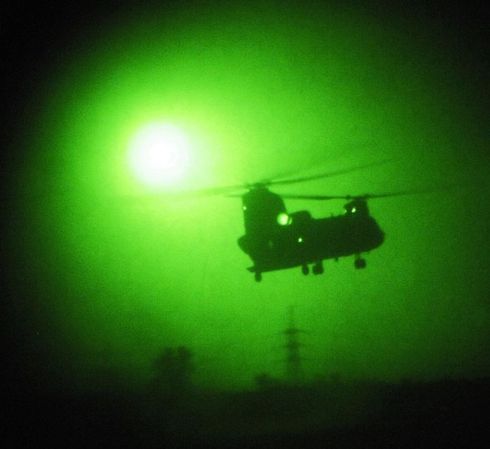
People will disintegrate, body parts will fall off, limbs will be poisoned and charred.
Democracy will teleport itself for its own arrogance, implicating a dictatorship and a sorry hybrid shall limp to an uncertain future.
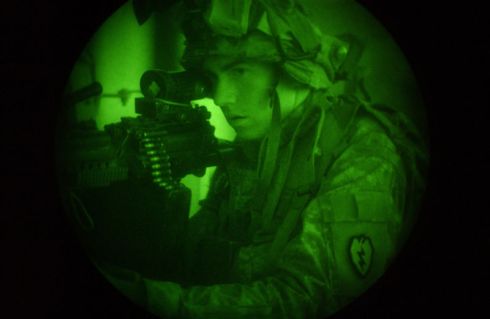
And the toll shall be personal, unsuspected, for the love of the state and its rhetoric.
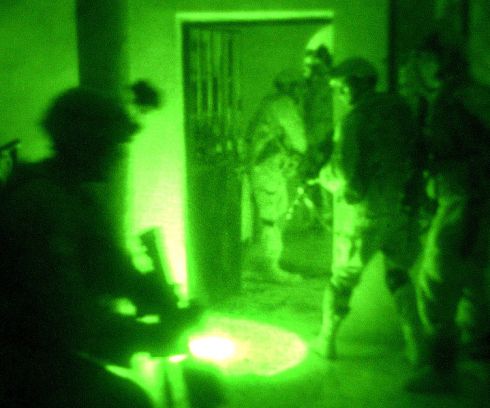
And the children will be the unhindered beneficiaries of a world not of their own, but the world of their violent predecessors, their decisions, amalgamations, actions and murders.

Kids become sad reminders that nostalgia, film photography and wildlife cinematics were forsaken before they could be rightfully demanded back. A new sterile age sports no death cells, no faces, no conscience, no history.
Immunology becomes the new high stakes industry …
…
…
By the way, have you ever noticed that the beat in Boards’ Kid for Today is the clickclack of a slide projector carousel?

Rendition. Photographer Unknown
Last week, Eliza Gregory at PhotoPhilanthropy got knee-deep in speculations about prison photography.

Eliza was spurred by NPR’s On the Media which “did a story about a series of images that the International Committee of the Red Cross made of the prisoners at Guantánamo Bay. The ICRC made pictures of the prisoners to send to their families, and allowed each prisoner to choose which particular image would be sent. Naturally, the images the prisoners collaborated in making are very different from the images we’ve seen of them in the news.”

Eliza contacted me and asked me to leave some comments.
I rounded off my comments with a question I think is very important: Could an American photographer complete a project with the access, familiarity and story-telling-verve as Mikhael Subotzky did in South Africa for his project Die Vier Hoeke?
Not wanting to funnel my diatribe down just one web avenue, I copy my comments here …
Eliza,
I’d like to talk about two issues that you point to in your post. First, the general absence of prison imagery in contemporary media and secondly the urge to judge the subjects of the imagery that does crop up.
I doubt highly that Guantanamo would’ve been closed if more photographs had come out of there. While there is no question visuals out of Gitmo were controlled stringently, the MoD had proven itself impermeable to even the most reasonable requests by human rights advocates and legal watchdogs.
The point you make about smiling detainees instantly changing ones perception could be applied to all prison populations. Phillippe Bazin, Luigi Gariglio and Dread Scott have each used straight portraiture to cause audiences think about the individual character of prisoners.
I recommend books by Douglas Hall Kent, Morrie Camhi, Bruce Jackson, Jane Evelyn Atwood and Ken Light. I recommend work by Carl de Keyzer, Joseph Rodriguez, Steve Liss and Andrew Lichtenstein for imagery of prisons beyond the press shots of tiered-cells and orange jump-suits.
More than any of these though I recommend photography of self-representation. I have speculated on it before, and it has been done by Deborah Luster in Louisiana, and by the inmates of Medellin prison, Bogota, Colombia.
All of these photographic interventions are inspiring but barely make it into the mindshare of media consumers. I believe the unforgiven monster who deserves no thought is the predominant version of “the prisoner” in the minds of most Americans and many others in the Western world.
Of course, the invisibility of prisons is a collective tactic. We are molly-coddled by zealous enforcement agencies to whom we’ve outsourced management of transgressors. We have no interest in dealing with the difficult issues surrounding mistakes, mental health, inequalities and human frailty … this is where the “lock ’em up” mentality comes from.
Prisons and prisoners are not scary places because they are threatening and violent, they are scary places because they are wasteful, boring, soul-sapping warehouses. This is the document we never see. America’s prisons are a human-rights abuse.
Photography will play its part, but it’ll take a monumental cultural and media shift to change sentencing and prison policies in the West.
In the meantime, It’d be interesting to see if a long-term project similar to Mikhael Subotzky’s could ever be completed in an American prison?

© Mikhael Subotzky, from the 'Die Vier Hoeke' series.

 Prison Photography