
You are currently browsing the category archive for the ‘Non-Prison’ category.

© Ruddy Roye
PDX Design Week wrapped up last weekend. Before I moved out of the city, I was asked to do a guest post for the PDXDW blog. I don’t know much about design, so I wrote about photographers that are making good use of emerging technologies or commenting on our brave new world dominated by emerging and automated technologies.
Thanks to Taryn Cowart for her assistance getting it published.
With some line-editing, I crosspost the listicle below.

PHOTOGRAPHY’S BEST
Good photography is good vibes. Often, even bad photography is good vibes. The world needs Seflies, SnapChat cheekiness, cat GIFs, and Doge bombs. However, sometimes, we have to search out the good stuff. We need to look around and ask what’s at stake. Frankly, there’s not a lot resting on your cellphone pictures — they’re not changing the world. When the technologies and file formats with which they were made are obsolete, no-one will care if your phone snaps are lost forever. Least of all you?
When we talk about art, journalism and photography we should be able to single projects out and to define worth. Some creative endeavors are world-changing. I want to give a nod to photographers and artists working with images who inform us about the world and some of its urgent issues. As users and consumers, I want to believe we can leverage rapid publishing and sharing for political and social improvement.
BEST USE OF INSTAGRAM
Ruddy Roye was the first photographer to really stake his style on the meaningful caption. He ditched the hashtags and asked real people some real questions. Based in New York most of his portraits are of people in his neighborhood and jollies around the Big Apple. His feed drips with humanity and reveals stories you couldn’t imagine. This is the REAL Humans OF New York! Also, I like to credit Roye for landing the fatal blow to the snarky #TLDR hashtag.

© EverydayAfrica
SECOND BEST USE OF INSTAGRAM
Peter DiCampo and fellow journalist Austin Merrill (both white American) set up the Everyday Africa after years of reporting from the continent and witnessing nothing but sensational and scary images of war, tragedy and the like. What about the normal everyday stuff? In an attempt to make the most of boring daily things, DiCampo and a wide cadre of collaborator quickly put together a simple, illuminating, sometimes colorful, and intimate Instagram feed. It’s political but not difficult. Okay, so it’s a free-for-all that promotes aesthetically ordinary pictures, but I’ll take neoliberal relativism over neocolonialist manipulation every day of the week.
EverydayAfrica spurned dozens of loose collective of photographers who set up EverydayMiddleEast, EverydayAsia, EverydayIran and even EverydayBronx. Instagram sponsored an Everyday “Summit” at the 2014 Photoville Festival and ponied up cash to fly in contributors from all corners of the globe. These guys are much better IG-movement than the creepy Christians making VSCO lifestyle shots to pair with their #blessed affirmations and bible quotes.
Watch out though: EverydayUSA has some of the best photojournalists under it’s belt. Photo-industry-folk reckon EverydayUSA will soon eclipse all the other accounts, at which point the whole Everyday movement may have announced its death. Get on this young movement while it’s still fresh and focused on countries other than the one you live in.

© Mishka Henner
BEST USE OF GOOGLE EARTH
If there’s a controversial topic Mishka Henner hasn’t produced a body of work on, he’s probably in his studio, right now, making it. From censorship, to prostitution in the Mediterranean, from military bases to big-ag food production, from war to big oil, Henner doesn’t shy away from tough topics. His skill is to do so without really leaving his studio. Henner is one of the cleverest, canniest and hardest working artists dealing with Google and the machine age of image-making.
He winds people up with his methods that are anathema to photo-purists but what else is there to do with available imagery if not to capture, ‘shop and frame it in political terms. Google is the all seeing eye that doesn’t care.
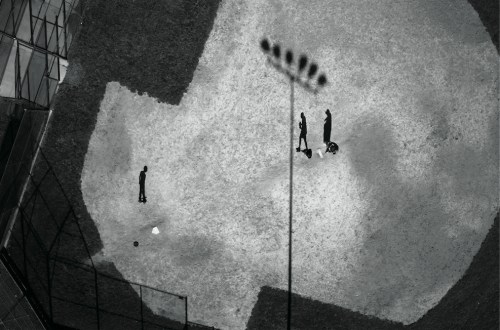
© Tomas Van Houtryve
BEST USE OF PERSONAL DRONES
The Bureau of Investigative Journalism estimates American operated drones have killed between 2,296 and 3,718 people, as many as 957 of them civilians. That’s a whole lot of killing.
The program of U.S. airstrikes which began in 2002, but was only publicly acknowledged in 2012 is a remote war driven by a remote technology. Belgian photographer Tomas Van Houtryve decided the best way to grab Americans’ attention to the issue was to show them how drone attacks would appear in America.
There’s no shortage of projects about drones to get us thinking about the issue. John Vigg has his Google surveilled drone research labs and airports; Jamie Bridle traced a drone shadow in Washington D.C. last year and launched Dronestagram to populate social media sites with satellite views of drone strike sites; Trevor Paglen has photographed drones at distance; and Raphaella Dallaporta took a drone to Afghanistan under the guise of an archaeological survey.
Most recently Not A Bug Splat made a splash. Cheeky and powerful the project installed massive portraits of children in regions subject to U.S. drone strikes, with the intent of pricking the conscience of remote U.S. drone operators stationed in Nevada about to bring the hammer of destruction down on that Waziristan village.

Screenshot of Josh Begley’s Prison Map
BEST USE OF SURVEILLANCE IMAGERY AGAINST THE SYSTEM
Data artist Josh Begley specializing in scraping images from publicly available sources. He then creates App and websites to publish the info and produce push notifications you can’t avoid.
For his project Prison Map, Begley took the GPS coordinates of every prison, jail and immigration detention center in America and fed them into a Google Maps API code he had modified. He ran the script and it spat out more than 5,300 satellite images — one for every locked facility in the U.S. The prison population in this country has grown 500% in the past 30 years. One in every one hundred adults is behind bars and most of them are poor people. The recurrent patterns of brutally functional architecture within Prison Map are staggering. We’ve been building prisons in high desert and rural backwaters. Begley makes the Prison Industrial Complex (PIC) visible once more.
Likewise, for his project Profiling Is, Begley snagged the NYPD’s surveillance shots of business and residences in the NY boroughs which were under monitoring.
He doesn’t stop there. Begley’s App MetaData alerts users to U.S. drone strikes in Pakistan, Yemen, Afghanistan and elsewhere. This didn’t happen until the conclusion of a merrigoround of negotiation with the “apolitical” Apple. Begley finally got his drone strike App approved when he removed all mention the word drone! Now, you can get next-day updates of Obama’s largely-ignored drone war on Afghanistan, Pakistan, and Yemen straight to your smartphone.

© Mari Bastashevski
BEST USE OF PHOTOGRAPHY, MUCK-RAKING AND INVESTIGATIVE NOUS
Mari Bastashevski skirts a fine line between journalist, artist, researcher, photographer and tourist to dig up the personalities and money makers in the international arms trade. Here’s the feature I did for WIRED a while back. Her ongoing project State Business is devastating inasmuch it reveals how pervasive and complicit most nations are in making billions on the slaughter of humans.The US, the UK, Croatia, Azerbaijan, Georgia; Bastashevski’s following of the money takes us all over the place … sometimes even to the carport on the Facebook pages of international arms dealers.

BEST MAKING SENSE OF SURVEILLANCE
If you can’t beat ‘em join ‘em. In 2002, after Hasan Elahi was mistaken for someone on the terror watch list and detained for hours at Detroit airport, he decided he’d save the authorities the bother and monitor himself. Caustic, direct, creepy and amusing, Elahi photographed everything he did, ate, shit, saw and worked on. He also GPS tracked his every move on a live web map. The project is titled Tracking Transcience. One of the by-products of the self-monitoring is the creation of a typology of toilets. Taking sousveillance to another level and entertaining thousands while he does it. Brill.

© MigraZoom. A migrant on a cargo train traveling from Arriaga, Chiapas to Ixtepec, Oaxaca. After crossing the Mexican-Guatemalan border and traveling to Arriaga, migrants hitch a ride on top of cargo trains to Ixtepec. This trip takes about 12 hours. In addition to the risk of falling off the train (amputations and death are common), gangs frequently extort migrants, charging them $100 to ride. They face threats of being thrown off the train, kidnapped, raped or trafficked if they do not pay.
REALEST VIEWS OF IMMIGRATION
There’s some great fine art projects out there about the U.S./Mexican border. Probably, the stand out is David Taylor’s Working The Line, which documents the militarization of the border. But it can be criticised for being to distant and tends to rest on the creaking aesthetic mores of American landscape photography. If we want to see what is really going on during the tough journey’s into North America, we should pay attention to MigraZoom, a project by Spanish-born photographer Encarni Pindado which puts disposable cameras in the hands of economic migrants during their perilous treks northward.

© David Taylor
Another beautifully shot and more unexpected treatment of new arrivals is Gabriele Stabile’s Refugee Hotel which documents approved asylum seekers’ first nights in America at four hotels adjacent to four hub airports through which new refugee migrants arrive. Respectful documentation that is pregnant with uncertainty.
Taylor’s work is currently on show at the amazing ‘Covert Operations’ at Scottsdale Museum of Contemporary Art.
BEST USE OF INTERNET FOR DISCUSSION
Photographer Hank Willis Thomas is a prolific force. One of his most recent projects Question Bridge is a platform for black males to ask other black males questions about black identity. Participants do so through video and provide answers similarly. Access is easy, involvement free, connections priceless and it works well in exhibition format too. The murder of Michael Brown in Ferguson is the latest incident to demonstrate to the entire nation our shared need to face racial inequality int he country. Willis Thomas is doing his bit.
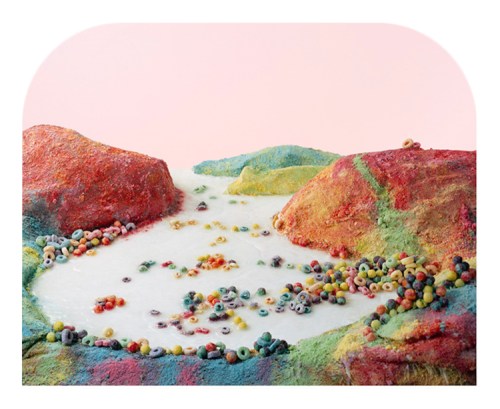
© Lindsay Lochman and Barbara Ciurej
BEST COMMENTARY ON MECHANICAL AGE FOOD PRODUCTION
With Ag Gag laws becoming ever more common, clever responses to imaging industrial food production must be inventive. Lindsay Lochman & Barbara Ciurej rip on the much-mythologized West and specifically on the hero-worship of Carleton Watkins by constructing sugar-coated and corn-fed diorama reconstruction of Watkins’ landscapes with shitty foodstuffs.
Will Potter ain’t a photographer but he’s putting imagery to good ends. Potter, a TED Fellow, has been reporting on the crack down on environmental activists under homeland security legislation that was designed to tackle terrorist. Instead of chasing bombchuckers, our law enforcement is going after tree huggers. The title of Potter’s book, Green Is The New Red, say its all. Routinely, it has been eco-activists who’ve brought us the shocking footage from inside factory farms. Potter, continuing the tradition of expose, wants to fly drones over feedlots and take advantage of laws being slow to be written. Again, we seeing the convergence of technologies and activist peel back the layers of obscurity purposefully put over our shady business practices in years past.
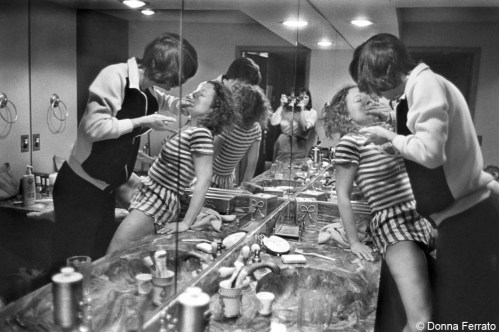
© Donna Ferrato
VIOLENCE AGAINST WOMEN
The greatest photography work being done to reveal the entrapped, terrorized lives of those victim to domestic violence, is done — perhaps not unsurprisingly by female photographers. Donna Ferrato has trained a lens on the topic for decades. Recently, young gun Sara Naomi Lewkowicz captured similar images to Ferrato as an intimate witness to partner abuse. The parallels were saddening proving that this is a strand of violent psychology we just are not dealing with effectively. To be frank, the issue isn’t being imaged enough; intimate partner abuse remains hidden behind closed doors.
Paula Bronstein was one of the earliest and most direct photographers to document the survivors of acid attacks in Asia. If we’re to mention women’s rights abroad we have to look at the work of Stephanie Sinclair, whose multiyear project Too Young To Wed is pitch perfect. Quiet, weighty, tragic and polychrome portraits of child brides throughout the world. Sinclair’s had help from all the major distributors and grant makers to cast the net of her survey far and wide. The transmedia project is about as good as it gets in terms of audience engagement tactics too.
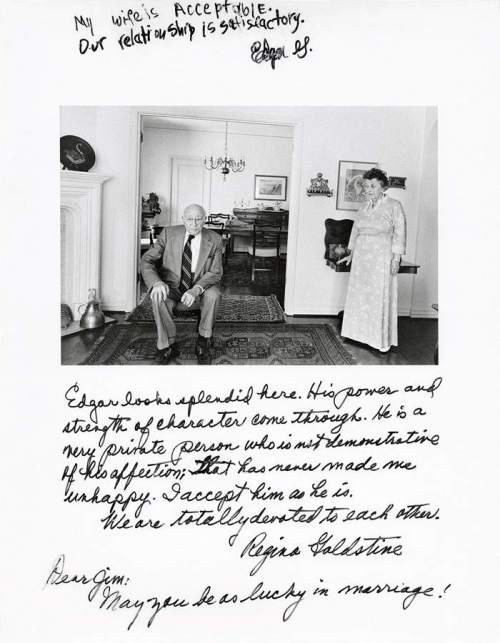
© Jim Goldberg
BEST COMMENTS ON WEALTH INEQUALITY
It’s difficult to name a stand out photographer who has taken on the wealth gap in a resonant way. It sounds strange to say but maybe cash is difficult to shoot? This apparent lack is consistent with other art forms though. If Occupy taught us one thing, some issues are designed for public performance, demonstration, walking and protest signs. Think of music, for comparison. In the sixties musicians such as Joe Strummer and Nina Simone emerged with brilliant anger toward social injustice. Despite public disgust made visible in anti-Iraq-war protests and Occupy, there’s not a protest song from the 21st century of note. Perhaps music isn’t the format for anger or the wealth gap either?
Don’t worry, I’m not being a pessimist here. Violent dismay certainly exists. I’m just not convinced art is the realm where we see the most direct political action. Gone are the days of the great labor photographers such as Lewis Hine and Jacob Riis. Inequality was laid bare in the photojournalism of the civil rights era (Ernest Cole, Charles Moore, Danny Lyon) and while those reportages were about money and opportunity they weren’t primarily about the markets. Check out the work of Gregory Halpern for your modern day Milton Rogovin.
The most indelible and forthright description of wealth inequality is Jim Goldberg’s Rich and Poor, which remains the high point and the tone at which aspiring photographers should aim.
Dang, that’s been a lot of men’s names. I think it right to end with LaToya Ruby Frazier’s name then. She, better than anyone currently making work, ties together class, race, income, post-industrial America, public health, personal health, family and environmental hazard with her generational survey of the women in her family and her home town of Braddock, PA, in The Notion OF Family.
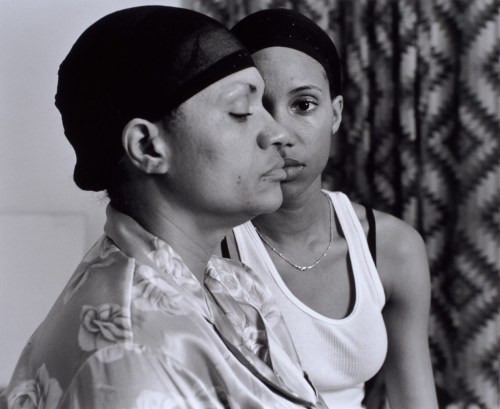
© La Toya Ruby Frazier
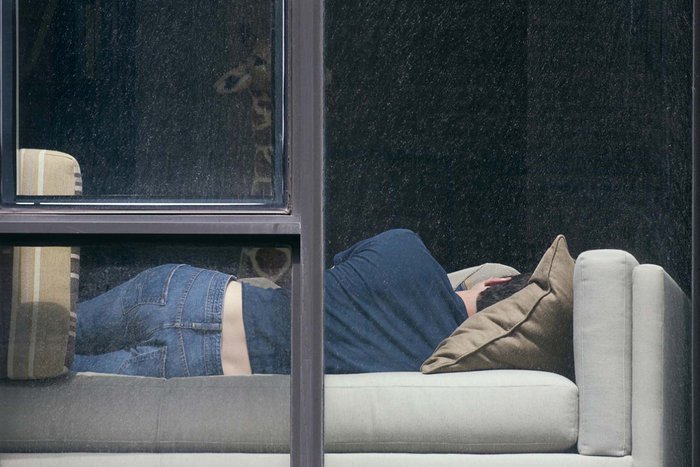
Arne Svenson, The Neighbors #11, 2012 © Arne Svenson, Courtesy Julie Saul Gallery, New York
The Prying Eye Of The Public Lens, a response piece I wrote for the Carnegie Museum of Art’s Hillman Photography Initiative was published earlier today.
A greater cynic than I might argue that Arne Svenson was working for the state when making photographs of his neighbors. One might suggest this not because there is any inherent value, lest any valuable information about the individuals within the snooping shots, but rather, because the brouhaha that erupted around the exhibition of The Neighbors at the Julie Saul Gallery was a distorting and damaging version of the ongoing conversation about privacy in our society.
I go on to explain how the protestations of Svenson’s (very affluent) neighbours, lawsuits and public outcry derailed us from actually seeing the more pernicious and invasive layers of surveillance we are subject to daily … and especially in New York city.
Read the 1,200 words here.
THE HILLMAN PHOTOGRAPHY INITIATIVE (HPI)
The inaugural HPI at CMOA “investigates the lifecycle of images: their creation, transmission, consumption, storage, potential loss, and reemergence. Technology accelerates the pace of this cycle, and often alters or redirects the trajectory of an image in unexpected, powerful ways.”
Transition and consumption: Love that. I’m proud to be associated with CMOA’s broader consideration of images within society. HPI is getting inside the bloodstreams of the media and changing the discussion.

FERGUSON
The unrest has abated in Ferguson. The quest for justice has not.
As I watched events unfold last month, I did not at any point feel I had something to add to the news coverage or commentary. I am still not convinced I do. That said, when the very soul of America is at stake, when the life of a young man has been taken, when the police turn up in military get-up, and when all this is being played out in front of the world’s media, I was aware questions needed to be asked of media-makers.
I take this opportunity not to make statements but to ask questions.
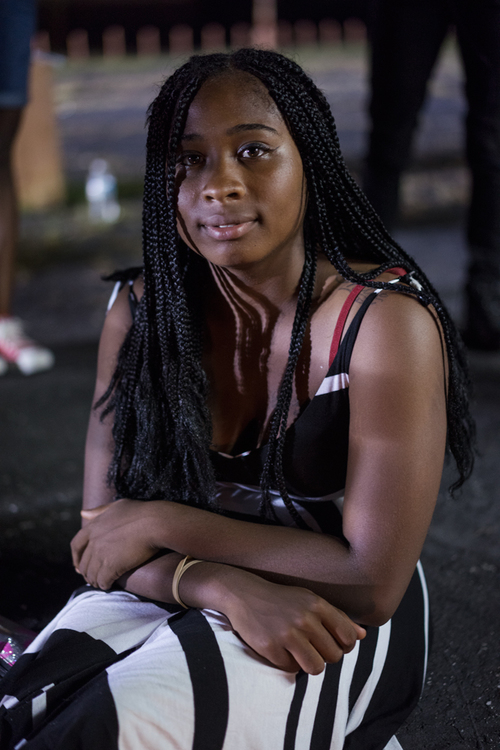
Barrett Emke, a young photographer from Kansas, was kind enough to share his photographs from Ferguson with me. He allowed me to make an edit. I publish them here alongside a short Q&A.
These are questions I’m just putting down in digital ink now, but probably come from weeks of thinking in circles. I was not brave or knowledgeable enough to write anything about Ferguson or its people when events were most immediate and raw; when people protested peacefully and faced off with law enforcement.
I want to start finding out about what photography did for the people of Ferguson and what it might do for them in the future. What might it do, or not do, for other communities wracked by racial inequities?
Barrett was in Ferguson August 19-21, I am penning this mid-September, but we know that from the tragedy of Michael Brown’s murder and from the town’s outrage must come long-term positive leaps forward; must come an accelerated and enlightened path to justice for us all as one.
Scroll down for the Q&A.
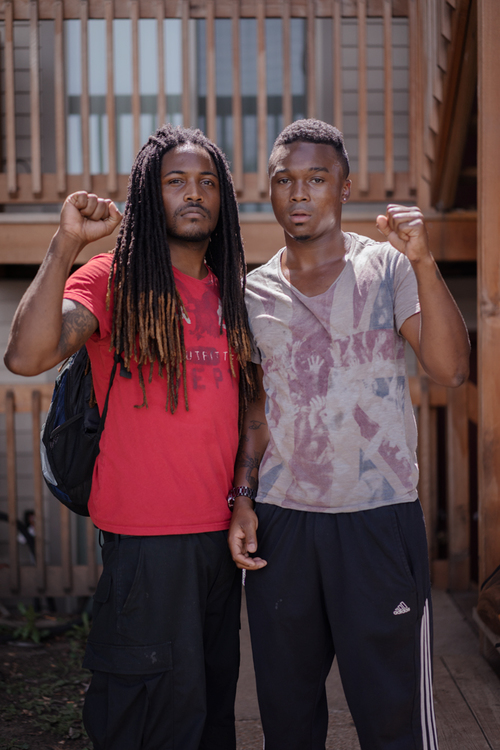
Q&A
Prison Photography (PP): Why did you go to Ferguson?
Barrett Emke (BE): I live in Kansas City, so the events in Ferguson definitely felt close to home. As a photographer and a person, I felt I had somewhat of a duty to go there and experience what was happening firsthand – this piece of history and injustice, and the community’s response.
I had to do something other than just watch what was happening on the news or read about it on the internet; maybe my photographs wouldn’t be seen by anyone or make any difference, but at least I would be there to document a piece of it.
PP: Did you know what you wanted to do beforehand?
BE: Not really. I just dove into the situation and worked intuitively, gauging the events as they came. From the first day I got there I had a rough idea that I wanted to make pictures of as many people as I could.
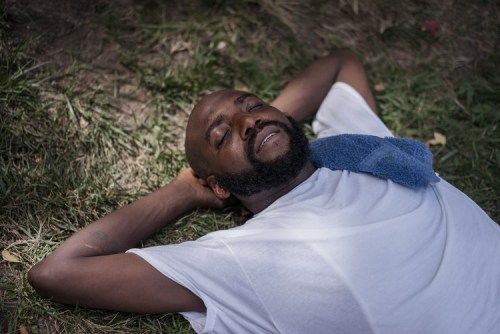

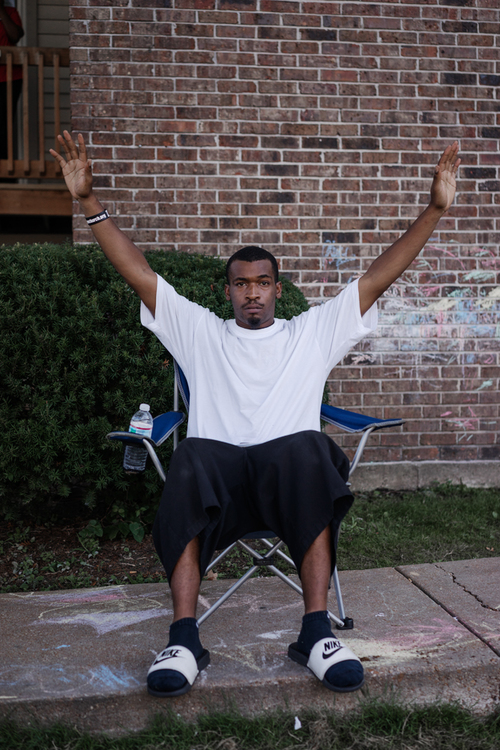
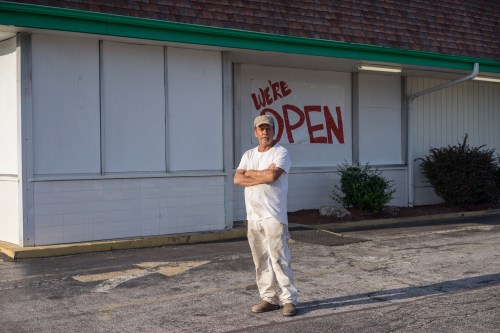
PP: What does it feel like to have tank in the street?
BE: It was a little overwhelming at first, but you acclimate quickly.
PP: On your website you’ve presented a wider edit with B&W images, pictures of law enforcement who are in action or stationary.
I’m not that interested in your distant (usually nighttime) images of cops. They seem to break up the warmth that maintains throughout the portraits of Ferguson residents. Does that make sense?
BE: I can see that. Obviously, the images of the militarized police, and the tear gassing, and all of that are everywhere now, and I knew that I wasn’t going to do that. But the images I did include I feel have their place in the sequence – I think of them more as portraits of the officers who were part of the situation as well.
PP: How did you feel when your were in Ferguson?
BE: Honestly, I felt human.
The people I interacted with and photographed were open, genuine, and earnest. Beyond the conflicts and the clashes between protestors and police, I definitely felt a strong sense of community and humanity present there, among those who lived in Ferguson and others who had traveled from elsewhere to be there.
PP: How do you think your feelings compare with residents?
BE: It’s hard to say. Many people who I spoke with and photographed were totally willing to engage with me – in times of crisis, that sort of social barrier kind of breaks down. At the same time, I definitely heard residents express their anger and a certain distrust toward the media, this sentiment that after the spectacle has ended, their lives in Ferguson go on.


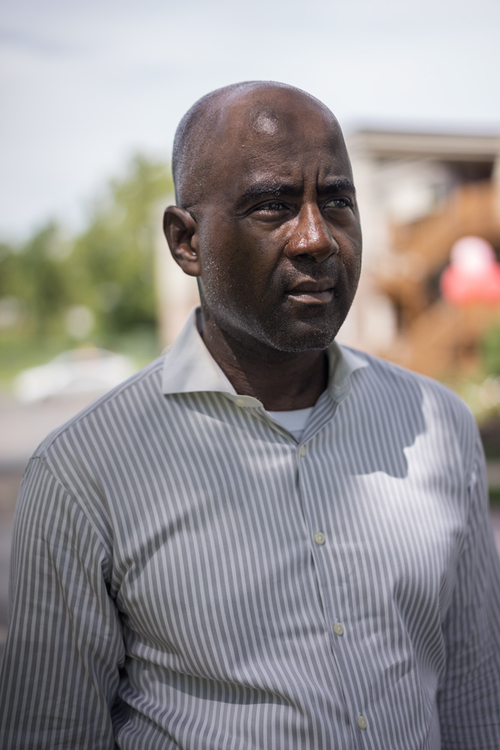
PP: What was the behavior of the media like in Ferguson?
BE: I think the presence of the media was essential, to record and broadcast what was happening. At the same time, it became a little gross to the see the camera crews flocking to and descending upon every little scrap of conflict each night, trying to get the scoop. It definitely seemed vulture-like at certain moments, and there were instances in which I felt like the media’s presence was exacerbating the situation.
There were times when interactions between protestors, police, and the media became problematic, with the media fanning the flames a bit. I’m not sure what the alternative would have been; if the media hadn’t been there reporting, would the militarized aggression of the police have only escalated? Would Michael Brown’s story and its larger implications have been told?
PP: How did people react to you photographing?
BE: Generally, people were receptive to me photographing. I tried to be as respectful and sensitive to the situation and individuals as possible.
PP: What did Ferguson residents think generally about the media and/or photographers?
BE: There was a certain ambivalence about the media that I picked up on. As I mentioned previously, I heard the sentiment echoed that once the media circus had skipped town, the residents still had to go on about their lives and their realities. But at the same time, I heard many people express that the situation would be worse between protestors and the police if the media wasn’t there to report on what was happening, and to check that militarized aggression.


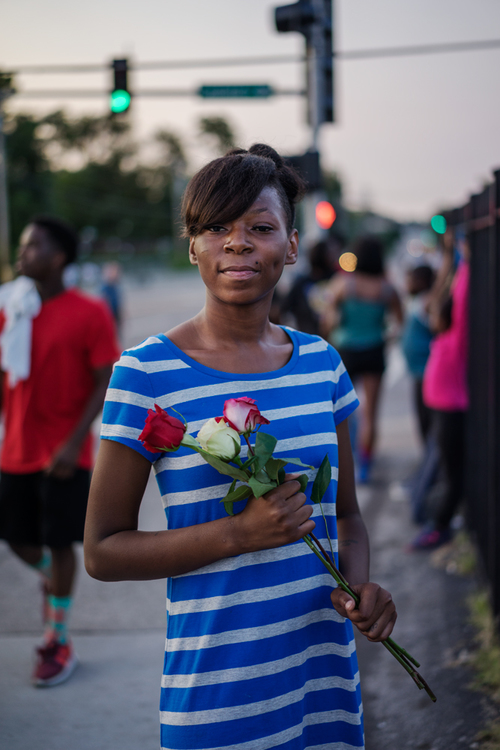
PP: What was the overall sentiment of the people you photographed?
BE: People were there on West Florissant in solidarity and were fed up with everything that had led to this point. Those I photographed were resolute in their anger and sought justice for Michael Brown, meaning the indictment of Darren Wilson and a major shift in policy, representation, and attitudes going forward. What I heard echoed again and again from people was that this situation wasn’t just about race, it was also a human thing. Beyond that, I perceived an overwhelming amount of positivity and hope from the individuals I met.
PP: Did this sentiment match that of the media generally?
BE: As in, did the media share the same drive for justice as the residents and protestors? I’m not sure, but I would say that they seemed to be there to do their job, which was reporting.
PP: Is America a racist country? I’m not being incendiary here; it actually seems like a fair question if we consider this excerpt from this New Yorker piece The Color of Justice:
Whites support tougher criminal laws at least partly because they overestimate black and Hispanic crime rates. Blacks and Hispanics do commit certain crimes more frequently, per capita, than whites, but not all. But whites consistently overestimate the difference, according to one study, by as much as twenty to thirty per cent. That perception affects attitudes toward offenders and sentencing. Studies show that the more whites attribute higher crime rates to blacks and Hispanics, the more likely they are to support harsh criminal laws. It is less that they are consciously seeking to subordinate racial minorities than that they fail to treat the negative consequences of high incarceration rates as their problem. As the report explains, “attributing crime to racial minorities limits empathy toward offenders and encourages retribution.”
This is a damning indictment. If anyone were to admit that they preferred the death penalty, life without parole, or harsh sentences because they believe the perpetrators of violent crimes are more likely to be black or Hispanic, we would immediately condemn them as the worst sort of racist. If a prosecutor, judge, or juror expressed such a sentiment, any resulting conviction or sentence would be swiftly overturned. No one admits that they feel this way, but the studies recounted by the Sentencing Project suggest that this is precisely what many white Americans feel.
BE: America is a racist country, with its long and complicated history of prejudice that it still cannot shake.
Racism in the United States is deeply entrenched and systemic, even today, as we’ve seen. As a white person, I have tried to be consistently aware of my privilege and the way racism can be internalized by someone who would never consider herself or himself “racist.” It is a process of learning and unlearning that I still grapple with. One can always do better, listen more. It is not enough to simply not be racist; one must be anti-racist.
When a person of color in America can’t be certain that she or he won’t be shot and killed during a routine encounter with police, or a total stranger, something is utterly, intrinsically wrong. I believe it is the duty of those who benefit from white privilege, male privilege, heteronormative privilege, to fight alongside those who are disenfranchised under the law and throughout society.


PP: What did photography achieve during August for the messages coming out of Ferguson?
BE: I’ve seen an abundance of profound, earth shattering photographs come out of the events of Ferguson. I believe these photographs have been successful in demonstrating to the world what was unfolding and to preserve these moments as historical documents.
PP: Do photographers need to stay in, or return to, Ferguson soon? And/or often?
BE: Speaking for myself, I don’t feel like my work was simply done when I returned home. A situation like this is ongoing. Nothing is solved. There is still more work to be done, and I would like to return to make more photographs.
PP: Do you think that’s going to happen?
BE: I believe that to be committed and thorough in a situation like this, it has to be longterm.
PP: Thanks Barrett.
BE: Thank you, Pete.

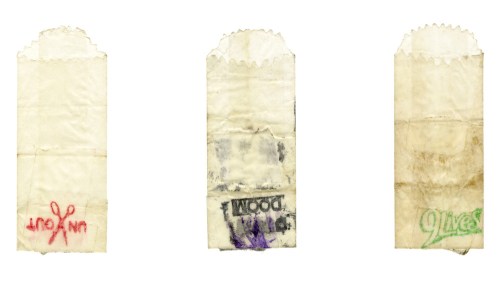
Even in the throes of addiction, Graham MacIndoe was able to take a relatively objective look at the visual culture of the drug trade. He collected more than 100 bags, in NYC, in which heroin was sold.
When other addicts emptied these little baggies, and after they’d cooked and injected the contents, what did they see? Trash? Incriminating evidence? MacIndoe saw the anthropology and informal economics of dealing.
Now, four years clean, photographs of the bags are collected in a new book All In: Buying Into The Drug Trade (Little Big Man Books, San Francisco).
For Wired, I wrote about the series, MacIndoe’s story and his thoughts about what the baggies might mean for us all: The Dark, Ironic Branding Drug Dealers Use to Sell Heroin


Final Words, launched today, is a sprawling documentary project that focuses on the humanity at center of the death penalty in America. It is the brainchild of photographer Marc Asnin known for his brick of a book Uncle Charlie. Well, this project takes Asnin from the personal to the political, but it is no less massive. Asnin’s got form.
Asnin is asking photographers and non-photographers alike to submit selfies as statements against the death penalty. I’ll get to that in a moment but first the project and the cause.
FINAL WORDS
Final Words is a book and traveling exhibition, featuring the final statements of the 515 prisoners executed by the state of Texas since 1982. Final Words will shape and deliver curricula to American high-schoolers. If we can get the youngest generation talking then perhaps we can engineer a future without the barbaric death penalty?
The project statement explains that more than one person every month for thirty-one years has been executed by the Lone Star State:
Just before the execution is completed, each prisoner is given the opportunity to share their final thoughts. […] It is their words, their final words in this life, that allow the reader to experience the underlining humanity central to the death penalty debate. […] Final Words comprises a part of the legacy that will live on beyond us and it will stand as a testament to the kind of society we were—who our criminals were and how we implemented our idea of justice. Final Words interrogates our presuppositions about the death penalty. […] While this book is a document of death—the death of both the guilty and innocent, the criminals and the victims—it attempts to create a dialogue about life.
All this takes a movement. And money. An IndieGogo campaign will launch in a months time.
The editioned Final Words books will cost a pretty penny. Their sales will help raise money to pump simpler versions of the content and curricula into the bloodstream of the education system.
Each page of the book features a prisoner’s mug shot, their age both at the time of the crime and when they were put to death, a description of the crime for which they stand convicted, and their final words.
Photographers Selfie Against the Death Penalty
In other efforts to corral some cash, Neverland Publications (cofounded by Asnin) and VII Association are collaborating on Photographers Selfie Against the Death Penalty, an international photo campaign to call for an end to executions in America. Highflying pixelmakers & imagershakers will submitting alongside us flailing Instagram plebs.
Note that the word “selfie” is used as a verb. I like that. Jury’s out as to how much a collection of selfies can effect entrenched moral politics, but it’s worth a try. Social media does nothing if not surprise regularly. And besides, all this just gets people talking ahead of Final Words‘ big fundraising campaign that ignites in October.
As the 501c3 sponsor of the project, VII Photo has asked all its photographers to participate in the selfie campaign. Get yourself in there too:
1. Make a selfie, save it to your computer.
2a. Upload selfie to http://www.final-words.org
2b. Fill out form (name, age, email address, location, how you heard about Photographers Selfies Against the Death Penalty, your preferred photography genre)
2c. Personalize your statement against the death penalty, by completing the following “I stand against the death penalty because …” in 140 characters or less.
Go on, selfie against the machine!
[Oh, if you’re wondering how and why Asnin and his colleagues have the last statements of 515 men and women, it is because for some reason the state of Texas keeps a public online database of them. Weird, no?!]
PROTEST
The 15th Annual March to Abolish the Death Penalty takes place in Houston, Texas on Saturday October 25th at 2pm. Details on the exact location in Houston will be announced later.

I moved from Portland, Oregon to San Francisco, California this past weekend.
Blake Andrews — everyone’s favourite photoblogger and Oregon resident — wanted answers.
PREAMBLE: PHOTOGRAPHING FROM WITHIN
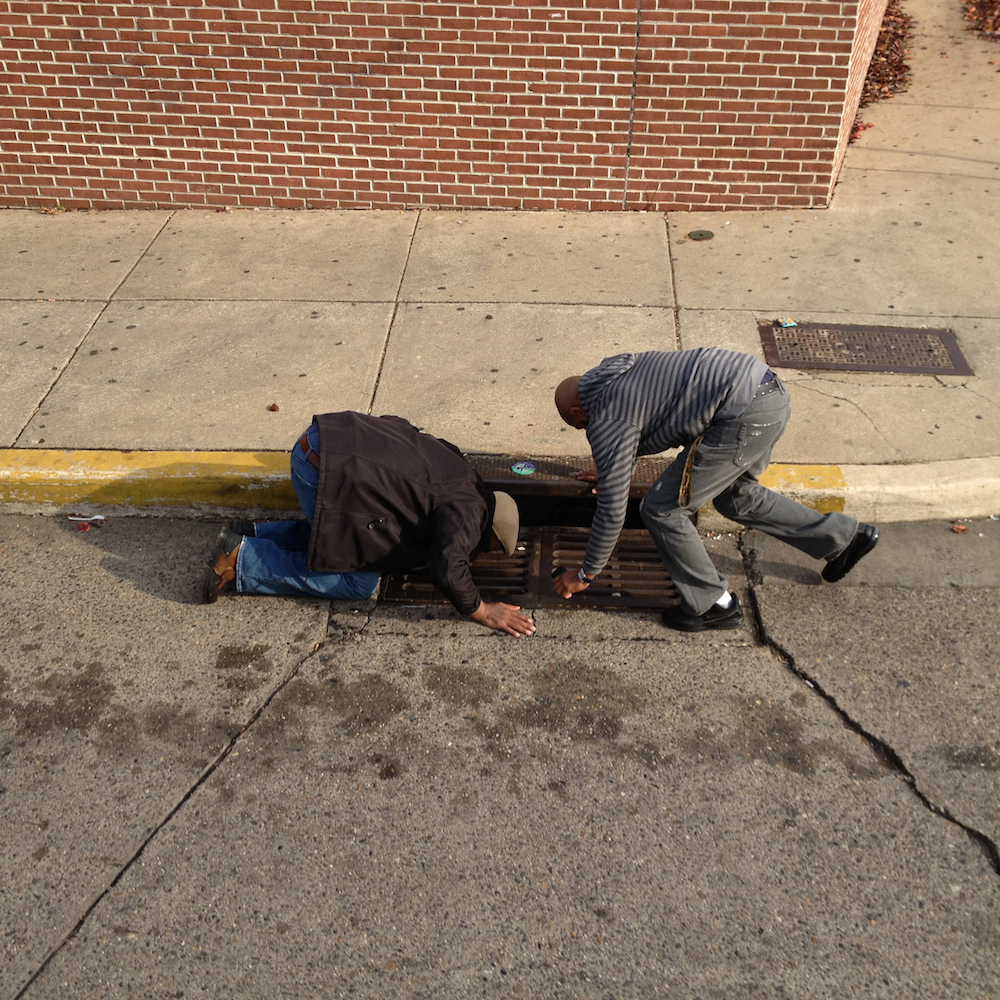
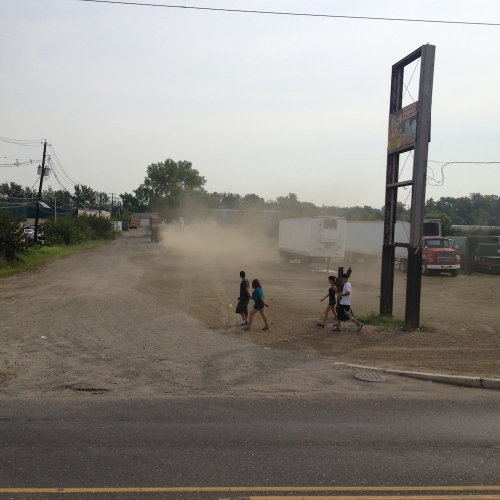
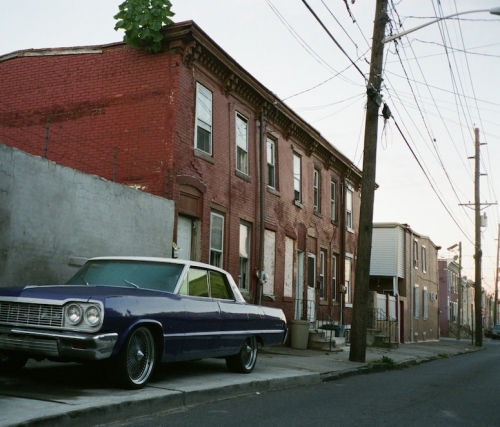
One of the most interesting street photographers in America right now is Gabe Angemi. He shoots daily and prolifically. He makes pictures with an iPhone, mostly, but on other cameras too. Angemi is a firefighter in Camden, New Jersey. His profession allows him to get close.
Elevated angles of passing moments in some of Angemi’s photos are reminiscent of images in the many curated Google Street View (GSV) projects. GSV projects tend to divide people. You love them or you hate them. Doug Rickard’s A New American Picture was one of the earliest, one of the best promoted and most divisive of the GSV projects. Why am I mentioning this? Well, Rickard got some flak because he drove-by shot America’s poorest neighbourhoods from behind his computer screen.He didn’t hit the streets himself, but drifted past scenes from the up-high vantage point of a 15-eyed Google car camera rig.
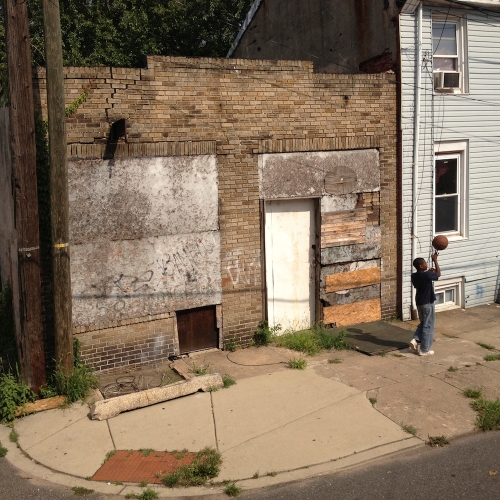
In his look at inequality in America, Rickard *travelled* the streets of Camden. Some of Angemi’s images may look similar but the intent and engagement is vastly different. I’m somehow reassured to know that Angemi is getting down of his rig, chatting with locals, watching the ebb and flow of energies, and shaping the city. He’s also responding to emergencies, securing vacants and putting out fires.
Angemi’s diaristic portrait of the city is raw. But it reflects a place in which 40+% of the population live below the poverty line; a city hall from which three past mayors have been convicted of corruption; a city which can’t support its own schools; and a city in which police misconduct was so rife that law enforcement was placed in the receivership of state forces.
Camden has one of the highest crime rates in the U.S. and is often described as the most violent city in America. In 2012, Camden had 2,566 violent crimes per 100,000 people which is five times the national average. Camden is a rough town, but it is more than its poverty. Angemi consistently puts the hardships and everyday events into a wider context.
Whereas Rickard simply restated that poverty exists in America, and in Camden in particular, Angemi is seeing and sharing it daily. He’s mapping change in Camden and he’s also trying to make it a safer place. That makes him one of the most interesting street photographers in the country.
Angemi pushes his stuff out on a popular but private Instagram account, @ANGE_261.
Scroll down for our Q&A
Q&A
Prison Photography (PP): Are you always using an iPhone? Are you always shooting on the job? Or do you use other cameras and venture out other times?
Gabe Angemi (GA): Not always. But the iPhone is just always there you know? It’s super easy. Occasionally though, it sucks. I also use a 35mm Olympus camera I got from Clint Woodside at Dead Beat Club, and a couple of Polaroid cameras. I’ve been using a Fuji X100 mostly as of late.
Recently, I gave Bruce Gilden and some friends from Magnum a tour of Camden, for a few hours on back-to-back days. I can’t shoot like that; the big cameras and the assistant will never suite me. I love that it’s out there and artists like Bruce are killing it, but I’ll keep making it work with what I got. I suppose that points to why the iPhone works so well for me, it’s just easiest. My photography is more timing, perspective and place than anything else. I suppose I just never had the money to buy a camera that’s *serious*. One day I’ll get a legit one I suppose.
PP: How long have you been a Camden firefighter?
GA: I’ll have been on the job in CMD for 16 years come December. I was recently promoted out of the Rescue Company to Engine Co. 11 in the city’s Cramer Hill section.
PP: How do you take pictures while you’re on call?
GA: I take my job very seriously. Being Johnny on the spot at a fire scene doesn’t jive well with making good photos. I’ve started making photos more and more off duty. The access though — it was invaluable to get me where I could be making interesting photos.
When I was shooting at work years ago, I needed quick and easy so it never interfered with my duty or performance. Hence, the iPhone. Clearly, I can’t have a big ass camera around my neck while I’m fighting fire!

GA: I rarely shoot on the job these days, it is illegal per department policy now. If I take a photo on duty it is with the intent of using it for a training presentation or a PowerPoint.
PP: Because you train other firefighters in fire abatement, right?
GA: Right. And nothing but harmless stuff goes on my social media. Ethical considerations are a big factor. Problems are to be avoided. I had to talk to an attorney about it extensively a few years back.
PP: When did you decide to start shooting in the city?
GA: I started shooting the day I was hired, using an old film camera. Maybe even before that, when I’d stop in a firehouse to see my dad.
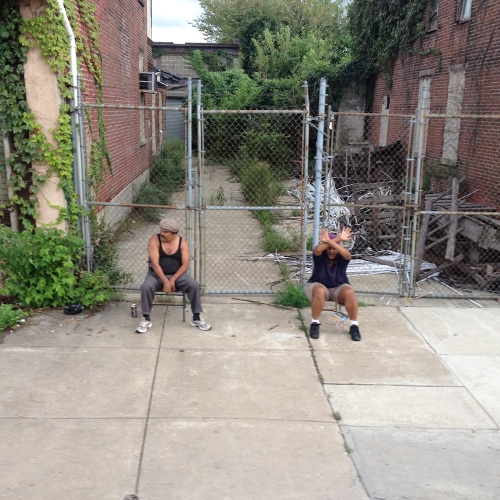
Initially, I was just shooting and documenting “us.” Somewhere along the line, I turned the camera towards the city, the issues, the people, the good, the bad. It all seems so normal now but its surely not. Camden’s a fascinating place. I like to be involved in friction, and trying to solve it. I shoot the friction in places that used to be what America was all about, and still is, but for entirely different reasons.

PP: Camden is a tough town. Lots of surveillance, lots of blocks where tensions between citizens and cops are high. How do you and your uniform and your camera fit into that?
GA: I think that collectively, the fire department is looked upon endearingly. The residents have family and friends on the job. The locals know we are not there to break their balls or be indignant. We’re just there to help.
It’s funny how most of the outsiders are the ones who confuse us with the police while were on the street. I mean, I get it, it’s a dark blue uniform, but we are clearly not the police; we do not carry weapons.
Anyone who sees us — from the corner boys to the politicians — should know we don’t judge, assume or push buttons that aggravate anything. We mind our own business, we just want to help.
I’m not dumb though, I’m not always going to fit in, and clearly I’m not going to try to fit me and my camera into a spot that isn’t going to work out. ‘Round pegs, round holes,’ as one of our Deputy Chiefs always said. It carries over from my career to my art.
Tensions are indeed high, and yes, the city is heavily surveilled. The municipality and county had acquired some state of the art detection and monitoring equipment by way of federal grants. The whole city sometimes feels like a prison. Cameras are everywhere, and there’s now a shot detection system that can pinpoint gunfire down to a city block.


GA: Tensions aren’t necessarily a consistent thing, but more like an ebb and flow depending on what’s going on in a particular part of town. Some spots are always hot, others rise and fall. I’m no authority mind you, and I won’t claim to be an aficionado on the vibe on the street between citizens and the law. I pay close attention, but I’m not in any position to really know anything about the police and their plight. It’s not my job. All I really know about them is they have a tough job, and it’s damn dangerous. So is ours.
PP: What’s the reactions of the locals?
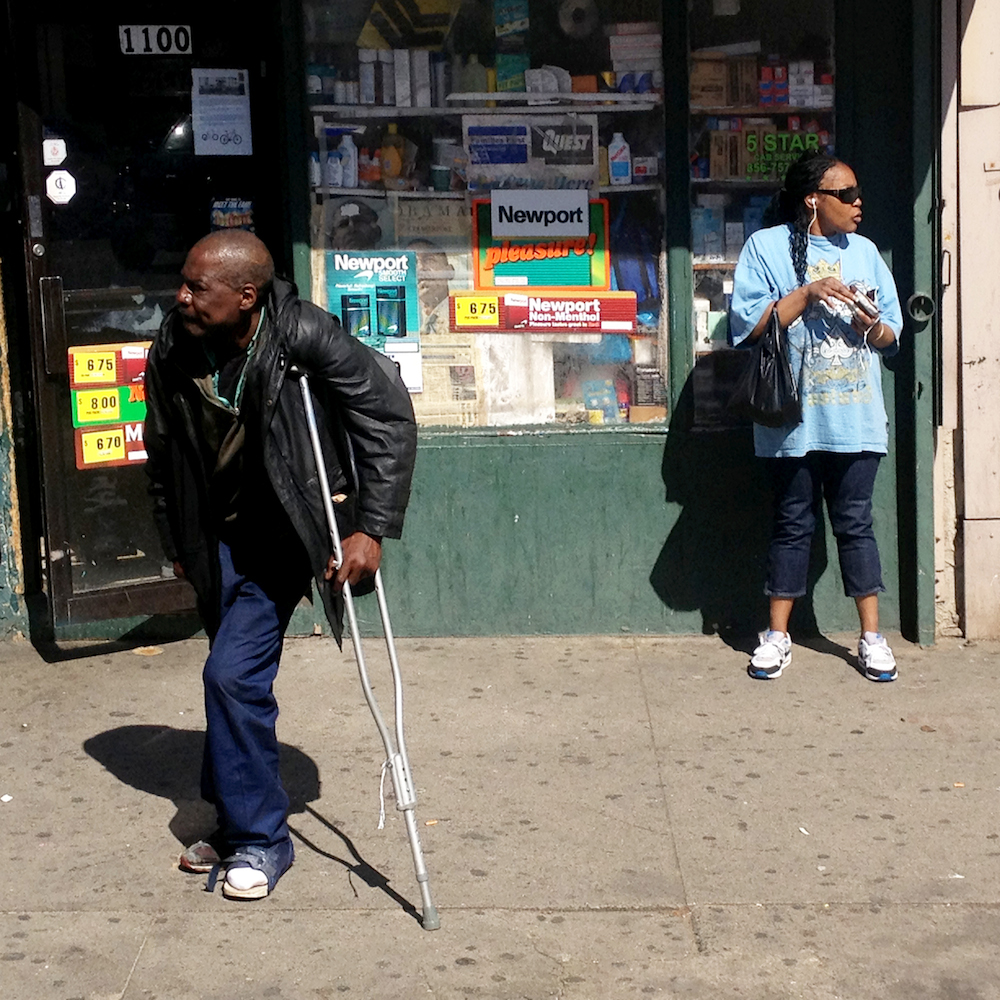
GA: My camera gets me smiles, waves, fun poses, friends, conversations and past barriers or preconceived notions. It also gets me dirty looks, threats and projectiles. Obviously, I prefer the former, but just like my job, I take the good with the bad.


PP: What’s your approach?
GA: I ask sometimes to shoot, sometimes I don’t. I build relationships with people I meet on the street when I’m working and try to create a bond or trust so that I can go to their space and photograph them. Sometimes it takes time, other times it can go down right away. Personalities abound; it’s very cool.
PP: Is Camden been talked about, written about, and/or depicted in the right ways?
GA: No.
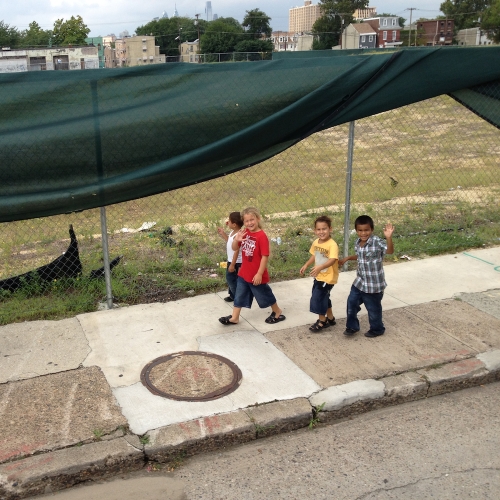
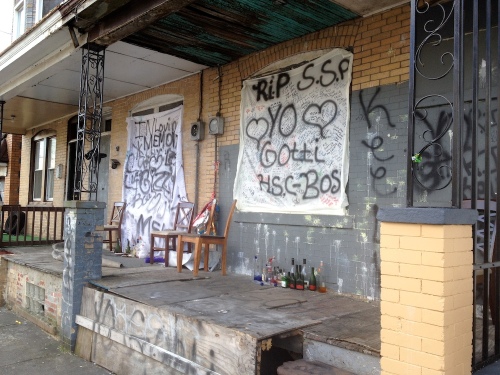
PP: You’ve a professional experience of the poverty, disrepair, vacancy and the destruction/burning of houses. Can you describe what you’ve witnessed in your work and how you’ve secured and watched properties burn never to be replaced? It seems your job — in real time — has tracked the decline of Camden.
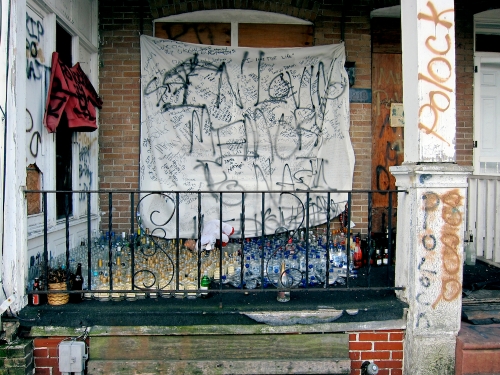
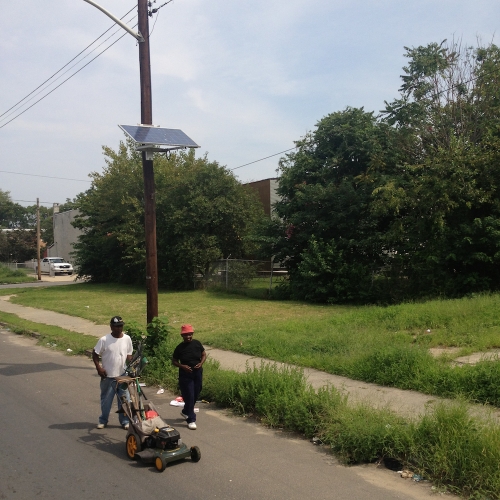
GA: Many of the buildings I was shooting initially for teaching purposes are no longer standing. Anyone that does what I do for any length of time should start to inadvertently become aware of the developing issues and predict whats coming or whats soon to happen. I’ve watched the city disappear over the last 16 years. When you drive around and see vacant lots, you become aware that it was once a thriving community, with street lights and brick and mortar row homes lining the sidewalk. People lived here.
Now, whole stretches of fenced in empty lots do not even have the fences anymore, they have been torn out and cashed in at one of the many local scrap yards. You can hear huge sections of fence being dragged through the street — day or night. The sound of hammers and improvised hacksaws emanate from behind rows of boarded up windows, working to remove any type of metal with a high price per pound. One can often smell gas leaking from stolen basement pipes in vacant buildings, thieves are disinterested in even turning the gas petcock off. Used tires are everywhere, lining the streets like weeds. Plastic bags from the bodegas blow like urban tumbleweeds.
PP: Extreme poverty.
GA: At work, When we are out preplanning vacant row homes, we see needles, used condoms, the insides of ball point pens, lighters, baggies, piles of clothes, stacked mattresses, tinfoil “sculptures,” shit buckets, piles of feces in corners, the carcasses of what would have been a pet in the suburbs … I could go on with this list for a half hour.
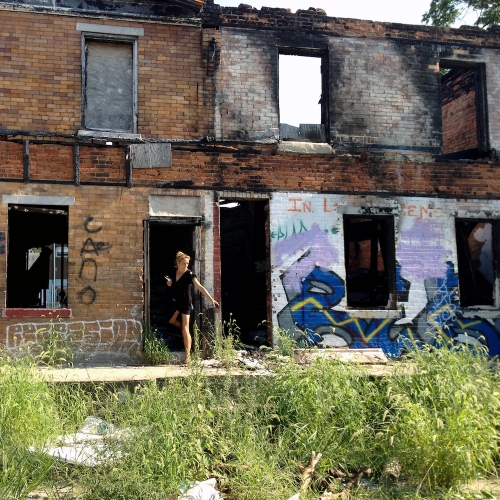

We speak to the neighbors, the mail man, the utility provider, squatters, prostitutes, everyone. We just assume the time is coming, you can just sense when a particular spot is going to burn. Then you’d catch the house, or the block, or the building, you turn the corner in the rig at 3am and the street is lit up like your on the surface of the sun.
Its always astonishes me, how it works. Not all of my peers are as tuned in I suppose, or they just prefer to ignore it. That would go for fireman working in any socioeconomically challenged urban city…
But, I think my artistic tendencies and growing up on a skateboard led me to observe closer. I can sorta relate a bit better, growing up in counter-culture mindset. I used to skate, bike, walk or drive around Philadelphia looking at everything from a skateboarding perspective. How could I creatively use the landscape to have fun on my skateboard? Now, I do the exact same thing, but in terms of forcing my way in and out of structures, in terms of understanding who or how many people might be living in a building that is supposed to have no one living in it. I’m constantly training myself to get a better understanding of how poverty affects people out here.
Where are they at? What are they willing to do or endure. I feel that everyone [in precarious or vacant houses] are my responsibility regardless of their job, tax bracket, or societal position. So I pay real fucking close attention and decide what I can and can’t do to make a difference. It’s best to see things up close so you know what you can safely do in the dead of night, maybe half asleep, when you need to be up on your game. We don’t get to warm up. We go full throttle, from a stand still-ice cold position.
The work kills our bodies. We might as well be the buildings were in and out of, becoming more and more structurally unsound over time. I mean fuck, I want to see my girls the next day too, so theres always this friction. I’m not sure exactly how to articulate what I see there, but its fascinating. Its also predictable and above anything else, a travesty. Sitting back is bullshit.
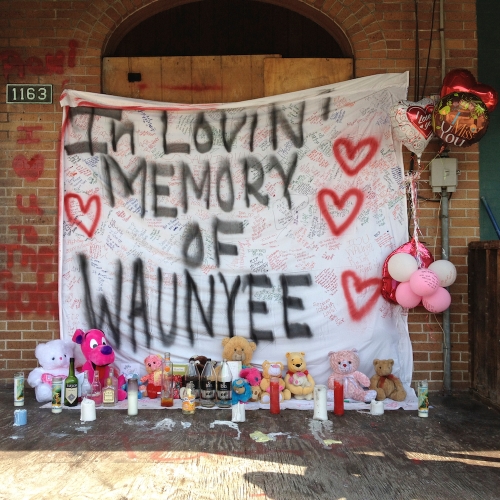

GA: I always say that Camden should have been Philadelphia. A lot of things and people have conspired both consciously and subconsciously over time, both with premeditation and without, to make this place what it is today. There’s so many issues its overwhelming.
I talk to the folks next door or nearby to where we are operating. It’s heartbreaking. Hearing a woman tell me she’s got kids in her house three doors down from where we just put a fire out. They knew it was coming, they saw squatters in and out, they saw addicts using the houses to get high and shelter themselves. They have perpetual anxiety about not if but when [their place might burn down].
There’s a documentary film called Burn, and one of the featured guys in it has a great quote, “I wish my head could forget what my eyes have seen during 30 years of firefighting in Detroit.” That poor bastard has seen some terrible things. I wish I could say I, or any of the guys I work with, were any different. This job can mess your life up, I watched it do it to friends, both mentally and physically. It’s a battle for sanity. We’re getting kicked from all angles, BUT I owe everything I have to the City of Camden Fire Department, and I try to earn that shit every time I go to work, and every time I take, or teach a class. We work hard for what we get, we do a great job, and I’m proud of the work we do.
Camden civilians see more fires than most fire departments.
PP: Fire is a symptom of poverty, right?
GA: I believe so. Our workload is indicative of that. It’s the same in other depressed communities — Detroit; Gary, IN; Flint, MI; Jackson, MS; Stockton, CA; East St. Louis; Bluefield, WV; Baltimore; as well as sections of Philadelphia, Chicago, Oakland, New Orleans. There are so many places dealing with poverty. It would be hard to argue that fire isn’t tied into a cycle of poverty.
PP: What do you colleagues think of your photography?
GA: I’m not really sure! I struggle to keep it separate, and I struggle to combine it. I have a lot of support from guys I spent years of my life with — they support me and it, even if they don’t get it. I’m sure there are guys who don’t know me too well who are not feeling it or very receptive. Some guys have talked to me about it and now understand. All I can do is keep on being me. I’m not looking to hurt, upset, take advantage or manipulate anyone. I want to throw-up when some one says I’m exploiting people. I’m far more invested in this town and its people.
PP: What’s next?
GA: I’d like to make a book, Pete. One of these days, I hope to put together a book dummy.
I would also like to do shooting elsewhere. I’d love to find a grant that would allow me to do what I do in Camden, in other cities. I could go hook up with friends in other fire departments and make photos.
But honestly, I’m trying to adjust to a new role in my job. And be a father to my young daughter. My wife is soon to give birth to a second daughter, so time and energy are harder and harder to come by!
Hopefully next year, I’m going to find myself sitting on the co-op board for Camden FireWorks, a great South Camden artistic endeavor. Those involved hope to start some revitalization on South Broadway out of the old CFD Engine Co. 3 fire house. Heart of Camden acquired it and put a ton of time, energy and grant money into refurbishing it into artist studio spaces, gallery and printing press with a program of lectures and classes.

PP: Anything else you want to add?
GA: I hope that no one ever interprets my opinions, intentions or photography as negative toward Camden. I’m invested here. My father was a CMD fireman for 33 years and busted his ass through two riots and decades of a fire-load that would make most of today’s firefighters quit. I feel that the city looks like it does now by some twisted and fateful design. I give back in my own ways, and try to make Camden a better place.
I can’t get by with out my family, they are the best ever! Thanks Nicole, Maria, Lillian, and Lucia. You allow me to make art, make photos and constantly deal with my obsessive nature and all that comes with it.
I owe a ton more to too many of my friends and influences to write here but they know who they are. ARTNOWNY and the Philadelphia art scene are awesome.
Oh, and firefighters rule! We are here for you.
PP: Cheers, Gabe.
GA: Thank you, Pete.


Today, the Philly Mag published a leaked document about the devastating decline in newspapers. It was created by Interstate General Media, owners of the Philadelphia Inquirer. It showed massive slumps nationwide but particular downturns in the fortunes of Philadelphia’s newspapers.
The slump has been rumbling on for over a decade now but the details in the leaked document make Will Steacy‘s project Deadline even more timely. Steacy is currently raising money to make a photobook and here’s why I think it deserves your support.
DEADLINE, by WILL STEACY
I was once Skyping with an artist on a residency in Europe. During the call, in the background, Will Steacy‘s head popped round the open door. Given the time difference, it was early morning for my friend, and for Steacy.
Pre-coffee, Steacy took the time to say hello. I noticed under Steacy’s arm a stack of the newspapers. Printed news from print newsrooms across the globe. Steacy told me it was his daily ritual to read, for hours, the news stories printed on actual paper. It shouldn’t have seemed so surprising, but in this era of digital information Steacy’s insistence on printed news was, in my mind, unusual. And comforting.
It makes sense that Steacy would not only notice — but also feel attachment — to the dying news daily in his once-hometown of Philadelphia. His photographs document an atrophying Philadelphia Inquirer newsroom. The number of staffers decrease, the presses go silent, the buzz of a breaking news scoop vibrates a little less.
The series is called Deadline, and Steacy is currently crowdfunding on Kickstarter to create a photobook version.
I tweeted last week that Steacy was “photographer, labor guy and workaholic” and deserving of your support. He’s worked on the series for 5 years. His father was an editor with the Philadelphia Inquirer for over 20 years before he was laid off in a round of cutbacks in 2011, and his family has been in the news industry for generations. Steacy talks of the newspaper as a form and as a bastion of an institution holding politicians, corporations and the like accountable to society as a whole. Steacy also believes the decline of the newsroom is a labour issue and more than just profits should dictate the operations of free press outlets.
Under corporate ownership every Inquirer asset is on the table in the strategy to stay alive. Ask any local, and they’ll tell you the Philadelphia Inquirer ain’t what it used to be. The focus on local coverage to secure it’s regional readership hails a goodbye to the days when the Inquirer racked up Pulitzers for fun.
The Philadelphia Inquirer still lives but it’s downsized from 700 to 200 staff, sold and moved out of its iconic headquarters, The Inquirer Building. This move, as documented by Steacy, is arguably one of the best visuals we have to grasp the size of the changes occuring now in news publishing.
While Deadline is specific to the Inquirer, the story is all too common. Large papers such as the Rocky Mountain News have shuttered completely in recent years. This devastating shift in news publishing was reflected in Philly Inquirer’s Hard Years Are Microcosm of Newspapers’ Long Goodbye, an article by my Raw File WIRED colleague Jakob Schiller, last year.
Deadline combines great images, great research, local and national narratives and a personal connection. The Kickstarter rewards are imaginative too: newsroom pencils and pin badges, and a limited edition artwork printed on the same presses that rolled out the Inquirer for decades.
Get over to Kickstarter and fund it!


 Prison Photography