
You are currently browsing the category archive for the ‘Opinion’ category.
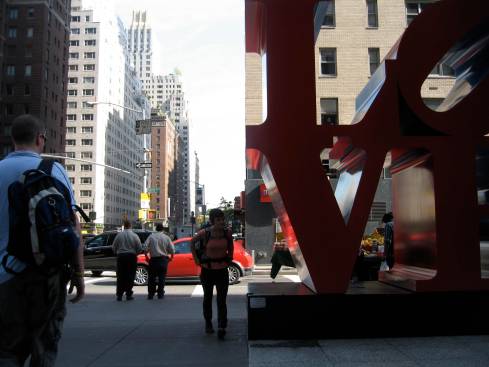
Had a fun time in New York last week. Stayed with Jack and Marisa. Below is not Jack. Below is Chris by Jack.
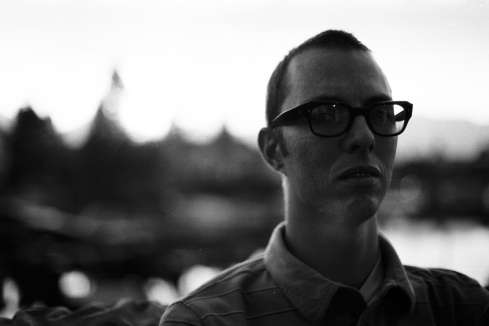
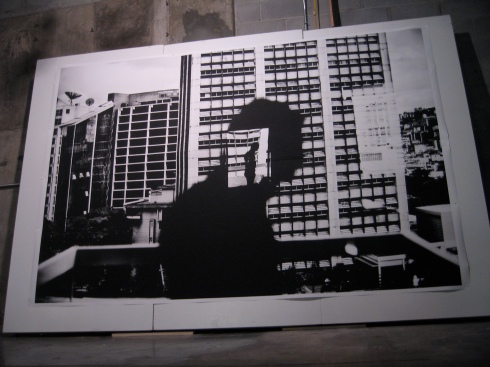
We went to Christopher Anderson’s book launch for Capitolio. It was great to see it after recent reviews, heated debates (check out comments) questions and wot not. I don’t think the selection of the images was the best.
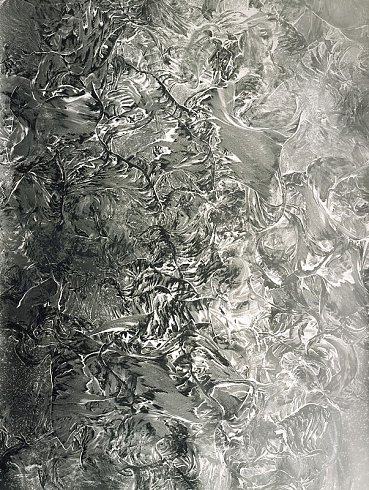
At the Metropolitan, Surface Tension: Photographs from the Permanent Collection was a pleasant whimsy into some mesmerizing works, notably Adam Fuss’ UNTITLED (1997) made by the metronome shimmers of snakes upon black dust upon white dust. Image Source: Cheim & Read
The Met’s photography department was putting together the final touches on Robert Frank’s The Americans which opened this week. It was all hands to the pump as evidenced by besuited Malcolm Daniel – who I spied carrying large, heavy object (post?) behind a partition and into the exhibition space.
Egg and Cheese Bagel.
Over at the Museum of Modern Art, I was pleased to see Russell Lee‘s work Bulletin Board in Post Office Showing a Large Collection of “Wanted Men” Signs, Ames, Iowa (1936). Who doesn’t love a mug shot?


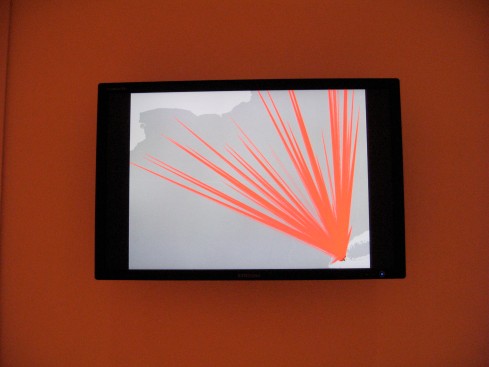
Bringing the practice of mapping of transgressions into the 21st century, the Spatial Design Lab from the Graduate School of Architecture, Planning and Preservation at Columbia University exhibited its Million Dollar Blocks Project (2006).

On Monday night I sat with Andrew Lichtenstein. We talked. Andrew recommended Brennan Linsley‘s work and was quite emphatic about the book ‘Concrete Mama‘. He also spoke highly of Max Kenner and the work at the Bard Prison Initiative
Tuesday, I met Emiliano Granado. We were first in contact over his San Quentin Giants pictures. We talked about many things including Trevor Paglen, Argentina, the Burke Gilman, and the Horticultural Society of New York, which recently lost Barbara Margolis who was an inspiring leader. Emiliano recommended Alessandra Sanguinetti‘s work.

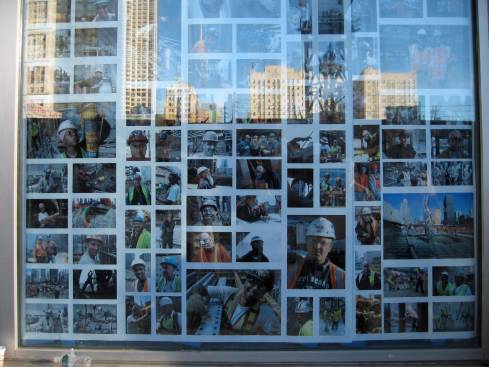
On Sunday, I’d been at the WTC construction site. There was some portraiture on display in a window. The space behind the window was closed but would usually be open. The photographs were easy on the eye.
On my last night I checked out Steven Hirsch’s Courthouse Confessions.
That’s Matt Kelley looking at Steven’s work. He’s coordinator for Change.org Criminal Justice, online communications for the Innocence Project and all together nice bloke. Matt’s double identity is twittered and can be followed here and here.
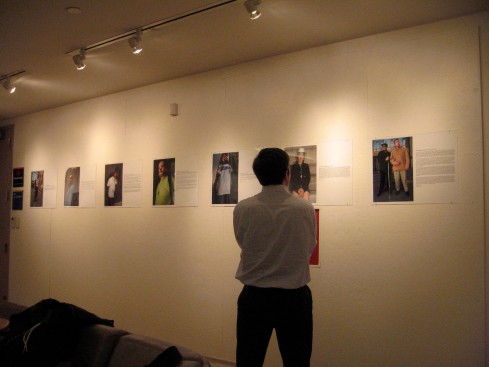
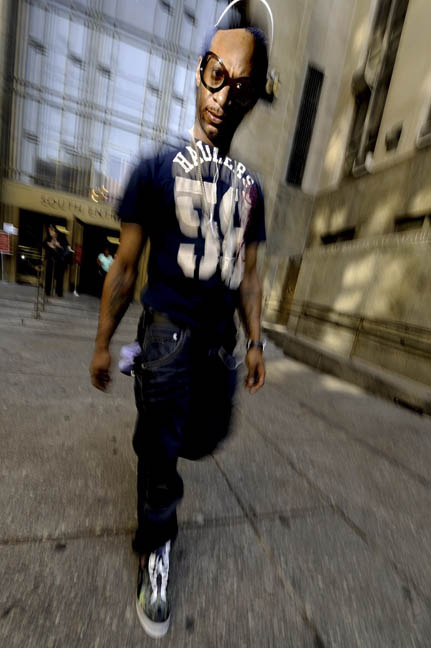
Hirsch takes street portraits of folk going to court, secures (in some ironic twist) a non-binding statement and then transcribes it verbatim to go with the portrait. Constantly moving the camera, Hirsch uses hard flash and distorted angles/zoom to depict these individuals as shape shifters; as anomalies. The fact Hirsch’s subjects (in most cases) seem alien to the logic of the courts – that any lessons arising from their cases are unlikely to effect sentencing laws in the future – should but be a source of disquiet for us as an audience.
One last thing. On Saturday, I saw John Baldessari sat outside a Grennwich Village coffeehouse, but I bottled saying anything. I’ve learnt that famous people abound in Manhattan and you see ’em everywhere.
Thanks to everyone who altered their orbits a little to coincide with mine.

AP Photographer, Brennan Linsley has visited Guantanamo twelve times in the past four years. Why? “My goal is to come back from each trip with a couple of shots that will allow me to paint more of a picture of this place'” says Linsley.
A journalist’s visit to Guantanamo is a frustrating experience – newsmen have a constant escort on a preplanned itinerary and must read and follow the fifteen pages of ground rules provided by the US military.
To offset these limitations Linsley chose repeated visits as a a tactic. In an attempt to humanise the detainees, he has weaved a photo-essay in-spite of Guantanamo’s milieu which is counter to all notions of free speech, experience and objective fact-gathering.
The British Journal of Photography has a brief but interesting interview with Linsley about his project.
This sequence of interactions between a Chinese detainee and photographers (described by Linsley) exemplifies the minutiae with which the US military must control the flow of information out of Guantanamo.
Just to get the juices flowing, Linsley closes the interview with this position, “The Golden Age of photography has been over for a long time. It died somewhere between the Vietnam War and the Gulf War.”
Discuss.
_______________________________________________________________
BJP’s interview coincides with Linsley’s work showing at the 2009 Visa pour l’Image at Perpignan.
For more images and links on Guantanamo see Prison Photography‘s Directory of Visual Sources.
Words
Prisoners All posits that we are all severely impeded, individually and as a community, because of bad politics, poor policy and family devaluation. The posts are really well composed.
The anonymous author – by the pseudonym of Zebulon Brockway – has “worked many years in [California] prisons, and worked many years in journalism” and believes “much written about prisons is misleading at best and wrong at worst. The false impressions and false information are not helpful to public discourse”.
Moving Images
John Malsbary contacted me at the start of the Summer to tell me of his new venture Prison in Cinema.
John’s moving across a country at the moment. His few posts suggest he’ll be worth watching. John brought to my attention the film The Jericho Mile made on location at Folsom State Prison in 1979. Anthony Friedkin photographed Folsom convict portraits twelve years later. Mann’s directing and Friedkin’s shooting share in visual dialogue.

Four Convicts, Folsom Prison, CA. Anthony Friedkin. 1991. Silver Print. 16 x 20 inches.
Reading
Governing through Crime; WA State Library; Grits and Bid’ness in Texas; and Ben Gunn (Serving prisoner) and John Hirst (Released) in the UK.
Followed LEAP’s twittering and other ones …
Stats
The Dallas News reported the ‘Circumstances, Evidence, Problems and Outcome’ of five cases of arson in Texas under re-examination. That includes the Cameron Todd Willingham case. (via The StandDown Project)
‘A Paperclip and a CD’
Matt Kelley at Change.org had a well reasoned rallying call for support of prison book programs. Take Action.
Edmund Clark
A favourite of mine. Since recommended by Nathalie Belayche. Colin Pantall (recently back from a summer blogatical) and LensCulture showing Clark‘s new prison series, ‘If the Light Goes Out: Home from Guantanamo’.
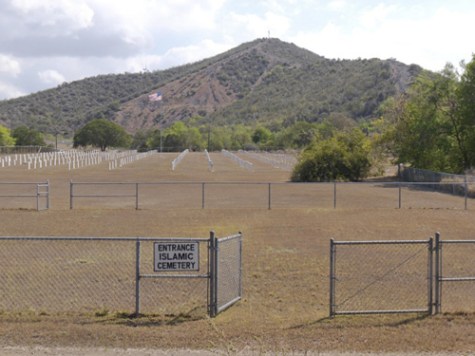
Naval Base Cemetery by Edmund Clark
Naval Base Cemetery (above) is not typical of the project. It is outside. ‘Home from Guantanamo’ uses the same detailed look at everyday institutional and domestic objects in their place. I don’t think it is as successful as ‘Still Life: Killing Time’, as I don’t think this approach lended itself as well to the War About Terrorism as it did to the Geriatric E-Wing of Kingston Prison, Portsmouth. ‘Killing Time’ is best viewed as a slideshow with Erwin James’ commentary.
Reciprocity Success
And finally, thanks to Stan for his coordinations and libations. Stan recommends Courthouse Confessions, as do I.
People ask how photojournalists and documentary makers get access to prisons, so I ask the photographers I meet. For every photographer, circumstances and events are unique.

The Society of Professional Journalists details media prison access policy, contacts, visitation rules, forms and permitted equipment state-by-state. There is no home page for the data, so I’ll link you to the Virginia Dept. of Corrections guidelines.
Prisoners in Virgina will be needing more visits to fill their time as their right to receive books via charities has just been withdrawn. The feeble reasoning by the Virginia DoC:
Because Quest [the Books Behind Bars program organiser] sent books directly to offenders and utilized volunteers to send these books, there was nothing in place to stop someone from attempting to introduce contraband to an offender by secreting it in a book.
This is plainly an excuse. It is also an embarrassment. If a prison system cannot provide efficient (and secure) passage of educational materials to its wards, then is it a system we should have any respect for or trust in?
These broken systems should be in our view.
Ben Gunn, Guardian. Monday September 14th, 2009
There is an interesting debate growing in the UK. Should prisoners be allowed to blog?

Ben Gunn, who claims to be the only serving UK prisoner who blogs, had a letter to his wife intercepted by the prison governor and told “the content is interesting enough to be published on the internet” and on this ground it was stopped from leaving the prison.
Gunn set up the blog at the end of August. He writes the content and his editor posts it to the web.
Gunn has caused a stir with forthright opinions on politicised victims groups, spineless politicians and poor prison management. These, he argues, are not fallacious rants, but genuine problems of an overly-punitive system and disengaged society.
Furthermore, Gunn argues that despite his original sentence of 10 years, he remains in prison after 30 because he has continuously challenged the prison authorities. At present Gunn is engaged in research towards a PhD, focused upon the role of Human Needs Theory in prison conflicts.
My question “How do we feel about Prison Bloggers?” is largely rhetorical. How we feel about them makes no impingement on their lawful right to write and publish from prison. Let’s be absolutely clear here. Gunn is breaking NO LAW.
The only law that may pertain is that Gunn may receive no compensation for his writing while a ward of the prison service. But this was never the issue at stake. Gunn’s free speech was deliberately quashed by the administration of a system that stood to face criticism through his words.
The official position as summarised by another excellent prison rights blogger John Hirst (The Jailhouse Lawyer):
The Ministry of Justice writes: “There is no specific Prison Service policy on prisoners using or posting blogs, as they do not have direct unregulated access to computers or the internet”. However, the reply goes on to to say that it can be implied from Prison Service order 4411, that a prisoner cannot ask someone else to communicate what the prisoner is not in a position to do himself and which violates the rules. The MoJ has clearly failed to take into account the human right to freedom of expression guaranteed under article 10 of the European convention, and prisoners’ rights to contact the media “on matters of legitimate public interest“.
I agree with many of Gunn’s positions, I don’t appreciate his tone sometimes, but I think he must absolutely exist within the dialogue about British criminal justice. His thoughts as a serving prisoner are of central value to debate and an informed public.
The echoes ring true and far. Gunn’s concerns over misinformation, scare-mongering and codes of silence are as acute (if not moreso) in the US prison industry.
I’ll leave you with Gunn’s view on prevailing distortions to debate and his admirable defiance:
In reducing discussions to trite slogans and vote-grubbing soundbites, we debase ourselves as a collective and as people. I realise that I pose a challenge, but regardless of any efforts expended by the government I am not going away.
_____________________________________________________________
As well as the Guardian sources linked in this article, the BBC picked up on this story and includes a brief but informative audio discussion of the issue.
_____________________________________________________________
Editor’s note: It seems strange that in the UK this quasi-controversial issue has taken a long time to rear its head – after all, Michael Santos has been blogging from US federal prisons at his own Prison Journal and as a guest at Change.org since January 2009.

I’ll be away for the next few days, swimming in lakes, musing over Jane Evelyn Atwood‘s photography, finishing Mumia’s new book and photographing flying dogs.
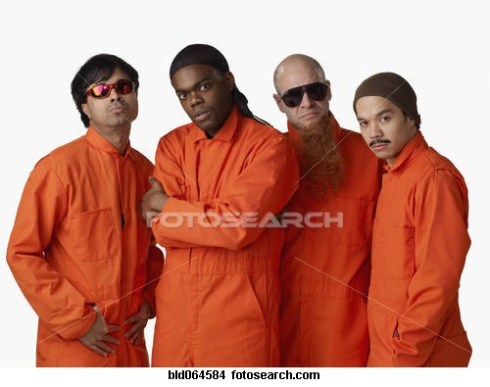
In contrast to the harsh reality of the last post, I present the laughably unreal.
Whenever I find a photographic archive I, by reflex, punch in ‘prison’ into the search tool. I’ve started to do the same with stock agencies.
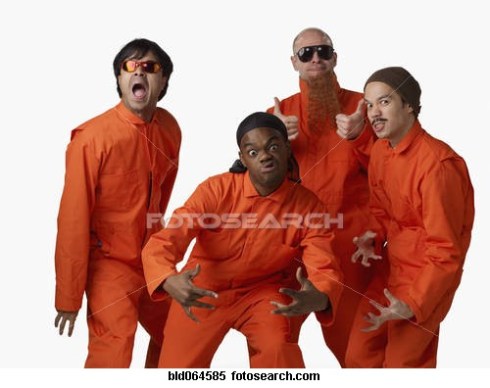
In the microstock world, image search results are disorienting. Instead of American Civil War jails, colonial prisons, prisoners of war, revolutionaries, genocide victims or political prisoners the return is staged portraiture, kitsch orange jumpsuit, bars, locks, handcuffs and silhouetted guard towers.
And, this is beyond the pale. WTF?
For simple graphic design purposes, I am sure even good intentioned advocates scout for imagery in stock databases of complete fiction in order to illustrate their message. Hmm.
A Teachable Moment: Avoiding Cliche
I have bemoaned before the cliche of cell-tier-perspective. I would encourage us all to really think about the relative contribution some prison photographs bring.
Even in photojournalism (a field not without its faults, but a mode I still firmly believe in) photographs of bars, keys and fences are common. So, to practitioners as to viewers, I urge the same rigour in critique.
Jenn Ackerman, Jane Evelyn Atwood, Lloyd Degrane, Jean Gaumy, Andrew Lichtenstein, Danny Lyon, Darcy Padilla, Lizzie Sadin and Taro Yamasaki are just some of the many photographers who’ve managed to describe prison life without overly-relying on the physical fabric of institutions. They spend enough privileged time with the inmates to tell the stories of the inmates.
This is the first of three posts celebrating the work of journalists/academics/photographers bringing to popular conscience the abuse of women in the American prison system.
I have called this triplet mini-series Women Behind Bars and it was spurred by a couple of news stories this week. In New York state, protesters outside the Governors house drew a promise from David Paterson that he’d sign legislation banning the chaining of incarcerated women who are giving birth.
Also, a class action lawsuit is gearing up in Michigan, which seeks a $100million settlement for over 900 female inmates and former-inmates who suffered harassment, groping and rape between the years of 1993 and 2009.
Women Behind Bars as a name for this mini-series was co opted from the Silja J. Talvi‘s most recent book of the same title.
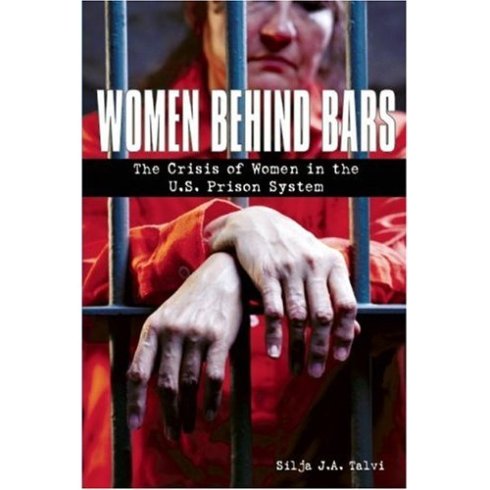
I had the pleasure of hearing Silja talk at the Seattle Public Library. Silja speaks as she writes – without jargon or polygonal argument. She keeps it simple; she is usually retelling the testimony of female prisoners she has visited and interviewed. No flourish required.
Beyond the physical and sexual harassment of female prisoners, Talvi asks us to reevaluate our understanding of psychological welfare as it is handled by the prison system. The 775% increase in the US female prison population since 1977 is – for want of a better word – criminal. It is double the rate of growth for the male prison population. Talvi is in no doubt that this increase is due for the most part to the war on drugs. Talvi also describes the constituencies entering US womens prisons.
Talvi’s work crystallises the fact that the massive incarceration of American women has not been a result of crime on the streets, but a result of criminalisation by writ of political assemblies. In the war on drugs, women are involved but surely we must analyse that involvement. Occupying residence, associating with family drug dealers are indirect misdemeanours that stand to be punished. When a society is blighted by drugs and the dealers are involved in the “war” on the street, usually it is women who hold the threads of family and community – and home – together … despite its faults and its drug use.
Talvi points to another remarkable trend,
There’s also the fact that women are less likely than men to snitch on loved ones. Prosecutors will come to them and say they will go to prison unless they give up the names of three higher-ups, but women usually either say they don’t know those people or will simply decline. Men will snitch and, unfortunately, they often get less time in prison than women who don’t.
The shocking statistics are simply an application of US culture that is too morally bankrupt & class divided to think of more imaginative forms of criminal justice than incarceration.
Prison is a violent, inhumane environment – the modern designations of built with violent offenders in mind. But what proportion of women prisoners are violent? Not nearly as many as our fear-gripped culture would presume.
The prison is a disciplinary tool that has needlessly subjugated women. It has been imposed and it has demolished poor communities.
When Talvi supports prison for violent murderers and rapists and then argues for its non-implementation for female ‘criminals’ she is entirely consistent. The prison has a place, but it is not in the persecution of non-violent females, it’s counter to the notion of justice and it flies in the face of social justice.
As This Is Not A Book Sale put it,
The book Women Behind Bars was produced as part of the Women Behind Bars Project which:
[Source]
Women Behind Bars. The Book: More and more women—mothers, grandmothers, wives, daughters, and sisters—are doing hard prison time all across the United States. Many of them are facing the prospect of years, decades, even lifetimes behind bars. Oddly, there’s been little public discussion about the dramatic increase of women in the prison system. What exactly is happening here, and why?
Bio: Silja J. A. Talvi is an award-winning journalist with credits in more than seventy-five publications nationwide, including The Nation, In These Times, and the Christian Science Monitor. She was honored as a recipient of the 2005 and 2006 PASS awards for criminal justice reporting by the National Council on Crime and Delinquency, a 2006 New American Media Award, and twelve regional SPJ awards for excellence in journalism. Talvi’s work has appeared in numerous anthologies, including Prison Nation: The Warehousing of America’s Poor, Body Outlaws, The W Effect, It’s So You, and Prison Profiteers. She lives in Seattle.

 Prison Photography