
You are currently browsing the category archive for the ‘Press’ category.

Guantanamo © Chris Maluszynski/Agence VU

Guantanamo Map http://www.cubafutour.de/Karte%20Guantanamo%20Provinz.jpg

Guantanamo Bay Tents. Courtesy of The Department of Defense Visual Information Center
I am very happy with the way Prison Photography is progressing. I have done interviews with some outstanding photographers and artists. I have offered opinion where I think there’s something to be said. The most satisfying work on the blog is that contributed by guest bloggers, comment-makers and interviewees. Photographers have contacted me and I have been eager to comment upon their work.
But, there is one audience I never anticipated – The Google Image Search Audience. I get many hits for searches on Guantanamo, Guantanamo video, Iraq prison, Abu Ghraib, Abu Ghraib Images of Prisoners, etc, etc – which is strange because these are topics that many people have grappled over with more proficiency and depth than I am likely to.
It is obvious that there is a need for fast access to images of America’s sites of torture and incarceration, namely Abu Ghraib and Guantanamo. I certainly don’t wish to fuse the two institutional histories so I shall deal only with Guantanamo Bay.
Louie Palu
Walrus Magazine. 8 of Palu’s photographs and accompanying article.
The Atlantic. 6 of Palu’s photographs.
Private galleries. Palu’s Photoshelter profile offers three separate galleries, but they’re password protected. Contact the photographer directly.
NPR Interview. Palu offered insight into his experience and impressions of Guantanamo.
Christopher Sims
Mother Jones. 15 images of daily life outside of the prison complex.
Civilian Arts Project. 25 images of a bizarrely serene Guantanamo Naval Base.
BBC, The Other Side of Guantanamo. Article about Sims’ series.
Daylight Magazine. 4 minute audio of Sims’ experiences on project.
Chris Maluszynski
Agence VU/Moment. Twenty-six images exhibited. Likely more on file at the agency.
Cesar Vera
Guantanamo Prison. 18 Black & White images. 3 Colour.
Joint Task Force (JTF)
Many of the photographs shown in the press over the last few years were taken by members of the Navy’s own Joint Task Force. When press photographers visited the JTF vetted all images before release.
Boston Globe. 30 Hi-Res images.
Repeat of above selection. 20 Hi-Res images selected.
JTF Photo Galleries. 22 months (July 2007 – May 2009). Hundreds of images. Official photography.
Miami Herald
Description of the 8 different camps at Guantanamo
Explanation of the Legal contexts: Key defendants, the judges, the defense and prosecution counsel.
Cursory look at Art influenced by Guantanamo
Magnum
Bruce Gilden. Guantanamo Bay. Enemy Combatant Camps, 2003
Paolo Pellegrin. Guantanamo Detainees, 2006
Stuart Franklin’s work Cuba, 2003, included images from Guantanamo and you’ll need to search the Magnum website for images.
McClatchy
An eight-month McClatchy investigation of the detention system created after the Sept. 11 terrorist attacks has found that the U.S. imprisoned innocent men, subjected them to abuse, stripped them of their legal rights and allowed Islamic militants to turn the prison camp at Guantanamo Bay, Cuba into a school for jihad.
Intro. Text and 11 minute video.
Photos. Detainees held at Guantanamo Bay
Photos. Faces of Guantanamo Detainees. Part one.
Photos. Faces of Guantanamo Detainees. Part two.
Photos. Detainees held in Afghanistan.
Eyeballing
Comprehensive overview of base using Google Maps, official photographs. Details structures, uses and topography of naval base.
Camp America, Camp Delta, Camp V and Administrative & Court building.
Camp X-ray and construction of later detention camps.
Associated Press
Images of facilities and interiors of various detention blocks and camps.
Stars & Stripes “The Independent News Source for the U.S. Military Community”
Work at Guantanamo
Education at Guantanamo
Recreation at Guantanamo
Artistic Turns
David Hicks. Virtual Guantanamo Cell
Penny Byrne. Porcelain Guantanamo Detainee Figurines
Gregor Schneider. 21 Cells, Bondi Beach, Australia
Legofesto. Guantanamo reconfigured with Lego men and Lego pieces and Wired Interview
Flickr – Protest Images
Amnesty International. Guantanamo Protests
Various Photographers. 100 Days to Close Guantanamo and End Torture.
James M. Thorne. Protest images.
Miscellaneous Media
Prisoners of War. 2004 article by the San Francisco Gray Panthers with images of US airforce transporting detainees and early 2003 images of Camp X-Ray.
BBC. Life in a Guantanamo Cell

Rendition. Photographer Unknown
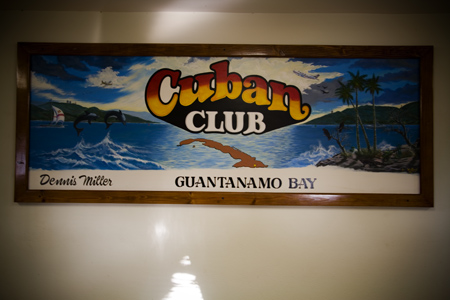
© Cesar Vera

Guantanamo Bay Navel Base with a New Commander-in-Chief. Photographer Unknown. http://www.obamalouverture.com/f39/guantanamo-bay-switch-bush-photo-obama.html
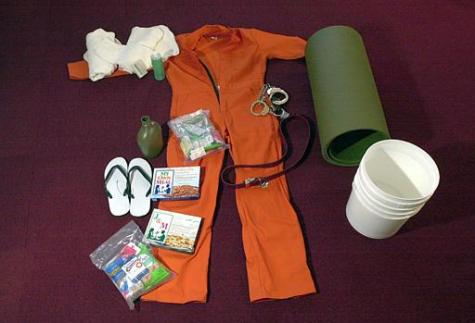
The standard issue of clothing, sleeping mat, food, sandles, canteen, soap, and buckets for detainees of Camp X-Ray is pictured in Camp X-Ray at the U.S. Navy Base at Guantanamo Bay, Cuba, on Wednesday, Feb. 20, 2002. © Tomas van Houtryve/AP Photo
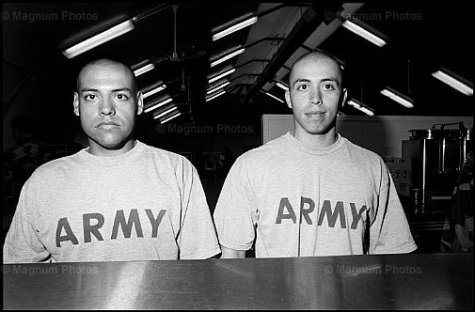
CUBA. Guantanamo Bay. 2003. Soldiers wait for their meals before a prayer breakfast at Camp America. Photo: Bruce Gilden/Magnum
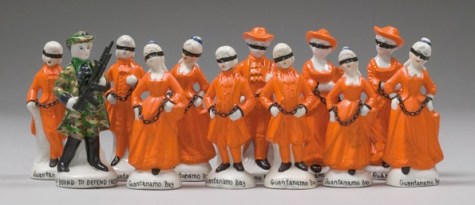
Penny Byrne Guantanamo Bay Souvenirs 2007, vintage figurines, metal chains, epoxy resin, plastic, re-touching medium, powder pigments, 14 x 32 x 10 cm.
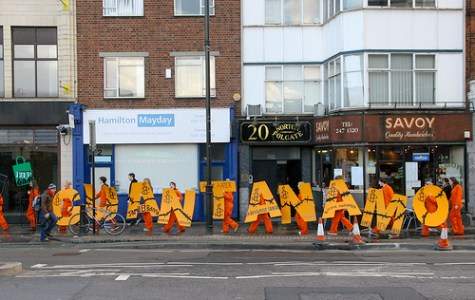
Photo: Jon McClean. http://www.flickr.com/photos/jonmclean/410055117/
IF YOU HAVE ANY RESOURCES TO SUGGEST,
PLEASE CONTACT ME AND I’LL ADD THEM TO THIS LIST.
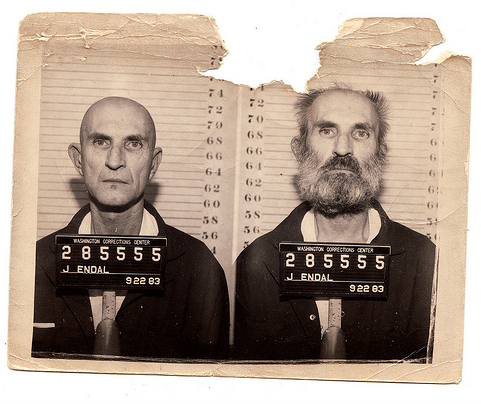
Torn Shorn, Misc. Set. Courtesy of Least Wanted aka Mark Michaelson. http://www.flickr.com/photos/leastwanted/sets/72157605201939008/
Another nod for Blake Andrews. Although not planned, it is welcome, as I think he tries keeps the blogophotosphere fresh, trying new stuff from his hideout in Portland.
Earlier this week I featured Blake’s Brief History of the U.S. Passport Photograph. An artist/collector with hundreds of Passport and ID Photographs, named Least Wanted, followed up with Blake to get the word out on his sprawling collection.
Also earlier this week, I put up a piece about the JUSTICE Art Installation in Bridewell Police Station, London. Coincidentally, one of the artists for the JUSTICE exhibition exhibition was Mark Michaelson, aka Least Wanted. It seems like a small-internet-triangle-of-providence presented itself this morning and it is up to me to draw the hypotenuese …

Head Gear, Misc. Set. Courtesy of Least Wanted aka Mark Michaelson. http://www.flickr.com/photos/leastwanted/sets/72157605201939008/
Least Wanted collects, groups and displays a huge collection of I.D. photos on Flickr. In addition to passport shots, it includes medical photographs, badge I.D. photos and other documentary ephemera. Prison Photography is interested in the majority of the collection: Mugshots.
Least Wanted’s sets are a mad enough curatorial project to keep me going for months. For now, I’ll just echo Blake’s sentiment and point you in the direction of Michaelson’s epic archive.

Austin Old Timer, Misc. Set. Courtesy of Least Wanted aka Mark Michaelson. http://www.flickr.com/photos/leastwanted/sets/72157605201939008/
The three images used in this article were drawn from Least Wanted’s misc. Set
Couldn’t resist with this story. Afghanistan’s only pig, known as “Pig”, has been locked up in quarantine to protect itself and other animals.
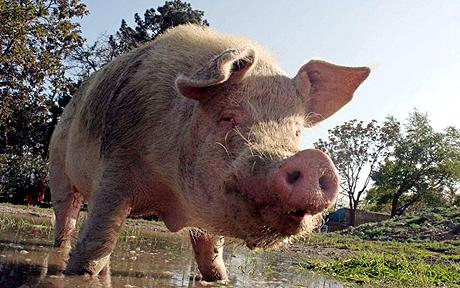
Pig is photographed, at a zoo in Kabul, Afghanistan on 30 April 2009. The World Health Organization (WHO) on 30 April said, that it would cease use of the word swine and stick with the scientific title of a new variant of influenza A(H1N1), in light of complaints from the pork industry. WHO updated the number of laboratory-confirmed cases of swine influenza to 257, including eight deaths. EPA/S. SABAWOON
However this is not all light-hearted banter. According to this article, by Golnar Motevalli, the Swine Flu is the latest blow during a tragic few years at Kabul Zoo.
Shabby and rundown, Kabul Zoo is a far cry from zoos in the developed world, but has nevertheless come a long way since it suffered on the front line of Afghanistan’s 1992-4 civil war. Mujahideen fighters then ate the deer and rabbits and shot dead the zoo’s sole elephant. Shells shattered the aquarium. One fighter climbed into the lion enclosure but was immediately killed by Marjan, the zoo’s most famous inhabitant. The man’s brother returned the next day and lobbed a hand grenade at the lion leaving him toothless and blind.
And, as the Telegraph notes, it has been a traumatic journey for “Pig” also.
“Pig” was one of two given to Afghanistan by China in 2002, months after the ouster of the hard line Taliban regime, to help reestablish the zoo after it was destroyed during civil war. However, the other pig – and their offspring – were killed in an attack by a bear. Despite being the only pig, it was not too lonely, Zoo Director, Mr Saqib said. “The pig made friends with a goat and was happy sticking to the goat in the enclosure, where some other goats and deer were on show for visitors.”
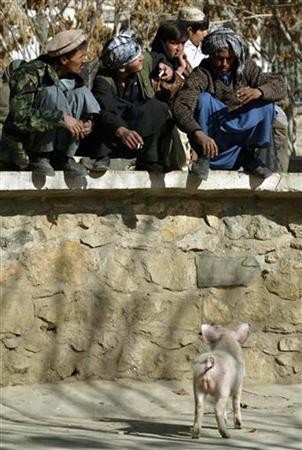
Credit: Reuters
There are no pig farms in Afghanistan and no direct civilian flights between Kabul and Mexico.
Two stories from the British press this week mimicking to two pressing issues of the American justice system – care provision for mentally ill prison populations & exoneration after wrongful conviction.
First off. As the Beeb reports, The Lord Bradley Report has recommended moving mentally ill inmates out of prisons and into alternative care environments. That’s a significant victory for prison mental health reformers, and for the UK public.
The impressive thing Bradley’s report is that he ties the shortcomings of the prison system to provide appropriate mental-health care to wider problematic practices of policing; highlighting in particular the relatively new anti-social behaviour (ASBO) as inflexible and routinely applied. From the BBC,
It is expected to highlight how ASBO and penalty notices can accelerate the treatment of mentally ill people as criminals. Some estimates suggest 70% of inmates have two or more mental disorders
and
In February, Ministry of Justice (MoJ) figures revealed that a record 3,906 offenders with mental disorders were being held in secure hospitals in England and Wales at the end of 2007.

'I miss the prison crowds' ... Sean Hodgson. Photograph: David Levene/Guardian
Secondly, The Guardian ran Sean Hodgson’s story about time served on a 27 year wrongful conviction. It also covered the first three days following release and the circumstances of Hodgson and reporter, Aina Edemariam, meeting. Edemariam picked Hodgson up off the street after he’d been clipped by the wing mirror of a passing taxi.
Sean Hodgson has been dealt a shitty hand. He suffers from a long list of serious health problems, his money has run out so he survives on coffee. He is lonely. On a ‘couple of times he has felt so depressed he has called a crisis line. But it was busy, he says. “So I just went to bed.”‘ He has also been stalked by a tabloid photographer.
In the US, The Innocence Project has led the way using DNA evidence to overturn wrongful convictions. I think Britain lawyers’ eyes were opened by the Innocence Project’s legal endeavours. The UK has been slower in it’s use of DNA testing for old cases. Sean Hodgson has served the second longest term for a wrongful conviction in the history of British law. And after doing that time? Well it was an abrupt transition:
Lifers who admit guilt go through a few years of preparation for their release: they are given parole, are able to work outside the prison, to put housing and income in place; they can retreat to the prison whenever the outside world gets too overwhelming. Those who have never admitted their guilt very rarely get parole, and thus receive none of this. So Hodgson was taken immediately to the housing and benefits offices – where it transpired that someone had stolen his identity and he no longer had a national insurance (social security) number, meaning that officially he did not exist. His MP had to intervene to sort that out.
With his brother he had his first pint and cigarette as a free man. Although they had spoken twice a week throughout his incarceration they hadn’t actually seen each other for over 10 years, because, he says, his brother couldn’t afford to travel to the prison. After their drink, his brother went back to his hotel, and the next morning, home, to work a night shift. And then Hodgson was on his own.
And then in some final insult, Hodgson’s compensation from the government, which will take at least a year and for which he must apply!, will pan out like this:
Then, when compensation is finally paid out, the government, unbelievably, docks room and board, or “saved living expenses” calculated on the basis of what a frugal person might have spent on their own upkeep if they were free. “As if you voluntarily popped into the local prison,” says Young, contemptuously. “Yes, it would have cost them something to live – but you’ve taken their liberty. If you can afford £50bn to bail out a bank you can afford to compensate someone for 27 years in prison.” McManus estimates that Hodgson will pay a minimum of £100,000 for the privilege. The appeal was paid for by legal aid, but it does not cover the process of applying for compensation. And so Hodgson will have to pay legal fees too.
______________________________________________________
I know it’s quote heavy. I tried to reduce the articles down to their essentials.
David Levene’s photographic work for the Guardian
Permanent for Sean Hodgson article, ‘Freedom? It’s lonely’
Continued Guardian coverage of Sean Hodgson

US Soldiers in a Mosul Internet Cafe. Photo Credit: Andy HoboTraveler.com World Travels. http://www.hobotraveler.com/120mosul03.shtml
Last week, BLDGBLOG published How The Other Half Writes: In Defence of Twitter. It slammed Margaret Dowd’s “brain-dead editorial” in which she pouted like an adolescent instead of actually interviewing Twitter founders, Stone and Williams.
In Defense of Twitter was vitriolic and robust in its argument. Geoff usually sticks to urban-tectonics, mobile architecture and Los Angeles, so it was unusual to see him drop down to the base debate over whether Twitter is good or not. Alas, he dropped in and closed the debate.
Geoff’s argument was that Twitter is essentially a note taking application, and we shouldn’t crap ourselves just because the post-its are seen by the world.
Paul Carr’s article in the Guardian today suggested Twitter can take care of itself anyway. Twitter and other webomediasphere-folk have been brought in to consult on the loose ends and cable ends of a frayed Iraq. Carr exhorts
“I am not making this up. The department has just airlifted Twitter’s Jack Dorsey along with representatives from WordPress, Meetup.com, YouTube and Google into Baghdad to discuss how social media can help build Iraq 2.0″
Carr’s article runs at the same time the New York Times picks up on the story.
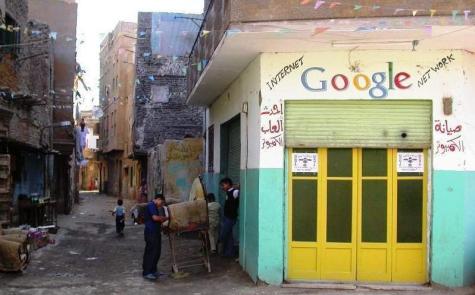
Internet Cafe in Baghdad. Photo Credit: BlogIraq (died April 2008). http://www.blogiraq.info/2007/02/22/at-last-google-opens-and-office-in-baghdad/
The US military’s partnership with non-military groups/corporations takes me back to a presentation made in 2005 (the pre-Obama era). Thomas Barnett bleated about the failings of the Iraq (mainly the “six months of dicking around” after Saddam was toppled). He relates all of this to the US military’s ongoing deficiencies since the end of the cold war. The American army can annihilate any chosen subject but it has not paid much attention to post-major-operations rebuilding. Iraq is a sorry testament to that fact. Barnett suggested a flood of 250,000 “administrators” into Iraq in April 2003 would have stabilised the country a lot quicker.
It seems the US military is now calling upon Twitter and others as “post-war administrators” infrastructure builders, vacuum fillers – whatever you want to call them – as described by Barnett. What should one make of this? Why shouldn’t Twitter et al. be working to improve the long term prospects of Iraq? The US military is great at shock, awe, power and might, but not building community. Barnett prefers his soldiers “young, male, unmarried and slightly pissed off”. But he insists the military personnel be followed up by a flood of partners who facilitate the the rebuilding of infrastructure. A 19 year old marine cannot carry out both distinct functions/philosophies of war.
I don’t like Barnett’s tone. I like his honesty about the realities of military combat, but not his pompous humour. Barnett takes on many groups; multiple government agencies, the UN, TSA, and not least liberals who squirm uncomfortably to pussy jokes. But just because he takes on the military – just because we share opposition to the Iraq war – does not makes us allies in thought. Barnett wants to make military better and ultimately a more efficient killing machine.
Military Icons for PC
It is perhaps this quote by Barnett describing the relationship of military and non-military responsibilities through hypothetical steps of entering, winning and closing warfare, that positions Twitter best. Twitter is part of the second group.
“The first group takes down networks, the second group puts them up. You’ve got to wage war here, in such a way to facilitate that [second group reconstruction activities]. “
Again, what should one make of this? Everyone knows about Halliburton, because of Cheney’s associations. Are Twitter and its do-no-evil web 2.0 pioneers any different to the tens of thousands of other corporate interests in Iraq?
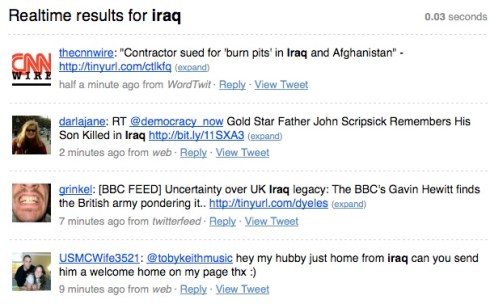
Screenshot of "Iraq" Search on Twitter. April 28th 2009

London Metropolitan Police Anti-Photography Propaganda Campaign Poster
When I began writing this blog, it was meant as a vehicle to display the documentary work of photographers working in sites of incarceration and to generally expound the stories touched upon. It was also meant to deconstruct some of the persistent myths surrounding prisons and prison populations and how visual culture has played its part in weaving some of those myths.
Not once did I envisage the current situation whereby the act of photography could bring about the threat of detention and imprisonment. Such impingement on basic rights of expression has been known in some of the dictatorial and despotic regimes of modern history … but not so much in the West, right? The times they are achangin’.

Photo: Liam Oliver Newton Craik-Horan. http://www.flickr.com/photos/liamch/3423810669/
When my brother visited from the UK last month he couldn’t stress enough how much of a police state it has become. We reasoned that the fingerprints taken by US homeland security are know also the possession of the UK government. It used to be the case that fingerprints were only taken and kept on file in the UK if you had been convicted for a crime. How things change.
A few months ago I signed up as a member of ACLU, the decisive moment was when the ACLU representative said to me, “You don’t want the US turning out like Britain with all those cameras and surveillance do you?”

Photo: Stickerklub. http://www.flickr.com/photos/stickerklub/3420240889/
Britain really is a country that has got itself on edge; it’s culture promoting men and women in all guises of security to exert illegitimate power and enforce ludicrous policy. Unfortunately, this robotic application of rules has infected even our art galleries, as the venerable John Berger discovered.
This past months have seen a slew of stories coming out of Britain regarding the rights of photographers in public spaces. All these are in response to a slew of legislation to slowly whittle down the rights of photographers; the rights of UK citizens.
On 16th February, the Counter Terrorism act came into effect making it illegal to photograph a police officer or “elicit information” about them. The British Journal of Photography has the details.
After the disgust at such brazen restriction of rights, the response by the photographic community in London was to go to Scotland Yard, headquarters of the Metropolitan police, and in an act of mass civil disobedience take lots of photographs of lots of officers.
The Guardian UK has been the mainstream print media that has really pursued this topic, reminding us all of what we have just lost. They broke the story that Kent police monitored members of the press during an environment protest, for which the Kent constabulary have apologized.
The Press Gazette explained this tactic and the associated tension between police and photographers.
David Hoffman, a photographer with 32 years’ experience, said he now carries shinpads in his bag, claiming he had been kicked by police officers at protests.
“The police today [NUJ Protest] have been beautiful – but that isn’t always the case,” he said. “Recent protests have been very bad. The worst was October last year, at the Climate Rush demo. One copper spent his time kicking my leg. Stood there with his steel toe caps kicking away – and me, a silver-haired man. I’ve still got chunks missing from my legs five months on. They want you to think: I won’t cover it next time. They have been using FIT [Forward Intelligence Teams, who use cameras], they have been using intimidation.”
Hoffman added, “It’s important the police know they’re being watched and observed. If you don’t see what’s going on, your society’s less democratic.”

Photo: Tom Kondrat. http://www.flickr.com/photos/toguko/3409931955/in/pool-met
It is almost like the lines have been drawn so indelibly, people are having to pick a side. It is sad to see but the police fall in line with the government and the majority sympathise with the press. This has led to a conflation of stories involving the G20 protests, police misconduct, and the death of (and vigil for) Ian Tomlinson. Judging by the Guardian’s recent coverage, you’d be forgiven for thinking that London was on the edge of civic breakdown.
I think the media and the Guardian in particular are taking a principled stance here and just reminding the Met at every opportunity that they are watched and the press will not be cowed. I think most of us realise that with millions of people in possession of recording equipment it is unenforceable to stop people from documenting the streets.

Photo: Tristam Sparks. http://www.flickr.com/photos/friendly-fire/3287739662/in/set-72157613984292743/
Ian Tomlinson’s death received a lot of coverage and rightly so, but I shall wait for the inquiry ruling before making a call, despite the early damning evidence. We, however, in the business of images know that they can never tell the full story. This is now an investigation of excessive force by the police and distinct from the main issue of photographers/civil rights.
Yesterday, the Guardian published this footage of the police threatening photographers with arrest if they did not move. Again, later the force apologized. But what is interesting here is the Guardian‘s decision to line up video footage of various scenes of confrontation from different days in the right hand nav bar. It is a dossier of police activity and unlike anything I have seen in mainstream media.

Photo: Roger Lancefield. The protesters stickers read "I am not a Terrorist, I am a Photographer". http://www.flickr.com/photos/rlancefield/3285904973/in/set-72157613975803636/
From the sublime to the ridiculous, the Guardian showed that front-line press aren’t the only ones under scrutiny. Metropolitan police deleted a tourist’s photographs this week to “prevent terrorism”. Klaus Matzka, the tourist involved summed his experience up as such:
“I’ve never had these experiences anywhere, never in the world, not even in Communist countries.”
So, at best you are harassed for your photographic activity and at worst, if thought to hold sinister motives, arrested and face a 10 year sentence.

Photo: Tristam Sparks. http://www.flickr.com/photos/friendly-fire/3414147417/in/pool-met/
Before all this gets to any court, however, the clashes are felt on the street, on the shins and in the constantly diminished rights to freedom of expression. Where citizen photographers may feel powerless, it seems the press – and the Guardian in particular – are just getting powered up.
_________________________________________
Thanks to all the Flickr users credited above for their images, but more importantly their acts of documentation in the face of legislation to prevent such freedoms. I hope we all stay out of prison.
When Jehad Nga’s photographed Somali pirates it was at a time when frigates not people were perceived as the main victims of their contemporary skull-duggery. It was also before American military engagement and the associated global media entered the fray
The main reason I focussed on Nga’s work back in December was because his pirate-subjects were imprisoned. Nga’s work at the time was featured in Time Magazine and The New York Times and I’d be lying if I wasn’t part of the consuming public that took more notice of the pictures than the politics.
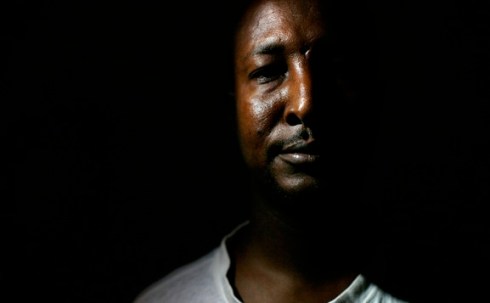

Since the close of 2008, activities in the Gulf of Aden have ramped up. So has Nga’s career; in photojournalist terms he unleashed another blockbuster this week with his portraits of US Marines in the New York Times. I’ll confess – I’m a sucker; I think Nga’s Chiaroscuro portraits are irresistible. My only problem is that the same aesthetic has been put in place by Nga and I am left confused.
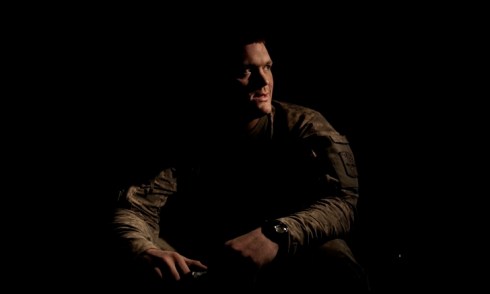


Nga described the jails in which Somali pirates were kept as dark and dank, so his visual language makes sense when working in that context. Has he made multiple photo essays of high contrast, using vibrant colour-schemes and dark negative space. Nga, has to my mind, forged himself a visual brand.
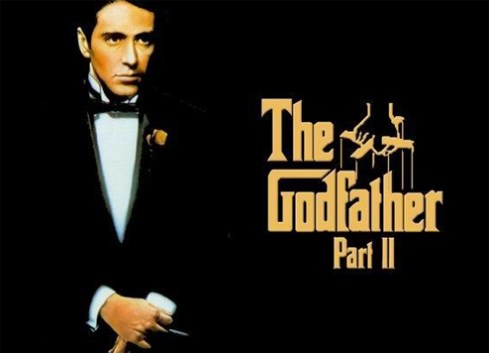
What is the end result of this? Is Nga just playing a longview game, in which his brand sustains longer than the stories? Is Nga just giving the public the cinematic frames it has lapped up previously? Is it problematic that he gives the same treatment to the ‘vilified pirates’ and ‘patriotic heroes’ we’ve seen in the newspapers this week? Are my queries unfair. After all one man’s terrorist is another’s freedom fighter. One man’s criminal is another’s political prisoner. Is it even Nga’s place to distinguish, or use visual devices to shape viewers’ thinking? We’d do well to remember Brando and Pacino played great villains, but they were villains we loved to hate.
What do you think? Do you contemplate the character of a subject differently when it is struck by bright pockets of light if it is an American soldier or Somali pirate? How do you reconcile that?

All images, except the Godfather II and Apocalypse Now still (final image) ©Jehad Nga.
Author’s Note: If there exist any photographs of the violence described below I wouldn’t want to see them, only trust that photographs were used to bring high ranking US officials to justice for crimes against human rights.
I have been familiar with Mark Danner‘s work since reading the excellent Torture and Truth. It dealt commandingly with the Abu Ghraib scandal, putting it into the procedural context of the Bush administration and US operations during the War on Terror. Not to be distracted by the available Abu Ghraib images, Danner continued his fervent document-trawling professionalism and pursued the truth with regard to other Black Sites and detainee torture & interrogation.

Abu Zubaydah after his capture in Pakistan, 2002. Credit: ABC News
Last month, Danner published an Op-Ed piece for the New York Times (to accompany an extended piece for the New York Review of Books) that laid out the details of an International Red Cross report of detainee testimonies. I have only read the shorter NY Times piece and strongly urge you to take 10 minutes to do so. It is a succinct presentation of facts detailing US torture procedures.
Men were tortured in America’s name.
Indeed, since the detainees were kept strictly apart and isolated, both at the black sites and at Guantánamo, the striking similarity in their stories would seem to make fabrication extremely unlikely. As its authors state in their introduction, “The I.C.R.C. wishes to underscore that the consistency of the detailed allegations provided separately by each of the 14 adds particular weight to the information provided below.”
Danner deals with the circumstances of three high ranking Al Qaeda prisoners, one of whom is Abu Zubaydah (pictured above following his 2002 capture). Judging by the Red Cross report which used separate chapters – “suffocation by water,” “prolonged stress standing,” “beatings by use of a collar,” “confinement in a box” one can assume Zubaydah looked significantly more broken after his months of early detention and beatings.
Danner concludes;
What we can say with certainty, in the wake of the Red Cross report, is that the United States tortured prisoners and that the Bush administration, including the president himself, explicitly and aggressively denied that fact.
The use of torture was a decision made by the US government. Danner’s conclusion is ominous;
The consequences of this choice, legal, political and moral, now confront us. Time and elections are not enough to make them go away.

 Prison Photography
