
You are currently browsing the category archive for the ‘Visual Feeds’ category.

A Developing Story is a new joint venture by Johnny Bennett, Phil Maguire and Benjamin Chesterton of duckrabbit.
In an email a few months ago, Ben said to me his interest lies in “getting under the skin of NGOs” and have them realise that they can deliver their stories and campaigns in far more effective ways. A Developing Story wants the stories told in Government & NGO international development campaigns to outlast the short term objectives of said campaigns.
A Developing Story proposes that the media of these campaigns is deposited in a common silo, accessible by all (usually under a Creative Commons license) so stories – once created – can tell themselves infinitum.
Given the primacy of Creative Commons and open-source content, Matt and Scott at DVAfoto needed clarification on A Developing Story‘s impact on the photographer (which was provided). I have fewer worries as I feel this venture is aimed at transforming media sharing practices among government funded and NGO initiatives rather than another pressure on the distribution and remuneration of individuals’ works.
I would anticipate that the payments made to photographers and journalists by media campaign management will continue and that photographers will take on assignments in the knowledge that their work can be used repeatedly for non-profit purposes.
That said, A Developing Story is very open to individual contributions. This is the most relaxed approach to collaboration I’ve witnessed!
So, as Ben asked, “Can You Help?”

Past and present ruminations about what is and isn’t a photograph have been a source of frustration for me. For one, people can draw whatever lines they wish to determine the point at which manipulation tricks out a photograph and thus qualifies it as photo-illustration. And for another, as Errol Morris keeps banging on about, ALL photography is lies (and manipulation).
These debates are not about truth. Interventions – power relations, habit, photographic custom, complicity among subjects, props, political agendas (and framing), cropping, tweaking of exposure levels before and after development, digital alterations – mean that photography can never be, will never be truthful.
People forget that often it is the ingenious tricks that have spurred the largest wonder among viewing public – think Oscar Rejlander’s Two Ways of Life, Spirit Photography and – in a different sense – Ansel Adams’ Zone System.
It is therefore, with some relief that an artist like Azzarella comes along using photo-manipulation as the tactic and purpose for his work.
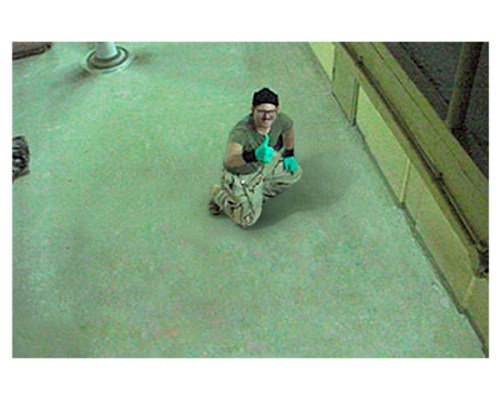

Last week, I questioned Anton Kratochvil’s Homage to Abu Ghraib, mainly because I think it makes little contribution to the discourse on the political aesthetics of Abu Ghraib. The blurry references to torture in Kratochvil’s images are in response only to a personal, conscious and willing point of view. I understand that Kratochvil’s work was an exercise in self-therapy but that shouldn’t stop me comparing it to Azzarella’s broader concerns about more general and unconscious reactions to well-circulated images.
If I w re to wr t th s sent nce wi h lette s m ss ng, you can still read it. The human brain is a wonderful instrument drawing on past experience to quickly filter out the non-possibilities. Just as the brain instantaneously deciphers gaps in text so it does with gaps in images.
With every passing hour the Spectacle suffuses itself further. It isn’t so much us reading images but images reading us. Our involuntary responses to images are predictable, predicted, precoded. The redacted action of violence in Azzarella’s pictures plays second fiddle to the original image, for it is the original image we drooled over and devoured.
The hooded detainee, dead student, wailing child or falling soldier needn’t even be present; our internal, emotional feedback spun by these images will forever be the same. We fill in the gaps and short circuit to prescribed disgust, sadness and politics, thus confirming our prevailing bias.
Azzarella’s works expose the fraud in us all … and our cheapened, robotic response to image.

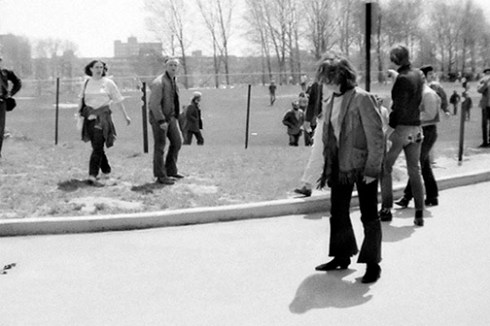
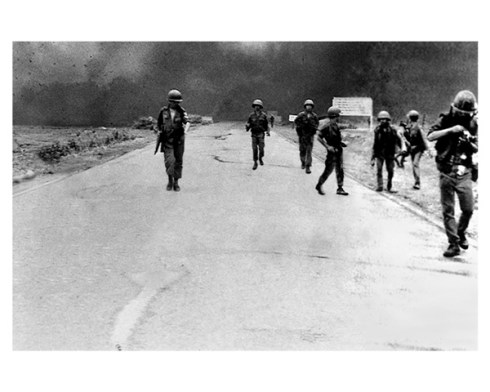
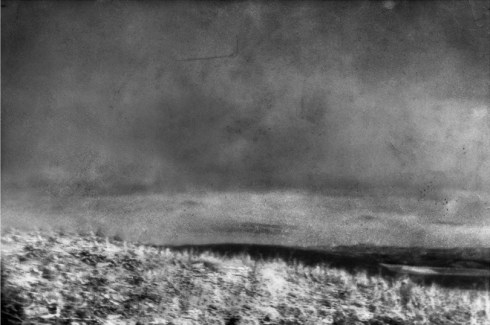
ALL IMAGES © JOSH AZZARELLA. FROM TOP TO BOTTOM: UNTITLED #13 (AHSF); UNTITLED (SSG FREDERICK); UNTITLED #24 (GREEN GLOVES); UNTITLED #35 (CAFETERIA); UNTITLED #39 (265); UNTITLED #20 TRANG BANG; UNTITLED #43 (PAR115311).
It might be unwise. It might be aborted if it only increases the speed of my daily internet treadmill. But …
Photography Prison is on Tumblr.
It is the alter-ego of Prison Photography, focused on more things photography than things prison.
Basically, I see loads of cool things in any given day and I’d like to share them without the production that goes into Prison Photography.
Hope you find some worth. I’ll reevaluate this Tumblr thing in 4 weeks, but until then you know you can enjoy all these things …
Adam Broomberg and Oliver Chanarin
‘Unconcerned but not Indifferent’ Foto8 (March 2008)
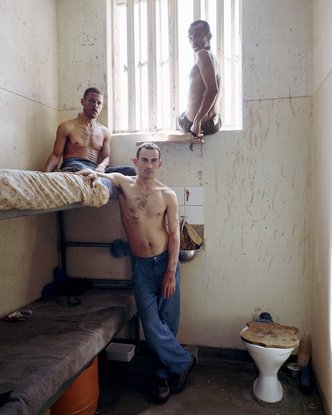
Timmy (center), with Peter (left) and Frederick, Pollsmoor Maximum Security Prison, South Africa (c-type print, 12" x 16", 2003)

Dion, 41, General in the 28s describing his imaginary uniform, Pollsmoor Maximum Security Prison, South Africa (c-type print, 12" x 16", 2003)
If two ends of the spectrum were identified this week during the debate about race and how it is (mis)treated by photographic practice we could see them as the moronic fashion world practitioners and then everybody else – “everybody else” being social documentarians, new-media image-makers, old-school bang-bang-club photographers and fine art practitioners. This second larger group is where most thoughtful folk place their energies.
Bizarrely there are a couple of guys who run the length of this spectrum. Adam Broomberg and Oliver Chanarin used to be the creative directors of Benetton’s controversial Colors Magazine AND they travel through Africa and Central America taking photographs of people in institutions.
Broomberg and Chanarin have also pissed a lot of people off. They are that good.
We all remember Steven Mayes’s departure speech from the World Press Photo, but Broomberg and Chanarin beat him to his oft-repeated remarks that photographers repeat motifs and collectively thicken the pen around photojournalism’s self-drawn caricature.
A full year prior to Mayes’ rallying call for new imagery (genuine, everyday Black culture; affluent drug use and users; and real sex), Broomberg and Chanarin were throwing punches low and hard at photojournalism’s conceit. They quoted Brecht; ‘The tremendous development of photojournalism has contributed practically nothing to the revelation of the truth about conditions in this world. On the contrary photography, in the hands of the bourgeoisie, has become a terrible weapon against the truth.’
In turn, Broomberg and Chanarin relied on Sontag and Barthes;
‘Since its inception photojournalism has traded in images of human suffering. If one of its motivations for representing tragedy has been to change the world then it has been unsuccessful. Instead the profession has turned us into voyeurs, passively consuming these images, sharing in the moment without feeling implicated or responsible for what we are seeing. Roland Barthes summed up the analgesic effect of looking at images of horror when he wrote “someone has shuddered for us; reflected for us, judged for us; the photographer has left us nothing – except a simple right of intellectual acquiescence”.’
They provide a pat description of the “obscene feeling” jury process in which there is no text, caption or context. Judgement is dependent only on the aesthetics of the image: “We are asked to judge whether, for example, a photograph of a child suffocating to death in a mudslide is sufficiently beautiful to win a prize.” After this Broomberg and Chanarin explain the means by which the panel narrowed down the 81,000 images to five winners, suggesting with some contempt that Hetherington’s Exhausted Soldier was a predictable result.
Before I go any further, I should say that Tim Hetherington voiced a stirring rebuttal to Broomberg and Chanarin’s derision.
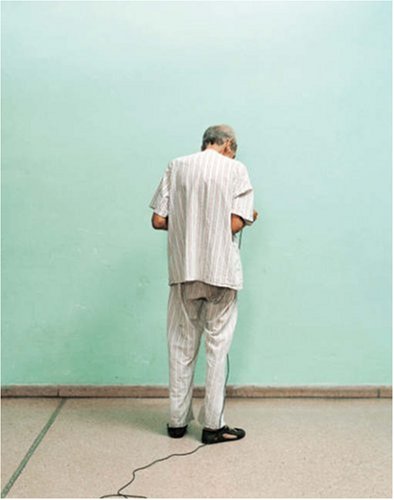
Self-Portrait by Mario, Ren Vallejo Psychiatric Hospital, Cuba. (c-type print 12" x 16", 2033)
So what? They’re a grumpy duo with a pocket full of common critical theory? Yes … and no. They go further. To my observations they apply what they preach. I have coined the term Slow Photography for this piece because they lug about a 4×5 camera and as well as standing over the top of their medium format to hold a conversation, they’ll usually stick around for a week or three.
They’ve described the relationships they build with their subjects as very important. Lucky for them they have the leisure to hang around you are saying?! Fair point, but they use their time well.
With Ghetto, they went to Pollsmoor Maximum Security Prison in South Africa and made portraits of male, female and transgendered inmates. They went to Ren Vallejo Psychiatric Hospital, Cuba also. In total they went to twelve rare communities, methodically photographing and asking the same questions: “Who is in power here? Where do you go to be alone, to make love, to be with friends? What are your hopes and dreams?”
I love that question, “Who’s in power here?”
Broomberg and Chanarin simultaneously reference old slower photo-processes and question the sped-up practices of 21st century photojournalism. Charlotte Cotton, Curator of Photographs at the V&A, has observed, “The sense of activity being slowed for the camera references nineteenth century photography both in terms of process and style. It also serves to detach their photographs from the conventions of photojournalism.”
And if we needed any more proof that these two geezers are on top of their game, lets look how they dealt with the two major conflicts of the beginning of the 21st century.
They got quiet with wartime scratches and scrawls, but have received none of the plaudits Peter Van Agtmael, Tim Hetherington, Roger Ballen or bubble chamber photography have.
The Red House documented the prison and torture center run by Saddam Hussein’s Baath party in Sulaymaniyah, Iraki Kurdistan, 330 kilometres from Baghdad.

The Red House

The Red House
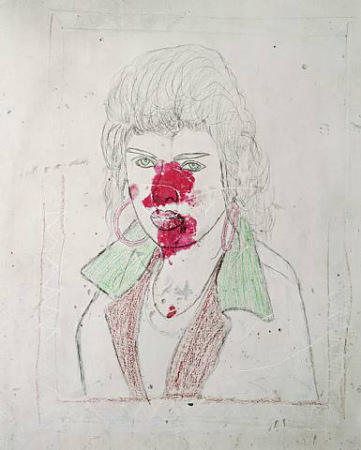
The Red House
And, then when they were “privileged” enough to merit an embedded assignment with the British military in Afghanistan they thumbed their noses at any notion of photojournalism. Instead they took 70 metres of photo sensitive paper and unrolled sections to expose it to light and that became the record of each day and their time in conflict.
Each roll was given its title based on the occurrence of an event, death or absence of death during that day. Below is the work from the day of a prison escape.

The Jail Break, June 13th 2008. 76.2 x 600cm, c-type
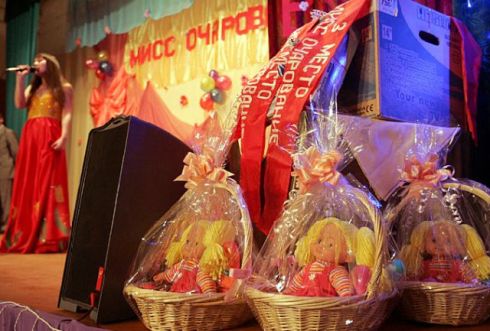
I realise things have been drab and monochromatic (and quite frankly depressing) on Prison Photography recently. My solution was to put up some prison beauty pageant images from Russia I found on a Russian website via BoingBoing.
I reckoned they’d stand in nice contrast to Jane Evelyn Atwood’s bleak images of the womens penal colony, Perm, Russia by directly testing Atwood’s view and undermining our preconceptions oncemore.
The photographs could also provide some much needed colour without much need for commentary, right? Wrong. The comments on BoingBoing suggest that not all, if any, are from Russian womens’ prisons.
Comparison with Fabio Cuttica’s work here and here holds up this assertion. Compare the two images below:
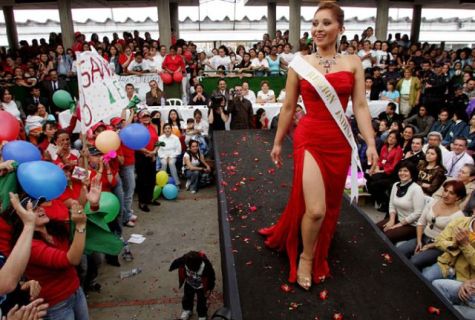
PHOTOGRAPH CLAIMING TO BE FROM RUSSIAN PRISON. Source: http://www.webpark.ru/comment/52940
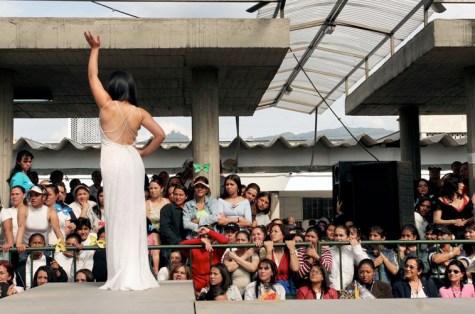
PHOTOGRAPH KNOWN TO BE FROM COLOMBIA. Credit: Fabio Cuttica. Source: http://www.nerve.com/dispatches/prisonpageant/
I’d proffer that seven of the fifteen images in the original (Russian) web posting are from the same pageant Cuttica photographed in Columbia.
The image at the top and the three below I would guess are from Russia, but who can be sure if they are even from inside a prison?
I am left wondering how often I’ve read a caption or commentary ON ANY PHOTOGRAPH – and taken it as truth. Very often, I bet. Which leads me to wonder how often we’re dangerously misled by images. Who knows?
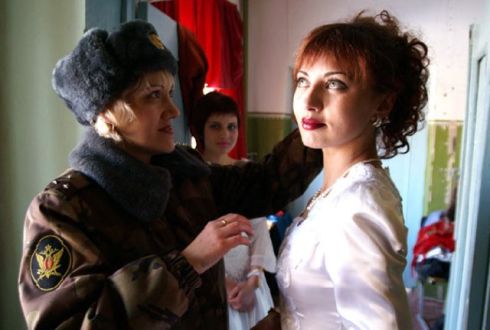

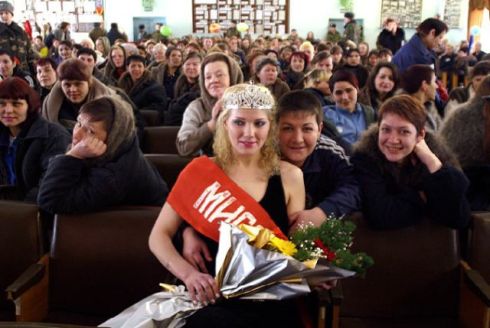
I suppose this only matters if you care if the images came from within a prison. Amputated from a true story, these images aren’t a malicious misrepresentation but probably a product of absent research. Although one wonders under what circumstances images from separate continents were sourced and paired.
So, beware the caption! Adam Broomberg and Oliver Chanarin have said “A photograph that relies on its caption to create meaning is impotent.” The reverse position holds sway too. Mustn’t captions be absolutely necessary at times to stave of the wild presumptions viewers bring to imagery?
Marvin Heiferman pointed me in the direction Tim Padgett’s Time article about news outlets’ adoption of Mug-shot galleries. Padgett remarks, “Mugshot galleries are increasingly popular features on newspaper websites, which are on a crusade for more page views and the advertising revenue that accompanies additional eyeballs.”
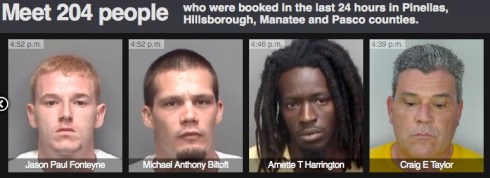
The example offered is that of Mugshots at TampaBay.com of the St. Petersburg Times. The site even breaks down the prior sixty days of bookings into the age, height, weight and eye colour statistics of those arrested.
This exercise is as artless as one would think. The laziness of the filtering of information via an automated platform is matched by the disclaimer regarding mugshots’ accompanying text.
The news group has recognised this and produced these ridiculous FAQ‘s in advance of those booked being disappointed … or worse, misrepresented.
I was arrested but cannot find my mug shot. What gives? Our goal is to provide a complete profile for individuals booked into jail in Pinellas, Hillsborough, Manatee and Pasco counties. A complete profile on Mug Shots constitutes: name, photograph, booking ID, height, weight, age, gender, eye color, birth date, booking date and booking charge.
The majority of arrest records from the county sheriff’s sites have no problems, and we store them and make them available. However, on rare occasions, the photo we receive from the sheriff’s office is flawed, or sometimes the site does not make a photo available. We skip the records that do not have photos attached. You can always search for an individual on the sheriff’s site, but just because you were booked doesn’t mean you’ll necessarily show up on Mug Shots.
I was released and my record was cleared. Will you take down my mug shot? A sheriff’s office Web site maintains publicly accessible arrest records regardless of the disposition of any particular case.One principle behind Mug Shots is to mirror the sheriff’s office Web site policies closely. We provide links from every individual’s profile page to the detail page at the corresponding sheriff’s office site, which contains instructions about how to follow up on any particular case. Much like a county sheriff’s office, there are very few instances in which we would remove a mug shot from the Web site.
Will you fix incorrect biographical information? What if the sheriff does? One guiding principle is to mirror the collective sheriff’s office sites closely. However, sometimes the sheriff’s office site contains a typo or another form of incorrect data. We don’t alter the information that we gather. We do provide links from individual’s profile page directly to their detail page at the corresponding sheriff’s office site.
Continually-updated mugshot galleries continue a long tradition of crime-obsessed media and publics. They are the latest step toward the eradication-of-reason when interfacing with social transgression.
Internet “news” mugshot galleries now dominate a new, middle-ground of visual consumption; that wasteland lies somewhere between the dark pathology (and allure) of Weegee‘s world and the instant digital delivery of crime related stats (think Comp-Stat and the Sex Offenders Registry). They are bland.
These galleries are continuous, and unnecessary, visual feeds of societies’ constructed “bogey-man”.
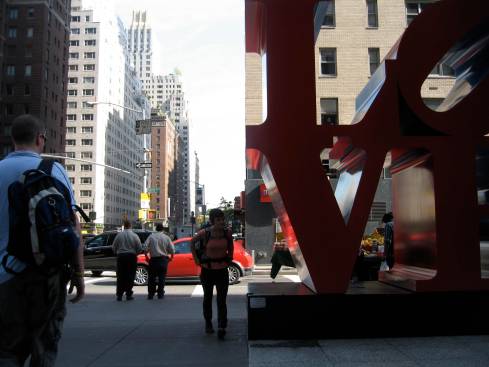
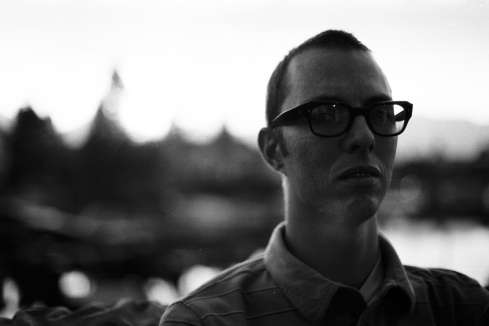
Had a fun time in New York last week. Stayed with Jack and Marisa. Below is not Jack. Below is Chris by Jack.
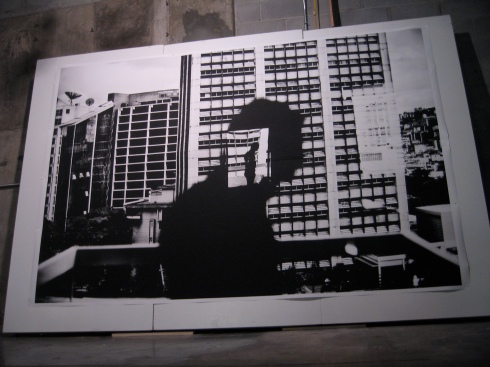
We went to Christopher Anderson’s book launch for Capitolio. It was great to see it after recent reviews, heated debates (check out comments) questions and wot not. I don’t think the selection of the images was the best.
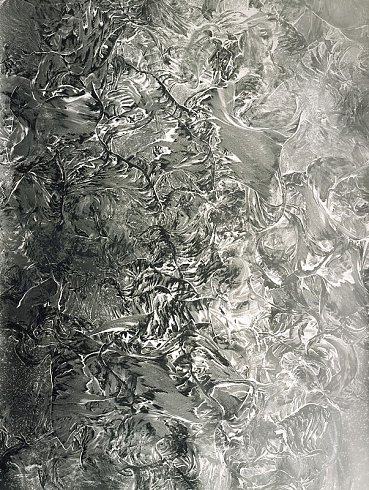
At the Metropolitan, Surface Tension: Photographs from the Permanent Collection was a pleasant whimsy into some mesmerizing works, notably Adam Fuss’ UNTITLED (1997) made by the metronome shimmers of snakes upon black dust upon white dust. Image Source: Cheim & Read
The Met’s photography department was putting together the final touches on Robert Frank’s The Americans which opened this week. It was all hands to the pump as evidenced by besuited Malcolm Daniel – who I spied carrying large, heavy object (post?) behind a partition and into the exhibition space.
Egg and Cheese Bagel.
Over at the Museum of Modern Art, I was pleased to see Russell Lee‘s work Bulletin Board in Post Office Showing a Large Collection of “Wanted Men” Signs, Ames, Iowa (1936). Who doesn’t love a mug shot?


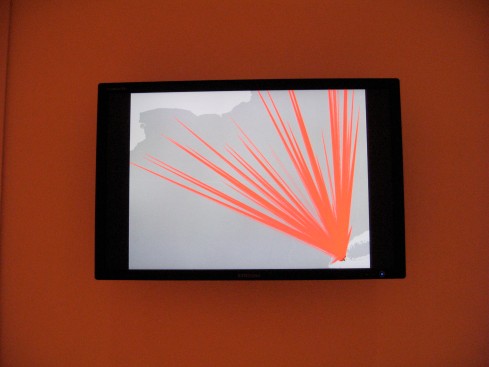
Bringing the practice of mapping of transgressions into the 21st century, the Spatial Design Lab from the Graduate School of Architecture, Planning and Preservation at Columbia University exhibited its Million Dollar Blocks Project (2006).

On Monday night I sat with Andrew Lichtenstein. We talked. Andrew recommended Brennan Linsley‘s work and was quite emphatic about the book ‘Concrete Mama‘. He also spoke highly of Max Kenner and the work at the Bard Prison Initiative
Tuesday, I met Emiliano Granado. We were first in contact over his San Quentin Giants pictures. We talked about many things including Trevor Paglen, Argentina, the Burke Gilman, and the Horticultural Society of New York, which recently lost Barbara Margolis who was an inspiring leader. Emiliano recommended Alessandra Sanguinetti‘s work.
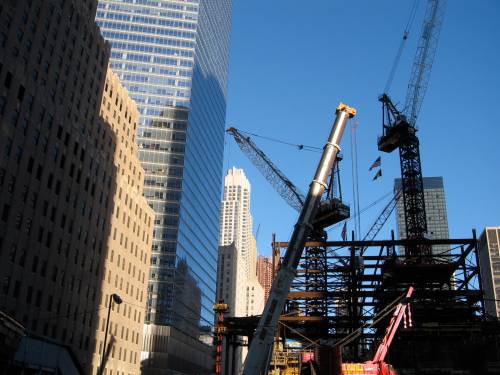
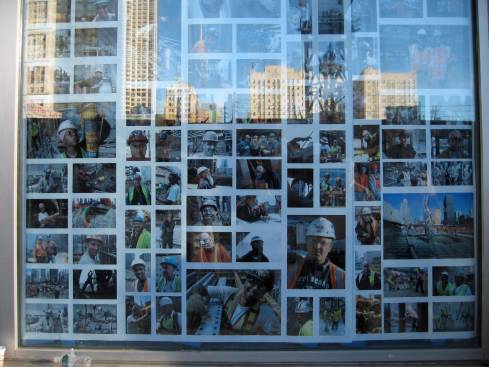
On Sunday, I’d been at the WTC construction site. There was some portraiture on display in a window. The space behind the window was closed but would usually be open. The photographs were easy on the eye.
On my last night I checked out Steven Hirsch’s Courthouse Confessions.
That’s Matt Kelley looking at Steven’s work. He’s coordinator for Change.org Criminal Justice, online communications for the Innocence Project and all together nice bloke. Matt’s double identity is twittered and can be followed here and here.
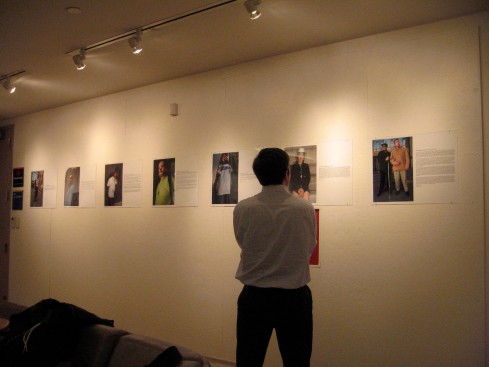
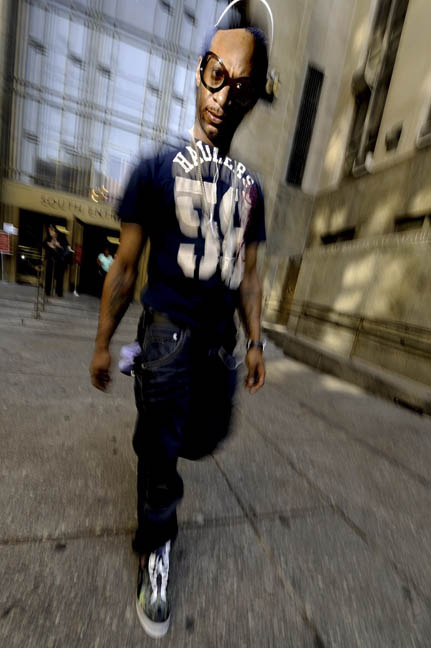
Hirsch takes street portraits of folk going to court, secures (in some ironic twist) a non-binding statement and then transcribes it verbatim to go with the portrait. Constantly moving the camera, Hirsch uses hard flash and distorted angles/zoom to depict these individuals as shape shifters; as anomalies. The fact Hirsch’s subjects (in most cases) seem alien to the logic of the courts – that any lessons arising from their cases are unlikely to effect sentencing laws in the future – should but be a source of disquiet for us as an audience.
One last thing. On Saturday, I saw John Baldessari sat outside a Grennwich Village coffeehouse, but I bottled saying anything. I’ve learnt that famous people abound in Manhattan and you see ’em everywhere.
Thanks to everyone who altered their orbits a little to coincide with mine.

AP Photographer, Brennan Linsley has visited Guantanamo twelve times in the past four years. Why? “My goal is to come back from each trip with a couple of shots that will allow me to paint more of a picture of this place'” says Linsley.
A journalist’s visit to Guantanamo is a frustrating experience – newsmen have a constant escort on a preplanned itinerary and must read and follow the fifteen pages of ground rules provided by the US military.
To offset these limitations Linsley chose repeated visits as a a tactic. In an attempt to humanise the detainees, he has weaved a photo-essay in-spite of Guantanamo’s milieu which is counter to all notions of free speech, experience and objective fact-gathering.
The British Journal of Photography has a brief but interesting interview with Linsley about his project.
This sequence of interactions between a Chinese detainee and photographers (described by Linsley) exemplifies the minutiae with which the US military must control the flow of information out of Guantanamo.
Just to get the juices flowing, Linsley closes the interview with this position, “The Golden Age of photography has been over for a long time. It died somewhere between the Vietnam War and the Gulf War.”
Discuss.
_______________________________________________________________
BJP’s interview coincides with Linsley’s work showing at the 2009 Visa pour l’Image at Perpignan.
For more images and links on Guantanamo see Prison Photography‘s Directory of Visual Sources.

 Prison Photography