
You are currently browsing the category archive for the ‘Words’ category.

Image source: Insouciant Writing
THE WRITING ON THE WALL
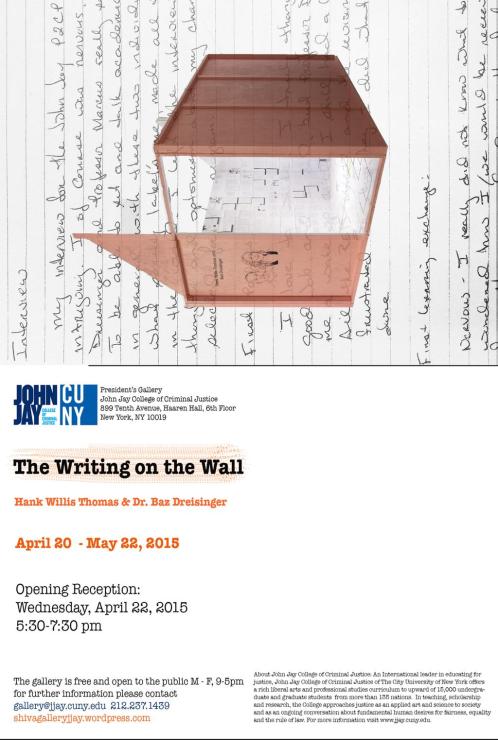
If you’re in NYC between now and May 22nd go see The Writing on the Wall, an installation by Hank Willis Thomas and Baz Dreisinger. It opened yesterday at the President’s Gallery at John Jay College.
The Writing on the Wall debuted in September 2014, at the Museum of Contemporary Art in Detroit (MoCAD) where it was part of the Peoples’ Biennial.
There’s an opening reception tomorrow night, Weds, April 22nd, from 5:30 to 7:30pm.
THE BLURB
The installation is made from essays, poems, letters, stories, diagrams and notes written by individuals in prison around the world, from America and Australia to Brazil, Norway and Uganda. The hand-written and typed pieces were accrued by Dr. Dreisinger during her years teaching in US and international prisons, in the context of both the Prison-to-College Pipeline program she founded at John Jay and her forthcoming book Incarceration Nations: Journeying to Justice in Prisons Around the World.
On a basic and literal level, The Writing on the Wall is about giving voice to the voiceless and humanizing a deeply de-humanized population. It represents a kind of modern-day hieroglyphics, projecting a hidden world into a very public space and allowing a people too often spoken of and for—by politicians and a punishment-hungry public—to speak for themselves, in the most intimate of ways. It is a tribute to the power of the pen, a deliberate verbal intrusion and an assertion that some words need very much to be seen in order to be heard. Indeed the writing is not just on the wall but on the floor, on every inch of the installation space, such that the viewer, unable to look away, is compelled to confront a crisis: global mass incarceration. The piece thus fittingly references the Biblical story in which the writing on the wall, as interpreted by the prophet Daniel, foreshadowed imminent doom and destruction.
Just as mass incarceration is a living, growing global phenomenon, The Writing on the Wall is an ever-evolving installation. With every iteration, it grows and assumes a new shape, because the documents comprising it—material written by those living behind bars—continue to land in Dr. Dreisinger’s hands and mailbox.

THE BIOGRAPHIES
Hank Willis Thomas is a photo conceptual artist working with themes related to identity, history, and popular culture. He received his BFA from New York University’s Tisch School of the Arts and his MFA in photography, along with an MA in visual criticism, from California College of the Arts (CCA) in San Francisco. Thomas has acted as a visiting professor at CCA and in the MFA programs at Maryland Institute College of Art and ICP/Bard and has lectured at Yale University, Princeton University, the Birmingham Museum of Art, and the Musée du Quai Branly in Paris. His work has been featured in several publications including 25 under 25: Up-and-Coming American Photographers (CDS, 2003) and 30 Americans (RFC, 2008), as well as his monograph Pitch Blackness (Aperture, 2008). He received a new media fellowship through the Tribeca Film Institute and was an artist in residence at John Hopkins University as well as a 2011 fellow at the W.E.B. DuBois Institute at Harvard University. He has exhibited in galleries and museums throughout the U.S. and abroad. Thomas’s work is in numerous public collections including the Whitney Museum of American Art, the Brooklyn Museum, the Guggenheim Museum, and the Museum of Modern Art. His collaborative projects have been featured at the Sundance Film Festival and installed publicly at the Oakland International Airport, the Oakland Museum of California, and the University of California, San Francisco. He is an Ellen Stone Belic Institute for the Study of Women and Gender in the Arts and Media, Columbia College Chicago Spring 2012 Fellow.
Baz Dreisinger is an Associate Professor in the English Department at John Jay College of Criminal Justice, City University of New York. She is the founder and Academic Director of the college’s Prison-to-College Pipeline Program (P2CP), which offers credit-bearing college courses and reentry planning to incarcerated men at Otisville Correctional Facility. She is also a reporter on popular culture, the Caribbean, world music, and race-related issues for the New York Times, Los Angeles Times and Wall Street Journal, among other outlets; she produces on-air segments for NPR and is the co-producer and co-writer of the documentaries Black & Blue: Legends of the Hip-Hop Cop, which investigates the New York Police Department’s monitoring of the hip-hop industry, and Rhyme & Punishment, about hip-hop and the prison industrial complex. The author of Near Black: White to Black Passing in American Culture (2008) and the forthcoming Incarceration Nations: A Journey to Justice in Prisons Around the World (2015), Dreisinger earned her Ph.D. from Columbia University and has been a Whiting Fellow and a postdoctoral fellow in African-American studies at UCLA.
THE DETAILS
President’s Gallery, John Jay College of Criminal Justice, CUNY 899 10th Avenue, Haaren Hall, 6th Floor , NY 10019.
Hours: 9am-5pm, Mon-Fri.
Contact: gallery@jjay.cuny.edu or 212.237.1439.
LET’S AGREE TO AGREE
There’s nothing new here that advocates for prison reform don’t already know, but it’s worth a listen just to hear Obama declare that Omar was his favourite character in The Wire.
The conversation starts off pretty left of progressive with Simon asserting that “What the drugs didn’t destroy, the war on them did.” It’s a line he uses often but it’s a good one, and an accurate summary.
Obama makes pains a few minutes in to stress sympathy for police forces. To be expected from a leader who is taking the effort to first and foremost express sympathy for people who may have antagonist views toward an arrogant and broken record of policy as regards crime and punishment in American cities.
The political turn turns us toward the children. If we can’t all rally around a love of the children then what have we? The depiction of struggling Baltimore schools in The Wire was particularly hard for Obama, he says.
These 12 minutes weren’t a total waste of time. Simon got to register his dismay at the failings of government to help poor and addicted people. Obama got to express optimism for the more sensible debates we’re having about crime and transgression and where that might take us. He was very excited about bipartisan buy in, without any criticism that’s its come decades later than it should. Oh, that’s right people’s lives impacted by tough-on-crime-rhetoric were political footballs for the past 40 years.
The most sensible and realistic thing in the conversation is the closing remark of Obama when he says if we keep being honest about putting our policing, policy and sentencing failures right, we may see an improvement in about 20 years.
This was good PR for everyone involved. I doubt Obama would have sat down with Simon for this same conversation in 2009, but now it’s safer to be sensible — government budgets have told us so.
It’s not really significant what Obama and Simon said when they sat down together. Of most significance is the fact they sat down together, for the cameras, at all.
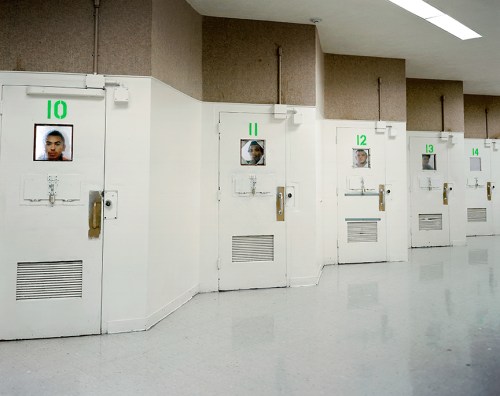
10, 11, 12, 13 & 14. © Steve Davis.
TRY YOUTH AS YOUTH
Currently on show at David Weinberg Photography in Chicago is Try Youth As Youth (Feb 13th — May 9th), an exhibition of photographs and video that bear witness to children locked in American prisons. As the title would suggest, the exhibition has a stated political position — that no person under the aged of 18 should be tried as an adult in a U.S. court of law.
In the summer of 2014, selling works ceased to be David Weinberg Photography’s primary function. The gallery formally changed its mission and committed to shedding light on social justice.
Try Youth As Youth, curated by Meg Noe, was conceived of and put together in partnership with the American Civil Liberties Union of Illinois. Here’s art in a gallery not only reflecting society back at itself, but trying to shift its debate.
The issue is urgent. In the catalogue essay Using Science and Art to Reclaim Childhood in the Justice System, Diane Geraghty Professor of Law at Loyola University, Chicago notes:
Every state continues to permit youth under the age of 18 to be transferred to adult court for trial and sentencing. As a result, approximately 200,000 children annually are legally stripped of their childhood and assumed to be fully functional adults in the criminal justice system.
This has not always been the case in the U.S. It is only changes to law in the past few decades that have resulted in children facing abnormally long custodial sentences, Life Without Parole sentences and even (in some states) the death penalty. In the face of such dark forces, what else is art doing if it is not speaking truth to power and challenging systems that undermine democracy and our social contract?
Noe invited me to write some words for the Try Youth As Youth catalogue. Given Weinberg’s enlightened modus operandi, I was eager to contribute. Here, republished in full is that essay. It’s populated with installation shots, photographs by Steve Davis, Steve Liss and Richard Ross, and video-stills by Tirtza Even.
–
Scroll down for essay.
–
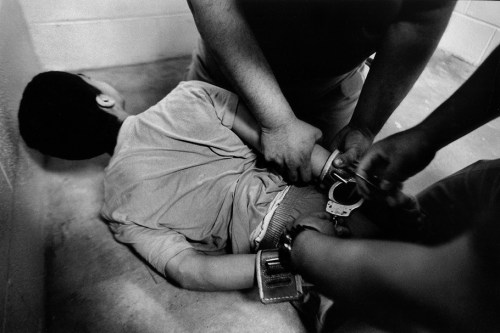
Image: Steve Liss. A young boy held and handcuffed in a juvenile detention facility, Laredo, Texas.
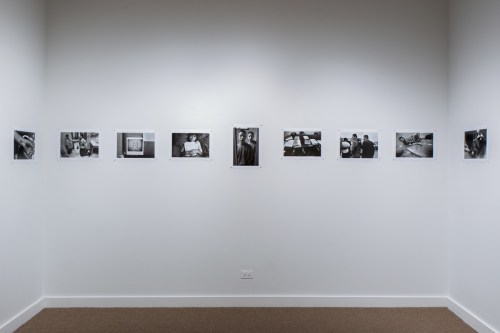
Installation shot of Try Youth As Youth at David Weinberg Photography, Chicago.
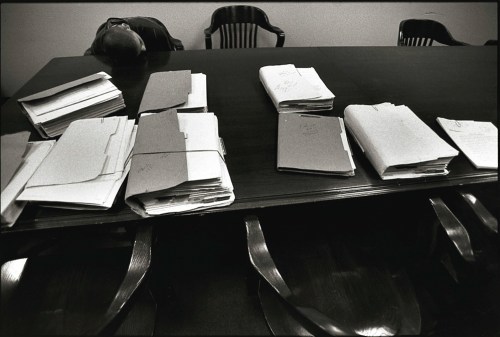
Image: Steve Liss. Paperwork for one boy awaiting a court appearance. How many of our young “criminals” are really children in distress? Three-quarters of children detained in the United States are being held for nonviolent offenses. And for many young people today, family relationships that once nurtured a smooth process of socialization are frequently tenuous and sometimes non-existent.
–
Try Youth As Youth Catalogue Essay
–
WHAT AM I DOING HERE?
–
Isolated in a cell, a child might wonder, “What am I doing here?” It is an immediate, obvious and crucial question and, yet, satisfactory answers are hard to come by. The causes of America’s perverse addiction to incarceration are complex. Let’s just say, for now, that the inequities, poverty, fears and class divisions that give rise to America’s thirst for imprisonment have existed in society longer than any child has. And, let’s just say, for now, that the complex web of factors contributing to a child’s imprisonment are larger than most children could be expected to understand on a first go around.
As understandable as it might be children in crisis to ask “What am I doing here?” it should not be expected. Instead, it is we, as adults, who should be expected to face the question. We should rephrase it and ask it of ourselves, and of society. What are WE doing here? What are we doing as voters in a society that locks up an estimated 65,000 children on any given night? In the face of decades of gross criminal justice policy and practice, what are we doing here, within these gallery walls, looking at pictures?

Installation shot of Try Youth As Youth at David Weinberg Photography, Chicago.
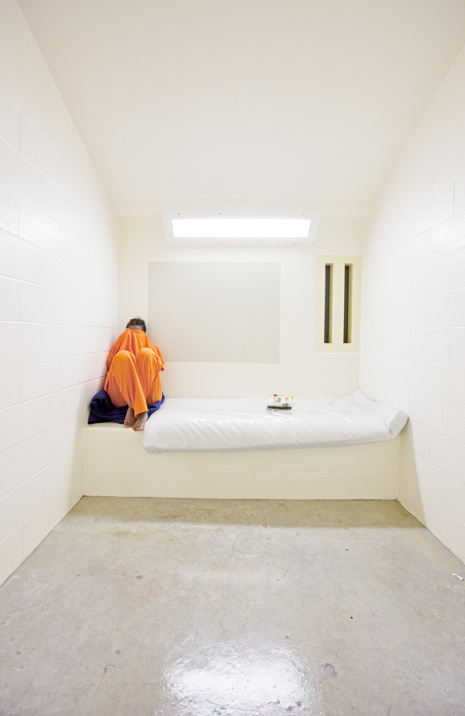
Oak Creek Youth Correctional Facility, Albany, Oregon, by Richard Ross. “I’m from Portland. I’ve only been here 17 days. I’m in isolation. I’ve been in ICU for four days. I get out in one more day. During the day you’re not allowed to lay down. If they see you laying down, they take away your mattress. I’m in isolation ‘cause I got in a fight. I hit the staff while they were trying to break it up. They think I’m intimidating. I can’t go out into the day room; I have to stay in the cell. They release me for a shower. I’ve been here three times. I have a daughter, so I’m stressed. She’s six months old. At 12 I was caught stealing at Wal-Mart with my brother and sister. My sister ran away from home with a white dude. She was smoking weed, alcohol. When my sister left I was sort of alone…then my mother left with a new boyfriend, so my aunt had custody. She’s 34. My aunt smoked weed, snorts powder, does pills, lots of prescription stuff. I got sexual with a five-year-older boy, so I started running away. So I was basically grown when I was about 14. But I wasn’t doing meth. Then I stopped going to school and dropped out after 8th grade. Then I was in a parenting program for young mothers…then I left that, so they said I was endangering my baby. The people in the program were scared of me. I don’t know what to think. I was selling meth, crack, and powder when I was 15. I was Measure 11. I was with some other girls — they blamed the crime on me, and I took the charges because I was the youngest. They beat up this girl and stole from her, but I didn’t do it. But they charged me with assault and robbery too. This was my first heavy charge.” — K.Y., age 19.

Installation shot of Try Youth As Youth at David Weinberg Photography, Chicago.
I have spent a good portion of the past six-and-a-half years trying to figure out just what it is that images of prisons and prisoners actually do. Who is their audience and what are their effects? If I thought answers were always to be couched in the language of social justice I was soon put right by Steve Davis during an interview in the autumn of 2008.
“People respond to these portraits for their own reasons,” said Davis. “A lot of the reasons have nothing to do with prisons or justice. Some people like pictures of handsome young boys — they like to see beautiful people, or vulnerable people, whatever. That started to blow my mind after a while.”
My interview with Davis was the first ever for the ongoing Prison Photography project. It blew my mind too, but in many ways it also prepared me for the contested visual territory within which sites of incarceration exist and into which I had embarked. Davis’ honesty prepared me to face uncomfortable truths and perversions of truth. It readied me for the skeevy power imbalances I’d observe time and time again in our criminal justice system.
The children in Try Youth As Youth may be, for the most part, invisible to society but they are not far away. “I was just acknowledging that this juvenile prison is 20 miles from my home,” says Davis of his earliest motivations. If you reside in an urban area, it is likely you live as near to a juvenile prison, too. Or closer.
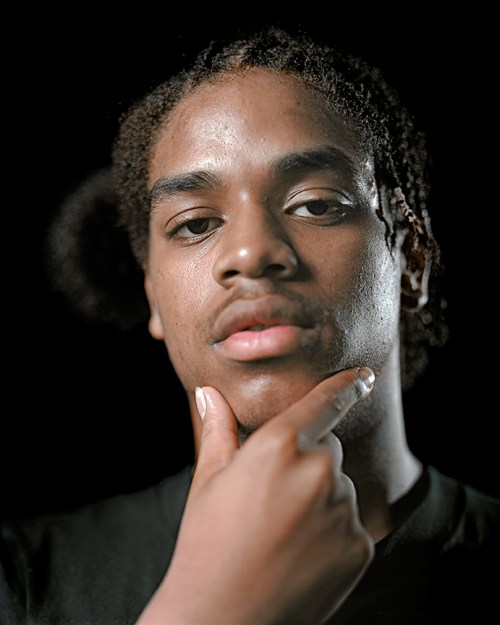
Image by Steve Davis. From the series ‘Captured Youth’

Image by Steve Davis. From the series ‘Captured Youth’
Prisoners, and surely child prisoners, make up one of society’s most vulnerable groups. Isn’t it strange then that rarely are they presented as such? Often depictions of prisoners serve to condemn them, but not here, in Try Youth As Youth.
As we celebrate the committed works of Steve Davis, Tirtza Even, Steve Liss and Richard Ross, we should bear in mind that other types of prison imagery are less sympathetic and that other viewers’ motives are not wed to the politics of social justice. A picture might be worth a thousand words, but it’s a different thousand for everyone. We must be willing to fight and press the issue and advocate for child prisoners. Our mainstream media dominated by cliche, our news-cycles dominated by mugshots and the politics of fear, and our gallery-systems with a mandate to make profits will not always serve us. They may even do damage.

Image: Steve Davis. A girl incarcerated in Remann Hall, near Tacoma, Washington State.
Given that the works of Davis, Even, Liss and Ross circulate in a free-world that most of their subjects do not, it is all our responsibility to handle, contextualize and talk about these photographs and films in a way that serves the child subjects most. It is our responsibility to talk about economic inequality and about the have and have-nots.
“No child asks to be born into a neighborhood where you can get a gun as easily as a popsicle at the convenience store or giving up drugs means losing every one of your friends,” said Steve Liss “They were there [in jail] because there was no love, there was no nourishing, there was anger in startling doses, and there was poverty. Tremendous poverty.”
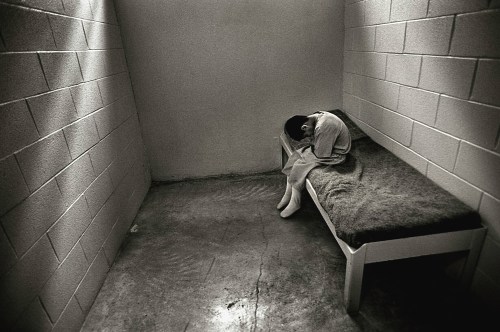
Image: Steve Liss. Alone and lonely, ten-year-old Christian, accused of ‘family violence’ as a result of a fight with an abusive older brother, sits in his cell.Every day the inmates get smaller, and more confused about what brought them here. Psychiatrists say children do not react to punishment in the same way as adults. They learn more about becoming criminals than they do about becoming citizens. And one night of loneliness can be enough to prove their suspicion that nobody cares.
Davis, Even, Liss and Ross understand the burden is upon us as a society to explain our widespread use of sophisticated and brutal prisons more than it is for any individual child to explain him or herself. The image of an incarcerated child is an image not of their failings, but of ours. We must do better — by providing quality pre and post-natal care for mothers and babies, nutritious food, livable wages for parents, and support and safety in the home and on the streets. Most often, it is a series of failures in the provision of these most basic needs that leads a child to prison.
“Poverty would be solved in two generations. It would require an enormous change in our priorities. Look at how we elevate the role of a stockbroker and denigrate the role of a school teacher or a parent, those who are responsible for raising the next generation of Americans,” says Liss.
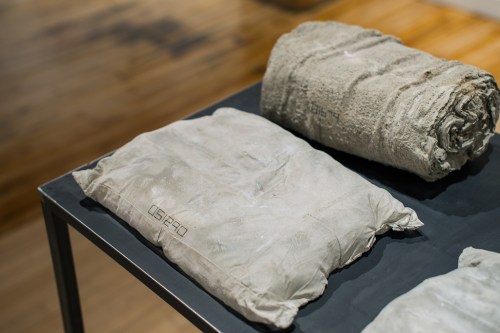


(Top to Bottom) Installation shot; video still; and drawings from Tirtza Even & Ivan Martinez’s Natural Life, 2014.
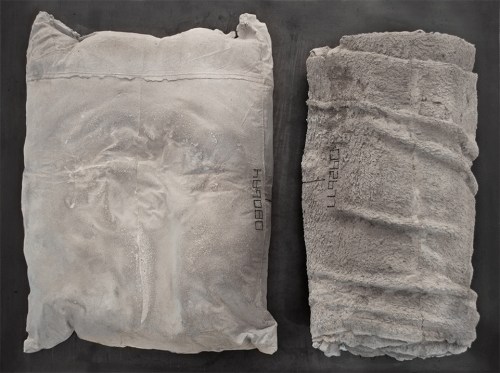
Tirtza Even & Ivan Martinez. Natural Life, 2014. Cast concrete (segment of installation). A cast of five sets of the standard issue bedding (a pillow, a bedroll) given to prisoners upon their arrival to the facility, are arranged on raw-steel pedestals in the area leading to the video projection. The sets, scaled down to kid size and made of a stack of crumbling and thin sheets of material resembling deposits of rock, are cast in concrete. Individually marked with the date of birth and the date of arrest of each of the five prisoners featured in the documentary, they thus delineate the brief time the inmates spent in the free world.
Each of the artists in Try Youth As Youth have seen incredible deprivations inside facilities that do not — cannot — serve the needs of all the children they house. Ross speaks of a child who has never had a bedtime. A social worker once told Davis of one child in the system who had never seen or held a printed photograph.
Documenting these sites is not easy and brings with it huge responsibility. Tirtza Even has grappled with the weight of her work “and how much is expected from them is a little heavy.” In some cases, these artists are the outside voice for children. Liss acknowledges that expectations more often than not outweigh the actual effects their work can have.
“People ask how do you get close to kids in a facility like that. That isn’t the problem. The problem is how do you set up enough artificial barriers so you don’t get too close. So you’re not just one more adult walking out on them in the final analysis,” he says. “I, at least, convinced myself into thinking it was therapeutic for the kids. At least someone was listening to them.”
So far, the efforts of Davis, Even, Liss and Ross have been recognized by those in power. Liss’ work has been used to lobby for psych care and an adolescent treatment unit in Laredo, Texas. Ross’ work was used in a Senate subcommittee meeting that legislated at the federal level against detained pre-adjudicated juveniles with youth convicted of committed hard crimes.
“That’s a great thing for me to know that my work is being used for advocacy rather than the masturbatory art world that I grew up in,” says Ross.

Sedgwick County Juvenile Detention Facility, Wichita, Kansas, by Richard Ross. “Nobody comes to visit me here. Nobody. I have been here for eight months. My mom is being charged with aggravated prostitution. She had me have sex for money and give her the money. The money was for drugs and men. I was always trying to prove something to her…prove that I was worth something. Mom left me when I was four weeks old — abandoned me. There are no charges against me. I’m here because I am a material witness and I ran away a lot. There is a case against my pimp. He was my care worker when I was in a group home. They are scared I am going to run away and they need me for court. I love my mom more than anybody in the world. I was raised to believe you don’t walk away from a person so I try to fix her. When I was 12 my mom was charged with child endangerment. I’ve been in and out of foster homes. They put me in there when they went to my house and found no running water, no electricity. I ran away so much that they moved me from temporary to permanent JJA custody. I’m refusing all my visits because I am tired of being lied to.” — B.B., age 17.

Richard Ross’ works in the Try Youth As Youth exhibition at David Weinberg Photography, Chicago.

Installation shot of Try Youth As Youth at David Weinberg Photography, Chicago.
The walls of David Weinberg are not the end point of these works’ journey. An exhibition is not a triumph it is a call to action. The work begins now.
Programming during the exhibition — phone-ins to prison, discussions with ACLU lawyers and experts in the field, conversations with formerly incarcerated youth — will all direct us the right way. The gallery space works best when it sutures artists’ creative processes into a larger process that we can shape as socially informed citizens. Our process of building healthy society.
“Kids need us,” says Liss. “They need our time, they need our involvement, and they need our investment. If you own an automotive shop, open it up to kids and the community. It does take a community.”
There are a host of wonderful arts communities doing work, here in Chicago, around criminal justice reform and social equity — Project NIA, 96 Acres, AREA, Prison + Neighborhood Art Project, Lucky Pierre and Temporary Services to name a few.
The arts can trail-blaze the conversation we need to be having. Photography and film are the ammunition with which we arm our reform arguments. First we see, then we do. If art is not speaking truth to power, then really, what are we doing here?
–
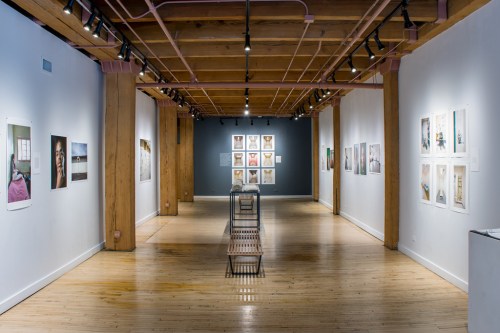
Installation shot of Try Youth As Youth at David Weinberg Photography, Chicago.
–

David Weinberg Photography is at 300 W. Superior Street, Suite 203, Chicago, IL 60654. Open Mon-Sat 10am-5pm. Telephone: 312 529 5090.
Try Youth As Youth is on show until May 9th, 2015.

–
Text © Pete Brook / David Weinberg Photography.
Images: Courtesy of artists / David Weinberg Photography.

The Big Graph (2014). Photo: Courtesy Eastern State Penitentiary.
Eastern State Penitentiary Historic Site Guidelines for Art Proposals, 2016
Eastern State Penitentiary in Philadelphia has announced some big grants for artists working to illuminate issues surrounding American mass incarceration.
READ! FULL INFO HERE
ESP is offering grants of $7,500 for a “Standard Project” and a grant of $15,000 for specialized “Prisons in the Age of Mass Incarceration Project.” In each case the chosen installations shall be in situ for one full tour season — typically May 1 – November 30 (2016).
DEADLINE: JUNE 17TH
THE NEED
ESP has, in my opinion, the best programming of any historic prison site when it comes to addressing current prison issues. Last year, they installed The Big Graph (above) so that the monumental incarceration rates could tower over visitors. Now, ESP wants to explore the emotional aspects of those same huge figures.
“Prisons in the Age of Mass Incarceration will serve as a counterpoint to The Big Graph,” says ESP. “Where The Big Graph addresses statistics and changing priorities over time, Prison in the Age will encourage reflection on the impact of recent changes to the American criminal justice system, and create a place for visitors to reflect on their personal experiences and share their thoughts with others.”
ESP says that art has “brought perspectives and approaches that would not have been possible in traditional historic site programming.” Hence, these big grant announcements And hence these big questions.
“Who goes to prison? Who gets away with it? Why? Have you gotten away with something illegal? How might your appearance, background, family connections or social status have affected your interaction with the criminal justice system? What are prisons for? Do prisons “work?” What would a successful criminal justice system look like? What are the biggest challenges facing the U.S criminal justice system today? How can visitors affect change in their communities? How can they influence evolving criminal justice policies?” asks ESP.
While no proposal must address any one or all of these questions specifically they delineate the political territory in which ESP is interested.
“If our definition of this program seems broad, it’s because we’re open to approaches that we haven’t yet imagined,” says ESP. “We want our visitors to be challenged with provocative questions, and we’re prepared to face some provocative questions ourselves. In short, we seek memorable, thought-provoking additions to our public programming, combined with true excellence in artistic practice.”
“We seek installations that will make connections between the complex history of this building and today’s criminal justice system and corrections policies,” continues ESP. “We want to humanize these difficult subjects with personal stories and distinct points of view. We want to hear new voices—voices that might emphasize the political, or humorous, or bluntly personal.”
GO TO AN ORIENTATION
ESP won’t automatically exclude you, but you seriously hamper your chances if you don’t attend one of the artist orientation tours.
They occur on March 15, April 8, April 10, April 12, May 1, May 9, May 15, June 6.
Also, be keen to read very carefully the huge document detailing the grants. It explains very well what ESP is looking for including eligibility, installation specifics, conditions on site, maintenance, breakdown of funding (ESP instructs you to take a livable artist fee!), and the language and tone of your proposal.
For example, how much more clear could ESP be?!
• Avoid interpretation of your work, and simply tell us what you plan to install.
• Avoid proposing materials that will not hold up in Eastern State’s environment. Work on paper or canvas, for example, generally cannot survive the harsh environment of Eastern State.
• Be careful not to romanticize the prison’s history, make unsupported assumptions about the lives of inmates or guards, or suggest sweeping generalizations. The prison’s history is complicated and broad. Simple statements often reduce its meaning.
• A proposal to work with prisoners or victims of violent crime by an artist who has never done so before, on the other hand, will raise likely concern.
• Do not suggest Eastern State solely as an architectural backdrop. Artist installations must deepen the experience of visitors who are touring this National Historic Landmark, addressing some aspect of the building’s significance.
• Many successful proposals, including Nick Cassway’s Portraits of Inmates in the Death Row Population Sentenced as Juveniles and Ilan Sandler’s Arrest, did not focus on Eastern State’s history at all. They did, however, address subjects central to the topic we hope our visitors will be contemplating during their visit.
• If you are going to include information about Eastern State’s history, please make sure you are accurate. Artists should be sensitive to the history of the space and only include historical information in the proposal if it is relevant to the work. Our staff is available to consult on historical accuracy.
• Overt political content can be good.
• The historic site staff has been focusing explicitly on the modern American phenomenon of mass incarceration, on questions of justice and effectiveness within the American prison system today, and on the effects of race and poverty on prison population demographics. We welcome proposals that can help engage our visitors with these complex subjects.
• When possible, the committee likes to see multiple viewpoints expressed among the artists who exhibit their work at Eastern State. Every year the committee reviews dozens of proposals for work that will express empathy for the men and women who served time at Eastern State. The committee has accepted many of these proposals, generally resulting in successful installations. These include Michael Grothusen’s midway of another day, Dayton Castleman’s The End of the Tunnel, and Judith Taylor’s My Glass House. The committee rarely sees proposals, however, that explore the impact of violence on families and society in general, or the perspective of victims of crime. Exceptions have been Ilan Sandler’s Arrest (2000 to 2003) and Sharyn O’Mara’s Victim Impact Statement (2010). We hope to see more installations on those themes in the future.
PAST GRANTEES
Check out the previous successful proposals and call ESP! Its staff are available to discuss the logistics of the proposal process and the history and significance of Eastern State Penitentiary.
DEADLINE: JUNE 17TH, 2015
Additional Resources
Sample Proposals
Past Installations
For more information contact Sean Kelley, Senior Vice President and Director of Public Programming, at sk@easternstate.org or telephone on (215) 236-5111, with extension #13.

IS THE INTERNET BECOMING LESS SNARKY?
Portraits of incarcerated youth made by Steve Davis were published on BuzzFeed yesterday. That they are featured does not surprise me; no, it is the reasonable comments that follow that surprise me.
They internet, a space known to often bring out the worst in people has had a special place for trolls as far as images of American prison and prisoners are concerned. Often photographs themselves are bypassed in discussion in order for commenters to shortcut straight to their long held positions — by they left or right, sympathetic or not, nuanced or short-sighted, familiar or prejudiced. Prisons are a divisive issue and often people miss the point of prison photographers who, in the first instance at least, are merely trying to hold a mirror to a system. In this case, Davis holds a mirror to a nation that locks up 65,000 youth on any given night at a cost of $5billion per year.
In my own prejudice, I would’ve expected THE INTERNET + BUZZFEED + KIDS IDENTIFIED AS CRIMINALS would be an equation for vitriol. Not so.
Why would I be so pessimistic? Well, despite BuzzFeed founder Jonah Peretti’s insistence that serious, longform news can exist beside listicles — and despite recent pieces — on last meals of the executed, a trans-activist transforming a prison from within, reflections on wrongful conviction, and the shacking of women prisoners in labor — BuzzFeed content still leasn heavily on shock, innumerable pet vids, “27 things you only know if…” nonsense, and flashes of celeb flesh. The lowest denominators remain our and BuzzFeed’s bread and butter.
All that said, let’s just be thankful for this comment thread:
Some of these faces are so hard. Some are bewildered. And some are just heartbreaking. So beautiful and tragic.
Each one of these faces should never have ended up there. Their incarceration marks the failure of society to raise contributing citizens.
That would imply that society failed every person who has made bad choices. That’s simply not a generalization that pans out entirely. I don’t disagree that we have failed many of these faces as a society, just the generalization.
Look to the parents. Well, perhaps they are/were also incarcerated. Sad all around.
There needs to be a better solution to helping these kids achieve more in life. Yes punish them for their crimes but surely there is better way! Locking them up like this gives them no hope of something better! Nobody but them know the full story so why jump to saying they “deserve” it? some of these kids have been failed by family, peers, society which has resulted in this! Tragic!
I think we should look to the systems used in Scandinavian countries — humane prisons, lots of community service, a focus on rehabilitation, not punishment. …Or we could just stop monetizing the prison system, that would help.
The system makes money off of these children, and I guarantee you there is not one child in there whose parents have a little bit of money! Our prisons are filled with poor people! Justice is definitely not blind!
I can see where you’re coming from, but in my personal experience (two relatives that have been incarcerated both as youth and as adults), there are individuals who will, regardless of the number of chances given, continue to make the wrong choices. You can not force, coerce, or convince someone to act and live as you see fit. They will make choices of their own. These are individuals that do, in fact, deserve the punishments they receive. Like you said only they know the whole story, but regardless of that fact, there are some choices that incarcerated individuals have made that have impacted the lives of innocent people. Do those choices, then, not merit the fullest punishment?
I DO, however, believe there are also individuals who can be guided into a better life because they’ve only known one way. These are the individuals that CHOOSE to make themselves better, both in their own eyes and in societies eyes. They make the choice, and seek out those that can help guide them.
One summer in college, I had an internship in WA for an office of juvenile probation. I went to one of these places with one of the counselors because one of the kids was going to be getting out soon and heading home. This kid was probably 14 or 15 and I remember him sitting there crying because he didn’t want to leave. He had been in out of the system for years and I remember him telling us that no matter how bad it was there, he knew he was going to get fed and have a place to sleep. He told us that he was going to do something as soon as he got out that would send him back. It was tragic on so many levels. Everyone had just given up on this kid and he had pretty much given up on himself.
Locking up a young person in prison is always a shocking and sad thing, but what concerns me is people’s knee jerk reaction that all youth incarceration reflects society’s ultimate failure. Remember, most of you are also the same people who regularly rage against the violent and intolerable stories we read about rape and murder that we regularly see on this site. There are thousands of teenagers (perhaps some of the faces you are seeing here) who are guilty of these crimes. Are you saying that we needn’t incarcerate minors who commit violent crime? Should these individuals only be counseled then allowed to return into society? Despite the fact that several here have unilaterally declared that each of these incarnations are the wholesale fault of society’s failure?
But our prisons out not filled to the brim with people who have committed the kinda of crimes you speak of, and THAT is the failure.
I work in the teen department of my library system, and every librarian takes turns to go visit our JDC to talk to the kids there and find books for them in the collection we maintain at the facilities for them. It’s hard seeing them…especially when they’re super young (I swear a couple I’ve seen couldn’t be older than 11), or especially when you’ve helped them in your branch before. It sucks, and I just always hope that they can come around and learn from the experience and never become a repeat offender.
I have a serious problem with photographers leaving their [captioning on] photos blank when it comes to picturing at risk groups. Each has their own valuable story to tell and name. They are not just “black kids: or troubled youths or street punks etc…the categories that pop up due to the viewers own prejudices. We live in a fucked up world. Such photography should be there to give names to the victims and not participate in their being reduced to a number in the “incarceration game.”
Perhaps the Facebook-linked comment board has sophistication to remove idiot comments and promote those exhibiting most human thought?
Internet, you have my faith again.
Even the commenter that wonders about an anonymous portrait showing a youth with painted nails and foolishly labels the child as possibly “a fabulous homosexual” goes on to demonstrate a knowledge of the system that is unable to adequately care for LGBQIT youth; “In adult prisons obviously gay or transgendered individuals are usually put in solitary confinement for their own protection.” We know that is an unacceptable situation. LGBQIT prisoners are denied access to programming because prisons cannot guarantee their safety in general population.
Unfinished: Incarcerated Youth
Steve Davis is currently taking pre-orders for a book of his photographs from Washington State juvenile prisons, titled, Unfinished: Incarcerated Youth.
You can preorder with Minor Matters Books.

THE VISUAL CULTURE OF PRISON RESISTANCE
Liz Pelly‘s conversation with Josh MacPhee in The Media is a wonderful read. It coincided with MacPhee and his cohort’s incredible exhibition of prisoner made protest materials going all the way back to the early seventies.
MacPhee urges us to dismantle the idea that prisons are separate from outside society. Crucially, he’s not making, in the first instance, a moral point about how we’re all the same, prisoners and all. MacPhee makes an observation of the structural characteristics of the prison system.
“It’s getting harder and harder to hold up the pretense that prison is somehow distinct from the rest of society,” says MacPhee. “When there’s this many people going in and out all of the time, there’s no way that our lives out here don’t leak into there, and that their lives in there don’t leak out into the rest of society. The idea that these are completely separate realms needs to be dismantled.”
Of course, once the structural facts of the system are revealed, the moral point that we are all one-and-the-same, prisoners and all, is indisputable.
I contacted Pelly and asked if I could republish the conversation. It originally appeared as Inside/Out: On Prison Justice, Art of the Incarcerated, and Interference Archive’s New Show in Issue #44 of The Media (October 10, 2014). It is a privilege to feature Pelly and MacPhee’s interview in full here on the blog.
A LITTLE BACKGROUND
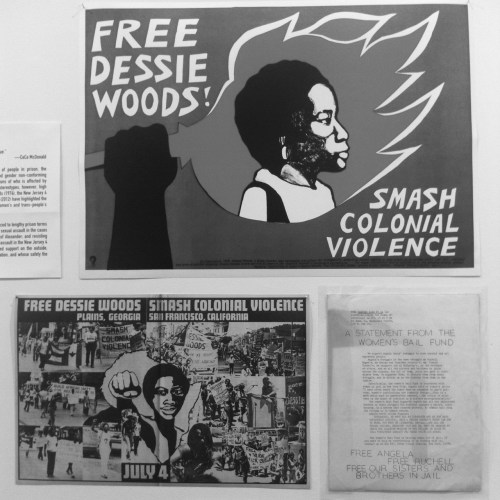
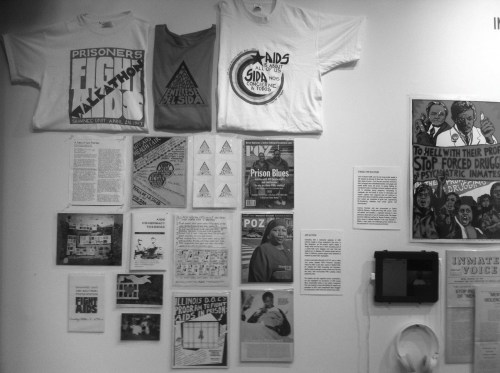
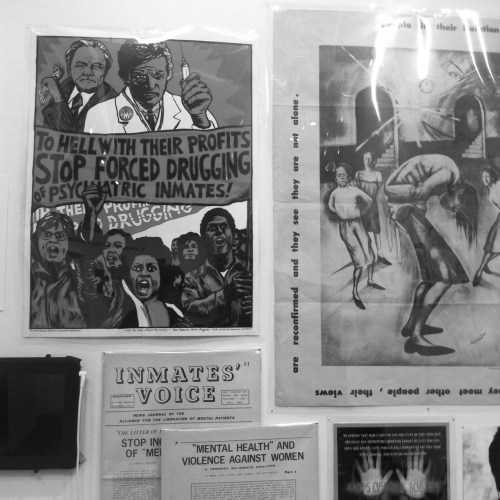
Between September 11th and November 16, 2014, Interference Archive exhibited, Self-Determination Inside/Out: Prison Movements Reshaping Society a look back at the visual and material culture of prisoner-led political movements.
Organized by Molly Fair, Josh MacPhee, Anika Paris, Laura Whitehorn, and Ryan Wong, Self-Determination Inside/Out includes sections on the work of incarcerated AIDS educators, the experiences of women and queer prisoners, prison and control unit prisons. The exhibition features prison newsletters, pamphlets, video and audio interviews, prints, photography (!!!) and magazine covers — starting with materials created during the 1971 Attica Rebellion, a massive prisoner uprising in upstate New York, and concluding with work made by current political prisoners, the show highlights moments of self-organization within the prison industrial complex.
You can buy a booklet and a poster for the exhibition.
Interference Archive is a volunteer-run archive in Gowanus, Brooklyn, dedicated to preserving cultural ephemera related to social movements.

Inside/Out: On Prison Justice, Art of the Incarcerated, and Interference Archive’s New Show
Liz Pelly (LP): What initially inspired the creation of Interference Archive, which mostly houses ephemeral material like posters, t-shirts, and newsletters?
Josh MacPhee (JM): For the different people involved, there are different answers of course. For me, I grew up making this stuff through DIY music, cultural stuff, politics. Through the act of doing, I started collecting it. Flyers, t-shirts, buttons, the ephemera that gets produced by people who are organizing. It was a combination of wanting to understand the history of what I was doing and then at the same time, I was getting really interested in this idea of how people make art and culture in the context of trying to their lives. It’s distinct from art that’s produced purely in the realm of self expression, and the art that tends circulate within the contemporary art world.
This kind of material gets lost. It’s often not clearly authored. Institutions that deal with art don’t quite know what to do with it. Since it’s so political, places like history museums don’t know what to do with it either. It sort of falls through the cracks. But we can see during times like Occupy, or Tahrir Square in Egypt, or with the Maidan in the Ukraine, that this is the stuff of life, [created] when transformation starts to happen. When people have their arms shoulder deep into the constructions of representations of a new world, and the way they want things to be articulated.
For me, doing an archive was a way to say, “just because these moments come and go, and movements have ebbs and flows, doesn’t mean that once the peak has been reached that this material isn’t still valuable to us, to where we’ve come from and therefore where we are going.”
LP: That said, how do you think this sort of exhibit in particular shines light on the experiences of prisoners?
JM: There were five of us who organized this exhibition, and most of us have been engaged with issues around prisons in different ways, whether having been formerly incarcerated, or working with prison activism programs. As far as I know, nothing like this has ever been done before.
We live in a moment where over two million people are in prison. It’s getting harder and harder to hold up the pretense that prison is somehow distinct from the rest of society. When there’s this many people going in and out all of the time, there’s no way that our lives out here don’t leak into there, and that their lives in there don’t leak out into the rest of society. The idea that these are completely separate realms needs to be dismantled.
We thought it was important to marshal primary source material to show that people aren’t just objects of repression or study or someone else’s activism. But they have done immense amounts of organizing inside themselves. Often times that organizing takes place at the same time, or sometimes even ahead of, what people were doing on the outside. Some of the focus we have on organizing around AIDS and AIDS education in prison was really fascinating and important because it shows how people that had the least access to medical care were doing in some cases the most organizing in order to try to deal with a problem that at the time the government was not even acknowledging existed.
LP: Can you tell me more about your own experiences with prison reform activism?
JM: I first learned about how the prison system functions in the early 1990s. It just sort of blew my mind that there was a whole world of people who largely because of race and class were basically being warehoused. And that, at the time, it was completely absent from the radar of public In the 90s, the only thing discussed in relationship to prisons and criminal justice was this sort of “tough on crime” thing. There was no acknowledgment that a massive increase of the prison population going on, and that it wasn’t actually working. And that the system that decided who went in and out was so manifestly unjust, random often.
That sent me on a path of doing organizing around prison issues. I started in Ohio, and then did some work in Colorado, and then in Chicago. A lot of the organizing I did was around Control Unit Prisons, basically trying to stop solitary confinement. [Organizing around] these men and women who were spending twenty-three-and-a-half or twenty-four hours a day alone in their cells, and the psychological damage that causes and how it basically goes against international conventions of torture, yet it’s completely commonplace in this country.
LP: Over the past year, there has been lot of in the news about the racist criminal justice system. It’s an apt time for Self-Determination Inside/Out: Prison Movements Reshaping Society. But obviously there is a lot of history of racism in the criminal justice system that this brings to light. Were you inspired to put this together because of recent events, or has this exhibit been in the works longer?
JM: We worked on the exhibition for 6 months. As a space, as an institution, one of our goals is to take this material that’s perceived as marginal and present it in ways that will allow it to be in its own context, but also to actually show that it’s not marginal. Our primary audience is not people who already necessarily agree with everything that would be in this exhibition. We are conscious of, and trying to take advantage of, a moment.
The question becomes, how do we push [the discussion] farther? If we say mass incarceration is not okay, at what point is incarceration okay? If 2 million people in cages is not acceptable, is 1.9 million people in acceptable? Or 1.8? Once you start asking those questions it opens up the space to say, “this whole system is just absolutely corrupt.”
Mass incarceration accomplishes a number of things, none of which are its stated goals. It accomplishes deeply suppressing working class communities of color. That’s never been articulated as what the prison system is supposed to do. It’s just clear that that’s what it does. It clearly is completely ineffectual at actually dealing with crime.
LP: What are some underreported sides to the prison industrial complex that you hope this exhibit brings to light?
JM: The fastest growing portion of the prison population for years now has been women.
Increasingly there is a real gendered aspect of being able to look at how the criminal justice system works. Increasingly it’s used to enforce gender binaries. It’s a brutal system for queer and trans people that get sucked up into it. People are doing a lot of organizing around it now, but until recently, it was assumed if you were gender non-conforming, they have to choose where to put you, and then once they chose a men or a women’s prison, then almost immediately you’d get sent to solitary confinement. You’d do your sentence out in solitary confinement, in complete isolation, because the system is not prepared to deal with gender non-conformity. You are being punished because your very existence challenges the bureaucratic way the system works.
It’s really clear that women who refuse to be abused, who fight back against abusers, almost always get pulled into the criminal justice system. So we have things like Trayvon Martin being shot, and Zimmerman getting off. But any woman that stops an attack from an abuser is inevitably going to do time because that’s just absolutely taboo.

LP: What were the biggest challenges to getting this exhibit together?
JM: Each exhibition has unique challenges and obstacles, and then there are ones that are sort of similar across the board. For this exhibition, was just that cultural material produced by incarcerated people is hard to access. A lot of it is made in prison and then just never leaves prison.
In general, one of the challenges for all of the exhibitions, is that unless we do something that’s very focused, inevitably there’s so much stuff it’s hard to know when to say “okay we’ve got enough” or to know when to draw the lines. It’s hard to know when to accept that you’re never going to have all of the stuff that you wish you could, that you’re never going to be able to tell the whole story, that maybe even the idea that you’re going to tell some sort of master narrative is questionable in its own right.
When you’re representing things that are so deeply underrepresented, people get attached to wanting their part of the story told, because it’s been marginal or silenced for so long. It makes it really hard to make those choices, because you don’t want anyone else to continue to feel [that way].
We are collecting material from movements that are marginal. Even though they often have extremely deep impacts, rarely is that impact known or visible when they’re most active. It’s kind of like an extra kick in the face when your ideas become commonplace 10 or 20 years later and you’re still written out of the history even though you’re the ones who came up with the ideas.
LP: What do you hope, in general, visitors learn from Self-Determination: Inside/Out?
JM: On the one hand, I hope this contributes to a shift [towards] the idea that prisons are maybe not the answer to the problems that they claim to be. And that locking people in cages is not actually accomplishing what we’re being told it is.
On another level, that incarcerated people are not just objects. They’re loved ones and family members and neighbors and community members. The thing that primarily defines someone as a human being is not whether or not they’re in prison. That people that happen to find themselves in prison, many for reasons that are and then also at the same time many for doing reprehensible things, doesn’t make them not human. It doesn’t mean they don’t have the same desires, life goals, and relationships that everyone else has. And as such, the way that they conceive themselves and their world is part of, needs to be part of, any movement for social transformation.
THE PEOPLE
The Interference Archive is a collection of posters, flyers, publications, photographs, books, t-shirts, buttons, moving images, audio recordings, and other materials, made by participants of social movements throughout past decades. It is an archive “from below” — collectively run space, powered by people, and with open stacks accessible to all. The Interference Archive explores the relationship between cultural production and social movements. It provides public exhibitions, a study and social center, talks, screenings, publications, workshops, and an online presence, with an aim to preserve and honor histories and material culture that are often marginalized in mainstream institutions. It is at 131 8th Street, #4 , Brooklyn, NY 11215 (2 blocks from F/G/R trains at 4th Ave/9th Street).
Josh MacPhee is an artist, curator and activist living in Brooklyn, NY. MacPhee is one of the founder of the Just Seeds Artists’ Cooperative, which organizes, creates and distributes radical art. MacPhee is the author of Stencil Pirates: A Global Study of the Street Stencil, which is dedicated to stencil street art. He co-edited Realizing the Impossible: Art Against Authority, Reproduce and Revolt and the upcoming Paper Politics: Socially Engaged Printmaking Today. In 2001 he co-organized the Department of Space and Land Reclamation in Chicago with Emily Forman and Nato Thompson. In 2008 he co-curated the exhibition Signs of Change: Social Movement Cultures 1960’s to Now with Dara Greenwald.
Liz Pelly is a freelance writer and editor based in Brooklyn, NY. I lives and works at the all-ages collectively-run art space The Silent Barn, where she books (and sometimes plays) shows. She and her friends run the ad-free bi-weekly online newspaper The Media.
The Media is a webpaper covering alternative arts, culture, music, news, and grassroots activism. With contributors often embedded in the communities they cover, The Media aims to bridge the gap between underground presses and mainstream media. Crucially, it is AD-FREE and simply designed. “At a moment marked by short attention spans, decentralized click-bait articles, and newspapers in flux, rethinking the aesthetics of our news websites feels just as crucial as re-imagining their content,” says The Media. “We want our content to resonate on its own merit, free of frivolity and flash, and grounded by a homepage that’s striking in its radical simplicity.”
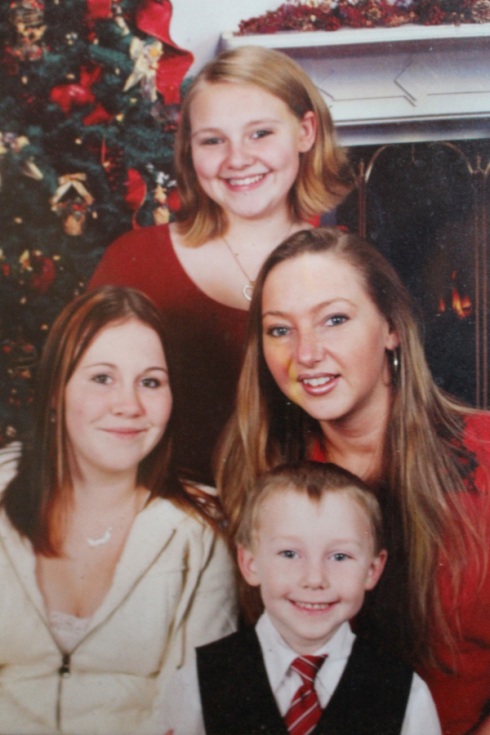
Claudia Cass with her children, Matthew, Kaylee, left, and Courtney in 2006. Credit: Alysia Santo/The Marshall Project
The lives of prison officers, as I have said before, are rarely represented by means of photography. I don’t know if that is the case for other mediums. Regardless, Alysia Santo‘s profile of Claudia Cass, a prison officer in New Hampshire, is essential reading.
“Her work in the prison had become so overwhelming that Matthew, her 11-year old son, was often alone, cooking his own dinner and seeing himself off to school,” writes Santo.
Cass, 42, is so stretched by the long hours of her job she feels unable to care adequately for her son. She made the toughest decision of her life and transferred legal custody of Matthew to her mother.
Imagine that? Having to give up legal custody of your child because you’re spending all your waking hours working in a prison? Crazy and depressing.
Santo writes:
Prison guards are often characterized, whether in news accounts or movies, as living under some constant threat of mayhem. But for Cass and her fellow officers, the recurring nightmare is not a prison riot. It is falling asleep at the wheel after a series of 16-hour shifts. Or nodding off with your sidearm exposed while escorting a sick inmate to the hospital. Or even having to tell your child that you don’t have time to be a mother.
Read 16-Hour Shifts, 300 Prisoners to Watch and 1 Lonely Son

ACTIVIST-SHAREHOLDERING
I love the term “activist-shareholder.” I envision a person wearing protest t-shirts at the AGM, or the organisation of a silent bloc that suddenly bursts into action and derails the agenda of a meeting. Activist-shareholders are moles in the system. Granted they are very visible roles, and it is soon very obvious as to why they have bought shares in a corporation whose practices they oppose, but still. yay for the little man.
Alex Friedmann, associate director of the Human Rights Defense Center and managing editor of Prison Legal News is one such activist shareholder. He made the reasonable proposal that private prisons make attempts to rehabilitate prisoners. Shock horror! And, guess what? The private prison company refused.
I just adore these tactics. If the prison industrial complex is to be dismantled it’ll take an untold amount of imagination and the combination of many tactics. Friedmann’s colleague at Prison Legal News Paul Wright was on hand this week to remind us that talking about the problem is not always doing something about the problem. Wright spoke with Alysia Santo for The Marshall Project, in a provocatively titled interview piece Sure, People Are Talking About Prison Reform, but They Aren’t Actually Doing Anything.
Go forth, let your imagination run wild.
Below, the Human Rights Defense Center press release:
Nation’s Largest Private Prison Firm Objects to Resolution to Fund Rehabilitative, Reentry Programs
Nashville, TN – Last Friday, Corrections Corporation of America (NYSE: CXW), the nation’s largest for-profit prison firm, formally objected to a shareholder resolution that would require the company to spend just 5% of its net income “on programs and services designed to reduce recidivism rates for offenders.”
The resolution was submitted by Alex Friedmann, associate director of the Human Rights Defense Center and managing editor of Prison Legal News. An activist shareholder, Friedmann owns a small amount of CCA stock; in the 1990s he served six years at a CCA-operated prison in Clifton, Tennessee prior to his release in 1999.
“As a former prisoner, I know firsthand the importance of providing rehabilitative programs and reentry services,” Friedmann stated. “I also know firsthand the incentive of private prisons to cut costs – including expenses associated with rehabilitative programs – in order to increase their profit margins.”
Citing data from the Bureau of Justice Statistics, the resolution notes that “Recidivism rates for prisoners released from correctional facilities are extremely high, with almost 77% of offenders being re-arrested within five years of release.” Further, “[t]he need to reduce recidivism rates for offenders held in [CCA’s] facilities is of particular importance, as two recent studies concluded that prisoners housed at privately-operated facilities have higher average recidivism rates.”
The shareholder resolution states that it “provides an opportunity for CCA to do more to reduce the recidivism rates of offenders released from the Company’s facilities, and thus reduce crime and victimization in our communities.”
CCA filed a formal objection with the Securities and Exchange Commission (SEC), seeking to exclude the resolution from its 2015 proxy materials distributed to shareholders. In its objection, CCA argued that the resolution relates to “ordinary business operations,” comparing it to other shareholder resolutions that have, for example, sought to require companies to “test and install showerheads that use limited amounts of water.”
In a press release issued by CCA last year, the company announced “a series of commitments” to rehabilitative programming, stating it would “play a larger role in helping reduce the nation’s high recidivism rate.” At the time, CCA CEO Damon Hininger claimed that “Reentry programs and reducing recidivism are 100 percent aligned with our business model.”
“CCA’s objection to a shareholder resolution that would require the company to spend just 5% of its net income on rehabilitative and reentry programs demonstrates the lack of the company’s sincerity when it claims to care about reducing recidivism,” stated HRDC executive director Paul Wright. “Evidently, retaining 95% of its profits isn’t enough for CCA – which isn’t surprising, because as a for-profit company CCA is only concerned about its bottom line, not what is best for members of the public, including those victimized by crime.”
“If CCA was serious about investing in rehabilitation and reentry programs for prisoners who will be released from the company’s for-profit facilities, then it would not have objected to this resolution,” Friedmann added. “But it did, so we can draw our own conclusions.”
–
The Human Rights Defense Center, founded in 1990 and based in Lake Worth, Florida, is a non-profit organization dedicated to protecting human rights in U.S. detention facilities. HRDC publishes Prison Legal News (PLN), a monthly magazine that includes reports, reviews and analysis of court rulings and news related to prisoners’ rights and criminal justice issues. PLN has around 9,000 subscribers nationwide and operates a website (www.prisonlegalnews.org) that includes a comprehensive database of prison and jail-related articles, news reports, court rulings, verdicts, settlements and related documents.
For further information:
Alex Friedmann
Associate Director
Human Rights Defense Center
(615) 495-6568
afriedmann@prisonlegalnews.org
Paul Wright
Executive Director
Human Rights Defense Center
(561) 360-2523
pwright@prisonlegalnews.org

 Prison Photography