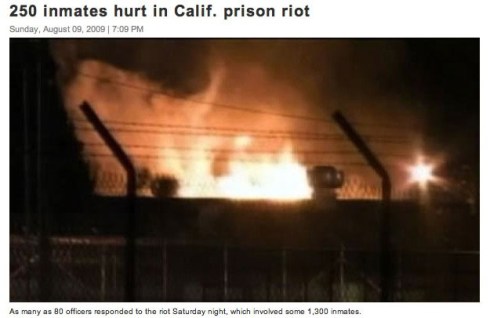
Credit: CDCR

California Institution for Men, Chino, CA. August 2009 riot aftermath. Credit: CDCR

THE OFFICIAL

The California Department of Corrections & Rehabilitation (CDCr) filled the visual hole left by the absence of press photography. I discovered via the CDCr Twitter stream that it had a Flickr profile and more than 72 hours after the event published these images. I use them throughout this post.

THE UNOFFICIAL

I was also contacted by a friend who also happens to have worked in CDCr facilities, is a PP guest blogger and now qualified fact-checker!

He was able to offer some clarification, correction and background on the physical environment at Chino and the CDCR desegregation policy that news sources and I referred to as a factor in the heightened racial tensions. Read on.

Spatial Orientation

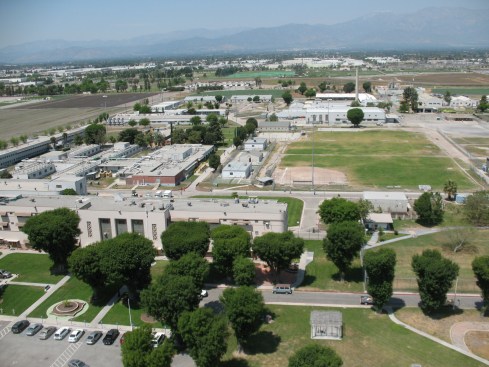
The CDCR picture used in the original post shows only the minimum [security] facility at California Institution for Men (CIM). From the picture’s POV, the entire Reception Center infrastructure is behind you. That’s where the riot happened. Nothing happened anywhere in the area pictured.

The large building in the foreground is the administration building for the entire prison. The large building directly behind it is the prison hospital – yes, this is one of the rare prisons that actually has its own hospital. To the right of the hospital is the main walkway toward the back end of the minimum facility and in that upper left corner is a Substance Abuse Program yard with its own dorms and programming facilities. The large baseball field is considered the main yard.

California Institute for Men, Chino, CA. Credit: CDCR

California Institution for Men, Chino, CA. Credit: CDCR

Implementing CDCR Integration Policy

The integration/desegregation issue has not been raised or put into effect in any prison except two – Mule Creek State Prison (MCSP) in Ione and Sierra Conservation Center (SCC) in Jamestown. These were the so called pilot programs for housing integration.

Like all things in CDCR, the reality is not what you think. These two prisons were chosen because they would seem to cause the least possible problems. MCSP is entirely SNY (Sensitive Needs Yard) with only a few hundred general population inmates in a separate minimum facility, and that’s designed for support of the prison itself. Inmates from that population work in administrative areas as clerks, porters, landscapers, etc. Some are sent out to work in local parks, on roads, etc. And some are bussed each day to the training academy for officers in Galt. Almost all of them are within a year or two of release and aren’t interested in getting into any trouble. Anyway, the three SNY yards house about 3600 inmates (1200 on each yard), and they are all in cells and already fully integrated because they are SNY. (Those not in cells are in badly overcrowded gyms and dayrooms.)

Many on the Mule Creek SNY yards, about 1500, are rated EOP mental health inmates (enhanced outpatient program – the most serious level of mental health programming). Virtually all of those are on psychotropic drugs of one sort or another and are essentially in la la land most of the time. Another several hundred are considered CCCMS (correctional clinical case management system) inmates. Some of those are on drugs, and all are doing some sort of mental health programming (support groups, etc.). There is a mental health staff there of about 150 people. Anyway, inmates in this prison are already quite docile and have been de facto integrated for a long time (since it was made SNY three or four years ago). They have had no discord around the housing integration issue that I’m aware of.
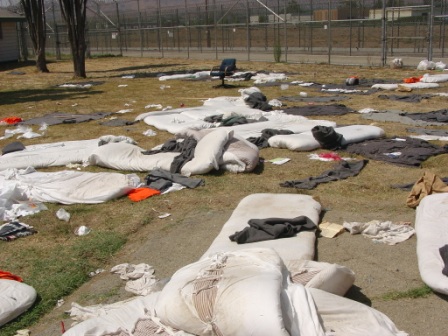
Credit: CDCR

California Institution for Men, Chino, CA. August 2009 riot aftermath. Credit: CDCR

Credit: CDCR

California Institution for Men, Chino, CA. August 2009 riot aftermath. Credit: CDCR

Now, Sierra Conservation Camp (SCC) is a different situation. Half of that prison is a [lower security] 3-level SNY facility, and integration in that half is no issue. [But] the general population side of the prison is a different story.

There is a 1-level yard with about 1200 inmates in dorms. An identical 2-level yard is next to it. The mission of these yards is to train inmates to be firefighters and to staff the small fire camps around the state. It’s hard and dangerous work, but the rewards are substantial. The food in the camps is excellent, and there’s as much of it as you want. The pay is very good (by inmate standards) and some have been able to accumulate a parole nest egg of several thousand dollars. Finally, good time credits mean your in-prison time is as little as 35% of your sentence so you can get out a lot earlier. These inmates are typically not the most violent offenders, although some will have violence in their past. Some are affiliated and active gang members. (On SNY yards there are no active gang members, in theory anyway, because you can’t get to an SNY until you renounce your gang.) The housing integration flies in the face of the gang conventions so it has caused some problems at SCC on those two general population yards.

Credit: CDCR

California Institution for Men, Chino, CA. August 2009 riot aftermath. Credit: CDCR

The CDCR started the integration effort last summer, and it quickly backed off when inmates put up resistance. Summer is not a good time in prison; heat makes violence flare more easily. Also, it’s fire season and the camps must be staffed. So they waited until the fall and tried again. Many dorms had mini-riots as gangs instructed incoming inmates not to comply. There were a couple of yard-level disturbances. The inmates tried refusing to come out of their dorms for a couple of days. They believed the officers would bring food to them as they would in a lockdown situation. When they did not, the stomachs settled it temporarily. Eventually, the administration settled on dealing with the situation by depriving any inmate who refused a bunk assignment of privileges. He would be given a disciplinary writeup and not be allowed phone calls, programming, visits, etc. It is currently this kind of a stalemate.
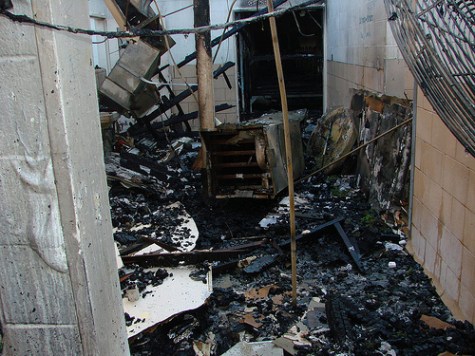
Credit: CDCR

California Institution for Men, Chino, CA. August 2009 riot aftermath. Credit: CDCR

Existing Racial Enmity

One thing that has not been mentioned is the ongoing Black/Hispanic rivalry in the southern half of the state. You may recall in early 2006 there were major riots in the Los Angeles County jails between Blacks and Hispanics. Over 2000 inmates participated, one died and at least 100 were injured. Many men involved in that could be the same people who were at Chino this weekend. Since that part of the Chino prison is a reception center, many inmates were probably local parolees who’d violated. These, and others, would have been through the LA county jail system, probably over the last few years. So this could all be no more than a continuation of the ongoing violence with many of the same people. Who knows!?

I’ve been in those Chino dorms many times and always felt uneasy. Only two officers are assigned, and at any given time one is on the phone or at the door doing an unlock or in the restroom or off on some administrative quest. There is no “gun coverage” as they call it when an armed officer is placed in an elevated position to provide less-than-lethal and lethal force to quell disturbances. As the administrative representative made plain in the interviews, the inmates are really in control. Two officers armed with pepper spray, batons and alarms can be overpowered in seconds. One officer had to be airlifted to medical care from that facility a year or so ago. His partner was doing something and he got hit from behind and they just beat him unconscious. He is extremely lucky he didn’t die; I’m sure the inmates left him for dead. Those dorms are classic World War II era barracks style housing. They would not meet the current standards of prison housing. Actually, they probably would not get any kind of occupancy permit in any municipality in the state.

Conclusion

Finally, a note of purely personal opinion. I believe the CDCR went about integration all wrong. In effect, they asked inmates to integrate. For a year or so prior to the start date, they had meetings with inmates to tell them what it was about and why it was being done. Worst of all, they created a video to sell them on the idea and played it incessantly on the prison TV system. It reminded me of parents who had decided to ask their children to go to school rather than simply telling them to go to school. Inmates are like children, and psychologically, they respond like children. If the administration had simply told them the courts were ordering integration and on a certain date it was happening, I think they would have had less trouble.
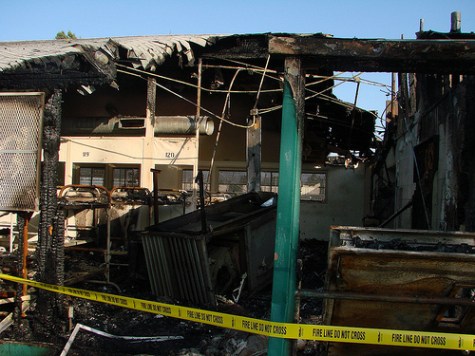
Credit: CDCR

California Institution for Men, Chino, CA. August 2009 riot aftermath. Credit: CDCR

Here’s the official CDCr press release update (11th August)

____________________________________________________

Editor’s note: ‘Sensitive Needs Yards’ (SNY) can be understood, essentially,  as protective custody areas. They were conceived seven years ago to accommodate the following populations;
1. Guys who had dropped out of gangs. And you have to go through a six-month to one-year deprogramming that includes telling everything you know about the gang and its activities.
2. High notoriety inmates – ex-cops, celebrities, etc. For example, Tex Watson, the Manson family murderer is at MCSP. Phil Spector is on an SNY at Corcoran.
3. Sex offenders.
4. Mental health inmates.
5. Old and infirm people who are still ambulatory.
Chino

California Institute for Men at Chino, 2008 (Prior to Riot). Photo Credit: CDCR

Michael Shaw over at the excellent BAGnewsNotes pointed out a rather bizarre anomaly in our image-saturated world. There exist barely any photographs of the prison riot at the California Institute for Men at Chino that occurred this weekend.

Given that Shaw has his hand firmly on the newswire pulse of America I’ll take him at his word … photojournalist coverage of this significant riot was is scant.

I even think that the image Shaw presents is a concession; a still from film footage.

Today, the Los Angeles Times published this image showing the aftermath of the riot.

aftermath

Photo: A view from outside the fence after weekend rioting at the California Institute for Men at Chino shows a dorm with a hole burned through its roof and a yard littered with mattresses and other debris. Credit: Allen J. Schaben / Los Angeles Times

The BBC was quick to cover the riot. Most news sources framed the riot as a result of racial tension, but in truth those tensions only came to surface due to inexcusable and acknowledged overcrowding. In 2007, Doyle Wayne Scott, a former Texas corrections chief consulting on California prison security reported that overcrowding at the California Institute for Men at Chino created “a serious disturbance waiting to happen.”

chinofire

Overcrowding is a problem that ignites other problems, and represents a serious issue that has no easy answers. Some prison reform activists would be wiling to see new (temporary) facilities built to ease the tensions, but this is an unlikely scenario as trust between they and the legislature, Governor’s office, CDCr and CCPOA is low. Recent history has taught us that when new prisons are built, they are filled and calls for more prisons follow. The solution is to change the laws that over the past two decades have warehoused increasing numbers of non-violent offenders.

One of the other depressing aspects to this story is that the racial tensions are apparently the result, partly, of enforced desegregation at Chino. Prison populations operate on strict codes and it would seem that top-down-enforcement of an anti-racist policy doesn’t change the attitudes of the men only agitates their existing prejudices, distrust and expected antagonisms toward one another.

My humble suggestion to work against these deep-seated hatreds would be to operate smaller facilities with immediate access to education programs. Sociological models taught as part of a basic curricula are revelatory for many prisoners. Many inmates, given the tools and the logic to explain their oppositions will identify other ways of seeing race.

It is true that some prisoners don’t want to rehabilitate, but they are in the minority. Often it is simply the case that race for this population has never been discussed in complex or nuanced terms.

Here’s some video of the aftermath.

Thanks to Scott Ortner and Stan Banos for the tips on this story.

Nikedunk Prison Blues

I have talked before about prison aesthetics in fashion. In the case of Haeftling, my criticism was tempered by the professed share of profits with the inmate population.

This example from Nike is less complex. These are trainers “inspired” by prison. The ‘Prison Blues‘ sneaker. How bland.

The jejune description of the shoe is trumped only by the inanity of the comments.

The Prison Blues come thoroughly packed with rugged details such as distressed denim featuring repeating prints of the star spangled banner splashed over in white; the edges of the panels are left deliberately unraveled for a worn, unfinished look. The white Swoosh features printed type in black on it and a zipper enclosure keeps the shoes pulled together,  while the lace-up panels take a side-step. On the tongue is a number patch that uncannily resembles the number identification patches on prison uniforms. Prison Blues is set to drop on Aug 9 at 10PM EST, so pen that date down in your iPhone for a pair in time.

The quotes on the sneaker are those of Johnny Cash – an inadvertent and tellingly naive inclusion. Cash, despite his self-manipulated jail-bird image, only spent one night in lock up and (certainly today) has little to do with the reality of American prisons. I’d loved to have seen quotations from Eugene Debs, Clarence Darrow, Angela Davis or Elliot Currie used instead, but they aren’t commerce-compliant …

Ever wonder how many stories you’ve missed? Ever wonder if your world-view could be different?

Take a camera into a prison and you’re going to hear some honest tales. When people are going through a process of self-forgiveness or asking for forgiveness from others then honesty pours …

“I Knew a Man Named Simon”

In this film, M.K. talks honestly about his life as a British driug dealer – from the romance of guns to the denial of past customers. He talks with great frankness about his family, feelings and forgiveness.

The Forgiveness Project is an international charity which, among other activities, offers free digital media courses in British prisons. At the end of each course, the prisoners produce a short film on the subject of forgiveness

M.K’s story is well-delivered and uninterrupted by the questions or expectations of society. Other films from The Forgiveness Project are less gripping, but the purpose isn’t solely to entertain – it is to provide a medium through which an individual can unravel their thoughts, (often) guilt and apply forgiveness in a form that rings true.

Prisoners Offering Advise for New Prisoners

Brixton prison was in the news recently with the success of its radio station, so it should be no surprise it would also embrace film as a means to self-rehabilitation. According to the introduction, this is “the first ever film made by prisoners about life in a British prison uncensored and uncut.”

H.M.P. High Down also hosted The Forgiveness Project


Alistair Pirrie has been the lead on The Forgivness Project’s work in prisons.

http://www.lacountyarts.org/civicart/01_First_District/1_ela_s_sbi_ppdt_davis.htm

The Sybil Brand Institute for women, Los Angeles. Photo Credit: LA County Arts http://www.lacountyarts.org/civicart/01_First_District/1_ela_s_sbi_ppdt_davis.htm

The fixations of Prison Photography on the infrastructural order of sites can as easily be applied outside of carceral space.  The Center for Land Use Interpretation has terminus container ports, petrochemicalscapes, first responder training sites, landfill waste streams, pacific coastlines, nuclear proving grounds and even the Trans-Alaska pipeline covered by roving reconnaissance.

There is even a brief field report from the Angola Prison Museum, but I’ll have to come back to that.

I’d like to present the archive for the CLUI’s 2001 exhibit, On Locations: Places as Sets in the Landscape of Los Angeles.

Have you ever questioned the fabric of prison environments in TV or film? There were plenty prison (visiting room) scenes in The Wire, but I was too engrossed in episodes to pay the backdrop any mind. Well, this should get you thinking.

Filming in active prisons is generally not permitted for obvious reasons, and as a result, prison sets are built in soundstages, back lots, and inside other locations. A few prisons in Los Angeles are currently closed, and are regular filming locations. The Sybil Brand Institute, at the County Sheriff’s complex in City Terrace, east of downtown, was the primary Los Angeles County correctional facility for women before it closed in 1997. Though still managed by the sheriff’s department, it is now used exclusively for filming.

 Credit: CLUI. Portions of the Sybil Brand Institute are familiar from films shot there. This visiting area has appeared in several films.

Credit: CLUI. Sybil Brand Institute's visiting area has appeared in several films.

Built in 1963, Sybil Brand was a minimum to maximum security facility, with a design capacity of 900, and a peak occupancy of 2,800. It once housed Susan Atkins (whose confessions to a cellmate at the prison led to the arrest of Charles Manson and family), and Susan McDougall of Whitewater scandal fame. When Sybil Brand closed, inmates were transferred to the new Twin Towers complex. The County may renovate the building and open it again as a prison, but in the meantime it offers modern looking prison rooms including cafeterias, hallways, recreation areas, visiting areas, infirmaries, and cells from solitary confinement to dormitories. As it was a women’s prison, the interior walls have a pink color, which is usually painted over for filming.

Productions film here at a rate of two or three per month. The film Blow, about cocaine dealers, recently spent five weeks shooting all over the prison. Other productions include Arrest and Trial, Gangland, X-Files, and America’s Most Wanted.

Though older and more run down, the City of Los Angeles jail in Lincoln Heights is also closed, and is used regularly as a film location, appearing in NYPD Blue, Unsolved Mysteries, and other film and television projects.

Mel Melcon / Los Angeles Times. VISITING ROOM: L.A. County Sheriff's Deputy Jack McClive peers through safety glass, while standing in the visiting room, during a tour of the Sybil Brand Institute Women's Jail in Monterey Park.

Mel Melcon / Los Angeles Times. VISITING ROOM: L.A. County Sheriff's Deputy Jack McClive peers through safety glass, while standing in the visiting room, during a tour of the Sybil Brand Institute Women's Jail in Monterey Park.

… or put another way, the apparently unassailable problem that is Guantanamo only amounts to 2% of the actual problem.

guardian logo

This is only one of the many astounding facts I learnt from following the Guardian’s Slow Torture series.

I particularly valued this half hour podcast in which an expert panel of legal professionals discuss the cyclical, “odious” and often ludicrous procedures for trials based on ‘secret evidence’. Clive Stafford Smith has many valuable things to say about American legal protocols. He has represented detainees at Guantanamo Bay and says that, in the overwhelming majority of cases, ‘secret evidence’ used against terrorism suspects does not stand up to judicial scrutiny.

The majority of the Slow Torture series looks at British ‘secret evidence’ trials, how it affects the lives of terror suspects and the consequent erosion of Britain’s legal reputation:

The UK government’s powers to impose restrictions on terror suspects – without a trial – amounting to virtual house arrest have been condemned as draconian by civil liberties campaigners. In a series of five films, actors read the personal testimonies of those detained under Britain’s secret evidence laws and campaigners and human rights lawyers debate the issues raised.

Basically, the same problems embroiled in the acquisition and control of “sensitive” evidence exist on both sides of the Atlantic and are ultimately putting our societies at more of a long-term risk.

Photography alone is worthless. Interviews, think-pieces, investigation, theatre, video, debate, political fight and direct action make issues reality.

What are we to do with our Gitmo preoccupations when the real problem has been moved to Bagram, Afghanistan by President Obama?

NCN

No Caption Needed (NCN) is a bubbling blog-broth of visual politics and opinion that swills about their own cast-iron-think-piece cauldron. Last year, NCN (Robert Hariman & John Louis Lucaites) posted thoughts on America’s Prison Industrial Complex.

NCN began by stating, in my opinion, an irrefutable fact, “The prison system in the United States gives a hard meaning to the adage ‘out of sight, out of mind’.”

2008. Copyright: Andrew Lichtenstein

2008. Copyright: Andrew Lichtenstein

Specifically, NCN was reacting to the formidable work of Andrew Lichtenstein who has documented for many years America’s sites of incarceration. In 2006, he was a Soros Documentary Photography Grant recipient.

The words that stuck with me from NCN’s post The American Gulag were those that lamented Democrat and Republican obstinacy and mutual blindness to shared agendas. NCN suggests both major parties have ideological roots which should inform progressive positions on prison reform and thus the down-scaling of US reliance on custodial sentencing:

The US has the highest incarceration rate in the world; the causes include both excessive income inequality and the disintegration of the family. Given that both conservative and liberal arguments are proved correct, you might think that a strong bi-partisan effort could be made to keep millions of Americans out of prison. Think again, for why would anyone bother to fix something they never see?

NCN’s brand of commentary on this type of pariah-issue is in stark comparison to the empty promises of politicians to reach across the aisle.

Scott Langley is slowly building a portfolio of portraits which feature famous folk stating their political opposition to execution in the US.

From L to R, Top to bottom: David Strathairn, actor, Boston, MA, June 2007; Ani DiFranco, folk musician, Raleigh, NC, December 2004; Steve Earle, musician, Boston College, June 2001; Eve Ensler, author, activist, Boston, MA, June 2007; Michael Moore, documentary filmmaker and author, Boston, October 2000; Bill Pelke & George White, Founders of ‘Journey of Hope … from Violence to Healing’, Somewhere along Hwy 40, Indiana, November 2000;  Martin Sheen, actor, Boston, MA, March 2008; Sam Reese Sheppard, Boston College, Boston, MA June 2001; Kurt Vonnegut, author, New York, 2006; Howard Zinn, author, historian, professor, New York City, NY, June 2006.

EMAIL

prisonphotography [at] gmail [dot] com

Prison Photography Archives

Post Categories