Scott Langley has orbited the protests, prison protocols and politics of execution for over ten years. Judged by sheer coverage, his activism with the camera is without equal.

Capital punishment is one of the major failings of the US criminal justice system – it also remains one of the most divisive. Prison Photography was grateful to pick Scott’s brain about America’s current death industry, the legal landscape and his personal involvement.

1

We agreed that it would be wise to focus on Scott’s coverage of Troy Davis’ stay of execution.

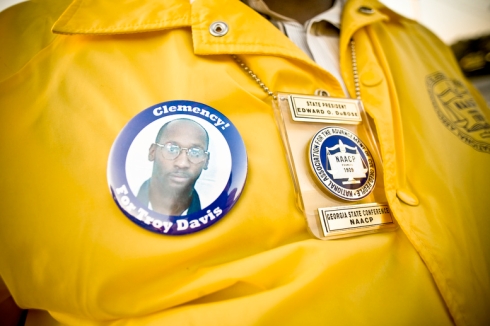
Troy Davis‘ case is currently the most high-profile death penalty case in America. It has become a focus for anti-death penalty activists not only because a man’s life is on the line, but also because so many doubts have been brought to bear on the original jury verdict. Through Davis’ case, society is realising that juries are fallible, eye-witness testimonies are unreliable, proceedings can be flawed and fatal errors have been made … continue to be made.

Prison Photography: What were you first, a photographer or an activist against the death penalty?

Scott Langley: I was first a photographer, working for my college newspaper and yearbook. I didn’t become active on the death penalty until a human rights class my senior year that challenged me to use photography as a tool to report on the death penalty.

PP: Your portfolio of images documenting executions, prisons, vigils, families and celebrities is the most comprehensive of any photographer currently working in the United States. Did you envisage your project would become so large, and important?

SL: I never thought it would get this far, cover so many facets, and continue for so long (over 10 years now). As I said, it started as a class project, but I quickly realized the importance of such historical documentation and the effect it could have on an important issue.

PP: This work is obviously borne of your political position, but you also work as a freelance photographer to earn a living. Are your conflicted or compromised by pressures of time and money?

SL: I am proud to say I am not compromised by pressures of time and money. I live a very non-traditional lifestyle, for the sole purpose of maintaining an emphasis on my political activism on a number of human rights issues. I do work for pay as a self employed photographer – picking up news assignments, weddings, and other photo jobs as they come up. But those take up minimal time. Of course working for pay “as it comes up” requires living a bit more simply than the average person. I run my car off of used vegetable oil. I grow much of my own food. I do all my shopping at thrift stores, yard sales, dumpsters. All these things greatly reduce the need for money, which in turn allows me to work on the death penalty photo project and my political action full time, and neither of those pays much, if anything.

PP: You are particularly well connected with the capital punishment abolitionist movements of Texas, Massachusetts and North Carolina. Describe those territories and the current legislative and cultural situations in those states.

SL: My work in North Carolina is the most in-depth and extensive. I was only there two years, but it was two years engrossed full-time in the death penalty debate. North Carolina obviously is a southern state. And it is the southern states that leads in executions and death sentencing. At the time I was there (2004-2006), North Carolina was the number two executing state, only behind Texas. And the death row was 6th largest in the United States.

But the momentum there has shifted. There hasn’t been an execution there in almost 3 years now. And more people have been found innocent on death row. And right now, as I sit here, NC is considering the Racial Justice Act, a bill that provides those on death row the ability to appeal their case due to race discrimination at the time of trial (which is a huge, huge problem in the south).

North Carolina has come close to legislatively putting a moratorium on executions. There is real hope of ending the death penalty in NC in the near future.

In Texas, where my work began, it is a whole other world. Texas executes by far the most people – more than most countries combined. There are some great organizations and activists in Texas, but there is little hopeful movement in the legislature to end or limit the death penalty. In fact, Governor Perry just oversaw his 200th execution. And to think, the media gave Bush a hard time about 152 executions back when he ran for president in 2000.

Massachusetts is in a whole different position. The Commonwealth ended the death penalty in the 1980s, and hasn’t had an execution since the 1940s. Capital punishment came close to reinstatement back in the late 1990s, but has since seen a decline in support in the Governor and legislative bodies. It will be a death penalty free state as far as I can see, although there is the real threat of federal capital prosecutions there.

2

4

3

PP: Explain precisely your opposition to the death penalty. Is it a religious, moral, political, ethical or philosophical stance?

SL: It started as ethical. I first learned about the death penalty through a human rights history class, where we also studied the holocaust, genocide, war… all those gruesome atrocities carried out by governments – even democratically elected governments. I learned right away the grave danger of giving the state the power to kill – to choose who lives and who dies. The class took me down many roads since then, and so my opposition covers all facets – religious, philosophical (arguments I love, but can never wrap my mind around on my own), moral, political… the whole gamut of reasons. It is now to the point where I just cannot fathom how anyone, for any reason, could justify the taking of a human life.

PP: Bill Richardson recently signed in a moratorium of the death penalty in New Mexico, joining 14 other states to ban the death penalty. How much of a victory is this?

SL: It is a huge victory. It made what happened in New Jersey the year before not just a random occurrence dependent on a liberal governor or a certain regional mentality, but part of a movement and a trend. It will cause waves of effect – and it has. Colorado, Montana, Maryland, Connecticut, North Carolina … they are all very close to drastically changing the way the death penalty will be used – or hopefully, not used.

PP: In banning the death penalty, Governor Richardson put aside his personal opinion (support) for the death penalty cited a lack of trust in the cogs of the criminal justice system to act as “the final arbiter when it comes to who lives and dies”. The death penalty is actually a procedure of criminal justice that affects a small minority of convicted criminals. What are your thoughts on the prison system as a whole.

SL: The whole prison system is a complete failure. We’ve got the majority of people locked up for harsh sentences for mere drug possession. We’ve got a system that has no policy or effort to rehabilitate. We’ve got a system that spits people back out into the exact same environments that put them in prison in the first place. And meanwhile, there is extreme racism, abuse and torture within the whole system and the walls of the prisons. Not to mention that the taxpayers are funding all of this. It is just maddening that we don’t have a better way of doing things. It is obvious that it is not working. We have a higher per capital imprisonment rate than any other country in the world, including China. Prison in the U.S., as it is, serves no positive function for the vast majority of those who go through it.

PP: Describe from personal experience the attitudes toward capital punishment in the US compared to other nations you’ve visited.

SL: During the summer of 2000, I spent six weeks backpacking through Western Europe, with camera gear in tow, to photograph sites connected with the death penalty issue in Europe’s history. This was the summer of the heated U.S. presidential race between Al Gore and George W. Bush. Because of the impending election and Bush’s history with state sanctioned killing, the Texas death penalty had become the forefront of much political conversation. When I met folks in Europe and mentioned that I was from Texas (born and raised), the first thing that always came out of their mouth was something about the death penalty. They just could not fathom how a nation, so “advanced” and “great” as the USA, could go about with a barbaric and failed practice of exterminating prisoners – at a rate of nearly 2 per week. It was a stigma that was held against me everywhere I went.

I acknowledge that not all Europeans are whole-heartedly anti-death penalty. There is ongoing talk about whether executions should resume, but it is a real minority view at this point.

5

6

7

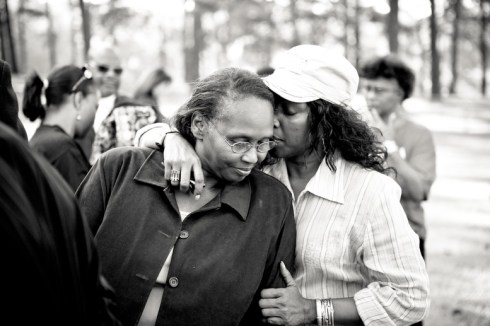
PP: Your project is over 800 pictures deep and touches upon many stories of those affected by the death penalty, but here we have focused on the case of Troy Davis. You were present to document his most recent stay of execution. Give us your thoughts on the case.

SL: Troy Davis‘ case is particularly disturbing. People who support the death penalty are starting to ask questions about this case. Even a former Georgia official publically stepped up to question why there hasn’t been a hearing of the new evidence to prove Troy’s innocence. When you have 7 out of 9 trial witnesses saying they lied, and were even coerced into lying by the police, you have to stop and say there is a problem here. It just baffles (and depresses me) that the courts just won’t hear the new evidence. The system is so caught up in judicial process that there is no humanity whatsoever. But remember, it is human life we are talking about. Real people with real family. The courts need to hear this case, desperately, because it stands for so much that is wrong with our broken system. If we, as a country, fail with the Troy Davis case, we have failed justice, failed humanity and failed all good that could possibly come out of a system designed to right wrongs and keep society safe.

PP: It seems this activism will be with you for life. Is that a fair assumption?

SL: I hope that my activism remains with me for life. There is a great need for people to always be on call to step up and do the right thing. Sometimes that might be little things like challenging the status quo by collecting used grease to run one’s car, and sometimes it might mean crossing a line to risk arrest to stop a greater harm from being done.

PP: What are your hopes for, and activities in, the future?

SL: I hope for an end to the death penalty soon. I hope to always have opportunities to educate people – through photos, through words, and through actions – about these issues of injustice. I have projects in the works to expand the death penalty documentary project and am planning for a cross-country trip in the winter 2010 to make photos in a wider variety of states.

I will continue to follow the Troy Davis case, using my camera as a tool when the opportunity arises.

8

View all of Scott Langley’s work here. Scott has also spoken out against sites of incarceration used in America’s global war on enemies. He has presented at the University of North Carolina, partnered with the Innocence Project, worked with Amnesty International, North Dakota Human Rights Coalition, Unitarian Universalists Against the Death Penalty and many, many more. He has also recently started working with video.

This post is to salve the disappointment of thousands of visitors to Prison Photography that are tempted by the post titled View Inside Guantanamo: Video only to find that the Guardian’s rights to the three minute “tour” video have expired.

guardian.guantanamo.expired

There exists a bristling irony in the Guardian’s curt and formal explanation of circumstance: the erasure of evidence based upon ‘rights’ pertaining to the command is an insulting reminder of the powerlessness of detainees whose lives are manipulated at will.

Paradoxically, in this case, it is the denied party that is the apologist for the US military’s enforced expiration and unavailability of material. It seems the controlled release of this footage has been trumped by its controlled withdrawal.

Paolo Pellegrin/Magnum Photos

As a worthy (and non-governmental) alternative, Magnum offers Paolo Pellegrin’s 11 minute slideshow ‘Guantanamo. There are a few interesting things about this piece none of which are the actual photographs. The prints are steeped in morbid detachment and the unsurprising truth that the photographer was also controlled throughout this military prison.

The slideshow’s early description of Guantanamo as a small American town is sinister; the edited audio interviews of former UK detainees, family members, detainee lawyer and psychologist are very successful. The follow-up portraits of former detainees that Pellegrin later completed in Afghanistan are very strong.

Paolo Pellegrin/Magnum Photos

Paolo Pellegrin/Magnum Photos

All photos copyright of Paolo Pellegrin/Magnum Photos

Please, refer to my earlier post, for a comprehensive directory of photographic resources for Guantanamo including Bruce Gilden’s subtle flash-bulb mockery of Guantanamo’s rank and file. (Search within Magnum archives as deep-linking is impossible).

“Those walls aren’t there just to keep me in, but to keep you out.”

Tyrone W. (Prisoner and student)

Providing meaningful education in sites of incarceration is a difficult task. How do educators get inside the walls?

  Inmates taking an Adult Basic Education class at the Norco prison include Paul Rodriguez (left), Jobentino Romero (front), Felipe Ramos (right) and Marco Tielve (back). Chronicle photo by Michael Macor  Photo: Michael Macor / SFC

Inmates taking an Adult Basic Education class at the Norco prison include Paul Rodriguez (left), Jobentino Romero (front), Felipe Ramos (right) and Marco Tielve (back). Chronicle photo by Michael Macor Photo: Michael Macor / SFC

In 1994, the Clinton Administration withdrew Pell Grants and thus all funding for college education in US prisons. Prisoners were deemed unworthy of tertiary education. The disaster of this legislation (law was amended to omit prison populations) immediately impacted the prospects for tens of thousands of men and women, but also it crippled America’s critical thinking and cultural landscape.

With the stroke of the president’s pen, education – a cornerstone of the American dream narrative – was denied to a stipulated group by popular consensus. It was, and remains, discrimination defined.

Since that time, any college courses taught within US prisons have been supported entirely by non-profit organisations, brave foundation funding, volunteer hours and volunteer skills.

With this in mind, I’d like to bring to your attention some of the venerable organisations providing education despite innumerable legal and practical obstacles.

Prison Education Organisations

Recently, I took on a teaching role at Washington State Reformatory, one of four facilities at the Monroe Correctional Complex, WA. I teach in the University Behind Bars project, one of the programs run by the Prisoners Education Network (PEN).

PEN

PEN is a fledgling organisation that has just taken on an expanded curriculum, new teachers and a two year strategic plan for sustainable growth. It is the only college education provided to any inmates in the state of Washington.

In order to inform our growth we’ve been scrutinising other education programs across the United States.

Insideout

Temple University, Philadelphia runs the Inside Looking Out program which pairs prisoners with students as peers to develop educational goals. For background, view this video by Tiffany Kimmel which describes the work at Oregon State Penitentiary.

PUP

The Prison University Project at San Quentin is the model program for the state of California.

PrisoneReentryInstitute

John Jay College, New York runs the Prison Reentry Institute.

pep_boston

Boston University administers the Prison Education Program.

bpi

Bard College operates the Bard Prison Initiative.

Partakers

Faith-based group Partakers in Massachusetts calls for sponsors to support its College Behind Bars program.

TexasPEP

And, last but not least, is the business oriented Prison Entrepreneurship Program (PEP) in Texas.

If you have a spare hour watch PEP’s director Catherine Rohr talk about the inspiration provided by the students and how they overturned her prior apathy and self-confessed ignorance to the needs of prisoners.

These are a mere selection. I’d be very happy to hear of more prison education programs from any corner of the US and beyond

Onward.

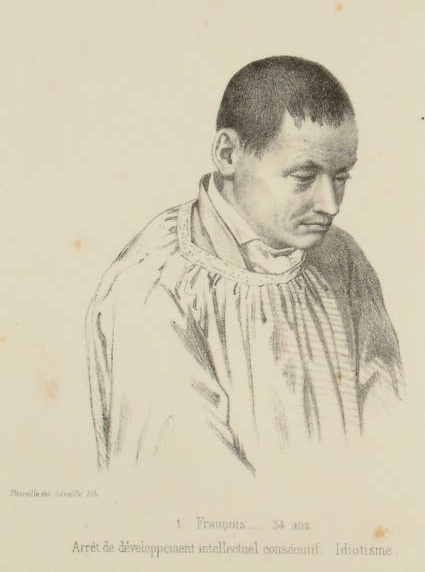
"Francois. 34 ans. Arret de Developpement intellectuel conscentif. Idiotisme." From ‘Traites des Degenerescences', by Morel (1857)

"Francois. 34 ans. Arret de Developpement intellectuel conscentif. Idiotisme." From ‘Traites des Degenerescences', by Morel (1857)

Green Hill, 2000 (C) Steve Davis

Green Hill, 2000 (C) Steve Davis

A couple of comments that have blown me away in the last 24 hours.

Convergence

From Patrick McInerney;

The similarity between Steve’s photographs and the scientific studies of psychiatric inmates the mid nineteenth century asylums is striking. (For a particularly good example see pictures of psychiatric inmates in Benedict Augustin Morel’s 1857 ‘Traites des Degenerescences: physiques, intellectuelles et morales de l’espèce Humaine

And its interesting that they have a similar effect today as the early images did in the past, i.e. they encourage us to read the prisoner’s “true” character in their faces, with all the difficulty that incurs. It was obviously not Steve’s intent to mimic 19th c. scientists but maybe its quite understandable he feels that the style has become a bit jaded … it has after all been around for some time!

Steve was jaded not only by the limits of the portrait to communicate but also by the disconnected agendas viewer brought to his works, “People respond to these portraits for their own reasons. A lot of the reasons have nothing to do with prison justice. Some of them like pictures of handsome young boys; they like to see beautiful people, or vulnerable people, whatever. That started to blow my mind after a while.”

It is a serious issue within photography that we are all lazy viewers. The less curious and less open we are, the more likely we are to fall back on pleasing, self-affirming bias.

Memory

Three months ago I posted some images of the Prison Ship/Torture Museum, The Success

Wooden Coffin / Wooden Maiden / Iron Maiden?

Wooden Coffin / Wooden Maiden / Iron Maiden?

Today, I received this;

I believe it was around 1944 that a prison ship, maybe it was The Success came to Cleveland Ohio at Lake Erie. I remember seeing the torture devices and one sticks in my mind to this day. I was told it was called the ‘Iron Maiden’, but your photos call it the ‘Wooden Coffin’.

Although I saw it as a child the memory stays with me to this day.

Age following age has propagated its own fascination with the macabre and majority-assigned human defect. From “scientific” research to childhood memory the will to understand difference has played out (and continues to play out) the shifting – and ultimately false – parameters of normal.

cooleh

Fearful Symmetry

Sorry, more self-promotion. For Cooleh magazine, I rewrote old speculations on the non-existent genre of prison photography. I discuss the visual vocabulary of prison photography and the slipperiness of cliche depending on the experience of the camera operator.

The editor confirmed it for me though: It was the strength of the images by nameless inmates of Remann Hall youth detention facility that carried the story! Fearful Symmetry is part of Cooleh’s 14th issue which takes a story-based, raw and somewhat irreverent angle on crime; politics of crime in jamaica, urban pot growers, secession states, botched 7/11 robberies and interviews with the unheard.

fearfulsymmetry

unemployed youths

Joseph Rodriguez‘s work is essential. If I and others can promote his photography humanity then we’ve done some good.

Last week PDN ran a post about the value of the “Digital Curator“. It was a well threaded argument about things we already know: that if an online presence (blogger) does his/her thing for long enough and with a consistent (their own) voice they’ll begin to garner readers, respect and influence.

[WARNING: link blitz, but all justified]

Thankfully, we have (I believe) a healthy photography blogosphere in which plenty of photographers present their own STUFF; megaliths go vernacular; academics question and answer; fine art specialists point us in the direction of good practice & theory; insiders offer editorial, publishing, gallery, collector, buyer or industry viewpoints; universities promote; non-profits take new angles; curmudgeons grumble; old media gets hip; young guns splash out with collective and interview projects & some hover untouchably above.

In September, duckrabbit joined the fray. You may know already, but I am a fan of duck’s blog (by Ben Chesterton). I am not a fan because I agree with everything Ben has to say, but because he says it without frills and then will spend the time necessary to engage the consequent discussions. Such commitment is a priceless commodity.

duckrabbit deals primarily with photojournalism and multimedia and so Ben’s coverage doesn’t always dovetail with the preoccupations of other photographic genres – which is fine, we all have our favourite corners.

To get to the point. I am nodding furiously toward the coverage of Joseph Rodriguez on duckrabbit for three reasons:

1) Because Rodriguez (along with Leon Borensztein) made me realise how vital the relationship between photographer and subject is in creating images. Rodriguez is worth more time than duck or I could ever commit.
2) Because this is the latest in principled stances duckrabbit has taken, AND it happens to highlight the stories of formerly incarcerated.
3) Because I am committed to writing more about Rodriguez in the next month … and need to let you know.

duckrabbit’s first feature of his new series ‘Where It’s At’ (stuff that kicks a duck’s arse) is Rodriguez’s work on Re-entry after prison. Rodriguez worked with Walden House (I remember fondly the stained glass of the San Francisco WH, Buena Vista Park). As duckrabbit puts it, “Rodriguez records lives lived and he never measures the lives of those he shoots against a photographic award, magazine spread or advertising contract. His eye is never on the future, it is always in conversation with the now.”

Go to duck’s post and watch Rodriguez’s 7 minute multimedia piece on re-entry. California is where I cut my teeth in the prison policy and prisoners’ rights fields, so for me, it is especially resonant … and vital.

Also worth noting is Benjamin Jarosch, Rodriguez’s current assistant.

While we are on the topic of different realities in urban America, keep an eye out for this film at your local cinemaplex indie-theatre.

In the next few weeks I’ll be making comment and whirring the brain cogs over Rodriguez’s photographic endeavour Juvenile Justice . Stay tuned.

juvenile

Rodriguez has won acclaim from all the important people that need to take notice, including Fifty Crows, which incidentally started up a blog recently. Everyone reading this should follow Fifty Crows because they support photographers who get in knee deep … and then some.

Peace.

An argument to say that a cheap photo print economy obscures the good and the bad.

This week’s discussion between Jörg Colberg at Conscientious and Paddy Johnson at ArtFagCity about the culture of “Cheap” relates directly to last weeks concerns (and rightful criticisms) about Chris Anderson’s futurescape ecology of the “Free”.

Anderson took the nature of our ever-connected world and (disposable) media, extrapolated it, stretched it some, and applied it to future practices of production, “Every industry that goes digital eventually becomes free”. This is quite an obnoxious notion as human creativity is not broadband, but let’s move on.

I trust none of us reading here would dispute the utility of product created on ones own time and dime to be dangled in front of an audience. Self-promotion will always be with us. But ‘Free’ production as practice is short-term tactic not long term strategy. ‘Free’ is a philosophy rooted in a culture of the intern and the society of high personal-risk. As one photographer noted, “My free assignments have only ever led to more free assignments.” [I’d be happy to find that source again, help? APE maybe?]

Lower priced prints present as many dangers as ‘free’ for the artist, particularly the emerging photographer. There is a legitimate worry that creators will suffer an infrastructure unable to support photography as a profession.

Jörg is worried about several things (correct me if I’m wrong, Jörg):
a) our collective acceptance of cheap prints
b) the reality of “Cheap”, now, that few of us have digested
c) the limited discussion of cheap and its obstruction to other (more pressing) discourse

I contend that some of the angles to tackle this discussion are not only undigested but unsaid.

I say that there’s a lot of bad photography masquerading as fine art today – and that our acceptance of low price economics for photography lays down the perfect conditions for bad art to skulk in and nest among finer company.

Are some echelons of the fine art photo industry polishing turds?

To leave photographers or organizations dealing in knockdown pricing unnamed is diplomatic but we shouldn’t assume it is necessary. I think we can still acknowledge these parties and still ask, as Jörg did, “Is this [low pricing] good for the artist?”

Paddy Johnson named 20×200. Personally, I think 20×200’s curatorial eye is disciplined and the work put into establishing the model for “art for everyone” is nothing short of miraculous. But what follows 20×200?

What pricing terrain is developing? Jörg asks, “What is good for the artist?” Firstly, awareness and readiness. The artist must be privy to the lay of the land to navigate it, right?

Photography, unenviably, dominates the turf of mass reproduction.

Whether we like it or not “art photography” takes many forms, many of which can be of poor quality, lazy and/or lacking purpose or message. So whilst, we can talk about Gurskys and Richters there are a billion framed and unframed prints at every price level between they and the box of photos at the local thrift store.

It is true low prices can call into question an artist’s status and consequently hinder his or her progression. What hasn’t been said is that sometimes low prices are an accurate reflection of the quality of work – or it’s worth as a material (reproducible/reproduced) object.

I think of shit digital photography as the cultural replacement for the wall coverage of the three ceramic ducks & painting of dogs playing cards. Everyday, photographic prints are more available than the day before.

When we say photography is democratic, we mean it is common.

In purely descriptive terms, photography as rare commodity is oxymoronic. In art terms, photography as rare commodity is much, much more than the mere product – it is a support network, a dance of semantics, limited edition runs, a strong backbone of theory packaged for the prevailing culture; it is an earned CV, patronage, mindshare and a lot of hard work.

Depressingly, few of these things are solely in the control of the photographer … and this is why I think Jörg began the discussion … because the price is should be in the control of the photographer.

Cheap prints should not be too much of a concern; all photographers have the prerogative to start at any price stratum. The treacherous route to career-supporting prices is more of a concern. Success on this route is, unfortunately, not solely based on the quality of work but also on the dance of self-promotion around it.

Photographers need to be objective to the point of outer body experience. More than being able to hear their photography is not working (selling), they need to be able to see it and be able to tell themselves.

This is coming from a belief that the world owes an artist naught. I personally believe a self-respecting artist/photographer should be ultimately responsible for their work and the issues (prices) surrounding (on) it.

Work that is priced low because it deserves to be, will remain so and the artist will need to find a new career. Work that is priced low because it’s the first time on the shelf – but is good – will not stay low priced for long.

In the same way I believe photographers should be responsible for their work, so too should buyers be for their purchases. I can’t imagine that $20 prints have affected the sales of Winnogrands at auction. I do suppose $20 prints have created a bottom tier market for photographers and buyers to thrash it out in.

When we say we are scared of low prices, are we in fact saying we are scared of a drop (perceived/real) in standards?

It is true that we should all live with good art, but it is our discernment that decides what is good or not. If enough buyers support an artist through purchases and both parties are happy then so be it. As Ian Aleksander Adams put it, The real question about cost should only be ‘Is it enough to support the artist?'”

Jörg openly admittedly to leaving something out of his first post, only to gratefully reconcile his contentions after Paddy Johnson’s post;

“I’m very glad that Johnson spelled out what I (on purpose) omitted from my post: “we tend to treat the cheaper objects we own with greater disregard”. There it is. If your photography is cheaper than those bad photos you can buy in Union Square or than those terrible photo posters they sell at IKEA – is that really a desirable goal for emerging fine-art photographers?”

We all know what we like, and we all know what we are willing to pay in time, words, cheer or cashmoney. The industry doesn’t impose itself entirely – it is a two way street and we create the conditions of the industry too.

Perhaps we should stop looking at price tags, and more the number of prints churned out? Have we simply filled the gap between rarefied fine art and ‘Free’ with sheer ‘Cheap’ quantity?

Quality, not quantity, abides.

Blake Andrews, as if on cue, offers this laudable example,

“I think this is a pretty exciting project which circumvents one of the major conundrums facing both music and photography. If anything digital is easily replicated, how does gain compensation for creating unique works? A limited edition LP with hand-printed photo is certainly one way to do it. There will never be more than 300, no two are quite the same, and they cannot be copied. Problem solved.”

Of course another issue here is the conflagration of art/documentary/editorial/press/enthusiast photography. We’d all make different arguments for the survival of certain proclivities within the photographic medium.

What I find irritating is the continuing bleating from photojournalists about the death of old (newsprint) media* when simultaneously they have dozens other new media avenues to explore and exploit.

We can’t have it both ways. Everything is quicker: production, promotion, sales and prices. In this breakneck atmosphere it makes perfect sense that photographers would (gamble) sell their prints at cheap prices – in order to rally support for their work long term.

Is it heresy to think of cheap prints as supplemental material to ones main art? This seems to be the way the discussion may be headed. Whether a print is framed or in a book is somewhat irrelevant if both (one presumes) are priced to sell – and hence – promote.

If we choose to take the other tack, bemoan any discussion on price and talk only of art as experiential then we return to issue of monetary privilege anyway. Not all art can be met/seen first hand. Leah Sandals challenges Paddy Johnson’s argument and asks us to think beyond the rarefied print hanging in a gallery;

Part of the delight of print (or web, or any other secondary source) is the way it democratizes information access for those of us who (a) cannot afford travel the globe to hear oral and experiential histories (or hey, even just plain ol’ see shows) firsthand and (b) can only afford to go to the library rather than the museum.

The digital manufacture of photographic stuff is embedded within a digital culture of 1s and 0s that has generally benefited art consumers. It should benefit art producers if they’re honest about the modes of photographic production, hold their work accountable and identify & outlast the turds.

__________________________________________________________

*Assumptions that the loss of large papers will mean the loss of investigative (photo)journalism may be valid but by no means certain. I fear for the corporatization of media, but all other evidence suggests new media provides non-authoritarian comment. That said, we should worry about who controls the networks for new media and how malevolent they may become. But given that both old and new media are driven by advertisement revenue aren’t concerns of major media polluted by commercial interest likely to remain in status quo?


This is a continuation from the Interview Part One, published Tuesday, 21st July, 2009.

– – – – –

Steve Davis, Green Hill, 2000

PP: Tell us about the objectives of the workshops?

SD: The purpose of the first workshop [at Maple Lane] was to create images that would describe what life was like. To treat the camera as a photojournalist would. They had a story to tell. And they had an audience that they were supposed to reach. Once I was there I quickly realized that most of these kids have never completed a project of any description.

Photography was secondary. They just needed something to do as a group that might actually have some kind of consequence. That people could look to and be happy with. A lot of them had never had [that type of validation].

We agreed, and it wasn’t hard to get them to agree that the group as a whole took credit for each picture. And they were all okay with that. I’d print them, take them back and show them. The group would edit them and they’d feel part of the process.

The Green Hill School was a little less resolved. I wasn’t quite sure I was there honestly. I don’t think they’d quite figured it out. And so that was a little tougher I think.

When I was at Remann Hall there was a whole issue with not photographing faces. So with that I took a whole different tack and gave them pinhole cameras, which ran on long exposures.

The girls had to plan the shot. They were thinking in terms of illustration and performance for the camera. It wasn’t about trying to document as much as create these worlds for the camera. And those pictures are really beautiful.

The purpose of those pictures was to become part of a construction that they were building; It was a house with all sorts of representations, photos, paintings and stuff like that. That went to the Tacoma Museum of Glass. It might even still be there? The photos didn’t work well in the house, unfortunately, mostly for technical or logistical reasons.  However, they were very significant in the catalog.

PP: What lessons did you learn?

SD: When it worked at its best we worked as a small group and we did a lot of talking.

Steve Davis, Basketball, Remann Hall

The Institution Adapts

PP: Any problems?

SD: They’d take photos, show them and sell them to the other kids and get in trouble for that. They had a whole economy going. They were photographers for hire. The other kids would hire them. They were all doing gang signs, which completely got everyone in trouble.

PP: So they had the cameras with them during the project? In their cells?

SD: It depended which facility we’re talking about. It was actually a huge struggle at the start of the project, especially at Maple Lane where they’d confiscate the cameras. The staff would confiscate the cameras as a form of punishment. As soon as I left the building they’d take the cameras away. That part was really hard.

It got better when there was enough dialogue about it. There was a whole education process that had to go on with the staff too. They weren’t used to cameras being there! They were not comfortable with that. They allowed kids to go outside with one of the staff, you know, photograph a tree and then give the camera back to the staff member.

PP: Describe the education you gave to staff.

SD: The only thing I could do with staff was to explain my view and then get the management of the facility on my side … who could then explain to the staff and sanction the activity. The photographs were all censored at the end.

When the staff realized that the superintendent was saying it was okay they began to lay-off, but in truth there wasn’t a lot I could do with the staff. At the time, there was some really progressive staff who thought this would be good for the kids and that the exposure would actually be good for them. Over the years that changed, and they became very protective again.

Steve Davis. Green Hill, 2000

PP: How did each of the workshops wrap up then?

SD: Maple Lane: I was there as long as I was supposed to be there. But it was clear I was never going to get to be back. I was caught in the middle of larger differences between organizations. That shut me out of that.

Green Hill School: I was amazed at the amount of support they gave me after a while. I went into the intensive management unit (IMU), which is the hard-core wing – the lock down.

I thought they weren’t likely to let me in there, but I approached the management anyway and I said I really needed to take pictures of that [the IMU]. I explained I didn’t want to make it pretty. The administrator said ‘Yes’ which really blew me away.

And the staff at the IMU were just so excited that someone came out to visit because that place was usually off limits.

Spotlight On/Spotlight Off

A while later the New York Times magazine was going to run my pictures including those of the IMU. I made a mistake and I went back to [Green Hill] and told them the New York Times was interested and that I wanted to get some updated photographs and releases. The management had changed by then – they threatened me with lawyers and state attorney general. It got complicated and the story never ran.

PP: Which photographs were problematic? Or was the project as a whole problematic for Green Hill?

SD: I’d sent New York Times a lot of stuff and they were interested but the final selection was never made, so I don’t know which individual pictures would’ve been the problem. The project was the problem.  The editor said “do what you need to do and get it right,” but editors have very short time lines and attentions spans.  When I was ready they had already moved on.  My fault.

PP: Your stark environment photographs. These are pictures of the IMU too?

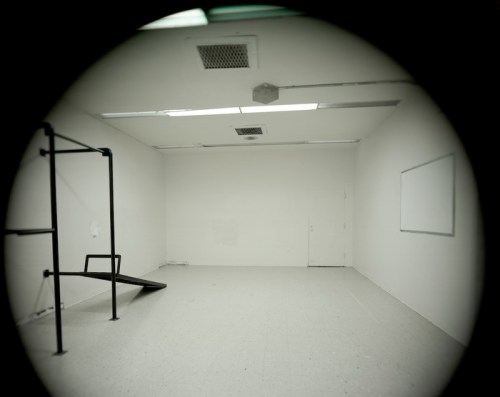
SD: Yes. That’s a play area that had been shut down for months. They couldn’t even use it. That’s IMUs exercise room with no weights, no anything.

Rec Room, Intensive Management Unit, Green Hill School 2000

The situation here is that they’d get a chair if they were still enrolling themselves in school; they had their own choice if they wanted to be enrolled in school. If they acted up, which many did because they were locked up 23/7, they’d take away their mattress and they’d sleep on the cement. And if there was more trouble than that they strip them, and if there was more trouble than that they’d chain them up in the fetal position.

PP: Seriously?

SD: I’m serious. This is what I was told – I was told by staff. It was bad and that’s probably why they didn’t want any of my pictures running in the New York Times. They told me they were cleaning up their act. This was 2000 so that may well be true. My response was, “Great, can you invite me back? I’d like to see it.” They said they were not into that.

PP: You’ve many photographs of the steel doors and hatches.

SD: The hatch is where they’d get their food, mail and medical needs. That’s when the IMU really started to affect me emotionally. You know, when I was working with them face to face in these institutions it wasn’t any different to working with kids anywhere. But …

10, 11, 12 13 & 14, Green Hill, 2000

Cell, Green Hill, 2000

PP: Were these juveniles in the IMU because they were violent offenders or were they there because they’d broken prison rules?

SD: Because they’d broken prison rules.

PP: It was punishment?

SD: Yes, but part of understanding this is also getting accurate information.

I was told they put people there for their own protection. There was one kid who was a pedophile who was apparently there for his own protection, but then I was told later that that wasn’t the case. “Oh, you can’t do that [type of separation].”

PP: One would think prisons could run protective cells and wings without resorting to these stark punitive environments? It doesn’t have to be run like that?

SD: Maple Lane it is less punitive, as far as I could tell.  But they’ll separate gangs as well. You know kids can’t just be housed anywhere. It has to fit with the institution.

PP: I am shocked to learn that juveniles are in isolation. What are your thoughts on solitary confinement?

SD: About the time I was shooting this story, Tim McVeigh was about to be executed for his Oklahoma bombings. Watching him on TV, he was on death row and he clearly had a better cell than those kids. This was interesting but also depressing – some kids told me they’d go to IMU because they just wanted to get away and some of them would only be there for two or three days. But some of them would be there for months.

The staff, there was one guy, I forget his name, was extremely bitter. He said in front of everybody, including the kids. “I could solve this problem easily, I’d just get a gun” and this is how he’d talk to these kids. He said back a few years ago they had tables in the open hallway and a TV and pool table.

The kids took the pool balls and beat the staff with them, they broke the television. So they removed all these things just because the staff were scared – that was the only reason. They told me one woman couldn’t go back to work because her arm could was damaged. And so you realize it is very complicated. These people come to work everyday and they don’t want to be constantly threatened with violence.

Court, Green Hill, 2000

SD: But, of course, these kids [I was photographing] had nothing to do with that. Right? They had nothing to do with it but had to pay the consequences.

Some kids would go to IMU just for mouthing off and others may have done something serious.

As for the staff; some most of them were really good. And I don’t know how they do it every day. Others were those who were bringing in dope for the kids and being nasty.

The kids complained about this and there was nobody there to listen.

PP: No accountability? Did complaints ever get out of the facility – say to the DSHS for example?

SD: I don’t know. Part of the problem is the kids lie their heads off. No matter what they tell me I can’t assume it is true and that is part of the problem and just makes it more complicated. But the more I got to know them they all have their underground. You know – they’ve all got something they can get high on. It must be the staff that’s bringing the stuff in.

PP: What’s in it for the staff? Behavioral management?

SD: Well, they’d get something out of it … I don’t know what. I had camera stuff stolen. I know the staff stole it; it wasn’t the kids.

The kids would always get punished because the state didn’t know what to do with these kids. It was about management – it was not about justice.

Steve Davis, Oakridge, 2005

PP: Tell us about your portraits. Did the kids see your work?

SD: Yeah, they all got a picture. If I did a portrait they all received one. Although yeah [laughs/sighs] some of the kids swore they never got them. I’d give them to staff to pass on …

Something I think is really interesting is this desire for photographs. (I video taped in there too and interviewed a lot of them). They would have empty rooms, but they’d have maybe a few pictures on the wall that they were allowed to have.

It was a huge deal to them to have these pictures. Photographs were important. And one kid who was an outsider (you could tell the other kids didn’t like him) approached the group and said, “I’ve got something but I can’t show it to you.” And they said, “Fine, we not interested.” And he kept nagging; it was clear that he did in fact want to show the group this thing.

Usually contraband is drugs or porno, but no. He pulled out this picture of him and his parents from when he was a kid. It was all wrinkled up and that was his prize that nobody could take from him, I’d never seen anything like that before.

I’d heard from Susan Warner, from before I was in there, that she came across one kid who had never even seen a photograph. I’m thinking, “He must have seen a photograph?” but some of these kids have backgrounds that are so hard to imagine.

Anyway, they loved having their picture taken and they loved having the power to visualize the result.

Steve Davis, Oakridge, 2005

PP: Their futures? Do you wonder what happened to them?

SD: I tried to track them down. And it was impossible. I tracked one down. He made it into community college in Centralia. He was in college when I met him.

Another kid everybody liked. He was popular and he was smart. After he got out he called me once. The Experimental Gallery got him a scholarship. The college wouldn’t admit a felon so he couldn’t use his scholarship. He was on parole, so he had to stay in his local area and so his options were limited to colleges there. So he had a scholarship and he worked in McDonalds!

Later, I was working with a legal advocacy group in Seattle and they could identify a lot of these kids as being in the adult system now. The recidivism rate is 80%. I think in the back of their minds they just kind of expect that [return to an institution]. Prison is where their dad is in many cases. A lot of them – more than I would have imagined – were affiliated with gangs. I never really appreciated that as being a serious problem in Washington State, but most of them had some allegiance. After release most of them return to their homes and familiar neighborhoods.

PP: In how many cases did you think that the institution as it existed served the child and society?

SD: Only one. There was one who was scary. Out of his mind. But there was only one.

PP: Talk about the procedures one must go through to photograph in a site of incarceration.

SD: Everybody asks me, “Can I go do this, who do I need to call?” somebody needs to call you. They’ve already gone through the hoops and they’ve already got that figured out.

PP: Do you see yourself photographing in sites of incarceration again?

SD: Yes. Am I planning for it, no, but it could happen through other avenues. I have been planning for some years to do a project on American war veterans, which falls under the same sort of scope. That is going to be my next big project.

If I do go back to prisons or jails, I don’t want to photograph more portraits that look the same. I don’t want to take the same pictures. I would like to penetrate into [the issue] with something deeper.

PP: Any closing thoughts?

SD: I don’t know a lot about prisons. I don’t know a lot about the adult systems but the youth systems (and I have a two and half year old now) is an embarrassment. It’s really bad they don’t know how to deal with these kids and they don’t know how to make them better.

The real smart ones will figure out how to get out of there and the rest … ?

Door 2, Intensive Management Unit, Green Hill, 2000

Steve Davis is the Coordinator of Photography and adjunct faculty member of The Evergreen State College in Olympia, Washington. He received the Santa Fe Center for Photography’s Project Competition in 2002, and recently won an Artist Trust Fellowship. His work has appeared in the New York Times Magazine, and is in the collections of the George Eastman House, the Tacoma Art Museum and the Musee de la Photographie in Belgium. He is represented by the James Harris Gallery, Seattle.

EMAIL

prisonphotography [at] gmail [dot] com

Prison Photography Archives

Post Categories