1

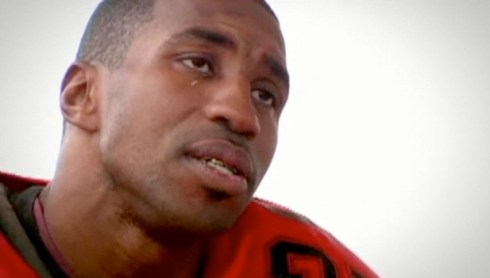
“At one time Angola was well known as the bloodiest penitentiary in America. And now you don’t have nearly as much as the violence as you woulda had.”

Troy West, Angola Inmate

Louisiana has the highest incarceration rate per capita of all US states. over 1,100 per 100,000 – that’s more than 1 in a 100. Angola (Louisiana State Penitentiary) is the mother of all prisons, carrying a weighty reputation and weightier history.

Only Georgia has a rate above 1 in a 100, as Louisiana does. The other Southern states make up the top five (Texas, Alabama and Mississippi).

These stats are due in most the more frequent sentencing of men to life without parole. The disproportionately high rate of prisoners who die within Southern prisons as compared to other state institutions makes for a very different culture.

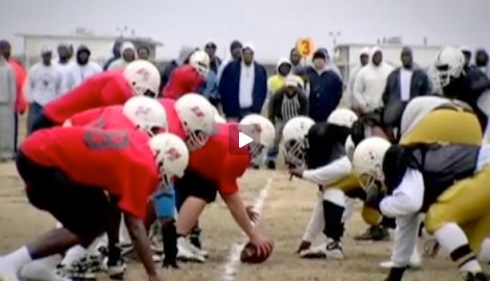
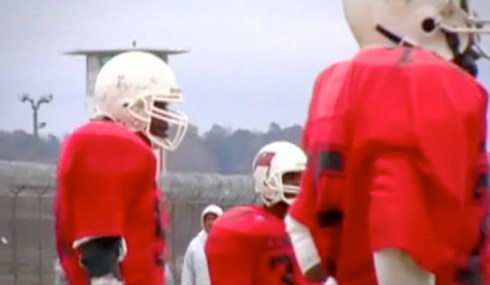
Many photographers including Damon Winter and Lori Waselchuk have focused on the unique aspects of Angola culture. The rodeo is well known, the hospice less so, but least well known may be the football league.

3

2

I have noted before the value of sports in prison, and Angola Prison Football a film-short by Charlie Gruet supports my position.

In it, Angola warden Burl Cain states his philosophy, “Good food, good medicine, good play and good pray. Lose any of those elements and you’ll have violence in your prison, but you would in your home. You think about it.”

The inmates back up the third point. It’s a well done documentary and to think that over 70% of the men in the film won’t ever get out just blows my mind. (Source: 2008 LSP Report).

Watch closely from 4.03 onward.

4

This is the first part of a two part interview. Part two was published on published Thursday, 23rd July, 2009.

– – – – –

Steve Davis. Green Hill, 2000

You already know the work of Steve Davis, you just don’t know it. Prison Photography‘s most popular post was that of pinhole photographs made by the young ladies of Remann Hall, Tacoma. Steve Davis conceived of and led the workshop.

Concurrent to workshops, Steve worked on his own project, Captured Youth (1997 – 2005) turning his lens on the juvenile offenders and institutions within Washington State. Steve’s introduction to the Captured Youth book reads, “What are officially referred to as “schools” are, in fact, youth correctional facilities – jails for juniors. It’s a world kept secret from the general public, but there are no secrets inside. Everyone is watched.”

Steve and I sat down to talk about the circumstances of the workshops and portraits, the involvement of – and benefit to – the teens, the atmosphere in the facilities and how the practice of photography manifests in sites of incarceration.

___________________________________________________________

Prison Photography: Steve, you photographed in four institutions in total?

Steve Davis: Yes, Maple Lane, Green Hill School, Oakridge and Remann Hall.

PP: How did you pick those?

SD: I fell into it years ago. It was fairly unintentional. I was doing PR photography for an [non-profit] organization called The Experimental Gallery that was trying to bring in art teachers on residencies into juvenile facilities. It came up they were interested in maybe having a photography workshop. I said it was something I was interested in.

And, nothing happened for a couple of years, but then I got a phone call and they asked if I’d like to teach the kids photography and double up as a photographer for their publications.

I thought about it and I asked if I could do something different. I wanted to slow the process down and bring in a large 8×10 camera. I just wanted to do portraits; focus on who the kids were without all the trappings, bars, etcetera that go along with images of young offenders.

So, I went in and worked with the kids [within a photographic workshop format] and then organized outside of that to take in the large camera.

Essentially, I was working under the umbrella of The Experimental Gallery, which had a grant, so I could only be there when they said I could be there. And when they were done and the grant was over, I had no more access.

Steve Davis, Remann Hall, 2002

Beginnings

SD: It started in 1997 at Maple Lane, then later the Green Hill School and Remann Hall. Each of those placements was under the direction of Susan Warner and The Experimental Gallery. Susan is now the Director of Education at Tacoma Museum of Glass. Between time, Susan had a job at the Children’s Museum in Seattle and they supported her doing this and she continued through them. And likewise, since she has worked at Tacoma Museum of Glass they have supported her as well. So the name has always been the same.

Lastly, at Oakridge – that was all my own work, with anyone’s sponsorship.

PP: You returned to Oakridge and the project in 2005. Why did you decide to return?

SD: Well, at the time the project didn’t seem resolved. I wanted to do something a little different. Oakridge is a transitional facility so they are not so much under lock and key, they are allowed to wear their own clothes and they have day jobs. That is where they reside just prior to release.

Soon after [Oakridge] I felt like I was getting to the point where I was taking the same picture.

PP: How did you respond to that?

SD: I tried contacting other facilities. I really wanted to get in to Clallam Bay, which is an adult institution but has a juvenile facility. It is really hidden from the public. But none of that panned out.

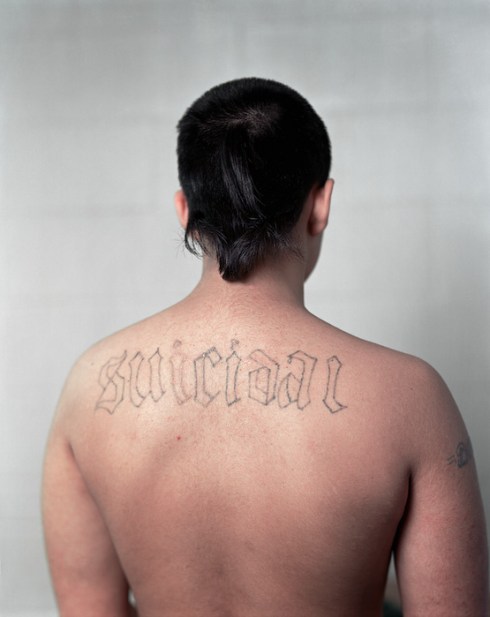
Overall, my interest with portraits has pretty much been about people who are controlled and lack all sorts of freedoms. I haven’t only focused on prison; I did a lot of work at an institution for the mentally disabled.
Steve Davis, Green Hill School, 2000

PP: What’s the attraction to these types of subjects?

SD: When I got into the work, I fell in with these mini societies with their own economies and their own rules and they’re all over the place. They are thoroughly hidden by intention from the public – who have no interest in examining it.  It doesn’t benefit the public to do that.

I found these places intriguing partly because once you are there in the middle of it, the people you come across, they’re linked together by reasons that are not of their own choice. It’s not the type of community where people have something in common so they create their own economies. They are like dogs in a pound. They might be friends, they might not, but they share common concerns.

I was interested in trying to zero in on these people as individuals with personalities and hopefully open up a lot of questions with the viewer. That s all I wanted to do. I wasn’t trying to reach conclusions or force anything down anybody’s throat. I am just trying to acknowledge that this is 20 miles from home.

All these [sites of incarceration] have names that sound like country clubs! You’d never know that Maple Lane was anything but a nice street or golf club. When you drive past, it is a beautiful place, but you won’t see a kid outside. It looks good from the road, but it is not a place you can walk around.

When I did workshops, they’d love it if I walked them over to the fence; they’d never been! Just little things like that were huge thrills to them.

PP: So the youth were always willing participants?

SD: The first residency at Maple Lane was the best organized. The kids were engaged – some were working with painting and music. The goal was to create a mixed media large exhibition that would go into the high schools of King County, and other areas that had a lot of at-risk youth.

So the kids [inmates] would present the information of their own lives. The message was for the exhibition was generally “You don’t want this”. The young prisoners understood that and got behind it.
Steve Davis, Maple Lane, 1997

Method

PP: Tell us about your portrait work. How much direction did you give the boys as sitters?

SD: Well, they knew the reason why I was there. And all they knew was that their portraits were to go into a catalog. In all, three catalogs were produced. They knew the photos would be published and shown. Other than that, the motivation from these kids to have their picture taken was overwhelming.

I did go in with a bit of theater. I had a large camera, I had lights and I had an assistant. So they were just begging to get their picture taken. It wasn’t hard at all. Direction was minimal. I’d ask them to turn their head or look into or away from the camera. Because I was shooting 8×10 on a limited budget, I’d take a limited numbers of pictures of each person, maybe 2 or 3, and then they were gone.

PP: The personalities of these kids comes through very strong. Are these images an accurate reflection of the individuals in the group?

SD: Yes, each photograph is one accurate reflection. Many of the sitters look very somber, but in fact they’d be laughing their heads off a lot of the time.

Some of the portraits I feel stronger about than others. There are some portraits I don’t have a particular connection with and there’s other I really love. Kids that really struck a chord with me, part of it was the experience of them sitting with me, knowing their character.

Steve Davis, Maple Lane, 1997

PP: Can you talk about a few of them?

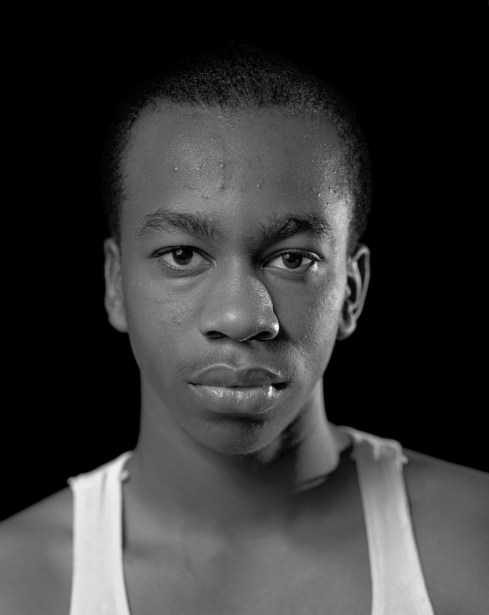
SD: This guy. The nicest guy in the world. Total white racist. Had as many black friends as white, but he was basically raised to be a white racist. Once you got to know him you fell into that world, his world. He got along with everybody, but if you asked him he would’ve told you what his views were. I shot a lot of him, indoors and outdoors, more complicated environments.

PP: This portrait?

SD: I like that one. I don’t know if it’s the picture or the kid. But out of all the time I was there, he was the only one where the staff said, “He should not be here.” He was a Mexican who got busted for being a drugs mule from Mexico. Apparently, some rivals burnt his house down. He couldn’t or wouldn’t speak English. He was scared and totally out of his element. But over about three months he started playing the role of the tough guy and you saw this transition. He was becoming what he was assumed to be to begin with. Becoming a hard guy – it was sad.

Steve Davis, Green Hill, 2000

Steve Davis, Green Hill, 2000

PP: And this guy?

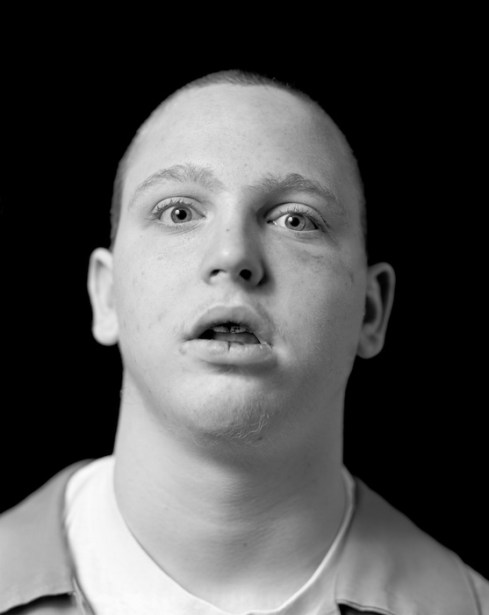
SD: This was in the psychiatric ward and they were all seriously medicated. This kid here was heavily medicated. He’s got blood on his teeth.

PP: Explain the blood.

SD: He told me he was in a fight the day before and he was walking around like this. Maybe he was continuing to bleed.

PP: Did he always have that look?

SD: Probably not. I didn’t really know this kid. But when I saw him I really wanted to photograph him. I was never demanding, but he was the only one I had to cajole. I said “If you want to make a dent, let me take your picture.” He said okay. That was just his gaze. I really thought his look was gripping. And there was a whole wing of them.

PP: Was it a common attitude among the juveniles, that they knew they were medicated and they knew they didn’t want to present themselves as such to the camera?

SD: He was the only one. I only took two pictures in the psychiatric ward.

Steve Davis, Maple Lane, 1997

PP: And this young man?

SD: He was the only other one I photographed on this wing and he was fine with it. A couple of years later when I was working at Green Hill, I was showing the staff my work and they recognized him and told me he’d got out and was later murdered on the street. He was involved in a knife fight.

PP: This one may stick with viewers but maybe for the wrong reasons? This is your only image where the sitter comes across as full of attitude, possibly angry?

SD: Yeah, he’s got a smirk. This picture never struck me as much as others, but many people have commented. I just never really connected with the portrait.

Steve Davis, Green Hill, 2000

SD: One thing I learnt from putting the work out is that people respond to these portraits for their own reasons. A lot of the reasons have nothing to do with prison justice. Some of them like pictures of handsome young boys; they like to see beautiful people, or vulnerable people, whatever. That started to blow my mind after a while.

But on the other hand, I don’t want to force people into thinking that these portraits should be considered in one particular context. Just, here they are. Portraits are really charged that way.

PP: My wife’s favourite is the kid blowing gum. What was that scenario?

SD: He was the nicest kids. He was overweight. He had a massive pack of bubble gum and it was in Oakridge, so he was on work release during the day. He seemed like a nice kid and so I asked “could you blow a bubble”. He did. I like that picture precisely because he looks as if he doesn’t belong.

Steve Davis, Oakridge, 2005

SD: But more than the portraits, the pinhole photographs from Remann Hall are my favorites.

___________________________________________________________

Please return on Thursday, 23rd July to read Part Two of this Interview.

My call on Friday for more information on Civil War era prisons bore an unexpected rich harvest. A single reply but an absolutely riveting one.

Imagined Prisons responded with this:

These images are fascinating and haunting, and the idea of the modern prison as “a permanent abstraction of earlier jails” is a compelling one.

As for the carceral spaces – makeshift and otherwise – of the Civil War, some authorities have cited Lincoln’s suspension of habeas corpus rights as a precedent for the Bush Administration’s policies in today’s war prisons. E.E. Hale’s classic short novella, “The Man without a Country,” written in response to Lincoln’s controversial move, tells the story of a man sentenced to spend the rest of his life aboard U.S. Navy ships, in the extralegal zone outside the boundaries of the nation-state.

You might also be interested in this poem by Herman Melville, from the 1866 volume “Battle-Pieces, and Aspects of the War”:

In the Prison Pen

Listless he eyes the palisades
And sentries in the glare;
‘Tis barren as a pelican-beach–
But his world is ended there.

Nothing to do; and vacant hands
Bring on the idiot-pain;
He tries to think–to recollect,
But the blur is on his brain.

Around him swarm the plaining ghosts
Like those on Virgil’s shore–
A wilderness of faces dim,
And pale ones gashed and hoar.

A smiting sun. No shed, no tree;
He totters to his lair–
A den that sick hands dug in earth
Ere famine wasted there,

Or, dropping in his place, he swoons,
Walled in by throngs that press,
Till forth from the throngs they bear him dead–
Dead in his meagreness.

Imagined Prisons is the accompanying website for the book The Prison and the American Imagination, by Caleb Smith, which will appear from Yale University Press in September of 2009.

The Prison and the American Imagination, by Caleb Carr. Yale University Press, September 2009

The Prison and the American Imagination, by Caleb Smith. Yale University Press, September 2009

The book examines the history of the U.S. prison system and its imaginative life in nineteenth – and twentieth – century culture. Caleb Smith argues that the dehumanization inherent in captivity has always been at the heart of American civil society.

Imagined Prisons is a forum for conversation about the book and the questions it raises;

What is the history of incarceration in America? What roles do prisons and prisoners play in our political life and in our culture? How have artists and writers, both inside prisons and in the world at large, invited us to imagine the institutions of captivity? Visitors to this site might be interested in the sprawling prison system of the twenty-first century, including the scandals of American war prisons overseas. They may also wish to explore the long, sometimes tortured history of jails, penitentiaries, plantations, and other dark places that have haunted the new world, with its promise of liberty and justice for all.

What a significant new resource with which to reassess the prison within America’s cultural landscape. Prison Photography, too, is attempting (admittedly ham-handedly on occasion) to define the current representation/consumption of prison imagery within our society.

May I suggest that books such as Caleb Smith’s and sites such as mine exist because sites of incarceration – “dark places” – have been over-zealously operated by controlling minorities and not adequately discussed by the at-large majority?

Lewis Payne

Lewis Payne, seated and manacled, at the Washington Navy Yard about the time of his 21st birthday in April 1865, three months before he was hanged as one of the Lincoln assassination conspirators. Photograph by Alexander Gardner, probably taken aboard the ironclad U.S.S. Montauk or Saugus.

Quick post & a request. We all know about the relentless Shorpy and the site’s daily dose of long gone photo ephemera. It is indeed a treat.

Today, two images from the 1920s went up. Shorpy’s keen to focus on the visual narratives that arrest the attention. Consider it a human interest archive if you will. It is my guess is he/she/it chose these two photographs relating to crime and punishment because they deal with women and children. If there is still one thing true today as was back then, these two groups are distinguished from, sometimes condescended to, and likely protected and abused in equal measure by, prevailing patriarchies.

Women Jail

Washington, D.C., circa 1920. “Jail, Women’s School.” Alternate title: “Complete this sentence.” National Photo Co. Collection glass negative.

JuvenileHall1920

Washington, D.C., circa 1922. “House of Detention, Ohio Avenue N.W.” Equipped with a nice playground. National Photo Company glass negative.

These came at an opportune moment because I’ve been wondering what to do with the following four images from the American Civil War. It is not an area I am well read up on. I guess the make-shift nature of jails and prisons in the vicinity of battlefields and front lines attests to the constant flux and shroud of unpredictability across a bloodied young nation.

Prison Photography blog is often concerned with inflexibility and pursuant damage it can cause as applied to institutions. But the modern prison is merely a permanent abstraction of earlier jails. ‘Transitory’ sites of incarceration, especially in times of war, are even more contested as sites than the Supermax prisons of the 21st century.

It’s got me thinking how Castle Thunder and Belle Isle relate to the the GWOT prisons – namely the early incarnation of Abu Ghraib prison, Bagram Airbase and other as yet unknown ‘Black Sites’ of detention and interrogation.

Castle Thunder

Richmond, 1865. “Castle Thunder, Cary Street. Converted tobacco warehouse for political prisoners.” Main Eastern theater of war, fallen Richmond, April-June 1865. Wet plate glass negative, photographer unknown.

Prison run by the Confederacy. Used for civilian prisoners, Castle Thunder was generally packed with murderers, cutthroats, thieves & those suspected of disloyalty, spying or Union sympathy

Belle

Spring 1865. Belle Isle railroad bridge from the south bank of the James River after the fall of Richmond. Glass plate negative from the Civil War collection compiled by Hirst D. Milhollen and Donald H. Mugridge.

One of the first Confederate prison camps. Opened after the First Battle of Bull Run and held Union Army NCO’s and enlisted men. There were no barracks constructed, the only shelters were tents. Intended to hold only 3,000 but numbers grew to double that and led to many prisoners being shipped further south to other camps, most infamously Andersonville.

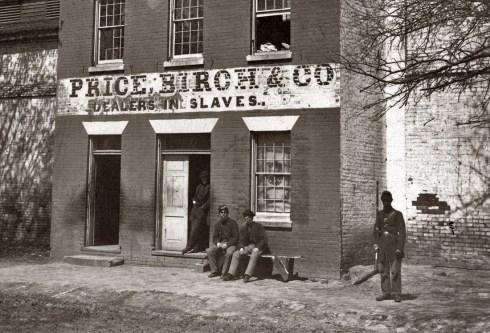
And finally, this site is described as a “slave pen”. This document of slave incarceration is gut-thumping and, however agonising the means, justifies the Civil War and its righteous ends.

Request: I am keen to know more about prisons and jails of the Civil War era. If you’ve any resources I should absolutely be aware of please drop me a note. Thanks

PriceBirchCo1865

Built in 1812 as a residence for General Andrew Young, this was the office building of the former interstate slave trading complex which stood on the site from 1828 to 1861. By 1835 Franklin and Armfield controlled nearly half the coastal slave trade from Virginia and Maryland to New Orleans. In 1846 the property was sold to a Franklin and Armfield agent, George Kephart, whose business became “the chief slave-dealing firm in [Virginia] and perhaps anywhere along the border between the Free and Slave States.” After 1858, the slave pen was known as Price, Birch, and Co., and their sign can be seen in a Civil War era photograph. The business was appalling to many, especially to active abolitionists in Alexandria, where the large Quaker population contributed to a general distaste for slavery. Several abolitionists’ accounts survive which describe the slave pen and the conditions encountered therein. Male slaves were located in a yard to the west, while women and children were kept in a yard to the east, separated by a passage and a strong grated door of iron. The complex served as a Civil War prison from 1861 to 1865, and housed the Alexandria Hospital from 1878 to 1885.

1

Fabio Cuttica‘s 2006 photo essay in Nerve from the Buen Pastor (Good Shepherd) Prison, Bogota was brought to my attention via industry-insider Rachel Hulin’s A Photography Blog. She describes a well-rude awakening.

I woke up in the middle of night after dreams of Sarah Palin, and realized that in my subconscious I had placed her into a photo essay I ran years ago as a photo editor at Nerve. She was a beauty queen in the Prisoner Pageant in Bogota, and she was glorious.

If you can get past this description from Hulin’s subconscious, I encourage you to think about the merits of this particular pageant. Despite the obvious interest from media (who are unlikely to refuse such a unique/titillating story) the benefit here seems to be predominantly for the women of the institution.

3

5

The pageant in is honour of the Virgin Mercedes, the patron saint of prisoners. Ada Calhoun – in the intro for the Nerve photo essay – hams up the language to sensationalise the event, but I don’t think there is a need. Cuttica’s photographs are brimming with the fun, the nerves, ecstasy and community of the event.

It is obviously novel day. It would seem to me that the opportunity to celebrate femininity and to express notions of beauty normally obscured by the institution would be a welcome relief for many female prisoners; I hope its a hell of a lot of fun.

But, this is a curious contradiction to how I usually feel about beauty pageants. I generally consider beauty contests as shallow, if not ridiculous. They make a whole lot of noise over very trivial matters. To my mind, a beauty contestant on stage is as pathetic as a dog in a sweater; cringe-worthy, vulnerable and compromised.

I suppose an answer lies in who has the power and the organising authority. I may be wrong, but I presume the women of Buen Pastor prison have a huge investment in the pageant – supporting their friends, stage preparations, making costumes and accommodating guests to the prison on their day.

This is, of course, in contrast to the usual female beauty contestant who is likely genderised by her community, normalised into swimsuit & high heels at an early age and conditioned to not question the strange gaze of a town’s older (men) folk.

2

6

4

Fabio Cuttica resides in Bogota, Colombia. His work is distributed by Contrasto & Redux agencies. He has worked across Latin America, recently winning acknowledgment from the College Photographer of the Year for his work documenting the La Maria & their struggle for land rights in the Cauca Region of Colombia. In 2008, Cuttica was honorably mentioned at the National Press Photographer Association’s Best of Photojournalism Awards for his extended essay about gang violence in Barrio Petare, Caracas, Venezuala. He has also worked on assignment for GEO about the Basque Region of Spain and covered the traditional family life and weaving in Valledupar, Colombia.

screen

Sunday night/Monday morning (depending on your seaboard) was the point in which my first professionally recognized byline hit the internets.

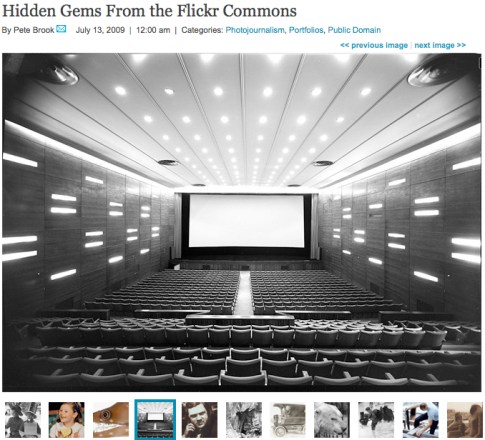
The piece, Hidden Gems From the Flickr Commons, is a walk through my Wired’s personal favourites. The crux of my pitch to Wired was that we all need to get out from under the mass-consumed images of the FSA/OWI archives.

2849454868_14a8240f90_b

Wired’s new blog Raw File deals specifically with photography and is marshaled by a close friend Keith Axline. Keith held out a hand and gave me a finite amount of time to grab hold. I’m glad I didn’t pass up the opportunity.

There’ll be more to come in the future. And I’ll probably force it down your necks again. If you’ve seen me relentlessly plug Raw File material these past few weeks on my Twitter stream, you now know why.

3404663739_6d909b0886_o

Top Image: Screenshot

Middle Image: Canthigaster rostrata, Inflated (Caribbean Sharp-Nose Puffer), Belize Larval-Fish Group 2005, National Museum of Natural History, Smithsonian Institute Collection.  Fujifilm FinePix S3 Pro 12.3-megapixel camera with a 105-millimeter f/2.8D AF Micro-Nikkor lens and dual Nikon SB28 flash units. (Source)

Bottom Image: Polar bear (Ursus maritimus) in cage at Lincoln Park Zoo. 1900. Original size and material: 4×5 inch glass negative. Field Museum Collection – Digital Identifier: Z80007 (Source)

2

“What started out as an assignment for school has produced a piece that has changed my life and hopefully will do the same for the people that view it.”

Jenn Ackerman

“We are the surrogate mental hospitals now.”

Larry Chandler, Warden of Kentucky State Reformatory, La Grange, KY

“My students are my biggest inspiration.”

Jenn Ackerman

3

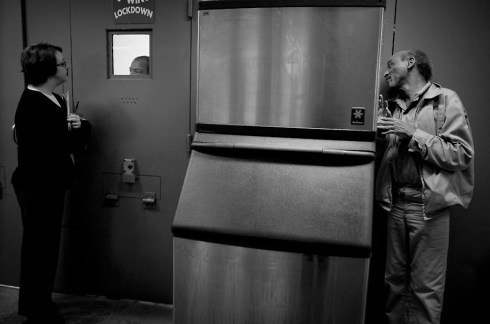
This year, more than 700,000 people will be released from prisons and jails in the U.S. and more than half of them suffer from some form of mental illness. (Source)

A few months ago I wrote to Jenn Ackerman, praised her Trapped project and of course offered to promote it. I wanted to get at her stories behind the images – namely do an interview. Jenn, however, is as good a promoter as she is a photographer.

The list of questions I wrote out while eating my chili-verde burrito on Wednesday are made largely redundant by her blog post “Trapped: Questions Answered”. Her photography and multimedia is so strong that it also speaks for itself. There is a painful truth in her work; more questions than answers.

I have plenty material to give you a thorough summary of Jenn’s work.

13

8

Firstly, allow me to give a run down of the current situation of mental health care provision in America’s prisons and jails.

A 2006 report by the U.S. Department of Justice shows that the number of Americans with mental illnesses incarcerated in the nation’s prisons and jails is disproportionately high. Almost 555,000 people with mental illness are incarcerated while fewer than 55,000 are being treated in designated mental health hospitals. That is inadequate provision.

555,000 represents, at the very least, 16% of inmate populations of state and local jails. I would contend the figure is higher – well above 20% – but this is only my personal belief.

If these numbers are not shocking enough, one must consider the pressures the prison system – in and of itself – exerts on the mental health well-being of those incarcerated by consequence of the increased reliance on solitary confinement to control populations, unqualified staff (especially in private prisons), overcrowding, institutional violence, lack of volunteer programming and engagement (in remote facilities) and the inadequate/unconstitutional general health care provided in states such as Ohio and California. California Department of Corrections has been the subject of a high profile federal lawsuit for the short comings to provide suitable care. (Incidentally, the $1.9b figure quoted in the linked article used to be $6b, until Schwarzenegger rejected it … and there is a serious threat it will be nothing if California cannot sort out its budget disaster).

In prison systems with such endemic problems, it is those who have no way to advocate for themselves who suffer most. Jails have effectively become America’s defacto mental institutions; they house a larger volume of mentally ill people than all other programs combined.

Against this backdrop, Ackerman went to work.

6

5

Prison Photography is keen to unveil the means by which photographers, anyone, can gain access to prisons to engage with the “invisibles” of society. In that spirit I quote Jenn;

How did you get access to this story?

I had done a lot of research and had decided on the story I wanted to tell when going to talk to the warden. I always feel that a an in-person visit is more beneficial. — I can better express my passion and excitement for this story. I had called a couple of prisons days before I called the Kentucky State Reformatory and to no surprise they didn’t respond to my messages. But then I came across a wing that was dedicated to mental illness in a prison. Warden Chandler answered on the second ring. This caught me off guard but got it together enough to tell him what I wanted to do. He said I had a lot of work to do before I could start on the project but that he might be interested. I sent a proposal days later and asked to come visit the reformatory to talk to him in person.

How did the warden and officials respond to the project?

I didn’t know how they would respond at first. But I also knew that the warden and everyone involved wanted this story to be told. I was very honest with everyone from the beginning. I told them that I knew that they were doing something to acknowledge mental illness in prisons which hasn’t happened in every state but that I also knew that the program was not perfect. I told them that was going to be my approach. So from the beginning they knew that I was not going to make them look bad but also wasn’t trying to say that they have the final answer to this issue. But I visited the warden the day before I published it on my site to get his reaction. He loved it and thanked me for creating an honest portrayal of the mental illness in prisons. I told him that was the best compliment I could ever get.

There can be no doubt that Jenn was lucky to find Warden Chandler who was so sympathetic to her objective and realised the importance of the project.

1

4

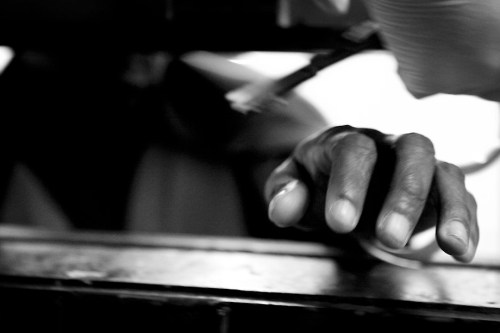
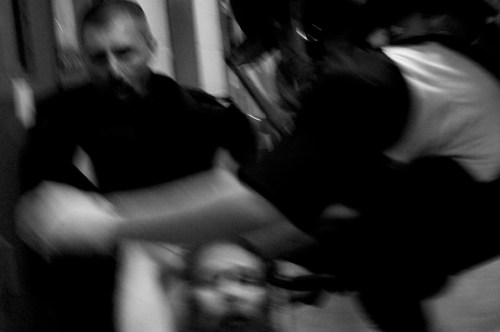
Jenn has explained that she spent a total of 10 weeks on the project, including 10 days of still and video shooting. Her time commitment is reflected in the comprehensive coverage. Trapped is a dark bubbling cloud of stories and troubling images that are weft with human emotion, the occasional reprieve but predominantly the collision of lives – lives that orbit tormented psyches that a punitive world of reinforced doors & service hatches cannot soothe.

Jenn’s commitment is epic. Besides the Trapped feature film, Jenn breaks the project into a series of presentations. Firstly, the In Their Corner short about the inmate watch. Secondly, In Their Minds a series of seven film shorts allowing individual inmates camera time to represent themselves. Trapped is segmented into six photography galleries; each one a captivating photo-essay in its own right. I cannot over-emphasise the sensitive depth with which Jenn has documented the incidents on the Correctional Psychiatric Treatment Unit (CPTU) at the Kentucky State Reformatory. Jenn also provides an extended essay about her own response to the CPTU environment.

12

10

Jenn interviews for 25 minutes at Multimedia shooter. The audio is wobbly and distorted but the information is valuable. Check out from 21 mins. onward to learn of the administration’s response.

Trapped: Mental Illness Inside America’s Prisons has deservedly received acclaim from burn magazine, 100 Eyes, Verve Photo, the White House News Photographers Association (honorable mention), Inge Morath Foundation and CPoY. Jenn recently won an internship at the New York Times.

Jenn credits her students for much of her inspiration. Check out Jenn’s class website for more details.

9

11

San Pedro Prison in Bolivia has ceased tours for foreign visitors.

I regret my one missed opportunity. I’d been mildly obsessed with the La Paz prison for a couple of years before I arrived outside its gate and got turned away. That was July, 2008. I had read in Lonely Planet it was a piece of cake to get in and get a tour. Apparently not in my case. I surmise, that I had experienced the beginning of the end for La Paz’s most bizarre tourist attraction.

It’s definitely over now. This from yesterday’s Guardian;

It used to be one of South America’s most fabled tourist attractions. Celebrated as unique in the world, San Pedro in La Paz, Bolivia, was a prison like no other. Foreign tourists would pay bribes to enter, gawk, shop, dine and even do drugs. A sweeping crackdown has barred tourists from the complex, replaced corrupt guards and challenged bizarre practices which had become the stuff of lore.

Tours have never been officially recognised and the vagaries of securing visiting privileges for foreigners stems from the fact that prison guards have different rules/corruptions and relationships to outside ‘tour-guides’. Basically, foreigners had to be lucky or connected to get inside.

Flickr searches prove that “wide-eyed travellers” have visited in all the months since my failed attempt.

The reason for the end of this bizarre tourist ritual? Seemingly, tourists got too cocky and too brazen. The new prison warden ended the debacle. This was a peculiar decision (on first glance) given years of international coverage and tolerance by the authorities, but basically, everyone involved had become too comfortable – objectionably so – with the institution-turned-circus.

The group most guilty for giddy spectacle was of course the tourists. In February the self-titled “Wild Rover Group” posted this video.

And it was the tipping point. The video doesn’t show anything that wasn’t commonly known, but it spells it all out with clarity and (critically) to an unrestricted worldwide audience.

This thorough dissection of the events by a Bolivian source, explains;

In an irreverent tone they boasted about their tour, were seen laughing and enjoying it, and they filmed some of the cocaine manufactured inside, as well as the facilities, rooms, kitchen and other areas. Days later, tourists began to show up in record numbers at the Plaza across from the prison. This drew the attention of neighbors and the general population. There were too many and it was too obvious.

It is surprising that a single video should be the tipping point, especially after a decade of widely circulated photographs. Nevertheless, the circus could no longer be ignored, nor controlled.

Interest online was mirrored by interest on the ground. Tourists filled the square outside wishing to visit; such numbers could no longer be surreptitiously ghosted in the side-door.

Vicky Baker explains,

The tours have been run on and off for years, but this time the (totally unofficial) organisers pushed it too far. There was an increasing lack of discretion. Travellers were being allowed to take cameras in and were uploading pics on to flickr and videos on to YouTube (Were all prisoners asked permission about this?). Rumour had it that local tourist offices were offering tours under-the-table, while those that turned up at the door, like I did, found that money was exchanging hands in a sideroom on prison premises.

The prisoners leading the tours had become greedy. If they’d had any sense, they would have halted them on the six-month anniversary of the arrest of Leopoldo Fernández, a controversial ex-governor accused of genocide. That day inevitably brought protesting crowds and film crews. According to James Brunker, a photographer based in La Paz, when one of the film crews got wind of a tour group inside, they decided this was “far more interesting!”.

Here’s the local media shining a big spotlight on activities with long-overdue questioning and coverage of the tours. Foreigners reacting to the attentions, flipping off the camera and scampering away under jackets were only ever going to look bad!

Unrest

Governor, Jose Cabrera, is emphatic, “The prisoners have to understand that this is a penitentiary.”

The tourism, while exploitative, was a reliable source of revenue for the prisoners and their families. By shutting down the tours, incomes for over a 1,000 men, women and children was dragged out from under them.

San Pedro was/is indelibly tied to society outside. Family members come and go daily to bring goods and services to the self-made micro-economy. The decision to close the tours down was exacerbated by new restrictions on visiting privileges. Discord grew.

On March 26th at about 4:00 p.m. in the afternoon, what apparently began as a small discussion and fight escalated into an all out prisoner mutiny. Hundreds of police officers were sent in to control the situation. The police shot canisters of tear gas into the prison’s interior patio. Soon prisoners were scrambling up walls and onto the roof.

As the Bolivian news crews were present to film the hoards of foreign tourists in the square, they captured the three hours of unrest from start to finish. Families, including children, of the prisoners were caught in the tear gas clouds. Unfortunate scenes.

The riot was a predictable end point to the new warden’s crude (but probably) necessary shut-down of this dubious spectacle. Many Bolivians didn’t like the fact the nation’s biggest prison was a site of titillation for foreign visitors; many were understandably ashamed and angered.

Paradoxically, one of the factors that allowed mass visitation was the accommodation of family members to spend unlimited amounts of time with incarcerated husbands & fathers during daylight hours. The institution had a generous (and unAmerican) protocol for the relaxed coming and goings of non-inmates.

What Next?

Money and the necessities it brings are key to solving the tensions. According to a prisoner interviewed by La Rázon, “70% of the [250 peso] fee goes to the police and the people who organize the foreigners for the tours,” the rest being split up among prisoners. This monetary ecosystem may not have been fair but it was consistent.

The new warden has since negotiated and agreed new rules for San Pedro, presumably taking into account the stymied income for all inside. Time will tell. As an indication of how fragile authority is at the prison, the new warden has adopted a fast rotation of guards to prevent foreigners … the suggestion being, a guard needs only to get comfortable at his gate post before he can start manipulating bribes to get tourists in again.

I’ll leave you arguments for permanent closure of San Pedro to foreigners with the thoughts of two Bolivians;

This type of tourism contributes to a blatant abuse of prisoners’ rights and human rights in general. A handful of pesos from tourists is not a substitute for the government providing the inmates with basic food, shelter and medical care (and as many as 75% of prisoners in San Pedro are simply awaiting trial and have not been convicted of any crime). Thousands of pesos a day being poured into the prison via tourism serves mainly to maintain and sustain the system of corruption that governs the prison and turns its inmates into the rough equivalent of animals in a zoo.

and

Isn’t it possible to be more responsible? To be more respectful? When touring a foreign country must it be treated like a traveler’s playground with no regard for local inhabitants? Not to mention, is your own safety actually worth it? And what kind of message is being sent to those who are imprisoned? That they must pay for their crimes but foreigners can get away with illegal activities for Bs. 250 per tour?

True.

The Remains

The photographic legacy is wide and varied. Amateur snaps prevail here, here, here and here. Enthusiasts occasionally turn their skills, and professionals such as Hector Mediavilla have focused on cocaine manufacture and drug addiction in San Pedro Prison.

EMAIL

prisonphotography [at] gmail [dot] com

Prison Photography Archives

Post Categories

RSS PETE BROOK’S TUMBLR ‘PHOTOGRAPHY PRISON’

  • An error has occurred; the feed is probably down. Try again later.