cooleh

Fearful Symmetry

Sorry, more self-promotion. For Cooleh magazine, I rewrote old speculations on the non-existent genre of prison photography. I discuss the visual vocabulary of prison photography and the slipperiness of cliche depending on the experience of the camera operator.

The editor confirmed it for me though: It was the strength of the images by nameless inmates of Remann Hall youth detention facility that carried the story! Fearful Symmetry is part of Cooleh’s 14th issue which takes a story-based, raw and somewhat irreverent angle on crime; politics of crime in jamaica, urban pot growers, secession states, botched 7/11 robberies and interviews with the unheard.

fearfulsymmetry

unemployed youths

Joseph Rodriguez‘s work is essential. If I and others can promote his photography humanity then we’ve done some good.

Last week PDN ran a post about the value of the “Digital Curator“. It was a well threaded argument about things we already know: that if an online presence (blogger) does his/her thing for long enough and with a consistent (their own) voice they’ll begin to garner readers, respect and influence.

[WARNING: link blitz, but all justified]

Thankfully, we have (I believe) a healthy photography blogosphere in which plenty of photographers present their own STUFF; megaliths go vernacular; academics question and answer; fine art specialists point us in the direction of good practice & theory; insiders offer editorial, publishing, gallery, collector, buyer or industry viewpoints; universities promote; non-profits take new angles; curmudgeons grumble; old media gets hip; young guns splash out with collective and interview projects & some hover untouchably above.

In September, duckrabbit joined the fray. You may know already, but I am a fan of duck’s blog (by Ben Chesterton). I am not a fan because I agree with everything Ben has to say, but because he says it without frills and then will spend the time necessary to engage the consequent discussions. Such commitment is a priceless commodity.

duckrabbit deals primarily with photojournalism and multimedia and so Ben’s coverage doesn’t always dovetail with the preoccupations of other photographic genres – which is fine, we all have our favourite corners.

To get to the point. I am nodding furiously toward the coverage of Joseph Rodriguez on duckrabbit for three reasons:

1) Because Rodriguez (along with Leon Borensztein) made me realise how vital the relationship between photographer and subject is in creating images. Rodriguez is worth more time than duck or I could ever commit.
2) Because this is the latest in principled stances duckrabbit has taken, AND it happens to highlight the stories of formerly incarcerated.
3) Because I am committed to writing more about Rodriguez in the next month … and need to let you know.

duckrabbit’s first feature of his new series ‘Where It’s At’ (stuff that kicks a duck’s arse) is Rodriguez’s work on Re-entry after prison. Rodriguez worked with Walden House (I remember fondly the stained glass of the San Francisco WH, Buena Vista Park). As duckrabbit puts it, “Rodriguez records lives lived and he never measures the lives of those he shoots against a photographic award, magazine spread or advertising contract. His eye is never on the future, it is always in conversation with the now.”

Go to duck’s post and watch Rodriguez’s 7 minute multimedia piece on re-entry. California is where I cut my teeth in the prison policy and prisoners’ rights fields, so for me, it is especially resonant … and vital.

Also worth noting is Benjamin Jarosch, Rodriguez’s current assistant.

While we are on the topic of different realities in urban America, keep an eye out for this film at your local cinemaplex indie-theatre.

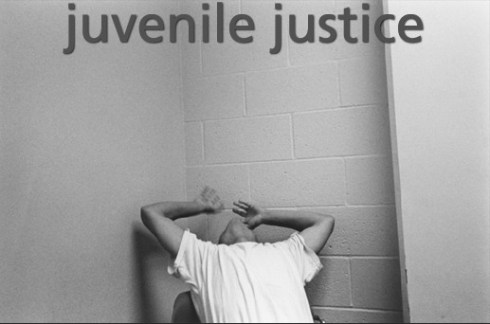
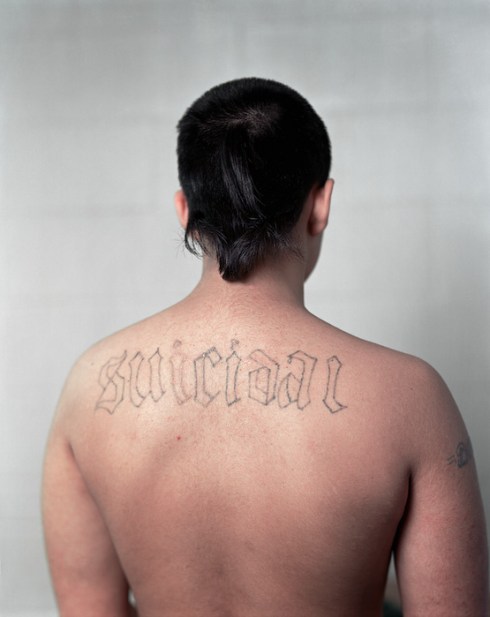
In the next few weeks I’ll be making comment and whirring the brain cogs over Rodriguez’s photographic endeavour Juvenile Justice . Stay tuned.

juvenile

Rodriguez has won acclaim from all the important people that need to take notice, including Fifty Crows, which incidentally started up a blog recently. Everyone reading this should follow Fifty Crows because they support photographers who get in knee deep … and then some.

Peace.

An argument to say that a cheap photo print economy obscures the good and the bad.

This week’s discussion between Jörg Colberg at Conscientious and Paddy Johnson at ArtFagCity about the culture of “Cheap” relates directly to last weeks concerns (and rightful criticisms) about Chris Anderson’s futurescape ecology of the “Free”.

Anderson took the nature of our ever-connected world and (disposable) media, extrapolated it, stretched it some, and applied it to future practices of production, “Every industry that goes digital eventually becomes free”. This is quite an obnoxious notion as human creativity is not broadband, but let’s move on.

I trust none of us reading here would dispute the utility of product created on ones own time and dime to be dangled in front of an audience. Self-promotion will always be with us. But ‘Free’ production as practice is short-term tactic not long term strategy. ‘Free’ is a philosophy rooted in a culture of the intern and the society of high personal-risk. As one photographer noted, “My free assignments have only ever led to more free assignments.” [I’d be happy to find that source again, help? APE maybe?]

Lower priced prints present as many dangers as ‘free’ for the artist, particularly the emerging photographer. There is a legitimate worry that creators will suffer an infrastructure unable to support photography as a profession.

Jörg is worried about several things (correct me if I’m wrong, Jörg):
a) our collective acceptance of cheap prints
b) the reality of “Cheap”, now, that few of us have digested
c) the limited discussion of cheap and its obstruction to other (more pressing) discourse

I contend that some of the angles to tackle this discussion are not only undigested but unsaid.

I say that there’s a lot of bad photography masquerading as fine art today – and that our acceptance of low price economics for photography lays down the perfect conditions for bad art to skulk in and nest among finer company.

Are some echelons of the fine art photo industry polishing turds?

To leave photographers or organizations dealing in knockdown pricing unnamed is diplomatic but we shouldn’t assume it is necessary. I think we can still acknowledge these parties and still ask, as Jörg did, “Is this [low pricing] good for the artist?”

Paddy Johnson named 20×200. Personally, I think 20×200’s curatorial eye is disciplined and the work put into establishing the model for “art for everyone” is nothing short of miraculous. But what follows 20×200?

What pricing terrain is developing? Jörg asks, “What is good for the artist?” Firstly, awareness and readiness. The artist must be privy to the lay of the land to navigate it, right?

Photography, unenviably, dominates the turf of mass reproduction.

Whether we like it or not “art photography” takes many forms, many of which can be of poor quality, lazy and/or lacking purpose or message. So whilst, we can talk about Gurskys and Richters there are a billion framed and unframed prints at every price level between they and the box of photos at the local thrift store.

It is true low prices can call into question an artist’s status and consequently hinder his or her progression. What hasn’t been said is that sometimes low prices are an accurate reflection of the quality of work – or it’s worth as a material (reproducible/reproduced) object.

I think of shit digital photography as the cultural replacement for the wall coverage of the three ceramic ducks & painting of dogs playing cards. Everyday, photographic prints are more available than the day before.

When we say photography is democratic, we mean it is common.

In purely descriptive terms, photography as rare commodity is oxymoronic. In art terms, photography as rare commodity is much, much more than the mere product – it is a support network, a dance of semantics, limited edition runs, a strong backbone of theory packaged for the prevailing culture; it is an earned CV, patronage, mindshare and a lot of hard work.

Depressingly, few of these things are solely in the control of the photographer … and this is why I think Jörg began the discussion … because the price is should be in the control of the photographer.

Cheap prints should not be too much of a concern; all photographers have the prerogative to start at any price stratum. The treacherous route to career-supporting prices is more of a concern. Success on this route is, unfortunately, not solely based on the quality of work but also on the dance of self-promotion around it.

Photographers need to be objective to the point of outer body experience. More than being able to hear their photography is not working (selling), they need to be able to see it and be able to tell themselves.

This is coming from a belief that the world owes an artist naught. I personally believe a self-respecting artist/photographer should be ultimately responsible for their work and the issues (prices) surrounding (on) it.

Work that is priced low because it deserves to be, will remain so and the artist will need to find a new career. Work that is priced low because it’s the first time on the shelf – but is good – will not stay low priced for long.

In the same way I believe photographers should be responsible for their work, so too should buyers be for their purchases. I can’t imagine that $20 prints have affected the sales of Winnogrands at auction. I do suppose $20 prints have created a bottom tier market for photographers and buyers to thrash it out in.

When we say we are scared of low prices, are we in fact saying we are scared of a drop (perceived/real) in standards?

It is true that we should all live with good art, but it is our discernment that decides what is good or not. If enough buyers support an artist through purchases and both parties are happy then so be it. As Ian Aleksander Adams put it, The real question about cost should only be ‘Is it enough to support the artist?'”

Jörg openly admittedly to leaving something out of his first post, only to gratefully reconcile his contentions after Paddy Johnson’s post;

“I’m very glad that Johnson spelled out what I (on purpose) omitted from my post: “we tend to treat the cheaper objects we own with greater disregard”. There it is. If your photography is cheaper than those bad photos you can buy in Union Square or than those terrible photo posters they sell at IKEA – is that really a desirable goal for emerging fine-art photographers?”

We all know what we like, and we all know what we are willing to pay in time, words, cheer or cashmoney. The industry doesn’t impose itself entirely – it is a two way street and we create the conditions of the industry too.

Perhaps we should stop looking at price tags, and more the number of prints churned out? Have we simply filled the gap between rarefied fine art and ‘Free’ with sheer ‘Cheap’ quantity?

Quality, not quantity, abides.

Blake Andrews, as if on cue, offers this laudable example,

“I think this is a pretty exciting project which circumvents one of the major conundrums facing both music and photography. If anything digital is easily replicated, how does gain compensation for creating unique works? A limited edition LP with hand-printed photo is certainly one way to do it. There will never be more than 300, no two are quite the same, and they cannot be copied. Problem solved.”

Of course another issue here is the conflagration of art/documentary/editorial/press/enthusiast photography. We’d all make different arguments for the survival of certain proclivities within the photographic medium.

What I find irritating is the continuing bleating from photojournalists about the death of old (newsprint) media* when simultaneously they have dozens other new media avenues to explore and exploit.

We can’t have it both ways. Everything is quicker: production, promotion, sales and prices. In this breakneck atmosphere it makes perfect sense that photographers would (gamble) sell their prints at cheap prices – in order to rally support for their work long term.

Is it heresy to think of cheap prints as supplemental material to ones main art? This seems to be the way the discussion may be headed. Whether a print is framed or in a book is somewhat irrelevant if both (one presumes) are priced to sell – and hence – promote.

If we choose to take the other tack, bemoan any discussion on price and talk only of art as experiential then we return to issue of monetary privilege anyway. Not all art can be met/seen first hand. Leah Sandals challenges Paddy Johnson’s argument and asks us to think beyond the rarefied print hanging in a gallery;

Part of the delight of print (or web, or any other secondary source) is the way it democratizes information access for those of us who (a) cannot afford travel the globe to hear oral and experiential histories (or hey, even just plain ol’ see shows) firsthand and (b) can only afford to go to the library rather than the museum.

The digital manufacture of photographic stuff is embedded within a digital culture of 1s and 0s that has generally benefited art consumers. It should benefit art producers if they’re honest about the modes of photographic production, hold their work accountable and identify & outlast the turds.

__________________________________________________________

*Assumptions that the loss of large papers will mean the loss of investigative (photo)journalism may be valid but by no means certain. I fear for the corporatization of media, but all other evidence suggests new media provides non-authoritarian comment. That said, we should worry about who controls the networks for new media and how malevolent they may become. But given that both old and new media are driven by advertisement revenue aren’t concerns of major media polluted by commercial interest likely to remain in status quo?


This is a continuation from the Interview Part One, published Tuesday, 21st July, 2009.

– – – – –

Steve Davis, Green Hill, 2000

PP: Tell us about the objectives of the workshops?

SD: The purpose of the first workshop [at Maple Lane] was to create images that would describe what life was like. To treat the camera as a photojournalist would. They had a story to tell. And they had an audience that they were supposed to reach. Once I was there I quickly realized that most of these kids have never completed a project of any description.

Photography was secondary. They just needed something to do as a group that might actually have some kind of consequence. That people could look to and be happy with. A lot of them had never had [that type of validation].

We agreed, and it wasn’t hard to get them to agree that the group as a whole took credit for each picture. And they were all okay with that. I’d print them, take them back and show them. The group would edit them and they’d feel part of the process.

The Green Hill School was a little less resolved. I wasn’t quite sure I was there honestly. I don’t think they’d quite figured it out. And so that was a little tougher I think.

When I was at Remann Hall there was a whole issue with not photographing faces. So with that I took a whole different tack and gave them pinhole cameras, which ran on long exposures.

The girls had to plan the shot. They were thinking in terms of illustration and performance for the camera. It wasn’t about trying to document as much as create these worlds for the camera. And those pictures are really beautiful.

The purpose of those pictures was to become part of a construction that they were building; It was a house with all sorts of representations, photos, paintings and stuff like that. That went to the Tacoma Museum of Glass. It might even still be there? The photos didn’t work well in the house, unfortunately, mostly for technical or logistical reasons.  However, they were very significant in the catalog.

PP: What lessons did you learn?

SD: When it worked at its best we worked as a small group and we did a lot of talking.

Steve Davis, Basketball, Remann Hall

The Institution Adapts

PP: Any problems?

SD: They’d take photos, show them and sell them to the other kids and get in trouble for that. They had a whole economy going. They were photographers for hire. The other kids would hire them. They were all doing gang signs, which completely got everyone in trouble.

PP: So they had the cameras with them during the project? In their cells?

SD: It depended which facility we’re talking about. It was actually a huge struggle at the start of the project, especially at Maple Lane where they’d confiscate the cameras. The staff would confiscate the cameras as a form of punishment. As soon as I left the building they’d take the cameras away. That part was really hard.

It got better when there was enough dialogue about it. There was a whole education process that had to go on with the staff too. They weren’t used to cameras being there! They were not comfortable with that. They allowed kids to go outside with one of the staff, you know, photograph a tree and then give the camera back to the staff member.

PP: Describe the education you gave to staff.

SD: The only thing I could do with staff was to explain my view and then get the management of the facility on my side … who could then explain to the staff and sanction the activity. The photographs were all censored at the end.

When the staff realized that the superintendent was saying it was okay they began to lay-off, but in truth there wasn’t a lot I could do with the staff. At the time, there was some really progressive staff who thought this would be good for the kids and that the exposure would actually be good for them. Over the years that changed, and they became very protective again.

Steve Davis. Green Hill, 2000

PP: How did each of the workshops wrap up then?

SD: Maple Lane: I was there as long as I was supposed to be there. But it was clear I was never going to get to be back. I was caught in the middle of larger differences between organizations. That shut me out of that.

Green Hill School: I was amazed at the amount of support they gave me after a while. I went into the intensive management unit (IMU), which is the hard-core wing – the lock down.

I thought they weren’t likely to let me in there, but I approached the management anyway and I said I really needed to take pictures of that [the IMU]. I explained I didn’t want to make it pretty. The administrator said ‘Yes’ which really blew me away.

And the staff at the IMU were just so excited that someone came out to visit because that place was usually off limits.

Spotlight On/Spotlight Off

A while later the New York Times magazine was going to run my pictures including those of the IMU. I made a mistake and I went back to [Green Hill] and told them the New York Times was interested and that I wanted to get some updated photographs and releases. The management had changed by then – they threatened me with lawyers and state attorney general. It got complicated and the story never ran.

PP: Which photographs were problematic? Or was the project as a whole problematic for Green Hill?

SD: I’d sent New York Times a lot of stuff and they were interested but the final selection was never made, so I don’t know which individual pictures would’ve been the problem. The project was the problem.  The editor said “do what you need to do and get it right,” but editors have very short time lines and attentions spans.  When I was ready they had already moved on.  My fault.

PP: Your stark environment photographs. These are pictures of the IMU too?

SD: Yes. That’s a play area that had been shut down for months. They couldn’t even use it. That’s IMUs exercise room with no weights, no anything.
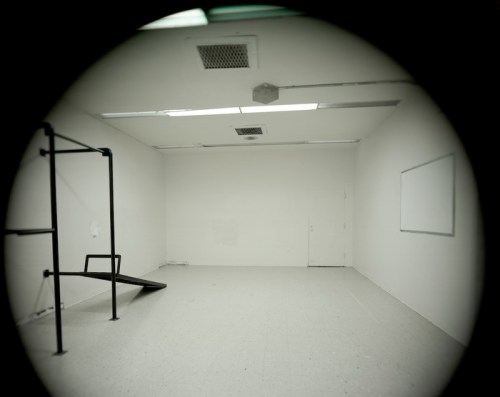
Rec Room, Intensive Management Unit, Green Hill School 2000

The situation here is that they’d get a chair if they were still enrolling themselves in school; they had their own choice if they wanted to be enrolled in school. If they acted up, which many did because they were locked up 23/7, they’d take away their mattress and they’d sleep on the cement. And if there was more trouble than that they strip them, and if there was more trouble than that they’d chain them up in the fetal position.

PP: Seriously?

SD: I’m serious. This is what I was told – I was told by staff. It was bad and that’s probably why they didn’t want any of my pictures running in the New York Times. They told me they were cleaning up their act. This was 2000 so that may well be true. My response was, “Great, can you invite me back? I’d like to see it.” They said they were not into that.

PP: You’ve many photographs of the steel doors and hatches.

SD: The hatch is where they’d get their food, mail and medical needs. That’s when the IMU really started to affect me emotionally. You know, when I was working with them face to face in these institutions it wasn’t any different to working with kids anywhere. But …

10, 11, 12 13 & 14, Green Hill, 2000

Cell, Green Hill, 2000

PP: Were these juveniles in the IMU because they were violent offenders or were they there because they’d broken prison rules?

SD: Because they’d broken prison rules.

PP: It was punishment?

SD: Yes, but part of understanding this is also getting accurate information.

I was told they put people there for their own protection. There was one kid who was a pedophile who was apparently there for his own protection, but then I was told later that that wasn’t the case. “Oh, you can’t do that [type of separation].”

PP: One would think prisons could run protective cells and wings without resorting to these stark punitive environments? It doesn’t have to be run like that?

SD: Maple Lane it is less punitive, as far as I could tell.  But they’ll separate gangs as well. You know kids can’t just be housed anywhere. It has to fit with the institution.

PP: I am shocked to learn that juveniles are in isolation. What are your thoughts on solitary confinement?

SD: About the time I was shooting this story, Tim McVeigh was about to be executed for his Oklahoma bombings. Watching him on TV, he was on death row and he clearly had a better cell than those kids. This was interesting but also depressing – some kids told me they’d go to IMU because they just wanted to get away and some of them would only be there for two or three days. But some of them would be there for months.

The staff, there was one guy, I forget his name, was extremely bitter. He said in front of everybody, including the kids. “I could solve this problem easily, I’d just get a gun” and this is how he’d talk to these kids. He said back a few years ago they had tables in the open hallway and a TV and pool table.

The kids took the pool balls and beat the staff with them, they broke the television. So they removed all these things just because the staff were scared – that was the only reason. They told me one woman couldn’t go back to work because her arm could was damaged. And so you realize it is very complicated. These people come to work everyday and they don’t want to be constantly threatened with violence.

Court, Green Hill, 2000

SD: But, of course, these kids [I was photographing] had nothing to do with that. Right? They had nothing to do with it but had to pay the consequences.

Some kids would go to IMU just for mouthing off and others may have done something serious.

As for the staff; some most of them were really good. And I don’t know how they do it every day. Others were those who were bringing in dope for the kids and being nasty.

The kids complained about this and there was nobody there to listen.

PP: No accountability? Did complaints ever get out of the facility – say to the DSHS for example?

SD: I don’t know. Part of the problem is the kids lie their heads off. No matter what they tell me I can’t assume it is true and that is part of the problem and just makes it more complicated. But the more I got to know them they all have their underground. You know – they’ve all got something they can get high on. It must be the staff that’s bringing the stuff in.

PP: What’s in it for the staff? Behavioral management?

SD: Well, they’d get something out of it … I don’t know what. I had camera stuff stolen. I know the staff stole it; it wasn’t the kids.

The kids would always get punished because the state didn’t know what to do with these kids. It was about management – it was not about justice.

Steve Davis, Oakridge, 2005

PP: Tell us about your portraits. Did the kids see your work?

SD: Yeah, they all got a picture. If I did a portrait they all received one. Although yeah [laughs/sighs] some of the kids swore they never got them. I’d give them to staff to pass on …

Something I think is really interesting is this desire for photographs. (I video taped in there too and interviewed a lot of them). They would have empty rooms, but they’d have maybe a few pictures on the wall that they were allowed to have.

It was a huge deal to them to have these pictures. Photographs were important. And one kid who was an outsider (you could tell the other kids didn’t like him) approached the group and said, “I’ve got something but I can’t show it to you.” And they said, “Fine, we not interested.” And he kept nagging; it was clear that he did in fact want to show the group this thing.

Usually contraband is drugs or porno, but no. He pulled out this picture of him and his parents from when he was a kid. It was all wrinkled up and that was his prize that nobody could take from him, I’d never seen anything like that before.

I’d heard from Susan Warner, from before I was in there, that she came across one kid who had never even seen a photograph. I’m thinking, “He must have seen a photograph?” but some of these kids have backgrounds that are so hard to imagine.

Anyway, they loved having their picture taken and they loved having the power to visualize the result.

Steve Davis, Oakridge, 2005

PP: Their futures? Do you wonder what happened to them?

SD: I tried to track them down. And it was impossible. I tracked one down. He made it into community college in Centralia. He was in college when I met him.

Another kid everybody liked. He was popular and he was smart. After he got out he called me once. The Experimental Gallery got him a scholarship. The college wouldn’t admit a felon so he couldn’t use his scholarship. He was on parole, so he had to stay in his local area and so his options were limited to colleges there. So he had a scholarship and he worked in McDonalds!

Later, I was working with a legal advocacy group in Seattle and they could identify a lot of these kids as being in the adult system now. The recidivism rate is 80%. I think in the back of their minds they just kind of expect that [return to an institution]. Prison is where their dad is in many cases. A lot of them – more than I would have imagined – were affiliated with gangs. I never really appreciated that as being a serious problem in Washington State, but most of them had some allegiance. After release most of them return to their homes and familiar neighborhoods.

PP: In how many cases did you think that the institution as it existed served the child and society?

SD: Only one. There was one who was scary. Out of his mind. But there was only one.

PP: Talk about the procedures one must go through to photograph in a site of incarceration.

SD: Everybody asks me, “Can I go do this, who do I need to call?” somebody needs to call you. They’ve already gone through the hoops and they’ve already got that figured out.

PP: Do you see yourself photographing in sites of incarceration again?

SD: Yes. Am I planning for it, no, but it could happen through other avenues. I have been planning for some years to do a project on American war veterans, which falls under the same sort of scope. That is going to be my next big project.

If I do go back to prisons or jails, I don’t want to photograph more portraits that look the same. I don’t want to take the same pictures. I would like to penetrate into [the issue] with something deeper.

PP: Any closing thoughts?

SD: I don’t know a lot about prisons. I don’t know a lot about the adult systems but the youth systems (and I have a two and half year old now) is an embarrassment. It’s really bad they don’t know how to deal with these kids and they don’t know how to make them better.

The real smart ones will figure out how to get out of there and the rest … ?

Door 2, Intensive Management Unit, Green Hill, 2000

Steve Davis is the Coordinator of Photography and adjunct faculty member of The Evergreen State College in Olympia, Washington. He received the Santa Fe Center for Photography’s Project Competition in 2002, and recently won an Artist Trust Fellowship. His work has appeared in the New York Times Magazine, and is in the collections of the George Eastman House, the Tacoma Art Museum and the Musee de la Photographie in Belgium. He is represented by the James Harris Gallery, Seattle.


1

“At one time Angola was well known as the bloodiest penitentiary in America. And now you don’t have nearly as much as the violence as you woulda had.”

Troy West, Angola Inmate

Louisiana has the highest incarceration rate per capita of all US states. over 1,100 per 100,000 – that’s more than 1 in a 100. Angola (Louisiana State Penitentiary) is the mother of all prisons, carrying a weighty reputation and weightier history.

Only Georgia has a rate above 1 in a 100, as Louisiana does. The other Southern states make up the top five (Texas, Alabama and Mississippi).

These stats are due in most the more frequent sentencing of men to life without parole. The disproportionately high rate of prisoners who die within Southern prisons as compared to other state institutions makes for a very different culture.

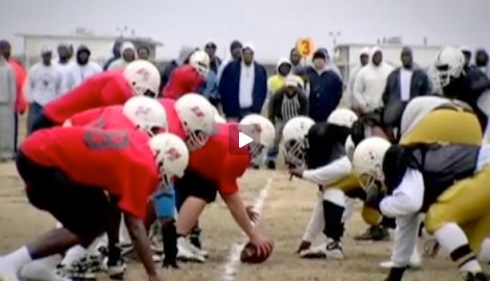
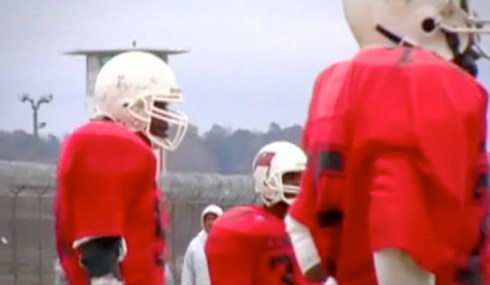
Many photographers including Damon Winter and Lori Waselchuk have focused on the unique aspects of Angola culture. The rodeo is well known, the hospice less so, but least well known may be the football league.

3

2

I have noted before the value of sports in prison, and Angola Prison Football a film-short by Charlie Gruet supports my position.

In it, Angola warden Burl Cain states his philosophy, “Good food, good medicine, good play and good pray. Lose any of those elements and you’ll have violence in your prison, but you would in your home. You think about it.”

The inmates back up the third point. It’s a well done documentary and to think that over 70% of the men in the film won’t ever get out just blows my mind. (Source: 2008 LSP Report).

Watch closely from 4.03 onward.

4

This is the first part of a two part interview. Part two was published on published Thursday, 23rd July, 2009.

– – – – –

Steve Davis. Green Hill, 2000

You already know the work of Steve Davis, you just don’t know it. Prison Photography‘s most popular post was that of pinhole photographs made by the young ladies of Remann Hall, Tacoma. Steve Davis conceived of and led the workshop.

Concurrent to workshops, Steve worked on his own project, Captured Youth (1997 – 2005) turning his lens on the juvenile offenders and institutions within Washington State. Steve’s introduction to the Captured Youth book reads, “What are officially referred to as “schools” are, in fact, youth correctional facilities – jails for juniors. It’s a world kept secret from the general public, but there are no secrets inside. Everyone is watched.”

Steve and I sat down to talk about the circumstances of the workshops and portraits, the involvement of – and benefit to – the teens, the atmosphere in the facilities and how the practice of photography manifests in sites of incarceration.

___________________________________________________________

Prison Photography: Steve, you photographed in four institutions in total?

Steve Davis: Yes, Maple Lane, Green Hill School, Oakridge and Remann Hall.

PP: How did you pick those?

SD: I fell into it years ago. It was fairly unintentional. I was doing PR photography for an [non-profit] organization called The Experimental Gallery that was trying to bring in art teachers on residencies into juvenile facilities. It came up they were interested in maybe having a photography workshop. I said it was something I was interested in.

And, nothing happened for a couple of years, but then I got a phone call and they asked if I’d like to teach the kids photography and double up as a photographer for their publications.

I thought about it and I asked if I could do something different. I wanted to slow the process down and bring in a large 8×10 camera. I just wanted to do portraits; focus on who the kids were without all the trappings, bars, etcetera that go along with images of young offenders.

So, I went in and worked with the kids [within a photographic workshop format] and then organized outside of that to take in the large camera.

Essentially, I was working under the umbrella of The Experimental Gallery, which had a grant, so I could only be there when they said I could be there. And when they were done and the grant was over, I had no more access.

Steve Davis, Remann Hall, 2002

Beginnings

SD: It started in 1997 at Maple Lane, then later the Green Hill School and Remann Hall. Each of those placements was under the direction of Susan Warner and The Experimental Gallery. Susan is now the Director of Education at Tacoma Museum of Glass. Between time, Susan had a job at the Children’s Museum in Seattle and they supported her doing this and she continued through them. And likewise, since she has worked at Tacoma Museum of Glass they have supported her as well. So the name has always been the same.

Lastly, at Oakridge – that was all my own work, with anyone’s sponsorship.

PP: You returned to Oakridge and the project in 2005. Why did you decide to return?

SD: Well, at the time the project didn’t seem resolved. I wanted to do something a little different. Oakridge is a transitional facility so they are not so much under lock and key, they are allowed to wear their own clothes and they have day jobs. That is where they reside just prior to release.

Soon after [Oakridge] I felt like I was getting to the point where I was taking the same picture.

PP: How did you respond to that?

SD: I tried contacting other facilities. I really wanted to get in to Clallam Bay, which is an adult institution but has a juvenile facility. It is really hidden from the public. But none of that panned out.

Overall, my interest with portraits has pretty much been about people who are controlled and lack all sorts of freedoms. I haven’t only focused on prison; I did a lot of work at an institution for the mentally disabled.

Steve Davis, Green Hill School, 2000

PP: What’s the attraction to these types of subjects?

SD: When I got into the work, I fell in with these mini societies with their own economies and their own rules and they’re all over the place. They are thoroughly hidden by intention from the public – who have no interest in examining it.  It doesn’t benefit the public to do that.

I found these places intriguing partly because once you are there in the middle of it, the people you come across, they’re linked together by reasons that are not of their own choice. It’s not the type of community where people have something in common so they create their own economies. They are like dogs in a pound. They might be friends, they might not, but they share common concerns.

I was interested in trying to zero in on these people as individuals with personalities and hopefully open up a lot of questions with the viewer. That s all I wanted to do. I wasn’t trying to reach conclusions or force anything down anybody’s throat. I am just trying to acknowledge that this is 20 miles from home.

All these [sites of incarceration] have names that sound like country clubs! You’d never know that Maple Lane was anything but a nice street or golf club. When you drive past, it is a beautiful place, but you won’t see a kid outside. It looks good from the road, but it is not a place you can walk around.

When I did workshops, they’d love it if I walked them over to the fence; they’d never been! Just little things like that were huge thrills to them.

PP: So the youth were always willing participants?

SD: The first residency at Maple Lane was the best organized. The kids were engaged – some were working with painting and music. The goal was to create a mixed media large exhibition that would go into the high schools of King County, and other areas that had a lot of at-risk youth.

So the kids [inmates] would present the information of their own lives. The message was for the exhibition was generally “You don’t want this”. The young prisoners understood that and got behind it.

Steve Davis, Maple Lane, 1997

Method

PP: Tell us about your portrait work. How much direction did you give the boys as sitters?

SD: Well, they knew the reason why I was there. And all they knew was that their portraits were to go into a catalog. In all, three catalogs were produced. They knew the photos would be published and shown. Other than that, the motivation from these kids to have their picture taken was overwhelming.

I did go in with a bit of theater. I had a large camera, I had lights and I had an assistant. So they were just begging to get their picture taken. It wasn’t hard at all. Direction was minimal. I’d ask them to turn their head or look into or away from the camera. Because I was shooting 8×10 on a limited budget, I’d take a limited numbers of pictures of each person, maybe 2 or 3, and then they were gone.

PP: The personalities of these kids comes through very strong. Are these images an accurate reflection of the individuals in the group?

SD: Yes, each photograph is one accurate reflection. Many of the sitters look very somber, but in fact they’d be laughing their heads off a lot of the time.

Some of the portraits I feel stronger about than others. There are some portraits I don’t have a particular connection with and there’s other I really love. Kids that really struck a chord with me, part of it was the experience of them sitting with me, knowing their character.

Steve Davis, Maple Lane, 1997

PP: Can you talk about a few of them?

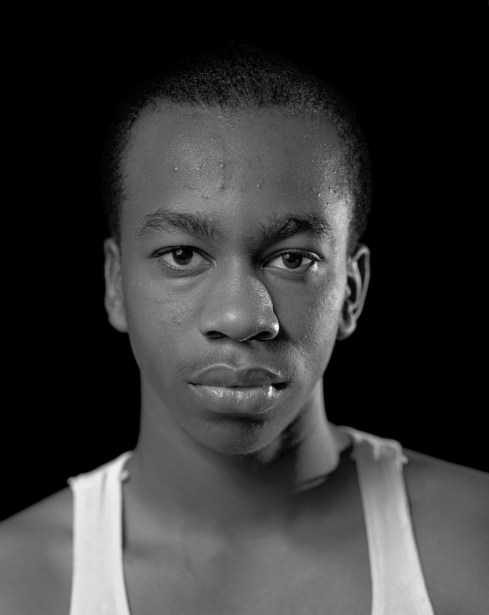
SD: This guy. The nicest guy in the world. Total white racist. Had as many black friends as white, but he was basically raised to be a white racist. Once you got to know him you fell into that world, his world. He got along with everybody, but if you asked him he would’ve told you what his views were. I shot a lot of him, indoors and outdoors, more complicated environments.

PP: This portrait?

SD: I like that one. I don’t know if it’s the picture or the kid. But out of all the time I was there, he was the only one where the staff said, “He should not be here.” He was a Mexican who got busted for being a drugs mule from Mexico. Apparently, some rivals burnt his house down. He couldn’t or wouldn’t speak English. He was scared and totally out of his element. But over about three months he started playing the role of the tough guy and you saw this transition. He was becoming what he was assumed to be to begin with. Becoming a hard guy – it was sad.

Steve Davis, Green Hill, 2000

Steve Davis, Green Hill, 2000

PP: And this guy?

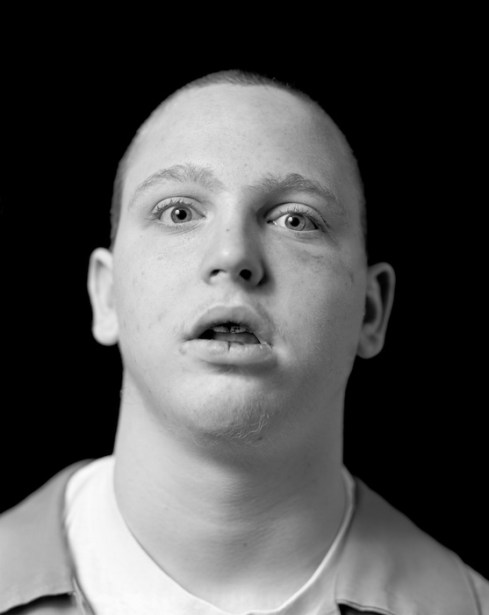
SD: This was in the psychiatric ward and they were all seriously medicated. This kid here was heavily medicated. He’s got blood on his teeth.

PP: Explain the blood.

SD: He told me he was in a fight the day before and he was walking around like this. Maybe he was continuing to bleed.

PP: Did he always have that look?

SD: Probably not. I didn’t really know this kid. But when I saw him I really wanted to photograph him. I was never demanding, but he was the only one I had to cajole. I said “If you want to make a dent, let me take your picture.” He said okay. That was just his gaze. I really thought his look was gripping. And there was a whole wing of them.

PP: Was it a common attitude among the juveniles, that they knew they were medicated and they knew they didn’t want to present themselves as such to the camera?

SD: He was the only one. I only took two pictures in the psychiatric ward.

Steve Davis, Maple Lane, 1997

PP: And this young man?

SD: He was the only other one I photographed on this wing and he was fine with it. A couple of years later when I was working at Green Hill, I was showing the staff my work and they recognized him and told me he’d got out and was later murdered on the street. He was involved in a knife fight.

PP: This one may stick with viewers but maybe for the wrong reasons? This is your only image where the sitter comes across as full of attitude, possibly angry?

SD: Yeah, he’s got a smirk. This picture never struck me as much as others, but many people have commented. I just never really connected with the portrait.

Steve Davis, Green Hill, 2000

SD: One thing I learnt from putting the work out is that people respond to these portraits for their own reasons. A lot of the reasons have nothing to do with prison justice. Some of them like pictures of handsome young boys; they like to see beautiful people, or vulnerable people, whatever. That started to blow my mind after a while.

But on the other hand, I don’t want to force people into thinking that these portraits should be considered in one particular context. Just, here they are. Portraits are really charged that way.

PP: My wife’s favourite is the kid blowing gum. What was that scenario?

SD: He was the nicest kids. He was overweight. He had a massive pack of bubble gum and it was in Oakridge, so he was on work release during the day. He seemed like a nice kid and so I asked “could you blow a bubble”. He did. I like that picture precisely because he looks as if he doesn’t belong.

Steve Davis, Oakridge, 2005

SD: But more than the portraits, the pinhole photographs from Remann Hall are my favorites.

___________________________________________________________

Please return on Thursday, 23rd July to read Part Two of this Interview.

My call on Friday for more information on Civil War era prisons bore an unexpected rich harvest. A single reply but an absolutely riveting one.

Imagined Prisons responded with this:

These images are fascinating and haunting, and the idea of the modern prison as “a permanent abstraction of earlier jails” is a compelling one.

As for the carceral spaces – makeshift and otherwise – of the Civil War, some authorities have cited Lincoln’s suspension of habeas corpus rights as a precedent for the Bush Administration’s policies in today’s war prisons. E.E. Hale’s classic short novella, “The Man without a Country,” written in response to Lincoln’s controversial move, tells the story of a man sentenced to spend the rest of his life aboard U.S. Navy ships, in the extralegal zone outside the boundaries of the nation-state.

You might also be interested in this poem by Herman Melville, from the 1866 volume “Battle-Pieces, and Aspects of the War”:

In the Prison Pen

Listless he eyes the palisades
And sentries in the glare;
‘Tis barren as a pelican-beach–
But his world is ended there.

Nothing to do; and vacant hands
Bring on the idiot-pain;
He tries to think–to recollect,
But the blur is on his brain.

Around him swarm the plaining ghosts
Like those on Virgil’s shore–
A wilderness of faces dim,
And pale ones gashed and hoar.

A smiting sun. No shed, no tree;
He totters to his lair–
A den that sick hands dug in earth
Ere famine wasted there,

Or, dropping in his place, he swoons,
Walled in by throngs that press,
Till forth from the throngs they bear him dead–
Dead in his meagreness.

Imagined Prisons is the accompanying website for the book The Prison and the American Imagination, by Caleb Smith, which will appear from Yale University Press in September of 2009.

The Prison and the American Imagination, by Caleb Carr. Yale University Press, September 2009

The Prison and the American Imagination, by Caleb Smith. Yale University Press, September 2009

The book examines the history of the U.S. prison system and its imaginative life in nineteenth – and twentieth – century culture. Caleb Smith argues that the dehumanization inherent in captivity has always been at the heart of American civil society.

Imagined Prisons is a forum for conversation about the book and the questions it raises;

What is the history of incarceration in America? What roles do prisons and prisoners play in our political life and in our culture? How have artists and writers, both inside prisons and in the world at large, invited us to imagine the institutions of captivity? Visitors to this site might be interested in the sprawling prison system of the twenty-first century, including the scandals of American war prisons overseas. They may also wish to explore the long, sometimes tortured history of jails, penitentiaries, plantations, and other dark places that have haunted the new world, with its promise of liberty and justice for all.

What a significant new resource with which to reassess the prison within America’s cultural landscape. Prison Photography, too, is attempting (admittedly ham-handedly on occasion) to define the current representation/consumption of prison imagery within our society.

May I suggest that books such as Caleb Smith’s and sites such as mine exist because sites of incarceration – “dark places” – have been over-zealously operated by controlling minorities and not adequately discussed by the at-large majority?

Lewis Payne

Lewis Payne, seated and manacled, at the Washington Navy Yard about the time of his 21st birthday in April 1865, three months before he was hanged as one of the Lincoln assassination conspirators. Photograph by Alexander Gardner, probably taken aboard the ironclad U.S.S. Montauk or Saugus.

Quick post & a request. We all know about the relentless Shorpy and the site’s daily dose of long gone photo ephemera. It is indeed a treat.

Today, two images from the 1920s went up. Shorpy’s keen to focus on the visual narratives that arrest the attention. Consider it a human interest archive if you will. It is my guess is he/she/it chose these two photographs relating to crime and punishment because they deal with women and children. If there is still one thing true today as was back then, these two groups are distinguished from, sometimes condescended to, and likely protected and abused in equal measure by, prevailing patriarchies.

Women Jail

Washington, D.C., circa 1920. “Jail, Women’s School.” Alternate title: “Complete this sentence.” National Photo Co. Collection glass negative.

JuvenileHall1920

Washington, D.C., circa 1922. “House of Detention, Ohio Avenue N.W.” Equipped with a nice playground. National Photo Company glass negative.

These came at an opportune moment because I’ve been wondering what to do with the following four images from the American Civil War. It is not an area I am well read up on. I guess the make-shift nature of jails and prisons in the vicinity of battlefields and front lines attests to the constant flux and shroud of unpredictability across a bloodied young nation.

Prison Photography blog is often concerned with inflexibility and pursuant damage it can cause as applied to institutions. But the modern prison is merely a permanent abstraction of earlier jails. ‘Transitory’ sites of incarceration, especially in times of war, are even more contested as sites than the Supermax prisons of the 21st century.

It’s got me thinking how Castle Thunder and Belle Isle relate to the the GWOT prisons – namely the early incarnation of Abu Ghraib prison, Bagram Airbase and other as yet unknown ‘Black Sites’ of detention and interrogation.

Castle Thunder

Richmond, 1865. “Castle Thunder, Cary Street. Converted tobacco warehouse for political prisoners.” Main Eastern theater of war, fallen Richmond, April-June 1865. Wet plate glass negative, photographer unknown.

Prison run by the Confederacy. Used for civilian prisoners, Castle Thunder was generally packed with murderers, cutthroats, thieves & those suspected of disloyalty, spying or Union sympathy

Belle

Spring 1865. Belle Isle railroad bridge from the south bank of the James River after the fall of Richmond. Glass plate negative from the Civil War collection compiled by Hirst D. Milhollen and Donald H. Mugridge.

One of the first Confederate prison camps. Opened after the First Battle of Bull Run and held Union Army NCO’s and enlisted men. There were no barracks constructed, the only shelters were tents. Intended to hold only 3,000 but numbers grew to double that and led to many prisoners being shipped further south to other camps, most infamously Andersonville.

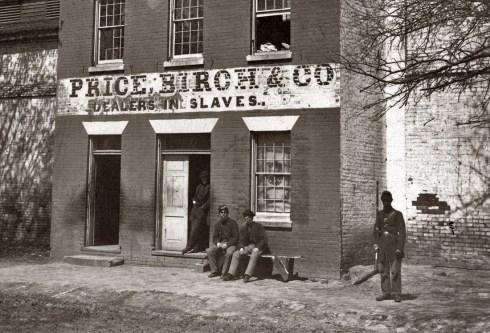
And finally, this site is described as a “slave pen”. This document of slave incarceration is gut-thumping and, however agonising the means, justifies the Civil War and its righteous ends.

Request: I am keen to know more about prisons and jails of the Civil War era. If you’ve any resources I should absolutely be aware of please drop me a note. Thanks

PriceBirchCo1865

Built in 1812 as a residence for General Andrew Young, this was the office building of the former interstate slave trading complex which stood on the site from 1828 to 1861. By 1835 Franklin and Armfield controlled nearly half the coastal slave trade from Virginia and Maryland to New Orleans. In 1846 the property was sold to a Franklin and Armfield agent, George Kephart, whose business became “the chief slave-dealing firm in [Virginia] and perhaps anywhere along the border between the Free and Slave States.” After 1858, the slave pen was known as Price, Birch, and Co., and their sign can be seen in a Civil War era photograph. The business was appalling to many, especially to active abolitionists in Alexandria, where the large Quaker population contributed to a general distaste for slavery. Several abolitionists’ accounts survive which describe the slave pen and the conditions encountered therein. Male slaves were located in a yard to the west, while women and children were kept in a yard to the east, separated by a passage and a strong grated door of iron. The complex served as a Civil War prison from 1861 to 1865, and housed the Alexandria Hospital from 1878 to 1885.

EMAIL

prisonphotography [at] gmail [dot] com

Prison Photography Archives

Post Categories