1

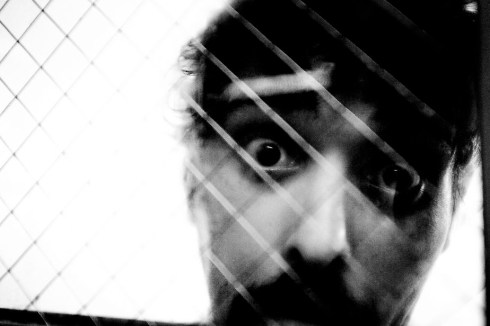
Fabio Cuttica‘s 2006 photo essay in Nerve from the Buen Pastor (Good Shepherd) Prison, Bogota was brought to my attention via industry-insider Rachel Hulin’s A Photography Blog. She describes a well-rude awakening.

I woke up in the middle of night after dreams of Sarah Palin, and realized that in my subconscious I had placed her into a photo essay I ran years ago as a photo editor at Nerve. She was a beauty queen in the Prisoner Pageant in Bogota, and she was glorious.

If you can get past this description from Hulin’s subconscious, I encourage you to think about the merits of this particular pageant. Despite the obvious interest from media (who are unlikely to refuse such a unique/titillating story) the benefit here seems to be predominantly for the women of the institution.

3

5

The pageant in is honour of the Virgin Mercedes, the patron saint of prisoners. Ada Calhoun – in the intro for the Nerve photo essay – hams up the language to sensationalise the event, but I don’t think there is a need. Cuttica’s photographs are brimming with the fun, the nerves, ecstasy and community of the event.

It is obviously novel day. It would seem to me that the opportunity to celebrate femininity and to express notions of beauty normally obscured by the institution would be a welcome relief for many female prisoners; I hope its a hell of a lot of fun.

But, this is a curious contradiction to how I usually feel about beauty pageants. I generally consider beauty contests as shallow, if not ridiculous. They make a whole lot of noise over very trivial matters. To my mind, a beauty contestant on stage is as pathetic as a dog in a sweater; cringe-worthy, vulnerable and compromised.

I suppose an answer lies in who has the power and the organising authority. I may be wrong, but I presume the women of Buen Pastor prison have a huge investment in the pageant – supporting their friends, stage preparations, making costumes and accommodating guests to the prison on their day.

This is, of course, in contrast to the usual female beauty contestant who is likely genderised by her community, normalised into swimsuit & high heels at an early age and conditioned to not question the strange gaze of a town’s older (men) folk.

2

6

4

Fabio Cuttica resides in Bogota, Colombia. His work is distributed by Contrasto & Redux agencies. He has worked across Latin America, recently winning acknowledgment from the College Photographer of the Year for his work documenting the La Maria & their struggle for land rights in the Cauca Region of Colombia. In 2008, Cuttica was honorably mentioned at the National Press Photographer Association’s Best of Photojournalism Awards for his extended essay about gang violence in Barrio Petare, Caracas, Venezuala. He has also worked on assignment for GEO about the Basque Region of Spain and covered the traditional family life and weaving in Valledupar, Colombia.

screen

Sunday night/Monday morning (depending on your seaboard) was the point in which my first professionally recognized byline hit the internets.

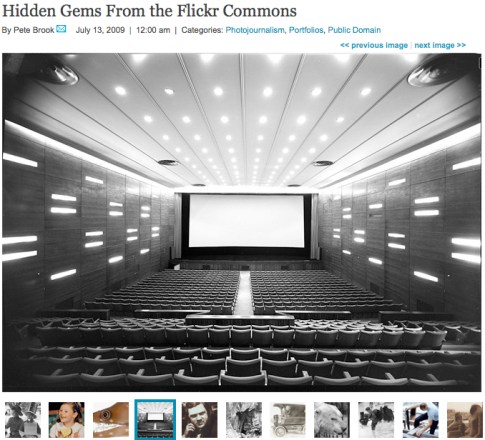
The piece, Hidden Gems From the Flickr Commons, is a walk through my Wired’s personal favourites. The crux of my pitch to Wired was that we all need to get out from under the mass-consumed images of the FSA/OWI archives.

2849454868_14a8240f90_b

Wired’s new blog Raw File deals specifically with photography and is marshaled by a close friend Keith Axline. Keith held out a hand and gave me a finite amount of time to grab hold. I’m glad I didn’t pass up the opportunity.

There’ll be more to come in the future. And I’ll probably force it down your necks again. If you’ve seen me relentlessly plug Raw File material these past few weeks on my Twitter stream, you now know why.

3404663739_6d909b0886_o

Top Image: Screenshot

Middle Image: Canthigaster rostrata, Inflated (Caribbean Sharp-Nose Puffer), Belize Larval-Fish Group 2005, National Museum of Natural History, Smithsonian Institute Collection.  Fujifilm FinePix S3 Pro 12.3-megapixel camera with a 105-millimeter f/2.8D AF Micro-Nikkor lens and dual Nikon SB28 flash units. (Source)

Bottom Image: Polar bear (Ursus maritimus) in cage at Lincoln Park Zoo. 1900. Original size and material: 4×5 inch glass negative. Field Museum Collection – Digital Identifier: Z80007 (Source)

2

“What started out as an assignment for school has produced a piece that has changed my life and hopefully will do the same for the people that view it.”

Jenn Ackerman

“We are the surrogate mental hospitals now.”

Larry Chandler, Warden of Kentucky State Reformatory, La Grange, KY

“My students are my biggest inspiration.”

Jenn Ackerman

3

This year, more than 700,000 people will be released from prisons and jails in the U.S. and more than half of them suffer from some form of mental illness. (Source)

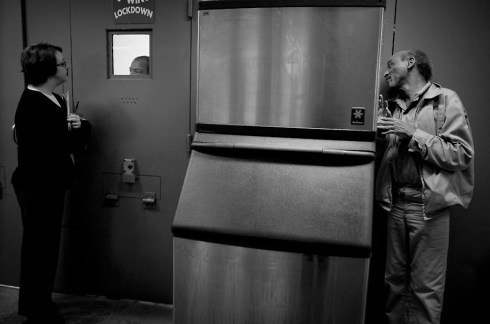
A few months ago I wrote to Jenn Ackerman, praised her Trapped project and of course offered to promote it. I wanted to get at her stories behind the images – namely do an interview. Jenn, however, is as good a promoter as she is a photographer.

The list of questions I wrote out while eating my chili-verde burrito on Wednesday are made largely redundant by her blog post “Trapped: Questions Answered”. Her photography and multimedia is so strong that it also speaks for itself. There is a painful truth in her work; more questions than answers.

I have plenty material to give you a thorough summary of Jenn’s work.

13

8

Firstly, allow me to give a run down of the current situation of mental health care provision in America’s prisons and jails.

A 2006 report by the U.S. Department of Justice shows that the number of Americans with mental illnesses incarcerated in the nation’s prisons and jails is disproportionately high. Almost 555,000 people with mental illness are incarcerated while fewer than 55,000 are being treated in designated mental health hospitals. That is inadequate provision.

555,000 represents, at the very least, 16% of inmate populations of state and local jails. I would contend the figure is higher – well above 20% – but this is only my personal belief.

If these numbers are not shocking enough, one must consider the pressures the prison system – in and of itself – exerts on the mental health well-being of those incarcerated by consequence of the increased reliance on solitary confinement to control populations, unqualified staff (especially in private prisons), overcrowding, institutional violence, lack of volunteer programming and engagement (in remote facilities) and the inadequate/unconstitutional general health care provided in states such as Ohio and California. California Department of Corrections has been the subject of a high profile federal lawsuit for the short comings to provide suitable care. (Incidentally, the $1.9b figure quoted in the linked article used to be $6b, until Schwarzenegger rejected it … and there is a serious threat it will be nothing if California cannot sort out its budget disaster).

In prison systems with such endemic problems, it is those who have no way to advocate for themselves who suffer most. Jails have effectively become America’s defacto mental institutions; they house a larger volume of mentally ill people than all other programs combined.

Against this backdrop, Ackerman went to work.

6

5

Prison Photography is keen to unveil the means by which photographers, anyone, can gain access to prisons to engage with the “invisibles” of society. In that spirit I quote Jenn;

How did you get access to this story?

I had done a lot of research and had decided on the story I wanted to tell when going to talk to the warden. I always feel that a an in-person visit is more beneficial. — I can better express my passion and excitement for this story. I had called a couple of prisons days before I called the Kentucky State Reformatory and to no surprise they didn’t respond to my messages. But then I came across a wing that was dedicated to mental illness in a prison. Warden Chandler answered on the second ring. This caught me off guard but got it together enough to tell him what I wanted to do. He said I had a lot of work to do before I could start on the project but that he might be interested. I sent a proposal days later and asked to come visit the reformatory to talk to him in person.

How did the warden and officials respond to the project?

I didn’t know how they would respond at first. But I also knew that the warden and everyone involved wanted this story to be told. I was very honest with everyone from the beginning. I told them that I knew that they were doing something to acknowledge mental illness in prisons which hasn’t happened in every state but that I also knew that the program was not perfect. I told them that was going to be my approach. So from the beginning they knew that I was not going to make them look bad but also wasn’t trying to say that they have the final answer to this issue. But I visited the warden the day before I published it on my site to get his reaction. He loved it and thanked me for creating an honest portrayal of the mental illness in prisons. I told him that was the best compliment I could ever get.

There can be no doubt that Jenn was lucky to find Warden Chandler who was so sympathetic to her objective and realised the importance of the project.

1

4

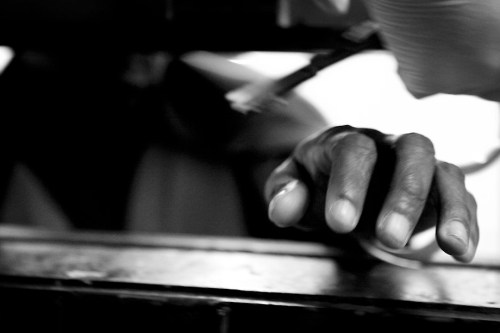
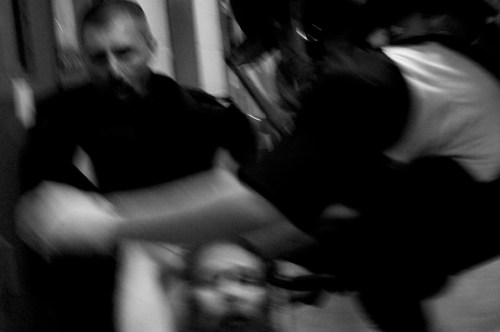
Jenn has explained that she spent a total of 10 weeks on the project, including 10 days of still and video shooting. Her time commitment is reflected in the comprehensive coverage. Trapped is a dark bubbling cloud of stories and troubling images that are weft with human emotion, the occasional reprieve but predominantly the collision of lives – lives that orbit tormented psyches that a punitive world of reinforced doors & service hatches cannot soothe.

Jenn’s commitment is epic. Besides the Trapped feature film, Jenn breaks the project into a series of presentations. Firstly, the In Their Corner short about the inmate watch. Secondly, In Their Minds a series of seven film shorts allowing individual inmates camera time to represent themselves. Trapped is segmented into six photography galleries; each one a captivating photo-essay in its own right. I cannot over-emphasise the sensitive depth with which Jenn has documented the incidents on the Correctional Psychiatric Treatment Unit (CPTU) at the Kentucky State Reformatory. Jenn also provides an extended essay about her own response to the CPTU environment.

12

10

Jenn interviews for 25 minutes at Multimedia shooter. The audio is wobbly and distorted but the information is valuable. Check out from 21 mins. onward to learn of the administration’s response.

Trapped: Mental Illness Inside America’s Prisons has deservedly received acclaim from burn magazine, 100 Eyes, Verve Photo, the White House News Photographers Association (honorable mention), Inge Morath Foundation and CPoY. Jenn recently won an internship at the New York Times.

Jenn credits her students for much of her inspiration. Check out Jenn’s class website for more details.

9

11

San Pedro Prison in Bolivia has ceased tours for foreign visitors.

I regret my one missed opportunity. I’d been mildly obsessed with the La Paz prison for a couple of years before I arrived outside its gate and got turned away. That was July, 2008. I had read in Lonely Planet it was a piece of cake to get in and get a tour. Apparently not in my case. I surmise, that I had experienced the beginning of the end for La Paz’s most bizarre tourist attraction.

It’s definitely over now. This from yesterday’s Guardian;

It used to be one of South America’s most fabled tourist attractions. Celebrated as unique in the world, San Pedro in La Paz, Bolivia, was a prison like no other. Foreign tourists would pay bribes to enter, gawk, shop, dine and even do drugs. A sweeping crackdown has barred tourists from the complex, replaced corrupt guards and challenged bizarre practices which had become the stuff of lore.

Tours have never been officially recognised and the vagaries of securing visiting privileges for foreigners stems from the fact that prison guards have different rules/corruptions and relationships to outside ‘tour-guides’. Basically, foreigners had to be lucky or connected to get inside.

Flickr searches prove that “wide-eyed travellers” have visited in all the months since my failed attempt.

The reason for the end of this bizarre tourist ritual? Seemingly, tourists got too cocky and too brazen. The new prison warden ended the debacle. This was a peculiar decision (on first glance) given years of international coverage and tolerance by the authorities, but basically, everyone involved had become too comfortable – objectionably so – with the institution-turned-circus.

The group most guilty for giddy spectacle was of course the tourists. In February the self-titled “Wild Rover Group” posted this video.

And it was the tipping point. The video doesn’t show anything that wasn’t commonly known, but it spells it all out with clarity and (critically) to an unrestricted worldwide audience.

This thorough dissection of the events by a Bolivian source, explains;

In an irreverent tone they boasted about their tour, were seen laughing and enjoying it, and they filmed some of the cocaine manufactured inside, as well as the facilities, rooms, kitchen and other areas. Days later, tourists began to show up in record numbers at the Plaza across from the prison. This drew the attention of neighbors and the general population. There were too many and it was too obvious.

It is surprising that a single video should be the tipping point, especially after a decade of widely circulated photographs. Nevertheless, the circus could no longer be ignored, nor controlled.

Interest online was mirrored by interest on the ground. Tourists filled the square outside wishing to visit; such numbers could no longer be surreptitiously ghosted in the side-door.

Vicky Baker explains,

The tours have been run on and off for years, but this time the (totally unofficial) organisers pushed it too far. There was an increasing lack of discretion. Travellers were being allowed to take cameras in and were uploading pics on to flickr and videos on to YouTube (Were all prisoners asked permission about this?). Rumour had it that local tourist offices were offering tours under-the-table, while those that turned up at the door, like I did, found that money was exchanging hands in a sideroom on prison premises.

The prisoners leading the tours had become greedy. If they’d had any sense, they would have halted them on the six-month anniversary of the arrest of Leopoldo Fernández, a controversial ex-governor accused of genocide. That day inevitably brought protesting crowds and film crews. According to James Brunker, a photographer based in La Paz, when one of the film crews got wind of a tour group inside, they decided this was “far more interesting!”.

Here’s the local media shining a big spotlight on activities with long-overdue questioning and coverage of the tours. Foreigners reacting to the attentions, flipping off the camera and scampering away under jackets were only ever going to look bad!

Unrest

Governor, Jose Cabrera, is emphatic, “The prisoners have to understand that this is a penitentiary.”

The tourism, while exploitative, was a reliable source of revenue for the prisoners and their families. By shutting down the tours, incomes for over a 1,000 men, women and children was dragged out from under them.

San Pedro was/is indelibly tied to society outside. Family members come and go daily to bring goods and services to the self-made micro-economy. The decision to close the tours down was exacerbated by new restrictions on visiting privileges. Discord grew.

On March 26th at about 4:00 p.m. in the afternoon, what apparently began as a small discussion and fight escalated into an all out prisoner mutiny. Hundreds of police officers were sent in to control the situation. The police shot canisters of tear gas into the prison’s interior patio. Soon prisoners were scrambling up walls and onto the roof.

As the Bolivian news crews were present to film the hoards of foreign tourists in the square, they captured the three hours of unrest from start to finish. Families, including children, of the prisoners were caught in the tear gas clouds. Unfortunate scenes.

The riot was a predictable end point to the new warden’s crude (but probably) necessary shut-down of this dubious spectacle. Many Bolivians didn’t like the fact the nation’s biggest prison was a site of titillation for foreign visitors; many were understandably ashamed and angered.

Paradoxically, one of the factors that allowed mass visitation was the accommodation of family members to spend unlimited amounts of time with incarcerated husbands & fathers during daylight hours. The institution had a generous (and unAmerican) protocol for the relaxed coming and goings of non-inmates.

What Next?

Money and the necessities it brings are key to solving the tensions. According to a prisoner interviewed by La Rázon, “70% of the [250 peso] fee goes to the police and the people who organize the foreigners for the tours,” the rest being split up among prisoners. This monetary ecosystem may not have been fair but it was consistent.

The new warden has since negotiated and agreed new rules for San Pedro, presumably taking into account the stymied income for all inside. Time will tell. As an indication of how fragile authority is at the prison, the new warden has adopted a fast rotation of guards to prevent foreigners … the suggestion being, a guard needs only to get comfortable at his gate post before he can start manipulating bribes to get tourists in again.

I’ll leave you arguments for permanent closure of San Pedro to foreigners with the thoughts of two Bolivians;

This type of tourism contributes to a blatant abuse of prisoners’ rights and human rights in general. A handful of pesos from tourists is not a substitute for the government providing the inmates with basic food, shelter and medical care (and as many as 75% of prisoners in San Pedro are simply awaiting trial and have not been convicted of any crime). Thousands of pesos a day being poured into the prison via tourism serves mainly to maintain and sustain the system of corruption that governs the prison and turns its inmates into the rough equivalent of animals in a zoo.

and

Isn’t it possible to be more responsible? To be more respectful? When touring a foreign country must it be treated like a traveler’s playground with no regard for local inhabitants? Not to mention, is your own safety actually worth it? And what kind of message is being sent to those who are imprisoned? That they must pay for their crimes but foreigners can get away with illegal activities for Bs. 250 per tour?

True.

The Remains

The photographic legacy is wide and varied. Amateur snaps prevail here, here, here and here. Enthusiasts occasionally turn their skills, and professionals such as Hector Mediavilla have focused on cocaine manufacture and drug addiction in San Pedro Prison.

flagprison

I took some flak for questioning America’s Day of Independence celebrations. I suggested that flag-waving is sometimes an empty exercise and distracts society from scrutiny of serious problems.

To support the point, I stated some positions:

America is the only Western nation in the world to execute human beings.
America has 1 in 30 adults locked up in prisons (4 times the amount of any other Western state).
America’s middle class has fled to the banality of the suburbs and hung its public school systems out to dry.
America has 50 million medically uninsured people, including 11 million children.

America has embraced the privatisation of prisons and stockholders profit from the incarceration of men, women and children.
America’s drug war is in fact a war on the lower classes, who are predominantly minority groups.

As if on cue, these three things have fallen into my lap in the intervening 72 hours.

Schools

The Economist reports on the US’ private school sector; a sector totally unaffected by the recession. Amanda Uhry of Manhattan Private Schools Advisors speaks brutality and unabashedly about the robustness of the private school sector. It’s success is based on fear, individualism, constant educational benchmarks set from the earliest of grade levels, and a severe lack of imagination; “America has fallen far, far behind other nations in providing public education”.

Prisons

I hope most Americans would prefer not to be number one in this country-by-country comparison.

PrisonStatsCountry

And, just in case you’re wondering, the US is 4th most frequent executioner of its citizens. The other countries making up the top five are the often vilified and demonised China, Iran, Saudi Arabia and Pakistan.

Hospitals

My family in the UK is an average bunch. Nevertheless, three of the five of us have required major surgery (all three more than once). The NHS provided – in every case – timely and impeccable care. Taxes aren’t a burden, they are peace of mind.

As John Pilger puts it, “The way the National Health Service is represented in the United States is truly scandalous. That word ‘Socialist’ is pulled out; it’s kind of infantile almost. Well, if Socialist is taking away the fear of being denied health care, then yes it is.”

As I refer to it, the cushty-cell-theory, that is to say, the idea that prisoners shouldn’t be any better off than the worst off in open society is common. But, it is not an argument; rather it is an extension of bitterness and misinformation.

It makes no sense to hold the conditions of a single institution, the prison, to the lowest identifiable standards of society elsewhere. To do so is prejudice.

The following passage from the provocative and authoritative The Oxford History of the Prison (Norval & Rothman, eds.) sets out to explain this idea:

Inmates are the best and the worst among us. They include Mahatma Gandhi, Martin Luther King, Nelson Mandela, Thomas More, Oscar Wilde, Bertrand Russell – a very mixed group but not lacking in virtue – and a long list of highly principled dissenters. There is no point in cataloguing the worst. Prisoners are ourselves writ large or small. And, as such, they should not be subjected to suffering exceeding fair expiation for the crimes which they have been convicted. Below that admittedly vague ceiling of suffering, they are entitled to a reasonably safe, clean environment. They must be spared cruelty, cruelty being defined as violations of their bodily and psychological integrities beyond the legitimate necessities of their punishment.

There is one theme, however, that has complicated this whole analysis of appropriate prison conditions – the alleged principle of “less eligibility.” It is the idea, which dates back to at least the nineteenth century, that the prisoner’s condition must not in any particular be preferable, more comfortable, or more adequate than those of the worst off members of the community who have not been convicted of a crime. Otherwise, it is suggested, a positive incentive is created for those worst-off citizens to commit crime so as to improve their conditions. This is a daft idea, but it captures men’s minds. Happily, it is not taken seriously by prison administrators who know that if they are not to operate death camps, their prisons must be run by consent. The administrators hold the ultimate power at the periphery, but within the walls power lies with the prisoners. In the end, the prison embodies the largest power the state exercises over its citizens in time of peace. If the balance between authority and autonomy is struck fairly here, it is not likely to go far wrong elsewhere.

[Emphasis mine]

To postpone all standards for society’s incarcerated class is to distinguish oneself from them. It becomes an “Us & Them” scenario, in which abuses are tolerated or ignored.

I chose to focus on this repugnant prejudice-masked-as-theory for Wednesday Words because I have been troubled for many years at the acceptance and even casual sadistic humour in mainstream society regarding prison violence.

The illicit manufacture of tools by prisoner piqued Marc Steinmetz‘s curiosity. He called around German prisons to inquire if they were still in possession of particularly ingenious contraband tools and escape devices.

Santa Fu, Celle, Wolfenbuttel and Ludwigsburg prisons all welcomed Steinmetz to view their collections. (The historical objects of Stammheim and Hohenasperg prisons were part of the Ludwigsburg collection.)

Steinmetz’s photographs were used in a German magazine editorial, but I have seen similar series of object types displayed as fine art.

When photographers set up objects (food, seeds, dead birds, insects, fish, etc) it is usually to draw extended attention to common characteristics and impose drama upon ‘the ordinary’. Against a white backdrop and removed form the clutter of daily life, it is intended that these objects can (if only briefly) transcend their functional purpose and be appreciated within the discourses of beauty and/or high art.

Steimetz wanted to highlight the ingenuity and intelligent design of these objects, and I’d like to do the same.

I have included some weapons here and omitted others. I deliberately omitted crude weapons for this post as they are hardly novel … anything with any weight becomes a dangerous weapon, right? On the other hand, I included guns and rifles as I never thought they could be manufactured from scratch. I was particularly impressed by the electrical items.

Below are Prison Photography‘s pick of the bunch with Steinmetz’s own captions. Thereafter is a brief Q & A with Steinmetz.

flucht_pistole

DOUBLE-BARRELED PISTOL This gun was found along with other homemade firearms in the cell of two Celle prison inmates on November 15, 1984. The weapons had been made in the prison’s metal workshop. They were loaded with pieces of steel and match-heads.

flucht_tattoo

TATTOOING NEEDLE made from a toothbrush handle, a ball pen and an electric motor; confiscated in ‘Santa Fu’ prison in Hamburg, Germany. Tattooing instruments are a popular and common source of income among inmates but are banned as ‘illegal objects’ due to the danger of infection (Aids, Hepatitis, etc.).
flucht_grill

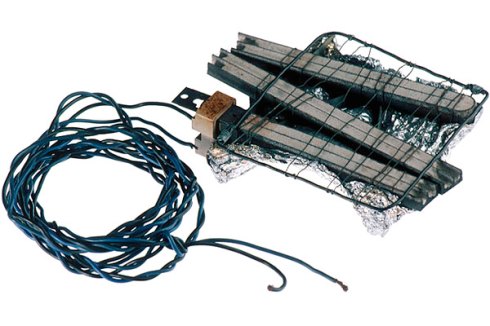
STOVE / GRILL / TOASTER An inmate of Ludwigsburg prison, Germany, botched together this multi-purpose tool from wire, a broken heating rod and some tin foil. It was found in his cell and confiscated sometime in the mid-eighties.
flucht_tube

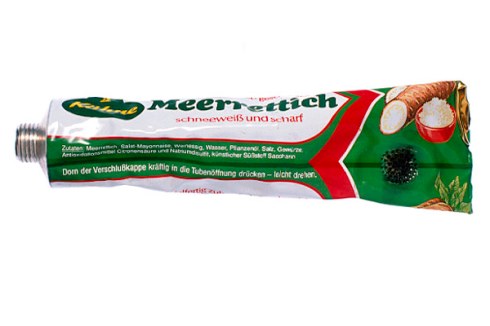
HASH PIPE fashioned from an empty horseradish tube; confiscated in ‘Santa Fu’ prison in Hamburg, Germany. Bongs are the most common of all forbidden items in prisons. The range of materials they are made of mirrors the inmates’ great imagination. And their prior needs.

flucht_wanze

RADIO TRANSMITTER / BUG made of radio recorder parts by an inmate of Wolfenbüttel prison, Germany (battery is missing). Prisoners occasionally manage to install gizmos like this one in guard-rooms to be prepared for upcoming cell searches. Also suitable as a means of cell-to-cell communication among inmates. A standard radio serves as a receiver.

flucht_tauchsieder

IMMERSION HEATER made from razor blades; found in a cell in ‘Santa Fu’ jail in Hamburg, Germany. Jailbirds use these tools to distil alcoholic beverages forbidden in prisons. Your typical inmate’s moonshine still includes a plastic can containing fermented fruit mash or juice, an immersion coil of some sort, a rubber hose, and a plastic receptacle for the booze.

flucht_buch

RADIO RECEIVER Sometime in the seventies an inmate of Ludwigsburg prison, Germany, built this radio on the sly and hid it inside an encyclopedia. It was probably commissioned by another inmate who had no electronic expertise himself.
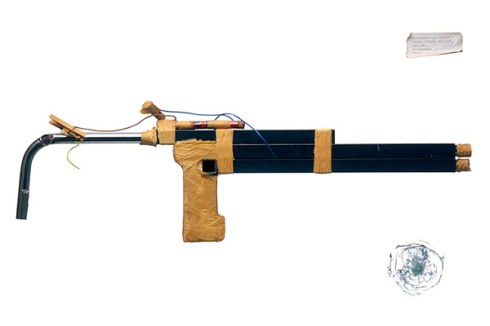
flucht_gewehr

SHOTGUN made from iron bedposts; charge made of pieces of lead from curtain tape and match-heads, to be ignited by AA batteries and a broken light bulb. On May 21, 1984 two inmates of a prison in Celle, Germany, took a jailer as a hostage, showed off their fire power by letting go at a pane of bullet-proof glass, and escaped by car.

________________________________________________________

Q & A

When did you complete this project and why did you take on this subject?

I shot the whole project in April and May 1999. I had read a magazine article about a prisoner in Berlin who had whittled a key to his cell from a toilet seat. Unfortunately, prison officials in Berlin weren’t cooperative, so I wasn’t allowed to take a picture of that key for ‘security reasons’. (Can you believe that?).

But it nevertheless provided the key to the story and got me interested. Süddeutsche Zeitung Magazine editors [provided a catalyst] too – they bought the story.

The objects range in date from the 70s through to the mid 90s and from multiple German prisons. How and where did you source the objects?

Prisons often have a collection of items which were secured from inmates’ cells or after attempts at escape.

I did my research exclusively by phone and located a handful of prisons which seemed worth a visit. I decided then and there which objects to photograph.

Much of your previous photography has been about complex scientific experimentation and grand research. Was this project a departure?

Not at all. I have always been interested in the uncommon or even bizarre.

What about the objects is of interest to you?

Ingenuity of improvisation. Intelligence. Purposefulness.

In my work, not everything depends on meticulous planning, but to a great extent on chance and my ability to improvise. Therefore I can relate to these escape tools. I admire their no-nonsense design, their simplicity. Even if their escape attempts fail, these guys cross boundaries in that they find uses for things other than what they were made for.

What do your photographs of the objects add to the stories objects?

To me, they communicate intelligence and the flexibility of the human mind under adverse conditions. I wanted to share my surprise: ‘What the … ?’

Did this project inform or reflect your understanding of German prisons, prison history and/or current prison politics?

Not really. I wasn’t interested in the political or social aspects of the subject matter. It was an interesting experience, though, to get to peek inside these facilities even though I had no contact with any of the inmates.

To compensate for that and to communicate credibility, I tried to collect as much information about the objects as I could. I felt they should be preserved the same way that archaeological artifacts are.

What are you working on now?

Currently, I am working on an independent project which is called ‘Toter Winkel’. I am still searching for an international title which works both in German and English, even though I focus exclusively on Germany.

I started wondering about what cars have done to our cities. I ended up doing night shots of elevated roads with a 4×5″ field camera. It’s hard to believe what monstrosities have been erected for the sake of misconceived mobility!

But this is more of a long-term fine art project than an editorial piece. Fieldwork is completed, but post-production will take a few more months, I’m afraid.

Thank you, Marc

________________________________________________________

Marc Steinmetz is a photographer specialising in Science and Technology stories. Prison Photography recommends his work on Plasticination, Karakarum – The Archaeology of Genghis Kahn’s Empire and his series on Drinking Water. An extended interview with Marc, is here.

flucht_milch

DUMMY PISTOL from blackened cardboard; found on June 23, 1988, in an inmate’s cell in Stammheim prison, Germany, after a fellow prisoner tipped off the jailers. The dummy was hidden in an empty milk pack and was most probably intended to be used for taking hostages in an escape attempt.

________________________________________________________

All images © Marc Steinmetz.

I originally came across Steinmetz’s work at Accidental Mysteries – a blog I highly recommend for its polished curatorial eye of surprising, inventive and humourous human interventions.

Samuel F. B. Morse's Daguerreotype Equipment, by Thomas Smillie, 1888, Smithsonian Institution Archives

Samuel F. B. Morse's Daguerreotype Equipment, by Thomas Smillie, 1888, Smithsonian Institution Archives

Source, and more here.

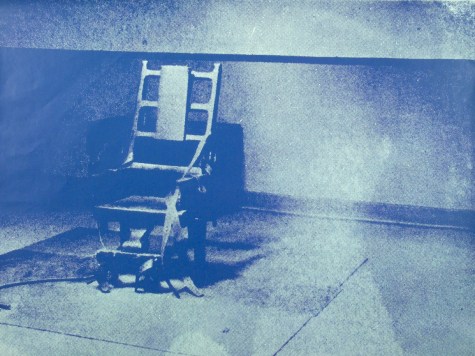
Little Electric Chair. Andy Warhol, 1965

Little Electric Chair (Detail). Andy Warhol, 1965

Merry A. Foresta, Director Smithsonian Photography Initiative, informs,

“In addition to being the Smithsonian’s first staff photographer, Thomas Smillie was also the institution’s first photography curator. Interestingly, in 1896 when a formal Section of Photography was established Smillie was titled “Custodian” and the first objects he collected – bought for the sum of $23 – were the daguerreotype camera and photographic apparatus used by Samuel Morse, one of the first Americans to experiment with photography…”

When I saw the deathly familiar blue of Smillie’s cyanotype, I was thrown back to the electric hues of one of Warhol’s many electric chair prints.

From the rarest, unique image to the mass produced commodity. Both images of apparatus; both apparatus a steal on time and both definitively (institutionally) American.

The Smithsonian has operated Click! Photography Initiative for a couple of years now. They publish sporadically on The Bigger Picture Blog with a variety of essays about every imaginable application and interpretation of photographic culture in society. Contributors include high school kids to photography greats such as Robert Adams and a wealth of respected curators and educators including Wendy Ewald and Sandra Phillips. There’s even space for you if you wish to try you hand.

The project also nudged me back into the mind space and work of Bay Area heroine Carla Williams. Read her blog and your life will be better.

EMAIL

prisonphotography [at] gmail [dot] com

Prison Photography Archives

Post Categories