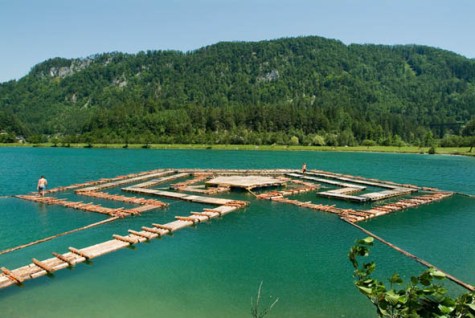
Floating Maze, Festival der Regionen. 2007, by Peter Sandbichler.

Floating Maze, Festival der Regionen. 2007, by Peter Sandbichler.

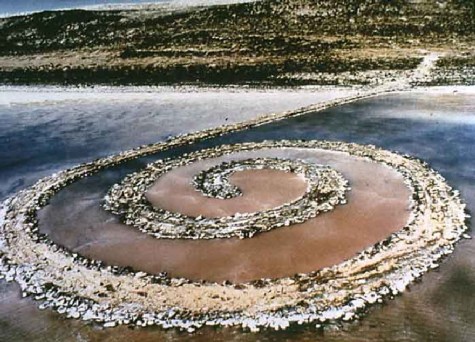
This weeks convergence pairs Peter Sandbichler’s Floating Maze with Smithson’s Spiral Jetty. Smithson’s pile of rocks have been subject to the rise and fall of the Great Salt Lake waters. Only recently has it re-emerged in a walkable state. If Smithson wasn’t so obsessed with the “Mud, salt, crystals, rocks, water” he may have come up with a buoyant solution that was always atop the surface.

Spiral Jetty, 1970. Robert Smithson (EUA 1938-1973). Great Salt Lake , Utah

Spiral Jetty, 1970. Robert Smithson (EUA 1938-1973). Great Salt Lake , Utah

Source: Sandbichler

Source: Smithson

Archive of Convergences

A TB patient at Tomsk Regional Clinical Tuberculosis Hospital, Building #3. Photograph and caption © James Nachtwey/VII.

A TB patient at Tomsk Regional Clinical Tuberculosis Hospital, Building #3. Photograph and caption © James Nachtwey/VII.

“Tuberculosis is a disease of poverty and stress“.

Merrill Goozner, The Center for Science in the Public Interest.

“Sixty percent of all new cases of tuberculosis have resulted from the rapid growth of the post-Communist prison archipelago”.

Proceedings of the National Academy of Sciences. Aug. 26th, 2008

Tuberculosis (TB) was under relative control in the former USSR. Soviets had lifestyles, nourishment and conditions of living that kept disease at bay. When communism fell, so did a civil order in many areas. The phalanx of activity that filled the vacuum involved new systems, new relationships, new businesses and new criminal opportunities.

The prisons filled in a society that needed to organize itself before it could organize it’s transgressors. The prison population swelled to 1.1 million (it is now down to little over 700,000). Post-communist prisons held malnourished, crowded populations with weak immune systems; they have been described as ‘Tuberculosis incubators‘.

Correctional Treatment Unit #1, a TB prison colony in Tomsk, Siberia. TB patient/prisoner gets a chest x-ray. Treatment is supervised by Partners in Health in partnership with the government TB program. James Nachtwey/VII

Correctional Treatment Unit #1, a TB prison colony in Tomsk, Siberia. TB patient/prisoner gets a chest x-ray. Treatment is supervised by Partners in Health in partnership with the government TB program. James Nachtwey/VII

TB is best treated with various labour intensive methods known under the umbrella-term Directly Observed Therapys (DOTs). Due to TB’s many different strains – each with different drug resistancies – case by case treatments differ according to patient reactions to drugs. At the least, a patient must be observed and his/her drug regime modified over a 6 month period. For Multi-Drug-Resistant Tuberculosis (MDR-TB) the treatment can take as long as two years. And, MDR-TB & XDR-TB are increasingly common among prison and civilian populations of Tomsk and other Siberian urban centers. Unfortunately, closely monitored drug regimes are improbable in over-stretched and poorly funded state systems.

It wasn’t always so dire. The former Soviet provided a regular supply of drugs to abate disease amongst its prison population, but those supplies were interrupted in the fall of Communism – sporadic and incomplete treatments gave rise to multiple resistant strains of tuberculosis. To compound this the side effects of drugs were enough to discourage patients, and rarely, if ever, did courses of treatment go with a prisoner into his community following release.

TB patients smoke cigarettes in the smoking room of Tomsk Regional Clinical Tuberculosis Hospital, Building #1. James Nachtwey/VII

TB patients smoke cigarettes in the smoking room of Tomsk Regional Clinical Tuberculosis Hospital, Building #1. James Nachtwey/VII

James Nachtwey‘s mega-promoted TED prize crusade addresses the spread of Extremely Drug Resistant Tuberculosis (XDR-TB), its mutant forms and human tolls. This excellent Guardian article notes Nachtwey has photographed the epidemic worldwide, from Siberian prisons to Cambodian clinics.
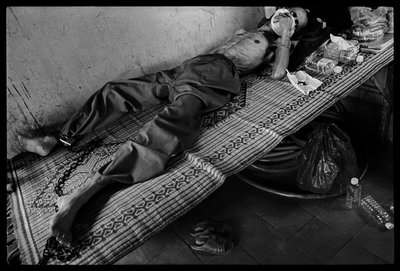
A prisoner who was convicted of murder was moved from prison to the TB ward of Battambang Provincial Hospital, Battambang, Cambodia when he was diagnosed with TB. He is coinfected with AIDS. James Nachtwey

A prisoner who was convicted of murder was moved from prison to the TB ward of Battambang Provincial Hospital, Battambang, Cambodia when he was diagnosed with TB. He is coinfected with AIDS. James Nachtwey

Nachtwey stands with Sebastião Salgado in the “super-photographer” stakes. They both make the ugly beautiful.

Both Nachtwey and Salgado have inspired others to action and both believe firmly in the power of photography to change existences … even in a time when such sentiment is derided as old-fashioned, false idealism.

But, despite the odds, Nachtwey has succeeded in forcing his work into the conscience of millions. For some his work is an inspiration for social justice; but for others his work is a sub-conscious default to guilt, despondency and powerlessness to help others less fortunate.

James Nachtwey puts human faces to global suffering. And we are outraged. Or we feel we should be outraged.

I think Nachtwey wants us to believe in ourselves as agents of change. Nachtwey deliberately chose Tuberculosis – because while the situation is critical, it is not terminal and TB is theoretically entirely curable. Beating TB on a global scale is dependent on the behaviours of individuals and their communities.

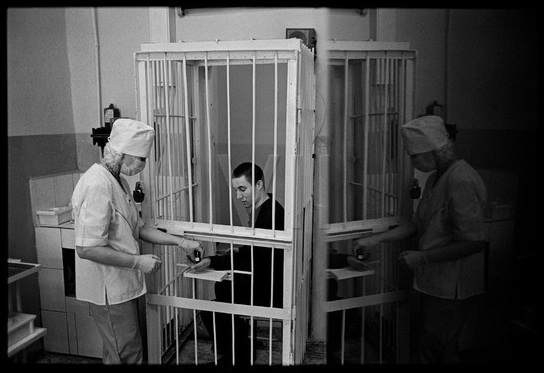
Correctional Treatment Unit #1, a TB prison colony in Tomsk, Siberia. A prisoner proves to a nurse that he has swallowed his daily oral TB medication. The prisoners receive treatment through metal bars in order to give security to the nurses. Treatment is supervised by Partners in Health in partnership with the government TB program.

Correctional Treatment Unit #1, a TB prison colony in Tomsk, Siberia. A prisoner proves to a nurse that he has swallowed his daily oral TB medication. The prisoners receive treatment through metal bars in order to give security to the nurses. Treatment is supervised by Partners in Health in partnership with the government TB program. © James Nachtwey/VII.

Nachtwey’s work extended beyond the prison walls in Tomsk and went into the public clinics (some images included here show those facilities); TB is no respecter of human walls or demarcations. Regional, economic poverty will spike rates of TB.
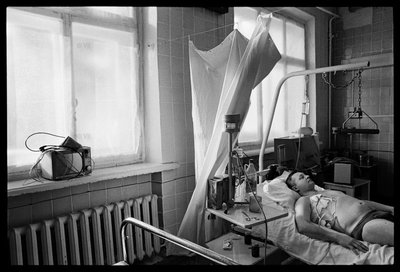
A TB patient has excess fluid drained from his chest a Tomsk Regional Clinical Tuberculosis Hospital, Building #1. James Nachtwey/VII

The worst thing we could do here would be to think that TB is a disease of other nations and other peoples. In Pathologies of Power (2004), Paul Farmer wrote about the New York prison system’s huge Tuberculosis epidemic of the mid-nineties, “By some estimate, it cost $1 billion to bring under control”. The strains that arose in the NYDoC have been directly related to the resistant strains of the former Soviet Union. Tuberculosis is latent within one third of the world’s population. Tuberculosis needs only the conditions for its growth.

Paul Farmer, of Mountains Beyond Mountains fame has taken the lead on combating TB, as well as other infectious diseases, amongst the world’s poorest populations. He worked with Partners in Health partly funded by a Soros Grant to “develop demonstration tuberculosis control projects which could become a model for replication throughout Russia.”
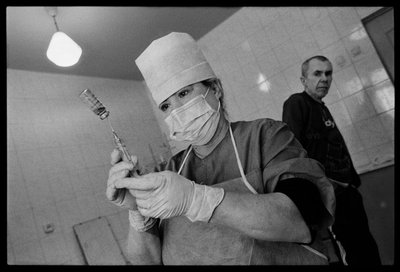
A nurse prepares a daily injection for TB patients at Tomsk Regional Clinical Tuberculosis Hospital, Building #3. James Nachtwey/VII

A nurse prepares a daily injection for TB patients at Tomsk Regional Clinical Tuberculosis Hospital, Building #3. James Nachtwey/VII

Prison Photography blog has focused twice previously on photographers’ responses to the USSR and its aftermath – the Gulag and the new prisons that arose. While Anna Shteynshleyger and Yana Payusova are working with very different issues, regions and populations they – along with Nachtwey’s work – remind us of the severe problems facing parts of modern Russian society. Unfortunately, and certainly in the case of Tuberculosis, these problems exist in other nations also. Nachtwey focused on TB because it was not – despite being a global problem – on the radar of most people. That sounds like something I’d say about prisons and prisoners’ rights.

Correctional Treatment Unit #1, a TB prison colony in Tomsk, Siberia. A patient/prisoner receives a daily medical injection. The prisoners receive treatment through metal bars in order to give security to the nurses. Treatment is supervised by Partners in Health in partnership with the government TB program. James Nachtwey/VII

For more information on XDR-TB read the Action – Advocacy to Stop TB Internationally website, and the Center for Disease Control & Prevention website. For the most accessible and recent article, read Merrill Goozner’s 2008 Scientific American article about Russian Tuberculosis strains which also includes a audio segment with a clear explanation of the situation.
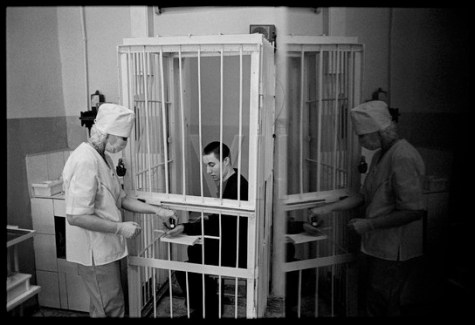
James Nachtwey, A TB patient/prisoner receives his daily oral medication at Correctional Treatment Unit #1, a TB prison colony in Tomsk, Siberia.

A TB patient/prisoner receives his daily oral medication at Correctional Treatment Unit #1, a TB prison colony in Tomsk, Siberia. © James Nachtwey/VII.

James Nachtwey built his reputation as a combat photographer.

He was always reluctant to be the focus of media attention but after 5 Capa Gold Medals for War Photography he couldn’t escape the curiosity of Christian Frei who made the extraordinary film War Photographer. Nachtwey comes across as an articulate, self-isolated journalist-force devoted to his craft and courteously distant to others; here is a clip.

Nachtwey has done interviews here, here and here. Read an interview about his 9/11 pictures, and associated videos on Digital Journalist. The images were published in TIME.

He worked in Rwanda for his book Inferno.

View his TED Prize acceptance speech and the consequent October 2008 launch of his XDR-TB project and Flickr pool.

Obama’s decision to quash the release of Iraqi prison torture photographs has welled across the journo networks today. It began as a rumour and then confirmed by the Huffington Post, New York Times and other major news outlets.

Last month, I blogged about ACLUs legal victory and announcement of images release on May 28th. I told you to keep the date in mind as the images were sure to be a thwack on the retina – of course,  not half as bad as some of the thwacks of twisted acts meted out by American rank and file under America military order.

I even went as far to say that Obama – with seeming little control – would possibly suffer at the fate of an early leak. Well, Obama’s done his u-turn and it looks like he might stop their release. He gets some support from Tomasky at the Guardian, but I can’t buy this argument. Obviously, Obama’s worried about the safety of his troops but the rest of us are worried about Cheney et al. getting off scott-free. The official line is that the Abu Ghraib abuses have been investigated fully, but in truth 25 low ranking officers were hung out to dry. There was no accountability further up the chain.

We should bear in mind that these are new images to the public and media, but not to politicians and internal investigators, and this is not the first time images have been suppressed and challenged.

The military’s mood was one of relative calm last month, with army investigators going on record that “these images are not as near as bad as Abu Ghraib”, but some are recalling long forgotten testimonies from 2004, namely by Seymour Hersh, here, here and here.

Hersh alleged that the children of female prisoners were sodomized in front of their mothers. These assertions were made on two occasions in 2004 – during a speech at the University of Chicago and at an ACLU conference.

There were audio files of these speeches online, but they do not seem to be operating. ACLU will have this on file nonetheless. And, in any case, Information Clearing House has a transcript of Hersh’s statements, from which I quote below:

Some of the worst things that happened that you don’t know about. OK? Videos. There are women there. Some of you may have read that they were passing letters out, communications out to their men. This is at [Abu Ghraib], which is about 30 miles from Baghdad — 30 kilometers, maybe, just 20 miles, I’m not sure whether it’s — anyway. The women were passing messages out saying please come and kill me because of what’s happened. And basically what happened is that those women who were arrested with young boys, children, in cases that have been recorded, the boys were sodomized, with the cameras rolling, and the worst above all of them is the soundtrack of the boys shrieking. That your government has, and they’re in total terror it’s going to come out. It’s impossible  to say to yourself, how did we get there, who are we, who are these people that sent us there.

When I did My Lai, I was very troubled, like anybody in his right mind would be about what happened, and I ended up in something I wrote saying, in the end, I said, the people that did the killing were as much victims as the people they killed, because of the scars they had.

I can tell you some of the personal stories of some of the people who were in these units who witnessed this. I can also tell you written complaints were made to the highest officers. And so we’re dealing with an enormous, massive amount of criminal wrong-doing that was covered up at the highest command out there and higher. And we have to get to it, and we will. And we will, I mean, you know, there’s enough out there, they can’t.

And finally, if you thought you’d experienced the depravity of Abu Ghraib via the pictures – and if you thought you understood the extent to the crimes – you’d be wrong. This Guardian article, quoting Washington Post relays the testimony of a detainee witness to juvenile rape.

Detainee, Kasim Hilas, describes the rape of an Iraqi boy by a man in uniform, whose name has been blacked out of the statement, but who appears to be a translator working for the army.

“I saw [name blacked out] fucking a kid, his age would be about 15-18 years. The kid was hurting very bad and they covered all the doors with sheets. Then when I heard the screaming I climbed the door because on top it wasn’t covered and I saw [blacked out], who was wearing the military uniform putting his dick in the little kid’s ass,” Mr Hilas told military investigators. “I couldn’t see the face of the kid because his face wasn’t in front of the door. And the female soldier was taking pictures.”

It is not clear from the testimony whether the rapist described by Mr Hilas was working for a private contractor or was a US soldier. A private contractor was arrested after the Taguba investigation was completed, but was freed when it was discovered the army had no jurisdiction over him under military or Iraqi law.

IF THE IMAGES PEGGED FOR RELEASE ON THE 28TH ARE TO STIR UP FRESH INQUIRY INTO SEXUAL ABUSE OF JUVENILES THEN OBAMA HAS A SERIOUS PROBLEM.

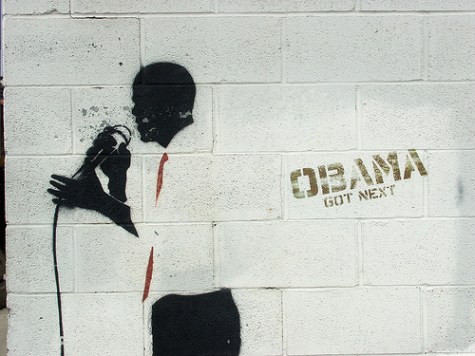
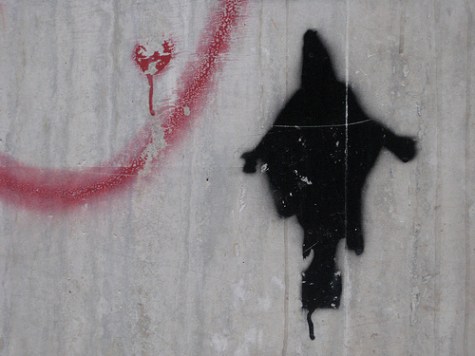
Detainee on Box Stencil. By Steve Reed. Source: http://www.flickr.com/photos/sreed99342/2077223377/

Detainee on Box Stencil. By Steve Reed. Source: http://www.flickr.com/photos/sreed99342/2077223377/

Author’s Note: I am taking my lead from Michael Tomasky for this blog post tying Obama’s call for a block on the release of images to the worst case scenario (sexual torture). Bear in mind that the buzz has been over 44 images – why, I don’t know – but over 2,000 were/are set to be released on May 28th. Also bear in mind that the images are said to be predominantly from facilities other than Abu Ghraib. There are a lot of unknowns in this matter. Nevertheless, I am sure of two things: 1) there is more visual evidence of abuse in existence and 2) Obama is obstructing the release of the latest evidence. Time will tell how these two variables cross or diverge.

First image by photographer Christopher V. Smith whose work can be found on his Flickr profile.

Second image by Steve Reed, whose work is on his Flickr profile and blog Shadows & Light.

I came across this excerpt on BOMBsiteBlog. It’s by Idra Novey.

The Little Prison, I, excerpted from The Little Prison

Enter the little prison a comma
And you come out a question mark

Enter in English
And you come out murmuring
The language your great grandmother spoke
To the birds
And that her mother spoke
To the other birds on the other shore

Enter a fish
And come out a conch shell

Enter an apple
And come out the teeth marks
In its yellowed core

Do not enter the little prison

I admire Novey’s words because they describe succinctly the drastic predictability of the experience prison. Life is generally unpredictable, unless it is taken away and controlled. Prison relentlessly beats down on the lives within.

Idra Novey’s first book of poems, The Next Country, was published by Alice James Books in fall 2008.  She teaches in the School of the Arts at Columbia University and in the Bard College Prison Initiative.

Note: This one’s off topic, but I’ll be coming back with prison related visual critique sooner than you can say “Jack Lemon”.

The Computer History museum in Mountain View, California. Credit: David Glover

The Computer History museum in Mountain View, California. Credit: David Glover

How do museums and galleries use online media to promote themselves?

I have been required to think about “The Museum” and it’s engagement with public and web2.0 audiences recently. If you look about you’ll find really good uses and catastrophic uses of web2.0 by museums and galleries alike. I don’t want to beat up on small galleries for their ill-advised, tweeting non-personas nor criticise lackadaisical irregular blog posting; both of these activities are for the intern. I’d really complain if I thought someone was getting paid to stumble through blog posts and ideas after a full day educating outreach audiences.

I do think the MoMA and San Francisco MoMA are fair game though.

Let’s start with the good.

MoMA: A delicate, understated film-short, with good production values. Some might argue it’s over sentimental and panders to arty self obsessions, but the MoMA is the beacon of an art world, art market and art-as-brand that has Western obsessions about the object at its core. I’ll allow it to veil this truth and remould it as individual yearning.

Click on the image below to view the video at The Contact Sheet blog.

Still from MoMA's promotional video "I See"

Still from MoMA's promotional video "I See"

And now, to the bad.

SFMoMA: Apparently inspired by the White House launch of Obama coverage on Flickr, the San Francisco MoMA launched its own stalking eye upon director Neal Benezra. They call it Director Cam.

Benezra at press preview, being interviewed by Don Sanchez for ABC7, in the SFMoMA rooftop sculpture garden.

Benezra at press preview, being interviewed by Don Sanchez for ABC7, in the SFMoMA rooftop sculpture garden.

Now, I am all for transparency, informality, familiarity and all that, and, to be fair, SFMoMA has done this reasonably well with its other Flickr sets (although I’d prefer less high-society party coverage and more high-school outreach coverage).

However, Director Cam just rubs me the wrong way. I don’t want to see the privileged folk of the museum-world lording over its institutions, I want to see public audiences getting knee deep in collections & archives and mixing it up a bit. I want to see Flickr used as a means to entice people into the museum not as a mirror for already existing (and exclusive) engagements.

Neal talking with Exhibitions Design Manager / Chief Preparator Kent Roberts. With Chuck Schwab, chairman of the board of trustees (center) and Catherine Kuuskraa (right). In the background on the left wall you can just slightly see the new bridge commission, by Rosana Castrillo-Diaz.

Neal talking with Exhibitions Design Manager / Chief Preparator Kent Roberts. With Chuck Schwab, chairman of the board of trustees (center) and Catherine Kuuskraa (right). In the background on the left wall you can just slightly see the new bridge commission, by Rosana Castrillo-Diaz.

BLDGBLOG (via Twitter) this week called for an alternative narrative of the built environment.

As I understood this, it is a theoretical proposal that would include interviews and testimonies of electricians, security guards and the fixers that keep the nuts and bolts in place while arty self-obsessed types flit about amid well-maintained frameworks.

After the white-collar fraudulent dismantling of the city, there is no better time to call for an alternative version of urbanity. A blue-collar city narrative.

With these thoughts looming, it is not Benezra that interests me, rather Kent Roberts, Exhibitions Design Manager and Chief Preparator at SFMoMA. Bring on ‘Museum Preparator Cam’!

All of this throws up more unanswered questions about the role of new media in the operations of museums and galleries. Fortunately, I recently discovered Nina Simon’s Museum 2.0 blog which provides some riposte.

___________________________________________________________

Images. Computer History Museum by David Glover. As well as his Computer History Museum Set, you should check out his Byte Back Set.

If you search “Prison Photography” on Twitter you’ll get nowt back. That’s because I use an inverted version of my pseudo-faux-baptismal avatar, brookpete.

Network Noises

In truth, you’d all be better spending time with Brian Solis’ latest tussle divining Twitter’s worth than following my twits, twats and tweets.

Mikhael Subotzky is an infrequent contributor for the Magnum blog. In fact, it happened only once; in response to the Magnum blog competition, for which, members of the public drew visual similarities between the works of Magnum photographers and the works of art historical cannon.

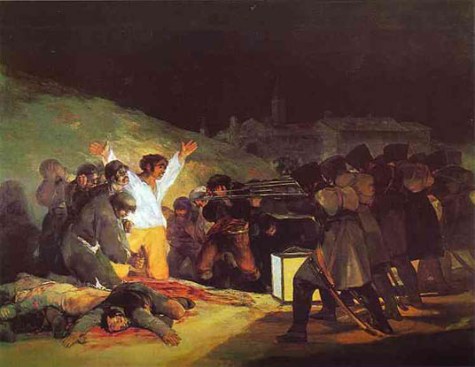
If a convergence is presented by the artist himself does it make it indisputable? Or at least 50% indisputable?

"May 3, 1808: Shooting at Montana del Principe Pio", 1814. Francisco Jose de Goya (1745-1828) Collection of the Prado, Museum, Mardid.

"May 3, 1808: Shooting at Montana del Principe Pio", 1814. Francisco Jose de Goya (1745-1828) Collection of the Prado, Museum, Mardid.

Beaufort West Police Station, South Africa,  2006. © Michael Subotzky

Beaufort West Police Station, South Africa, 2006. © Michael Subotzky

Subotzky warns against referencing for referencing’s sake. (I’ll be vigilant). And, I’ll leave you with the most succinct of Subotzky’s comments:

I don’t think anybody [in photography] has more intelligently related to philosophy or the history of painting then Jeff Wall.

The Subotzky Trajectory has been steep. His photographic conscience and works warrant the worldwide attention they have. He is with Magnum. See his website. And read this and this. Book here. There is an interview over at Conscientious.

Oh, and by the way, no wikipedia page on Mikhael Subotzky, which surprises me.

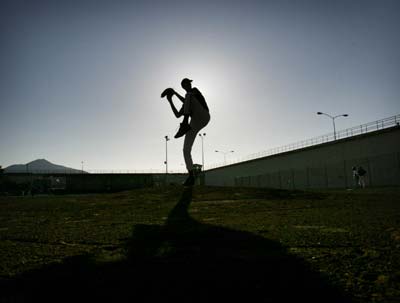
Two months ago I interviewed Emiliano Granado about his experience photographing the San Quentin Giants.

Pitcher for San Quentin Giants. Credit: David Bauman/PE.com

Pitcher for San Quentin Giants. Credit: David Bauman/PE.com

In my research I came upon a lot of media coverage, but I recently unearthed this gem of a slideshow by David Bauman. Enjoy.

EMAIL

prisonphotography [at] gmail [dot] com

Prison Photography Archives

Post Categories