98 prisoners are kept in a cell measuring 25 square meters originally designed for 16 inmates. The longest-serving prisoner in one of these cells has been there for 5 years. The prisoners are locked up for crimes as varied as non-payment of alimony to murder. The long-timers sleep in hammocks up high, the newcomers on the floor. Temperatures reach 50 degrees celsius in the summer. The prisoners are the poorest members of society, have poor legal representation, and are disenfranchised from political representation as they have no vote.

Gary Knight, Private Photo Review

Overcrowding at Polinter pre-trail detention centre, Rio de Janeiro © Gary Knight, VII Agency

Overcrowding at Polinter pre-trail detention centre, Rio de Janeiro © Gary Knight, VII Agency

Originally published in Social Issues #42 last Autumn, Gary Knight‘s astonishing photography at one of the (now closed) overcrowded Polinter Prisons in Rio de Janeiro, Brazil. Polinters are temporary holding facilities used to house police detainees.

There’s a bit of back story in to Knight’s work in his interview with the Financial Times.

Two things intrigue me about this. Firstly, my research tells me this prison closed down late 2006/early 2007. Why has it taken so long for Knight’s photography to get even short coverage? Secondly, I am astounded by Knight’s answer to the question of how he secured access:

I was doing a project on poverty, and a photographer at O Globo newspaper in Rio introduced me to the governor of Polinter prison – a place with conditions so bad the governor herself was appalled. She wanted something to be done but she couldn’t really let in a photographer from a local paper. She felt more comfortable with a foreigner: I guess she thought that stories published overseas might put pressure on the government from abroad.

Can you imagine a reversal of this logic? That US prison wardens would accommodate foreign photojournalists more readily?

Knight does his part in bringing visibility to the situation, but that doesn’t affect the shut out experienced by local photographers. That said, it is a great example of the power of international photojournalist activity bringing new possibilities to bear.

Detailed information on the Polinter prisons is hard to come by. We should share Knight’s relief that the Polinter he photographed is now closed. Amnesty International mentioned it in its 2006 report on Brazil:

In Rio de Janeiro, human rights groups denounced conditions in the Polinter pre-trial detention centre. In August the unit held 1,500 detainees in a space designed for 250, with an average of 90 men per 3m x 4m cell. Between January and June, three men were killed in incidents between prisoners. Officials in the detention centre were also forcing detainees to choose which criminal faction they wished to be segregated with inside Polinter. In November the Inter-American Commission on Human Rights ordered the Brazilian government to take measures to improve the situation.

Finally, let’s consider with necessary dexterity the role that Pastor Marcos Pereira da Silva plays in all of this. He visits, evangelises, “foot-stomps”, exorcises evil and sends prisoners collapsing to the floor. Knight confesses a “real disquiet about him”. Supporters point to the fact that violence in Polinter has abated since da Silva’s visits, but Knight parries that its easy to influence the most vulnerable of groups.

I cannot bring myself to embed the video of the Pastor at work, but you can follow this link and thusly imagine him bouncing around the walls of a prison, agitating its population and putting on a show they’re not likely to witness again or even understand. I guess different eyes experience different wonder.

_______________________________________________________

UPDATE (06.01.2012): The Open Society Institute published ‪Justice Denied: Brazil’s Polinters, documentary video focusing on “the costs of excessive and unnecessary pretrial detention.”

The poor conditions are obvious. OSI describes the film as part of their broader work on “a Global Campaign for Pretrial Justice […] helping governments develop bail and supervision systems that can make pretrial detention an exception, and not the rule.”

_______________________________________________________

Gary Knight, born in England, started working as a photographer in Southeast Asia during the 1980s as Indochina emerged from bitter wars and the region came to grips with the end of Cold War. In 1993, he moved to collapsing Yugoslavia where he returned repeatedly from the siege of Sarajevo through the fall of Kosovo. Between assignments for Newsweek, he documented crimes against humanity.

After 9/11, he worked in Afghanistan and two years later independently followed U.S. troops into Iraq. He covered wars in the Middle East, Africa, Europe and Asia and other breaking news, but Knight’s central focus is on the survival of the world’s poor and fundamental human rights issues.

Knight is founding director of VII Photo Agency. He established the Angkor Photo Festival, is a board member of the Crimes of War Foundation, a trustee of the Indochina Media Memorial Foundation and Vice President of the Pierre & Alexandra Boulat Foundation.

His work, widely awarded, published in magazines, is in museums and private collections. He has initiated education programs with universities and voluntary agencies, and is the author of Evidence: War Crimes in Kosovo.

If you are going to spend time with anything though, make it dispatches, a superbly edited magazine co-founded by Kinght. It cuts to the core of the issues, the rest of us skirt from distance.

(Found via Travel Photographer)

Bilingual Signs © Andreina, IDRA/Albuquerque Public School District, Critical Exposure Photography Project

Images Unseen, Images Unknown written by a guest blogger on Prison Photography last week was well received by readers, provoking more questions and some intriguing possibilities.

Change.org offered a synopsis of the article. Change.org focused on the concluding points of Images Unseen, Images Unknown which described the culture of shame shrouding California prisons created by the control of images and manipulated invisibility.

Too many prisoners are hidden from view to serve out their time. Many prisoners refuse visits from family because they don’t want loved ones to see them in institutions that deny them individuality, work to subdue the general population, hide prisoners from society, and keep them docile.

So, the issue of self-representation and empowerment arises. Specific to my interest would be the possibilities of empowerment through photography.

Recently, Stan Banos asked me, “Are you aware of any photography programs in prison for prisoners.”

My answer, in short, is no. This doesn’t mean they don’t exist, it just means for all my searching I have unearthed nothing.

Art therapy has been explored among prison populations and recently San Quentin piloted it’s first ever ‘Film School’. The project did many things at once, teaching inmates the technical skills of documentary film making, building team work and trust; and it allowed inmates to communicate narratives of their choosing from prison life.

Inmates documented the work of the prison nurses distributing medications; filmed the prison kitchens; recorded the “wasted talent” of artists, musicians and writers within San Quentin; and studied American Islamic faith in prison.

With that in mind, we can say empowerment through the arts has been well explored and apparently successful in a number of penal institutions. However, it would seem photography in prisons has not been used as a tool for self-representation and rehabilitation … yet.

Turn Away © Stephene Brathwaite, Red Hook Community Justice Center Photo Project

Turn Away © Stephene Brathwaite, Red Hook Community Justice Center Photo Project

The model for this type of program exists. Dozens of important non-profits use photography as a means for at-risk-youth to tell their stories. Organisations such as Youth in Focus, Seattle; AS220 Youth Photography Program, Providence, RI: Focus on Youth, Portland; New Urban Arts, Providence; Critical Exposure, Washington DC; First Exposures by SF Camerawork in San Francisco; The In-Sight Photography Project, Vermont; Leave Out ViolencE (LOVE), Nova Scotia; Inner City Light, Chicago; My Story, Portland, OR; Picture Me at the MoCP, Chicago; and Eye on the Third Ward, Houston; The Bridge, Charlottesville, VA; and Emily Schiffer’s My Viewpoint Photo Initiative are exemplars of empowerment through photography.

The Red Hook Photo Project New York offers photography opportunities specifically to a community blighted by crime. The photo project is run by the Red Hook Community Justice Center which operates many programs to improve the lives of teens within the geographically and socially isolated Red Hook Neighbourhood.

Only slight tweaks would be necessary to these types of programs for them to be effective as rehabilitative tools among prison populations. The central driving philosophy is to offer individuals a method of self-representation they’ve never been afforded previously.

A Backwards Eye © Gwendolyn Reed, Red Hook Community Justice Center Photo Project

A Backwards Eye © Gwendolyn Reed, Red Hook Community Justice Center Photo Project

It seems the main factor, aside of funding, for rehabilitative programs establishing themselves in prisons, is the philosophy of individual wardens. San Quentin Film School was pitched repeatedly across 47 states until Warden Robert Ayers decided to launch it at San Quentin. Likewise Burl Cain, at Louisiana State Penitentiary (Angola) has become well known for maintaining a varied roster of programs to keep inmates occupied. They include the renowned (and ethically questionable) Rodeo, an American Football league and a hospice program in which inmates volunteer to carry out the palliative care tasks.

On this evidence, it would make sense that criminal justice reformers and those interested in increasing the visibility of prisons should actively seek out wardens currently supporting novel, or even pilot, projects. Wardens currently accommodate programs in education, the arts, dog-training, first aid, video and much more. Photography could be added to that list.

There is a lot of mainstream media programs featuring American prisons – Lockdown, Americas Hardest Prisons, Inside American Jail – but of course these are all made for cable distribution and ultimately profit; their common denominator is a heightened sensationalism.

© Wayman, Inner City Light Student Photography Project

© Wayman, Inner City Light Student Photography Project

Documentary projects upholding rehabilitation and education as their core purpose are a distinctively different type of exposure. There would be no need for regional or national television channels to provide financial backing as an end (marketable) product would not be the motivation. That said, if the narratives of such documentary projects could be shown to enhance the image of an institution the prison authority might be open to trying them. The prison warden has the decision making power, so if under a wardens leadership a prison is given (positive) exposure it makes sense that the warden would be interested.

All successful rehabilitative arts programs presumably share a cooperative approach from the outset. Wardens and authorities are not to be feared or misunderstood, but can be convinced, cajoled and open to novel suggestions and programs.

Matt Kelley has suggested that the criminal justice reform community take note of wardens who are open to more transparency within their institution. Could coordinated media access drive a movement against the “invisibility” of prisons in America today?

The ideal program I envisage, would have only a small operating budget allowing pre-screened inmates to learn the practical skills of photography and apply them for the purposes of self representation.

If San Quentin can mount a film school I am sure any prison in the future can develop a Photography School? What do you think?

I Reach © Stephene Brathwaite, Red Hook Community Justice Center Photo Project

I Reach © Stephene Brathwaite, Red Hook Community Justice Center Photo Project

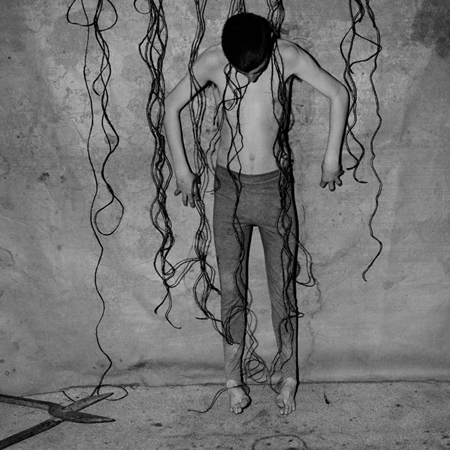
Cut Loose. Roger Ballen, 2005

Cut Loose. Roger Ballen, 2005

In critiques of Roger Ballen‘s photography I haven’t seen more than mere passing references to Abu Ghraib. New York Art Beat coyly described Ballen’s prints as “Reminiscent of the images from Abu Ghraib” and continued, “Untitled (1069) shows a gaunt man clad only in sweatpants. His head hangs down, toes curled and fingers scraping the wall.”

Culture Vulture afforded Ballen just one sentence in its review of the After Nature group exhibition, “Roger Ballen’s b/w photos draw on our deep visual memories of Abu Ghraib, without truly recording any torture.”

7_41 4_19

4_14 1_15

In real time and the real world Ballen’s work has absolutely nothing to do with Abu Ghraib. But my charge is to speculate on the meandering visual cultures and cross overs that wash over us daily.

Let me start by saying that Ballen has not in any way been influenced by Abu Ghraib. He began his Shadow Chamber work in 2001 and continued for 6 more years. His visual vocabulary was drawn from his own portfolio and observations from as early as the 70s when he photographed in homes of the poor with exposed wires, smears and semi-feral mammals.

Prowling. Roger Ballen, 2001

Prowling. Roger Ballen, 2001

New York Photo Festival will have to be special in 2009 if it is to eclipse Ballen’s show-stealing lecture of last years inaugural show. Just as Ballen had quietly plied his craft for decades without much commercial interest, so he quietly took to the stage for the unrockstar 11am slot on the first morning. Many concluded at midday that they may as well go home there and then. Ballen was it; “So if you missed it sorry the festival might just be all down hill after this.”

Why? Apart from being unexpected, Ballen took the viewer deep into a closely controlled isolated world and into the psychological uncertainties of his vision. Ballen is the perfect foil to typologies, minimalist cliche, first-project enthusiasm and the manicured fine art of contemporary photography.

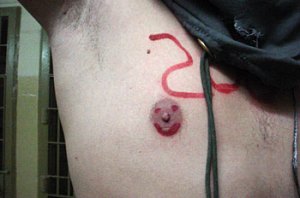
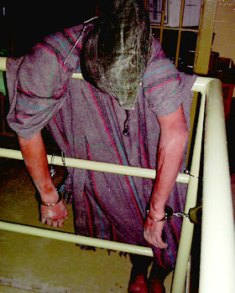
Effigy and Prowling are disconcerting, bizarre, staged and lit with hard flash – in other words they hold the same characteristics as the Abu Ghraib images.

abu-ghraib8 ballenfour

ballenthree
abu-ghraib1

It seems the comparison is so glaring no-one has wanted to state it! Is it with guilt we accept Ballen’s work into an art aesthetic, and then stand with repulsed incertitude before the Abu Ghraib images? Much has been made of Ballen’s hypnotic work and his vortex of image and dis-logic. I wouldn’t suggest he is a mystic seer, but if some sort of visual, global Zeitgeist exists, I would suggest that Ballen tapped it. Few commentators have readily acknowledged this visual convergence. Why? Strange forces.

We have argued the ethics and presence of torture in non-photographic media, but have we failed to satisfactorily take up issues surrounding the aesthetics of torture in photography?

Maybe all the visual culture theorists were worn out and distracted after the publication of the Abu Ghraib images; maybe I am writing this a year or two too late; maybe visual similarities aren’t enough for a water tight hypothesis? But, you must admit the smudging and blurring of faces is further provocation toward comparison and spinal shudders.

_______________________________________________

There are some amazing resources online for Roger Ballen. The indubitable Lens Culture has a 25 image gallery and 18 minute audio interview.

Heather Morton compares his Ballen’s with Ralph Meatyard, Joel Peter-Witkin and Tim Roda.

Colin Pantall does the best blogosphere survey of Ballen’s aphorisms, antics and work.

Hot Shoe has a solid review of the Shadow Chamber book.

The V&A offers three very short audio snippets by Ballen.

And, these are the best of the articles provided by Ballen’s own website – 1, 2, 3, 4, 5, 6,

Author’s Note: If there exist any photographs of the violence described below I wouldn’t want to see them, only trust that photographs were used to bring high ranking US officials to justice for crimes against human rights.

I have been familiar with Mark Danner‘s work since reading the excellent Torture and Truth. It dealt commandingly with the Abu Ghraib scandal, putting it into the procedural context of the Bush administration and US operations during the War on Terror. Not to be distracted by the available Abu Ghraib images, Danner continued his fervent document-trawling professionalism and pursued the truth with regard to other Black Sites and detainee torture & interrogation.

Abu Zubaydah after his capture in Pakistan, 2002. Credit: ABC News

Abu Zubaydah after his capture in Pakistan, 2002. Credit: ABC News

Last month, Danner published an Op-Ed piece for the New York Times (to accompany an extended piece for the New York Review of Books) that laid out the details of an International Red Cross report of detainee testimonies. I have only read the shorter NY Times piece and strongly urge you to take 10 minutes to do so. It is a succinct presentation of facts detailing US torture procedures.

Men were tortured in America’s name.

Indeed, since the detainees were kept strictly apart and isolated, both at the black sites and at Guantánamo, the striking similarity in their stories would seem to make fabrication extremely unlikely. As its authors state in their introduction, “The I.C.R.C. wishes to underscore that the consistency of the detailed allegations provided separately by each of the 14 adds particular weight to the information provided below.”

Danner deals with the circumstances of three high ranking Al Qaeda prisoners, one of whom is Abu Zubaydah (pictured above following his 2002 capture). Judging by the Red Cross report which used separate chapters – “suffocation by water,” “prolonged stress standing,” “beatings by use of a collar,” “confinement in a box” one can assume Zubaydah looked significantly more broken after his months of early detention and beatings.

Danner concludes;

What we can say with certainty, in the wake of the Red Cross report, is that the United States tortured prisoners and that the Bush administration, including the president himself, explicitly and aggressively denied that fact.

The use of torture was a decision made by the US government. Danner’s conclusion is ominous;

The consequences of this choice, legal, political and moral, now confront us. Time and elections are not enough to make them go away.

It gives me great pleasure to introduce Prison Photography‘s first guest blogger. However, it saddens me as much that he must remain anonymous.

A couple of months ago, I received an email from a California state employee who worked as a prison educator. To paraphrase that initial contact, he stated that “California prisons were places of extreme emotion and stress – due in part to their ‘invisibility’  – and photography within the walls of prisons could go some way in bringing visibility and public understanding to the realities of contemporary prisons.”  This was a remarkable statement and the first of its kind that I had heard from someone in employment at a state prison. I asked if he could expand on those thoughts and I am grateful he did.

The great irony of this is that the essay is not illustrated by the images he witnesses daily. He has offered us poignant descriptions of scenes from within prison. The descriptions are a powerful device to get us thinking about what we think we know and what we potentially could know about our penal system.

He suggested I use some of CDCR’s own images. The aerial shots included are the official vision of the California prison system that disciplines and orders the different sized units that comprise the institution; cells, wings, blocks and facilities. The institutional eye of CDCR’s aerial views lies in powerful contrast to the personal narrative recorded here.

Avenal State Prison. Courtesy CDCR

Avenal State Prison. Courtesy CDCR

I work in California prisons. Penology has become grown into avocation over the last 10 years. A past career in journalism with some practice in photojournalism informs a strong inclination to report/communicate what I see and experience. So I am daily frustrated by prison policies against recording the visual images I see. Each day I wonder if these policies are justified. If not, are they an impediment to rehabilitation, perhaps even prison reform? Do these policies protect society and the prisoners and staff persons who are a part of society? Or are these policies so much heavy furniture upon the carpeting under which we have swept our societal human detritus?

[IMAGE] There but for the grace of God go I – Close up of a hollow expression on the face of a prisoner as he watches two uniformed guards escort another prisoner across the bare, brown dirt of a prison yard. One guard holds a baton at the ready, the other menacingly waves a carafe-sized container of pepper spray, his finger on the trigger. In the background are multiple 12-foot chain-link faces topped by rounds of glistening razor wire.

North Kern State Prison. Courtesy CDCR

North Kern State Prison. Courtesy CDCR

If you ever work with law enforcement on the street, you will hear the mantra “officer safety.” Policies, procedures, even individual officer actions have this mantra as an underlying core within their stated mission to serve public safety. In the prison, that mantra becomes “safety and security of the institution.” Everything is measured against that mantra. Nothing is approved if anyone can show that it may be a threat to institutional safety and/or security. Uncensored and uncontrolled photographic images seem to be considered an inherent threat to institutional safety and security. From a rookie guard to the departmental secretary, few things seem to frighten them quite so much as image impotence in the institutions they so wholly control. From regular staff trainings to informal reminders I have been inculcated (brainwashed?) to accept the imprudence of taking pictures on prison grounds. Simply having a camera on prison property could be cause for termination.

[IMAGE] The burden of laundry – a prisoner wearing only boxer shorts sits on the lowest metal slab of a three-high tier of bunk beds in a prison gymnasium. His hands are deep in a bright yellow, worn mop bucket on the floor in front of him. Inside, white socks and underwear mingle in lukewarm, soapy water.

Prison regulations acknowledge their public nature and the public’s right to know what goes on inside prisons, at least bureaucratically. Title 15 of California Code of Regulations, Section3260 is entitled “Public Access to Facilities and Programs.” It states:

“Correctional facilities and programs are operated at public expense for the protection of society. The public has a right and a duty to know how such facilities and programs are being conducted. It is the policy of the department to make known to the public, through the news media, through contact with public groups and individuals, and by making its public records available for review by interested persons, all relevant information pertaining to operations of the department and facilities. However, due consideration will be given to all factors which might threaten the safety of the facility in any way, or unnecessarily intrude upon the personal privacy of inmates and staff. The public must be given a true and accurate picture of department institutions and parole operations.”

Is absolute control over visual images in and around prison an unreasonable imposition on prisoners, staff, families, general public, media, etc? Does it interfere with the desirable goal of family/community connection with prisoners? Does it contribute anything to either rehabilitation or punishment, the two general goals of incarceration? I’ve catalogued the reasons I’ve been given, or even imagined, over the years and want to see how they stand up to public scrutiny.

Pleasant Valley State Prison. Courtesy CDCR

Pleasant Valley State Prison. Courtesy CDCR

The first and foremost reason for image control would seem to be the prevention of both escapes and incursions. Photographs of prisons may provide intelligence to anyone planning escapes, contraband smuggling, perhaps even terrorist activities. This seems reasonable enough, at least until you start prowling around the Internet. The California Department of Corrections and Rehabilitation Web site has high-resolution aerial photographs of every one of its prisons. Anyone with even rudimentary analysis skills could do serious escape/incursion planning based on these photographs alone. But wait, there’s more. Google maps have more information – local maps, photographs of the prisons, even their “street view” photographs in some instances that clearly show fences, towers, gates, etc. With that level of public information available, I don’t see how you make a credible argument that I can’t take pictures on prison grounds.
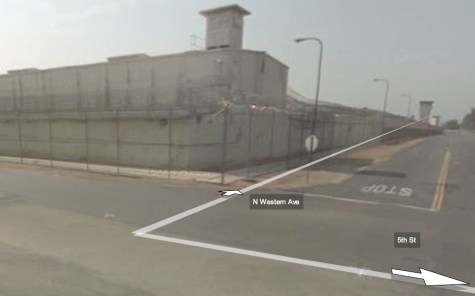
5th & Western, Norco, CA. Google Street View.

5th & Western, Norco, CA. Google Street View.

[IMAGE] The spread – four heavily tattooed prisoners in underwear standing around a dented, dingy gray metal locker. There are bowls on top of the locker and they are sharing food they cooked using hot water, instant soup noodle packets and canned meats, vegetables and seasonings. On the dirty gray concrete wall behind them is stenciled in fading red paint: NO WARNING SHOTS FIRED.

Privacy would seem to be the next strongest argument for prohibiting prison images. Given the open policies in other states, this argument seems flimsy. For prisoners, all conviction information is public. Simply go to the appropriate county court and the information is openly available to the public. Yet it is extremely difficult to get any information about prisoners in the California prisons. For the public there is one telephone number you can call. [916 445-6713] You must know either the prisoner’s CDCR Identification Number or the full name and correct date of birth. The line is perpetually busy and, if answered, the caller can expect to be put on hold for a long, long time (yes, hours). On the other hand, if you go to the Nevada Department of Corrections Web site, you can search for Orenthal Simpson and it will show not only his prison and address but all his convicted offenses, terms and release date. Oklahoma, not generally known for openness, shows the prisoner’s location, convicted offenses, release and parole dates, even pictures. The federal Bureau of Prisons will provide prisoner location and release dates for current and past prisoners. Try a search on their site for Martha Stewart.
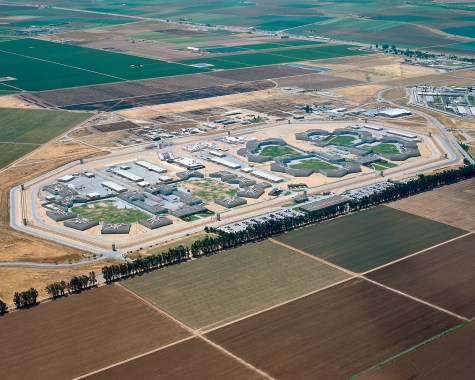
Salinas Valley State Prison. Courtesy CDCR

Salinas Valley State Prison. Courtesy CDCR

A major defense California prison management will make for the privacy argument is gang violence. They believe if it is easy to find a person in a particular prison, that can make it easier for gangs to use him. The gangs may use the prisoner to do their illegal work or to order him killed if he has fallen from grace, so to speak. CDCR logic is that by keeping prisoners hidden they are keeping them protected. If this is true, the magnitude of the gang problem is nothing short of monumental. Other states apparently do not have this problem. Why not?

[IMAGE] A pile of clothing, denim pants, orange coveralls, boots, etc. on a six-foot folding table. Two uniformed guards on one side of the table. Two naked inmates on the other side of the table, one bent over spreading his rear-end cheeks for officer inspection.

I categorize all other arguments against my taking prison pictures as simple totalitarian need for control. An uncontrolled image is seen as a risk – and why take a risk? The fewer images that exist, the fewer possibilities there are for something to happen that they can’t control. Statistically speaking, very few members of the public or the media ever get to see what happens inside prisons. Media representatives are escorted at all times and only see what prison management wants them to see. They are rarely given unfettered access to prisoners. Visitors are the bulk of the public that see anything of a prison, and that is a very limited view – parking lots, processing rooms and the visiting rooms. Even inmate appearance is tightly controlled in the visiting experience. The prisoner who shows up needing a shave or wearing a wrinkled shirt doesn’t get into the visiting room. And he or she will be strip-searched going in and coming out.
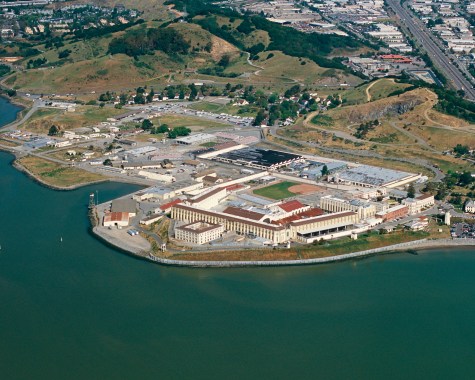
San Quentin. Courtesy CDCR

San Quentin. Courtesy CDCR

Prisons, at least in California, are reactive rather than proactive. California’s first permanent prison, San Quentin, opened for business in 1852. Since then, the prison system has been making rules and regulations based on preventing the recurrence of negative events. For example, a prisoner at R.J. Donovan prison at San Diego escaped using a fake staff identification card he had made. He walked out amid a small crowd of other staff leaving at shift change time. As was customary then, he simply held up his photo ID and was waved through with the rest of the ID card wavers. To prevent this from happening again, CDCR policy now requires the gate officer to physically touch and examine the employee ID card before letting the person through the gate. Such policy-creation has been repeated tens of thousands of times over the past 157 years of the California state prison system. It does not lend itself to the openness of unfettered prison images.

[IMAGE] The back of a prisoner’s shaved head as he sits in the audience of a GED graduation ceremony. Visible under his mortarboard are gang tattoos on his head and neck. Blurred in the background an inmate stands at the podium giving his valedictory address.

Until 1980, incarceration in California had rehabilitation as a major goal. The state legislature in that year, bowing to a Reganesque rabble-rousing changed prison law to say the purpose of incarceration is punishment. The concept of rehabilitation disappeared and so did most of the prisoner programming and policies meant to promote rehabilitation. Connection with family is known to be one of the most important factors in rehabilitation. I suggest the control of images in the prison system is one policy that discourages family connections.

Substance Abuse Treatment Facility at Corcoran. Courtesy CDCR

Substance Abuse Treatment Facility at Corcoran. Courtesy CDCR

Prison subsumes human beings. Prisoners disappear over time. As soon as a man goes to prison, he begins to fade from his former life. Just as a photographic print will fade over the years, the place of a man in his family fades while he is in prison. Life goes on – without him. His linkages to the fabric of family and community eventually fray and break. Phone calls, letters and visits cannot fully replace the foundations of shared daily interactions, family projects, adventures, challenges and the intimacy of shared emotions. Despite our ability to love, we are creatures of habit, and over time absence can become a habit that seems a normal reality.

The absence of prison images in society supports the concept of shame in incarceration. This shame then supports an estrangement that prison system managers find useful for their purposes. The human toll of that is prisoners who simply hunker down to do their time. Some resist family contact. “I don’t want my children coming to see me in a place like this,” is a common thing I hear from prisoners who could have visits if they wanted them. Would this change if prison images were common in our society? I think so. I think it’s worth a try.

If an individual and the law don’t agree to the point the individual is imprisoned, one hopes lawful imprisonment changes the individual, right? For the better, right?

Unfortunately, American prisons have proved the opposite of rehabilitative or hopeful of positive change. Recidivism rates in America are between 60% and 68% (depending on the source).

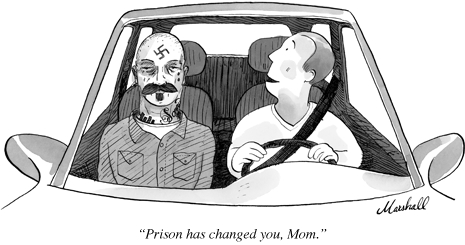
"Prison has changed you, Mom" © 2009 Marshall for the New Yorker

"Prison has changed you, Mom" © 2009 Marshall for the New Yorker

Spurred possibly by the fiscal-driven prisoner releases across the nation, Marshall penciled this pearl.

Some of the best comedy is simultaneously tragedy. The truth is America’s prison archipelago has bruised the lives of the current 2.2 million prison population, the lives of family members AND our lives and communities. Inmates returning to society haven’t been suitably prepared or shown new paths. Change has been for the worse in majority of cases.

I was astonished to read this AlertNet article. It excavates the background to Lovelle Mixon’s massacre in Oakland that killed four people.

I cannot agree with the article’s logic 100%. It would be a sad day if I ever presumed the individual totally powerless and unable to act upon non-violent decisions, but as the author writes:

“Though Mixon’s killing spree is a horrible aberration, his plight as an unemployed ex-felon isn’t. There are tens of thousands like him on America’s streets. In 2007, the National Institute of Justice found that 60 percent of ex-felon offenders remain unemployed a year after their release.”

It is not easy to resist the urge to think of mass-murderous crimes as the singular actions of an individual.

I appreciate Earl Ofari Hutchinson‘s article because it brings together the many invisible and minor trials in life that collectively make daily stress unbearable. I finished the article amazed that there are fewer desperate crimes akin to Mixon’s. An uncomfortable thought.

Again, Hutchinson reminds us that the problems of incarceration, recidivism, education, unemployment and crime are inseparable:

Washington, D.C. is a near textbook example of that. Nearly 3,000 former prisoners are released and return to the district each year. Most fit the standard ex-felon profile. They are poor, with limited education and job skills, and come from broken or dysfunctional homes. Researchers again found that the single biggest factor that pushed them back to the streets, crime, violence and, inevitably, repeat incarceration was their failure to find work.

Q. Why do we warehouse people, break them, and then return them to society in a poorer position to cope?

A. Punitive and immovable laws, collective arrogance & utter denial.

With an estimated 600,000 prisoners either released or due for release in 2009, it’s about time we make a small change in our accomodations – especially given the size of change we expect of former prisoners.

© 2009 Ged Murray

© 2009 Ged Murray

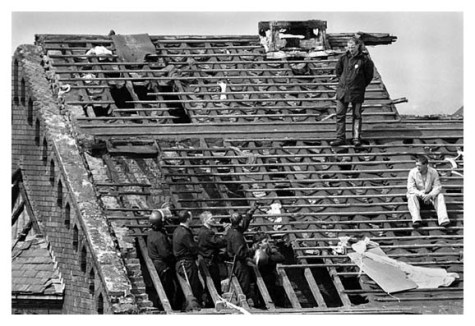
To append my last post about iconic photographs of rooftop inmates during the Strangeways riot of 1990 is a nod to the work of Ged Murray. Previous lamentations at the lack of Strangeways photography were premature on my part … I just had to keep digging.

© 2009 Ged Murray

© 2009 Ged Murray

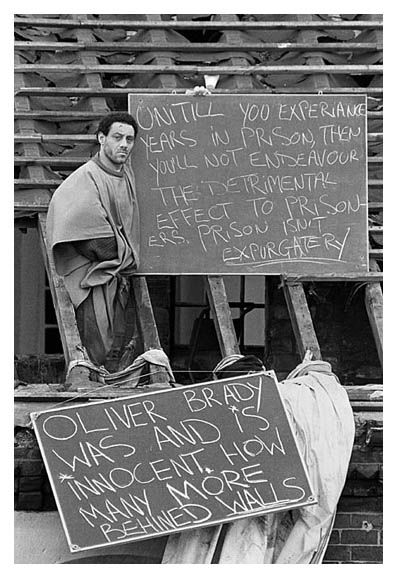
These are my choice shots from a series of 20 Strangeways images on Ged Murray’s website. The image below of the two inmates in discussion is iconic (according to my brother). The silhouetted tower is instantly recognisable.

© 2009 Ged Murray

© 2009 Ged Murray

© 2009 Ged Murray

© 2009 Ged Murray

© 2009 Ged Murray

© 2009 Ged Murray

© 2009 Ged Murray

© 2009 Ged Murray

© 2009 Ged Murray

© 2009 Ged Murray

This last image of an inmate with signs took a large portion of my time. I am still thinking it over. Unerringly, I like the image. The shot bypasses the potency of icon and dilutes our consumption of events; returning our appreciation to more modest levels, focusing on the individual lives involved during a brief but pivotal moment in the history of British governmental prison policy.

© 2009 Ged Murray

© 2009 Ged Murray

__________________________________

Thanks to Ged Murray for his permission to publish the images.

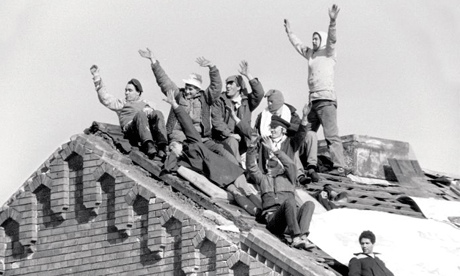
The Strangeways riots in 1990 led to breakthroughs in the prison system. Photograph: Don McPhee for the Guardian

The Strangeways riots in 1990 led to breakthroughs in the prison system. Photograph: Don McPhee for the Guardian

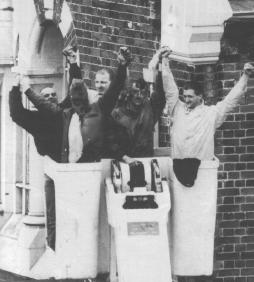
On April 1st 1990, began Britain’s largest prison riot in history. Strangeways may not mean a lot outside of the UK, but within, Strangeways, Manchester is synonymous with the romanticised image of the Northern criminal. The photographs of prisoners on the roof are iconic. Britons watched with shock.

Photo: Ged Murray

Photo: Ged Murray for the Observer

Prison conditions had rarely been in public debate. Our level of shock was only equivalent to our level of apathy, prior. The general public were in awe of the unprecedented institutional collapse.

Prisoners occupied the roof for 25 days in front of round-the-clock media coverage. The protest ended when the final five prisoners surrendered themselves peacefully on 25th April.

The estimated damage was pegged between £50 and 100 million. The true cost for the HM Prison Service was lord chief justice, Lord Woolf’s subsequent damning report, which cited inmate frustration and poor prison conditions as a main reasons for the riot.

Credit: Unknown

Photo: Ged Murray for the Observer

According to the Guardian – which includes a transcript of the prevailing exchange between proctor and prisoners – the stirrings of unrest began in the chapel following the 10am service. Prison officers evacuated the chapel and then (arguably) too hastily other areas of the prison. Inmates using keys taken from chapel guards released other inmates. Soon the overcrowded and understaffed facility was no longer in the control of government authority.

Strangeways roof protest photographs are iconic because their subject was so unexpected. Britain had harboured class and political confrontation much in the past. But in the miners strikes and clashes with police, football hooliganism, the general strike violence could be in some way predicted. The circumstances for those prior tensions had been played out through media narrative. UK Prisons were neglected; they were in desperate conditions and we – the public – were oblivious.

Don McPhee

Photographs of the Strangeways riot are hard to come by but I have gleaned a few from the web. In doing so I came across the work of the late Don McPhee.

I strongly urge you to watch this slideshow of his work.

McPhee had a 2005 exhibition at the Manchester Art Gallery and is a fondly remembered northern talent. He was a crucial part of the alternative editorial voice of the Guardian at that time. That distinctly Northern paper is now internationally distributed & respected.

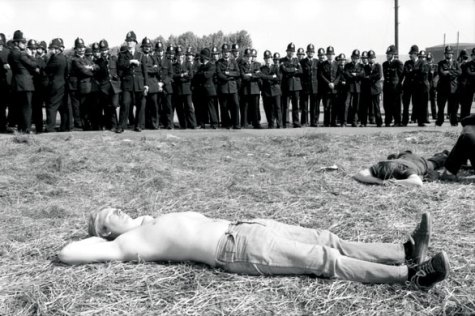
Miners sunbathing at Orgreave coking plant. Photograph: Don McPhee

Miners sunbathing at Orgreave coking plant. Photograph: Don McPhee

_______________________________________________________

Here is the inevitable percolating legacy of Strangeways in public dialogue.

Here, Eric Allison makes a succinct argument for British prison reform.

And here is the UK Parliament debate in 2001, ten years after the January, 1991 publication of Woolf’s report reviewing the response to the report recommendations.

EMAIL

prisonphotography [at] gmail [dot] com

Prison Photography Archives

Post Categories