nils


“We cannot build up a system of sanction on supposed danger, in my view.”

Nils Christie.

IN MEMORIAM

Nils Christie, Norwegian sociologist and criminologist, died Wednesday May 27th at the age of 87.

Christie’s great achievement was to detach discussion of prisons solely from discussions of crime and to afix them firmly to conversation about economic inequality and the definitions of behaviour we attach hastily to those outside of our social class.

Christie ushered in the modern prison abolition movement. Activist group Critical Resistance writes:

“Christie challenged the accepted notions of crime and the legitimacy of imprisonment throughout his career. Along with Thomas Mathiesen and Louk Hulsman, Christie was at the forefront of a tendency of European social scientists that pushed prison abolition into mainstream conversation.”

In this very accessible Q&A, Christie explains that someone stealing money or threatening violence inside or outside the family is an unwanted act in both cases, but only in the latter is it defined as “crime” and therefore more likely to be dealt with courts. Transgression has other “solutions” and responses than prosecution. Judicial systems have to be more than merely punishment.

At different times, Churchill, Mandela and Dostoyevsky encouraged scrutiny of a society’s prisons in order to understand a society itself. Christie asked us to go further and scrutinise the level of pain — psychological, physical, medical — induced by a society’s systems of crime control and punishment in order to understand a society’s character. What level of widespread revenge and hurt are American prisons willing to enact under the auspices of “justice”?

Christie’s seminal book Limits To Pain was the most rounded delivery of his ideas. It was translated into 11 languages. You can read it in full online here.

IN EUROPE, IN THE UNITED STATES

Christie was able to stave off, somewhat, the drive toward punitive sentencing and warehousing in his home nation Norway. He and other thinkers in the social sciences had a place at the table.

Unfortunately, the U.S. prison boom was driven by politicians’ fear of losing votes, guards’ fear of losing jobs, and the public’s fear of the ever-present, media-manufactured predator. The Prison Industrial Complex emerged as a result. Christie describes this money-driven brand of American exceptionalism:

It is quite a fantastic situation when those who administer the pain-delivery in our society have such a great say. It’s as if the hangman’s association got together to work for more hanging. We might feel a bit uneasy about this. But that is only the tip of the iceberg. There is a trend in the military industry to turn to law-and-order production. There has been a series of meetings between defence contractors and penal authorities. The US Secretary of Defence addressed them saying: ‘You won the war abroad, now help us win the war at home.’ It is the electronics industry that is most heavily involved wiring prisons, producing electronic bracelets, electric monitoring both inside and outside prisons. It involves lots of industries – construction, food-catering, even telephone companies. The journal of the American Corrections Association is filled with ads to tap this billion-dollar market.

Rest in peace, Nils.

coppic

Two white cops posing with rifles as they stand over a black man lying on his belly with deer antlers on his head. For years, the image was kept under wraps. The Chicago PD said they wanted to protect the man who wasn’t the cop in the picture! — yeah, the one lying on the floor subjected to humiliation. But it is secret no more.

The Chicago Sun-Times writes, “A Cook County judge has refused to keep secret the shocking image of former Officers Timothy McDermott and Jerome Finnigan kneeling with what the police department says is an unidentified African-American drug suspect.”

“Believed to have been taken in a West Side police station between 1999 and 2003, the Polaroid photo was given to the city by the feds in 2013 and resulted in McDermott, a clout-heavy cop, being fired last year by the police board in a 5-to-4 vote,” the Sun-Times continues.

Finnigan is now serving a 3-and-a-half years in prison for leading a robbery ring and McDermott is currently fighting his dismissal. In McDermott’s case, he should walk away quietly and accept he got off lightly, but clearly he’s not the brightest or most modest of individuals.

You can and should read the full story about how this potent image was the loci of a multi-year backroom political tug of war. The Chicago Sun-Times’ decision to publish it was not taken lightly. In an excellent and long statement made by Jim Kirk, publisher and editor in chief of the Chicago Sun-Times, the knowns and unknowns are laid out so there can be no misunderstanding. Kirk warns against presuming to know everything from this single image. He writes:

Photographs can do a number of things. They can help frame a news story or put it into better context. They can convey details and nuances of a story that might otherwise be lost.

But if we don’t know all the facts surrounding a photograph, some things are left open to interpretation. It is why news organizations are careful in considering the images they run and try as hard as possible to detail what is being displayed.

[…]

It’s an offensive image, so much so that this newspaper had to think long and hard before publishing it today. When two Chicago Police officers pose like hunters with rifles over a black man with deer antlers on his head, a responsible newspaper cannot withhold the image from its readers, especially when you consider that one of the officers, Timothy McDermott, was fired because of the image and is fighting to get his job back.

[…]

There is a lot we don’t know, including most importantly, the name of the suspect. We also don’t know exactly when the Polaroid photo was taken, though it is believed that the image was snapped at a West Side police station sometime between 1999 and 2003. Was the man forced to pose? Was he coerced into wearing those mocking dear antlers? Was he the involuntary victim of a sick joke or, in his own mind, in on the joke? We exhausted all avenues before printing the story. We don’t know and the police say they don’t know either.

This photograph will offend people, as it offends us. We also know it can be a tool to raise the level of constructive discourse to make our city better.

It’s the type of caveat and engagement with an image I’d like to see next to every news photograph, but we know no writer, editor or human has the time for to add that deep contextual treatment to all visual news content.

Fascinating image, unfolding story and analysis from within the industry. A potential case-study for journalism students, I’d suggest.

06PrisonsVanMalleghem

I had a quick chat with Sébastien van Malleghem about why he is crowdfunding a photobook following his three years photographing prisons in Belgium.

It’s over at Vantage: Making Photos Inside To Bring The Stories Out

In short, this:

“The book is, for me, the closure of the story. Photographs must end on paper. That’s how the medium exists — in print. On paper, with full context, you can touch the pictures, understand the whole story. Things fade away on the Internet. Clicked, Like, then something else. Good photos in a book stick to your head. The largest part of my photo story will be exclusive to the book.”

02PrisonsVanMalleghem

03PrisonsVanMalleghem

04PrisonsVanMalleghem

05PrisonsVanMalleghem

08PrisonsVanMalleghem

09PrisonsVanMalleghem

01PrisonsVanMalleghem

07PrisonsVanMalleghem

Ross


STATE BILL 124

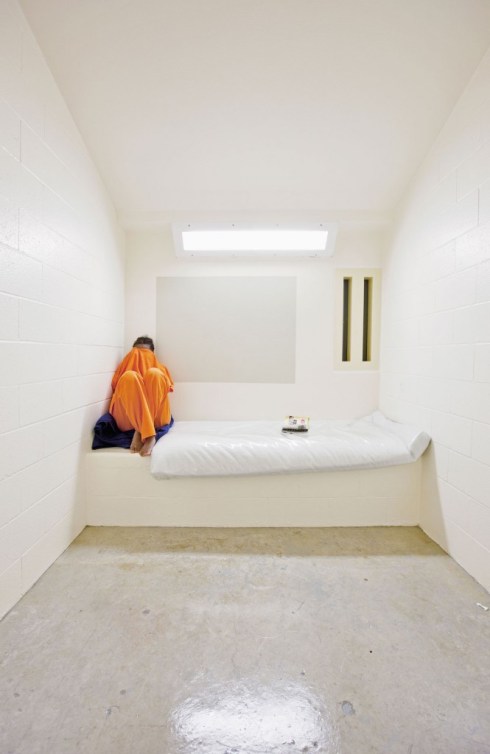
The indubitable Ella Baker Center alerted me this morning to the efforts by activists and good-headed politicians in California to prevent the use of extended solitary confinement for people under the age of 18.

The Ella Baker Center is working to end the solitary confinement of youth with the Youth Justice Coalition,Children’s Defense Fund California, and California Public Defenders Association. Senator Mark Leno introduced the bill, SB-124

DeAngelo Cortijo who is formerly incarcerated explains why SB-124 is a good thing.

The first time I experienced solitary confinement, I was 11 years old.

Now, 11 years later I’m fighting to end the widespread use of solitary confinement in California’s youth prisons.

I’m writing today to ask you to join me in taking action.

As I would stare out of my cell window I could see the other kids outside and I remember feeling empty and afraid. On several occasions I contemplated suicide.

My own experiences in solitary are the reason I am supporting Senate Bill 124, a bill introduced by Senator Mark Leno (D-San Francisco) that would limit the solitary confinement of youth. SB 124 is about to come up for a vote in the Senate and we need you to let senators know that we will no longer stand for this torture of our youth.
Along with Youth Justice Coalition, Children’s Defense Fund-California, and the California Public Defenders Association, the Ella Baker Center is a co-sponsor of this legislation, which would also provide a uniform definition of solitary confinement and require statewide reporting of its use.

If we unite and make our voices heard, we can end this cruel and inhumane practice.

I was most recently placed in solitary confinement last year for two months. I spent at least 21 hours per day alone in a tiny cell. I kept thinking, I could be in college right now, but instead I’m just wasting away in here.

Today, I am still affected by these experiences. I am afraid of being alone. I went into prison feeling angry and confused and I ended up coming out of the system feeling even worse than when I went in.

Now, I am an intern at the National Center for Youth Law, working to ensure that young people like me have a chance at a better life. This bill is an important first step toward that goal.

Kids in California’s youth prisons and jails cannot wait—Will you stand with me and all of the other young people who have been victims of this abusive practice?

In solidarity, DeAngelo Cortijo, Intern, National Center for Youth Law

Yup. If you live in California, sign this and let them know you support the bill.

Image © Richard Ross, from the series Girls In Justice.

SHOOTING DEATH

“I have seen 4 seconds of it. I heard my son begging for his life. I cannot watch. I know it is very disturbing,” said Janetta Brown to Democracy Now! about a 17-minute video which documents the death of her son Sergeant James Brown in a jail in El Paso.

Sgt. James Brown voluntarily checked himself in to the Texas jail on a Friday night in 2012 to serve a two night sentence for a 2011 DUI (driving under the influence of alcohol) charge. The only reason Brown’s death has been in the news recently is because a video of the incident was recently acquired by an El Paso TV station. Brown’s family, including his mother did not know of a video of his death until it was mentioned, in passing, by a lawyer. That led to the request and release of the disturbing footage.

The video has been widespread across the news this past week. I have had the YouTube window open in my browser for days, knowing I should respond, but not quite knowing how to. This is my beat — imagery emerging from a state-administered locked facility, made by the state authority being used and interpreted against itself. My anger, sadness and outrage were immediate and obvious. I felt those negative emotions but they did not fully describe my experience. I was paralysed from writing because of guilt. I feel guilty that I am viewing a video of a man’s death that his mother has not. I feel guilty that I am so far removed from the subject I can move on from its devastating truth on a whim. The browser reamined open because I couldn not close it; to do so would be to, likely, never return.

“It’s devastating. It’s inhumane,” said mother, Janetta Brown. She was describing the events leading up to her son’s death, but she could as easily have been described the videoing of events. “It’s inexplicable what happened to him,” she added.

It is inexplicable that we are able to view a death online. Centuries ago, people witnessed death in war, workplace accidents, hate crimes, in person. Decades ago, people began to witness death (not the aftermath of death, but the actual drawing of final breath) in sequenced still news imagery and some TV footage. Years ago, we became accustomed to seeing deaths online. It’s almost inexplicable that once people mostly encountered death at the bedside of a loved one, and now children can watch snuff-movie-equivalents on the internet, at will.

DEATH IN PUBLIC

Authorities claimed Sgt. James Brown died due to a Sickle Cell Crisis which prevented oxygen getting to his brain and organs, but the family say he had no prior record of Sickle Cell Disease. Brown repeatedly says he can’t breathe and appears not to resist. By the end of the video, he is shown naked, not blinking or responding, his breathing shallow. Attorneys say an ambulance was never called. Brown was eventually brought to a hospital, where he was pronounced dead.

Unfortunately, Brown’s filmed death is the latest in a series of high profile videos to hit the news channels. The deaths of Tamir Rice in Cleveland, Eric Garner in New York, Charly Leundeu Keunang in Los Angeles, James M. Boyd in Albuquerque, John Crawford III in Ohio, and Walter Scott in North Charleston have all been consumed by the public. As challenging as these videos are, we would not want them to not exist. The judicial system, as it currently operates, serves to protect law enforcement officers with their fingers on the trigger more than it does those who are victim to cops’ bullets. We know that video evidence is one of the few things that can sway legal decisions in a direction favourable to the victims and their advocates.

I suspect that if videos of the murders of Akai Gurley, Trayvon Martin and Michael Brown had existed prosecutions for the assailants may have stood a chance in court. (I fully acknowledge the murder of Eric Garner taped from start to finish resulted in no indictment of the officers.)

Given the calls for more police body cams — from the White House to Michael Brown’s family — it might be that our future will hold more videos of death. And so we have news and evidence to be analysed; the use of video as witness versus the circulation of video as internet fodder; and the empowerment of knowing versus the guilt of knowing at a distance. The multiple roles these types of video play created my long hesitation to write this post.

My paralysis was broken when I read Teju Cole’s well-pitched Death In The Browser. Cole also grapples with the discomfort of being a consumer but he manages to reconcile his emotions and untangle their confusion. He admits to writing about many things related to the issue of Walter Scott’s videoed death before arriving at his main point about Scott’s death. But Cole’s words are not wasted.

“If you set enough tangents around a circle, you begin to recreate the shape of the circle itself,” writes Cole.

Cole brings us gently to a point at which we all must stand if we’re to function in a culture now unhesitant to circulate images of fellow humans’ deaths. Rather elegantly, Cole draws a parallel between the person killing and the person watching the killing.

We need to adapt to the new type of life and death data to which we are exposed. Cole points out that watching a time bar creep across the bottom of our screen is a conscious action. Just as raising a gun and pulling a trigger is a conscious action. As individuals, we are not able to change decisions made by others, but we can consider deeply the decisions we make before the screens of our devices.

Have we comprehended that there are profound differences to the material we see on the internet? All things are not the same. And yet it’s pretty easy to open or close a browser window, regardless. Find something else to hold our attentions.

I’m not talking about being desensitized per se (arguments that photos of death and disaster numb us are largely discredited). I am not talking about a psychological or evolutionary shift; I’m talking about a structural fact of our internet browsers. It’s all too easy to click the next tab, the next news story, the next or previous image in a gallery. We remain appalled by (videoed) injustices but will we be moved to political action because of them? Do we see the urgency in a video, the same way we see the urgency in a burning building or baby on the tracks? A lot of my concern feeds into a larger worry that we’re living a step apart anyway, making the harder work of political organising more of a challenge. We need to ensure footage of violence emboldens us against violence.

Is the seriousness of death and murder, repeated, on our screens enough of a spur for us to enact equally serious discretion over our online consumption? I left my browser open all week, Cole closed his before the shots ended. There’s no right or wrong answer, but there is a right or wrong decorum.

My thoughts return to Janetta Brown. And they will every time I have the option to press play on an internet vid. She made a conscious choice not to watch the video of her son’s death; she did so to avoid further trauma. Yet, Janetta Brown understands the role the video will play for educating hundreds of thousands of people on the injustices behind bars in America. Killing videos are not for entertainment. Imagine meeting a victim’s mother or family or loved ones and imagine telling them that you watched the video in any other spirit than sympathy and solidarity.

glove

I was recently alerted about a disturbing change in policy within the California prison system. There are numerous reasons to be alarmed and thankfully Kenneth Hartman details them below and in the linked Los Angeles Times Op-Ed he wrote.

Californians United for Responsible Budget (CURB), for whom Hartman is an Advisory Board Member, forwarded me his open letter.

Dear Friends & Colleagues:

As you may already know, the CDCR has implemented a new screening system for visitors that includes the use of Ion Scanners and dogs. The upshot of this is visitors, and only visitors, if found positive by either of these highly inaccurate methods, are required to submit to a strip search in order to have a contact visit. For the details of what constitutes a strip search, please see my opinion piece in the Los Angeles Times, Strip-Searches Will Keep Helpful Visitors, Not Illegal Drugs, Out Of Prison.

Over the past few weeks, at this prison alone, a 77-year old woman with a recent knee replacement was ordered to squat naked, another woman who refused to submit to the humiliation of a strip search was denied contact visits, but when she reluctantly agreed the following weekend she was forced to strip search twice as punishment, and multiple other visitors were placed on non-contact visiting status for not surrendering their dignity.

The goal of all of this is clear.  The CDCR wants to do away with contact visiting. They are heaping their own failure to control the drug problem in the prisons onto the backs of the visitors.  It’s a terrible thing we all have to fight back against now before it’s too late, before we’re all on non-contact visiting status forever.

As a starting point to this campaign, there’s an online petition called “Stop Strip Searching My Mom.” I encourage all of you to sign the petition and get everyone you know to sign the petition.  Further, please forward this to all your contacts and ask them to do the same thing.  We need 100,000 signers before we send it to the governor.  Let’s get to work!

And there will be more to this campaign, so please get ready to participate again when we press for legislative help and seek legal help in the not too distant future.

Thank you in advance for your help in defeating these unreasonable policies.

Take the best of care and strive to be happy. Peace…

Sincerely, Kenneth E. Hartman

0034

WHERE IS THE REFUGE IN A PRISON?

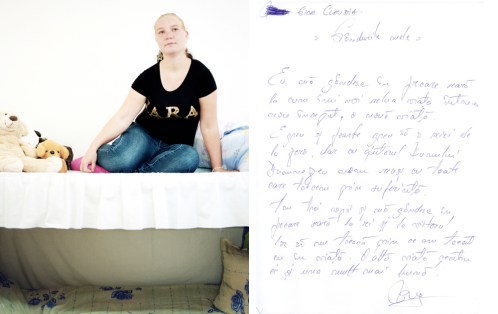
Where is our greatest refuge? A hideaway? Our home? The bedroom? The bed? Artist Dani Gherca reasoned that for women imprisoned in her home country of Romania, the greatest refuge was the bed.

“The bed is no only an object used for the body’s physiological and physical rest, but it’s also an intimate space for the women during the detention. The two square meters around the bed, is the only perimeter she can keep for herself,” says Gherca. “After I talked with some prisoners, I found that, in the evening, when the lights go out in the detention room … that is the only moment when each one of them can afford a really intimate moment.”

As such, Gherca made portraits of women on their beds and asked each to provide context by asking them about their thoughts during those quiet, solitary minutes. The resulting series is called Intime (2012).

I asked Gherca a few questions to provide background to Intime. We publish the female prisoners’ responses in full.

Please continue scrolling.

Alina

Alina

The night-my thoughts. The night for me, as well for the people around, represents the most quiet period, in which the soul and the mind can meditate and can realize what they’ we done bad or good during the day. The night behind bars is both sweet and bitter. The loneliness oppresses me, the distance from my family struggles me. Every night I am thinking about my child that I love and respect with all my heart; at the beautiful moments that I lost because of my mistakes. I am thinking at the moment when I will step over the threshold to freedom; at my little’s girl innocent smile and sweet hug. Every night I pray to be strong to carry out the punishment and to can be next to my child and to make it up to the period in which she stayed without me.

Q&A WITH DANI GHERCA

Prison Photography (PP): I understand the method, the aim and the outcomes of Intime, but why did you want to photograph inside a prison in the first place?

Dani Gherca (DG): The idea of intimacy is very important for me. I think that us, as human beings, we need freedom of mobility, but have also the bigger need to be able to decide when we want to be alone. The prison is an institution that hides people’s need of intimacy, an institution that limits the woman’s need for mobility.

PP: Targsor has been photographed before – in a photo workshop format by Cosmin Bumbut and by photographer Ioana Carlig. Were you aware of these projects?

DG: Yes, I know Cosmin and Ioana’s projects. However, I am interested to document the prison only on the conflict between privacy and this space that compels people to live together 24 hours a day.

PP: Has Targsor been photographed so much because it is relatively relaxed?

DG: Targsor Prison has a more permissive status in this kind of approach. However, I was attracted by this prison because it is the only prison for woman from Romania.

PP: What do Romanians think about prisons?

DG: In the last 3 years, the prison has become an institution that is seen as a method of revenge, mainly due to politicians who were sentenced in large numbers in this period.

PP: What do audiences think about your portraits and the prisoners’ written thoughts?

DG: The audience was more interested in the letters written by the girls. It was a new situation: to have access at the thoughts of some prisoners. Given the fact that this wasn’t an interview, the girls were more relaxed, and acted like they had written letters.

PP: Did the women talk about photography and what it gave them? Did for them? How they used it?

DG: I took them some printed photos. They send pictures home so it’s a good opportunity for them to have some portraits to send to their families. Otherwise, they cannot take pictures. Generally, I think they like to pose. It makes them feel somehow important.

PP:  Thanks, Dani.

DG: Thank you, Pete.

WOMENS’ TESTIMONIES

Ana Maria

Ana-Maria 2

“Of all the moderates, the most detestable is the one of the heart.” (A. Camus)

Of how much love we gathered in my soul for you, I’d be able to build the whole world and would still remain. I could build seas and oceans, the sky with billiards of stars and would still remain because my love for you doesn’t knows limits or dimensions. That’s why, I will take a little piece from my soul and a little from your love and I will build a world JUST FOR US and a sky for OUR stars to shine and an infinite ocean of love in which we can swim after the OUR sun will burn our feet after longs wanderings though cities lost in antiquity, cities of a civilization where we have our roots and have never been known, only by angles because the holy land of our love has its foundation on the last rung of the ladder that climbs to God.

Ana-Maria

Ana-Maria

Before getting here I was very happy next to my children, next to my family. I regret I am sorry that I have to stay away from my family and she suffers too for me. Now I am sitting and thinking at a more beautiful and happy with my family. To find a place to work, to take walks with the children in the park, to build them a beautiful future, to teach them only nice things, to take them to school to stay away from various kinds of crimes. I have an advice for the ones outside, for all the scholars: stay away from the entourages. The entourages will make you steal, rob. They will make you commit various kinds of crimes and is it wrong to get here. Here is a big sufferance and it’s hard to abide, to stay away from your children, from your family, it is very hard. Please think well before getting in entourages and with who will hang out.

Claudia

Claudia

My thoughts. I am thinking every night at my little boy and at my family to arrive as soon as possible next to them at home. Millions of thoughts and ideas that I want to do appear in my mind, but all are in vain, because I am here. I like very much to listen to music and to sit in quiet because I am a calm person. I am waiting forward for the day when I will be at home. This is the only thing that I am thinking about.

Gica Claudia

Gica Claudia

My thoughts. I am thinking every night about how I will retake my life back into a new beginning, a new life. It’s hard and very hard to retake it from the ground, but with the help of the Good God, I will succeed with everything that I passed by sufferance. I have 3 children and I am thinking every night at them and at their future, do not go through what I went through in life. Another life for them, the very best.

Isaura

Izaura1

At night I am thinking about; my family, at the liberation, at what work place to find, night by night. I regret the day when I committed this crime, and I am thinking how to build my life so I won’t get here again, because it is very difficult to think that there is nothing more valuable than freedom.

Marcela

Marcela

What I’m thinking? Really, what I’m thinking? Only about the day that passed, and the day that will come…

Maybe nothing can be more beautiful and more good than to feel that what I’ve done today is better than what I did yesterday and tomorrow I will start something better. Any day is A BEGINNING for me!

Monica Luminita

Monica Luminita

My thoughts. I am thinking every night when I sit in my bed about my children and at how I will react after four years have passed day-by-day. I like listening oriental music. I like Turkish movies, the comedies.

At night, I have moments in which I can’t sleep because of the punishment and I am thinking from where I started and where I’ll finish at my day of freedom; when I will see my children after 4 years and a few months. I repent for getting in these places. Never in my life I will I commit crimes, to arrive here again. I won’t leave my children alone ever.

BIOGRAPHY

Dani Gherca (b.1988) lives in Bucharest and works in Romania. She holds a Bachelor of Arts degree from the Photo-Video Department, at the National University of Arts in Bucharest (2013) and a Masters of Arts from the Dynamic Image and Photography Department, at the National University of Arts in Bucharest (2015).

1

If you live in Portland, Oregon and you’re planning to get wed over Memorial Day weekend, why not let a Magnum Photos photographer come by and make some shots? Via.

EMAIL

prisonphotography [at] gmail [dot] com

Prison Photography Archives

Post Categories