selfie

Final Words, launched today, is a sprawling documentary project that focuses on the humanity at center of the death penalty in America. It is the brainchild of photographer Marc Asnin known for his brick of a book Uncle Charlie. Well, this project takes Asnin from the personal to the political, but it is no less massive. Asnin’s got form.

Asnin is asking photographers and non-photographers alike to submit selfies as statements against the death penalty. I’ll get to that in a moment but first the project and the cause.

FINAL WORDS

Final Words is a book and traveling exhibition, featuring the final statements of the 515 prisoners executed by the state of Texas since 1982Final Words will shape and deliver curricula to American high-schoolers. If we can get the youngest generation talking then perhaps we can engineer a future without the barbaric death penalty?

The project statement explains that more than one person every month for thirty-one years has been executed by the Lone Star State:

Just before the execution is completed, each prisoner is given the opportunity to share their final thoughts. […] It is their words, their final words in this life, that allow the reader to experience the underlining humanity central to the death penalty debate. […] Final Words comprises a part of the legacy that will live on beyond us and it will stand as a testament to the kind of society we were—who our criminals were and how we implemented our idea of justice. Final Words interrogates our presuppositions about the death penalty. […] While this book is a document of death—the death of both the guilty and innocent, the criminals and the victims—it attempts to create a dialogue about life.

All this takes a movement. And money. An IndieGogo campaign will launch in a months time.

The editioned Final Words books will cost a pretty penny. Their sales will help raise money to pump simpler versions of the content and curricula into the bloodstream of the education system.

Each page of the book features a prisoner’s mug shot, their age both at the time of the crime and when they were put to death, a description of the crime for which they stand convicted, and their final words.

Photographers Selfie Against the Death Penalty

In other efforts to corral some cash, Neverland Publications (cofounded by Asnin) and VII Association are collaborating on Photographers Selfie Against the Death Penalty, an international photo campaign to call for an end to executions in America. Highflying pixelmakers & imagershakers will submitting alongside us flailing Instagram plebs.

Note that the word “selfie” is used as a verb. I like that. Jury’s out as to how much a collection of selfies can effect entrenched moral politics, but it’s worth a try. Social media does nothing if not surprise regularly. And besides, all this just gets people talking ahead of Final Words‘ big fundraising campaign that ignites in October.

As the 501c3 sponsor of the project, VII Photo has asked all its photographers to participate in the selfie campaign. Get yourself in there too:

1. Make a selfie, save it to your computer.
2a. Upload selfie to http://www.final-words.org
2b. Fill out form (name, age, email address, location, how you heard about Photographers Selfies Against the Death Penalty, your preferred photography genre)
2c. Personalize your statement against the death penalty, by completing the following “I stand against the death penalty because …” in 140 characters or less.

Go on, selfie against the machine!

[Oh, if you’re wondering how and why Asnin and his colleagues have the last statements of 515 men and women, it is because for some reason the state of Texas keeps a public online database of them. Weird, no?!]

PROTEST

The 15th Annual March to Abolish the Death Penalty takes place in Houston, Texas on Saturday October 25th at 2pm. Details on the exact location in Houston will be announced later.


b

I moved from Portland, Oregon to San Francisco, California this past weekend.

Blake Andrews — everyone’s favourite photoblogger and Oregon resident — wanted answers.

1

Aug 12 – dbtvcampaign: #IfTheyGunnedMeDown which pic would they use? Thank you @underserverillance for Helping @dbtv13 shine light on the tragic shooting of 18yr old UNARMED Mike Brown, shot and killed by a St. Louis County police officer, show support by posting your photos! | Join in this movement. #DBTV #JPA #JusticeforMikeBrown #IFTHEYGUNNEDMEDOWN (Instagram)

“America. How do you think we look when the world can see you can’t come up with a police report, but you can find a video?”

— Rev. Al Sharpton, speaking at Michael Brown’s funeral, Friendly Temple Missionary Baptist Church, St. Louis, August 25th, 2014.

POLICING, IMAGING AND REIMAGINING POLICING

In the wake of Michael Brown’s killing by a police officer, the United States has been asked to look at itself in a grave and deep way, once more.

The Brown family, the Ferguson community and America generally must figure out how to turn a tragedy into a movement. The Brown family shouldn’t have to do this; they should be living normal lives, but once that police officer shot six bullets into Michael, their lives took an uncontrollable turn. Strength to them and to their ability to carry a movement born of circumstances no parent would want to endure.

Racial profiling is a national problem — the New York Police Department’s Stop & Frisk policy being the most overt example. Police abuse exists and minorities suffer the brunt of that abuse. The extent to which reports of mistreatment have declined among forces who adopted lapel-cameras for their officers is eye-opening. In Rialto, California — the city widely cited as the earliest pilot program of police officer body cams — had all 70 of it’s officer wear one. Between February 2012 and February 2013, public complaints against officers plunged 88% compared with the previous 12 months. Officers’ use of force fell by 60%.

4

Aug 14 – djuantrent: #ForThoseWhoHaveBeenGunnedDown “…because our souls cannot rest at the hands of injustice.” More on Djuan Trent’s blog)

Following Ferguson, a renewed call to look at policing rings loud. The figures from Rialto and other pilots like it prove problems exist. We must remember that these figures are merely late confirmation of what poor communities have known and experienced for decades — that they receive a particular and disproportionate amount of scrutiny.

[Ferguson police have started to wear body cameras, albeit 50 cameras donated by two private companies.]

Thinking about these convergences of issues, it’s surprising how much of the conversation comes back to sight: What is the nature of watching a police search? How do we see our society? How do we see class and race? How do people see the police force? How does the state see, monitor and discipline the citizenry? How are images and imaging technologies used to put forth a case when accounts conflict and versions stand to convict or acquit?

How bad does it look when police roll in military armored vehicles in the face of peaceful protest?

These preoccupations over perceptions and narrative were never more in evidence than when the Ferguson police, who unable and/or unwilling to present an officer’s name or autopsy report to the enraged public, were able to publish a corner-store CCTV camera showing Michael Brown push the store owner. Quite how some unrelated grainy footage impacts the facts of a cold-blooded murder is beyond any of us. In the early scramble to win over the public during what quickly developed as a cops v. community narrative, the police turned to video. Desperate and insulting.

3

Aug 13 – phoenixpsyd: If I were killed by police today, which picture would they use? #IfTheyGunnedMeDown #WhichPictureWouldTheyUse #IFTHEYGUNNEDMEDOWN (Instagram)

WHICH PICTURE WOULD THEY USE?

As awkward and insulting the police’s use of imagery was in the wake of Brown’s murder, the visual strategies employed by protestors was subtle, simple, subversive and hard hitting. On the streets, protestors walked with their arms in the air. Across the nation, the Tumblr Which Picture Would They Use gave young black Americans the opportunity to simultaneously show their support for the Ferguson protestors, skewer the media, and critique the duplicitous versions of character cast open them by wider society.

I am so impressed by Which Picture Would They Use. Its question is so simple and its rhetorical strategy so strong.

People of colour are subtly vilified daily, and young people of colour more so. Selfies are the snap of choice for many youngsters and Which Picture Would They Use is populated with dozens. This Tumblr shows that young millennials are savvy, canny, funny and more visually literate than us older folk. It shows that they’re totally hip to the media’s rating games. It’s a political engaged use of selfies and Tumblr’s “Like-culture.”

Which Picture Would They Use is a off-the-cuff (off-the-camera) stick in the eye to an ambivalent media. It doesn’t take much time, but the crowdsourced results are striking. Some might say youth might have been primed for this discussion (and controlled anger) following the politics surrounding the images of Trayvon Martin and George Zimmerman used in the media. But that would be glib. I would say each of the Which Picture Would They Use contributors are responding to years of experience and observations.

Which Picture Would They Use puts to bed the “conversations” about hoodies and the associated issues — race; presentation of the self; perceived dis/respect for adult America; generation gaps; and popular culture.

Hoodie or not, sports team colours or not, cross-dressing, swimwear or military fatigues, it doesn’t matter. Which Picture Would They Use demonstrates that we’re all combinations of many different traits and our personalities are not fixed. It is ludicrous to reduce a person to a single reading based upon the appearance of a dominant (most widely-circulated) image.

The young black Americans submitting to Which Picture Would They Use know Michael Brown had already been judged by a portion of America and know the remainder would judge (even if unconsciously) based upon the media’s choice of images.

2

Aug 12 – dbtvcampaign: #IfTheyGunnedMeDown which pic would they use? Thank you @labeledmisfit_ for Helping @dbtv13 shine light on the tragic shooting of 18yr old UNARMED Mike Brown, shot and killed by a Ferguson police officer. (Instagram)

P1080104

^^ That’s me ^^, last Tuesday, after two days of installation.

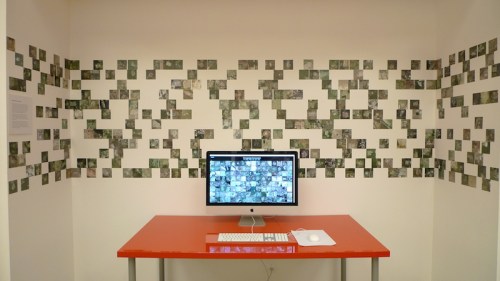
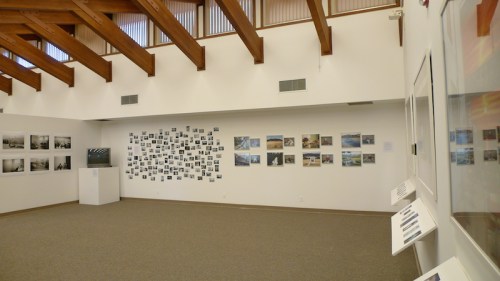
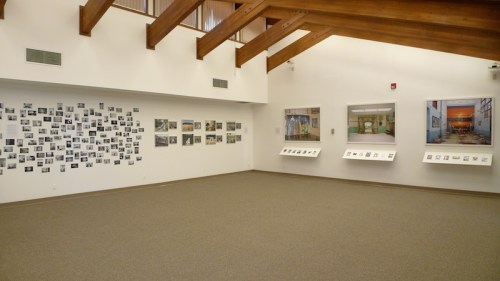
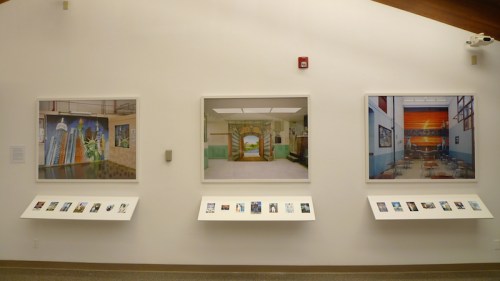
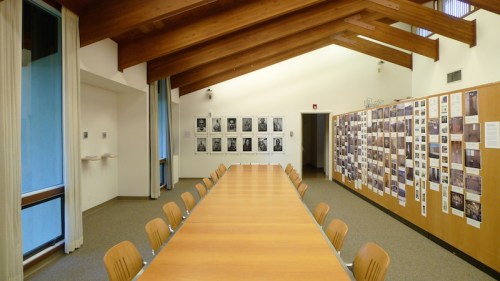
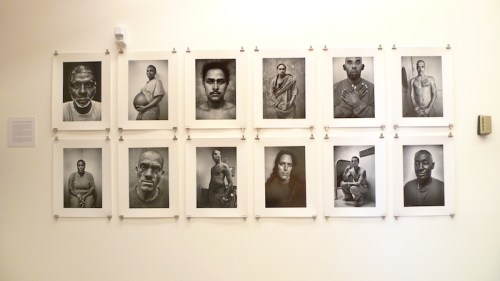
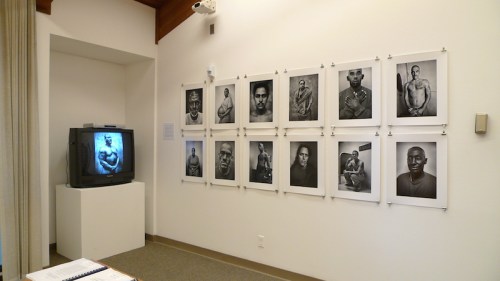
Today, Prison Obscura officially opened in the Clark Humanities Museum at Scripps College in Claremont, just east of Los Angeles. If you’re in the area pop by and have a peek. I’ll also be down there on the 2nd October to deliver a lecture ‘Prison Silences and to attend the opening reception.

Thanks to Kirk, T, Amy, Linda, Juliet and the staff at the Humanities Institute for their welcome, work and support.

P1080098

P1080083

P1080099

P1080082

P1080100

P1080078

P1080102

P1080085

P1080088

P1080087

P1080094

P1080093

All photos: Matthew Seamus Callinan

OPBcoffeeBlue_orlcrj

I’m making my debut on public radio, today. The realm of tote bags, fund drives, coffee mugs and responsible public-interest reporting just got a little more real.

I’ll be one of the guests on Think Out Loud, a stalwart of the Oregon Public Broadcasting schedule. I have no idea what I’ll be asked, but I can guarantee I’ll be speaking fast, squeezing in the urgent info, and encouraging people to see the abusive prison industrial complex within our midst.

Midday, August 12th, 2014. Tune in! 

Filmed by David Hoffman and Harry Wiland.

steacy

Today, the Philly Mag published a leaked document about the devastating decline in newspapers. It was created by Interstate General Media, owners of the Philadelphia Inquirer. It showed massive slumps nationwide but particular downturns in the fortunes of Philadelphia’s newspapers.

The slump has been rumbling on for over a decade now but the details in the leaked document make Will Steacy‘s project Deadline even more timely. Steacy is currently raising money to make a photobook and here’s why I think it deserves your support.

DEADLINE, by WILL STEACY

I was once Skyping with an artist on a residency in Europe. During the call, in the background, Will Steacy‘s head popped round the open door. Given the time difference, it was early morning for my friend, and for Steacy.

Pre-coffee, Steacy took the time to say hello. I noticed under Steacy’s arm a stack of the newspapers. Printed news from print newsrooms across the globe. Steacy told me it was his daily ritual to read, for hours, the news stories printed on actual paper. It shouldn’t have seemed so surprising, but in this era of digital information Steacy’s insistence on printed news was, in my mind, unusual. And comforting.

It makes sense that Steacy would not only notice — but also feel attachment — to the dying news daily in his once-hometown of Philadelphia. His photographs document an atrophying Philadelphia Inquirer newsroom. The number of staffers decrease, the presses go silent, the buzz of a breaking news scoop vibrates a little less.

The series is called Deadline, and Steacy is currently crowdfunding on Kickstarter to create a photobook version.

I tweeted last week that Steacy was “photographer, labor guy and workaholic” and deserving of your support. He’s worked on the series for 5 years. His father was an editor with the Philadelphia Inquirer for over 20 years before he was laid off in a round of cutbacks in 2011, and his family has been in the news industry for generations. Steacy talks of the newspaper as a form and as a bastion of an institution holding politicians, corporations and the like accountable to society as a whole. Steacy also believes the decline of the newsroom is a labour issue and more than just profits should dictate the operations of free press outlets.

Under corporate ownership every Inquirer asset is on the table in the strategy to stay alive. Ask any local, and they’ll tell you the Philadelphia Inquirer ain’t what it used to be. The focus on local coverage to secure it’s regional readership hails a goodbye to the days when the Inquirer racked up Pulitzers for fun.

The Philadelphia Inquirer still lives but it’s downsized from 700 to 200 staff, sold and moved out of its iconic headquarters, The Inquirer Building. This move, as documented by Steacy, is arguably one of the best visuals we have to grasp the size of the changes occuring now in news publishing.

While Deadline is specific to the Inquirer, the story is all too common. Large papers such as the Rocky Mountain News have shuttered completely in recent years. This devastating shift in news publishing was reflected in Philly Inquirer’s Hard Years Are Microcosm of Newspapers’ Long Goodbye, an article by my Raw File WIRED colleague Jakob Schiller, last year.

Deadline combines great images, great research, local and national narratives and a personal connection. The Kickstarter rewards are imaginative too: newsroom pencils and pin badges, and a limited edition artwork printed on the same presses that rolled out the Inquirer for decades.

Get over to Kickstarter and fund it!

steacy1

Kickstarter reward at the $25-level. Poster: “A MIRROR OF GREATNESS, BLURRED” (Edition of 50, hand numbered, signed by artist, 20″ x 24″)

Saucers

Over the course of an evening I am watching his face. He smiles, he relaxes, he shows disgust quickly, then laughs. There are so many things to keep track of. The next day I attempt to recall and I did not, as I had wished, see amalgams but instead discreet moments. There appears to be no use for the amalgamated image in recall. Perhaps this is the reason I am making the amalgamated portrait. It is an image that does not exist for me internally.

— Notes taken by Kristan Horton during production.

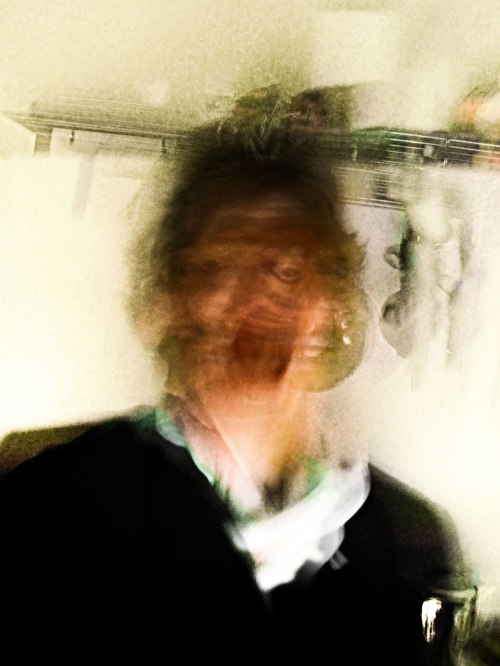
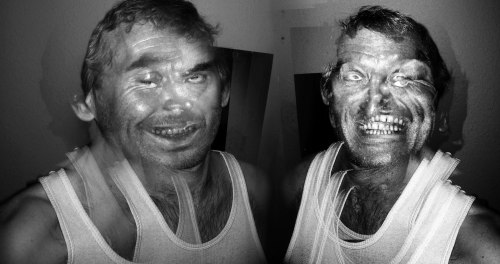
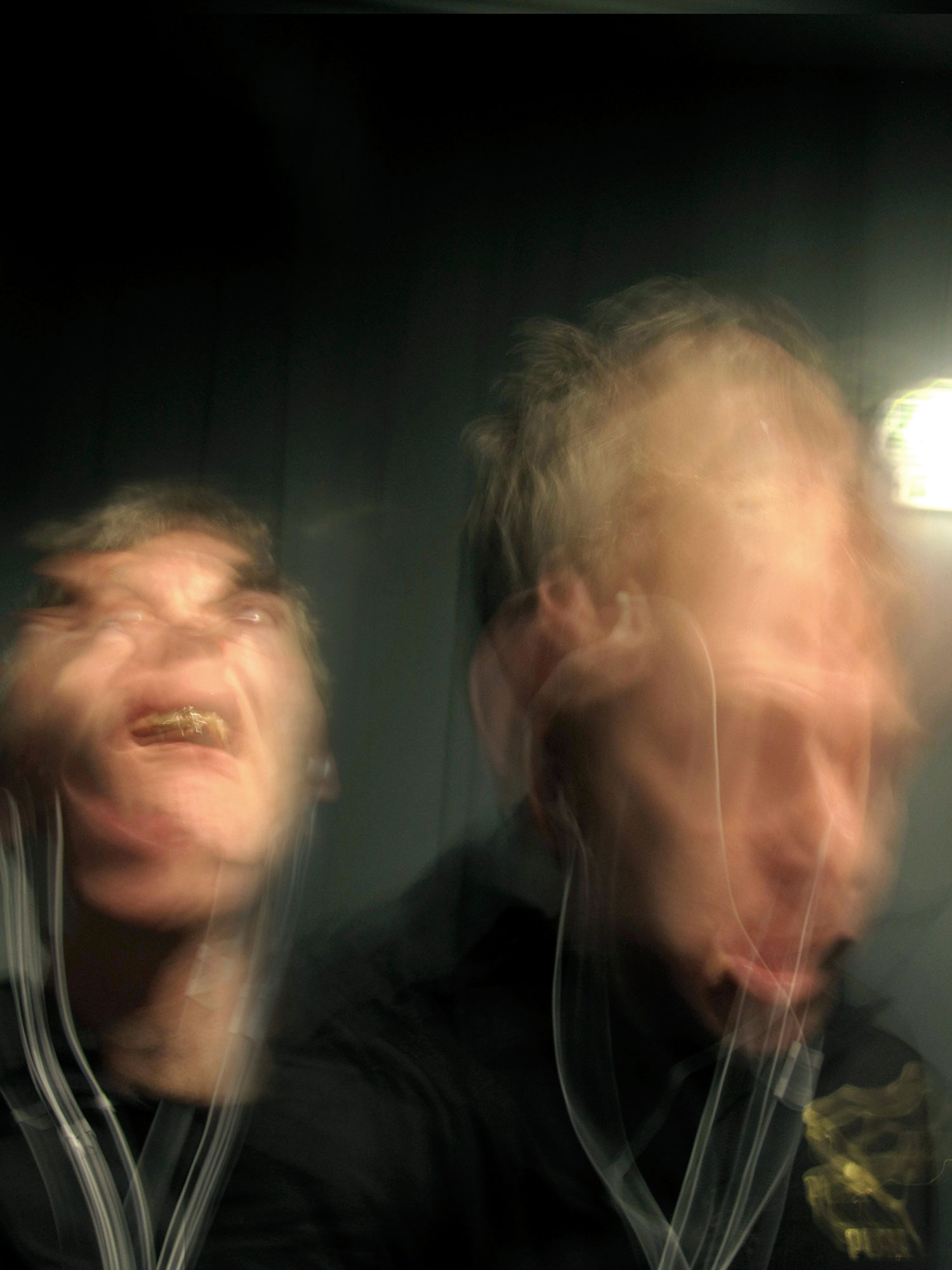
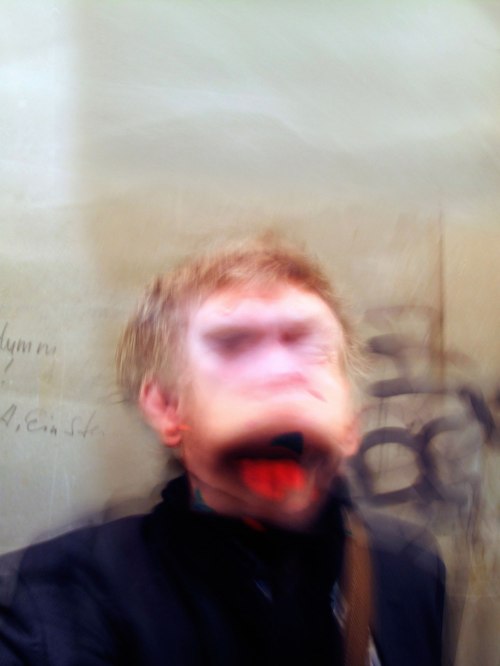
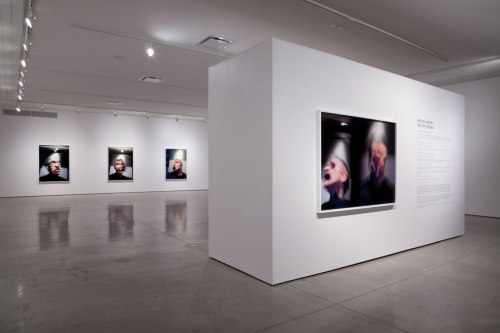
Ever flailed your head back-and-forth in front of the camera to catch a blurry selfie? Of course you have. We’ve all captured head-shots of seemingly maddened selves. Kristan Horton’s self-portraits are high-end versions of the blurred selfie … peppered with existential inquiry.

For his series One For Yourself, Horton faces the troubled relationship time and photography head on. Horton says a single photo is too hard to trust, so his animalistic portraits are made by combining multiple images.

“The document is never enough,” says Horton who’s discontent borders paranoia. “I need multiple perspectives to lessen an inner feeling of distrust. I think that’s why I get involved with duration.”

How can a single frame suffice? What about everything outside of the frame? What about the moment just before? Or just after? Horton prints out hundreds of images and as he flicks through the stack, configurations and blobs catch his eye.

“I’m trying to find the parts that match up and I combine them producing a neocubist portrait,” says Horton. “It was important to arrive at a result that was definitive. I keep using the word ‘solid’ [to describe the portraits]. These are heavily worked over — there’s evidence of long hours of careful collage, and yet they appear as very spontaneous things.”

Dandy

Old Master Heads

Octavius

Marty and Klaus

Jeff

Photographs are often mistaken as some sort of mirror to truth. Yet, they are static and we’re interminably moving away from every photograph ever taken; photographs don’t come close to describing the physical reality of our world. Horton’s amalgamation of image files tears each photo from its single moment in time. He uses image files as indistinguishable part of a larger artistic statement that collapses, attacks and interrogates time.

If you think of the work as navel-gazing, it’s probably because it is informed in some way by Horton’s fascination with the immediate and the everyday.

In 2010, Horton won the Grange Prize for his composite images of stacked materials in his studio. Then, I applauded the award. Horton has habitually sought to work with what is close.

“Since I’m usually living in the studio, it’s often the material of daily life,” says Horton. “Through these materials my observation and my preoccupations leak.”

The approach came undone, however, when Horton was an artist in residence in the remote west of Ireland.

“The studio was empty and at first this was disconcerting,” explains Horton. “Finally, I thought ‘If there’s nothing to work with then that’s the work.’ That’s when I grabbed the camera and took a shot of myself in this zero condition. In a sense, my reflexes kicked in and I designated myself as the raw material.”

Beak

Chatter

Sligo Heads

Underpainting

Monkey

From the solitary studio, Horton went on to make work on the subway in Berlin, in a backyard in Ireland, a kitchen in Canada. Wherever. Whenever. He makes portraits of others too.

The ease with which Horton fired off a hundred shots contrasts to the hard slog in post-production. The relationship of parts is not unlike cells used in drawn animation says Horton.

“A stack of clear sheets with parts of the character on each sheet,” he describes. “Looking at it from the top you just see the character together. I’m looking through the stack and trying to find where moments in time fit together.”

Fascinated by Kurt Vonnegut’s characters the Tralfamadorians who exist outside of time and by the early science fiction stories of Ray Cummings, Horton is wondering what it is to get beyond, outside of, or on top of time. He knows it’s a fruitless charge but the effort and discovery involved in pushing photography toward an impossible premise is reward enough.

“The combinations of images are without an end. To feel any kind of satisfaction under this condition I have to at least engage, and to engage until exhaustion.” he says. “Not exhausting the subject, but exhausting yourself; an exhaustive attempt to stay in step with the complexity.”

The tortured results bare resemblance to Francis Bacon paintings. A comparison Horton is quite happy with.

“Bacon once said, ‘Technique is always dissolving. The technique of recording has to all the time be remade. It’s like a continuous invention to record a fact.’ I feel the same way,” explains Horton. “I was just trying to satisfy thoughts about a state, and the result ended up looking like something out of Bacon’s oeuvre. It didn’t upset me to arrive at that.”

And the title, One For Yourself? How did he arrive at that. Sat at a Berlin Hotel Bar, Horton explained to a fellow drinker that he was working on a project that dealt with time and the self. The companion responded, ‘One for yourself, then.’

As a title, “it seemed sympathetic to the altered state of these portraits,” asserts Horton.

One For Yourself is about Horton, and of Horton, but the way it vies with the prevalence of single-shot selfies, it might just have technique for us to borrow in the description of our own time … and  our own states.

Installation

Installation

BIOGRAPHY

Kristan Horton was born in Niagara Falls in 1971. He lives and works in Toronto. Horton uses a variety of media — including but not limited to photography — to elaborate on the ways in which movement is represented, and the ways in which things are generated and regenerated. Horton studied at Ontario College of Art and Design and the University of Guelph, where he received his MFA in 2007. Preoccupations since the 1990s include the consumption of texts and mass media, the representation of simultaneous and rotated scenes, and the visualization of power generation. Horton is well known for his photographic series Dr. Strangelove Dr. Strangelove (2003–2006), for which he recreated scenes of a Kubrick film using items from his studio. Recent photography is in a neo-cubist vein; for his 2009 series Orbits, Horton presented photos that layered multiple, rotated views of scenes from his studio. In 2010, Horton won the Art Gallery of Ontario’s Grange Prize for contemporary photography and was included in the National Gallery of Canada’s Canadian Biennial.

Werewolf


EMAIL

prisonphotography [at] gmail [dot] com

Prison Photography Archives

Post Categories