
You are currently browsing the tag archive for the ‘California’ tag.

Dana Ullman, a Brooklyn-based photographer, has in recent years traveled back-and-forth to California; to Los Angeles’ Skid Row, to San Francisco’s Tenderloin, and to the San Joaquin Valley. The series’ title Another Kind Of Prison references the fact that many hardships of prison continue post-release and, furthermore, new challenges emerge. Ullman followed several women as they left prison and readjusted to life on the outside. For Ullman, the choice to go to California was logical.
“California is home to the world’s two largest women prisons and has an annual corrections budget of 10 billion dollars, the highest in the country, yet has limited reentry programs,” she says. “In California, there are about 12,000 women on parole. Unprepared once on parole, without money, housing or resources, institutionalized and isolated, these women find it difficult to regain hold of their lives.”
Over the past 15 years, the number of incarcerated women in prison increased by 203%, as compared to 77% for men. With such a rapid increase in prison populations, services within prisons have inevitably suffered. Ullman reports a lack of training, preparation and rehabilitation for the women she photographed.
Ullman is also keen to emphasize the common factors particular to female prisoners.
“62% of women in prison have children under 18. Many suffer from mental illness and have histories of sexual and physical abuse – 73% of women in prison have symptoms or are diagnosed with a mental illness compared to 55% of men in prison. 65% of women in state prisons are incarcerated for nonviolent drug, property, or public order offenses. Nearly one in three reported committing their offense to support a drug addiction. Many are battered women serving time for crimes related to their abuse,” Ullman writes.
But it’s not all doom and gloom. Ullman wants to communicate the strength of the women who – at a particularly difficult junctures in life – have kindly let her into their lives.
“While some women have had difficult transitions, others have become inspirational community leaders – I want to show both sides in an effort to break stigma associated with incarceration.”
Dana Ullman and I share a belief that prisons are increasingly defining our society and economy.
“Another Kind Of Prison is more important then ever in exploring new strategies to better address the complex needs of present and former women prisoners who are often left out of the conversation,” says Ullman. “These stories, the needs and dreams of each woman in their own voice, illuminate the ‘revolving door’ created by poor public policies and lives fragmented by ignorance, poverty and by years, even lifetimes, of abuse. They will also help the public understand who these women are.”
Scroll down for a brief Q&A and a dozen more images. All images and captions by Dana Ullman.
Top image: LaKeisha Burton, 38, a poet and reentry advocate, was convicted as an adult at the age of 15. Ms. Burton served 17 and a half years in prison for shooting a gun into a crowd at the age of 15. She was convicted as an adult for attempted murder and received life plus 9 years. No one was killed or injured. The victim (with whom LaKeisha reconciled while both were serving time in prison), who killed someone, was released from CIW after 9 years. LaKeisha’s story represents the beginning of the disturbing increase in juveniles being tried as adults when many are completely capable of rehabilitation.

Above: On any given day women are paroled in California with a box of personal items, $200 or less in “gate money” and a bus ticket to Skid Row. Unprepared once out on parole, with no income, housing or resources, institutionalized and isolated, many women find it difficult to regain hold of their lives independently.
Q & A
Prison Photography (PP): Clearly the success of a former-prisoner reentering society has a lot to do with their experience while locked up, but I feel in the past – for most people – dialogue about prison reform issues have been lumped in with dialogues about re-entry issues. That is to the detriment of both. It does seem though that, recently, re-entry has been recognised as its own vital step with its own set of issues to be explored. I’m thinking here of Convictions, Gabriela Bulisova’s excellent work in Washington D.C. and the forthcoming VII Photo’s documentary project and partnership with Think Outside The Cell.
Dana Ullman (DU): I am aware, too, of the increased focus on reentry [in photography] that really wasn’t there a few years ago. It is a difficult, complex and fragile issue to document because there are so many factors that lead to former prisoners’ success and failure, especially depending on where they live.
I am really happy to see Another Kind Of Prison getting some light because reentry is where one sees the emergence of all the issues that were not addressed while serving time, the societal factors that underline much of the mass incarceration today – sheer poverty, histories of abuse, racism and mental health. Once men and women are locked up and out of society, they are simplistically labeled “criminals” and the stigmas attached to poverty, abuse, race, mental health and crime are once again enforced.
PP: What are your hopes for the work?
DU: I envision, with some support, that Another Kind Of Prison will travel as an exhibition in community spaces such as libraries or ideally in county jails/state prisons where so many of these women (with very little support) are planning their release. There is one woman I interviewed who had no plan for even a place to sleep the night she got out. It was a random TV show featuring a transitional house that she saw one night, not her parole officer or a reentry prep class, that connected her to where she is now living. Women outside can really speak to those inside about their experiences. I have been making audio recordings of each woman’s story. I want the project to create a forum for discussion, rather than merely point out the problem.
PP: What’s next?
DU: I am not done with the project by any stretch. Documentary photography is tricky (and I am not a master of it by any means). I am following several, very fragile lives over time and waiting patiently for that “visual” moment that doesn’t always come. There is also so so much more I could do with some kind of funding, but that has been difficult, so I have to work with what I can. So for now, I hope to increase awareness of this experience shared by thousands of women in the USA with the general public and keeping plugging away at it making the work stronger.
In San Francisco, I was working very closely with the California Coalition of Women Prisoners who have used my work to support their own causes. I was very happy about that because the CCWP do a lot of direct services and support for these women. In New York, I am expanding the project to look a young 28-year-old upstate woman’s reentry process after being incarcerated at the age of 14 to try and get a younger person’s perspective.
I am going to Uganda this Fall where I will be working with the organization African Prisons Project documenting women in prison. I’ll also be collecting stories of people incarcerated and indefinitely-detained for homosexuality (for which the highest penalty is death). My work is quite capable of being a cross-cultural look at women and prison.

Central California Women’s Facility in Chowchilla, California is one of two of the largest women’s prisons in the world; the second, Valley State Prison, is directly across the street.
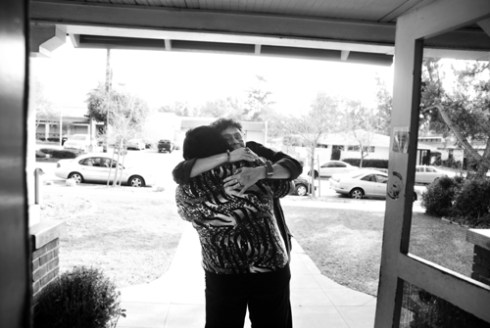
Mary Shields embraces a long-time friend and advocate one week after being released from Central California Women’s Facility. Mary served 19 years for a crime related to domestic violence.

Mary Shields a week after her release from Central California Women’s Facility laughs with a friend after she had trouble understanding how to use a cell phone, which were not widely used twenty years ago.

LaKeisha Burton performs a spoken word piece at Chuco’s Justice Center, which serves as a youth and community space in Inglewood, California. Today, LaKeisha shares her story through spoken word performances and is dedicated to working with at-risk youth susceptible to gangs and the same injustices as she once experienced.

LaKeisha watches a youth group perform at Chuco’s Justice Center in Los Angeles, California. With her infectious optimism and self-determination, LaKeisha Burton displays almost nothing of her past; she lives, works and dates, as any women like her. Yet, these things are exceptional for someone who had lost, some might say had stolen, nearly two decades of the most developmental period in one’s life and with very little preparation thrust out into society. Ms. Burton says when she was released it was as if she were still 15 going on 16.

In the United States over 1.5 million children have a parent who is incarcerated.* 75% of women in prison are mothers and over half have children under the age of 18. Many children suffer lasting emotional effects of a parent’s incarceration, which can affect all areas as they develop into adults.
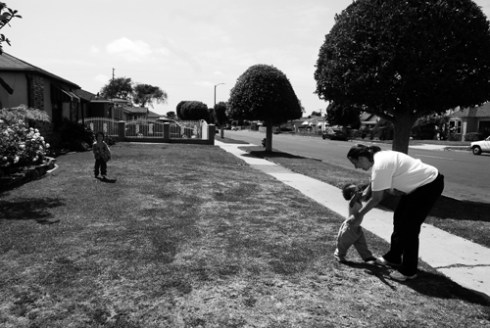
After cycling in and out of jail for crimes related to substance abuse, Jean Waldroup, 39, has found “home” at A New Way of Life, a transitional home for formerly incarcerated women that emphasizes keeping mothers and children together. For the last six months, Jean has maintained both her sobriety and role as mother to her son and daughter. Jean is the primary parent and she maintains a relationship with the children’s father.

A New Way of Life purchases homes in residential neighborhoods, giving a quieter, less institutional environment for families to rebuild relationships that may show signs of wear and tear after experiencing incarceration. Community-based organizations like A New Way of Life operate mostly under the radar with few resources and little public recognition despite their critical role in offering rehabilitation, family reunification and successful reentry.

Following her release, and to give her life structure, Molly volunteers to make lunch for clients at the behavioral health clinic she attends in San Francisco. Molly stills battles with drug addiction.
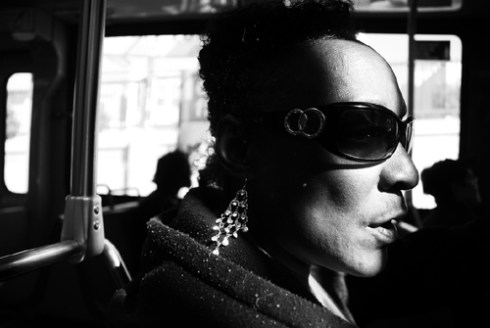
Molly on the bus. To avoid the caustic environment bubbling outside her building, Molly will ride Muni lines between Bayview-Hunter’s Point and Downtown San Francisco for hours. She tends to hide from nouns, that is people, places, and things. Molly’s mental health and substance abuse maintain instability and isolation in her life, some days are good, others hard.

A friend embraces Molly at a local community center.

Molly’s room at the Empress Hotel in San Francisco’s Tenderloin district. The first stable living she has had since the cycle of incarceration began in her life.
– – – –
*The advocacy group Children of Promise estimates the number of U.S. children with incarcerated parents at 2.7 million.
– – – –
DANA ULLMAN
Dana Ullman grew up in Portland, Oregon. She studied photojournalism at the Danish School of Journalism and holds a B.A. in Journalism from San Francisco State University. Dana currently lives in New York City photographing assignments and personal projects.
A New Way of Life Reentry Project is a non-profit organization in South Central Los Angeles with a core mission to help women and girls break the cycle of entrapment in the criminal justice system and lead healthy and satisfying lives.
California Coalition for Women Prisoners (CCWP) is a grassroots social justice organization, with members inside and outside prison, that challenges the institutional violence imposed on women, transgender people, and communities of color by the prison industrial complex. CCWP prioritizes the leadership of the people, families, and communities most impacted in building this movement.
The African Prisons Project (APP) is a group of people passionately committed to improving access to healthcare, education, justice and community reintegration for male, female and juvenile prisoners in Africa.

I stumbled across the California Department of Corrections‘ Flickr stream tonight. There are lots of sets to explore including some photo-galleries from various prisons of Bring Your Kids To Work Day.
Click on any image to see it larger.
I have always wondered if the prison system took part in Bring Your Kids To Work Day, and if so, how? Thanks to these clumsy attempts at community PR (clumsiness quite typical of large state agencies, I would say) we now know.
Children practicing fire abatement at California Correctional Centre; learning CPR at California Institute for Women; doing first aid at North Kern State Prison; riding the bus at Deuel Vocational Institute; and dressing up with the SERT team at Folsom.
Most of the photographs I have featured are from the Correctional Training Center, Galt, CA. Here’s head count – Hands Up Kids!
Third from bottom is a single image from San Quentin Prison’s Bring Your Kids To Work Day, and the final two images are from Avenal State Prison.
I’m a little speechless. You?
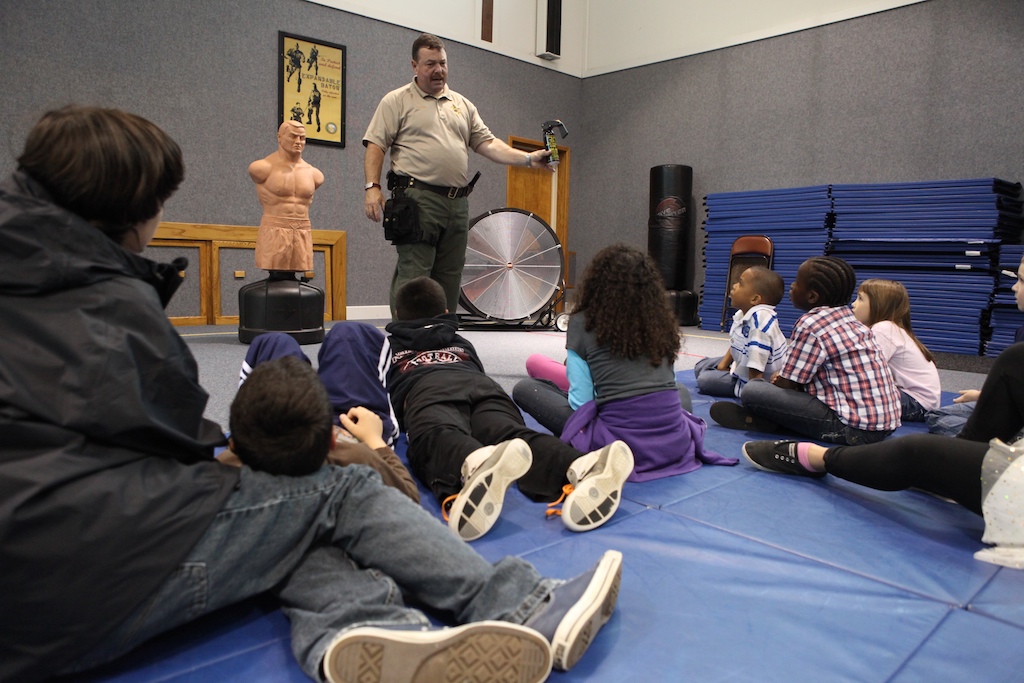






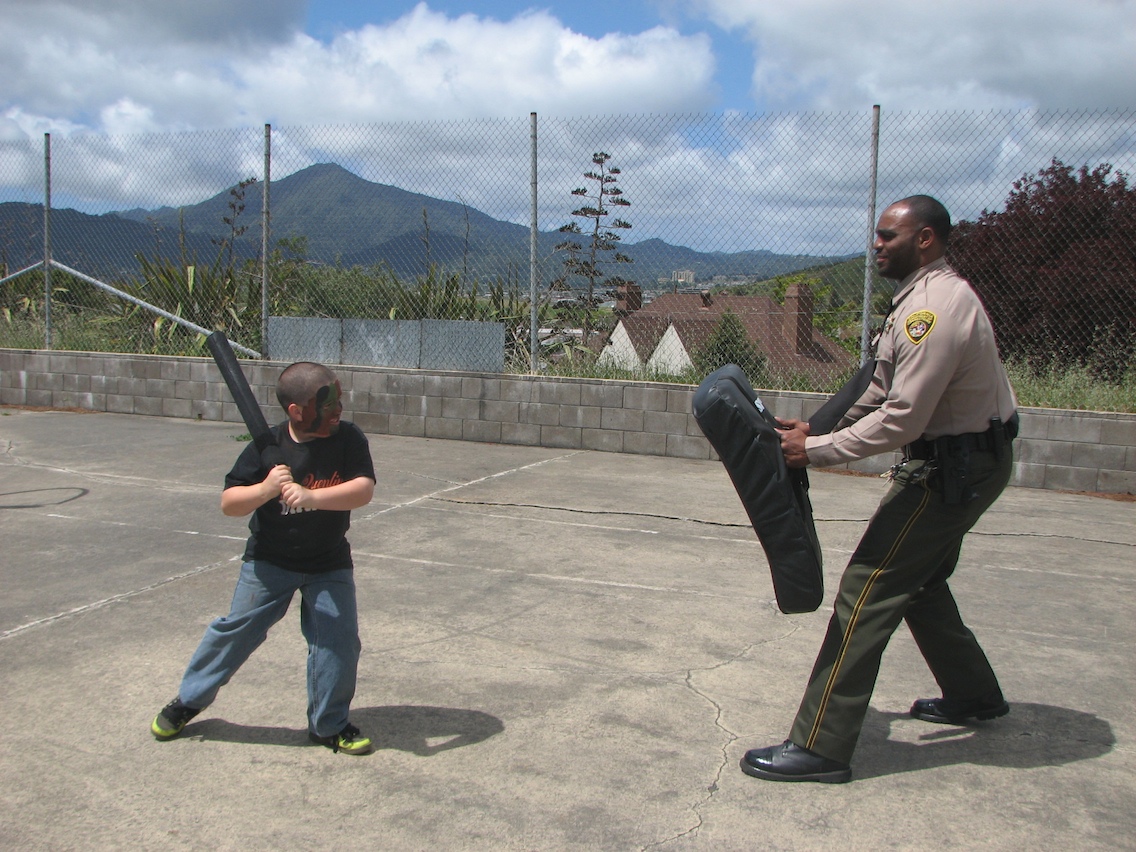


All images: Courtesy of the California Department of Corrections

Image: Rupert Ganzer
California has more prisoners serving life than any other state.
Life Support Alliance (LSA) has identified a group of prisoners – the life-term prisoners – who have increasingly become subject to Kafkaesque procedure in California justice. LSA advocates on behalf of these life-term prisoners and educates the public on the invisible cycle of parole denial.
CONTEXT
There are four types of sentences handed down to California prisoners; the death sentence (execution), life without parole (never released), determinate sentences of a fixed period (3,5,10 years for example), and indeterminate sentences (5 to life, 12 to life, 20 to life). It is in this last category that life-term prisoners fall. If they are ever to win release they must serve the minimum term first and then convince a parole board that they are suitable for release. Suitability means not being a public threat.
In California there are 22,000 men and women on indeterminate term-life sentences. The average number of years served by a prisoner serving a life sentence with the possibility of parole is 20 years. For all these prisoners release is dependent on the Board of Parole Hearings.
GAIL BROWN ON THE CALIFORNIA PAROLE SYSTEM
The Board of Parole Hearings is not a neutral group however, and it is susceptible to political influence. New appointees to the board are made by the Governor. During our conversation, Gail Brown, Founder of Life Support Alliance talks about how the parole grant rate under Governor Gray Davis was 0%. During the tenures of Schwarzenegger and current Governor Jerry Brown, the figure rose as high as 20% and now sits at 18%. This increase is partly due to a more sensible approach to criminal justice, but also down to the economic crunch and to the fact that the governorship is likely to be Brown’s final job in public office; he doesn’t have to bow to powerful *tough-on-crime* lobby groups. Incidentally, California is one of only 3 states in which the governor has veto power over the board of parole hearings.
LISTEN TO OUR CONVERSATION ON THE PRISON PHOTOGRAPHY PODBEAN PAGE
We should listen to Gail Brown. Her proposals will save every CA taxpayer money, forge progressive and forgiving attitudes, and force a return to legal procedure that means thousands of prisoners won’t be held in limbo, or worse, denied release because politicians don’t want to have prisoners – perceived as public safety hazards – released on their watch. (For a lesson in the damage a discharged prisoner can do in the worst circumstances to a political career, read up on Willie Horton and Al Gore.)
It also makes good common sense to release term-life prisoners. They are aging or aged. Costs to house an adult prisoner nearly double from $50,000/year to $98,000 when a prisoner turns 55. When they pass the age of 65, the cost triples to $150,000. The majority of these costs are medical care (which in CA was ruled as cruel and unusual in any case.)
As well as reducing costs, Gail Brown points out that aged prisoners have grown out of transgressive behaviours and are statistically the safest population to release.
In December 2011, the Stanford Criminal Justice Center released the first rigorous empirical study of prisoners serving life sentences with the possibility of parole in California called, “Life After Limbo: An Examination of Parole Release for Prisoners Serving Life Sentences with the Possibility of Parole in California.”
The report found that California has laws enacted through the three branches of government often contradict one another.
In 2008, Marsy’s Law (also known as Proposition 9) gave victims additional rights to participate in parole hearings and the law greatly extended the time between hearings once a lifer is denied parole by the Board.
That same year, the California Supreme Court ruled in the Lawrence Decision that while the commitment offense is probative, in and of itself, it cannot serve as the sole reason to deny parole. The relevant standard for the Board to use in considering whether to release an inmate serving a life sentence with the possibility of parole is whether the prisoner is a current threat to public safety.
To further complicate matters, newly proposed legislation – SB 391 – would authorize the Parole Board to base its decision to deny parole solely upon the circumstances of the commitment offense. That would directly overrule the California Supreme Court opinion.
THE LAST WORD
More than statistics, costs and legal definitions, Brown wants us to heal as a society and look toward restorative justice and not rely on state agencies to enact vengeance within unseen penal institutions. As much as we are all potential victims of crime, we are all potential activists against the cycles of punitive violence that persist in broken prison systems.
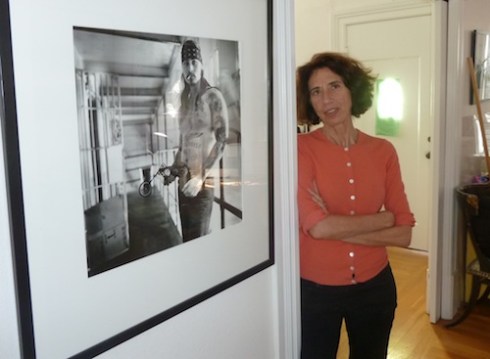
There were two categories of interviewees I planned to connect with during PPOTR – photographers and prison reformers. I didn’t expect to meet many individuals who satisfied both definitions. Ruth Morgan does.
Morgan became director of Community Works, a restorative justice arts program in the San Francisco Bay Area in 1994. Prior to that, she was director of the Jail Arts Program, in the San Francisco County Jail system (1980-1994).
It should be noted that the county jail system is entirely different to the state prison system and operate under separate jurisdictions. County jails hold shorter term inmates.
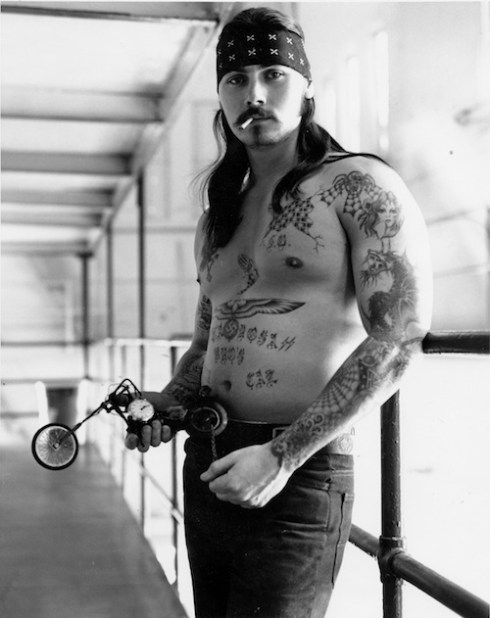
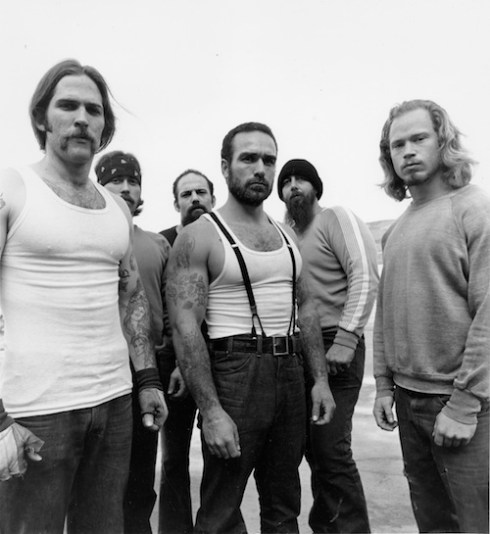
For three remarkable years, Morgan and her colleague Barbara Yaley had free reign of San Quentin State Prison to interview and photograph the men. In 1979, it was the sympathetic Warden George Sumner who provided Morgan and Yaley access. In 1981, a new Warden at San Quentin abruptly cut-off access.
“I think there were a few reasons [we were successful],” explains Morgan. “Despite the fact I was a young woman, I had a big 2-and-a-quarter camera and a tripod and so they took me seriously. That helped us get the portraits and the stories we did.”
The San Quentin News (Vol. I.II, Issue 11, June, 1982) reported on Morgan and Yaley’s activities. The story Photo-Documentary Team Captures Essence of SQ can be read on page 3 of this PDF version of the newspaper.
Ruth and I talk about how the demographics of prison populations remain the same; her original attraction to the topic; the use of her photographs in the important Toussaint v. McCarthy case (1984) brought by the Prison Law Office against poor conditions in segregation cells of four Northern California prisons; why she never published the photos of men on San Quentin’s Death Row; and the emergence, funding for, and power of restorative justice.
LISTEN TO THE DISCUSSION WITH RUTH MORGAN ON THE PRISON PHOTOGRAPHY PODBEAN PAGE

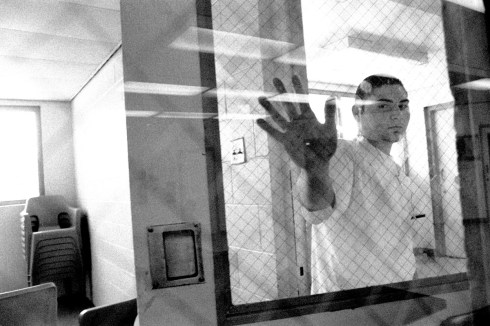
When Ara Oshagan was invited to shoot b-roll for a documentary film in the Los Angeles Central Juvenile Hall, he didn’t hesitate.
“I had lunch with Leslie [Neale, the filmmaker] on Monday, and on Tuesday I was inside with my camera,” says Oshagan. The film was Juvies.
As an Armenian emigre living in Los Angeles, Oshagan was aware of California’s bloated prison and jail systems, but had not thought about how he’d operate as a photographer within them. Previously, his approach was to spend years on his documentary projects often wandering and discovering. In Los Angeles Central Juvenile Hall, time was not a luxury … and neither was space. “I had to keep the film crew out the frame.”
Over the 3 years of the project, Oshagan identified shortcomings in the ability of his photographs alone to describe the experience of the children. His solution? To pair images with poetry and prose of the six children he followed.
When the kids got bumped up into the adult system he followed them there too. “I wanted this work to be about this passage. The adult system is a complete change in culture,” says Oshagan. “The whole culture will take advantage of the younger kids coming in.”
Oshagan witnessed teenagers he knew as small boys, bulk-up in their first six months in the adult system. They told him how the first thing they learnt was how to make weapons to protect themselves.
What surprised both he and his subjects was the length of sentences children are routinely given. And, after they move up through the system, their chances of a secure, violent-free life diminish.
The real kicker? Oshagan concludes his own kids are not too dissimilar to those he photographed in lock up. It’s not too difficult to imagine one poor decision and a life taken over by years of incarceration.
Why does this matter? Well, not only are sentence-lengths for juveniles growing, in recent years many states (40 in total) have introduced laws to allow the trial of juveniles as adults.
How is our society poised for the conversation on the culpability of under-18s and our shared capacity to manage and then forgive?
To help the conversation, Oshagan is to shortly publish the photobook A Poor Imitation of Death. The title comes from one of the kids’ description of imprisonment.
LISTEN TO OUR CONVERSATION AT THE PRISON PHOTOGRAPHY PODBEAN PAGE
All images © Ara Oshagan





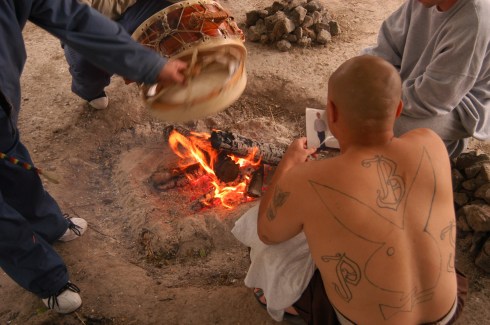
Wards tighten two drums over a fire in preparation for a Sweat Lodge Ceremony held each Thursday at the Heman G. Stark Youth Correctional Facility in Chino, CA.
In 2005, Berkeley-based photographer and videographer Jan Sturmann documented the young prisoners of the Heman G. Stark Correctional Facility in Chino, California during their Native American Sweat Lodge Ceremony.
For over 20 years Jimi Castillo, the prison contracted Native American Spiritual Leader, has presided over ceremonies that serve to awaken more fundamental truths about prayer and consciousness. The space created by Jimi doubles to as an arena to ease tensions, practice equality and resolved gang differences.
“I don’t differentiate between the races,” said Jimi Castillo, . “Anyone from the two-legged tribe is welcome to sweat with us.”
Jimi’s is a mentorship Sturmann admires.
For Sturmann, the issue of incarceration is not about punishment but about how institutions provide opportunities for personal and spiritual growth. Jimi provides a space devoid of the daily stresses of imprisonment. Jan hopes his photographs “can help build empathy” and understanding between populations either side of prison walls.
Sturmann was not just an outside observer. He was invited into the lodge to join the proceedings. He put his cameras down and crawled into the dark. The “transformation” he shared with Jimi and the young prisoners was profound – you can hear his emotion at 16m20secs in the interview.
LISTEN TO JAN STURMANN AND I DISCUSS HIS ASSIGNMENT ON THE PRISON PHOTOGRAPHY PODBEAN PAGE
All Images © Jan Sturmann http://www.albinocrow.com


An assistant to the Fire Tender brushes coal and ash off the glowing rock before it is placed into the Sweat Lodge. 56 rocks were heated for this ceremony, which Native American Spiritual Leader Jimi Castillo conducts each Thursday.
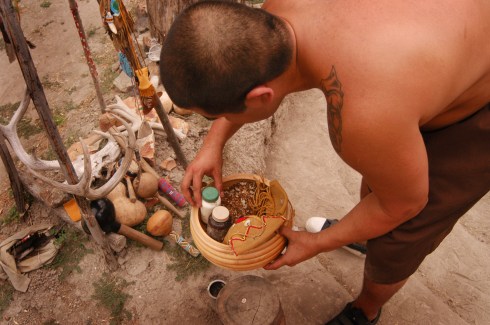

Wards offer each other comfort and support before entering the Sweat Lodge. No blood has ever been spilt in the Sweat Lodge area, and gang rivalries and personal disputes are often resolved during this time.

Fire Tender and ward, Jessy, distributes sacred tobacco to fellow participants, which they will toss onto the fire with a prayer, before entering the Sweat Lodge.

Since 1991, Native American Spiritual Leader Jimi Castillo has conducted this ceremony, which is open to all wards, irrespective of race.
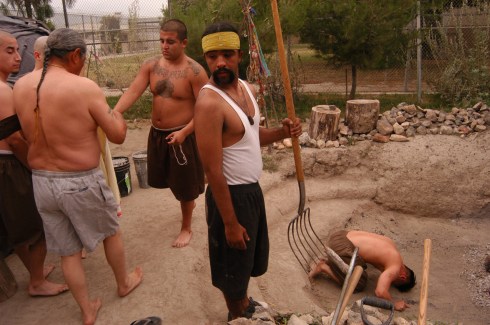
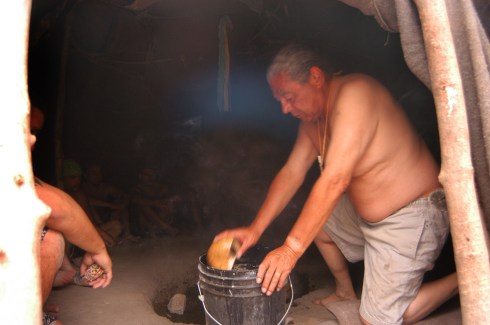
Native American Spiritual Leader Jimi Castillo welcomes a ward who prays before entering the Sweat Lodge.

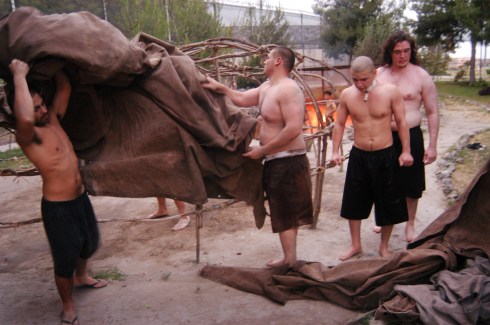
At the end of the ceremony wards pull tarps and blankets off the Sweat Lodge, which is made from bent willow saplings.
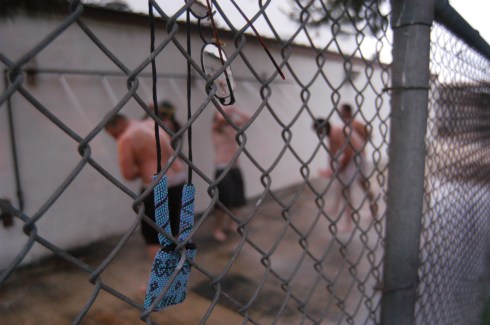
A beaded medicine bag hangs on a fence as wards shower after the Sweat Lodge Ceremony. Each bead is a sewn to the bag with a prayer.
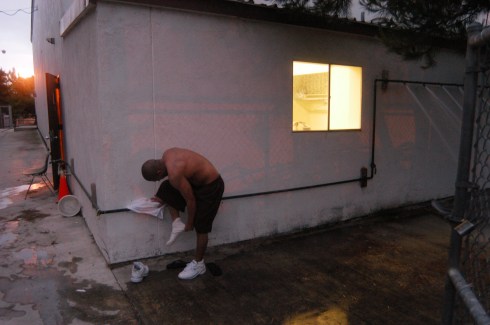
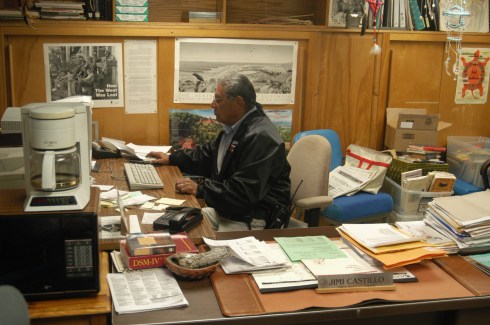
Jimi Castillo in his office in the Heman G. Stark Youth Correctional Facility.
All Images © Jan Sturmann http://www.albinocrow.com

“Prisons don’t work. They didn’t work in the eighteen-hundreds, they never worked in the nineteen-hundreds and they certainly don’t work in the 21st century,” says Dan Macallair, founder and executive director of the Center on Juvenile Criminal Justice (CJCJ).
Since the late 80s, Dan has called for community supervision instead of incarceration and, in cases where incarceration is necessary, for it to be carried out at the local level. Prisons are large (and often violent) and inmates can be sent to any part of the state. Local county jails have – in San Francisco at least – proved to be more flexible institutions and more successful in providing relevant programs preparing inmates for release back into their community.
Dan and I spoke about San Francisco’s leading role as a county in California willing to take risks and trial new strategies for rehabilitating prisoners. We also note how model programs developed by the CJCJ have been adapted nationwide.
On October 1st, California began its “Realignment” program; prisoners transferred from state prisons into the county jails and local jurisdictions. The move is the result of a Supreme Court ruling in May that ordered California to reduce it’s prison population by approximately 32,000 because the state prisons were overcrowded and unable to provide adequate health care.
In this context, we discuss what this means for California’s criminal justice system and the opportunities for organisations such as CJCJ to introduce progressive solutions that benefit the community, the criminal, the families, the victims and the taxpayers.
Dan notes that never in his experience has he seen a Secretary of the California Department of Corrections advise other jail and prison systems NOT to do what California has done. Matt Cate, the current Secreatary is doing that.
California’s prison boom and prison failures are a national example … for all the wrong reasons.
“I weep when I think it took this Supreme Court, with its conservative bent, to tell liberal California that its prison system is broke.”
LISTEN TO THE INTERVIEW WITH DAN MACALLAIR AT THE PRISON PHOTOGRAPHY PODBEAN PAGE
BIOGRAPHY
Daniel Macallair is the Executive Director and a co-founder of the Center on Juvenile and Criminal Justice. His expertise is in the development and analysis of youth and adult correctional policy. He has implemented model community corrections programs and incarceration alternatives throughout the country. In 1993, Mr. Macallair established the Detention Diversion Advocacy Program (DDAP) for serious and chronic youth offenders in San Francisco’s juvenile justice system. This program was cited as an exemplary model by the United States Department of Justice and Harvard University’s Innovations in American Government program. In 1994, Mr. Macallair received a leadership award from the State of Hawaii for his efforts in reforming that state’s juvenile correctional system and developing model community-based reentry programs. In August 2007, Mr. Macallair initiated a technical assistance project to assist California counties in developing model intervention programs for high-end youthful offenders. Mr. Macallair is presently involved in the efforts to reform California’s adult sentencing and parole practices and serves as an advisor to the State’s prestigious Little Hoover Commission.
© Richard Ross
Pelican Bay State Prison in Crescent City, California is one of the most oppressive regimes of the U.S. prison system. It was designed to control and isolate the growing gang affiliations within California prisons following the CDCR’s massive expansion throughout the 1980s. It opened in 1989 and established THE model for maximum security prisons in states across the U.S.
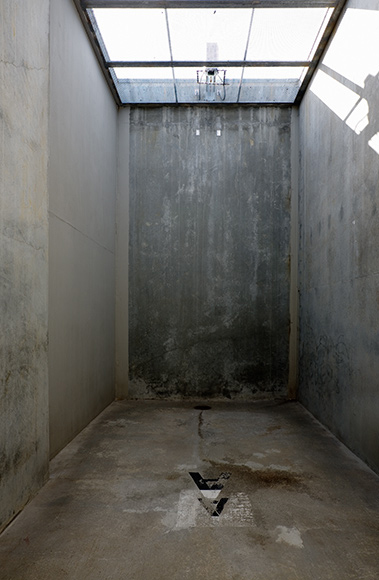
Pelican Bay Prison specialises in solitary confinement. When photographer Richard Ross documented prisons as part of his Architecture of Authority project he went to Abu Ghraib, Guantanamo Bay and Pelican Bay.
The most segregated inmates spend 22 and half hours in a cell barely larger then your bedrooms or bathrooms. For the other 1 and a half hours they occupy a concrete pen for “exercise.”
Pelican Bay is notorious for it’s history of violence and despair. It is also, according to Christian Parenti, a boon for small town economics.
It is a god-forsaken hole.
The most isolated prisoners have put together a strike plan. Yes, they have demands, but more than that they want to make a point about the inhumane and invisible conditions they inhabit. Yes, many of them have committed heinous crimes but cooping them up like dogs serves only to increase tension, anger and danger.
BACKGROUND AND DEMANDS
Prisoners in the Security Housing Unit (SHU) at Pelican Bay State Prison have called for an indefinite hunger strike as of July 1, 2011 to protest the cruel and inhumane conditions of their imprisonment. The hunger strike was organized by prisoners in an unusual show of racial unity. The prisoners developed five core demands.
California Prison Focus supports these prisoners and their very reasonable demands, and calls on Governor Jerry Brown, CDCR Secretary Matthew Cate, and Pelican Bay State Prison Warden Greg Lewis to implement these changes. California Prison Focus has also joined “Prisoner Hunger Strike Solidarity,” a coalition of grassroots human rights activist groups in the Bay Area supporting the demands of the prisoners participating in the hunger strike.
Briefly the five core demands of the prisoners are:
1. Eliminate group punishments. Instead, practice individual accountability. When an individual prisoner breaks a rule, the prison often punishes a whole group of prisoners of the same race. This policy has been applied to keep prisoners in the SHU indefinitely and to make conditions increasingly harsh.
2. Abolish the debriefing policy and modify active/inactive gang status criteria. Prisoners are accused of being active or inactive participants of prison gangs using false or highly dubious evidence, and are then sent to longterm isolation (SHU). They can escape these tortuous conditions only if they “debrief,” that is, provide information on gang activity. Debriefing produces false information (wrongly landing other prisoners in SHU, in an endless cycle) and can endanger the lives of debriefing prisoners and their families.
3. Comply with the recommendations of the US Commission on Safety and Abuse in Prisons (2006) regarding an end to longterm solitary confinement. This bipartisan commission specifically recommended to “make segregation a last resort” and “end conditions of isolation.” Yet as of May 18, 2011, California kept 3,259 prisoners in SHUs and hundreds more in Administrative Segregation waiting for a SHU cell to open up. Some prisoners have been kept in isolation for more than thirty years.
4. Provide adequate food. Prisoners report unsanitary conditions and small quantities of food that do not conform to prison regulations. There is no accountability or independent quality control of meals.
5. Expand and provide constructive programs and privileges for indefinite SHU inmates. The hunger strikers are pressing for opportunities “to engage in self-help treatment, education, religious and other productive activities…” Currently these opportunities are routinely denied, even if the prisoners want to pay for correspondence courses themselves. Examples of privileges the prisoners want are: one phone call per week, and permission to have sweatsuits and watch caps. (Often warm clothing is denied, though the cells and exercise cage can be bitterly cold.) All of the privileges mentioned in the demands are already allowed at other SuperMax prisons (in the federal prison system and other states).
The Pelican Bay hunger strikers have support form the other SuperMax in California Corcoran Bay Prison.

 Prison Photography