
You are currently browsing the tag archive for the ‘Photographers of Prisons’ tag.
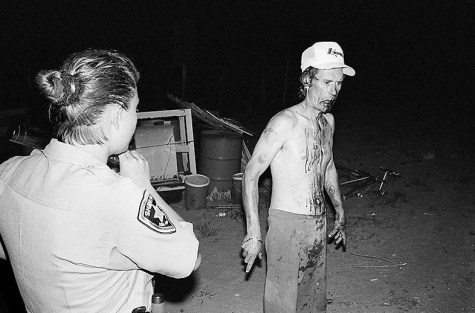
© 2009 Jerome Brunet Photography. All rights reserved.
Jérôme Brunet‘s photo essay Riding Shotgun with Texas Sheriff’s is a ferocious document of police activity and procedure in America’s ‘love-to-hate’ lone star state. I am in deep admiration of this project for it connects the dots and marries everything in a police officer’s routine from violent confrontation to mundane paperwork.
Brunet spent six months with Texas Sheriffs and the stark quality of his work demonstrates that.
Brunet’s work inevitably features sites of incarceration, but I contend viewers are more shocked Brunet’s depictions of inhumanity on the highways (and front yards) than they are of inhumanity within the confines of state institutions.
Prison Photography Blog embraces complexity and unanswerable questions and Brunet poses many. Prisons and jails are not isolated from society but a point of destination and departure throughout the cyclical mechanisms of state authority. It is right to feature a project that merges the chaotic unknowns (crime scenes) and prevailing controls (sites of incarceration) of police activity.
Brunet explains:
When asked why I’m interested in law enforcement, I’m compelled to reply, “We all should be.” The fact that we know so incredibly little about our ‘boys in blue’ all though we see them on our street corners and of course in more dramatized versions on television and in Hollywood, I’ve always been interested in the symbolic aspect of the modern day police officer; the man with the badge, gun and authority to dramatically change a persons life forever. Societies apparent answer to all life’s little and not so little problems. However bleak and insignificant a situation may seem, officers are constantly dealing with lost children, family quarrels, various assemblies of homeless and confronting each day, the violence and corruption humanity inflicts on each other everyday.

© 2009 Jerome Brunet Photography. All rights reserved.
Much of the Sheriff’s department’s work is devoted to tackling drug-smuggling and again Brunet comments with incredible even-handedness
Roads linking Mexico to the U.S., such as the I-10, are sensitive arteries of a flourishing contraband. Even though another deputy in a deep sigh, admitted to me catching only ten percent of the actual traffic, a task force made up of U.S. Customs, D.E.A., Texas and New Mexico police have seized over 30 kilos of heroin, 2 tons of cocaine and 75 tons of marijuana. Even though these quantities sound enormous, actually landing on a large bust was a different story, only luck and perseverance enabled me to land on what was to be one of US’s largest single drug bust in US’s history. As a nervous Mexican driver arrives at the U.S. border and a routine check is made on his car, officers reveal neatly packed away in the trunk, 23.3 pounds of black tar heroin, estimated at 24 million dollars. This package is later revealed to the local press in Hollywoodesque fashion. I watch in amazement and think of the outcome of this Mexican peasant paid 1000 dollars to transport this load into the land of the free.
As an editorial decision, I have not included Brunet’s images of the station or officers’ meetings, but they are as vital as the images from within the jail. The images inform one another.
Here are two desperate images from the station and I’d like to know the exact context. I shall not speculate, only present.

© 2009 Jerome Brunet Photography. All rights reserved.
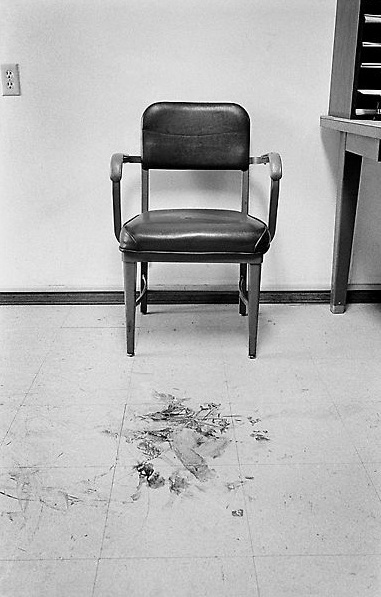
© 2009 Jerome Brunet Photography. All rights reserved.
Brunet offers insights into El Paso County Jail:
Texas, the second largest state in the U.S. also boasts the highest rate of incarceration (700 for 100 000). In an ultramodern county jail of El Paso, Texas, I witnessed different aspects of “the inside world”. Body searches, finger printing and delousing before the anonymous inmate dons the regulation blue overalls inscribed E.P.C.D.F. (El Paso County Detention Facility). On the top floor is the outdoor gym, from which you can admire the end of the Rocky Mountains and the beginning of the Sierra Madre into Mexico. Caged like lions, 40 federal prisoners await transport to a large prison. I am placed alone with one guard in this cage. Surprisingly enough, like a ghost, I hover through the crowd unnoticed, my heart beating for what felt like an eternity. Prisoners can only be exposed to the natural light of the gymnasium a sparsely granted privilege of only three hours a week.

© 2009 Jerome Brunet Photography. All rights reserved.
The photo essay even covers tactical training exercises.
An afternoon spent with the elite S.R.T. (Sheriff Reaction Team) proved to provide more excitement. This team made up of tough looking officers is specially trained to counter an unlikely riot in the prison. I was presented a billboard full of makeshift weapons made by previous inmates, everything from hand sharpened spikes, to knives made out of tooth brush handles with razor blades attached to their ends. All used for assassination purpose by gang members thriving too in the “inside world”.

© 2009 Jerome Brunet Photography. All rights reserved.
Brunet has admiration for officers “just like you and me”, whose work is unpredictable and occasionally very dangerous.
We will find in the police officers, goodness, honesty, corruption and brutality. In many cases we are the police, and like it or not we are responsible of their actions as much as our own. The more we know about them, the more we observe and tie ourselves to them, and the more this society will feel secure. This realistic testimony succeeds in making us share a few privileged moments into the life of these Texas and New Mexico cops as well as revealing the true backdrop of American culture.
Unlike other reportages of state authority, Brunet is keen to impress the absence of racial inequalities of power.
The majority of the men and women I interacted with were primarily Hispanic. Because of their ancestry they were able to bring forth a much appreciated warmth and understanding that I and, I’m sure, the rest of the townspeople, who were also Hispanic, enjoyed and accepted openly.

_________________________________________
Jérôme Brunet is a freelance photojournalist Jérôme Brunet was born in southern France and raised in London, Ontario (Canada). After obtaining his O.S.S.D. majoring in visual arts, he started his post secondary education in Paris, France, at the E.F.E.T. School of Photography, graduating in 1997. Jérôme Brunet has been published internationally through such diverse publications as Rolling Stone Magazine, Forbes and The New York Times. His client list includes The Discovery Channel, Fender Musical Instruments, Nikon Imaging Inc. and is currently featured on the official websites of musicians Eric Clapton, Carlos Santana and James Brown. Jérôme Brunet is currently working and residing in the Bay Area of San Francisco and is represented internationally by the Zuma Press agency.
Jérôme Brunet also takes portait pictures of musicians here and here.

An interior view of the dining facility at the newly opened Baghdad Central Prison in Abu Ghraib on February 21, 2009 in Baghdad, Iraq. Wathiq Khuzaie for Getty Images Europe.
Yesterday, my good friend Debra Baida sent me through the link to the New York Times Abu Ghraib – Baghdad Bureau Blog. This came at the same moment I was preparing a post to discuss the first images to come out of the renamed, refurbished and relaunched Baghdad Central Prison.
By far the best, and possibly the only, extended photo essay of Abu Ghraib Baghdad Central Prison is by Wathiq Khuzaie of Getty Images Europe. There is also this brief video from the BBC.
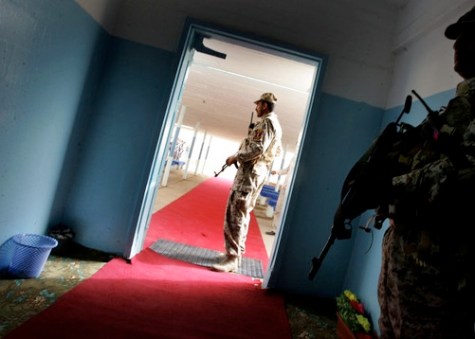
Iraqi security personnel stand guard at the newly opened Baghdad Central Prison in Abu Ghraib on February 21, 2009 in Baghdad, Iraq. The Iraqi Ministry of Justice has renovated and reopened the previously named "Abu Ghraib" prison and renamed the site to Baghdad Central Prison. Wathiq Khuzaie/Getty Images Europe
New Era, New Penology
The BBC noted, “Along with the change of name, the Iraqi justice ministry is trying to change both image and reality, billing it as a model prison, open to random inspection by the Red Cross and other humanitarian organisations.”
This transparency is a refreshing change to the policy of Abu Ghraib’s former operators. The work is not yet complete though and the upgrade is ongoing. The BBC describes, “[The prison] will eventually be the city’s main jail, holding about 12,000 inmates. Initially, only one of its four sections will be used. There are already about 300 prisoners there to test it out and, once the prison has been officially inaugurated, that figure will rise to 3,500.”
So, not only do Iraqi authorities want to repurpose the institution, they want to make it the penal institution of “The New Iraq”. This is an ambitious policy riddled with dangers; the site is loaded with memory and controversy. As the New York Times notes, “the promise of a new era can also be a time for remembrance.”
I highly recommend one goes onto read accounts from Iraqis, correspondents and photographers who lived and recorded Abu Ghraib’s recent history, particularly photographer Tyler Hicks’ account of Saddam’s prison amnesty in October 2002 that turned from celebration to human catastrophe.

Wathiq Khuzaie/Getty Images Europe

An interior view of one of the cells at the newly opened Baghdad Central Prison in Abu Ghraib on February 21, 2009 in Baghdad, Iraq. Wathiq Khuzaie/Getty Images Europe
Two things struck me about the photographic series of the new prison. Firstly, the number of flags, insignia and national colours across walls, above fences and emblazoned on uniforms. The Iraqi authorities have stamped their identity all over this project. It is the presentation necessary to supersede Abu Ghraib’s reputation.
Secondly, the pastel palette of many of the interior shots – namely the ubiquitous lilac. I want to know who has the decision-making power at Baghdad Central Prison! However, I suspect lilac paint was cheap and readily available; so it wasn’t so much a decision – more a fact created by circumstance.
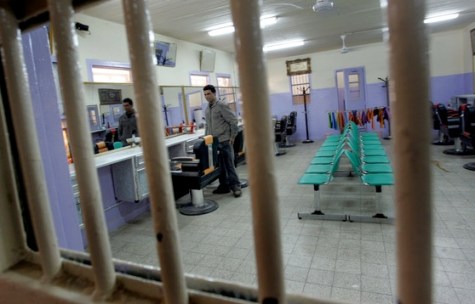
Interior view of the barbers shop at the newly opened Baghdad Central Prison in Abu Ghraib on February 21, 2009. Wathiq Khuzaie/Getty Images Europe.
Following that logic, one could presume lilac and purple fabric & thread is also at a surplus in Baghdad…

Interior view of sewing machines at the newly opened Baghdad Central Prison in Abu Ghraib on February 21, 2009. Wathiq Khuzaie/Getty Images Europe.
I don’t want to sound facetious, I was just shocked by the light purple, which according to colour theory is supposed to evoke emotional memory and nostalgia. Darker purples are supposed to represented, nobility, royalty and stability. From those evocations one is instilled with wisdom, independence, dignity and creativity.
If Baghdad Central Prison is to spur such emotional response in its inmate population it will succeed where many, many prisons have failed.
Basically, I am hopeful that the new prison can operate justly and succeed with the rehabilitation it emphasised this week. And despite all the lilac, soft-furnishings and current open media access – in reality it remains a prison with doors, locks and guards.
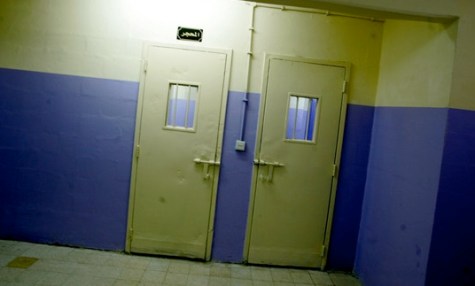
Interior view of cell doors at the newly opened Baghdad Central Prison in Abu Ghraib on February 21, 2009 in Baghdad, Iraq. The Iraqi Ministry of Justice has renovated and reopened the previously named "Abu Ghraib" prison and renamed the site to Baghdad Central Prison. According to the Iraqi Ministry of Justice about 400 prisoners were transferred to the prison which can hold up to 3000 inmates. The prison was established in 1970 and it became synonymous with abuse under the U.S. occupation. Wathiq Khuzaie/Getty Images Europe.
BURN Magazine, under the fiscal umbrella of the Magnum Cultural Foundation, have announced a $10,000 grant “to support [the] continuation of the photographer’s personal project. This body of work may be of either journalistic mission or purely personal artistic imperatives”
I am encouraging people to take on the difficult task of securing prolonged and necessary time with a prison/jail/detention-centre population in order to faithfully describe the stories and systems of its particular circumstance. On top of that your product must be “work is on the highest level”.
It’s a tall order but if you have carried out portrait or documentary photography in a site of incarceration before (I know many of you), then submit an application to continue that critical and valuable work. It will have to better than my attempt.

San Pedro Prison, La Paz. July 2008.
Hmm. On the same day I encourage photographers to attempt access into sites designed to be impenetrable, the government and police in my home country have introduced “laws that allow for the arrest – and imprisonment – of anyone who takes pictures of officers ‘likely to be useful to a person committing or preparing an act of terrorism’.” (British Journal of Photography via In-Public)
BURN Magazine is a new(ish) venture by David Alan Harvey whose got a Magnum portfolio and his own internets.
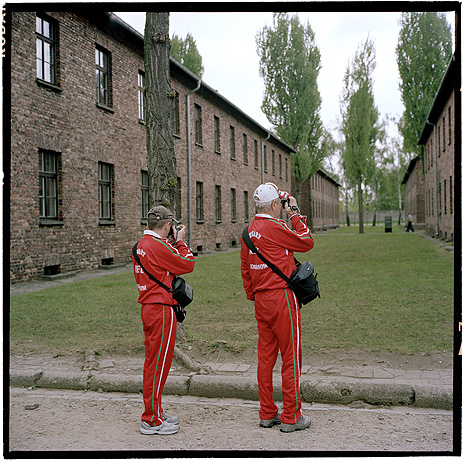
At the 2009 World Press Photo Awards, it was the work of Roger Cremers‘ tourist behaviours at Auschwitz-Birkenau that caught my eye.
In a photography climate that frequently pours cynicism and scorn on global tourism, Cremers is on tricky ground. He can thank Martin Parr for making his path a little more tricky. How do we not dismiss Cremers’ work as stating the obvious?
Cremers does not reduce his tourists to unthinking crowds. Instead, he isolates his subjects; they’re in their own thoughts, their own photo-trance and their own space. There is no throng at Auschwitz and nor is there in Cremers’ images … except for the tightly-packed shuttle bus.


Many of the prisons and concentration camps of the Third Reich have since been incorporated into the culture & heritage industry. Auschwitz receives 750,000/year and Dachau 900,000/year (Young, 1993). In the fifteen years since, one would expect figures to have risen.
Lennon & Foley’s excellent book Dark Tourism argues these sites ‘constitute attractions and they cannot simply be classified as “Genocide Monuments” since a monument in this context conveys a different meaning’. Furthermore, ‘these sites present major problems in interpretation … major problems for the language utilized in interpretation to adequately convey the horrors of the camps. Consequently, historical records and visual representation is extensively used.’


Used not only by the site curators, but created by the visitors for later return. I am not comfortable saying that visitors to Auschwitz consume in the same way tourists do at other sites. I believe the subjects of Cremers photographs are creating their own visual memories of the site AND I believe Auschwitz visitors do so with a consciously different sensibility than at other sites.
I visited Auschwitz in 2000. Words were redundant, the scale of the crime overwhelming and agog meditation my modus operandi. It would be cognizant of the average visitor – knowing they may never return to the site – and unable to muster words, to muster a few images.

Recommended: the Guardian Photo Editor’s summary of the World Press Photo Awards, 2009
Chris Jordan was low on my list of priorities but this timely post by Mike Kelley at Change.org (a blog as impressive for its readers’ comments as it is for the straight forward presentation of Jordan’s work) compelled me to bump it up and champion the depressingly and unfathomable figures that arise when one simply runs the numbers.

Chris Jordan. Prison Uniforms, 2007. 10x23 feet in six vertical panels. Depicts 2.3 million folded prison uniforms, equal to the number of Americans incarcerated in 2005. The U.S. has the largest prison population of any country in the world.
In reading Change.org’s straight forward commentary on America’s broken criminal justice system, I signed up for Change.org and read a few of their older posts. In doing so I was presented with the catalyst to comment on Obama’s momentous inauguration without repeating the media-lovefest that has surrounded the 44th’s swearing in. This post will cover Jordan’s astounding artwork, Obama’s astounding tasks-at-hand and where they politically overlap.

Chris Jordan. Prison Uniforms, 2007. Partial zoom.
Chris Jordan has spent his time making larger and larger photographic constructions to communicate the scale at which American society wastes its resources, its environmental future and its grasp on logic. In his effort to catalogue the linear and thoughtless waste of the US, he has progressed from crushed automobiles, to cell phone chargers, to polystyrene cups to American prisoners.
Jordan is a bright guy, now consumed by his photography (which to be quite frank is eco-hip and brilliantly executed). He talks passionately about a sea-change in our cultural consumption. He specialises in highlighting “the behaviours that we all engage in unconsciously on a collective level … the actions we are in denial about and the ones that operate below our daily awareness … like when you’re mean to you wife because you’re mad about something else or when you drink too much at a party because you’re nervous.” Jordan is no prophet, he just sees the necessary u-turn we must all make in our habits and thoughts to move toward sustainable existence.

Chris Jordan. Prison Uniforms, 2007. 10x23 feet in six vertical panels. Detail at half actual size.
I like to think the strength of Jordan’s visual framework that deals with soda cans to the landfill as it does with prisoners to the cell blocks is deliberate. As hard as it is to acknowledge, the majority of Americans have turned their back on a seven-figure-minority as if it were worth no more thought than discarded packaging. Mass imprisonment is the result of widespread apathy, denial and unpinnable responsibility. How unconscionable is this situation? We are all responsible. Barack Obama talked very little about criminal justice and prison policy during his electioneering. This is not surprising as helping the invisible incarcerated masses is on the electorate’s mind as much as the whereabouts of their last twinkie wrapper. But, Obama also made it very clear that this was the time for personal responsibility and accountability.
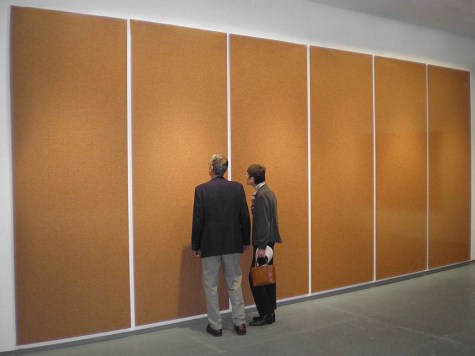
Chris Jordan. Prison Uniforms, 2007. Installed at the Von Lintel Gallery, NY, June 2007.
So after a week of photography gallery after gallery, the militarised eye vs. the personal touch, Gigapan-assisted user-generated snooping, faux controversy, minor mishaps, cult worship, sentimental clap-trap, unending debate, media catfights, nerdcore details, celeb fluff and even UFO’s isn’t it time we adopt the same realism that Obama trusted in for his inaugural speech?
A wonderful article from the Wall Street Journal lays out the realism and “the audacity of hope behind bars”. (Via Change.org). Angola prisoner, Mr. Dennis served up some REALISM: “He’s got his hands full: Two wars, the economy is going in the tank and the health-care costs are skyrocketing – I’d be surprised if he has time to brush his teeth in the next four years.” While another prisoner took care of the HOPE: “If the men here can have hope, then why can’t the rest of the country?”
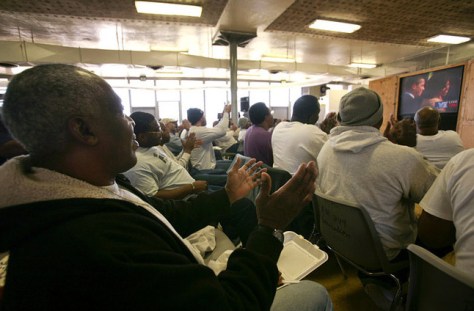
Prisoners at Louisiana State Penitentiary ("Angola") were given the day off to watch Barack Obama inaugurated as America's 44th president.
So how does this all connect? Jordan and Obama share the same call to think, with serious intent, about the things invisible to us. Both call us to consider the reality of our society and accept our shared responsibility for its faults, weaknesses and injustices. Both men challenge conventional wisdom; the logic that just because we didn’t turn the key nor bring down the gavel, we are not complicit – by our silence – in America’s mass incarceration.
What can you do? You can start by signing this petition immediately and by using web2.0 to access Obama’s administration as his team reached you during the election.
If you’d like to know more about Chris Jordan you could do worse than starting with this interview, this interview and this interview.
Update: Prison Photography collated a Directory of Photographic & Visual Resources for Guantanamo in May 2009.
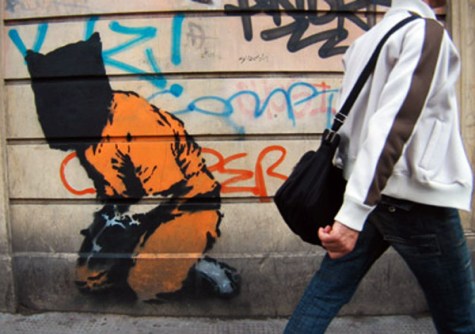
Guantanamo Prisoner, Political Graffiti. Banksy
Anyone who says the recent media tour of Guantanamo isn’t a public relations exercise by the lame duck has not had their eyes open. Global media were given a tour of camps 4, 5 and 6 at Gitmo and all the footage was screened and vetted before release.
Video: Here is the Guardian’s three minute offering. With any hope Obama will put this illegal operation out of action in 2009.
Artistic legacy of Guantanamo

Guantanamo Protesters outside the US Embassy, London
Meanwhile, we can think of the potency that the orange jump-suit has gained. It’s another icon of the Bush presidency. With regard it’s establishment and its bare-faced operations, Guantanamo was far outside of the public’s imagination. Our culture stomached the guilt and under the Bush administration it was never likely Guantanamo prison would be brought back into line with international law. Activist and non-activist art protested Guantanamo by subverting the camp’s own visual vocabulary.

UHC Collective. "This is Camp X-Ray". Art Installation, Manchester, 2003. Guards with replica guns were on duty 24 hrs and followed a regime copied from media reports.
Back on my home turf in Manchester, UHC, a notoriously bold and inventive art collective, scaled up a version of Camp X-Ray on an unused lot in Withington. It was complete with guard towers, fake guns and orders and activity that replicated the media’s reports of Guantanamo, Cuba. See other UHC Projects here, and read the BBC report here.

Road to Guantanamo (2006). A Michael Winterbottom Film, Spanish Release
And while we are not focusing entirely on photography, slightly off topic with video, I cannot recommend Road to Guantanamo highly enough. The film tells the ridiculous story of three young British-Pakistanis who were in the wrong place at the wrong time (southern Afghanistan, November 2003), and ended up in Guantanamo for 2 years. Your jaw will not leave the floor.
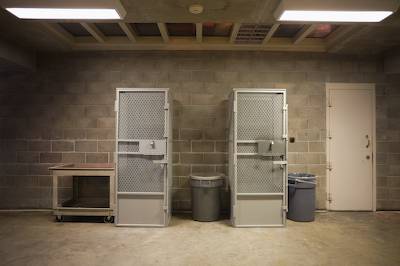
Holding cells, general population area, Security Housing Unit, Pelican Bay State Prison, Crescent City, California. Richard Ross
In this response to Richard Ross’ Architecture of Authority I’d like to discuss two pictures – the first, Interview room, Abu Ghraib prison (“hard site”), Abu Ghraib, Iraq and the second, the Detainee housing unit, Camp Remembrance, new Abu Ghraib Prison, Iraq.
There is rich discussion to be had with Richard Ross’ Architecture of Authority. Political footings jockey with ethical inertia, jockey with instructional histories, jockey with considerations of the soul. Readings thick and fast. No less, these meta-narratives are deformed by one’s own emotional interruptions. One recollects perhaps passages and interrogations through border controls, transport hubs, reception rooms and state corridors. One recalls school, streets and flaking paint.
Random knowledge bombards the equation, – Raves at Ansthruther’s decommissioned nuclear command centre during university days; A deliberate detour made during honeymoon to locate Pelican Bay maximum security prison; An introduction at San Francisco International.
My good friend, and Hesitating co-conspirator, Keith Axline recently featured Richard Ross in a Wired gallery. Keith explained to me that it is Ross’ ability to rattle shutter and catch the necessary shot every time that impressed him most. Ross’ manipulations are in spite of the unpredictable (and sometimes unexpected) access to the different sites. Ross prevails with perseverance; “No never really means no;” and aggressive networking (Ross’ chances of accessing Abu Ghraib depending largely on the trust and recommendations of military personnel he liaised with for his Guantanamo work).
Ross gets the shot he needs, even when he has only a limited number of exposures, and a limited amount of time. More surprising, Ross achieves this with almost perfect tonal harmony throughout the collection of prints. This said, Ross’ technical prowess is not my concern here, rather the gaps and routes between the images he has assembled. Ross consistently presents isolation, the viewer consistently seeks human incidence.
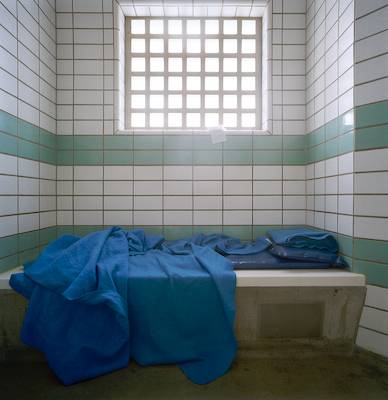
Holding cells, Metropolitan Police, Collingwood Road, Hillingdon, London. Richard Ross
One is compelled when looking at Richard Ross’ starkly depicted environments to search out the signs of life. On a few occasions one is rewarded, a curious tourist looks back at us from atop Syria’s Craq de Chevalier Crusader Fort; a heart shaped paperweight and polystyrene cup sit on the judge’s bench in Santa Barbara’s superior court; an open bag, that will travel home with its owner, sits at the foot of a movie executive’s desk. The loose blanket left in the cell at Hillingdon Road Jail presses us to fleetingly wonder if the person who unfolded and used the blanket in the cell earlier, will be back in the cell later, possibly to use the blanket once more.
The praying figure in Istanbul’s Blue mosque is representative of the building’s purpose. He is a motif of religious expression. The security guard at Topkapi is frozen rigid behind the glass, which serves to separate him from the viewer and present him as a part of the larger observing machinery. How different the shot would be if the guard stared straight down the camera lens? I imagine Ross made a few exposures in which the man did face the camera, but Ross prefers to keep attention on the environment. It is temperate and logical for Ross to choose an image in which the guard looks like a wax model – like a construction.
The austerity of The Architecture of Authority as a collection is hard to deal with. The geographical and institutional reach of the project is impressive. Inconceivably, across this wide subject matter Ross seems to have control in all the locations. Ross distills the form of each site and presents that bare form as the key to understanding the sites function.

Segregation Cells, Camp Remembrance, new Abu Ghraib prison, Abu Ghraib, Iraq. Richard Ross
To my mind, Ross has control in all the locations bar two. The old Abu Ghraib “Hardsite” and the new Abu Ghraib prison. In both forms, Abu Ghraib was a site of photographic desperation for Ross – he was forced briefly to compromise the overall tonality of his project.
The interrogation room is disordered. This room was not designed for interrogation purposes by the American military. It has inconvenient features such as two windows (one barred and boarded), an electrical box, a dusty fire extinguisher, exposed wires, a fallen map, makeshift furniture and used soda cans. There is also a plugged-in laptop, unidentified hold-all bags and what appear to be loose wire on the floor. There is a can or tub of something half-concealed behind the nearest chair. It seems to get more ridiculous the closer you look. There are two camp beds, one folded against the wall with a bag of belongings at the foot. What filled the bookcase? Why did Ross’ guides show him here? Is this an interrogation room? It looks like a sparse room for visiting guests. Is every room at the old Abu Ghraib, de facto, an interrogation room?

Interview room, Abu Ghraib prison ("hard site"), Abu Ghraib, Iraq. Richard Ross
There has been much made of the juxtapositions between photos presented in the Architecture of Authority book and exhibitions; between schools and prisons; between barracks and mental asylums. It is Ross’ right and responsibility to guide his audience in ways of seeing. But there is enough information, memory and rituals of communication embedded in any of Ross’ individual images to warrant singular assessment.
Humans in Ross’ pictures never threatens to steal attention for very long. The narrative of the building or structure dominates the narrative of the individual. There are moments when Ross’ photographs effortlessly adopt the surveillance philosophies of each object – bank, London tube station, hotel phone booths, or the confessional. This is part the photographers skill but also the unavoidable disclosure upon sight of the modes of each disciplining, single-purpose site.
Some sites are more difficult to read than others. Ross was in new Abu Ghraib as a guest, he had a guide. The fact he included a second image counter to his over all vision reveals, not unsurprisingly, that Ross would take what he could get from his tour of new Abu Ghraib, also.
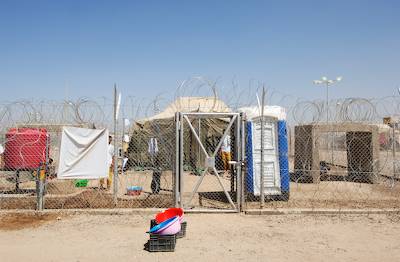
Detainee housing unit, Camp Remembrance, new Abu Ghraib prison, Abu Ghraib, Iraq. Richard Ross
Detainee housing unit, Camp Remembrance, new Abu Ghraib prison, Abu Ghraib, Iraq is a fierce image. It is at first glance still and linear but under a paper-thin surface it is simmering with tension. There are four detainees in this image. In Ross’ depopulated world, that is akin to a cacophonous arena crowd. The two clearly visible men are curiously peering at Ross’ activities and make a mockery of Ross’ attempt to mimic the prison’s personless eye of surveillance. A third man sits in the shade to the right of the image reading and otherwise oblivious. A fourth man sits on the left side of the image obscured by a water tank.
The sheepish glance of one detainee and the craned neck of the other come to dominate this image the longer one looks at it. The man at the door of the tent has no shoes on. Has he just emerged in response to the photographer’s presence? These two men brilliantly illuminate the unnatural and inflexible relationships that exist across and through chain link and barbed wire. They are merely curious at this point and do not gesture or ask anything of Ross, at least not in this exposure. They have been briefly distracted from house-keeping routines by another human that is as foreign to them as any other. Proximity means nothing here for Ross and his inadvertent subjects.
The most remarkable thing about Detainee housing unit, Camp Remembrance, new Abu Ghraib prison, Abu Ghraib, Iraq is not the clarity with which Ross communicates the apparatus of power, but rather how that drains human interaction of meaning or purpose. Does this mean I’d like to see more people in Ross’ photography? Absolutely not, there are plenty of documentary photographers who are trying to convey the spectrum of human existence, and it is not Ross’ charge. It just means that upon the appearance of non-typical images the audience’s attention is gripped. The two anomalous images from Abu Ghraib draw to attention Ross’ otherwise effortless manipulation of his audience. Ross shapes and prepares his viewer for a cold interaction. His manipulation of the audience’s eye is fitting for a project that studies dominance over subjects and imposed order of authorities.
Further investigation: Good text interview. Better audio interview. Best video presentations
Herman Krieger – stalwart of the Oregon photography community and Eugene resident – is a self-made specialist in the art of captioning. However, more than his quirky words, I appreciate the great lengths he goes to in order to document sites of the prison industrial complex.

View from Boise Gun Club, New Idaho State Prison. Herman Krieger
Krieger described the circumstances of the series, “The idea of making a photo essay on prisons and their settings came after driving from Tucson to Phoenix. The view of the prison in Florence, Arizona struck me as an odd thing in the middle of the landscape. At that time I was only looking at churches for the series, Churches ad hoc“.

With Lifetime Mortgage, Vacaville, California. Herman Krieger
“I then made some photos of prisons in Oregon and California. Others were made during a trip by car from Oregon to New York. I would have made a longer series, but I was too often hassled by prison guards who noticed me pointing a camera at a prison. They claimed that it was illegal to take a photo of the public building from a public road, and threatened to confiscate my film”, explained Krieger.

Room Without a View, Pelican Bay, California. Herman Krieger
Pelican Bay was opened in 1989 and constructed purposefully to hold the most violent offenders, usually gang members. Along with Corcoran State Prison, in the late 1980s, Pelican Bay ushered in a new era of Supermax facilities in California. They are remote (Pelican Bay is just miles from the Oregon border) and they are expansive. Their distant locations prohibit regular visits from inmates’ family members – a detail probably not lost on the CDCR authorities who sought to transfer, contain and stifle the aggressions of Californian urban areas.
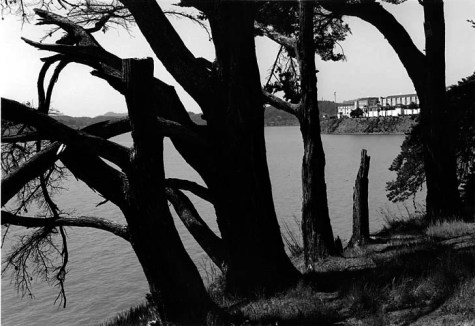
Bayside View, San Quentin, California. Herman Krieger
Having lived in San Francisco for three years, the policies, activities, controversies and executions at San Quentin State Prison were always well reported in the Bay Area press. One of the most frustrating repetitions of the San Quentin coverage was the journalist’s compulsion – regardless of the story – to remind readers of the huge land value of San Quentin and the opportunities for real estate on San Quentin Point.

Open for Tourists, Old State Prison, Wyoming. Herman Krieger.

Over the Hill, New State Prison, Wyoming. Herman Krieger
America is a large country. It should be no surprise that prisons are built in isolated areas – it makes economic sense to build on non-agricultural hinterlands and it makes strategic sense to purpose build facilities on flat open ground. More significantly, to locate these “people warehousing units” out of society’s view, allows convenient cultural and political ignorance for the authorities & citizens that sentenced men and women to America’s new breed of prison.
Krieger’s photographs summarise the key intrigues and detachment “we” feel as those excluded from prison operation and experience. Krieger, in some of his other images, gets closer to the prison walls and yet I deliberately featured these six prints precisely because of their disconnect. What terms, other than those of distance and exclusion, can we legitimately use in dialogue about contemporary prisons?

 Prison Photography