
You are currently browsing the yearly archive for 2011.

Sometimes it’s associated with a British band, and sometimes it associated with people who are banned.

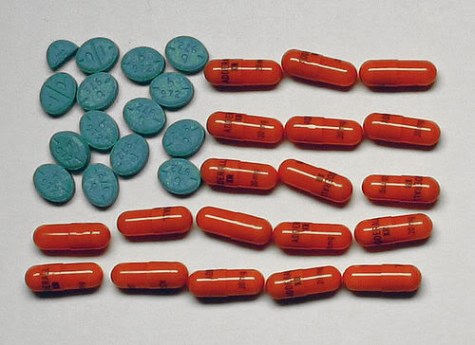
It’s about pills, madness and control. It’s about healing.

It’s about awesome fashions and it’s about bad accessories.


It’s about poor decisions by presidents.

It’s about corporate control and corporate profits.


It’s about death to ours and death to theirs.


Sometimes, it’s about imperialism.

It’s about religious freedom and freedom of religion.


It’s about fake sportspersons and real sportspersons.
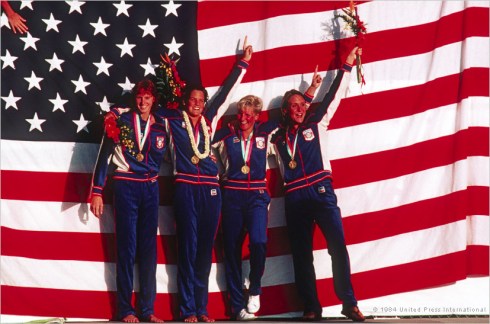

It’s about God and it’s about children.

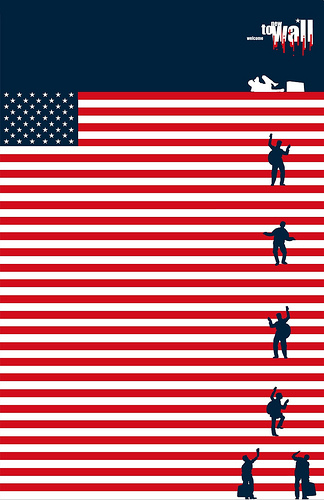
It’s about we the people, not them the people.

It’s about bigotry and it’s about a permanent underclass.


It’s about cold beer, cupcakes and weed.

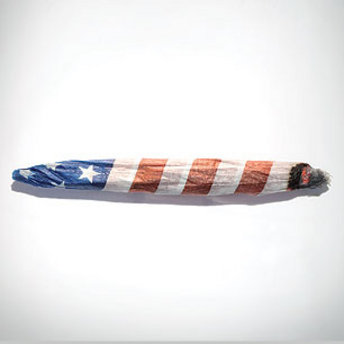
Images sources: Rolling Stones lips; Prison bars, from Teen in Jail; American flag of pills, by Talia Marisa; Heels, Fashion Munster; Spectacles, Linda Lovelock wears American flag sunglasses during the 2010 Tax Day Tea Party April 15, 2010 in Pleasanton, California. Tea Parties were held across the United States to denounce tax day. More than a thousand people attended the Tax Day Tea Party at the Alameda County Fairgrounds. (April 14, 2010 – Photo by Justin Sullivan/Getty Images North America); Bush family; Corporation flag; ISBN flag, via Adbusters; Coffin at night, Sudanese men look at the flag-draped coffin of U.S. diplomat John Granville, 33, who worked for the USAID, as it is received by U.S. officials in Khartoum, Jan. 3, 2008. (AP); US flag bomb graphic, via Daily Bleed; Imperialism flag, Christian cross, on eBay; Star-spangled burqa; Rocky Balboa shorts; Olympic winners, via Astropix (Teammates in the USA women’s 4 x 100 meter relay swim team stop in front of a giant American flag to wave to fans after winning the gold medal and setting a world record in the finals of the event during the 1984 Olympics in Los Angeles. From left are Jenna Johnson, Dara Torres, Carrie Steinseifer, and Nancy Hogshead.); Child’s drawing, via Fire Andrea Mitchell; School class photo, via Valley Community Newspaper (The Girl Scouts who meet for troop activities at Martin Luther King Jr. Elementary School had an American flag flown over the nation’s capitol on Dec. 6 to honor the school. Photo Credit: Unknown); Immigration wall graphic, by Luis Boix; “Does my fag offend you?” bumper sticker; Immigrant labour graphic, by La Mustia; Supermarket beers, via Corks and Kegs; Cupcakes, The Cupcake blog; Spliff, from Rolling Stone via The War on Drugs is a War on Me.
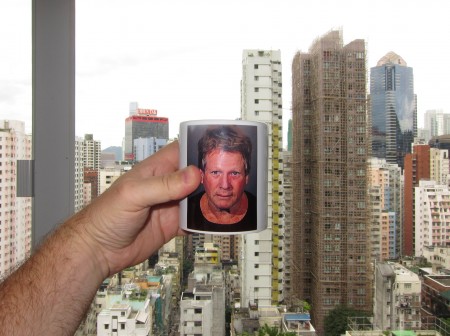
Michael Wolf’s mug. Photo by Michael Wolf for Hermann Zschiegner’s Mugshot Mugs project.
Hermann Zschiegner‘s cheeky Mugshot Mugs had me smiling. He wanted to make a comment on privacy and create and excuse to make contact with his heroes.
Zschiegner Googled and downloaded images of celebrities’ booking photos, printed them on mugs at Walmart and sent the mugs out to, as he puts it, “twenty people that have been of great influence to me in one way or another or whose work I have admired over the years. Some of the people who received a mug are friends, but most don’t know me very well – or at all. […] All I asked from the participants was to place the mug anywhere in their home and take a picture of it. The way the mug was framed in the picture dictates just how much privacy they were willing to give up.”
Zschiegner’s comparison of mugshots with paparazzi and within a framework of privacy-rights is thought-provoking:
“Federal booking photographs are automatically entered into the public domain in the United States, and can be obtained by anyone through the Freedom of Information Act. While designed as a tool to index and collect the images of potential criminals in a database, the publication and distribution of these pictures is an astonishing act of invasion of privacy. Institutionalized, but in effect not much different of paparazzi pictures shot from afar.”
Zschiegner is an active member of the Artists’ Books Cooperative (ABC) an international network created by and for artists who make print-on-demand books. Many of the recent book-projects within ABC have made overt use of public, internet and appropriated digital imagery. In a recent email, Zschiegner described ABC as “slow and spontaneous, small and excessive, serious and funny.” Okay, I’m amused so I’ll let you have it both ways.
THE BACKGROUND
In one of modern politics’ most outrageous adoptions of Doublespeak, Governor Arnold Schwarzenegger – in 2004 – renamed the California Department of Corrections the California Department of Corrections and Rehabilitation.* You can see videos – here and here and here – of the press conference announcing not only a change in name, but a supposed change in the management philosophy of the CDCr.
At that time, legal challenges were being made over the adequacy of healthcare. Following the 2004 criticisms and despite the 2004 promises, consistent constitutional healthcare was not provided to the prison population of California.
The CDCr failed to deliver on both medical care and meaningful rehabilitation. To prove the emptiness of the rhetoric we can look to John Gramlich’s report for the PEW Center’s Stateline last month. Gramlich made the point, that shortly after Schwarzenegger’s rebranding the “administration cut funding for prison rehabilitation programs by about 40 percent.”
THE PUSHBACK
It’s just as well for you and I, a diligent group of California citizens have for 17 years challenged the claim on the CDC acronym and since 2004 reclaimed entirely the discarded California Department of Corrections name. The CDC works to put right misleading messages, empty words and muddy communication.

Founded in 1994, the California Department of Corrections (CDC) describes itself as “a private correctional facility that protects the public through the secure management, discipline, and rehabilitation of California’s advertising.”
Above is the CDC’s latest correction of fact and assault on complacency. From their website:
The California Department of Corrections (CDC) has unveiled a new campaign of bus shelter ads to celebrate America’s assassination of Osama bin Laden.
Released prior to July 4th, a total of ten ads in MUNI bus shelters throughout San Francisco were apprehended, rehabilitated and discharged without incident. The ten liberated ads represent each year in the long decade spanning the declaration of the War on Terror by President Bush and the eventual demise of al-Qaeda’s elusive leader.
Joining in celebration with millions of US civilians after the demise of bin Laden, the red, white and blue advertisements not only pay patriotic tribute to our country, but also celebrate the unsung history of American assassinations.
The rehabilitated advertisements are currently at liberty and seem to have successfully readjusted to public life. However, these ads will remain under surveillance by department staff to prevent recidivism and any potential lapse into prior criminal behavior.
You gotta love direct action. View more works here.
* You may have noticed I always refer to the Golden State’s prison system as CDCr; using a lowercase “r” is an simple text-based slight but it makes the point.
(Via the ever-wonderful Just Seeds Blog.)

In an email, Dustin Franz explained that his project Finding Faith is about those who find spiritual direction “be it in any religion, while incarcerated”. It was made at the Marion Correctional Institute and documents the activities of the Horizon program, a multi-faith religious initiative.
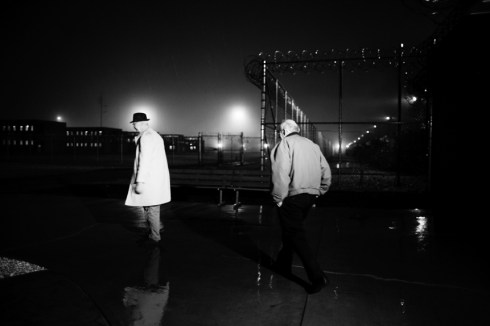
Dustin asked what I thought, so here goes. There’s a couple of strong images in among the series. I’ve selected my two preferred photographs (above): they closely approximate to the eerie weight of both incarceration and organised religion.
Like most others, Dustin is probably not aware of my aversion to shots of receding tiers! Same goes for barbed wire. So we’ll scratch those two.
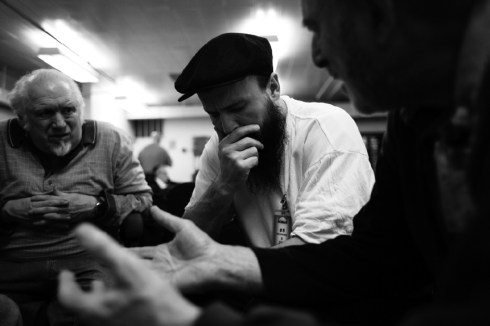
His shot of the chapel congregation is forgettable, but most B&W documentary shots are these days – that’s just the way percentages play out. His two group shots (one is below) are strong and show the connection, commitment and concentration ongoing between participants and volunteers.
The two shots of Muslims in prayer are indicative, but I wonder today if there’s a danger of stoking irrational fear by showing Islam in prison without conscientious background information? This is a reflection of my caution more than the photographer’s skill. If we are going to understand why any religions persist in prisons then we should start with a basic appreciation of their history. As a critic, I’m never satisfied.
The series is a nicely edited mixture of compositions, but I’m left feeling I need more. So often documentary photography describes the scene but doesn’t grip the emotions. Audio is a great complement, so kudos to Franz for producing the accompanying multimedia piece Hope is on the Horizon.
The narrated slideshow opens with this quote from Jeff Hunsaker, Horizon program coordinator, “If you stop and think about it, prisons today have become human junk yards. This is where we throw away the people we don’t want.”
Bang. Done. I’m hooked.
Quickly following Hunsaker’s words are those of a prisoner explaining that it is not about Christian bible-bashing (Horizon is billed as an ecumenical program) but about taking responsibility. Basically, as we all know, situations peered upon by journalists are often better described by the subjects than the reporters. Franz and his co-producer, Angela Shoemaker, were wise to adopt multiple media to tell the stories at Marion prison.
Dustin Franz is the photo editor for The Athens News. In the past, he has worked for The Aspen Daily News, Colorado. He’s the latest in a long line of budding photographers from the photojournalism program at The School of Visual Communication at Ohio University. Others include, of course, Angela Shoemaker (whose work I’ve pointed out before) and Maddie McGarvey who just won the LUCEO Student Project Award and took Dustin’s bio portrait. Dustin lives and works in Athens, Ohio and blogs here.
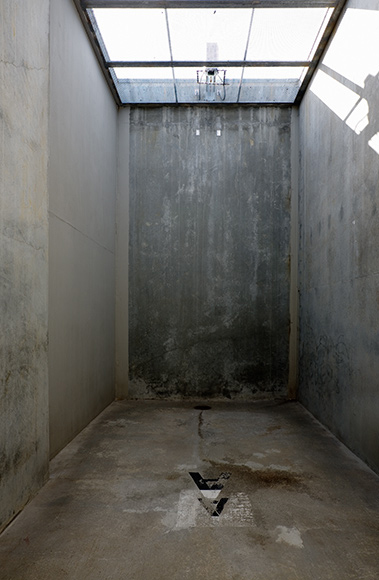
© Richard Ross
Pelican Bay State Prison in Crescent City, California is one of the most oppressive regimes of the U.S. prison system. It was designed to control and isolate the growing gang affiliations within California prisons following the CDCR’s massive expansion throughout the 1980s. It opened in 1989 and established THE model for maximum security prisons in states across the U.S.
Pelican Bay Prison specialises in solitary confinement. When photographer Richard Ross documented prisons as part of his Architecture of Authority project he went to Abu Ghraib, Guantanamo Bay and Pelican Bay.
The most segregated inmates spend 22 and half hours in a cell barely larger then your bedrooms or bathrooms. For the other 1 and a half hours they occupy a concrete pen for “exercise.”
Pelican Bay is notorious for it’s history of violence and despair. It is also, according to Christian Parenti, a boon for small town economics.
It is a god-forsaken hole.
The most isolated prisoners have put together a strike plan. Yes, they have demands, but more than that they want to make a point about the inhumane and invisible conditions they inhabit. Yes, many of them have committed heinous crimes but cooping them up like dogs serves only to increase tension, anger and danger.
BACKGROUND AND DEMANDS
Prisoners in the Security Housing Unit (SHU) at Pelican Bay State Prison have called for an indefinite hunger strike as of July 1, 2011 to protest the cruel and inhumane conditions of their imprisonment. The hunger strike was organized by prisoners in an unusual show of racial unity. The prisoners developed five core demands.
California Prison Focus supports these prisoners and their very reasonable demands, and calls on Governor Jerry Brown, CDCR Secretary Matthew Cate, and Pelican Bay State Prison Warden Greg Lewis to implement these changes. California Prison Focus has also joined “Prisoner Hunger Strike Solidarity,” a coalition of grassroots human rights activist groups in the Bay Area supporting the demands of the prisoners participating in the hunger strike.
Briefly the five core demands of the prisoners are:
1. Eliminate group punishments. Instead, practice individual accountability. When an individual prisoner breaks a rule, the prison often punishes a whole group of prisoners of the same race. This policy has been applied to keep prisoners in the SHU indefinitely and to make conditions increasingly harsh.
2. Abolish the debriefing policy and modify active/inactive gang status criteria. Prisoners are accused of being active or inactive participants of prison gangs using false or highly dubious evidence, and are then sent to longterm isolation (SHU). They can escape these tortuous conditions only if they “debrief,” that is, provide information on gang activity. Debriefing produces false information (wrongly landing other prisoners in SHU, in an endless cycle) and can endanger the lives of debriefing prisoners and their families.
3. Comply with the recommendations of the US Commission on Safety and Abuse in Prisons (2006) regarding an end to longterm solitary confinement. This bipartisan commission specifically recommended to “make segregation a last resort” and “end conditions of isolation.” Yet as of May 18, 2011, California kept 3,259 prisoners in SHUs and hundreds more in Administrative Segregation waiting for a SHU cell to open up. Some prisoners have been kept in isolation for more than thirty years.
4. Provide adequate food. Prisoners report unsanitary conditions and small quantities of food that do not conform to prison regulations. There is no accountability or independent quality control of meals.
5. Expand and provide constructive programs and privileges for indefinite SHU inmates. The hunger strikers are pressing for opportunities “to engage in self-help treatment, education, religious and other productive activities…” Currently these opportunities are routinely denied, even if the prisoners want to pay for correspondence courses themselves. Examples of privileges the prisoners want are: one phone call per week, and permission to have sweatsuits and watch caps. (Often warm clothing is denied, though the cells and exercise cage can be bitterly cold.) All of the privileges mentioned in the demands are already allowed at other SuperMax prisons (in the federal prison system and other states).
The Pelican Bay hunger strikers have support form the other SuperMax in California Corcoran Bay Prison.


On this blog last week, I raised questions about the viability of the Leica Oskar Barnack Award jury process. The 2011 winner Jan Grarup is a colleague with one of the five jurors, Stanley Greene.
Grarup and Greene, with seven other photographers, co-founded the NOOR Images Agency, based in Amsterdam, The Netherlands in September 2007.
I emailed the offices of both the Leica Oskar Barnack Award and NOOR Images with the following questions:
Do you see this as a conflict of interest?
Did you foresee this as a problem before judging began?
Was Stanley Greene exempt from voting on entries by fellow NOOR photographers?
I am interested to know the jury process and if Leica Oskar Barnack Award believes it needs to defend itself against ethical questions.
The questions were designed to be relatively open and non-accusatory while getting at each bodies’ staked and defendable positions.
TINA WIESNER ON BEHALF OF THE LEICA OSKAR BARNACK AWARD
Leica Camera AG invited 5 jury members for the 2011 judging of the Leica Oskar Barnack Award / Newcomer Award.
The jury voted “unanimously” for the winner. There was no conflict of interest.
Please note that we received more than 2000 entries, representing photographers from 89 countries, many of them independent or working for renowned agencies. During the judging process, the jury concentrates on the editing of the series of 10 – 12 images and the information given about the story behind.
CLAUDIA HINTERSEER ON BEHALF OF NOOR IMAGES
One of our photographers was invited to be on the jury and another NOOR photographer was allowed to enter work according to the Leica Oskar Barnack entry rules.
The Leica Oskar Barnack organization has judging rules in place and a secretary to oversee these are being abided to. Like most other international photography competitions, their judging rules includes a clause that at crucial moments jury members have to announce specific working and/or personal relationships where there tends to be a conflict of interest. I know that Stanley Greene has made no secret of the fact that he, Jan Grarup and seven other photographers (and myself) founded a photography collective several years ago. Taking into account the professionalism of the other jury members of this year’s LOB competition, and trusting the fact that the Leica Oskar Barnack secretary does his/her duty, I trust that the multi-membered jury’s decision was made on the basis of the outstanding quality of Jan Grarup’s work, rather than on the basis of one jury member’s particular business interest.
In his career, Jan Grarup has been honored with some of the most prestigious awards from the photography industry and human rights organizations, including: World Press Photo, UNICEF, W. Eugene Smith Foundation for Humanistic Photography, POYi and NPPA.
Looking at other international photography contests you will be amazed how often jury members are professionally or – as is very common in our industry – personally (on the basis of friendships) related to photographers whose work is rewarded.
A few things:
I am still unclear as to whether Wiesner’s “unanimously” means Greene voted or abstained on Grarup’s work; whether his vote was important or not to Grarup’s win.
Hinterseer’s argument is a little more convincing than Wiesner’s, mainly because she explains the mechanics of the jury process.
Grarup’s past awards have no relevance to this issue.
Hinterseer softens the blow by saying pretty much that this sort of thing happens all the time. And it is this last point that I think is the take away. I’ve not given it any thought in the past. Let’s change that.
I took a quick look at the judging process at the World Press Photo and noted Stephen Mayes, managing director of VII Photo. I thought it a pretty safe bet that a VII Photo photographer won something at WPP. Sure enough, Ed Kashi won the Contemporary Issues: 2nd Prize Singles.
No judgement on Kashi, Mayes or VII; I’ve just used them to illustrate Hinterseer’s point. Besides, the labyrinthine WPP jury process probably rinses out much direct influence.
So, I’ll conclude with two questions. 1) Is this situation – as suggested – really unavoidable? 2) If so, what are we to make of this web of casual association and sanctioned incest when it comes to industry awards?

Ever felt like she looks?
Alberto Lizaralde‘s Frail “is about those everyday moments when everything collapses.”

James Richard Verone peers through the glass of a visitation booth at the Gaston County Jail on Thursday June 16, 2011, where he is being held while awaiting trial for an alleged bank robbery. (Ben Goff / The Gazette)
There has been a portrait of an incarcerated man with wide eyes circulating the news this past week (above). Photographer Ben Goff (Flickr here) released of one other image (below) from his assignment photographing James Richard Verone in Gaston County Jail, N.C.
Verone, as Zachary Roth succinctly puts it, “robbed bank to get medical care in jail.” This is a man on the very brink. Or is he? Verone made a very drastic, but reasoned, decision to carry out a non-violent act outside the law. It’s an extreme protest admittedly, but he’s carrying all the risk. So cut him some slack.
Given that he thought through his bank robbing etiquette, waited patiently for the police and explained his motives to the press, don’t you think this man has a complex understanding of consequence? Could this be a photo of a man who knows how image and media work? Admittedly, there is potential that viewers will presume Verone’s mental health – as well as his physical health – is suspect. But could Verone be performing for the camera? I’d like to suggest Verone is in an interaction with one of the few people (Goff) who is in the business of creating testimony to stories so that they may be publicly consumed. As such, Verone consciously provides the exact facial expression he thinks we need to see.

James Richard Verone peers through the glass of a visitation booth at the Gaston County Jail on Thursday June 16, 2011, where he is being held while awaiting trial for an alleged bank robbery. (Ben Goff / The Gazette)
Verone is not pushing a political agenda; he’s trying to save his own life. He is just asking for us to see his truth. If we were in Verone’s circumstances we’d probably be severely unsettled (or, in the vernacular) crazy.
But here’s the paradox of the image: it is easier and lazier to think of Verone, even in a very small way, as crazy than it is to think of him as a rational being; to do so, would push us to ask why a rational person is behind bars. Wouldn’t logic dictate that the medical, societal and legal systems that conspired to put a rational man in jail are in fact themselves illogical?
Verone is a logic-evangelist and we need to see the light.
Within the fabric of our society, there exists a vast gulf between the ways people interface with services and institutions. To me, that is crazy.
I’m partly, suggesting a false dilemma here. There are, of course, more than two alternatives in how we see/react to the portrait. And yet, the glass of the visiting booth provides an excuse for our distance; an us and them; 1s and 0s; have and have-nots; not crazy and crazy.
Goff captions his two images Crazy Eyes and Crazy Eyes 2. Denigratory, clumsy and observant all in one, Goff describes the first startle (the first impression, if you like) Verone gives to his audience. But the introduction is only one part of this cruel photo that brims with abundance.
FREE
When I used the phrase “Verone gives to his audience” it was deliberate. That reaction is yours. Take it for free. That reaction is the opening gambit of an interaction between you, Verone and your conscience.
We believe that physical freedom ensures also the freedoms to worship, speech, choice, vote and so on and so forth. But in terms of providing immediate critical health-care, none of those things have provided for Verone. In “free society”, Verone was in economic shackles.
TRUST US
Verone’s dire straits have not been helped by America’s recession. How does Verone’s non-existent $1 bank robbery compare to the Inside Job in 2008 on Wall Street? What do we want to focus on? The pseudo-crime of an individual or the corruption of the finance sector? Michael Capuano, a Democratic representative for Massachusetts, once rebuked a panel of banking executives. He said, “You come to us today telling us we’re sorry, we won’t do it again; trust us. Well, I have some people in my constituency that actually robbed some of your banks, and they say the same thing”.
“Trust Us.” I’m sure Verone has said it to explain his truth, and I’m sure we’d say it too. “Trust us, trust me, I’m not crazy.”
LISTEN TO US
Verone’s story will resurface in the presidential debates I’m sure. It provides cheap political ammo for all parties depending on how it is spun. Verone’s face is read as either the failure of Democrat-led health reform or as the result of Republican-led economic meltdown. In either case, Verone plays both tragic hero and bogey man. Of which, he is neither.
CARE FOR US
The worst thing we could do would be to presume Verone has achieved, or will achieve, his objective. California demonstrated lethally how facilities of incarceration can fail to provide healthcare that meet minimum constitutional standards.
REMEMBER US
On the 1st of this month, an Ohio inmate who was denied medical care committed suicide. The prisoner, Greg Stamper hanged himself at Ohio’s Allen Correctional Institution. The press release from the Ohio Justice and Policy Center reads:
[Stamper] was suffering excruciating pain as a result of a nerve condition, and Dr. Myron Shank had refused to give him pain medications multiple times for non-medical reasons.
Stamper has his own truth and logic too. There’s likely two reasons his suicide was not widely circulated in the media. 1) It’s too final and upsetting. 2) Unlike Verone’s story, Stamper’s story is typical for the prison industry.

 Prison Photography