
You are currently browsing petebrook’s articles.
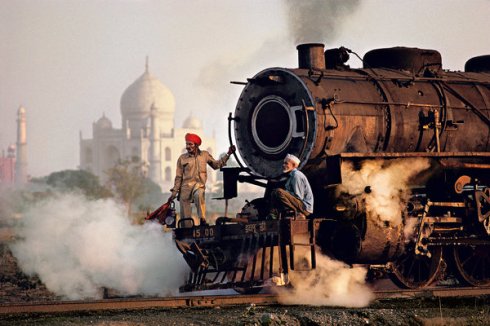
Taj Mahal and train in Agra, 1983. Credit Steve McCurry
–
I had a disagreement with a friend last week about whether Teju Cole writes well about photography. I think he does. My friend thinks he’s a very talented writer and critic but much prefers Cole’s books above his criticism. We agreed to disagree and left it at that.
I don’t know what the final verdict on Cole will be, but I sure did enjoy his skewering of Steve McCurry and Coldplay—bland, bland men—in a single article. For me, it only strengthens the argument that he’s a good writer on photography.
In McCurry’s portraits, the subject looks directly at the camera, wide-eyed and usually marked by some peculiarity, like pale irises, face paint or a snake around the neck. And when he shoots a wider scene, the result feels like a certain ideal of photography: the rule of thirds, a neat counterpoise of foreground and background and an obvious point of primary interest, placed just so. Here’s an old-timer with a dyed beard. Here’s a doe-eyed child in a head scarf. The pictures are staged or shot to look as if they were. They are astonishingly boring.
[McCurry’s] photographs in “India,” all taken in the last 40 years, are popular in part because they evoke an earlier time in Indian history, as well as old ideas of what photographs of Indians should look like, what the accouterments of their lives should be: umbrellas, looms, sewing machines; not laptops, wireless printers, escalators.
and
The song [Hymn for the Weekend] is typical Coldplay, written for vague uplift but resistant to sense (“You said, ‘Drink from me, drink from me’/When I was so thirsty/Poured on a symphony/Now I just can’t get enough”). […] The video is a kind of exotification bingo, and almost like a live-action version of Steve McCurry’s vision: peacocks, holy men, painted children, incense. Almost nothing in the video allows true contemporaneity to Indians. They seem to have been placed there as a colorful backdrop to the fantasies of Western visitors.
It’s not so much the point that McCurry is old-hat, but that the point is made with so much panache. If I’d written such luscious take downs, I’d cart myself into retirement, all happy-like. Good stuff.
Cole, however, has other ideas. He’s not opposed to outsiders taking photos of India. He points out that Mary Ellen Mark made telling portraits of prostitutes in Mumbai which presented, with a new sensibility and focus, an ignored community.
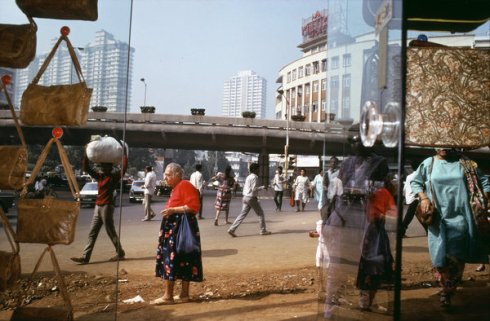
Kemps Corner, Mumbai, 1989. Credit Succession Raghubir Singh
–
Ultimately, the article is a celebration of Raghubir Singh, who is the best example of an Indian photographing India. The article is Cole’s call for us to (permanently?) redirect (all?) our energies from the photographs of McCurry and those of every fetishizing (white) (usually male) photographer who has mimicked McCurry, toward the photography of practitioners such as Singh and other cracking Indian photographers. Cole names them: Ketaki Sheth, Sooni Taraporevala, Raghu Rai and Richard and Pablo Bartholomew.
I mean, really, in a world replete with images made by folks in every corner of the globe, is there any defense for the space taken up by McCurry?
–
–
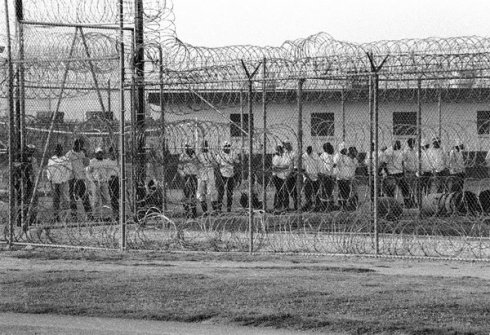
“Angola Prison, 2004,” by Keith Calhoun and Chandra McCormick.
–
It was gratifying to be mentioned in Sabine Heinlein’s recent NYT article Artists Grapple With America’s Prison System which surveyed the ways artists, curators and thinkers are responding to mass incarceration. The cue for the article, I’m guessing, was the two exhibitions currently on show in NYC–Andrea Fraser at The Whitney and Cameron Rowland (covered on PP) at Artists Space.
There’s some wonderful practitioners and projects profiled, including Deana Lawson, Keith Calhoun and Chandra McCormick, Ashley Hunt and Sable Elyse Smith among others.
The paragraph that immediately follows the mention of Prison Obscura reads:
Ben Davis, the author of 9.5 Theses on Art and Class, praises artists for taking up the topic, he warned: “We should push the question beyond just consciousness-raising. There is this progressive-era style of political art where well-to-do people throw banquets for homeless people and then stand up on the balcony and congratulate themselves. There is an icky history of using the suffering of the people at the bottom as a spectacle.”
Can’t argue with that.
Keeping check of ones own interests and benefits relative to those of prisoners and prisoners’ families is critical. I believe my work has not exploited incarcerated people but I never assume that the assessment of Prison Photography, Prison Obscura or any of my other projects is fixed or final.
With criminal justice reform and prison reform emerging into the mainstream over the past, say, 5 years, I habour a continuous niggling suspicion that my writing–my blogging–has less and less effect. This is down to several factors, most of them having to do with the way we consume content on the Internet today as compared to how we consumed in 2008 when I started Prison Photography. These include, but are not limited to, the dominance of Facebook and it’s pay-to-see algorithms (I’m not on Facebook); the killing of Google Reader which in turn made RSS and the independent sources/blogs RSS aggregates more impractical to access (not to say there aren’t other RSS readers out there, but none are as elegant, or free, as Google Reader); Tumblr and the trend toward infinite scrolls of visual content, not text; and, of course, the fact that on any given day NYT, WaPo, NPR, The Guardian, The Marshall Project, The Intercept, VICE, CJR and countless other international news outlets are covering the U.S. prison industrial complex–against a backdrop of such comprehensive coverage, Prison Photography barely registers.
Some days, it feels like I’m scrapping just to stay visible. That’s an icky place to be. It’s a dangerous place too; I think it’s a place where motives and energies can be tainted and focus on the issues can diminish. For that reason, practitioners–myself included–must be subject to continuous criticism and critique.
If you ever see me standing on the balcony and congratulating myself, call me out. Shoot me down.

–
Earlier this month, in Portland, Oregon, a coalition led by immigrants and refugees, successfully campaigned to see the city cut its ties with prison profiteer Wells Fargo. At the same time, in Los Angeles, Black students moved California State University Los Angeles (CSULA) to divest from private prisons and reinvest in services for Black students.
These victories follow on the heels of the divestment by a $25M endowment fund from the University of California and Columbia University’s decision to divest fully from prisons.
These victories demonstrate the sweeping effect that committed and targeted activism can have. Dismantling the prison industrial complex requires paradigmatic shifts, brave thinking, millions of small + incremental fixes as well as massive, infrastructural disassemblage. These divestment victories are such disassemblage, and they show that committed individuals can pressure institutions and civic authorities to enact transparency and moral judgement when it comes to invested monies, endowments and assets.
These victories feel like, if you will, a bright spot on the yard. Moments of illumination.
I’ve watched with great admiration as the divestment movement has grown in the past few years. A lion’s share of the good work has been done by Enlace, an alliance of low-wage workers, unions, and community organizations in Mexico and the U.S. Enlace’s interest began with the growth of privatized immigrant detention facilities (Under the rubric of homeland security, Federal laws have changed, and the detention of people without papers has grown exponentially.)
But of course, the capitalism and social fear that gives rise to ICE prisons, has the same roots as that which gave rise to the tumorous growth of state and federal prisons over the past four decades. Of all the factors that drive the growth of the prison industrial complex, money is the most pernicious and, perhaps, the most invisible. Enlace targets the cycle, intends to interrupt the flow of finance and influence.
–

Photo: Pete Shaw
Currently Enlace has offices in Portland, OR; New York, NY; and Los Angeles, CA. The organization has identified key targets within the cycle of exchanged goods, ideas and policy. From the Enlace website:
Private Prisons
Two publicly-traded companies dominate the private prison market in the U.S.: Corrections Corp of America (CCA) and GEO Group (GEO). CCA and GEO are notorious for abusing inmates, understaffing, and committing fraud at their for-profit prisons and detention centers. Both lobby the government for contracts and for policies that promote mass incarceration and immigration enforcement. In 2012 alone, they netted $3 billion of our taxes and spent over $1.8 million on lobbying and campaign contributions.
Million Shares Club
33 major investors own nearly all CCA and GEO stock. Each of these 33 investors owns over 1 million shares of private prison stock, so they have a huge stake in the growth and success of the prison industrial complex. With the financial and political support of the Million Shares Club, CCA and GEO are able to successfully lobby for policies that increase government demand for private prison, like “tough on crime” laws and criminalizing immigrants. We must sever the financial ties that allow shareholders to cash in on the incarceration of immigrants and people of color.
Local Institutions
Most of us are invested in private prisons–our universities, cities and faith institutions are invested with the Million Shares Club, which has no portfolio screen preventing the investment of our money in for-profit prisons. Some states, universities, cities and pension funds are even directly invested in CCA and GEO. It is unconscionable that our local institutions are using their investments–our money–to profit from and promote mass incarceration and immigration enforcement. We call on our local institutions to divest!
Politicians
Federal politicians have the power to stop private prisons. Members of the Budget and Appropriations committees have the most power to cut off funding for wasteful contracts with CCA and GEO, and for inhumane immigration enforcement policies. Unfortunately, many politicians take lobbying and campaign contributions from GEO and CCA. Others have assets in the Million Shares Club. Many politicians have both. We’re working to make private prisons a toxic liability, financially and politically.
Activism to stymie the ease with which corporations and politicians can exploit economically and socially disadvantaged communities is thrilling.
And it’s free! You can investigate private prison investments in your community and launch your own campaign. Map it here. More resources here.

For its seventh and final stop, Prison Obscura will be on show at Newspace Center for Photography in Portland, Oregon from April 1 to May 28.
(Check out official Prison Obscura website and the PP “Prison Obscura” tag for the background and journeying of the exhibition.)
I’ll be at Newspace for the opening next Friday night, April 1, 6–8pm. I’ll be installing Wednesday and Thursday so stop by and say hello.
Also, on the Saturday afternoon I’m moderating a panel titled Can Images Counter Mass Incarceration? with some of my favourite artists and thinkers. Here’s the Facebook event page and see bolded events’ details below.
THE BLURB (AGAIN)
No country incarcerates a higher percentage of its population than the United States. More than 2.2 million people are currently locked up in the U.S.—a number that has more than quadrupled since 1980. But sadly, the lives lived behind bars are all too often invisible to those on the outside. Prison Obscura sheds light on such experiences and the prison-industrial complex as a whole by showcasing rarely seen surveillance, evidentiary, and prisoner-made photographs. The exhibition encourages visitors to ask why tax-paying, prison-funding citizens rarely get the chance to see such images, and what roles such pictures play for those within the system.
Alyse Emdur’s prison visiting room portraits from across the nation and Robert Gumpert’s recorded audio stories from within the San Francisco jail system provide an opportunity to see, read, and listen to subjects in the contexts of their incarceration. Juvenile and adult prisoners in different workshops led by Steve Davis, Mark Strandquist, and Kristen S. Wilkins perform for the camera, reflect on their past, describe their memories, and self-represent through photographs. The exhibition moves between these intimate portrayals of life within the prison system to more expansive views of legal and spatial surveillance in Josh Begley’s manipulation of Google Maps’ API code and Paul Rucker’s animated video. Prison Obscura builds the case that Americans must come face-to-face with these images to grasp the proliferation of the U.S. prison system and to connect with those it confines.
Prison Obscura is made possible with the support of the John B. Hurford ‘60 Center for the Arts and Humanities and Cantor Fitzgerald Gallery at Haverford College, Haverford, PA.
PUBLIC PROGRAMS
In conjunction with the exhibition, Newspace is hosting a series of events related to the prison industrial complex and the role images play in exposing the structures of the U.S. criminal justice system.
OFFSITE Panel discussion: Can Images Counter Mass Incarceration? Saturday April 2, 2-4pm: Panelists Lorenzo Triburgo, Sarah-Jasmine Calvetti and Barry Sanders. Moderated by me. OFFSITE Location: Native American Student and Community Center, Portland State University (710 SW Jackson St). Sponsored by Portland State University Camera Arts Society.
Discussion: Re-Envisioning Justice: What Is Between Reform and Abolition of the Criminal Justice System?: Sunday, April 24, 4-6pm. At Newspace (1632 SE 10th Ave.)
Community Discussion: The Ethics of Photography: Thursday, May 12, 6:30-8pm, organized in collaboration with the Oregon Jewish Museum. At Newspace (1632 SE 10th Ave.)
All public programs are free, open to the public. Please note event location.
CLASSES
Expanding Photography: Discovering the Stories Behind Your Work: May 9 – May 23, 6:30 -9:30 pm | Instructor: Gregory Parra.
Education Lecture Series: The Screen Politics of Public Projections: May 17, 7:00 – 8:30pm | Instructor: Dr. Abigail Susik.
Build Your Own Pinhole Camera: June 5, 12:00-4:00pm | Instructor: Pete Gomena.
INFO + HOURS
Newspace Center for Photography, 1632 SE 10th Ave, Portland, OR 97214
Mon–Thurs 10am-9:30pm; Fri–Sun 10am-6pm
Facebook | Instagram | Tumblr | Twitter | Vine
For press inquiries, contact Newspace Curator Yaelle S. Amir at curator@newspacephoto.org or 503.963.1935.

–
There are many stories of prisoners’ resourcefulness and creative spirit. There’s lots of tales of redemption through art, or something akin to it. The grandly titled Prison Da Vinci is one of the better produced tellings of this type of story arc.
Filmmaker Zach Sebastian relies heavily on the subject Chris Wilson’s words and phrasing. The viewer is quickly told why a British guy was locked up in San Quentin so that we’re accelerated to the important details of how and why he made paintings made of candy.
I was surprised–but happily relieved–that Wilson was able to exist in San Quentin outside of the gang culture. He encounters philosophy for the first time and met a lot of good people, he says. And he made art.
(The Prison Da Vinci film recalls to mind the work of Donny Johnson, a man convicted of second degree murder who paints postcards with colours leached from M&Ms in his Pelican Bay State Prison solitary confinement cell for the past decade-or-more. In 2006, Johnson had a show in Mexico.)
Whilst Wilson–the artist–prevails, his existences is not far from hell. What’s missing from Prison Da Vinci is a fuller picture of the depravity Wilson experienced inside the California prison system … but that’s too big for a 4-minute short and would take us off the topic of art. We know from his book Horse Latitudes that Wilson had a torrid time of it.
Horse Latitudes first landed on my radar last year when Aaron Guy (and here) sent me a copy (Thanks, Aaron!)
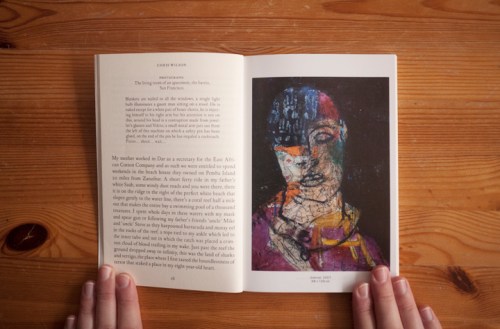
Spread from Horse Latitudes (Sorika) by Chris Wilson.
Here’s the lowdown on Horse Latitudes on Self Publish Be Happy.
What’s fascinating to me about the book is that it uses descriptions of “photographs” to anchor several scenes. Wilson describes regularly things he witnessed to put us in the picture–both when he was out on the streets living life as a junkie and later when he’s inside the nick. For example:
PHOTOGRAPH
Time Unknown
Foreground, a young man shirtless, tattooed, faces a mirror with his teeth bared, metal wires are entwined through his teeth to clamp his jaws together, in his right hand, which is raised to his mouth, he holds a red-handled pair of wire-cutters.
–
It’s dark, foreboding and inescapbaly bleak. Wilson has been called ‘The Nietzsche of Narcotics‘.
I was left to wonder how Wilson has even survived. Horse Latitudes is a short, violent and unapologetic read. Get it if you can.
The book differs massively in tone from Prison Da Vinci and that’s okay. Wilson has established himself as a successful artist and is not cagey about his tortured past. We know people change and we know identity isn’t fixed. We know people are more than their worst behaviours. Prison Da Vinci does its bit to celebrate Wilson’s post-prison and drug-free life. It’s one story of his storied life. Wilson got beyond incarceration’s grip. Art played its part. But painting with Skittles wasn’t even the half of it.

–
This is mind-boggling. But perhaps not surprising. It’s another very large leap in AI/robotics/super-computing.
At Google, Tobias Weyand and his team have trained a deep-learning machine to work out the location of almost any photo using only the photo; only the pixels it contains.
They fed the neural network–which they’ve named PlaNet–126 million images along with their accompanying Exif location data. Based upon that info, when fed a new image, PlaNet analyses visual clues (buildings, topography, vegetation, weather, etc) to determine the most probable location.
“PlaNet is able to localize 3.6% of the images at street-level accuracy and 10.1% at city-level accuracy,” say Weyand and co. What’s more, the machine determines the country of origin in a further 28.4% of the photos and the continent in 48% of them.
So that’s 3 in every 100 PlaNet puts right at the front door. 1 in 10, it knows the city, and in over a quarter the neural network correctly identifies the country. Impressive.
–
What’s the future looking like? For the first time, I’m really fretting over the strength of the global human community to make the right–and ever-recurring–decisions on the ethics and control of AI. After a computer beat the world’s best Go player this month, the making of AlphaGo (another Google project) warned against hasty application of AI technologies. Stephen Hawking has been erring caution for decades. AI is still is a long way from applying learning from one system to another so we needn’t worry about self-driving cars learning to control markets or journalism robots changing careers and taking the reigns of power.
But who’s to say that in a few decades, you won’t be able to connect the automated detection of news events in, say, social media, to trigger the dispatch of drones pre-programmed to make photos (behind police tape/above breaking stories/inside toxic environs)? Then the images are sent images to the systems of robot journalists which in turn publish a story in a template. Possible? Maybe. Fine-tune the identifying capacity of PlaNet and you’ve accurate captioning info enough to furnish a news agency … and dispose of the photojournalist!?!
Such a scenario would take care of breaking news, but I’ll still wager on humans, not robots, to fashion the long-form documentary projects. Hell, by then, documentary photography stories might be one of the few things left connecting us!
–
Thanks Robert Gumpert for the tip off

Cameron Rowland, “New York State Unified Court System” (2016), oak wood, distributed by Corcraft, 165 x 57.5 x 36 inches, rental at cost. Courtrooms throughout New York State use benches built by prisoners in Green Haven Correctional Facility. The court reproduces itself materially through the labor of those it sentences. (photo by Adam Reich, courtesy the artist and ESSEX STREET, New York)
You may have sat in the chairs, or slept on the pillows, or worn the smocks. What am I talking about? You may have used goods made by prison labour. You or your kids, depending what state you’re in, may have eaten school meals made by prisoners.
Wellington boots, uniforms, mattresses, furniture, binders, paper-goods, forms, flagpoles, hardware, utensils, even cookies … the list of goods made by prison industries is long. CALPIA (California Prison Industries Authority) in California and Corcraft in New York State are just two government agencies making high-quality goods while paying low-quality wages.
Prisoners working for CALPIA earn between 30 and 90 cents per hour (the higher end is rare) and then about 50% is taken out for taxes, charges and restitution. Supporters of these multimillion dollar agencies say it they provide valuable jobs training for prisoners. Opponents say it’s slave labor. Of course, you’re opinion will be swayed by whether you think prisons and jails are a net benefit or a net cost for society.
For prison abolitionists these state-insider agencies are second only in evil to the private prison companies. Why? Because they execute the quieter but some of the more pernicious maneuvering within capitalism. They devalue labor and devalue human beings. In California, those that defend CALPIA point out CALPIA only sells to other state bodies, but a market is a market and who the buyer is doesn’t change the work, wages or conditions for prisoners. In fact, most state-run prison industries don’t sell beyond state agencies is because they’d destroy many “free” markets simply by undercutting them on price–so great is the savings on wages. Look at those benches above; the joinery on those is out of this world. A steal at $654.50 (see below).

Artist Cameron Rowland is dismayed. And energised. The benches and the jackets and desk in the images here are from Rowland’s latest show 91020000 at Artists Space in New York. Continuing his minimalist installation approach, Rowland has put a few (of the bigger) Corcraft goods in the gallery space. The project is as much an extended and deeply researched essay as it is this gallery installation.
“Property is preserved through inheritance,” writes Rowland. “Legal and economic adaptations have maintained and reconfigured the property interests established by the economy of slavery in the United States. The 13th constitutional amendment outlawed private chattel slavery; however, its exception clause legalized slavery and involuntary servitude when administered “as a punishment for crime whereof the party shall have been duly convicted.”
To prison activists this is not new language. Even to Oprah’s List devotees this is not new. Michelle Alexander put into plain and passionate terms how the legal inequities of first, convict leasing, then Jim Crow laws and, now, expanded disenfranchisement laws in the era of mass incarceration, have maintained a “sub-class” made up disproportionately of people of colour.
Crucially, when Rowland talks of inheritance, he’s not talking about the bank accounts and assets of our parents. No, he’s talking about our shared inheritance as a nation that enjoys civic infrastructure and communities who benefit from, or not, the provision of nurturing institutions and spaces. Capitalism depends upon the movement and trade of raw materials. Roads, ports, markets, factories and comms all built upon a dependent system of inequality.
Rowland describes how convict leasing replaced a “largely ineffective” statute labor provision. And the roads in southern states got built. From there, Rowland rolls with the examples into modern day, not letting up to allow us an escape route argument of ‘This is now, That was then.’ It all connects. Read it.

Cameron Rowland, “1st Defense NFPA 1977, 2011” (2016), Nomex fire suit, distributed by CALPIA, 50 x 13 x 8 inches. Rental at cost “The Department of Corrections shall require of every able-bodied prisoner imprisoned in any state prison as many hours of faithful labor in each day and every day during his or her term of imprisonment as shall be prescribed by the rules and regulations of the Director of Corrections.” – California Penal Code § 2700. CC35933 is the customer number assigned to the nonprofit organization California College of the Arts upon registering with the CALPIA, the market name for the California Department of Corrections and Rehabilitation, Prison Industry Authority. Inmates working for CALPIA produce orange Nomex fire suits for the state’s 4300 inmate wildland firefighters. (photo by Adam Reich, courtesy the artist and ESSEX STREET, New York)
Alternatively, and also, read Ta-Nehisi Coates’ Case For Reparations. It looks at generations of African Americans robbed of earnings, assets and net-worth, with a focus on agriculture in the south and red-lining of properties in Chicago. Coates’ piece is not a tour de force only because of its impeccable research but because he puts figures on it.
Scholars have long discussed methods by which America might make reparations to those on whose labor and exclusion the country was built. In the 1970s, the Yale Law professor Boris Bittker argued in The Case for Black Reparations that a rough price tag for reparations could be determined by multiplying the number of African Americans in the population by the difference in white and black per capita income. That number—$34 billion in 1973, when Bittker wrote his book—could be added to a reparations program each year for a decade or two. Today Charles Ogletree, the Harvard Law School professor, argues for something broader: a program of job training and public works that takes racial justice as its mission but includes the poor of all races.
To celebrate freedom and democracy while forgetting America’s origins in a slavery economy is patriotism à la carte. Perhaps no statistic better illustrates the enduring legacy of our country’s shameful history of treating black people as sub-citizens, sub-Americans, and sub-humans than the wealth gap. Reparations would seek to close this chasm. But as surely as the creation of the wealth gap required the cooperation of every aspect of the society, bridging it will require the same.
Which brings us to the modern day. And to the darker corners of American commerce.
Let’s be clear, Rowland isn’t arguing about the merits, or lack thereof, of the existing judicial system and the rightness or wrongness of the control of prisoners. No, he’s more interested in the economic uses of the prisoners, of those bodies.
I’ll argue, in Rowland’s absence, that prisons in the U.S. are morally repugnant and a violence on poor Americans to a unconscionable degree. I’ll double back round and point to Rowland’s beautifully constructed text and visual arguments as one piece of evidence for the assertion.
I’m sure Rowland and I would agree that the over-arching forces of commerce (from which all hands are a few steps removed from the control panel and therefore responsibility) are the problem.
Now read Seph Rodney‘s review The Products of Forced Labor in U.S. Prisons on Hyperallergic.
This excerpt particularly:
But how do we conceal the theft? The question that has to be posed when people are systematically disappeared is: Where do we hide the bodies? “In prison” is only part of the answer. The deeper, more sinister response is also the most seemingly benign: we abstract them so they become only sources of labor and wealth. We reduce them to lines in an actuarial table, an oblique reference in a statute, a number in a log book. We dissolve people into fungible assets.
A lot of the time quiet gallery spaces don’t do a lot for me. They just seem sad. But when an artist can fill the space with poignancy … and especially when they are dealing with a grave matter that is–like in the case of prison labor–desperately sad, then I think it works.
Cameron Rowland: 91020000 continues at Artists Space (3rd Floor, 38 Greene St, Soho, Manhattan) through March 13. Get there if you can.
–

Cameron Rowland, “Attica Series Desk” (2016), steel, powder coating, laminated particleboard, distributed by Corcraft, 60 x 71.5 x 28.75 inches. Rental at cost: The Attica Series Desk is manufactured by prisoners in Attica Correctional Facility. Prisoners seized control of the D-Yard in Attica from September 9th to 13th 1971. Following the inmates’ immediate demands for amnesty, the first in their list of practical proposals was to extend the enforcement of “the New York State minimum wage law to prison industries.” Inmates working in New York State prisons are currently paid $0.10 to $1.14 an hour. Inmates in Attica produce furniture for government offices throughout the state. This component of government administration depends on inmate labor. (photo by Adam Reich, courtesy the artist and ESSEX STREET, New York)


Installation view of ‘Cameron Rowland: 91020000’ at Artists Space, New York (photo by Adam Reich)
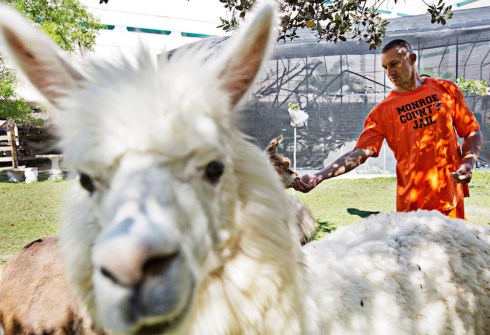
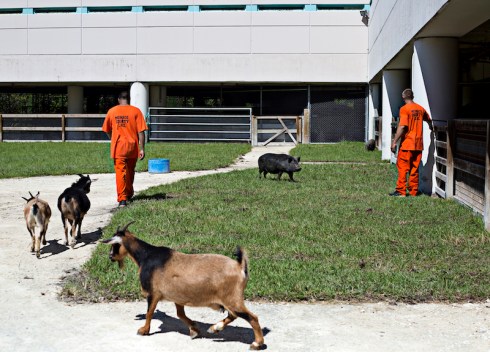
When Utah-based photographer Kim Raff was in Key West as an artist-in-residence, last year, she heard about an exotic animal farm in a jail just four miles from the iconic leisure-space Duval Street.
“It’s a pretty remarkable place,” says Raff who popped in to see what was happening on one of the two days each month the farm opens to the public.
“[My work] is not an investigative piece but just an uplifting slice of life inside a jail,” adds Raff.
I think we can be certain that petting zoos don’t hold the answer for the many rehabilitation and decarceration measures we’re needing, but there’s no doubt that for many prisoners, contact with animals bears positive results. Jailhouse cats, seeing-eye dog training programs, Puppies Behind Bars are the obvious examples. I’ve known prisoners to care for, and tame, birds. Jail birds.
There’s not many bright spots on the yard, so to speak, in America’s prison industrial complex and ones like these at the Monroe County Stock Island Detention Center are always well-covered by the media.
Tellingly, the farm is entirely volunteer-run. No taxpayers money goes toward it. So while we can clap Monroe County Sheriff for hosting the program we can as easily wag our finger at the predictably conservative attitudes of lawmen who refuse to help fund a program that has clear benefits for all.
Ultimately, as Raff puts it, here’s an example of a program that is “unconventional, interesting and actually working.”
–
Read Inside the Florida Jail that Doubles as an Exotic Animal Zoo to get Raff’s full account and see the images large.


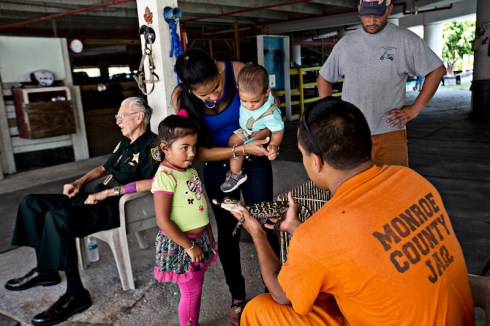
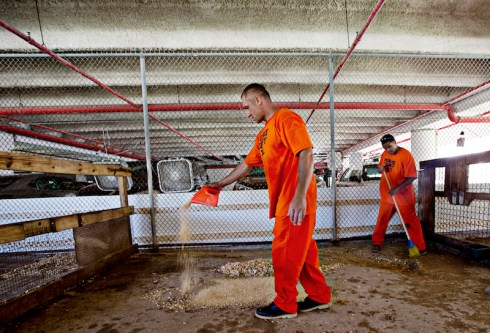

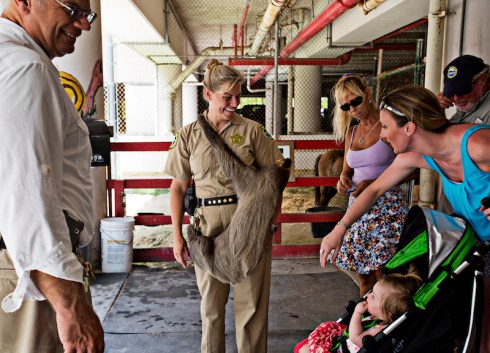
–
Kim Raff is a documentary and editorial photographer based in Salt Lake City, UT. Connect with Raff on Twitter, Facebook, Instagram, Linked In and Tumblr.
–

 Prison Photography