
You are currently browsing petebrook’s articles.
Street Photography is a recognised genre.
Prison Photography is yet ill-defined. For the most part, it is a series of interventions by camera and operator into the procedures and relations within institutions of containment.
With these criteria in mind – the familiarity of the subject; the public visibility of the practitioner(s); the obstacles to access; and the assumption of existing/distinctive authority – it seems like the two approaches to subject are in opposition.
My presumption my be illustrated as thus:

The x axis is Time on the job.
The y axis is The original number of leads (to securing access to your subject) still open. Shown as a percentage.
Danny Lyon spoke out last week about Google books’ disregard for rights, artistic craft and common respect. In Google vs. The Bikeriders he lays out a short and no nonsense argument.
Lyon doesn’t oppose digital distribution of his work – he just doesn’t want it scanned en masse. He wants publishers, software programmers and artists to do the work.
On the existence of books, Lyon warned, “I’d be real careful about messing with this stuff. I’m not sure I would want to live without them.”
FULL STATEMENT
The Bikeriders 1968, The Destruction of Lower Manhattan 1969, and Conversations with the Dead 1971, were all out of print within two years of their publications. They had all been remaindered by their publishers and would remain out of print for at least twenty years each.
“Conversations” is still out of print. Under Google’s new rules, Conversations with the Dead could be scanned and put on line by Google without even contacting me. Many photo book makers are torn between standing up for their rights, and “being left out” by the Ruler of the Internet.
So what is wrong with having Goggle (sic) bring my out of print work to the world wide web?
1) It is theft. Ownership of out of print work reverts to the author (me). Copyright has worked well in America for centuries and is part of the foundation of our Democracy and the Ist Amendment. I own my writing and my work. They really do have to ask.
2) Picture books are different. You cannot scan them and put them on the internet. Scanning a printed image destroys the beauty of the work which is embedded in the work itself. That is why authors make picture books. They are making a thing of beauty. That is why printers, ink, paper, and publishers and production managers are all so important. They all work to create a thing of beauty, a book. In this case, as picture book.
There is nothing wrong with putting a picture book on the internet. But that can only be done the way a book is printed, which is to scan the individual images. It is the difference between “the real thing” and a bad xerox of it.
If they want “Conversations with the Dead” on the internet they have to work with publishers, who employ the people to make the prints and make the scans and recreate the book for internet use, just the way a person makes a good website.
That’s a lot of work that will create a lot of jobs, and it should.
Publishers are the people to do this, as they are in the book business. Google seems intent on destroying the book business and its just possible, that they will.
Books, the printed smelly kind you hold in your hand, have been part of and have helped advance civilization for five hundred years. The Greeks and Ancient Jews used papyrus rolls, which they also held to write on, and to read, 2,500 years ago. I’d be real careful about messing with this stuff. I’m not sure I would want to live without them.
I am amazed that Lyon even needs to fight a corner on this. He surely is more valuable to us than scanned copies of his books.
How to tell Google to lay off Lyon’s publications?
__________________________________________________
Danny Lyon’s website is Bleak Beauty.
Here for everything else:
http://www.americansuburbx.com/2009/08/theory-end-of-age-of-photography-by.html
http://5b4.blogspot.com/2007/10/like-thiefs-dream-by-danny-lyon.html
http://www.luminous-lint.com/app/photographer/Danny__Lyon/C/
http://www.scottnicholsgallery.com/artists/danny-lyon/23.html
http://www.geh.org/ne/mismi2/lyon_sld00001.html
http://www.americansuburbx.com/2008/01/theory-doing-life-interview-with-danny.html
http://www.nytimes.com/2009/04/26/arts/design/26kenn.html
http://www.mocp.org/collections/permanent/lyon_danny.php
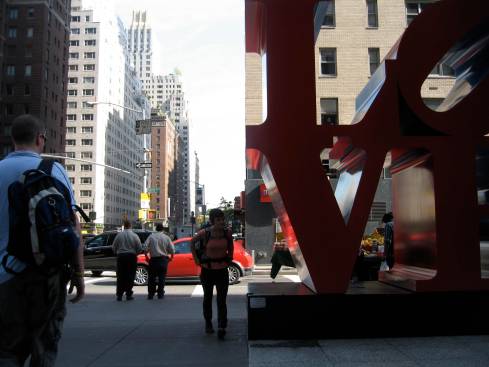
Had a fun time in New York last week. Stayed with Jack and Marisa. Below is not Jack. Below is Chris by Jack.
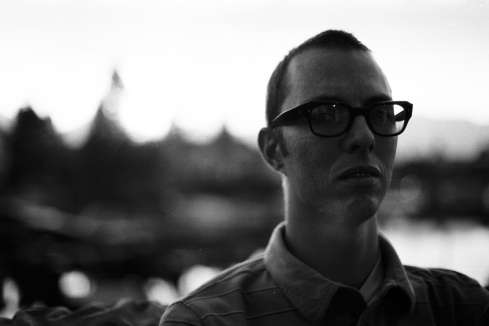
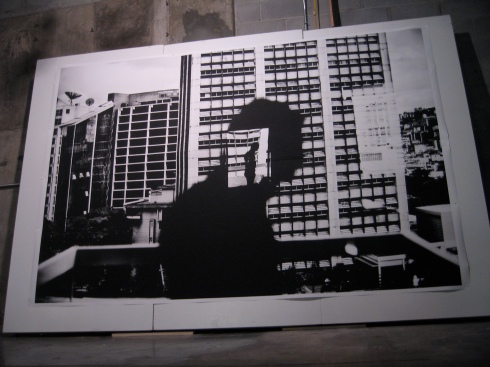
We went to Christopher Anderson’s book launch for Capitolio. It was great to see it after recent reviews, heated debates (check out comments) questions and wot not. I don’t think the selection of the images was the best.
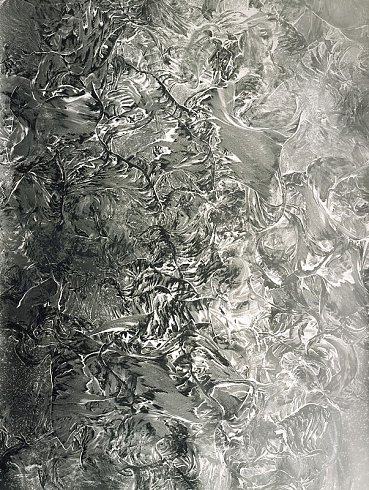
At the Metropolitan, Surface Tension: Photographs from the Permanent Collection was a pleasant whimsy into some mesmerizing works, notably Adam Fuss’ UNTITLED (1997) made by the metronome shimmers of snakes upon black dust upon white dust. Image Source: Cheim & Read
The Met’s photography department was putting together the final touches on Robert Frank’s The Americans which opened this week. It was all hands to the pump as evidenced by besuited Malcolm Daniel – who I spied carrying large, heavy object (post?) behind a partition and into the exhibition space.
Egg and Cheese Bagel.
Over at the Museum of Modern Art, I was pleased to see Russell Lee‘s work Bulletin Board in Post Office Showing a Large Collection of “Wanted Men” Signs, Ames, Iowa (1936). Who doesn’t love a mug shot?


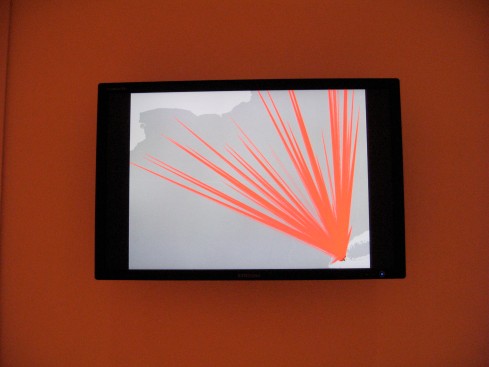
Bringing the practice of mapping of transgressions into the 21st century, the Spatial Design Lab from the Graduate School of Architecture, Planning and Preservation at Columbia University exhibited its Million Dollar Blocks Project (2006).

On Monday night I sat with Andrew Lichtenstein. We talked. Andrew recommended Brennan Linsley‘s work and was quite emphatic about the book ‘Concrete Mama‘. He also spoke highly of Max Kenner and the work at the Bard Prison Initiative
Tuesday, I met Emiliano Granado. We were first in contact over his San Quentin Giants pictures. We talked about many things including Trevor Paglen, Argentina, the Burke Gilman, and the Horticultural Society of New York, which recently lost Barbara Margolis who was an inspiring leader. Emiliano recommended Alessandra Sanguinetti‘s work.

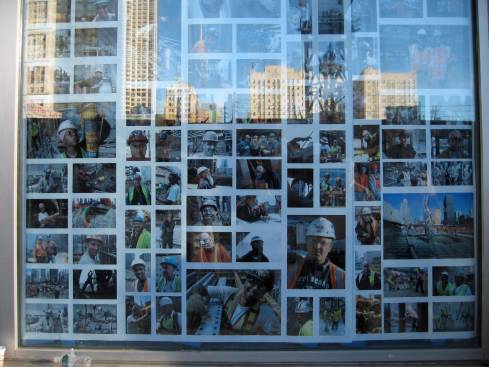
On Sunday, I’d been at the WTC construction site. There was some portraiture on display in a window. The space behind the window was closed but would usually be open. The photographs were easy on the eye.
On my last night I checked out Steven Hirsch’s Courthouse Confessions.
That’s Matt Kelley looking at Steven’s work. He’s coordinator for Change.org Criminal Justice, online communications for the Innocence Project and all together nice bloke. Matt’s double identity is twittered and can be followed here and here.
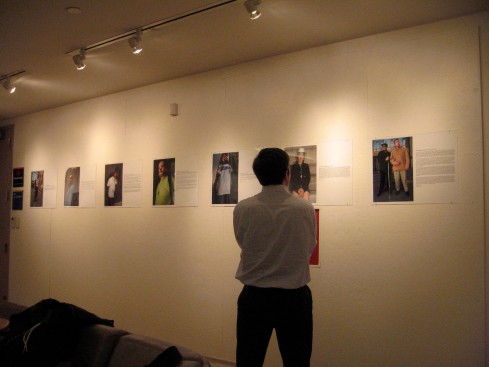
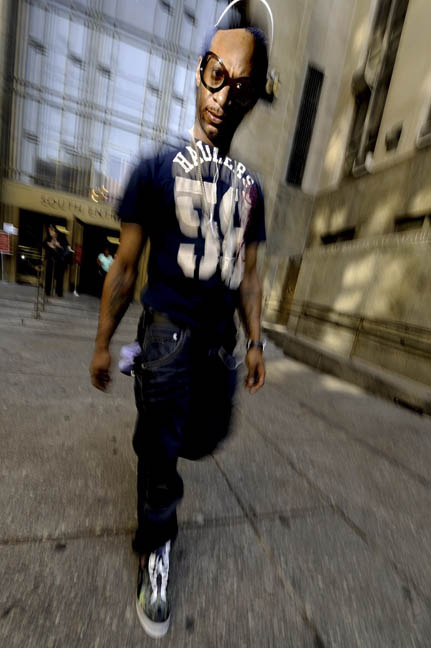
Hirsch takes street portraits of folk going to court, secures (in some ironic twist) a non-binding statement and then transcribes it verbatim to go with the portrait. Constantly moving the camera, Hirsch uses hard flash and distorted angles/zoom to depict these individuals as shape shifters; as anomalies. The fact Hirsch’s subjects (in most cases) seem alien to the logic of the courts – that any lessons arising from their cases are unlikely to effect sentencing laws in the future – should but be a source of disquiet for us as an audience.
One last thing. On Saturday, I saw John Baldessari sat outside a Grennwich Village coffeehouse, but I bottled saying anything. I’ve learnt that famous people abound in Manhattan and you see ’em everywhere.
Thanks to everyone who altered their orbits a little to coincide with mine.

AP Photographer, Brennan Linsley has visited Guantanamo twelve times in the past four years. Why? “My goal is to come back from each trip with a couple of shots that will allow me to paint more of a picture of this place'” says Linsley.
A journalist’s visit to Guantanamo is a frustrating experience – newsmen have a constant escort on a preplanned itinerary and must read and follow the fifteen pages of ground rules provided by the US military.
To offset these limitations Linsley chose repeated visits as a a tactic. In an attempt to humanise the detainees, he has weaved a photo-essay in-spite of Guantanamo’s milieu which is counter to all notions of free speech, experience and objective fact-gathering.
The British Journal of Photography has a brief but interesting interview with Linsley about his project.
This sequence of interactions between a Chinese detainee and photographers (described by Linsley) exemplifies the minutiae with which the US military must control the flow of information out of Guantanamo.
Just to get the juices flowing, Linsley closes the interview with this position, “The Golden Age of photography has been over for a long time. It died somewhere between the Vietnam War and the Gulf War.”
Discuss.
_______________________________________________________________
BJP’s interview coincides with Linsley’s work showing at the 2009 Visa pour l’Image at Perpignan.
For more images and links on Guantanamo see Prison Photography‘s Directory of Visual Sources.
Words
Prisoners All posits that we are all severely impeded, individually and as a community, because of bad politics, poor policy and family devaluation. The posts are really well composed.
The anonymous author – by the pseudonym of Zebulon Brockway – has “worked many years in [California] prisons, and worked many years in journalism” and believes “much written about prisons is misleading at best and wrong at worst. The false impressions and false information are not helpful to public discourse”.
Moving Images
John Malsbary contacted me at the start of the Summer to tell me of his new venture Prison in Cinema.
John’s moving across a country at the moment. His few posts suggest he’ll be worth watching. John brought to my attention the film The Jericho Mile made on location at Folsom State Prison in 1979. Anthony Friedkin photographed Folsom convict portraits twelve years later. Mann’s directing and Friedkin’s shooting share in visual dialogue.

Four Convicts, Folsom Prison, CA. Anthony Friedkin. 1991. Silver Print. 16 x 20 inches.
Reading
Governing through Crime; WA State Library; Grits and Bid’ness in Texas; and Ben Gunn (Serving prisoner) and John Hirst (Released) in the UK.
Followed LEAP’s twittering and other ones …
Stats
The Dallas News reported the ‘Circumstances, Evidence, Problems and Outcome’ of five cases of arson in Texas under re-examination. That includes the Cameron Todd Willingham case. (via The StandDown Project)
‘A Paperclip and a CD’
Matt Kelley at Change.org had a well reasoned rallying call for support of prison book programs. Take Action.
Edmund Clark
A favourite of mine. Since recommended by Nathalie Belayche. Colin Pantall (recently back from a summer blogatical) and LensCulture showing Clark‘s new prison series, ‘If the Light Goes Out: Home from Guantanamo’.
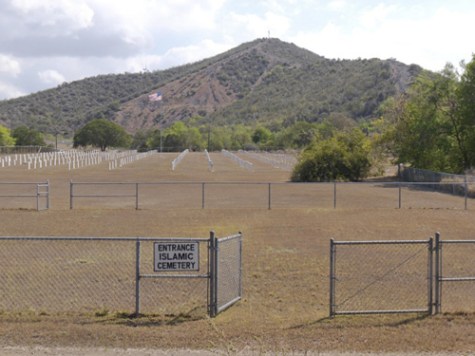
Naval Base Cemetery by Edmund Clark
Naval Base Cemetery (above) is not typical of the project. It is outside. ‘Home from Guantanamo’ uses the same detailed look at everyday institutional and domestic objects in their place. I don’t think it is as successful as ‘Still Life: Killing Time’, as I don’t think this approach lended itself as well to the War About Terrorism as it did to the Geriatric E-Wing of Kingston Prison, Portsmouth. ‘Killing Time’ is best viewed as a slideshow with Erwin James’ commentary.
Reciprocity Success
And finally, thanks to Stan for his coordinations and libations. Stan recommends Courthouse Confessions, as do I.
People ask how photojournalists and documentary makers get access to prisons, so I ask the photographers I meet. For every photographer, circumstances and events are unique.

The Society of Professional Journalists details media prison access policy, contacts, visitation rules, forms and permitted equipment state-by-state. There is no home page for the data, so I’ll link you to the Virginia Dept. of Corrections guidelines.
Prisoners in Virgina will be needing more visits to fill their time as their right to receive books via charities has just been withdrawn. The feeble reasoning by the Virginia DoC:
Because Quest [the Books Behind Bars program organiser] sent books directly to offenders and utilized volunteers to send these books, there was nothing in place to stop someone from attempting to introduce contraband to an offender by secreting it in a book.
This is plainly an excuse. It is also an embarrassment. If a prison system cannot provide efficient (and secure) passage of educational materials to its wards, then is it a system we should have any respect for or trust in?
These broken systems should be in our view.
Ben Gunn, Guardian. Monday September 14th, 2009
There is an interesting debate growing in the UK. Should prisoners be allowed to blog?

Ben Gunn, who claims to be the only serving UK prisoner who blogs, had a letter to his wife intercepted by the prison governor and told “the content is interesting enough to be published on the internet” and on this ground it was stopped from leaving the prison.
Gunn set up the blog at the end of August. He writes the content and his editor posts it to the web.
Gunn has caused a stir with forthright opinions on politicised victims groups, spineless politicians and poor prison management. These, he argues, are not fallacious rants, but genuine problems of an overly-punitive system and disengaged society.
Furthermore, Gunn argues that despite his original sentence of 10 years, he remains in prison after 30 because he has continuously challenged the prison authorities. At present Gunn is engaged in research towards a PhD, focused upon the role of Human Needs Theory in prison conflicts.
My question “How do we feel about Prison Bloggers?” is largely rhetorical. How we feel about them makes no impingement on their lawful right to write and publish from prison. Let’s be absolutely clear here. Gunn is breaking NO LAW.
The only law that may pertain is that Gunn may receive no compensation for his writing while a ward of the prison service. But this was never the issue at stake. Gunn’s free speech was deliberately quashed by the administration of a system that stood to face criticism through his words.
The official position as summarised by another excellent prison rights blogger John Hirst (The Jailhouse Lawyer):
The Ministry of Justice writes: “There is no specific Prison Service policy on prisoners using or posting blogs, as they do not have direct unregulated access to computers or the internet”. However, the reply goes on to to say that it can be implied from Prison Service order 4411, that a prisoner cannot ask someone else to communicate what the prisoner is not in a position to do himself and which violates the rules. The MoJ has clearly failed to take into account the human right to freedom of expression guaranteed under article 10 of the European convention, and prisoners’ rights to contact the media “on matters of legitimate public interest“.
I agree with many of Gunn’s positions, I don’t appreciate his tone sometimes, but I think he must absolutely exist within the dialogue about British criminal justice. His thoughts as a serving prisoner are of central value to debate and an informed public.
The echoes ring true and far. Gunn’s concerns over misinformation, scare-mongering and codes of silence are as acute (if not moreso) in the US prison industry.
I’ll leave you with Gunn’s view on prevailing distortions to debate and his admirable defiance:
In reducing discussions to trite slogans and vote-grubbing soundbites, we debase ourselves as a collective and as people. I realise that I pose a challenge, but regardless of any efforts expended by the government I am not going away.
_____________________________________________________________
As well as the Guardian sources linked in this article, the BBC picked up on this story and includes a brief but informative audio discussion of the issue.
_____________________________________________________________
Editor’s note: It seems strange that in the UK this quasi-controversial issue has taken a long time to rear its head – after all, Michael Santos has been blogging from US federal prisons at his own Prison Journal and as a guest at Change.org since January 2009.
Spot us
I filmed Dave Cohn‘s breakthrough Talking Heads jam sesh in 2005. The atmosphere was electric. It was also in our front room. I knew him when he was an intern at Wired.
I was really pleased therefore when he returned to San Francisco after grad school with a head full of ideas and pocket full of cash to launch Spot.Us

Spot.Us uses a crowd-funding model to support journalism. It is “an open source project, to pioneer ‘community funded reporting.’ Through Spot.Us the public can commission journalists to do investigations on important and perhaps overlooked stories … All content is made available to all through a Creative Commons license. It’s a marketplace where independent reporters, community members and news organizations can come together and collaborate.”
In the Spot.Us early days, I suggested a Tip to the community that it produced reporting on the impact of the economic downturn on California prisons. The speculation in the wording of my tip is now outdated – even laughable. We know that the CDCr has more than struggled – it has hit meltdown. The CDCr’s fiscal crisis can only turn inmates loose without sufficient re-entry support.
The function of ‘Tips’ seems to be simply to register interest; they are pithy when compared to the ‘Pitches‘ which are constantly promoted and on the search for supporters. Spot.Us not only empowers ordinary citizens through the $20 donations it also has established partnerships with big media – most recently the New York Times for Lindsay Hoshaw’s story on the Great Pacific Garbage Patch.
Prison Health Reporting
Prison Photography would like to encourage you all to support Bernice Yeung’s Prison Health Reporting.
Yeung explains the need for journalism, “Parolees without proper access to drug treatment, mental health and medical care could have potentially serious public health and public safety ramifications. This issue has attracted the attention of policy makers, prisons, doctors and social service providers, who are increasingly trying to connect parolees with medical care and social services upon their release.”

While my position on the broken and punitive prison system of the US is well known, I have hardly commented on the need for expanded reentry support programs.
I think public safety is a notion too easily manipulated and reduced to rhetoric when legislation is created, but it is a reality that must be objectively measured when former prisoners are released.
Yeung’s focus on the drug and mental health programs, the practitioners and clients, and their testimony is the right inquiry. Yeung’s work will crystallize the life-changing, damaging, shocking and (occasionally) redemptive effects of prisons on folk in our society. Any one of the stories she tells will be more worthy than the electioneers’ tough on crime doublespeak.
Here’s the latest from Bernice Yeung on the Spot.Us blog.
______________________________________________________
Spot.Us is a fantastic experiment and is a part of the puzzle to all of those questioning what the future of news reporting will look like. See what all the fuss is about here.
______________________________________________________
Image: The image above originally appeared in the Spot.US blog post Prisons & Public Health: Why Should You Care? It is uncredited. I am curious about the image, because I am not even convinced it is from an actual prison. I would guess that a closely-cropped black & white image including bars, an obscured face and a blinding source of outside light ticks all the right boxes for a photo illustration. Our brain is fooled by these visual cues.
In this case, the writing and the appeal are more important than the image and, if my reading is right, I understand why this image was manufactured. However, I could be completely wrong. I’d like to know the photograph’s back-story….


