
You are currently browsing the category archive for the ‘Amateur’ category.
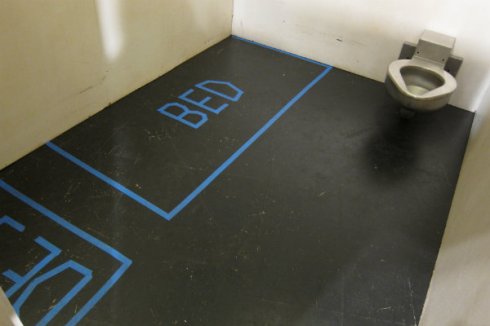
The NYCLU created a mock prison cell to show what life is like in solitary confinement. Kathleen Horan/WNYC
Today resumed a hunger strike by the prisoners of California’s Pelican Bay State Prison SHU (Secure Housing Unit). In solidarity, prisoners across the nation have also joined.
The main issue at hand is solitary confinement. Namely, its longterm use. UN Special Rapporteur on Torture, Juan Mendez, stated that any time over 15 days in solitary confinement constitutes torture. Yet California prisoners have been caged in solitary for 10 to 20 years or more. In addition, the prisoners kept under solitary confinement ask for nutritious food and the same educational programming accessible to prisoners in the general populations of state prisons.
Solitary confinement is an invisible cancer to those outside the system and a terror to those within it.
The prisoners — who refer to themselves at The Short Corridor Collective — are returning to protest that began two years ago. Neither Phase One (July/August 2011) and Phase Two (Sept/Oct 2011) secured the policy changes desired, despite promises from the California Department of Corrections to address the specific issues and reasonable demands made. In 2011, over 6,000 California prisoners went on hunger and work strike making it one of the largest peaceful protests in U.S. prison history.
The Pelican Bay State Prison SHU Short Corridor Collective state:
Our decision does not come lightly. For the past 2 years we’ve patiently kept an open dialogue with state officials, attempting to hold them to their promise to implement meaningful reforms, responsive to our demands. For the past seven months we have repeatedly pointed out CDCR’s failure to honor their word—and we have explained in detail the ways in which they’ve acted in bad faith and what they need to do to avoid the resumption of our protest action.
Five core demands
1. Eliminate group punishments. Instead, practice individual accountability. When an individual prisoner breaks a rule, the prison often punishes a whole group of prisoners of the same race. This policy has been applied to keep prisoners in the SHU indefinitely and to make conditions increasingly harsh.
2. Abolish the debriefing policy and modify active/inactive gang status criteria. Prisoners are accused of being active or inactive participants of prison gangs using false or highly dubious evidence, and are then sent to longterm isolation (SHU). They can escape these tortuous conditions only if they “debrief,” that is, provide information on gang activity. Debriefing produces false information (wrongly landing other prisoners in SHU, in an endless cycle) and can endanger the lives of debriefing prisoners and their families.
3. Comply with the recommendations of the US Commission on Safety and Abuse in Prisons (2006) regarding an end to longterm solitary confinement. This bipartisan commission specifically recommended to “make segregation a last resort” and “end conditions of isolation.” Yet as of May 18, 2011, California kept 3,259 prisoners in SHUs and hundreds more in Administrative Segregation waiting for a SHU cell to open up. Some prisoners have been kept in isolation for more than thirty years.
4. Provide adequate food. Prisoners report unsanitary conditions and small quantities of food that do not conform to prison regulations. There is no accountability or independent quality control of meals.
5. Expand and provide constructive programs and privileges for indefinite SHU inmates. The hunger strikers are pressing for opportunities “to engage in self-help treatment, education, religious and other productive activities…” Currently these opportunities are routinely denied, even if the prisoners want to pay for correspondence courses themselves. Examples of privileges the prisoners want are: one phone call per week, and permission to have sweatsuits and watch caps. (Often warm clothing is denied, though the cells and exercise cage can be bitterly cold.) All of the privileges mentioned in the demands are already allowed at other SuperMax prisons (in the federal prison system and other states).
You can download full text document of the demands here.
WHAT YOU CAN DO
Sign the petition.
Involvement in the July 13th Mass Mobilization!
Plan a solidarity action!
Follow! On Twitter and on Facebook
Use your imagination and your skills; talk to your family and friends about it, and maybe provide them with a handful of shocking facts about the psychological torture that is solitary ? (See below)
Don’t get despondent, get angry.
WHAT IS SOLITARY CONFINEMENT?
In California, nearly 12,000 imprisoned people spend 23 hours-a-day living in a concrete cell smaller than a large bathroom. Across the United states it is conservatively estimated that 20,000 people are in solitary every day. It could be as high as 70,000; it depends on definitions related to time and contact.
In California solitary cells have no windows, no access to fresh air or sunlight. People in solitary confinement exercise an hour a day in a cage the size of a dog run. They are not allowed to make any phone calls to their loved ones. They cannot touch family members who often travel days for a 90 minute visit. They are not allowed to talk to other imprisoned people. They are denied all educational programs, and their reading materials are censored.
UNFATHOMABLE SCALE AND WIDESPREAD USE
“The [psychological and cognitive effects of long term isolation] is not something that’s easy to study, and not something that prison systems are eager to have people look at,” says Craig Haney, psychology professor at the University of California at Santa Cruz, who notes that the widespread use of solitary is a very modern phenomena.
We have an overwhelmingly crowded prison system in which the mandate to rehabilitate and provide activities for prisoners was suspended at the same time as the prison system became overcrowded. Not surprisingly, prison systems faced with this influx of prisoners, and lacking the rewards they once had to manage and control prisoner behavior, turned to the use of punishment. And one big punishment is the threat of long-term solitary confinement. They’ve used it without a lot of forethought to its consequences. That policy needs to be rethought.
Writing for the New Yorker (Hellhole) in 2009, physician Atul Gawande quoted extensively from Haney’s research and added:
After months or years of complete isolation, many prisoners “begin to lose the ability to initiate behavior of any kind—to organize their own lives around activity and purpose. Chronic apathy, lethargy, depression, and despair often result. . . . In extreme cases, prisoners may literally stop behaving” (Haney). [They] become essentially catatonic.
Keep yourself informed; keep progressing; keep honest; follow news on the Prisoner Hunger Strike Solidarity website.
In solidarity, Pete.

–
UPDATE, 05/14/2013: Harpers Books confirmed that the collection was bought by an individual at Paris Photo LA.
–
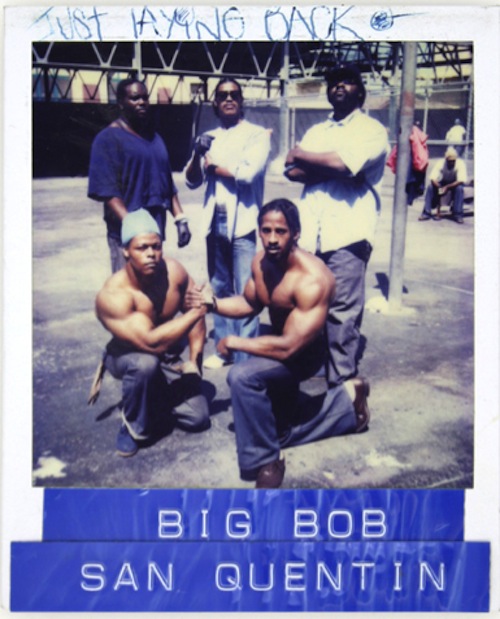
At Paris Photo: Los Angeles, this week, a collection of California prison polaroids were on display and up for sale. The asking price? $45,000.
The price-tag is remarkable, but so too is the collection’s journey from street fair obscurity to the prestigious international art fair. It is a journey that took only two years.
The seller at Paris Photo LA, Harper’s Books named the anonymous and previously unheard-of collection The Los Angeles Gang and Prison Photo Archive. Harper’s has since removed the item from its website, but you can view a cached version here. The removal of the item leads me too presume that it has sold. Whether that is the case or not, my intent here is not to speculate on the current price but on the trail of sales that landed the vernacular prison photos in a glass case for the eyes and consideration of the photo art world.

The Los Angeles Gang and Prison Photo Archive on display at Paris Photo LA in April, 2013.
FROM OBSCURITY TO COVETED FINE ART COMMODITY
In Spring 2012, I walked into Ampersand Gallery and Fine Books in NE Portland and introduced myself to owner Myles Haselhorst. Soon after hearing my interest in prison photographs, he mentioned a collection of prison polaroids from California he had recently acquired.
You guessed it. The same collection. Where did Myles acquire it and how did it get to Paris Photo LA?
“I bought the collection from a postcard dealer at the Portland Postcard Show, which at the time was in a gymnasium at the Oregon Army National Guard on NE 33rd,” says Haselhorst of the purchase in February, 2011.
As the postcard dealer trades at shows up and down the west coast, Haselhorst presumes that dealer had picked up the collection in Southern California.
Haselhorst paid a low four figure sum for the collection – which includes two photo albums and numerous loose snapshots totaling over 400 images.
“I thought the collection was both culturally and monetarily valuable,” says Haselhorst. “At the time, individual photos like these were selling on eBay for as much as $30 each, often times more. I bought them with the intention of possibly publishing a book or making an exhibition of some kind.”
Indeed, Haselhorst and I discussed sitting down with the polaroids, leafing through them, and beginning research. As I have noted before, prison polaroids are emerging online. I suspect this reflects a fraction of a fledgling market for contemporary prison snapshots. Not all dealers bother – or need to bother – scanning their sale items.
Haselhorst and I were busy with other ventures and never made the appointment to look over the material.
“In the end, I didn’t really know what I could add to the story,” says Haselhorst. “And, I didn’t want to exploit the images by publishing them.”
Another typical and lucrative way to exploit the images would have been to break up the collection and sell them as single lots through eBay or at fairs, but Haselhorst always thought more of the collection then the valuation he had estimated.
In January 2013, Haselhorst sold the collection in one lot to another Portland dealer, oddly enough, at the Printed Matter LA Art Book Fair.
“Ultimately, after sitting on them for more than two years, I decided they would be a perfect fit for the fair, not only because it was in LA, but also because the fair offers an unmatched cross section of visual printed matter. It was hard putting a price on the collection, but I sold them for a number well below the $45,000 mark,” he says.
Haselhorst made double the amount that he’d paid for them.
The second dealer, who purchased them from Haselhorst, quickly flipped the collection and sold it at the San Francisco Antiquarian Book Fair for an undisclosed number. The third buyer, also a dealer, had them priced at $25,000 at the recent New York Antiquarian Book Fair.
From these figures, we should estimate that Harper’s likely paid around $20,000 for the collection.
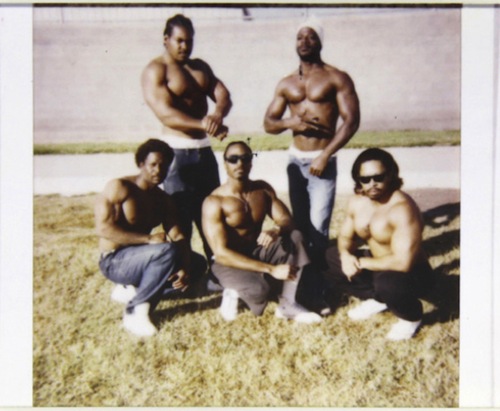


Harper’s Books’ brief description (and interpretation) of the collection reads:
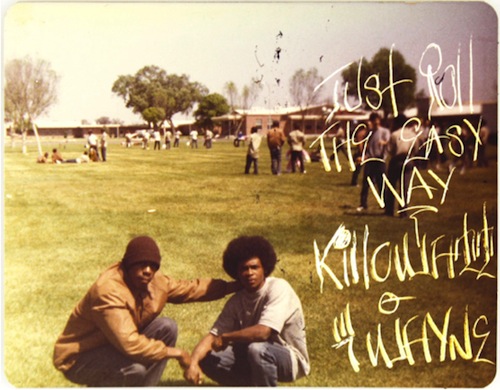
Taken between 1977 and 1993. By far the largest vernacular archive of its kind we’ve seen, valuable for the insight it provides into Los Angeles gang, prison, and rap cultures. The first photo album contains 96 Polaroid photographs, many of which have been tagged (some in ink, others with the tag etched directly into the emulsion) by a wide swath of Los Angeles gang members. Most of the photos are of prisoners, with the majority of subjects flashing gang signs.
[…]
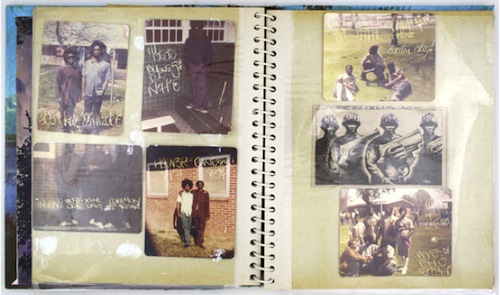
The second album has 44 photos and images from car magazines appropriated to make endpapers; the “frontispiece” image is of a late 30s-early 40s African-American woman, apparently the album-creator’s mother, captioned “Moms No. 1. With a Bullet for All Seasons.”
[…]
In addition, 170 loose color snapshots and 100 loose color Polaroids dating from 1977 through the early 1990s.
In my opinion, the little distinction Harper’s makes between gang culture and rap music culture is offensive. The two are not synonymous. This is an important and larger discussion, but not one to follow here in this article.
HOW SIGNIFICANT A COLLECTION IS THIS?
Harper’s is right on one thing. The newly named ‘Los Angeles Gang and Prison Photo Archive’ is a unique collection. Never before have I seen a collection this large. Visually, the text etched directly into the emulsion is a captivating feature of many of the polaroids.
We have seen plenty of vernacular prison photographs from the 19th and early to mid 20th century hit the market. Recently, a collection of 710 mugshots from the San Francisco Police Department made in the 1920’s sold twice within short-shrift. First for $2,150 in Portland, OR and then for $31,000 in New York just four months later! At the time of the sale, AntiqueTrader.com suggested it “may [have] set new record for album of vernacular photography.”
As a quick aside, and for the purposes of thinking out loud, might it be that polaroids that reference Southern California African American prison culture are – in the eyes of collectors and cultural-speculators – as exotic, distant and mysterious as sepia mugshots of last century? How does thirty years differ to one hundred when it comes to mythologising marginalised peoples? Does the elevation of gang ephemera from the gutter to traded high art mean anything? I argue, the market has found a ripe and right time to romanticise the mid-eighties and in particular real-life figures from the era that resemble the stereotypes of popular culture. It is in some ways a distasteful exploitation of people after-the-fact. Perhaps?



WHERE DOES THE $45,000 PRICE-TAG COME FROM?
Just because the so-called ‘Los Angeles Gang and Prison Photo Archive’ is rare, doesn’t mean similar collections do not exist, it may just mean they have not hit the market. This is, I argue, because no market exists … until now.
If the price tag seems crazy, it’s because it is. But consider this: one of the main guiding factors for valuations of art is previous sales of similar items. However, in the case of prison polaroids, there is no real discernible market. Harper’s is making the market, so they can name their price.
“All in all, it’s pretty crazy,” says Haselhorst, “especially when you think about how I bought it here in Portland over on 33rd, just a few miles from our gallery.”
All these details probably make up only the second chapter of this object’s biography. The first chapter was their making and ownership by the people in the photographs. Later chapters will be many. Time will tell whether later chapters will be attached to astronomical figures.
Harper’s suggests that rich “narrative arcs might be uncovered by careful research.” I agree. And these are importatn chapters to be written too.
I hope that more of these types of images with their narratives will emerge. If these types of vernacular prison images are to command larger and larger figures in the future, I hope that those who made them and are depiction therein make the sales and make the cash.


As it stands the speculation and rapid price increases, can be interpreted as easily as crass appropriation as it can connoisseurship. If these images deserve a $45,000 price tag, they deserve a vast amount of research to uncover the stories behind them. Who knows if the (presumed) new owner has the intent or access to the research resources required?
Along that same vein, here we identify a difference between the art market and the preservationists; between free trade capitalism and the efforts of museums, historians and academics; between those that trade rare items and those that are best equipped to do the research on rare items.
Whether speculative or accurate, the $45,000 price is way beyond the reach of museums. Photography and art dealers who are limber by comparison to large, immobile museums are working the front lines of preservation.
“Some might say that selling [images such as these] is exploitation, but a dealer’s willingness to monotize something like this is one form of cultural preservation,” argues Haselhorst. “If I had not been in a position to both see the collection’s significance and commodify it, albeit well below the final $45,000 mark, these photographs could have easily ended up in the trash.”
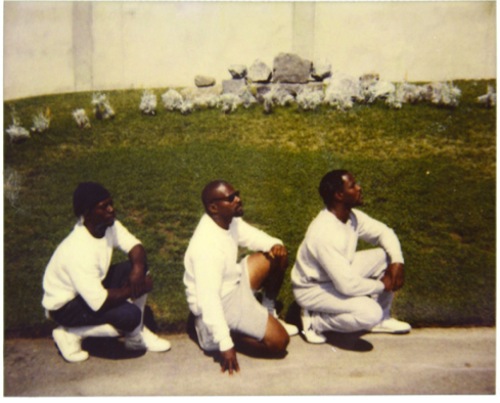

Loose Polaroids from the Los Angeles Gang and Prison Photo Archive as displayed by Harper’s Books at Paris Photo LA, Los Angeles, April, 2013.

A cover to one of the two albums that make up the Los Angeles Gang and Prison Photo Archive.

Antoine Ealy, Federal Correctional Complex, Coleman, Florida
You all know I’m a big supporter of Alyse Emdur and her six year project Prison Landscapes, so it was great to feature her work on Wired.com.
It’s gratifying when my interest in prisons overlap with wider issues of visual culture and with the curiosity of mainstream readers.
The article coincides with Emdur’s book Prison Landscapes, published by Four Corners, London is now available. Alyse Emdur is very grateful that Four Corners will donate books to each of the individuals whose portraits feature in the book.
Please read my piece about Emdur on Raw File.
ELSEWHERES
Prison Visiting Room Portraits, An Interview with Alyse Emdur. (Prison Photography)
Escapist Landscape Art From Inside America’s Prisons: The paintings that hide and decorate the lives of the incarcerated. (The Atlantic)
Up Against The Wall: Prison Snapshots. (New York Times)
‘Prison Landscapes’ and the Interior World of the Incarcerated. (KCET)

Found photo of an unknown prison cell.
Last week, I was interviewed twice – firstly, for DVAFOTO and secondly, for HERE BE MONSTERS – about Prison Photography On The Road and my activities since.
The DVAFOTO interview opens with my account of my arrest and 9 hours in jail in late 2011. The HBM podcast is about a workshop I delivered in Sing Sing State Prison, New York.
It may be ironic that I’d get locked-up during a research trip that is questioning incarceration, but it’s not funny and it’s no badge of honour. My actions were foolhardy and the police officer’s actions were over-zealous.
I’ve been thinking beyond what I think about the experience (It was stupid, bureaucratic and inconvenient), and more about how I think of the experience (What insight did I gain? What interactions did I have? Who did I meet?)
Inside the release-tank were about 15 men. They were there for different reasons. One young man faced a significant bail amount for a significant possession offense while another was brought in for cycling drunk in the wrong direction of the cycle path on a quiet road. Some men were in for DUI’s and in some cases not their first DUI. Two or three slept through the hours. Others were quiet and some told stories. The younger ones were more talkative and boastful. Several tried using the phone but only one succeeded. When they found out I was in for peeing on a tree and not answering questions they thought it was lame. Lame offense, lame arrest.
A tray of peanut butter sandwiches was brought in, but not enough. Some jumped on them, others weren’t interested. I think one person got two sandwiches.
Of the men with DUIs, I had little sympathy. They didn’t seem to acknowledge that their actions were potentially lethal. For a couple of them, cash-fines, points on their licenses and driving bans didn’t seem to be much deterrent.
A few men seemed contrite. Others seemed beaten down with either addiction or repeated arrogance.
I had huge sympathy for the drunk cyclist. Maybe in this fifties. Grey hair. He thought he was getting out until the administration realised he was a parolee. The bike-ride proved a violation and he was to be automatically rearrested and jailed for a fixed term. He had a job and children. Because of a night of excess, he was to lose those things again. Sure, his behaviour could have been better, but I think the authority’s response was of excess.
I didn’t ask what they did and they didn’t ask me. It was a small space. It was very dirty but not quite filthy. We only moved our place when others left and they did so in groups of 3 and 4 throughout the hours.
Part of me wishes I’d taken the opportunity to ask some questions, tap some opinions (I may have met a great conversationalist who’d improve my thinking as much as I hoped I might improve his). The other part of me knows only an intrusive nerd would be ask out-of-the-blue questions about personal circumstance and attitudes; especially in a temporarily-occupied cell at an unpredictable time.
No clocks.
Two weeks later: No court appearance. No charges brought.
Why is this relevant? The arrest and dismissal of charges — actually, the incomplete documentation of the arrest and dismissal — almost jeopardised my visit to Sing Sing to carry out a workshop with attentive, challenging, respectful and curious students of the education program there.
An arrest will always feature on a record, whether or not a conviction is brought, so-told me a law enforcement employee over the phone. New York Dept. Of Corrections which administers Sing Sing knew I’d been arrested but the information ceased there. I had to scramble for paperwork (that had not been given to me) to prove I had no criminal record. I wonder how much inefficiency and potential mistakes contribute to unfair and/or heightened levels of control. Frustration must be infinite in the prison industrial complex.
All in all, I’m glad I was able to teach and learn in Sing Sing and doubly happy that Jeff Emtman was able to craft a fine podcast splicing together audio of prisoners speaking, myself speaking, music and sound. Jeff conceived of the podcast titled The Other One Percent, to broadly challenge listeners to think about prisons and solutions.
The class, as a whole, discussed many images but specifically in the HBM audio, Robert Rose, Dennis Martinez, Deshawn Smalls and Jermaine Archer talk about these six images.
The first image mentioned is the one below by Brian Moss …

“Fear, I think people would think fear,” says Sing Sing prisoner, Robert Rose. “They can’t see what goes on in here, just as we can’t see much of what goes on out there.”
… then the three below by Alyse Emdur …
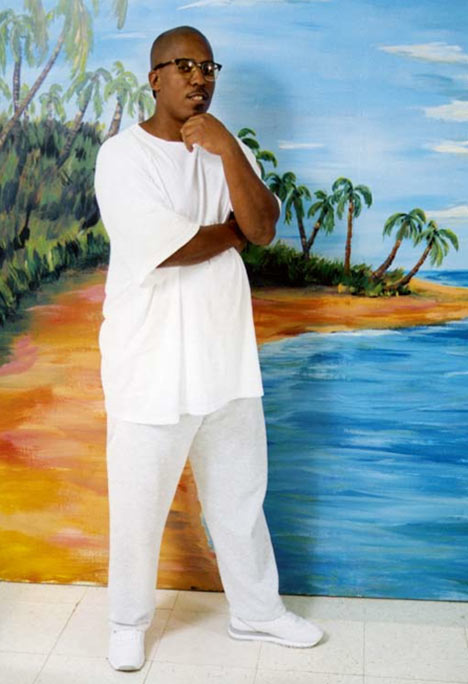

“Something needs to be said about the families who also do time. They are part of the narrative of mass incarceration, but they’re not talked about. They end up carrying the burden,” says Deshawn Smalls, Sing Sing prisoner.

… and finally, the two images below by Richard Ross of juvenile facilities.
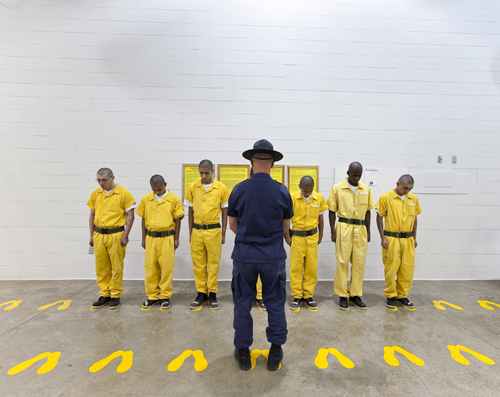
Sing Sing prisoner, Jeremy says, “You may have a man who refused [to adhere to regulations] and this is him in this picture. You probably won’t see the man at first, but he is there.”

HERE BE MONSTERS (HBM) is a podcast audio series about fear and the unknown, by Jeff Emtman, a 2012 Soundcloud Community Fellow.
HBM has previously covered Juggalo culture; placenta medicine; train-hopping; the disillusion and resignation of a favored NPR correspondent; a children’s book about a hallucinogenic trip; and the mind-made images created by the human brain when the body and the eyes experience total darkness – a condition known as ‘Prisoners Cinema.’
I like what Jeff is doing. I’m happy to share my experiences with him.
If you’re still interested in what I’m up to, I cover my immediate plans in the DVAFOTO interview. We also talk about what bloggers can do and do do.
LINKS
The Other One Percent (Here Be Monsters podcast)
Interview: Pete Brook On The Road (DVAFOTO)

A temporary gig as a set photographer took Jordana Hall to San Quentin State Prison; her heart and consciousness propelled countless return visits. She has worked particularly closely with men who were convicted when juvenile (under 18) and were sentenced to life in prison.
Hall has worked as a volunteer in existing programs; launched her own project that melds poetry, family letters, snapshots and her own portraits; and visited the hometowns and families of prisoners. The ongoing body of work Home Is Not Here is part of Hall’s senior thesis exhibition. It will be on show – beginning April 2013 – at the Corcoran Gallery of Art in Washington, DC.
I wanted to learn more about Hall’s motives and discoveries.
– – – – – – – – – – – – – – – – – – – – – – – – – – – – – – – – – – – – – – – –
Prison Photography (PP): How did you get access to San Quentin State Prison?
Jordana Hall (JH): My work at San Quentin started in June 2011. I was hired as the set photographer for a documentary (working title, Crying Sideways) by SugarBeets Productions. The documentary details the stories of a group inside San Quentin called KIDCAT (Kids Creating Awareness Together).
PP: KIDCAT is a group of lifers sentenced as juveniles, correct?
JH: Yes, you can follow KIDCAT on Facebook.
PP: They describe themselves as “men who grew up in prison and as a group have matured into a community that cares for others, is responsible to others, and accountable for their own actions.”
JH: I began attending KIDCAT’s bi-weekly group meetings as a volunteer. During this period of volunteering, I developed a working relationship with the members of KIDCAT. Showing up when I said I would, being accountable, and most of all keeping an open mind and heart while inside re-assured the men of KIDCAT that I was a trustworthy member.
Then in June 2012, I started working on my senior thesis for my Photojournalism BFA at the Corcoran College of Art and Design. I approached Lieutenant Sam Robinson, Public Information Officer at San Quentin, with the idea of starting the “Home Is Not Here” project. If I had not had the relationship that I do with the men of KIDCAT, Sam would not have been so willing to help. It really is this relationship that I have with the group that has allowed me so many opportunities to continue my work there. I’ve been going into San Quentin for a year and a half now, and have only been able to bring my camera three times.
To be granted access to San Quentin – even minimal access – requires a lot of work. There needs to be a legitimate return for the prison community. In my case, publishing my work to Young Photographer’s Alliance, posting to my website, and eventually in an exhibition at the Corcoran Gallery of Art was enough justification for the prison to allow me to continue working inside.
I never take my access for granted.
There are strict rules about what you can and cannot do, wear and say. If I slip up – even just a little – my access is on the line.

PP: Why did you take on the project?
JH: After hearing the inmate’s stories during the documentary filming, I realized that all of them were just teenagers who were dealt a bad hand. This is not to say they don’t take responsibility for what they did. They definitely do. Their stories resonated to my core; the stories would impact anyone who heard them. I left the prison gates that day realizing that they could be my brother, father, or best friend. I began to think about their families. Most of the men in the group are in their mid-thirties; they have spent more than half of their lives in prison. I thought about how they struggle to keep working relationships with their loved ones for so many years through the prison walls. That wondering led me to my senior thesis project.
Home Is Not Here documents the relationships between an incarcerated person and his family. I seek out the ways in which their relationship can be kept when there are so many barriers involved.
PP: What have you learnt?
JH: I’ve learned that the families of incarcerated people are the least documented victims of crime. Communities shun them for “raising a criminal.” There are limited resources available for them to get help. These families mourn the loss of their loved one’s free life with little to no support.
I learned the truth in the statement, “When one person is incarcerated, at least five people ‘serve the time’ with them.” I have seen family members go about their daily lives with a piece of their heart locked away in prison.
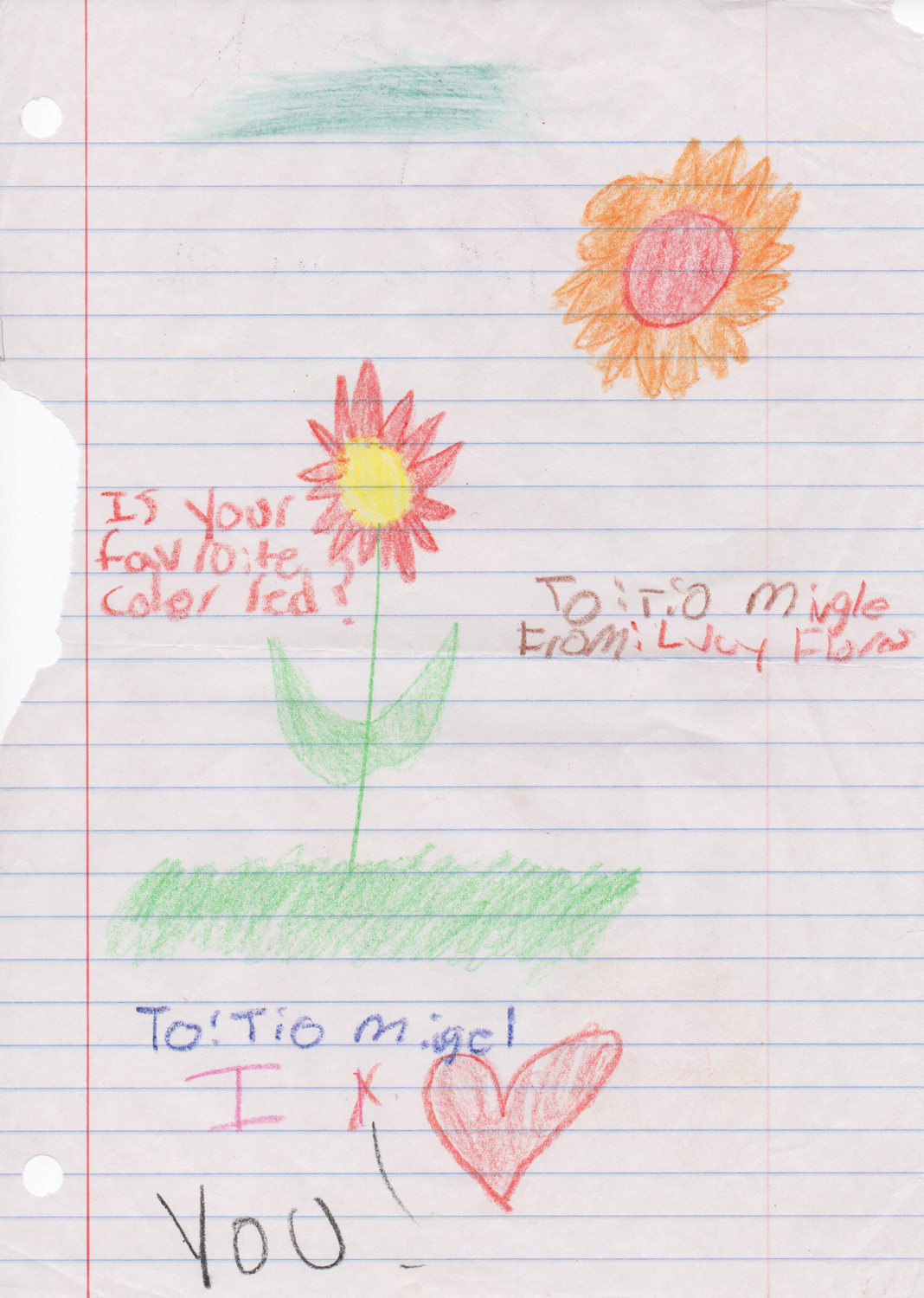
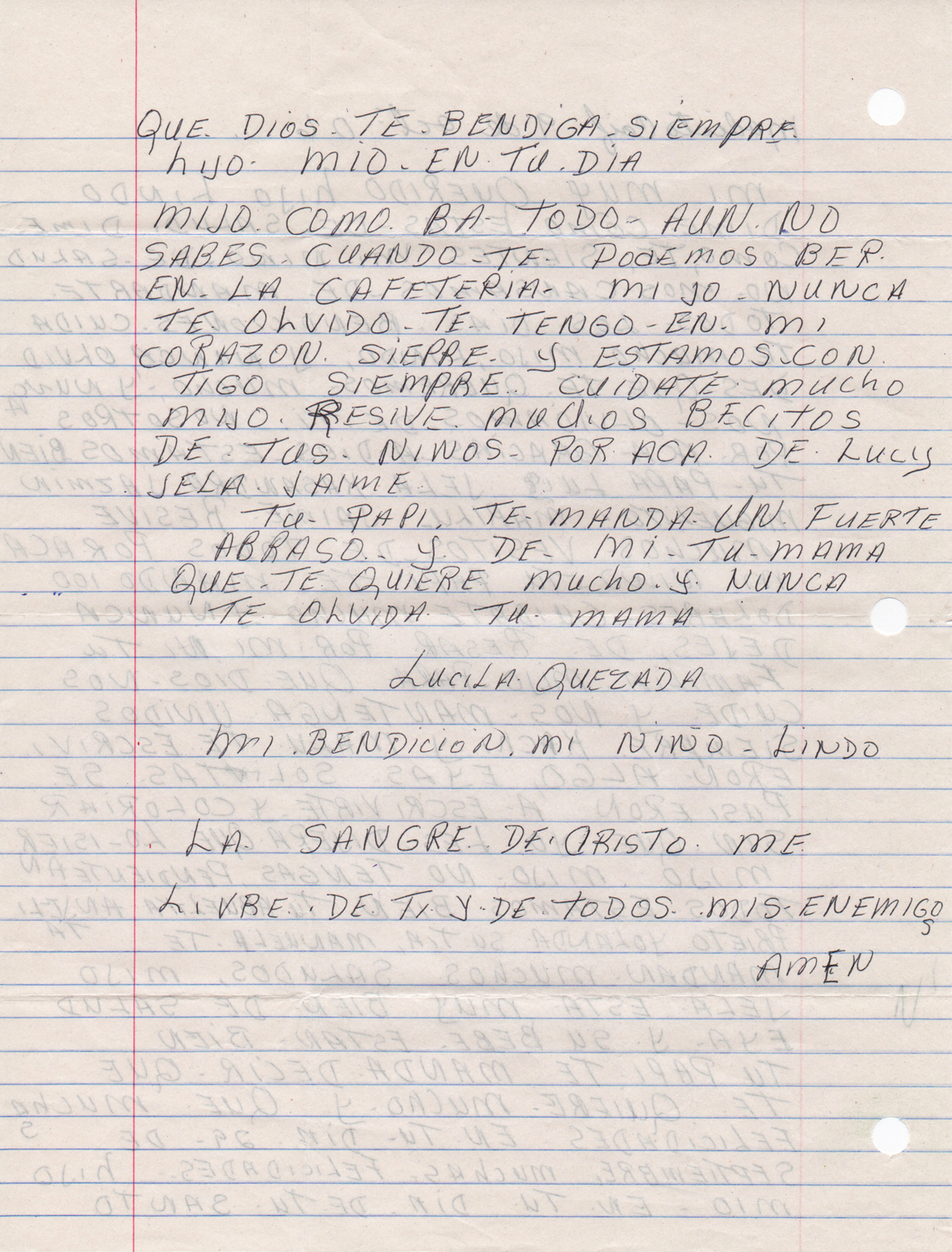
JH: I learned that letters from a child to their “Tio Miguel” (who they have never met outside of prison visitations) would break your heart. I learned that even the toughest looking men still get tears in their eyes when you ask about their family.
I am still learning.
PP: What did the prisoners think of being photographed?
JH: The first day they were most interested in seeing how a digital camera works. I am very hands-on with my subjects, and with the permission of Lt. Sam Robinson, I handed my second camera body to the guys to play with on the breaks during filming. It was both funny as well as saddening to watch their amazement at the foreign device.
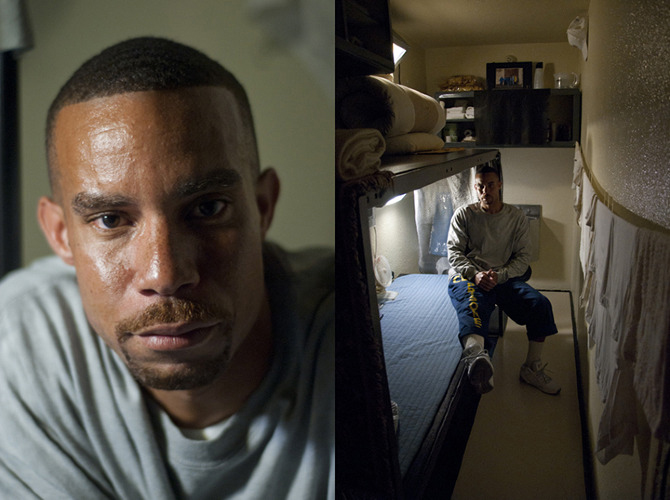
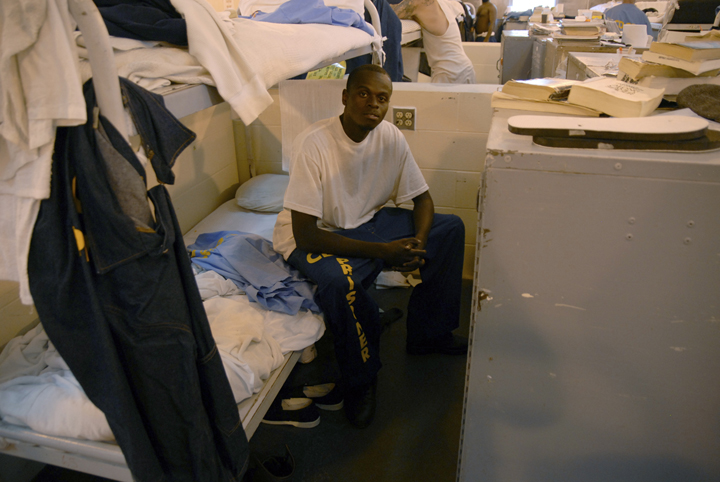
The first time I went in, I asked to see an inmate’s cell. The guys all looked at each other, waiting for someone to volunteer. One by one they denied my request to see their space. We ended up going to a stranger’s cell, just so I could poke my head in from the door. Soon after, I fully realized the shame that comes over them when asked about their cells. It is the only space that is their own, but it also the cage they are locked in at night. These 6 x 12 cement cages are a place both of safety and of degradation.
After I stuck around for a year, I approached the cell situation, again. This time they were excited to show me their space. Their family photos on the wall, bookshelf with notebooks, sketchbooks, and wall markings left from previous inmates. “Stay Focused” was scrawled into the yellowed paint next to the metal bunk. It took some time and a lot of trust building for me to get on that level with them.

PP: Did you give the men prints?
JH: Giving the guys the prints is absolutely one of my favorite parts!
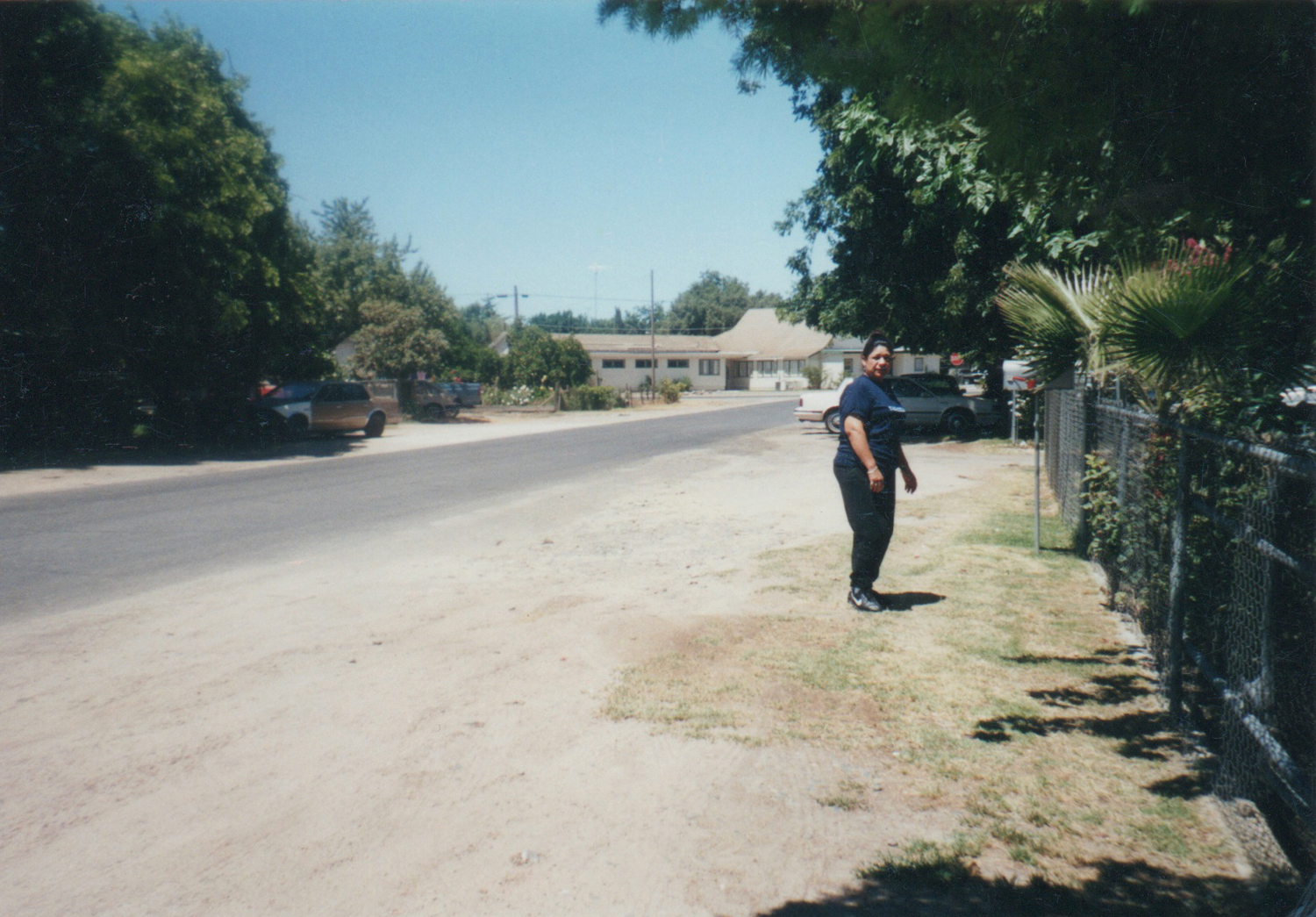
The Home Is Not Here project had me traveling to the hometowns of three men. I went with only small clues of what and where to photograph – “The Dairy Queen where I took my first girlfriend on my first date,” or “The restaurant named after the city in Vietnam where my family was from.”
When I brought back prints from my trips, the guys were blown away by how much had changed, and how much had stayed the same.
I was asked by one inmate to visit the grave of his grandmother. They were extremely close and she passed away while he was in prison. When he saw the photograph I took there, he began to cry. It was almost as if I had delivered him a physical place to grieve her passing.
I try to give back to my subjects as much as I can. I try not to be that photographer that comes in, gets the story, and never comes back. They give so much of themselves when they allow me to photograph them, giving prints to them is the least I can do.
PP: What did the staff think of being photographed?
JH: I never photographed the staff, although some day I hope to see some really thorough work done about the people who work in prisons. It would be a fascinating story.
PP: I agree. I’ve yet to see a photography project that suitably deals sympathetically and deeply the complex and stressful dynamics of correctional officers’ work and lives.
PP: Could photography serve a rehabilitative role, if used in a workshop format in prisons?
JH: I think a workshop on photography in a prison would be an incredible idea. These men are so introspective and have so much to offer, creatively. The documentation of life inside prison by an inmate could offer such insight for us all.


PP: Are prisoners invisible?
JH: Yes, I believe prisoners are invisible. Everything about the prison system is set up for them to be invisible, and stay invisible. To be silenced, and out of sight. What I aim to do with this project is to shed some light on a piece of an inmate’s life that is not seen. When people think prison photography they think of hardened criminals, drug addicts, grimy hands gripping cell door bars, and the underbelly of society. I am offering the alternative viewpoint, which is the humanity inside. These men are fathers, sons, brothers, friends, and they all have people who care about them. They also have built communities of support for each other, inside.
PP: What’s been the feedback to your the work?
JH: As I work I like to get feedback from my peers. A lot of people who see photographs of inmates and due to their preconceived notions will shake their head and walk away thinking, “What monsters…” but with the work I do, I try to side step this notion and say, “No, look closer.”
No matter what I do, some people will never see it the way I’d like them to, but for people who can be open-minded, the work gives an inside look to the humanity that exists inside prison, and awareness of the struggles of their families.
PP: Anything else you’d like to add?
JH: As I move forward in my thesis, I am turning my focus to just one inmate in particular, Miguel Quezada. This is the working statement:
“Estamos Contigo (We Are With You)” – Miguel Quezada (below) was incarcerated at age 16. Now 31, he has spent half of his entire life in prison. Due to a harsh judicial decision that he should serve his sentences consecutively, his first parole hearing is not until the year 2040. He will be 60 years old. Home, for Miguel, rests between the realities of life at San Quentin Prison today, memories of his childhood cut short, and dreams of a faraway tomorrow. His family shares this stress, mourning the loss of their loved one’s free life. From the part of South Modesto, California known for its lack of sidewalks and high crime rate, Miguel grew up in poverty with his parents who immigrated from Mexico. His mother and father, Arturo and Lucila, are almost completely illiterate, so writing letters takes a lot of time and energy. Miguel appreciates it when they do write, but loves when they send photographs. His nieces and nephew, who he has never met outside of prison visitations, write him frequently and give him a sense of connectivity to the outside world. Miguel is one of hundreds of men in the state of California with similar stories – serving life for a mistake made as a teenager. The barriers of the prison walls will never restrain the emotional longing of one human being to be with another.
PP: We look forward to checking in again soon. Thanks, Jordana.
JH: Thank you.



© Mark Murrmann, from the series, Invitation To A Hanging.
Two very potent articles published in Guernica Magazine have impressed recently.
First up, Ann Neumann details the heavy-handed force-feeding procedures by prison staff in response to the longest ongoing hunger strike in America.
The Longest Hunger Strike: American courts recognize rights to refuse life-saving treatment. So why won’t the State of Connecticut let William Coleman die?
“Staff turned off the video camera typically used to record medical procedures. They strapped Coleman down at “four points” with seatbelt-like “therapeutic” restraints. Edward Blanchette, the internist and prison medical director at the time, pushed a thick, flexible tube up Coleman’s right nostril. Rubber scraped against cartilage and bone and drew blood. Coleman howled. As the tube snaked into his throat, it kinked, bringing the force of insertion onto the sharp edges of the bent tube. They thought he was resisting so they secured a wide mesh strap over his shoulders to keep him from moving. A nurse held his head. Blanchette finally realized that the tube had kinked and pulled it back out. He pushed a second tube up Coleman’s nose, down his throat, and into his stomach. Blanchette filled the tube with vanilla Ensure. Coleman’s nose bled. He gagged constantly against the tube. He puked. As they led him back to his cell, the cuffs of Coleman’s gray sweatshirt were soaked with snot, saliva, vomit, and blood.”
““I have been tortured,” he would say later. And it was enough to make Coleman start drinking fluids again. For a while. When he stopped a few months later, the prison force-fed him again, and twelve more times over the next two years. By last year they could no longer use Coleman’s right nostril. A broken nose in his youth and repeated insertion of the tube have made it too sensitive.”
– – – – – – – – – – – – –
Secondly, S.J. Culver writes about his discomfort visiting Alcatraz, discussing the problems that plague all sites of dark tourism.
Escape to Alcatraz: Notes on prison tourism.
“Alcatraz Island, understandably, does not bill itself as a place to spend twenty-eight dollars to get really depressed about a country’s piss-poor priorities regarding human rights. […] I begin to think that, if the point of an authentic tourism experience (if such a thing exists) is to understand another condition closely, the Alcatraz cellhouse tour fails. The punishing repetitiveness of incarceration is utterly absent in the carefully paced rise and fall of the yarns on the recorded tour. Worse, there’s no mention of how the Alcatraz cellblock, with its dioramas meticulously re-creating midcentury prison life, might resemble or not resemble a contemporary working U.S. prison. Plenty of the visitors around me seem to think they are witnessing “real” incarceration. I sense my initial impression had more truth than I realized; what we’re taking in is closer to a film set than to county lockup.”
The gulf between the realities of prison life and museum prison narratives are sometimes more pronounced than the differences between the realities of prison life and photographs of prisons in the media.
– – – – – – – – – – – – – – – – – – – – – – – – – – – – –
While we’re on the topic of prison museums, a mention of Mark Murrmann‘s photographs of Invitation To A Hanging is long overdue. You might know Murrmann as the kick-ass photographer of punk. He is also the very kind and engaged photo editor at Mother Jones.
‘Prison museums?’ I hear you say. There’s more than you think.
Prison museums and dark tourism on Prison Photography
19th Century Museum Prison Ships
Roger Cremers: Auschwitz Tourist Photography
Daniel and Geo Fuchs’ STASI – Secret Rooms
Steve Davis visits the Old Montana Prison
Hohenschönhausen, Berlin: Stasi Prison Polaroids
Philipp Lohöfener at the Stasi Prison Museum, Berlin
San Pedro Prison, Bolivia: As the Tourists, Dollars and Snapshots End the Riots Begin
– – – – – – – – – – – – – – – – – – – – – – – – – – – – –
Thanks to Bob for the tip.

All I want for Christmas is more weird images.
Twelve months ago, I posted To You, Happy Christmas, From Google Image Search. I guess now that I’m revisiting the format, it’s now a holiday tradition? I don’t know if this years selection tops last. I’ll let you be the judges.
Merry seasonal cheer to one and all.



















As you know, I’m a great admirer of photography programs and mentorships for youth. Expression in the arts gives children their voice. I’ve even wondered if the empowerment provided through self-representation could benefit prisoners.
There exist dozens of important non-profits and volunteer programs helping youth of all backgrounds, including at-risk youth, to tell their stories through photography.
Organisations such as Youth in Focus, Seattle; AS220 Youth Photography Program, Providence, RI; New Urban Arts, Providence; First Exposures by SF Camerawork in San Francisco; The In-Sight Photography Project, Vermont; Leave Out ViolencE (LOVE), Nova Scotia; Inner City Light, Chicago; Focus on Youth and My Story in Portland, OR; Picture Me at the MoCP, Chicago; Eye on the Third Ward, Houston; The Bridge, Charlottesville, VA; the Red Hook Photography Project, New York; and Emily Schiffer’s My Viewpoint Photo Initiative are exemplars of youth empowerment through photography.
One of the leading participatory photography bodies is Photovoice in the UK. It has 50 programs in 23 countries.
This holiday season, Critical Exposure in Washington DC, a youth photo workshop organisation is raising money.
Simply and brilliantly, Critical Exposure – which was founded in 2004 – gives centre stage to Samera, one of the students. Watch it and celebrate the resilience and thoughtfulness of youth. It’s uncomplicated and effective storytelling, and you will be convinced of the undoubted value of these photography programs.
Samera is a compelling voice. After describing her own situation, she makes quite a simple request. She asks that schools within the same metropolitan area have better communication. She identified a fault in the system and she asked that it be fixed so others wouldn’t have to go through the same clumsy and disappointing mal-communications between Washington school district and a charter school. It’s a fair request.
Communities we shape for better, engender growth. Youths’ enthusiasm to be raised in an encouraging environment should not be neglected.

 Prison Photography